INTRODUCTION
During recent years, a growing body of research has been focusing on the theoretical conceptualization and empirical examination of existential concerns such as life attitudes, belief systems, meaning, and demoralization in the course of chronic and life-threatening illness and at the end of the life period (Baider et al., Reference Baider, Russak and Perry1999; Holland et al., Reference Holland, Passik and Kash1999; Kissane et al., Reference Kissane, Clarke and Street2001; Nelson et al., Reference Nelson, Rosenfeld and Breitbart2002; Thune-Boyle et al., Reference Thune-Boyle, Stygall and Keshtgar2006). Issues of meaning of life and health-related quality of life (HRQOL) are of particular importance to patients given the threat of a serious illness, treatment measures, and the potential confrontation with the finiteness of their own lives (Saleh & Brockopp, Reference Saleh and Brockopp2001; Xuereb & Dunlop, Reference Xuereb and Dunlop2003; Bower et al., Reference Bower, Meyerowitz and Desmond2005). Thus, addressing questions of existential domains of supportive care has been identified as essential by both patients and health care professionals (Kristeller et al., Reference Kristeller, Zumbrun and Schilling1999; Breitbart, Reference Breitbart2002; Cohen & Block, Reference Cohen and Block2004; Fife, Reference Fife2005). One third to approximately one half of cancer patients express their need for support with and communication about issues such as hope, sense, meaning and purpose in life, spirituality, and death and dying (Ginsburg et al., Reference Ginsburg, Quirt and Ginsburg1995; Jenkins & Pargament, Reference Jenkins and Pargament1995; Moadel et al., Reference Moadel, Morgan and Fatone1999). The ability to integrate stressful life events into a coherent autobiography and life story is an essential precondition to experience life as meaningful and establish a sense of self-continuity (Baumeister & Newman, Reference Baumeister and Newman1994). The diagnosis and consequences of a life-threatening illness such as cancer can shatter self-perceptions, life attitudes, individual assumptions, and value systems and can hamper the sense of autobiographical continuity and coherence (Habermas & Bluck, Reference Habermas and Bluck2000). Hence, it can impede the maintenance of purpose and meaning in life (Kissane, Reference Kissane2000; Cohen & Block, Reference Cohen and Block2004). Several empirical studies have found meaning defined as a sense of purpose and coherence in life to be positively associated with patient's adjustment to the disease and psychological functioning and to be inversely related with psychological distress (Kissane et al., Reference Kissane, Bloch and Miach1997; Griffiths et al., Reference Griffiths, Norton and Wagstaff2002; Degner et al., Reference Degner, Hack and O'Neil2003; Bower et al., Reference Bower, Meyerowitz and Desmond2005).
The Life Attitude Profile-Revised (LAP-R)
The Life Attitude Profile-Revised (LAP-R; Reker & Peacock, Reference Reker and Peacock1981; Reker, Reference Reker1992) is a self-report questionnaire assessing meaning and purpose in life and motivation to find meaning and purpose in life. The 48-item questionnaire is scored in terms of six 8-item scales: The Purpose dimension (PU) refers to having life goals, a notion for concerns of indiviual importance and a sense of direction in life. The presence of a logically integrated and consistent understanding of self, others, and existence in general is covered by the Coherence dimension (CO). The Choice/Responsibleness dimension (CR) refers to the extent to which a person perceives having personal influence in directing her/his life. The Death Acceptance dimension (DA) refers to the acceptance of death as a natural aspect of life and the absence of anxiety about death. A lack of meaning in life, lack of goals, lack of direction, boredom, and feelings of indifference are covered by the Existential Vacuum dimension (EV). The Goal Seeking dimension (GS) refers to the desire for new and different experiences away from everyday routine. All items are rated on a 7-point Likert scale from 1 (strongly disagree) to 7 (strongly agree). The instrument was translated forward and backward into the German language supported by a native English speaker.
The objectives of this study were to evaluate the psychometric properties of the German adaptation of the LAP-R in a sample of ambulatory prostate cancer patients. We analyzed factor structure and replicability of the dimensions, internal consistency, and concurrent validity through associations with measures of anxiety and depression, coping, and HRQOL.
METHOD
Study Design and Participants
The psychometric analysis of the LAP-R is based on a consecutive sample of 511 prostate cancer patients, who filled in questionnaires during outpatient follow-up care at the University Medical Center's Department of Urology (response rate 70%). The study protocol was approved by the ethics committee of the local chamber of physicians. The mean age of participants was 64 years, 88% were married, 66% had junior high school or lower education. Seventy-one percent were at disease stage pT2. The average time since surgery (prostatectomy) was 107 weeks, ranging from 1 to 566 weeks (Mo = 14). Eighty-one percent of patients had nerve-sparing surgery.
Measures
In addition to the LAP-R, the following self-report questionnaires were used. The Hospital Anxiety and Depression Scale–German Version (HADS-D) is a 14-item instrument for the screening of anxiety and depression in somatically ill patients (Zigmond & Snaith, Reference Zigmond and Snaith1983; Herrmann et al., Reference Herrmann, Buss and Snaith1995). The short form of the German version of the Dealing with Illness Inventory–Revised (DWI-R; Namir et al., Reference Namir, Wolcott and Fawzy1987; Zaun, Reference Zaun2002) contains 32 items covering six subscales: cognitive coping and reappraisal, active-emotional coping, active-behavioral coping, depressive coping, avoidance, and religiousness. The Short-Form Health Survey (SF-8; Ware et al., Reference Ware, Kosinski and Dewey1999) was used to assess HRQOL. Eight items measure different dimensions of health: general health, physical functioning, role physical, bodily pain, vitality, social functioning, mental health, and role emotional. The SF-8 provides two summary scores for physical and mental health.
Statistical Methods
Exploratory factor analysis (PCA, varimax rotation) was performed for the total sample and repeated for randomly split halves of the sample (n = 251 and n = 260) in order to test the stability of the samples. Item analyses were used, including internal consistency (Cronbach's α), discriminatory power, skewness, and kurtosis. Concurrent validity was analyzed using Pearson's correlation coefficient.
RESULTS
Factor Structure of the LAP-R Dimensions
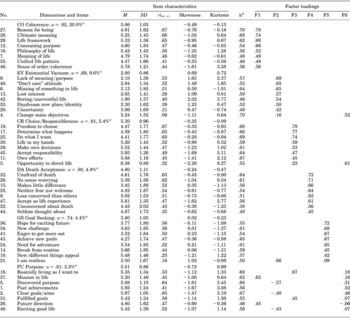
Ten factors were extracted using PCA with the number of factors defined by eigenvalues ≥1, which explored 57.2% of the variance. In varimax rotated PCA with the number of factors limited to six, a factor solution emerged whereby the dimensions of CO, EV, CR, DA, and GS for the most part of items loaded on separate factors. However, the PU dimension could not be replicated as a single factor. Table 1 presents factor loadings of the PCA with varimax rotation.
Item and scale characteristics (PCA, Varimax Rotation) of the LAP-R

M: mean (1 = strongly disagree to 7 = strongly agree), SD: standard deviation, ri (t−i): discriminatory power (corrected), h2: communalities.
aVariance explained.
This factor structure of the total sample was confirmed in the PCA of randomly split halves of the sample. In addition, the five-factor solution emerging through PCA was tested with a confirmatory factor analysis. Maximum likelihood estimation of this model produced acceptable fit statistics, χ2(293, n = 511) = 1007,21, p < .001, GFI = 0.87, RMSEA = 0.06 (CI [90%] = 0.06 – 0.07), CFI = 0.82.
Item Analysis
Table 1 contains item means, standard deviations, corrected discriminatory power, skewness, and kurtosis. Discriminatory power ranges from ri (t−i) = .08 (item 4) to ri (t−i) = .67 (items 19, 27). Items 3, 4, 10, 13, 20, 21, 33, 42, and 44 have low discriminatory power of ri (t−i) < .40; items 2, 17, 19, 27, 28, 29, 32, and 38 show the highest discriminatory power of ri (t−i) > .70.
Internal Consistency
The internal consistencies of the six dimensions as calculated by Cronbach's α have the following values: CO = .82, EV = .69, CR = .81, DA = .80, GS = .74, and PU = .81.
Intercorrelations of the Subscales
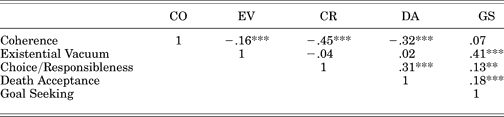
Analyses show significant intercorrelations among the LAP-R scales, except for the CO + GS, EV + CR and EV + DA scales. With regard to the substantial amount of shared variance, results show the Coherence subscale shared 20% of the variance with Choice/Responsibleness and 10% with Death Acceptance. Existential Vacuum shared 17% of the variance with Goal Seeking and 10% with Death Acceptance (Table 2).
Intercorrelations of the LAP-R subscales

** p<.01, ***p < .001.
Concurrent Validity
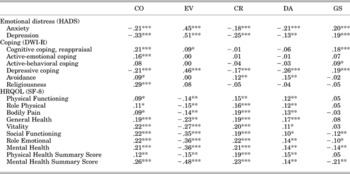
Results show significant associations between all LAP-R dimensions with anxiety and depression; however, moderate correlations were only found for EV, anxiety, and depression. Furthermore, moderately significant correlations were found for EV, and inversely for depressive coping and the mental health sum-scale (Table 3).
Correlations between the LAP-R subscales and emotional distress, coping, and HRQOL

* p < .05, **p < .01, ***p < .001.
Associations with Demographic and Medical Characteristics
Mildly positive significant correlations were observed between age and CO (r = .15), CR (r = .17) and GS (r = −.17, all p < .05). Unmarried patients as well as patients with pTNM stage IV had significantly higher scores at the LAP-R dimension EV (p < .05).
DISCUSSION
Few instruments for the measurement of existential issues in somatically ill patients have been adapted to the German language so far. Therefore, the current study tested the psychometric properties of the German adaptation of the LAP-R in a sample of 511 prostate cancer patients.
The factor analysis gave support to a five-dimensional instead of six-dimensional factor structure of the LAP-R. With the exception of the Purpose dimension and few single items, there is a good fit between the hypothesized original LAP-R dimensions and the empirically derived factor structure in the German sample of cancer patients. There is a strong overlap between the Purpose dimension and the Coherence dimension in the original as well as in this study (r = .72). This may be explained by the fact that both dimensions were hypothesized to constitute the construct of personal meaning (Reker, Reference Reker1992). The Personal Meaning Index (PMI) was developed to provide a more focused measure of personal meaning and is derived by combining both Purpose and Coherence dimensions.
Most LAP-R scales showed good internal consistencies with Cronbach's α between .80 and .82, whereas the reliability for Existential Vacuum and Goal Seeking was less sufficient, but still acceptable (.69 and .74). Correlation analyses with measures of emotional distress, coping, and HRQOL strengthen the underlying concept of meaning and its association with mental health. Associations are the strongest between Existential Vacuum, depressive coping, and depression, indicating that a lack of meaning could be linked with feelings of hopelessness and depression. In contrast, the correlations with cognitive coping and reappraisal are surprisingly low.
The good psychometric properties of the LAP-R and its application in cancer settings—at least for single subscales—have been reported (Vickberg et al., Reference Vickberg, Duhamel and Smith2001; White, Reference White2003). The results from the current study support the use of the LAP-R as a reliable and valid instrument in a group of cancer patients. However, because the LAP-R has 48 items in its full length, which might be a disadvantage for its use in clinical studies, factor analytical results strengthen the use of single subscales of the questionnaire for specific research questions. Furthermore, results suggest the construction of a short form of the questionnaire.
ACKNOWLEDGMENTS
This research has been supported by the Astrid-Haugstrup-Sörensen-Gedächtnisstiftung within the Donors' Association for the Promotion of Sciences and Humanities in Germany, Essen, Nordrhein-Westfalen, Germany. Special thanks to Gary T. Reker, Trent University, Peterborough, Ontario, Canada, for his support and permission for the German translation of the Life Attitude Profile–Revised.