Introduction
Maternal smoking during pregnancy has been associated with adverse neurobehavioral outcomes in offspring, particularly externalizing behavior problems. Studies have reported increased risks of conduct problems, oppositional defiant disorder, aggressive behavior and attention-deficit hyperactivity disorder (ADHD) among toddlers and children prenatally exposed to cigarette smoke.Reference Thapar, Fowler and Rice 1 – Reference Braun, Froehlich and Daniels 7 Studies extending into adolescence and adulthood have also observed increased risks of these same types of behavior problems.Reference Paradis, Fitzmaurice and Koenen 8 – Reference Cornelius, De Genna and Leech 10
Maternal smoking during pregnancy has more immediate effects on neonatal outcomes, including reduced fetal growth and low birth weight (LBW). Infants born to mothers who smoke during pregnancy are on average 150–250 g smaller compared with infants of non-smokers.Reference Steyn, de Wet and Saloojee 11 , Reference Bernstein, Plociennik and Stahle 12 In a study of term liveborn infants, 23.4% of LBW infants (<2500 g) were exposed to maternal smoking during pregnancy compared with 10.9% of their normal birth weight counterparts.Reference Dietz, England and Shapiro-Mendoza 13 Reduced birth weight is also associated with neurobehavioral outcomes, independent of prenatal smoking exposure, with effects observed across a spectrum of birth weights below 3500 g.Reference Kelly, Nazroo and McMunn 14 For example, very LBW infants (⩽1500 g) have an approximately three-fold increased risk for ADHD relative to children with normal birth weight.Reference Mick, Biederman and Prince 15 – Reference Wadsby, Nelson and Ingemansson 18
LBW has been proposed as one potential etiologic pathway that mediates the effect of in utero exposure to tobacco smoke on neurobehavioral development.Reference Herrmann, King and Weitzman 19 Given that maternal smoking is associated with reduced birth weight and that reduced birth weight is associated with impaired neurobehavioral development, it is plausible that the observed associations between maternal smoking and childhood behavior problems operate through a pathway involving birth weight. Although some studies have attempted to address the role of birth weight in the association between maternal smoking and ADHD,Reference Thapar, Fowler and Rice 1 , Reference Nigg and Breslau 20 there has been less focus on other behavioral outcomes. The aim of this study is to investigate the association between maternal smoking during pregnancy and several measures of childhood behavior problems, according to mother and teacher report, and to determine the role of birth weight in mediating such observed associations.
Method
A cohort study of childhood neurodevelopment was conducted among children born between 1996 and 2002 whose mothers had previously participated in a case–control study aimed at investigating risk factors for a specific birth defect, hemifacial microsomia. Cases, <36 months old, were identified from craniofacial centers in 26 cities in the United States and Canada and age-matched controls were selected from the pediatrician offices of the cases or offices within the same zip code. Participant mothers were re-contacted when their child reached an age of 5–6 years. A series of tests were administered when children were aged 5–12 years to collect data on several measures of neurodevelopment. The present analysis was restricted to singleton control children, or those without a structural birth defect. This study was approved by the Institutional Review Board (IRB) at Boston University and was completed in compliance with Health Insurance Portability and Accountability Act (HIPPA) standards.
Outcome measures
The Child Behavior Checklist (CBCL) and the Teacher Report Form (TRF) were used to measure behavioral adaptation based on maternal and teacher report, respectively. These instruments are easy to administer and are widely used in psychiatric research. Item content is similar between tests and allows for a systematic comparison of child behavior. Both measures provide summary composite scales of internalizing behavior problems (e.g. shy, withdrawn), externalizing behavior problems (e.g. hyperactive, disruptive) and total behavior problems. The reliability and validity of these measures is excellent.Reference Achenbach and Rescorla 21 T-scores are calculated for these three broadband scales on each test with a mean of 50 and an s.d. of 10. In addition to the three broadband scales, eight syndrome scales are constructed by summing scores for items reflecting problems or complaints in the following areas: aggressive behavior, anxious/depressed, attention problems, rule-breaking behavior, withdrawn/depressed, somatic complaints, social problems and thought problems. The present analysis is restricted to children with both a completed CBCL and TRF to facilitate comparison of mother-reported and teacher-reported behavior problems. Of the 884 controls included in the initial case–control study, 839 controls were from sites that received IRB approval to contact participants for follow-up. After excluding 13 non-singleton infants, 560 had either a completed CBCL or TRF, with 489 having completed both forms. In this sample, the correlation coefficients for mother and teacher-reported scores on the syndrome scales ranged from 0.09 for somatic complaints to 0.39 for attention problems.
Maternal smoking
Data on maternal smoking were collected through a structured interview conducted at the time of recruitment into the initial case–control study when the child was <36 months old. Mothers were asked about average number of cigarettes smoked per day before pregnancy, any change in average number of cigarettes smoked per day after they became pregnant and when the change occurred. We categorized women as non-smokers if they reported not smoking at the time of their last menstrual period (LMP) or at any point afterwards. Women who smoked during the time frame from their LMP but quit by the end of the third lunar month of pregnancy were categorized as quitters. Lastly, women who smoked after the third lunar month of pregnancy were categorized as smokers.
Statistical analysis
Distributions of maternal characteristics were calculated according to maternal smoking status: smoker, quitter or non-smoker. Unadjusted and adjusted linear regression models were used to calculate mean differences (MD) and 95% confidence intervals (CI) for internalizing, externalizing and total behavior problems on the CBCL and TRF tests using non-smokers as the reference group. Assumptions of linear regression models, including normality, linear relationship and homoscedasticity, were tested. Variables considered as potential confounders were maternal race/ethnicity (non-Hispanic white, other), maternal age (⩽25, 26–34, ⩾35 years), maternal education (⩽12, 13–15, ⩾16 years), marital status (married/cohabitating, single/divorced/separated), family income (<35,000, 35,000–64,999, ⩾65,000), periconceptional multivitamin use (yes/no), defined as 1 month before and after the LMP and prenatal alcohol use (yes/no). Data on these variables were collected in the initial case–control interview by maternal self-report. Data on birth weight and gestational age were collected. Using means and standard deviations published from a U.S. birth reference, birth weight z-scores standardized by gestational age and sex were calculated.Reference Talge, Mudd and Sikorskii 22
Negative binomial regression models were used to model the scores for the CBCL and TRF syndrome scales. These models account for overdispersion of data and their use in statistical analyses of these scales is recommended over the use of T-scores in order to retain the variation of the scores, which are truncated when converted to T-scores.Reference Achenbach and Rescorla 21 Computationally, the negative binomial regression model provides the incidence rate ratio that can be interpreted as the percentage increase or decrease in score for exposed compared with unexposed, independent of other covariates.
Sensitivity analyses
Because there are some data suggesting a threshold effect of maternal smoking and behavior problems,Reference Stene-Larsen, Borge and Vollrath 3 , Reference Cornelius, De Genna and Leech 10 we performed an analysis that restricted smokers and quitters to those reporting ⩾10 cigarettes/day. We also examined the impact of childhood exposure to environmental tobacco smoke (ETS). Information on exposure to ETS during childhood was obtained on a subset of participants through a supplemental questionnaire mailed to the parents during the follow-up study. Lastly, to assess the impact of non-participation, models from the primary analysis were weighted using the inverse probability of participation weights (IPW). Briefly, IPW are weights that are assigned to the available data to restore the representativeness of the original sample. The weights were determined from fitting a logistic regression model in which participation was predicted using the following measured covariates: maternal race, education, age, marital status, income, pre-pregnancy body mass index (BMI), parity, alcohol use, multivitamin use, smoking, infant gestational age, LBW and infant sex. All analyses were performed using SAS software version 9.3.
Mediation analysis
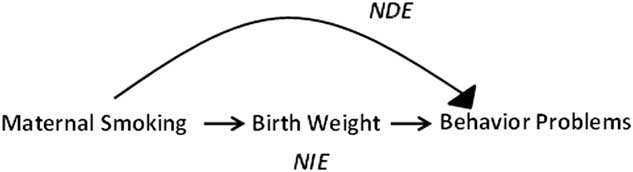
Based on evidence of associations between maternal smoking and birth weight, and between birth weight and behavior problems, birth weight can be considered as a potential causal intermediate. A causal mediation analysis framework was employed to estimate the total effect (TE) of maternal smoking on behavior problems and partition it into the natural direct effect (NDE) and the natural indirect effect (NIE) (Fig. 1).Reference Valeri and Vanderweele 23 The proportion of the association mediated (PM) by birth weight was also calculated. For T-score outcomes using a linear regression model, the PM was calculated as NIE/TE and for raw score outcomes using a negative binomial regression model the PM was calculated as ((NDE×(NIE−1))÷(NDE×NIE−1)). The proportion mediated can provide insight into the role of different pathways by indicating how much of the effect of the exposure on the outcome is due to the effect of the exposure on the intermediate. Birth weight was only considered as a potential mediator between smoking and childhood behavior for outcomes with which it demonstrated (i) one point change in the outcome measure for linear models (β>1.0 or β<−1.0) or (ii) a 10% change in the ratio measure for negative binomial models (β>0.095 or β<−0.10), after adjustment for smoking. Standardized birth weight was modeled as a continuous variable in the mediation analyses. Interaction between maternal smoking and birth weight on behavior problems was also considered.
Maternal smoking and childhood behavior: natural direct effect (NDE) and natural indirect effect (NIE) mediated through birth weight.

Several assumptions are required by the mediation analysis, including no unmeasured confounding of relationships between (i) exposure–outcome, (ii) mediator–outcome, (iii) exposure–mediator and (iv) no effect of exposure that confounds the mediator–outcome relationship. We performed a bias analysis to assess the potential impact of an unmeasured confounder of the mediator and outcome on the results of the mediation analysis using the CBCL aggressive outcome as an example. We simulated a binary confounder, U, 1000 times under a scenario of moderate confounding and a scenario of strong confounding using a random binomial distribution. U was simulated to have the following properties in each data set, a baseline probability of 15%, a decreased probability of 10% with each unit increase in standardized birth weight, and an increased probability of 5% in the moderate confounding scenario and 10% in the strong confounding scenario, with each unit increase in the outcome measure. The mediation analysis was subsequently performed on each of the 1000 data sets, adjusting for U, and the range of results for the indirect and direct effects under both the moderate confounding and strong confounding scenario were plotted.
Results
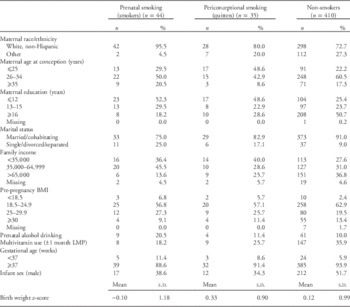
In our study, 16.1% of mothers (n=79) reported smoking during pregnancy. Among mothers who reported smoking at any point during pregnancy, ~44% quit in early pregnancy, defined as the first through third lunar month of pregnancy, whereas the remaining 56% (n=44) smoked into (n=6) or throughout late pregnancy (n=38). Compared with non-smokers, women who smoked into late pregnancy were more likely to be white, non-Hispanic, single and have <12 years of education. They were also less likely to use multivitamins in the periconceptional period and were more likely to drink during pregnancy (Table 1).
Characteristics of women by smoking status during pregnancy, 1996–2002

BMI, body mass index; LMP, last menstrual period.
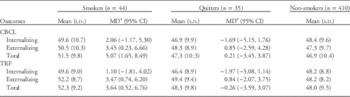
Maternal smoking during pregnancy was associated with higher average scores, indicating worse behavior, for broadband scales of externalizing and total behavior problems on the CBCL (MD: 3.45; CI: 0.23, 6.66 and MD: 5.07; CI: 1.65, 8.49, respectively) and on the TRF (MD: 3.47; CI: 0.74, 6.20 and MD: 3.64; CI: 0.52, 6.76, respectively). Compared with children of non-smokers, children whose mothers quit smoking in early pregnancy had similar mean scores for externalizing and total behavior problems on the CBCL and TRF (Table 2).
Adjusted mean differences (MD) and 95% confidence intervals (CI) for smoking and behavior problems, Child Behavior Checklist (CBCL) and Teacher Report Form (TRF) broadband scales, T-scores

a Adjusted for maternal race, education, age, marital status, prenatal alcohol use and periconceptional multivitamin use.
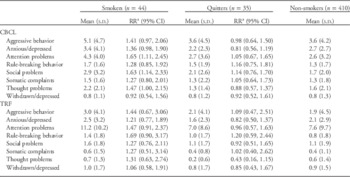
Negative binomial regression models for the syndrome scales are presented in Table 3. The largest increases in scores associated with maternal smoking during pregnancy were observed for CBCL syndrome scales of attention problems, social problems and thought problems with increases of 65, 63 and 47%, respectively. According to teacher report, point estimates were largest for syndrome scales of attention [rate ratios (RR): 1.47; CI: 0.91, 2.37] and rule-breaking (RR: 1.69; CI: 0.90, 3.17), but all CI included the null value. In general, associations with behavioral outcomes were attenuated for children of quitters.
Adjusted rate ratios (RR) and 95% confidence intervals (CI) for smoking and behavior problems on Child Behavior Checklist (CBCL) and Teacher Report Form (TRF) syndrome scales, raw scores

a Adjusted for maternal race, education, age, marital status, prenatal alcohol use and periconceptional multivitamin use.
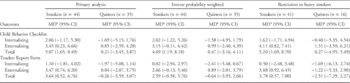
Results from the IPW analysis and the analysis restricted to heavy smokers (⩾10 cigarettes/day) are presented in Table 4. The associations between smoking during pregnancy and behavioral measures were attenuated after accounting for differences in participation, most notably for teacher-reported outcomes, which changed from MD: 3.64 (95% CI: 0.52, 6.76) for total behavior problems in the primary analysis to MD: 2.59 (95% CI: −0.58, 5.76) in the IPW analysis. Results from the sensitivity analysis restricted to heavy smokers demonstrated slight increases in the MD of externalizing and total behavior problem scores for smokers compared with non-smokers. Among those with complete information on prenatal and childhood smoke exposure, 43% of children exposed prenatally were also exposed in childhood, whereas 5% of children of non-smokers were exposed to ETS in childhood (n=8). Due to a small number of children with discordant prenatal and postnatal exposures, we were unable to disentangle the separate effects of prenatal and postnatal exposure to cigarette smoke on behavior problems.
Adjusted mean differences (MD) and 95% confidence intervals (CI) for smoking and behavior problems, broadband scales, sensitivity analyses

Reference group for all analyses is non-smokers.
a Adjusted for maternal race, education, age, marital status, prenatal alcohol use and periconceptional multivitamin use.
Mediation analysis
Birth weight was inversely associated with externalizing and total behavior problems on both the CBCL and TRF. Syndrome-scale outcomes on the CBCL were also inversely associated with birth weight, except anxiety, somatic problems and withdrawn/depressed. Associations between birth weight and TRF outcomes were fewer, thereby limiting the number of teacher-reported outcomes eligible for the mediation analysis.
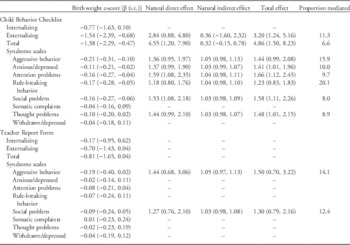
The NIE for all of the outcomes analyzed was small, ranging from 0.32 to 0.36 for the linear outcomes and from 1.03 to 1.05 for the count outcomes. The proportion of the observed association mediated through birth weight ranged from 6.6 to 20.1%. Where numbers were sufficient to allow for comparisons, mediated proportions were similar for mother-reported outcomes and teacher-reported outcomes (Table 5).
Mediation analysis of smoking and behavior problems by standardized birth weight z-scoreFootnote a

a Adjusted for maternal race, education, age, marital status, prenatal alcohol use and periconceptional multivitamin use.
The results of the mediation analysis with the adjustment of a simulated mediator–outcome confounder are presented in the Supplementary Materials. After 1000 simulations, the direct effect between maternal smoking and the aggressive syndrome scale on the CBCL that was most frequently observed after adjustment for a strong confounder was larger than the observed, 1.44 compared with 1.36, and ranged from 1.16 to 1.68. Upon adjustment for a moderate confounder, the direct effect ranged from 1.24 to 1.57, with a value of 1.37 most frequently observed. The indirect effect was similar to the observed of 1.05 in all scenarios (Supplementary Figs).
Discussion
Maternal smoking during pregnancy was associated with several types of childhood behavior problems, including externalizing and total behavior problems. Scales for attention problems were also associated with maternal smoking during pregnancy. Social problems according to mother-report and rule-breaking behavior according to teacher report were higher among children of smokers. These associations were attenuated or eliminated for mothers who quit by the third lunar month of pregnancy. In general, internalizing behavior problems were not associated with smoking exposure. These results are in agreement with previous studies in which associations have been observed between maternal smoking and externalizing problems, but not internalizing problems such as withdrawn, depressed and anxious behavior.Reference Batstra, Hadders-Algra and Neeleman 2 , Reference Orlebeke, Knol and Verhulst 4
The results of the mediation analysis indicated that a small proportion of the associations between maternal smoking and several types of behavior problems were explained by an indirect effect through birth weight. Although the percentage mediated ranged from 6.6% for mother-reported total behavior problems to 20% for mother-reported rule-breaking syndrome scale, the indirect effects were quite small and corresponding CI included the null value. The potential for mediation by birth weight with ADHD was addressed by Nigg and BreslauReference Nigg and Breslau 20 who concluded that LBW did not mediate the association due to minimal change in the effect estimate when included in the regression model. This was true for both mother-reported outcomes obtained from the DISC instrument (Dominance (D), Influence (I), Steadiness (S), and Compliance (C)) and teacher-reported outcomes from the TRF.Reference Nigg and Breslau 20 The present analysis improves on this through the quantification of both direct and indirect effects and by utilizing a continuous and standardized measure of birth weight; this allowed for analysis of the entire spectrum of birth weight. Furthermore, we performed a bias analysis to simulate and adjust for the presence of a confounder of the birth weight and behavioral outcome relationship, using the CBCL aggressive syndrome scale as an example, which did not materially alter our findings.
In a study of maternal smoking during pregnancy and academic performance among grade school children of both smokers and non-smokers,Reference Anthopolos, Edwards and Miranda 24 increases in birth weight, even within the clinically normal range, were associated with improved reading and math scores. Similarly, our results suggest that improvements in birth weight may result in a reduction, albeit a small reduction, of the magnitude of association between maternal smoking during pregnancy and selected behavioral measures. Birth weight was more strongly associated with most mother-reported behavior problems than with teacher-reported behavior problems, thereby limiting the number of mediation analyses on teacher-reported outcomes. Stronger correlations of birth weight with parent-reported behavior on the CBCL than with teacher-reported outcomes on the teacher’s checklist of psychopathology, an instrument comparable with the TRF, have previously been noted.Reference Buschgens, Swinkels and van Aken 25 Although the reason for stronger associations between birth weight and mother-reported outcomes is not clear, it is possible that mothers of LBW children overreport behavioral problems relative to mothers of children with normal birth weight. Despite a limited number of analyses of birth weight and teacher-reported outcomes, results between mother and teacher-reported outcomes were similar where comparison allowed.
One mechanism through which maternal smoking may affect the neurodevelopment of offspring is through fetal brain nicotine receptors that alter cell differentiation and proliferation causing deficits in the creation of cells upon nicotine exposure.Reference Slotkin 26 The mechanism through which birth weight affects neurobehavioral development may involve the disruption of cortical development. Cortical development is inversely related to birth weight and regional cortical volumes have been associated with some measures of poorer neurodevelopment.Reference Peterson, Vohr and Staib 27 Other proposed mechanisms include nutritional deprivationReference Makrides, Anderson and Gibson 28 and maternal illnesses that may alter fetal brain development through immune activation.Reference Smith, Li and Garbett 29 In addition to prenatal cigarette smoke exposure and birth weight, childhood ETS exposure has also been associated with behavioral problems in some,Reference Eskenazi and Trupin 30 but not all studies.Reference Fergusson, Horwood and Lynskey 31 Due to a small number of children with discordant prenatal and postnatal exposures, we were unable to disentangle the separate effects of prenatal and postnatal exposure to cigarette smoke.
Strengths of this study include the availability of data on behavior problems obtained from two separate sources, which included the CBCL and the TRF. Overall, the associations between maternal smoking during pregnancy and child behavior problems were of similar magnitude for both sets of reporters. Associations with attention and social problem syndrome scales were slightly larger for mother report than teacher report, whereas associations with rule-breaking syndrome scale were slightly larger for teacher report than mother report. A previously conducted study utilizing the CBCL and TRF similarly demonstrated that teachers reported fewer attention problems and more externalizing behavior problems than mothers.Reference Breslau and Chilcoat 32 Contrary to our findings, a study using a 10-item child behavior questionnaire observed that parents’ rating of externalizing behavior were higher when compared with teachers’ ratings, but this difference may be explained by the utilization of a different instrument.Reference Batstra, Hadders-Algra and Neeleman 2
Our study contributes to the existing literature regarding timing of prenatal exposure to cigarette smoke, a component that has been a limitation of previous studies on the topic.Reference Batstra, Hadders-Algra and Neeleman 2 Results indicated that scores on behavioral measures were similar among children of non-smokers and children of women who quit smoking early in pregnancy, suggesting that the effect of cigarette smoke on behavioral outcomes may be either a result of an accumulation of exposure or most detrimental later in pregnancy. Other studies have observed a decrease in risk of selected behavioral outcomes with quitting or decreasing levels of smoking, yet small associations remain, with one study reporting a reduction in child aggressive behavior associated with a decrease in smoking during pregnancyReference Brook, Zhang and Rosenberg 6 and another reporting smaller associations for child hyperactivity among mothers that quit smoking by the 8th week of pregnancy than among mothers that did not.Reference Kotimaa, Moilanen and Taanila 5 Rantakallio et al.Reference Rantakallio, Laara and Isohanni 9 reported little difference in the prevalence of delinquency among adolescent male children of mothers who stopped smoking during pregnancy and mothers that smoked throughout pregnancy, although the time at which mothers stopped smoking was not indicated. A study of maternal smoking and neurodevelopment among adolescent mothers reported that significant associations with CBCL outcomes of total behavior problems, externalizing behavior, delinquency and aggression were observed for first trimester exposure. Second and third trimester data were not presented because they did not achieve statistical significance, but it is possible that the parameter estimates were still elevated.Reference Cornelius, De Genna and Leech 10 Mothers who quit smoking in early pregnancy, defined by the third lunar month or ~10 weeks postconception, smoked fewer cigarettes per day than mothers who did not quit, therefore making it difficult to determine if the association between maternal smoking and behavior problems is driven by intensity or duration. The results of a sensitivity analysis restricting to mothers who reported smoking at least 10 cigarettes/day were similar indicating that even among heavy smokers the risk of behavior problems was greatly reduced if women stopped smoking in early pregnancy.
A limitation of our study was the small sample size. The results of the mediation analysis are based on 44 mothers that reported smoking during pregnancy. Another limitation is the possibility of unmeasured confounding of maternal smoking and behavior problems in offspring, specifically by parental behaviors and genetic risk factors.Reference Knopik 33 Researchers have demonstrated that the association between maternal smoking during pregnancy and behavior problems, specifically ADHD and conduct problems, in offspring can largely be accounted for by parental behaviors and genetic components that are related to maternal smoking and are risk factors for these behavioral outcomes.Reference Maughan, Taylor and Caspi 34 , Reference Thapar, Rice and Hay 35 The ability for such factors to potentially confound the association with behavioral outcomes other than conduct disorder and hyperactivity and attention problems is less clear. The presence of an unmeasured confounder that is associated with maternal smoking and an increase in behavioral problems would have caused our estimates to be overstatements of the true association. We evaluated possible mediation by birth weight, but were unable to evaluate other potential mediators, for example, offspring intelligence.Reference Rahu, Rahu and Pullmann 36 Misclassification of the exposure is another potential limitation. Data on smoking during pregnancy were based on maternal self-report and retrospectively collected and may be underreported. The prevalence of any prenatal smoking in our study was 16.2%, which is similar to national estimates corresponding to this time period. Lastly, participation bias is possible as our study included 60% of all eligible participants. Results from the IPW analysis showed an attenuation of overall results after accounting for differences between participants and non-participants.
In conclusion, we report associations between maternal smoking during pregnancy and several scales of behavior problems according to both mother and teacher report. Furthermore, we explain that only a minimal proportion of these associations can be explained by the difference in birth weight distributions between smokers and non-smokers, although our results are based on a small number of mothers that smoked during pregnancy. Future studies are needed to understand the role of birth outcomes and additionally to identify other intermediates that may be targeted by interventions.
Acknowledgments
None.
Financial Support
This work was supported by the National Institutes of Health (R01 DE11939).
Conflicts of Interest
None.
Ethical Standards
The authors assert that all procedures contributing to this work comply with the ethical standards of the relevant national guidelines on human experimentation and with the Helsinki Declaration of 1975, as revised in 2008, and has been approved by the Boston University Institutional Review Board.
Supplementary Material
For supplementary material/s referred to in this article, please visit http://dx.doi.org/10.1017/S2040174416000039