INTRODUCTION
As the concepts of adequate palliative and supportive cancer care have expanded beyond a focus on pain and physical symptom control, existential and spiritual dimensions have received increased attention from clinicians and clinical researchers, and also have been shown to be an important determinant of quality of life for family members of patients with advanced cancer (Clayton et al., Reference Clayton, Butow and Arnold2005; Sherman et al., Reference Sherman, Ye and McSherry2005; Lethborg et al., Reference Lethborg, Aranda and Cox2007).
Powerlessness and helplessness are two such existential dimensions relevant to palliative care in relation to symptom control (Sand et al., Reference Sand, Strang and Milberg2008), depression (Block, Reference Block2000), demoralization syndrome (Kissane et al., Reference Kissane, Clarke and Street2001), and adjustment disorders (Walden-Galuszko et al., Reference Walden–Galuszko and Majkowicz1995), and to strain and poor quality of life among family caregivers (Ferrell et al., Reference Ferrell, Ervin and Smith2002; Booth et al., Reference Booth, Silvester and Todd2003; Milberg et al., Reference Milberg, Strang and Jakobsson2004).
In a previous study that we conducted, 36% of the 233 responding family members of dying cancer patients stated that they had experienced perceptions of powerlessness and/or helplessness every day or several times per week during the palliative home care period (Milberg et al., Reference Milberg, Strang and Jakobsson2004). Episodes that had elicited such experiences had resulted in physical symptoms, anxiety, sadness, guilt, anger, loneliness, and strong feelings of insufficiency. Considering that the death of a close relation is consistently listed among the most highly stressful experiences, it was somewhat surprising that as many as 33% of the family members stated that they had never experienced powerlessness or helplessness during the palliative home care period.
Theorists have previously tended to assume that the normative responses to loss involve either chronic suffering or gradual recovery lasting several years and that the relative absence of distress in relation to death and dying of a significant other is thought to be rare as well as pathological (Bowlby, Reference Bowlby1980; Parkes & Weiss, Reference Parkes and Weiss1983; Worden, Reference Worden2002). However, in recent years there has been a major theoretical development in this area. In contrast to what was assumed, research has shown that the majority of bereaved persons manage to overcome their grief over the course of time without any interventions and only a minority experience severe and sometimes lasting consequences (Schut & Stroebe, Reference Schut and Stroebe2005). In fact, a large number of bereaved individuals experience little or no overt distress or disruptions in functioning and appear to be capable of genuine resilience to loss (Bonanno et al., Reference Bonanno, Wortman and Lehman2002, Reference Bonanno, Moskowitz and Papa2005; Coifman et al., Reference Coifman, Bonanno and Ray2007). For example, a prospective study of 205 individuals who had lost a spouse during the study period (Bonanno et al., Reference Bonanno, Wortman and Lehman2002, Reference Bonanno, Wortman and Nesse2004b) showed that the most frequent bereavement pattern was not the so-called common pattern of elevated depression that gradually declines over time (11%), but rather the resilient pattern (46%). This resilient group reported stable, low levels of depression throughout the study (from pre-loss through 18 months of bereavement), low levels of grief symptoms during bereavement, and no signs of either maladjustment (pre-loss to post-loss) or delayed grief or denial. That is, a highly stressful life event, such as losing a significant other, does not, per se, either elicit high levels of negative perceptions or have negative long-lasting consequences in relation to coping with such experience.
Therefore, instead of only focusing on the burdensome stressors and the need for grief work, recent studies have identified aspects that positively contribute to effective coping with severe illness and loss of a significant other. Such aspects include meaning (Folkman, Reference Folkman, Stroebe, Hansson, Stroebe and Schut2002), generalized resistance resources (GRR) according to the concept of sense of coherence (SOC) (Antonovsky, Reference Antonovsky1987), “dosage” of bereavement (Stroebe & Schut, Reference Stroebe and Schut1999), and repressing coping behavior (i.e., a tendency to direct attention away from negative affect or threatening stimuli) (Coifman et al., Reference Coifman, Bonanno and Ray2007). For example, acceptance of death, belief in a just world, instrumental support (Bonanno et al., Reference Bonanno, Wortman and Lehman2002), facial expressions of positive emotions during bereavement (Bonanno & Keltner, Reference Bonanno and Keltner1997), optimism and positive states of mind (Moskowitz et al., Reference Moskowitz, Folkman and Acree2003), the relationship with the patient (Kelly et al., Reference Kelly, Edwards and Synott1999), and patient symptom control (Kurtz et al., Reference Kurtz, Kurtz and Given1995, Reference Kurtz, Kurtz and Given1997) appear to be protective factors when investigated in prospective studies in relation to coping with loss and bereavement. There are also cross-sectional and retrospective studies suggesting protecting aspects such as staff emphasizing what can be done (control of physical symptoms, dignity, care, emotional and practical support), exploring realistic goals, discussing day-to-day living (Clayton et al., Reference Clayton, Butow and Arnold2005), family members participating in the care provided (Anderson & Kralik, Reference Anderson and Kralik2008), experience acceptance (Gysels & Higginson, Reference Gysels and Higginson2009), a sense of pride as a result of family involvement in care (Anderson & Kralik, Reference Anderson and Kralik2008), a feeling of security, and retained everyday life (Milberg & Strang, Reference Milberg and Strang2007).
Despite the fact that powerlessness and helplessness contribute to strain and poor quality of life among family caregivers (Ferrell et al., Reference Ferrell, Ervin and Smith2002; Booth et al., Reference Booth, Silvester and Todd2003; Milberg et al., Reference Milberg, Strang and Jakobsson2004) and “protecting” aspects seem of clinical importance, they have not systematically been studied in the palliative home care context. Therefore, the aim of this study was to describe aspects that, from the family members' perspective, are experienced as protection against perceptions of powerlessness and/or helplessness or as helpful when coping with such experiences during palliative home care.
METHODS
Participants
The study population was recruited from three advanced palliative home care (APHC) teams in one county in Sweden. The study design was cross sectional and targeted two groups of cancer patients' family members: (1) those of a patient who was in ongoing palliative home care, and (2) those of a patient who had died 3–9 months ago. Family members of patients who had died only 1–3 months earlier were excluded because of the risk of burdening them.
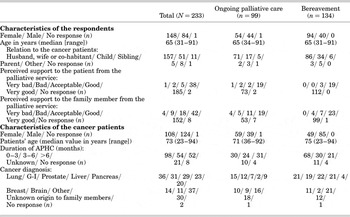
All three teams had a similar palliative care organization according to the Swedish model with a multi-professional team, 24-hour services, access to a backup ward, and continual access to a medical doctor around the clock (Beck-Friis & Strang, Reference Beck-Friis and Strang1993). Three hundred and twenty-three family members were mailed the study questionnaire. These included 149 of (152 possible, 98%) family members of cancer patients who were currently receiving palliative home care, and 174 (of 180 possible, 97%) bereaved family members of a deceased patient had been cared for by a palliative home care unit). Reasons for exclusions and attrition (ongoing care [n = 3]; bereavement [n = 6]) were because of unknown addresses, language problems, and lack of a close relative. The characteristics of the respondents are presented in Table 1. Because the questionnaire was submitted anonymously, a formal analysis of the dropout rate was not possible, but there were no major differences between the respondents and non-respondents in gender ratio (study population: 39% males vs. respondents 36% males), patients' gender ratio (study population 54% males vs. respondents 53% males) and patients' median age (75 years vs. 73 years).
Characteristics of the 233 responding family members

Procedure
As a result of the interrelated use of powerlessness and helplessness in everyday language and in research literature, as well as a lack of applicable definitions (Drew, Reference Drew1990; Clements & Cummings, Reference Clements and Cummings1991), we chose to combine both powerlessness and helplessness as one study phenomenon (more details of this process are presented in a previous publication) (Milberg et al., Reference Milberg, Strang and Jakobsson2004). A questionnaire was constructed with a focus on open-ended questions (Hickey & Kipping, Reference Hickey and Kipping1996), in which the family members were asked to describe their experiences of powerlessness and/or helplessness in their own words. This design was chosen in order not to limit their descriptions. The overall design of the open-ended questions was inspired by a qualitative interview technique whereby the informants are asked to share a concrete situation in which they have experienced the study phenomenon, in this study powerlessness and/or helplessness (Kvale, Reference Kvale1996, p.123).
Aspects that described the characteristics of powerlessness and helplessness according to the respondents, and the meaning and frequency of such feelings, had been presented in a previous article (Milberg et al., Reference Milberg, Strang and Jakobsson2004). The focus of the present article concerns aspects that were experienced as a protection against perceptions of powerlessness and/or helplessness or as a help when coping with such experiences. Family members were asked different questions depending upon their response to a Likert-type question: (1) If they stated that they had never or seldom experienced powerlessness and/or helplessness during the palliative home care period, they were asked: “What do you think has helped you to elude it?”; or (2) If they stated that they had had such experiences, they were asked: “What does/did it mean to you feeling powerlessness and/or helplessness? How did you try to cope with/ solve the situation? Did it help? Do you think that the healthcare system could have done anything to prevent or lessen your feelings of powerlessness and/or helplessness? In what way?”
The content validity was checked by clinicians (M.D.s and R.N.s experienced in palliative care and oncology) and researchers, who were not otherwise involved in the development of the questionnaire, both through personal contacts and in a seminar. In addition, the questionnaire was distributed to three family members in meetings with one of the authors. This pilot study showed that family members had no difficulties in completing the questionnaire, and only minor changes were made primarily because of one incident of ambiguous wording that was removed. The questionnaires were posted on different dates to the different participating units; therefore, we got responses from the first group of family members before we had posted questionnaires to the second group. This extra pilot study showed that the questionnaire seemed to work well with rich responses to the open-ended questions and distribution of the responses over the Likert scales. Therefore, no further changes were made.
The family members were identified using an existing clinical database and were mailed an invitation letter, an un-coded questionnaire, and a prepaid envelope. The questionnaires were un-coded to ensure anonymity. A reminder was sent after 2 weeks. Thirty-one of the patients died between the date the first questionnaire was posted and the date the reminder was to be sent, in which case no reminder was sent to those family members because of the risk of burdening them. Two hundred and thirty three (of 323) family members responded, which makes a response rate of 72 % (66% [99/149] in ongoing palliative care; 77% [134/174] in bereavement). The data were collected between December 2001 and August 2002. The study was approved by the Regional Ethics Committee.
The responses to the open-ended questions were analyzed using manifest qualitative content analyses with no predetermined categories ( Krippendorff, Reference Krippendorff1980; Graneheim & Lundman, Reference Graneheim and Lundman2004). The analysis was performed in the following steps. First, the material was read through to obtain an overall impression (naive reading) and develop themes. Second, the responses were systematically reread, line by line, to identify significant text segments (meaning units), and to develop matching codes, preliminary categories. The actual words written by family member were used to the greatest possible extent. Third, the statements in each preliminary category were scrutinized and compared to find their central component. Fourth, the final categories were compared to avoid obvious overlapping, and content descriptions and relations to other categories were developed. Fifth, persons involved were identified (as stated by the informants of what serves as a protection against powerlessness and/or helplessness or as a help when coping with such experiences), and the final categories were grouped accordingly. Quotations were used to exemplify the categories. The respondents' answers to all the open-ended questions were seen as the unit of analysis, and the final categories emerged in the analysis of the answers that all the respondents gave to all the questions.
Coding and development of categories were mainly done by the first author, while the coauthor concentrated on reviewing the findings. Both authors read through every response, and the categories were discussed until agreement was reached. Involving several researchers is a way of reducing the risk of investigator bias by researchers supplementing and contesting each other's readings, corresponding to the process of reflexivity (Malterud, Reference Malterud2001).
RESULTS
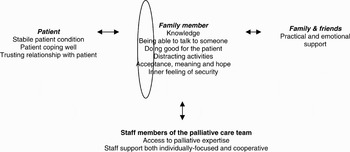
Twelve categories emerged in the analysis of the responses to the open-ended questions. There were no major differences between the aspects the family members had experienced as protection and as helpful. Therefore, all categories presented below concern both protection against powerlessness and helplessness and aspects that were experienced as helpful when coping with such perceptions. The categories related to the patient, to family and friends, to staff members of the palliative care team, and to the family member. An overview is presented in Figure 1.
Overview of the qualitative categories that emerged in the analysis concerning family members' experience of aspects that had been a protection against powerlessness and/or helplessness or a help when coping with such perceptions. The categories related to the patient, family and friends, the palliative care team, and to the family member himself/herself, are listed accordingly.

Stable Patient Condition
“Stable condition” described situations in which there was no sudden, negative change in the patient's disease trajectory reminding the family member of the forthcoming death, and when there was good symptom control and retained function of everyday activities, and when the family member perceived that the patient was not suffering. These aspects were comforting for the family members and contributed to protection against feelings of powerlessness and helplessness.
[I never experienced powerlessness and/or helplessness during the palliative home care period because] …he was able to take care of his personal hygiene, although it took a lot of time. … and the staff members of the palliative care team helped him with painkillers (73-year old wife, husband with sarcoma).
Patient Coping Well
If the patient was coping well and did not complain about his or her situation, this was experienced as protective and helpful. Coping well, according to the family member, meant the patient being calm, positive, secure, or having confidence that there was some kind of solution to the situation, such as an improvement in health or symptom control.
I did not experience powerlessness or helplessness so many times… [because] mother was very positive and brave. … (51-year old woman, mother with pancreatic cancer).
Trusting Relationship with the Patient
Having a trusting relationship with the patient was perceived as a protection and as helpful in relation to experiences of powerlessness and helplessness. Such relationships were described as trustful, close, and of significance to the family member. Two different types of trusting relationships with the dying patient emerged in the analysis. One included openness and free interchange in the communication about the serious situation (first quotation following). In the other type, participants mentioned that not talking about such things with the patient, although having a trusting relationship, had been helpful to them (second quotation following).
[I never experienced powerlessness or helplessness during the palliative home care period because] My husband and I had a very close relationship after 54 years of marriage, and we could speak openly about his disease and knew that we only had a limited time left together. We made the best of that time. (76-year-old woman, husband with pancreatic cancer).
[I never experienced powerlessness or helplessness during the palliative home care period because] We were told right from the start at the hospital that my husband was not going to survive the disease, but we tried to go on living as normal, we never talked about death. (76-year-old woman, husband with lung cancer).
Practical and Emotional Support from Family and Friends
The respondents described a conflict between their own needs for rest and the task of supporting their dying relative or friend. Support from family and friends solved this dilemma in the form of people offering practical help, relief, and opportunities to talk or just by being there.
I was privileged during the difficult period. My sister and brother-in-law were here all the time and helped my husband and me. My husband did not have to be alone in his room, and I could take a break, that was a great help for me [and this helped me when coping with powerlessness and helplessness] (66-year-old wife).
Accessibility of Palliative Expertise
Access to the APHC staff 24 hours a day had been experienced as protecting or served as a help in relation to perceptions of powerlessness and helplessness. It had relieved the family members of the burdensome responsibility of caring for a dying relative or friend, as well as the perception of loneliness in that situation, and also by contributing with hope, e.g., by the team's skills in symptom management. The family members knew that they could always get in touch with staff with expert knowledge in palliative care, and that both home visits and a backup ward were available around the clock.
I felt and knew all the time that it was serious…[but]…. my partner and I received all the help we needed from APHC. To me that was a great support [and this eluded me from experiencing powerlessness and helplessness during the palliative home care period]. ..We could phone whenever we wanted and get help. The final period would have been difficult without APHC. (41-year-old man, partner with cancer in lung and back).
Staff Support both Individually Focused and Cooperative
In encounters with staff members, the family members expressed that they had felt a sense of respect, commitment, hope, kindness, and empathy, which they had experienced as protecting or helpful in relation to powerlessness and helplessness.
Moreover, it had been important that the contacts with the staff were unhurried and centred on both the patient and on the family members as individuals. For example, asking if the patient wanted a urine catheter or not, and whether or not the family got individually adjusted amounts of information and enough time with the staff to feel calm and secure in the burdensome situation. Acknowledging that the family member was a person having important knowledge concerning the patient's situation, and inviting her or him to participate in the care process, to the extent he/she wanted, was perceived as supportive.
[It was helpful for me with informative] Talks with doctors and nurses at APHC at my pace. The staff had a supportive attitude that gave me a feeling of being one of the team, that was going to make life as comfortable as possible for my husband. (70-year-old woman, husband with brain tumor, never experienced powerlessness or helplessness during the palliative home care period).
Knowledge
It was experienced as helpful in relation to powerlessness and helplessness to get information about how the patient was coping and how the patient really felt, in particular whether he or she was suffering. Such helpful information could come either from the patient himself or herself or from the healthcare staff. Another area of knowledge of value concerned traditional medical information, for example about the disease trajectory, treatments, side effects, aids, and the opportunities for financial support. The family members had also gotten important knowledge from their own previous experiences, such as having relatives and friends dying. If the family members believed that they had their own reliable knowledge, this contributed to a feeling of being more able to handle difficult situations, and therefore not having to worry.
Throughout the whole period of my husband's illness, I tried to be with him as much as possible. I understood what was happening thanks to APHC. Especially during the last days they were very skilled in preparing us what was going to happen, step by step. I really felt secure and felt their deep human qualities! (49-year-old woman, husband with lymphoma; experienced powerlessness and/or helplessness occasionally during the palliative home care period).
Talking to Someone
Talking with the patient, staff, family, friends, or in formalized counseling groups, was a frequently mentioned protecting aspect against feelings of powerlessness and helplessness, including after the patient's death. The talks provided important information and an opportunity to express emotions in words, which some respondents experienced as relieving and helpful. Talking facilitated the family members' manageability of their situation, both on a practical and on an existential level.
I have experienced powerlessness sometimes when my brother phoned and was angry, when he cried and talked about his worries, nights when he had trouble with sleeping…Such situations [and the perception of powerlessness] can often be solved if you have someone to talk to (67-year old man, brother with lymphoma).
Doing Good for the Patient
Doing something good for the patient was perceived as helpful in relation to coping with powerlessness and helplessness, and could involve practical help with medication, making his or her favourite meals, talking, keeping him or her company, showing affection and making it possible for the patient to die at home according to his or her wishes.
I did my damnedest to help my husband, and I think I did and it has helped me afterwards [in relation to coping with perceptions of powerlessness and helplessness] now to know I did everything that was in my power. (74-year-old woman, husband with prostate cancer, occasionally experienced powerlessness and/or helplessness during the palliative home care period).
Distracting Activities
Distracting activities, such as walks, reading books, watching television, going to work, household chores, gardening, physical activity, and being in a familiar environment, were perceived as helpful in relation to powerlessness and helplessness. The activities mentioned had been part of everyday life before the present situation with a family member who was dying. By engaging in such activities, the family member was able to think of something other than the burdensome situation and could take a rest from it.
It was best for me to be busy all the time. Work, work, work. Baking, washing, cleaning, ironing, anything. The garden has saved me many times, when everything felt hopeless. Shovelling snow in the winter. You get some fresh air too. Reading books and doing crosswords also help you to think about other things. (68-year-old woman).
Acceptance, Meaning, and Hope
The family members, both those who often perceived/had perceived powerlessness or helplessness and those who seldom perceived it, wrote about the existential issues that they had to deal with and that had triggered perceptions of powerlessness and helplessness. Such issues often concerned “why does this happen?” and “why me?” questions, and the unfairness of their situation.
Helpful strategies when trying to cope with such existential challenges were trying to accept the situation, e.g., by “doing the best possible in the situation,” searching for meaning, and finding hope despite the difficult situation. Some respondents found meaning through a belief in a higher power or God.
We try to live on, but how do you explain it to the children—the oldest one is 15 years old? I try to think that things like this happen to everyone, that despite it all—there is a meaning, a higher power, what is happening is pre-ordained. (70-year-old woman, daughter with breast cancer, experiencing powerlessness and/or helplessness every day, but trying to cope).
I perceived powerlessness when my husband, during his illness, did not get enough attention and care from healthcare. Since APHC came into our lives the powerlessness has changed to confidence and calm. There is time, both for my husband and me, to reflect and to some extent accept the difficult situation we are in. (63-year old woman, husband with gastrointestinal cancer, experienced powerlessness and/or helplessness occasionally during the APHC period).
Inner Feeling of Security
Security was a frequently recurring description of an emotional state protecting against perceptions of powerlessness and helplessness or that served as a help when coping with such perceptions. Some described security as a part of their personality. Despite being in a stressful situation, they knew they could remain in a feeling of inner security, be calm, and trust that the situation could improve as a result of their own resources, which had been a help in relation to powerlessness and helplessness. Others felt secure because they trusted external resources, such as access to palliative expertise 24 hours a day or the help of God.
It makes you feel secure knowing that the doctors are available, that a nurse can come soon, and to get help, prescriptions, medication, information and that they can come if needed. I have called many times to doctors, before the referral when my husband has been in need of help, and it has been difficult getting in contact with someone and I have been queuing in the telephone time after time, and then I have felt powerlessness and anger. (63-year old wife, husband with sarcoma, occasionally experienced powerlessness and/or helplessness during the palliative home care period).
DISCUSSION
This study has highlighted some important aspects perceived as protective against feelings of powerlessness and helplessness or as a help when coping with such experiences. The results are supported by others in relation to coping and support for family members of dying patients (Hodgson et al., Reference Hodgson, Higginson and McDonnell1997; Kurtz et al., Reference Kurtz, Kurtz and Given1997; Carlsson & Strang, Reference Carlsson and Strang1998; Kelly et al., Reference Kelly, Edwards and Synott1999; Lethborg et al., Reference Lethborg, Aranda and Cox2007; Clayton et al., Reference Clayton, Butow and Arnold2005; Milberg & Strang, Reference Milberg and Strang2000, Reference Milberg and Strang2003, Reference Milberg and Strang2004; Andershed & Ternestedt, Reference Andershed and Ternestedt2001; Strang & Strang, Reference Strang and Strang2001; Folkman, Reference Folkman, Stroebe, Hansson, Stroebe and Schut2002; Harding & Higginson, Reference Harding and Higginson2003; Holtslander et al., Reference Holtslander, Duggleby and Williams2005; Goldschmidt et al., Reference Goldschmidt, Schmidt and Krasnik2006; Herbert et al., Reference Herbert, Prigerson and Schulz2006; Milberg & Strang, Reference Milberg and Strang2007; Anderson & Kralik, Reference Anderson and Kralik2008), although the roles of doing good for the patient, distracting activities, and avoidance of open communication have not hitherto been illuminated much.
Why Does Not Everyone Experience Powerlessness and Helplessness?
Existential ideas have made their way into the theories of clinically oriented theorists and therapists during the last century, e.g., Rollo May, Irvin Yalom, Emmy van Deurzen, and Viktor Frankl. Until relatively recently, existentialists did not perform empirical research, although theories within existential psychology can be used for generating testable hypotheses, and also to interpret and understand study results at a deeper level. However, there has been a change and a trend toward consideration of existential issues in modern psychological theorizing (Folkman, Reference Folkman, Stroebe, Hansson, Stroebe and Schut2002) and corresponding empirical research has gradually emerged (Breitbart, Reference Breitbart2002; Greenberg et al., Reference Greenberg, Koole and Pyszczynski2004; Chochinov et al., Reference Chochinov, Hack and Hassard2005).
According to existential psychology, crisis is part of life itself, and to manage misfortunes is an essential life task for all humans (van Deurzen, Reference van Deurzen1997/2006). Different sources of existential anxiety have been described: in relation to death, guilt, meaninglessness, freedom, and existential isolation (Tillich, Reference Tillich1952/2000; Yalom, Reference Yalom1980). Although existential anxiety is burdensome and provoking, it can awaken a human's existence in the world, and open up new opportunities for an authentic life by eliciting thoughts about what, within the limits of the situation, is actually of real value to the individual, who then can make meaningful, authentic choices (Spinelli, Reference Spinelli1997/2006).
Becoming a family member of a dying relative or friend can constitute a borderline situation, which can awaken existential anxiety and thoughts about death, existential guilt, and the meaninglessness of life, but also may contribute to a revised sense of life priorities (Milberg et al., Reference Milberg, Olsson and Jakobsson2008). The respondents in the current study expressed the view that doing good for the patient can serve as a protection against powerlessness and helplessness or be helpful when coping with such perceptions. In the light of existential psychology, the difficult situation of losing a significant other can mean that the family members become aware of what is of real value to them, namely doing good for the dying loved one. One could consider family members' urge for “doing good for the patient,” within the limits of the situation where cure no longer is an option, as an opportunity for authentic living. In other words, death, loss, and bereavement may, according to existential psychology, enable the individual to find meaning and improve authentic living, and therefore cope more effectively with existential challenges. Consequently, it seems important that staff members in palliative care be open to the family member's wish to do good for the patient by inviting him/her to participate in the care to the extent he/she wishes, and also acknowledge his/her efforts to do good in caregiving. Palliative care providers must also be aware of the significance 24-hour accessibility to teams with competence in palliative care may have on the individual family member's motivation and courage to participate in the care of a dying family member or friend at home, a care place putting a lot of responsibility on the family member. Such support may contribute to feelings of meaningfulness, acceptance, hope, and security (Milberg & Strang, Reference Milberg and Strang2000, Reference Milberg and Strang2003; Clayton et al., Reference Clayton, Butow and Arnold2005; Milberg & Strang, Reference Milberg and Strang2007; Milberg et al., Reference Milberg, Olsson and Jakobsson2008).
The Importance of Both Confrontation and Rest When Coping with Existential Challenges
The findings of the present study can also be interpreted by using “the Dual Process Model of Coping with Bereavement” (Stroebe & Schut, Reference Stroebe and Schut1999). This model suggests that optimal and adaptive coping with bereavement include both the confrontation and avoidance of stressors related to the bereavement. Such stressors have two origins: (1) those related to the actual loss in relation to the death, and (2) those related to restoration of new life after the death of the close person. Oscillation between these various demands of the situation is necessary for grieving to be effective. In addition, Stroebe and Schut also argued that it is important to “dose” the grief, that it is essential as an integral part of adaptive coping also to take a break from the confrontation of the stressors (both loss-oriented and restoration-oriented) in everyday life.
The participants in the current study expressed the view that a stable patient condition without burdensome symptoms, when the patient was coping well, and when the family members were mentally and practically distracted (e.g., by activities of their everyday life), had been important for their protection against powerlessness and helplessness or helped them to cope with such existential challenges. Good symptom control and distraction provided important opportunities for family members to take a much-needed break from the confrontation of stressors that were connected to loss and bereavement and that elicited perceptions of powerlessness and helplessness. It seems important to include such “dosing” into the support provided by palliative care, considering the fact that the family member's grieving may already start when the patient is still alive (Smith, Reference Smith2005). Although there is still insufficient evidence to draw conclusions about the efficacy of offering traditional respite care to support carers of patients with advanced disease (Ingleton et al., Reference Ingleton, Payne and Nolan2003), concerning the result of the present study in relation to powerlessness and helplessness, it seems important that staff members support family members' need to rest, when possible, from the burdening situation. Such support could take the form, for example, of encouraging family members to accept help and not feel guilty at times when they actually may feel joy or other positive emotions (Folkman & Greer, Reference Folkman and Greer2000).
Is Avoidance Really “Pathological”?
Since the 1960s, communication and awareness about dying in modern Western societies have been stressed (Glaser & Strauss, Reference Glaser and Strauss1965; Valdimarsdottir et al., Reference Valdimarsdottir, Helgason and Furst2004), and open awareness of dying, where both the dying person and the family members know that the person is dying, is nowadays the most prevalent awareness context (Seale et al., Reference Seale, Addington–Hall and McCarthy1997). Such an openness is in line with the dominating “grief work hypothesis,” i.e., that to adjust, the bereaved have to confront and express intense emotions accompanying their loss to reduce the risk of delayed grief reactions (as was mentioned in the Introduction) (Bowlby, Reference Bowlby1980; Parkes & Weiss, Reference Parkes and Weiss1983). It has further been assumed that emotionally avoidant or defensive individuals will have a difficult time adjusting to the loss of a loved one, e.g., in terms of delayed grief (Bowlby, Reference Bowlby1980), that others assist in this process, and that intervention programs are effective (Worden, Reference Worden2002).
Some of the family members in the present study stated that they were coping well with the existential challenges by having an open relationship with a free exchange of feelings. However, others stated that they did not talk about death and dying with the patient, although they seemed both to cope with the existential challenges and stated that they had never or only occasionally perceived powerlessness or helplessness during the palliative home care period. These findings raise some important questions that challenge the grief work theory: Can one be aware and cope effectively with existential challenges, such as death and dying, without explicitly talking about them? Or should such behavior be considered “pathological,” ineffective coping and should staff, consequently, consider intervening in these kind of situations?
In contrast to what was assumed concerning awareness and the need of grief work, a recent review found no evidence that emotional disclosure facilitates adjustment to loss in normal bereavement (Stroebe et al., Reference Stroebe, Schut and Stroebe2005b). In addition, research has presented some indications that there are different ways of effective coping with awareness including avoidance, and awareness does not necessarily mean open verbal communication about the issue. For example, in a study by Salander and Spetz (Reference Salander and Spetz2002), a series of 25 consecutive patients with malignant glioma and their spouses were followed through the whole course of the disease process with repeated thematic interviews. The authors concluded: “A few of the couples openly discussed death and dying. More common, and apparently sufficient, was a mutual acknowledgement of the serious facts, without using the words ‘death’ and ‘dying’.” (Salander & Spetz, Reference Salander and Spetz2002). Moreover, a prospective study showed that both bereaved (n = 61) and non-bereaved (n = 45) participants who exhibited repressive coping behavior (i.e., a tendency to direct attention away from negative affect or threatening stimuli) had fewer symptoms of psychopathology, experienced fewer health problems and somatic complaints, and were rated as better adjusted by close friends than those who did not exhibit repressive coping. Repressive coping was also predictive of better longitudinal adjustment among bereaved participants (Coifman et al., Reference Coifman, Bonanno and Ray2007). That is, it seems that emotional avoidance may actually serve adaptive functions during bereavement (Bonanno et al., Reference Bonanno, Keltner and Holen1995; Moskowitz et al., Reference Moskowitz, Folkman and Acree2003; Coifman et al., Reference Coifman, Bonanno and Ray2007), although the repressive coping style has been associated with a potential health cost, e.g., lowered immune function (Esterling et al., Reference Esterling, Antoni and Kumar1993) and cortisol dysregulation (Giese-Davis et al., Reference Giese-Davis, Sephton and Abercorombie2004), suggesting a greater susceptibility to cardiovascular, immune-related, and other diseases (Frasure-Smith et al., Reference Frasure-Smith, Lesperance and Gravel2002).
How can possible positive aspects of avoidance be understood from a theoretical perspective? With interpretation by applying the theory of the dual process model of coping with bereavement, was the limited verbal communication a necessary and effective way of dosing grief and perceptions of powerlessness and/or helplessness? That is, the family members confronted and dosed the loss-oriented stressors (e.g., the forthcoming death of their loved one) in a nonverbal, but also effective way (e.g., by being close, watching the deterioration, and taking care of him or her). Or was it part of a repressive coping behavior that promoted resilience to loss by a tendency to direct attention away from negative affective experiences, such as perceptions of powerlessness and helplessness, that can be elicited by open communication about loss and death (Milberg et al., Reference Milberg, Strang and Jakobsson2004; Sand et al., Reference Sand, Strang and Milberg2008)?
Recent research on coping has indicated that the crucial element in successful adaptation is not so much which particular strategies are used or not used, but rather the ability to both enhance and suppress emotional expression and to do so flexibly in accord with situational demands (Bonanno et al., Reference Bonanno, Papa and Lalande2004a). Avoidance as well as distraction and distancing can all have adaptive values in relation to coping with severe stress or bereavement (Bonanno et al., Reference Bonanno, Keltner and Holen1995; Moskowitz et al., Reference Moskowitz, Folkman and Acree2003; Phelps et al., Reference Phelps, Bennett and Iredale2006; Coifman et al., Reference Coifman, Bonanno and Ray2007). However, some types of avoidance seem to be more effective than others, and recent investigations have distinguished repressive coping behavior, which is generated relatively automatically and outside conscious awareness (Coifman et al., Reference Coifman, Bonanno and Ray2007), from the construct of suppression (Myers et al., Reference Myers, Vetere and Derakshan2004), a deliberate act of affect avoidance associated with potentially maladaptive consequences (Bonanno et al., Reference Bonanno, Papa and Lalande2004a).
Consequently, it might be important for staff in palliative care to be more observant, not of patterns of avoidance of communication of death and dying per se, but of the flexibility of an individual's emotional expressions in relation to the situational demands and of patterns of purposeful, conscious avoidance. In addition, to further understand how avoidant individuals adjust to bereavement, recent theoretical literature (Stroebe et al., Reference Stroebe, Schut and Stroebe2005a) has integrated theory dealing with adult attachment styles, which distinguish between two avoidant attachment patterns (Bowlby, Reference Bowlby1969; Mikulincer & Shaver, Reference Mikulincer and Shaver2007). Whereas fearfully avoidant individuals have a difficult time adapting to the loss of a loved one, dismissingly avoidant individuals show a pattern of resilience to loss (Fraley & Bonanno, Reference Fraley and Bonanno2004).
Until further evidence is presented, support from palliative care teams should preferably include sensitivity to the individual family member's particular needs. When communicating difficult issues, such as those in relation to death and dying, a non-normative attitude to wishes of limited verbal communication about death and dying during ongoing palliative care as well as in bereavement should be assumed. There should be openness to the possibility that there may be several effective ways of coping with such issues, including some types of avoidance, that permit adaptation to profound loss, and also the need of different types of bereavement support, which has been suggested by some authors (Neimeyer, Reference Neimeyer2000; Stroebe et al., Reference Stroebe, Schut and Stroebe2006).
CONCLUSION
Before concluding, some methodological considerations will be made. Although, there is a risk of recall bias in the bereaved group of what was perceived as protecting or served as a help during the actual palliative period (Safer et al., Reference Safer, Bonanno and Field2001), we wanted to also include this group to give their contributions with variations of the experience of powerlessness and helplessness, because time can reframe and give some distance to the experience.
The reader should also be aware that as a result of cross-sectional design, one does not know whether what the family members perceive would be helpful for them, actually is so in relation to long-term effective coping with distress and bereavement. It would be appropriate to investigate these aspects for their actual efficacy in prospective studies.
In conclusion, this study has identified several aspects, of clinical relevance, experienced by family members in palliative care as protective against powerlessness and helplessness or as helpful in coping with such experiences. It seems important to conduct further prospective studies concerning family members' coping with existential issues, such as powerlessness and helplessness, in relation to awareness and communication of dying and death. There may actually be several different types of effective coping with loss, bereavement, and existential challenges, and also a need of different types of bereavement support.
ACKNOWLEDGMENTS
We thank the staff at the APHC teams in Östergötland for various kinds of help, and the Swedish Cancer Society for financial support.