INTRODUCTION
Trichomonas gallinae is a protozoan parasite known to cause morbidity and mortality in columbiforms, birds of prey, and less frequently in passeriform and psittaciform species (Amin et al. Reference Amin, Bilic, Liebhart and Hess2014). Birds with trichomonosis show non-specific clinical signs of malaise (e.g. lethargy and fluffed-up plumage); sometimes in combination with dysphagia, which occurs as a result of necrotic pharyngitis and/or ingluvitis. Parasite transmission occurs through contact with fresh saliva, either directly through conspecific feeding (e.g. during courtship or when feeding young), or indirectly at contaminated water and food sources (Forrester and Foster, Reference Forrester, Foster, Atkinson, Thomas and Hunter2009).
Whilst isolated cases of trichomonosis in finches have been diagnosed in Great Britain (GB) since the early 1990s (Lawson et al. Reference Lawson, Robinson, Colvile, Peck, Chantrey, Pennycott, Simpson, Toms and Cunningham2012), finch trichomonosis was identified as a significant emerging infectious disease (EID) in 2005 (Robinson et al. Reference Robinson, Lawson, Toms, Peck, Kirkwood, Chantrey, Clatworthy, Evans, Hughes, Hutchinson, John, Pennycott, Perkins, Rowley, Simpson, Tyler and Cunningham2010). A single clonal strain of T. gallinae (Lawson et al. Reference Lawson, Cunningham, Chantrey, Hughes, John, Bunbury, Bell and Tyler2011a ) caused epidemic mortality of both greenfinches (Chloris chloris) and chaffinches (Fringilla coelebs) in subsequent years (Lawson et al. Reference Lawson, Robinson, Colvile, Peck, Chantrey, Pennycott, Simpson, Toms and Cunningham2012). This EID caused a 35% population decline of breeding greenfinches across GB from 2006 to 2009 (from ca. 4·3 to 2·8 million birds), with a concomitant 50% reduction of the maximum mean number of greenfinches (a proxy for flock size) visiting gardens (Lawson et al. Reference Lawson, Robinson, Colvile, Peck, Chantrey, Pennycott, Simpson, Toms and Cunningham2012). Greenfinch and chaffinch represent the species most frequently diagnosed with finch trichomonosis. Since its epidemic emergence, the disease has also been confirmed in a range of other passerines, comprising Emberizidae (yellowhammer, Emberiza citrinella), Fringillidae (Brambling, Fringilla montifringilla; bullfinch, Pyrrhula pyrrhula; goldfinch, Carduelis carduelis; siskin, Carduelis spinus), Paridae (great tit, Parus major), Passeridae (house sparrow, Passer domesticus; tree sparrow, Passer montanus), Prunellidae (dunnock, Prunella modularis) and Turdidae (blackbird, Turdus merula) (Robinson et al. Reference Robinson, Lawson, Toms, Peck, Kirkwood, Chantrey, Clatworthy, Evans, Hughes, Hutchinson, John, Pennycott, Perkins, Rowley, Simpson, Tyler and Cunningham2010; authors’ unpublished data).
Molecular investigation has found evidence of T. gallinae strain diversity in columbiform hosts in GB; however, infection with the same clonal strain of the parasite affecting finches is predominant in British non-passerine species comprising pigeons, doves and birds of prey (Chi et al. Reference Chi, Lawson, Durrant, Beckmann, John, Alrefaei, Kirkbride, Bell, Cunningham and Tyler2013). Finch trichomonosis is hypothesized to have emerged as a result of T. gallinae spillover from columbiform to passeriform hosts in GB. Whilst it remains speculative, this spillover may have occurred at a shared feeding site(s), such as domestic gardens with bird feeders (Lawson et al. Reference Lawson, Robinson, Colvile, Peck, Chantrey, Pennycott, Simpson, Toms and Cunningham2012). After emergence in GB, finch trichomonosis spread to continental Europe, with incidents first confirmed in Fennoscandia in 2008 (Neimanis et al. Reference Neimanis, Handeland, Isomursu, Agren, Mattsson, Hamnes, Bergsjø and Hirvelä-Koski2010) before its spread to central Europe (Peters et al. Reference Peters, Kilwinski, Reckling and Henning2009; Ganas et al. Reference Ganas, Jaskulska, Lawson, Zadravec, Hess and Bilic2014). Examination of epidemiological and ring recovery data indicated migrating chaffinches as the most likely vector, since they overwinter in GB before moving in large numbers to their summer breeding grounds in Fennoscandia with autumn passage through the northern coastline of western Europe on their return journey (Lawson et al. Reference Lawson, Robinson, Neimanis, Handeland, Isomursu, Agren, Hamnes, Tyler, Chantrey, Hughes, Pennycott, Simpson, John, Peck, Toms, Bennett, Kirkwood and Cunningham2011b ).
While T. gallinae can cause morbidity and mortality in wild columbiforms (Forrester and Foster, Reference Forrester, Foster, Atkinson, Thomas and Hunter2009), the majority of columbiform infections are aclinical (i.e. without disease) or subclinical (i.e. without observed clinical signs) with the outcome of infection influenced by factors such as parasite strain virulence and host immunity (Stabler, Reference Stabler1961; Kocan and Knisley, Reference Kocan and Knisley1970; Forrester and Foster, Reference Forrester, Foster, Atkinson, Thomas and Hunter2009). Given the sometimes high rates of T. gallinae infection without apparent disease (i.e. trichomoniasis) detected in wild columbiforms and the suspected spread of finch trichomonosis by chaffinch migration from GB to Fennoscandia and central Europe, we hypothesized that chaffinches may also carry T. gallinae without showing clinical signs thus enabling parasite spread. Since T. gallinae is a labile parasite killed by desiccation and is incapable of long-term environmental persistence [surviving only short periods in water and up to 5 days in moist grain (Forrester and Foster, Reference Forrester, Foster, Atkinson, Thomas and Hunter2009; Gerhold et al. Reference Gerhold, Maestas and Harnage2013; Purple et al. Reference Purple, Humm, Kirby, Saidak and Gerhold2015)], its movement by wild birds is likely to play an important role in the epidemiology of this parasitic infection.
Here we present findings from a polymerase chain reaction (PCR)-based survey of upper alimentary tract (crop and/or oesophagus) samples from 275 garden birds (Apodiformes, Passeriformes and Piciformes) found dead in the UK over a 3-year period (May 2009–July 2012) following the epidemic emergence of finch trichomonosis in GB. Birds were examined post-mortem and samples were selected from cases with no evidence of necrotic ingluvitis in order to investigate whether the parasite was present in passerines with no macroscopic disease.
MATERIALS AND METHODS
Sample selection
Wild bird carcasses found by members of the public within the UK were submitted to a national scheme for infectious and non-infectious disease surveillance of wild birds (Robinson et al. Reference Robinson, Lawson, Toms, Peck, Kirkwood, Chantrey, Clatworthy, Evans, Hughes, Hutchinson, John, Pennycott, Perkins, Rowley, Simpson, Tyler and Cunningham2010). Post-mortem examinations (PMEs) were conducted following a standardized protocol comprising systematic external and internal inspection of organ systems, with microbiology, parasitology and histology performed as indicated by the presence of macroscopic lesions (Robinson et al. Reference Robinson, Lawson, Toms, Peck, Kirkwood, Chantrey, Clatworthy, Evans, Hughes, Hutchinson, John, Pennycott, Perkins, Rowley, Simpson, Tyler and Cunningham2010). Culture of T. gallinae was attempted from the majority of Passeriform submissions when the carcass had not been frozen: oesophagus/crop tissue samples and/or swabs were inoculated into Oxoid Trichomonas Medium No. 2, incubated at 30 °C and checked at 1, 2 and 5 days for evidence of motile parasites (Robinson et al. Reference Robinson, Lawson, Toms, Peck, Kirkwood, Chantrey, Clatworthy, Evans, Hughes, Hutchinson, John, Pennycott, Perkins, Rowley, Simpson, Tyler and Cunningham2010). Tissue samples from a range of organs, including crop and/or oesophageal tissue, were routinely collected and stored at – 80 °C. A case definition was utilized for finch trichomonosis, based on detection of macroscopic necrotic ingluvitis lesions with diagnosis confirmation using parasite culture and/or PCR (Robinson et al. Reference Robinson, Lawson, Toms, Peck, Kirkwood, Chantrey, Clatworthy, Evans, Hughes, Hutchinson, John, Pennycott, Perkins, Rowley, Simpson, Tyler and Cunningham2010).
We selected available frozen crop/oesophagus samples from Apodiform, Passeriform and Piciform species that were examined post-mortem between May 2009 and July 2012, during the finch trichomonosis epidemic in GB, and which had no observed macroscopic lesions characteristic of finch trichomonosis.
DNA extraction
DNA was extracted from crop/oesophageal tissue using either the DNeasy Blood and Tissue Kit (Qiagen, UK) or Isolate DNA Kit (Bioline, UK) according to the manufacturers’ instructions. To test for possible DNA cross-contamination, a DNA extraction negative control was included every 24 samples. All DNA extracts were screened using PCR regardless of DNA concentration. It was possible to obtain PCR positives that generated high-quality sequence data even for samples with a low DNA concentration.
ITS1/5·8S rRNA/ITS2 region PCR
A PCR was used to amplify the ITS1/5·8S rRNA/ITS2 region (henceforth ITS region) using the published primers (TFR1 forward – TGCTTCAGTTCAGCGGGTCTTCC and TFR2 reverse – CGGTAGGTGAACCTGCCGTTGG) (Gaspar da Silva et al. Reference Gaspar da Silva, Barton, Bunbury, Lunness, Bell and Tyler2007). Modifications were made to published PCR protocols (Robinson et al. Reference Robinson, Lawson, Toms, Peck, Kirkwood, Chantrey, Clatworthy, Evans, Hughes, Hutchinson, John, Pennycott, Perkins, Rowley, Simpson, Tyler and Cunningham2010; Chi et al. Reference Chi, Lawson, Durrant, Beckmann, John, Alrefaei, Kirkbride, Bell, Cunningham and Tyler2013): reactions were run with 7·5 µL HotStarTaq plus Master Mix (Qiagen, UK), 2 µL of 10 pg µL−1 forward and reverse primers, 3·5 µL of molecular grade water, and 1 µL of extracted DNA to complete a 16 µL reaction mix. Samples were run on a GeneAmp PCR System 2700 (Applied Biosystems, UK) using the following temperature regime: 94 °C for 10 min initial denaturation, followed by 45 cycles of 94 °C for 1 min, 55 °C for 1 min and 72 °C for 1 min; final elongation took place at 72 °C for 10 min. Each PCR run included a PCR positive control (DNA extracted from a T. gallinae culture), a DNA extraction negative control (to confirm reagent negativity and the absence of cross-contamination during DNA extraction) and a PCR negative control consisting of molecular grade water.
Single subunit (SSU) rRNA gene PCR
To increase the sensitivity of detection, a nested PCR for the trichomonad small subunit (SSU) rRNA (or 18S rRNA) gene was also performed. The initial PCR was carried out using primers SSU-Fwd (TACTTGGTTGATCCTGCC) and SSU-Rev (TCACCTACCGTTACCTTG), as per Robinson et al. (Reference Robinson, Lawson, Toms, Peck, Kirkwood, Chantrey, Clatworthy, Evans, Hughes, Hutchinson, John, Pennycott, Perkins, Rowley, Simpson, Tyler and Cunningham2010). PCR reactions were run with 5 µL HotStarTaq plus Master Mix; 1·5 µL of 10 pg µL−1 forward and reverse primers, 2 µL of molecular grade water, and 2 µL of 1:10 diluted DNA. The temperature regime used an initial denaturation temperature of 95 °C for 5 min, followed by 35 cycles of 94 °C for 1 min, 55 °C for 1 min and 72 °C for 1 min; final elongation took place at 72 °C for 10 min. Four μL from this initial PCR were then added to 3 µL of forward and reverse primers (TN3 forward – ATAGGACTGCAAAGCCGAGA and TN4 reverse – TGATTTCACCGAGTCATCCA); 10 µL HotStarTaq plus Master Mix and 4 µL of molecular grade water. The temperature regime used was 95 °C for 5 min initial denaturation, followed by 40 cycles of 94 °C for 1 min, 57 °C for 1 min and 72 °C for 1 min; final elongation took place at 72 °C for 10 min.
PCR product visualization and sequencing
Amplified PCR products were run on an ethidium bromide or GelRed™ (Biotium) stained 2% agarose gel alongside a GelPilot 1000 bp Ladder (Qiagen, UK). Bands were visualized using a transilluminator. PCR products of the expected size (ca. 335 bp for ITS region PCR and ca. 149 bp for SSU rRNA gene nested PCR) were sequenced for confirmation using a 3130XL ABI sequencer using BigDye® Terminator v 3.1 sequencing kit (ABI). Sequence data were aligned in both directions for each sample using MEGA 5·0 software (Tamura et al. Reference Tamura, Stecher, Peterson, Filipski and Kumar2013) and were compared with available gene sequences within NCBI GenBank using the BLAST search function to determine species identification within the Trichomonadidae.
Samples were considered positive for T. gallinae on the basis of sequence data from amplification of either the ITS region and/or SSU rRNA gene. ITS region PCR was repeated for any samples negative on the first attempt if an SSU rRNA gene PCR product was obtained and confirmed as T. gallinae on sequencing.
Fe-hydrogenase gene PCR
To subtype T. gallinae, we conducted PCR for the Fe-hydrogenase gene on samples positive for the parasite on ITS region and/or SSU rRNA gene PCR and sequencing. This was limited to positive samples since amplification of the single-copy Fe-hydrogenase gene can be challenging in DNA extracted from tissue rather than parasite culture (Chi et al. Reference Chi, Lawson, Durrant, Beckmann, John, Alrefaei, Kirkbride, Bell, Cunningham and Tyler2013). The primers [TrichhydFOR (GTTTGGGATGGCCTCAGAAT) and TrichhydREV (AGCCGAAGATGTTGTCGAAT)] and protocol from Lawson et al. (Reference Lawson, Cunningham, Chantrey, Hughes, John, Bunbury, Bell and Tyler2011a ) were used with the following modifications: reactions were run with 10 µL BioMix™ (Bioline, UK), 3 µL of 10 pg µL−1 forward and reverse primers, 2 µL of molecular grade water and 1 µL of extracted DNA to complete a 19 µL reaction mix. Reactions were run using the following temperature regime: 94 °C for 15 min initial denaturation, followed by 35 cycles of 94 °C for 1 min, 52 °C for 30 s and 72 °C for 2 min; final elongation took place at 72 °C for 5 min. Each PCR run included a PCR positive control (DNA extracted from a T. gallinae culture obtained from a greenfinch) and molecular grade water as a PCR negative control.
RESULTS
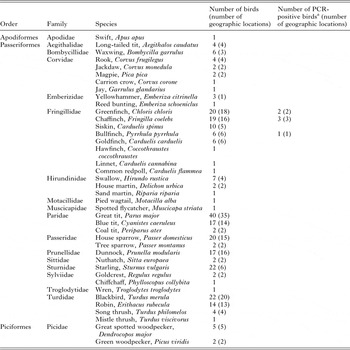
Tissue samples that matched our selection criteria were available from 275 wild birds (one Apodiform, 269 Passeriformes and five Piciformes) from 18 different families submitted from across the UK: these comprised 250 from England, 20 from Wales, one from Scotland and four from Northern Ireland (Table 1). The causes of death determined at PME were: trauma (35%; 95/275), infectious disease (15%; 42/275), predation (11%; 29/275), a combination of infectious disease and either trauma or predation (17%; 48/275), other (1%; 3/275) and undetermined (21%; 58/275).
Number of Apodiform, Passeriform and Piciform birds from which oesophagus/crop was tested by PCR for the presence of T. gallinae

a Positive on the basis of PCR targeting the ITS region and/or the SSU gene and/or Fe-hydrogenase gene.
Nested PCR of the SSU rRNA gene amplified product from six finches (Table 1): three chaffinches, two greenfinches and one bullfinch from separate sites in six counties across England (from three regions comprising South West, North East and West Midlands), Wales and Northern Ireland. In all cases, the sequence obtained was homologous to published data from British finches (GenBank HG008106). ITS region PCR amplified product from four of these same finches; in all cases, the sequence obtained was homologous to published data from British finches (GenBank GQ150752). Fe-hydrogenase gene PCR amplified product from two chaffinches and one greenfinch. The sequence of both of these products was homologous to published data from British finches (GenBank JF681136), confirming that they were the A1 finch epidemic strain of T. gallinae.
Trichomonas gallinae parasite DNA was detected in a significantly greater proportion of Fringillidae (3/8) than non-Fringillidae passerine species (0/29) examined (χ 2 = 7·3, df = 1, P = 0·007).
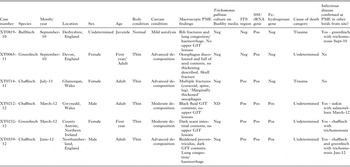
Details of the incident history and pathological examinations conducted for the six PCR-positive finches are presented in Table 2. These birds were found dead across the study period (2010, n = 2; 2011, n = 1; 2012, n = 3) from March to September inclusive. They comprised three females, two males and one finch of undetermined sex. Each age category was represented with three adults, one first year, one juvenile and one first year/adult identified by plumage inspection. The cause of death category assigned on the basis of available pathological findings was trauma for two finches and undetermined for the remaining four finches. Trichomonosis was confirmed at PME in other finches that were found dead and examined from three of these sites and salmonellosis was confirmed in a finch from a fourth site: no concurrent infectious disease was identified at the remaining two sites.
Case details and pathological findings for T. gallinae PCR-positive finches
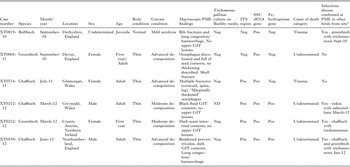
Neg, negative; Pos, positive; ND, not done.
Culture of T. gallinae was attempted at the time of PME for five of these six finches (their carcasses were examined fresh and not frozen) and was negative in all cases. No formalin-fixed tissue of the upper alimentary tract was available from the finches for histopathological examination.
DISCUSSION
In this study of wild birds without macroscopic lesions of necrotic ingluvitis, collected during epidemic finch trichomonosis in GB, we found evidence of T. gallinae parasite DNA only in finch species: greenfinch, chaffinch and bullfinch. Nested PCR of the SSU rRNA gene amplified product with sequence identity to T. gallinae from six finches, of which four were positive when tested with the ITS region PCR, and three were positive when tested with the Fe-hydrogenase gene PCR. It is not unexpected that not all three PCR tests were positive in these six finches, because the nested PCR (SSU rRNA gene) has a higher sensitivity than standard PCR (ITS region and Fe-hydrogenase) and the single-copy Fe-hydrogenase gene can be problematic to amplify from infected host tissue. The negative culture results do not preclude the presence of a true T. gallinae infection, since isolation relies on the presence of viable parasites and five of the six PCR-positive carcasses were in a moderate or advanced state of decomposition at the time of sample collection.
The presence of T. gallinae in a greater proportion of Fringillidae than non-Fringillidae passerine species examined is consistent with the hypothesis that finches are vectors of spread of T. gallinae to continental Europe (Lawson et al. Reference Lawson, Robinson, Neimanis, Handeland, Isomursu, Agren, Hamnes, Tyler, Chantrey, Hughes, Pennycott, Simpson, John, Peck, Toms, Bennett, Kirkwood and Cunningham2011b , Reference Lawson, Robinson, Colvile, Peck, Chantrey, Pennycott, Simpson, Toms and Cunningham2012). In the absence of histopathological examinations confirming the presence of parasites without lesions, however, these results could have arisen from alternative scenarios. Possible explanations for our results are that PCR positive finches: (1) were in the incubation stage of infection and died from an alternative cause before disease developed; (2) had trichomonosis but with only microscopic lesions of necrotic ingluvitis; (3) had resolved T. gallinae infection with no viable parasites present (i.e. no active infection); (4) had recently ingested parasite DNA in the absence of active infection; and (5) had carriage of viable T. gallinae parasites without any disease developing. Both (2) and (5) would be consistent with the birds being able to spread the parasite over migratory distances, and (1) could be consistent with this, depending on the length of the incubation period.
The cause of death based on macroscopic, parasitological and microbiological examinations was trauma for one chaffinch and one bullfinch and undetermined for the remaining four finches: consequently we cannot exclude the possibility that one or more of these four finches had trichomonosis, which would have been evident on microscopic examination. The bullfinch that died of trauma was in normal body condition; the other finches were thin, indicating that they might have been suffering from disease prior to death, particularly as one of the greenfinches had equivocal evidence of ‘oesophageal discolouration’ and one of the chaffinches had ‘marginal oesophageal thickening’.
Prolonged carriage of T. gallinae has been demonstrated over a 20-month period in the pink pigeon Columba mayeri (Bunbury et al. Reference Bunbury, Jones, Greenwood and Bell2008); whether this phenomenon occurs in British finches requires investigation. Our understanding of finch trichomonosis could be advanced through live capture and sampling of large numbers of wild finches for the collection of oropharyngeal swabs to be examined using parasite culture and T. gallinae-specific PCR (McBurney et al. Reference McBurney, Kelly-Clark, Forzán, Lawson, Tyler and Greenwood2015). In addition, challenge studies of captive greenfinches and chaffinches with the T. gallinae A1 finch epidemic strain would enhance our understanding of the pathogenesis and infection outcomes. Captive studies could include the repeated sampling of live, infected, individuals to determine the proportions of each species that develop overt disease and die or recover, successfully clear the infection and become only transient carriers or become aclinical carriers for a significant period of time. The ability of carriers to transmit infection could be assessed using similar protocols to those of Kietzman (Reference Kietzman1990), who experimentally demonstrated T. gallinae transmission through access to shared drinking water in ringed turtle doves (Streptopelia risoria).
We detected T. gallinae DNA in three British finch species without macroscopic lesions of necrotic ingluvitis. Further research is required to determine the significance of different finch species in the epidemiology and spread of this parasite.
ACKNOWLEDGEMENTS
The authors would like to thank the members of the public who reported wild bird mortality incidents; their colleagues from the Institute of Zoology: Gabriela Peniche, Louise Wong, Matthew Perkins and Dada Gottelli; and Rob Robinson from the British Trust for Ornithology, for their assistance.
FINANCIAL SUPPORT
This study was supported by the Zebra Foundation (E. Z. E.), the Cott Fund (E. Z. E.), the Universities Federation for Animal Welfare (A. A. C. & B. L.), the Royal Society for the Protection of Birds (A. A. C. & B. L.), Department for the Environment Food & Rural Affairs through the GB Wildlife Disease Surveillance Partnership and Animal Plant & Health Agency's Diseases of Wildlife Scheme (A. A. C. & B. L), CJ Wildbird Foods (A. A. C. & B. L.), Gardman Ltd. (A. A. C. & B. L.), Cranswick Pet Products (A. A. C. & B. L.), the Birdcare Standards Association (A. A. C. & B. L.) and the BVA Animal Welfare Foundation (A. A. C. & B. L.).