INTRODUCTION
For many years, host size has been considered an important determinant of parasite community structure in fish species (Guégan et al. Reference Guégan, Morand, Poulin, Thomas, Renaud and Guégan2005; Luque and Poulin, Reference Luque and Poulin2008) by affecting parasite diversity through its influence on the rates of parasite speciation and colonization by new parasites at evolutionary and ecological time scales, respectively. However, whereas the relevance of host size as an evolutionary force driving parasite assemblages is still controversial, with many recent papers providing evidence for (i.e. Luque and Poulin, Reference Luque and Poulin2007; Timi et al. Reference Timi, Luque and Poulin2010; Poulin and Leung, Reference Poulin and Leung2011) and against its importance (i.e. Luque and Poulin, Reference Luque and Poulin2008; Timi et al. Reference Timi, Rossin, Alarcos, Braicovich, Cantatore and Lanfranchi2011); there is a greater consensus of the effect of fish size at ecological time scales. In fact, ontogenetic changes in the composition of parasite communities in fish host species have been frequently reported (Dogiel et al. Reference Dogiel, Petrushevski and Polyanski1958; Vidal-Martinez et al. Reference Vidal-Martinez, Kennedy and Aguirre-Macedo1998; Poulin, Reference Poulin2000; Poulin and Valtonen, Reference Poulin and Valtonen2001; Timi and Poulin, Reference Timi and Poulin2003; Johnson et al. Reference Johnson, Nelson and Dick2004; Pérez-del-Olmo et al. Reference Pérez-del-Olmo, Fernández, Raga, Kostadinova and Poulin2008).
An increase in both parasite abundance and species richness in larger hosts is a common feature of fish–parasite systems (Poulin, Reference Poulin2000, Reference Poulin2004; Valtonen et al. Reference Valtonen, Marcogliese and Julkunen2010; Timi et al. Reference Timi, Rossin, Alarcos, Braicovich, Cantatore and Lanfranchi2011). However, these patterns are far from universal (Poulin, Reference Poulin2007; Luque and Poulin, Reference Luque and Poulin2008), probably because hosts inherit parasites from their ancestors, mostly independently of their body size (Poulin, Reference Poulin2007), and because other variables, related to size, may cloud any underlying association between host size and parasite diversity; among these variables, trophic level and longevity have been proposed (Luque and Poulin, Reference Luque and Poulin2008; Timi et al. Reference Timi, Rossin, Alarcos, Braicovich, Cantatore and Lanfranchi2011; Alarcos and Timi, Reference Alarcos and Timi2012).
In any case, and independently of the strength and shape of the relationship between fish size and parasite diversity, other size-related patterns of parasite diversity have been recently observed. Indeed, it has been reported that, within given host species, juvenile fish harbour more variable and stochastic parasite assemblages than older hosts (Timi et al. Reference Timi, Luque and Poulin2010), while a similar picture has been observed across species for fish with low trophic level compared to those with higher trophic level (Timi et al. Reference Timi, Rossin, Alarcos, Braicovich, Cantatore and Lanfranchi2011). In the first case, this pattern was attributed to the fact that fish begin their life free of parasites and small differences in exposure to different parasites can generate substantial differences between individual hosts. Over time, parasite communities become homogenized by repeated exposure (Timi et al. Reference Timi, Luque and Poulin2010). In the second case, it was suggested that fish with low trophic levels display more heterogeneous parasite assemblages because they harbour impoverished assemblages, drawn by stochastic events of encounter at low densities as a consequence of the dilute nature of parasite distributions in previous intermediate invertebrate hosts. The similarity in high-trophic level fish can be reinforced by the accumulation of higher numbers of infective stages acquired as packets of helminth species (Bush et al. Reference Bush, Heard and Overstreet1993) that travel together in paratenic hosts along food chains (Timi et al. Reference Timi, Rossin, Alarcos, Braicovich, Cantatore and Lanfranchi2011).
The proposed explanations for such patterns involve changes in both the identity and the amount of parasites in the assemblages along an ontogenetic or trophic gradient. However, an important issue remains unsolved: to discern how much of this variability is driven by differences in composition or abundance of assemblages. Here we address this issue by applying multivariate dispersions as a measure of β-diversity of parasite assemblages of the Argentine conger, Conger orbignianus Valenciennes, 1837, using a series of dissimilarity measures with different degrees of emphasis on presence/absence versus relative abundance information, which are analysed in relation to changes in fish size (Anderson et al. Reference Anderson, Ellingsen and McArdle2006). The original measure of β-diversity (Whittaker, Reference Whittaker1960) represents the proportion by which a given area is richer than the average of samples within it. Here we apply the concept of β-diversity proposed by Anderson et al. (Reference Anderson, Ellingsen and McArdle2006), which considers that β-diversity can be measured as the variability in species composition among sampling units for a given area at a given spatial scale; in other words, it can be measured as the average distance (or dissimilarity) from an individual unit to the group centroid, defined in the principal coordinate space of the dissimilarity measure chosen. The possibility of testing statistical differences of dispersion among size classes (Anderson, Reference Anderson2006), also allows us to study the rate at which similarity in assemblage dispersion tends to decay exponentially with increasing differences in host size. In other words, it allows us to study β-diversity as turnover (Anderson et al. Reference Anderson, Crist, Chase, Vellend, Inouye, Freestone, Sanders, Cornell, Comita, Davies, Harrison, Kraft, Stegen and Swenson2011), and to measure and compare the rates of such variations as a function of fish size along a gradient that emphasizes compositional versus abundance information.
MATERIALS AND METHODS
Fish samples and parasite inventories
A total of 50 congers, Conger orbignianus, were examined for parasites. Fish were caught by trawl in waters off Villa Gesell, Argentina (37°30´ S/56°39´ W) on 20 June 2010. Fish were either kept fresh or were deep frozen in plastic bags at −18 °C until examination. After thawing, congers were measured for total length (cm). Body surface, gills, branchial and body cavities, viscera (stomach, intestine, liver, gall bladder, spleen, heart, gonads and mesenteries), swim bladder, kidneys and musculature were examined with the aid of a stereoscopic microscope. Parasites were recovered, identified and their prevalence and mean abundance were calculated, as well as the total abundance and species richness of each infracommunity, following Bush et al. (Reference Bush, Lafferty, Lotz and Shostak1997).
Relationships between fish size and parasite population descriptors
The effect of fish size on parasite abundance was analysed for those species with prevalence >10%, as well as for species richness and total abundance by means of Spearman rank correlations. For the same set of parasite species, logistic regressions were used on presence/absence data to determine the effect of fish size on parasite prevalence (Zar, Reference Zar1999).
β-diversity as a measurement of compositional and abundance variability
Following the protocol of Anderson et al. (Reference Anderson, Ellingsen and McArdle2006), β-diversity was measured as the variability in species composition among sampling units (individual fish) for a given area (fish sample), and it was calculated as the average distance or dissimilarity from an individual unit to the group centroid, using different distance or dissimilarity measurements, with the centroid being defined in the principal coordinate space of the dissimilarity measure chosen. For delimiting samples, fish were ordered by size and arbitrarily divided into 10 consecutive size groups (n = 5 fish each).
To reveal how much of the dissimilarity is driven by compositional difference and how much is driven by differences in relative abundance, we applied a series of dissimilarity and distance measures. These were, in order of their relative emphasis on composition versus abundance information, the Jaccard index of compositional dissimilarity (presence/absence), the Bray-Curtis index, which includes relative abundance information, the modified Gower log 10 which explicitly weights an order-of-magnitude change in abundance the same as a change in species composition, the modified Gower log 2, which weights a compositional change equal to a doubling in abundance and the Euclidean distance on both log-transformed and raw data (Anderson, Reference Anderson2006; Anderson et al. Reference Anderson, Ellingsen and McArdle2006, Reference Anderson, Crist, Chase, Vellend, Inouye, Freestone, Sanders, Cornell, Comita, Davies, Harrison, Kraft, Stegen and Swenson2011).
The effect of fish size on β-diversity was analysed in 2 ways, with reference to the 2 types of β-diversity as defined by Anderson et al. (Reference Anderson, Crist, Chase, Vellend, Inouye, Freestone, Sanders, Cornell, Comita, Davies, Harrison, Kraft, Stegen and Swenson2011): non-directional variation and directional turnover along a fish size gradient. For non-directional variation, averaged distances to centroids were calculated for each sample (age class) with the different dissimilarity measurements and their values regressed against the averaged fish size in each sample. Since average distances to centroids of different indices were at very different orders of magnitude, to standardize these variables we converted them to relative distances by expressing each value as a percentage of the maximum value for a given index. In this way, the y-axis on all plots had the same scale, which allowed visual comparisons of regression slopes between indices. The analyses were repeated after grouping congers in 5 size classes (10 fish each) and 7 size classes (7 fish each, smallest conger excluded), in order to reassure that results are not an artifact of the arbitrary groupings. This also increased the number of fish per size class in the analyses, but decreased the number of values for regressions. Linear regressions of Euclidean distances on raw data were repeated after log-transformations of average distances to centroids (Log (x + 1)-transformation for Modified Gower, base 2), to linearize data and because residuals were observed to increase with fish size for some indices in preliminary analyses.
For analysing the effect of host size on β-diversity as turnover, differences in β-diversity among size classes were compared through a multivariate test for homogeneity in multivariate dispersions, with P-values being obtained by permutation of residuals (Anderson, Reference Anderson2006). The variations of β-diversity as a function of host size was assessed by plotting log-transformed differences in β-diversity values against differences in mean fish size between all possible pairs of samples; this procedure was repeated after replacing differences in β-diversity by their P-values. Linear regressions were fitted to each plot, and their slope was used as a measure of the rate of decay in similarity as a function of difference in host size. Since differences of distances to centroids of different indices were at very different orders of magnitude, these variables were also converted to relative distances as in the case of previous analyses. Since data are not truly independent in a statistical sense (each sample was used in more than one pair-wise comparison), and to account for any deviation from normality in data distributions, the significance of all regressions was determined by permutation procedures. All P-values are based on 10 000 data permutations.
All analyses were implemented in PERMANOVA + for PRIMER package (Anderson et al. Reference Anderson, Gorley and Clarke2008), multivariate dispersions and the significance of their comparisons were applied using the routine PERMDISP, whereas the routine distLM was used for all regression analyses.
RESULTS
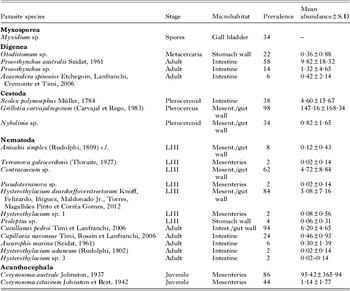
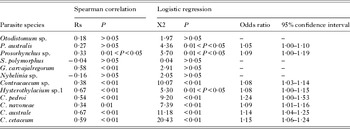
In total 13 909 helminth individuals were recovered from the whole sample. All congers were found parasitized by at least 2 of 21 parasite species. Spores of Myxidium sp. were also found in gall bladders at relatively high prevalence (Table 1) but, because only their presence was recorded, myxosporeans were not included in analyses. Twelve helminth species showed prevalences higher than 10%, including 5 intestinal (4 at adult and 1 at larval stage) and 7 non-intestinal larval parasites. The maximum values of prevalence were for Grillotia carvajalregorum, Cucullanus bonaerensis, Corynosoma australe and Hysterothylacium deardorffoverstreetorum, with G. carvajalregorum and C. australe also displaying notably high values of abundance. Eight species showed a significant increase of abundance in larger fish (Table 2). The same species also displayed a higher prevalence in larger fish, except for G. carvajalregorum, which was present in 49 out of the 50 congers, and P. australis, which show no variations in abundance with fish size (Table 2). A strong positive relationship was observed between fish length and both species richness and total abundance (Rs = 0·54 and 0·59, respectively; both P < 0·01).
Taxonomic composition, microhabitat, and population descriptors of parasites of Conger orbignianus in the Argentine Sea

Relationships of the length of Conger orbignianus with the mean abundance (Spearmann correlations) and prevalence (logistic regressions) of parasites with prevalence >10% (more than 5 host parasitized)

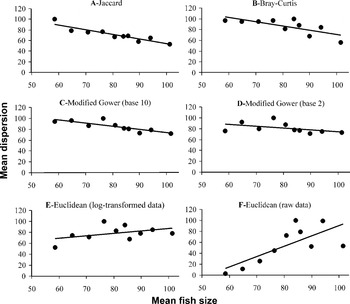
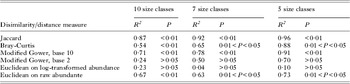
Analyses of β-diversity as non-directional variability in fish divided in 10 size classes showed that average distance to centroids behaved differentially in relation to fish size depending on the dissimilarity/distance measure used (Fig. 1). Measures emphasizing compositional differences (Jaccard), decreased significantly with increasing fish size (R 2: 0·84, P < 0·01); the same pattern was observed after slightly increasing the emphasis on parasite abundance with Bray-Curtis (R 2: 0·55, P = 0·01) and modified Gower, base 10 (R 2: 0·70, P < 0·01) (Fig. 1A–C). In contrast, analyses emphasizing differences in relative abundances (Euclidean on raw data) indicated the opposite trend: significantly greater variation among large fish compared with smaller ones (R 2: 0·54, P = 0·02) (Fig. 1F). In fact, distances to centroids based on Euclidean distances on raw data showed no relationship with fish size (R 2 = 0·07, P > 0·05), but this was due to the presence of 2 congers harbouring an unusually high number of C. australe (1128 and 2364, respectively) and belonging to 2 different size classes; the removal of these outliers yielded the relationship shown in Fig. 1F. Therefore, variation in species composition was greater in smaller congers, while variation in relative abundances was greater in larger fish. The analysis based on modified Gower base 2 (Fig. 1D) showed a tendency to decrease with fish size, while in contrast the analysis based on the Euclidean distances on log transformed abundances (Fig. 1E) showed the opposite pattern. Regression analyses, however, did not detect statistically significant relationships for these indices (R 2: 0·22 and 0·19, respectively; both P > 0·05). The slopes of all regressions clearly show this gradual change in the relative importance of composition and abundance in parasite communities as fish grow (Fig. 1). The same patterns were observed after Log-transformation of data, but with slightly increased values of R2 (except for Bray-Curtis index) and of the significance of regressions (Table 3). All dissimilarity/distance measures displayed the same relationships with fish length after grouping fish into 7 or 5 size classes (Table 3), showing that the effect of fish size on compositional and abundance variability was independent of the arbitrary grouping procedures used.
Relationship between β-diversity as non-directional variation of parasite infracommunities, measured as average distance to centroid, and mean size of Conger orbignianus classified in 10 size classes, using each of several dissimilarity measures as indicated. Distances to centroids are shown as a percentage of the maximum value for that dissimilarity index.

Regression parameters between fish length and log-transformed distances to centroids of infracommunities of Conger orbignianus distributed into size classes with different size ranges and based on dissimilarity/distance measurements with different emphasis on composition versus abundance information

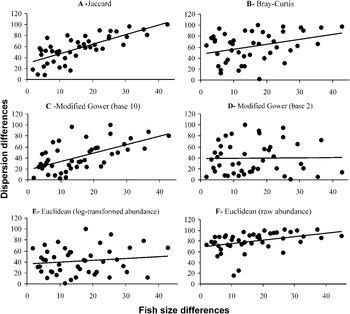
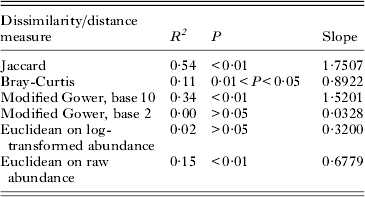
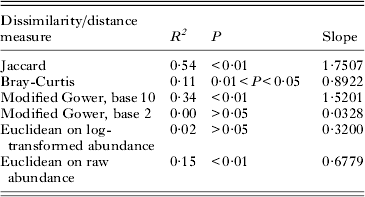
Analyses of β-diversity as turnover showed an increase in the differences of distance to centroids of parasite communities as a function of increasing length differences between 10 size classes for the same dissimilarity/distance indices that showed significant changes of non-directional variability (Table 4, Fig. 2). The slopes of regression lines showed that the similarity decay for the Jaccard index (Fig. 2A) was about twice as steep as that for Euclidean distance on raw data (2 outliers removed) (Fig. 2F), indicating a stronger change in the variability of community composition than of abundance as fish grow. Exactly the same pattern was observed when differences in distance to centroids were replaced by the P value of multivariate test for homogeneity in multivariate dispersions (data not shown). As the same patterns were observed after grouping fish into 7 or 5 size classes for analyses of β-diversity as non-directional variability, no analyses of β-diversity as turnover were carried out for these two groupings.
β-diversity as directional turnover of parasite infracommunities of Conger orbignianus using each of several dissimilarity measures, as indicated. β-diversity measured as log-transformed differences between average distance to centroids, as a function of increasing size differences in body length between two host size classes, calculated across all possible pairs of size classes. Differences between distances to centroids are shown as a percentage of the maximum value for that dissimilarity index.

Regression parameters between differences in fish length and differences in distance to centroids of infracommunities of host size classes based on dissimilarity/distance measurements with different emphasis on composition versus abundance information
DISCUSSION
The present study extends the list of species parasitizing C. orbignianus in the Argentine Sea. Tanzola and Guagliardo (Reference Tanzola and Guagliardo2000) reported 10 helminth species in this host from Bahia Blanca, southern Buenos Aires Province. Later, other species were added to the list by taxonomic studies carried out in waters off Mar del Plata (Etchegoin et al. Reference Etchegoin, Lanfranchi, Cremonte and Timi2006; Timi and Lanfranchi, Reference Timi and Lanfranchi2006; Timi et al. Reference Timi, Rossin and Lanfranchi2006). In the present paper 13 new host records are reported, including Myxidium sp., Otodistomum sp., Prosorhynchus sp., Nybelinia sp., A. simplex, Pseudoterranova sp., H. deardorffoverstreetorum, Hysterothylacium sp. 2, Hysterothylacium sp. 3, H. aduncum, Proleptus sp., A. marina and C. cetaceum.
The Argentine conger is a semelparous species. They reach sexual maturity after living for a period in coastal waters, cease feeding, decalcify, lose their teeth and migrate to deep waters to spawn in a still unknown region (Figueroa et al. Reference Figueroa, Macchi and Haimovici2010). Despite the fact that all congers living in shallow waters can be considered as juveniles, the species richness they reach is one of the highest recorded for fishes in the region, and it is comparable to those of other piscivorous fish with opportunistic habits, such as Merluccius hubbsi, Cynoscion guatucupa, Percophis brasiliensis and Paralichthys patagonicus (Sardella and Timi, Reference Sardella and Timi2004; Timi et al. Reference Timi, Luque and Sardella2005; Braicovich and Timi, Reference Braicovich and Timi2008; Timi et al. Reference Timi, Rossin, Alarcos, Braicovich, Cantatore and Lanfranchi2011; Alarcos and Timi, Reference Alarcos and Timi2012).
The high species richness harboured by C. orbignianus, as well as the high abundance of several parasites, make this host-parasite system a suitable one for analysing the effect of fish size on community structure in terms of both composition and abundance. As expected, a strong increase of both variables was observed with increasing fish length. This kind of relationship is frequently observed in fish–parasite systems, due to larger bodied hosts being able to harbour more parasite species and to sustain a greater number of individuals than small ones; they also provide larger surface areas and more diverse niches for parasite attachment and ingest larger quantities of food with a higher exposure to infective stages (Guégan et al. Reference Guégan, Lambert, Lévêque, Combes and Euzet1992; Poulin, Reference Poulin2000, Reference Poulin2004, Reference Poulin2007; Valtonen et al. Reference Valtonen, Marcogliese and Julkunen2010). Large fish can also feed on larger prey, broadening the range of potential parasites (Timi et al. Reference Timi, Rossin, Alarcos, Braicovich, Cantatore and Lanfranchi2011). Fish of different sizes, but exposed to the same pool of infective stages, acquire therefore qualitatively or quantitatively different parasite assemblages depending on the amount and type of prey they eat. In fact, larger congers tend to be more piscivorous than smaller ones, although carcinophagy is maintained throughout their life-span (Cousseau and Perrotta, Reference Cousseau and Perrotta2004). Increasing differences in intraspecific characteristics as fish grow leads them, consequently, to be exposed to increasingly different subsets of infective stages of parasites available in the environment. These differences represent mainly changes in the relative proportions of larval stages acquired as a consequence of changes in the ratio of invertebrates/fish eaten, rather than a replacement of species by shifts in dietary items. On the other hand, the dominance in the assemblages of long-lived parasites, which persist for long periods in the host, indicates that not only fish size, but also age, contribute to the increasing abundance as fish grow.
The observed variability of β-diversity along the ontogenetic gradient, in the shape of average dissimilarities from infracommunities to their size class centroid in the multivariate space, clearly showed that its significance depended on the dissimilarity measure used. It was evident that smaller fish displayed high variation in species composition, while relative abundances of species were more variable in larger hosts. The lower compositional similarity among smaller fish can be a consequence of stochastic events of acquisition of infective stages, which occur in previous intermediate invertebrate hosts at low densities (Marcogliese, Reference Marcogliese1995, Reference Marcogliese2002). Over time, repeated exposure can lead to more homogeneous assemblages in terms of composition (Timi et al. Reference Timi, Luque and Poulin2010), with abundance arising consequently as the main source of variability in larger fish.
As suggested for changes observed in β-diversity of invertebrates associated with kelp holdfasts of different size, increased heterogeneity of abundance in larger ‘habitats’ can also be merely a consequence of Taylor's power law (variance increasing with the mean) (Anderson et al. Reference Anderson, Ellingsen and McArdle2006), due to the cumulative effect of long-lived parasites in our host-parasite system. Intrinsic mean–variance relationships in abundances for measuring multivariate dispersion based on different dissimilarity measures and its consequences are still unclear and require further research (Anderson et al. Reference Anderson, Ellingsen and McArdle2006). However, biological causes such as differential availability of prey items at microgeographical spatial scales, individual dietary preferences or selectivity, and aggregated distribution of trophically-transmitted parasites in previous hosts, could lead to increasingly variable immigration rates, resulting in the observed patterns. On the other hand, higher variations in extinction rates (parasite death) in larger fish are less probable, because of the dominance of species persisting for long periods, even throughout the entire host life-span.
For each dissimilarity/distance measure, β-diversity showed a similar behaviour in relation to host size irrespective of the number of fish in each size class, as well as of the number of size classes. Therefore, these observed patterns reflect real biological processes and are not artifacts due to the arbitrary grouping of fish in size classes, nor to the number of congers in each size class. This was confirmed by performing similar analyses on a sample of anchovies, Engraulis anchoita from the same region, divided into 16 size classes of 30 fish each (unpublished data). This larger dataset showed patterns of variation of multivariate dispersions, in terms of both composition and abundance, along an ontogenetic gradient similar to those of congers. However, further studies should be based on larger numbers of size classes and including a broader spectrum of fish age or developmental stages (juvenile to adults) in order to determine the specific shape of this kind of relationship along host ontogeny.
Our analyses not only allowed the discernment between the effect of both composition and abundance on the heterogeneity of parasite assemblages along a host ontogenetic range, but also showed that both variables act at different rates. Indeed, the significant exponential decay in the compositional variability as a function of increasing length differences between size classes was about twice as steep as the decay in abundance variability. In other words, compositional homogeneity is reached faster than abundance heterogeneity as fish grow. This may indicate that a threshold in species richness exists for a given component community, which obviously depends on the pool of potentially infective stages available in the environment. On the other hand, changes in abundance, especially in the proportion of different parasite species (relative abundance), produce a gradual, but continuous increase of heterogeneity as fish grow.
This is, to the best of our knowledge, the first attempt to disentangle quantitatively the relative role of compositional versus abundance variability on heterogeneity of parasite assemblages during fish ontogeny. We acknowledge that analyses were carried out along a restricted portion of the length range of C. orbignianus, which in turn do not display marked changes in diet composition at these sizes. Further studies including broader size ranges, as well as host species with different feeding habits, could shed some light on the generality of these patterns, and could lead to the proposal and testing of new hypotheses linking size/age variability in host populations with the development of their parasite communities.
ACKNOWLEDGEMENTS
The authors thank Dr K. MacKenzie (School of Biological Sciences, University of Aberdeen, Aberdeen, Scotland, UK) and two anonymous reviewers for their valuable suggestions on the manuscript. This work received financial support from CONICET (PIP #112-200801-00024), ANPCYT (PICT #02199) and UNMdP (EXA 621/12).