The sulphate ion (SO42-) is one of major species in freshwater as well as seawater, originating from various natural and anthropogenic processes (Krouse & Mayer Reference Krouse, Mayer, Cook and Herczeg2000). Compared to the Northern Hemisphere, where human activities affect the sulphate concentration and isotopic signatures, the contribution of anthropogenic sulphate is likely to be negligible in freshwater and ice cores in the Antarctic region (Patris et al. Reference Patris, Delmas, Legrand, De Angelis, Ferron, Stiévenard and Jouzel2002). This means that the sulphur and oxygen isotope compositions of the dissolved sulphate could hint at information on the sources, formation and deposition due to various natural processes and sulphur cycling in the Antarctic region, especially for the dissolved sulphate in surface waters such as ponds and creeks (Patris et al. Reference Patris, Delmas and Jouzel2000, Kim et al. Reference Kim, Lee, Seo, Lee and Farquhar2017). Here we report the ion concentration and sulphur and oxygen isotope compositions of the dissolved sulphate in freshwater from King George Island in the Antarctic Peninsula, which provide implications regarding the sources of the dissolved sulphate and the sulphur cycling in the Antarctic region.
The freshwater samples were collected from creeks and small ponds at King George Island for sulphur and oxygen isotope analysis through dissolved sulphate and ion analysis (Table SI). More than 50 l of freshwater were sampled from each site and moved to King Sejong Station for pre-concentration of the dissolved sulphate from the freshwater samples using anion-exchange resin (Amberlite IRA 400) columns. The dissolved sulphate was precipitated from the pre-treated water samples into BaSO4, and the sulphur and oxygen isotopes were measured using a mass spectrometer (Finnigan MAT Delta Plus XL) in continuous-flow (CF) mode at the Isotope Science Laboratory (ISL) of the University of Calgary (see Supplemental Material for details of the sampling and analytical methods).
The sulphur and oxygen isotope values of the dissolved sulphate (δ34Ssulphate and δ18Osulphate) in freshwater at Barton Peninsula range from 2.6‰ to 16.3‰ with a median value of 14.3‰ and from -1.1‰ to 6.4‰ with a median value of 5.0‰, respectively (Table SII). The major ion concentrations and isotopic compositions are given in the Supplemental Materials (Table SII).
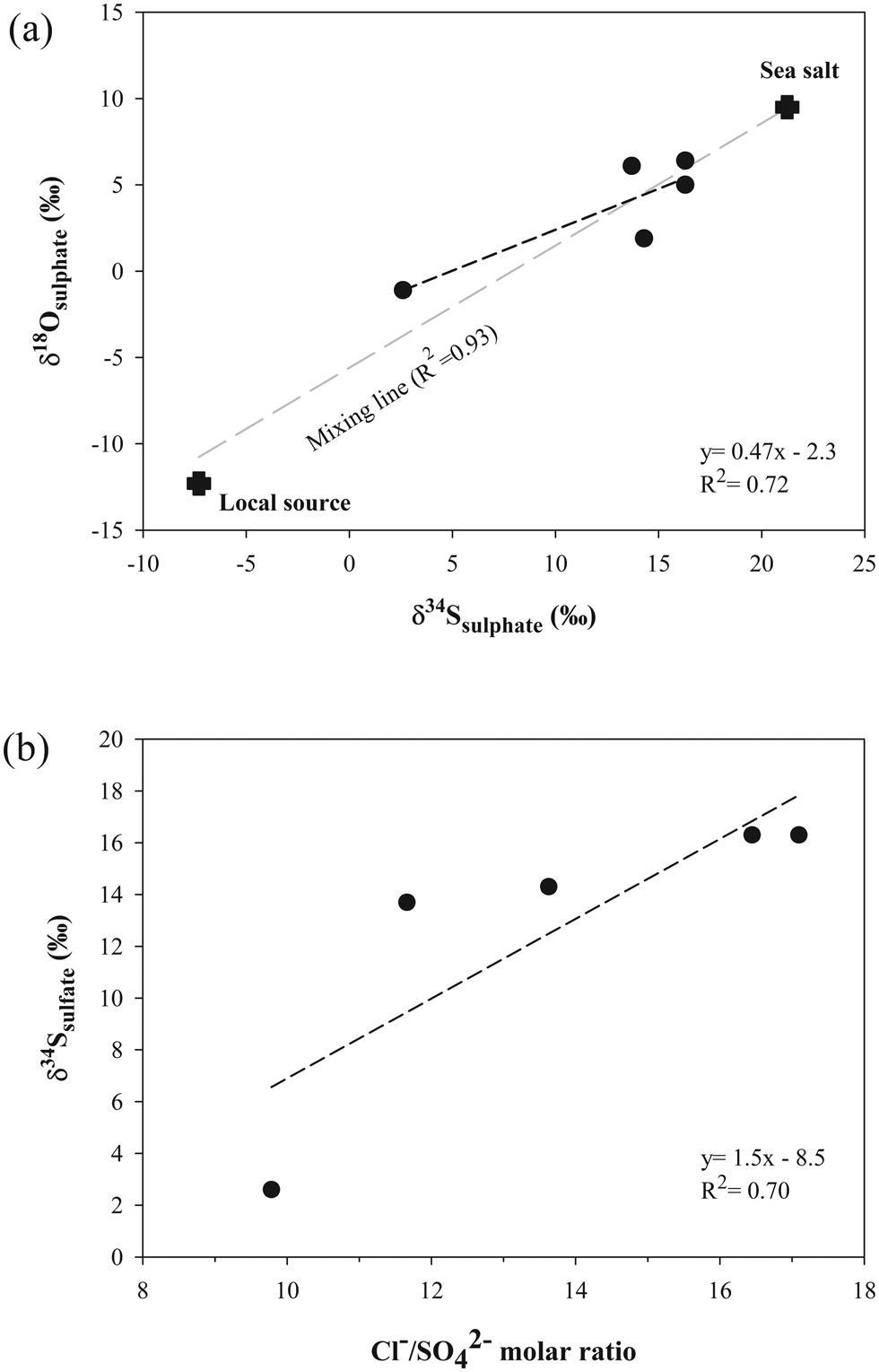
The δ34Ssulphate and the δ18Osulphate values plotted in Fig. 1a show a linear trend with a relatively high correlation coefficient (R 2 = 0.72), indicating mixing between the two end members. Among various sources, a strong candidate for the first end member with high δ34S and δ18O values is likely to be sulphate from seawater. The reported δ34S and δ18O values of the dissolved sulphate in seawater are 21.24‰ (Tostevin et al. Reference Tostevin, Turchyn, Farquhar, Johnston, Eldridge, Bishop and McIlvin2014) and 9.5‰ (Longinelli & Craig Reference Longinelli and Craig1967), respectively. The absence of evaporates in King George Island (Fig. S1) enables us to exclude their influence on the sulphur budget in freshwater.
Plots of a. the δ34Ssulphate vs the δ18Osulphate values of freshwater samples with a linear regression line and b. the δ34Ssulphate values vs the Cl-/SO42- molar ratio of freshwater samples with a linear regression line. The plus symbols denote the sea salt spray, local volcanic rocks and sulphide minerals in the ambient water. See the text for details.

The atmospherically derived sulphate and dimethyl sulphide (DMS) with its oxidation products could act as one of the main sulphate sources in the Antarctic region (e.g. Patris et al. Reference Patris, Delmas and Jouzel2000). The atmospheric sulphates derived from terrigenous and anthropogenic sources have lower δ34S ranges than DMS (Krouse & Mayer Reference Krouse, Mayer, Cook and Herczeg2000, Patris et al. Reference Patris, Delmas and Jouzel2000). The nitrate concentrations, which have been used as an indicator for contaminants from anthropogenic activities, are extremely low in this study, indicating a negligible contribution of sulphate from anthropogenic sources (e.g. Patris et al. Reference Patris, Delmas and Jouzel2000, Kim et al. Reference Kim, Lee, Seo, Lee and Farquhar2017). Therefore, DMS and its oxidation products have greater potential to act as end members with both high δ34Ssulphate and high δ18Osulphate values (Kim et al. Reference Kim, Lee, Seo, Lee and Farquhar2017).
Considering that the δ18Osulphate values derived from atmospheric oxidation are controlled by the δ18O values of the principal oxidants, the relatively low δ18Osulphate values of this study might be indicative of the involvement of OH radicals as major atmospheric oxidants. The δ18O value of OH radicals is lower due to them being in equilibrium with local water, whereas other major oxidants have extremely high δ18O values of up to +125‰ (Savarino & Thiemens Reference Savarino and Thiemens1999). However, the contribution of OH radicals to the atmospheric oxidation of sulphur species was suggested to be < 40% at the global scale and even lower at 11% in the Antarctic region (Sofen et al. Reference Sofen, Alexander and Kunasek2011). This suggests that sea salt and DMS spray are more likely to contribute to sulphate sources with high δ34Ssulphate and δ18Osulphate values than atmospherically derived sulphate, although their specific contributions remain uncertain.
Another end member of the dissolved sulphate in King George Island water is likely to have both low δ34Ssulphate and low δ18Osulphate values (Fig. 1a), indicating local sulphide oxidation as the most likely candidate. The δ34S values of local volcanic rocks and sulphide minerals in King George Island range from -12.5‰ to -7.0‰ and from -9.6‰ to -1.8‰, respectively (Hwang et al. Reference Hwang, Zheng, Ripley, Lee and Shin2011). When abiotic and biological sulphide oxidation occurs in surface environments, small sulphur isotope fractionation of < 2‰ enables them to retain their original sulphur isotope signatures (Balci et al. Reference Balci, Shanks, Mayer and Mandernack2007). This means that the dissolved sulphate derived from sulphide oxidation processes in the surface water retains the δ34S value of the original sulphur. During sulphide oxidation into the dissolved sulphate in surface environments, the oxygen atoms of water molecules are involved in the oxidation processes, leading to the impact of δ18Owater values on δ18Osulphate values (Balci et al. Reference Balci, Shanks, Mayer and Mandernack2007).
Two end members (sea salt spray and oxidation of local rocks) were plotted together with the King George Island water samples in Fig. 1a. The δ34S and δ18O values of lower end members are set as -7.3‰ and -12.3‰, where each value is averaged from local rocks in King George Island (Hwang et al. Reference Hwang, Zheng, Ripley, Lee and Shin2011) and ambient freshwater in Deception Island (Kusakabe et al. Reference Kusakabe, Nagao, Ohba, Seo, Park, Lee and Park2009). The samples plotted with two end members show a more linear relationship (R 2 = 0.93) compared to the samples plotted without two end members (R 2 = 0.72), indicating a mixing trend between sea salt spray and the oxidation of local rocks with ambient water (Fig. 1a).
The plot of the δ34Ssulphate and Cl-/SO42- molar ratio is shown in Fig. 1b, and a linear trend (R 2 = 0.70) is observed with a y-intercept value of -8.5. Several studies suggest that the y-intercept in the plot of the δ34Ssulphate vs Cl-/SO42- molar ratio or 1/[SO42-] might represent the lower end members of the dissolved sulphate in ice cores and freshwater in the Antarctic region with a high correlation (Patris et al. Reference Patris, Delmas and Jouzel2000, Kim et al. Reference Kim, Lee, Seo, Lee and Farquhar2017). The estimated y-intercept in this study is low and similar to the average δ34S value of local volcanic rocks and sulphide minerals (-7.3‰), which are considered to be lower end members according to the δ34Ssulphate and the δ18Osulphate values in Fig. 1a. This consistency therefore supports the idea that the oxidation of local rocks acts as a lower end member in the King George Island water.
Supplemental material
A supplemental figure will be found at https://doi.org/10.1017/S0954102021000286.
Acknowledgements
The authors acknowledge the staff and researchers at the Korea Polar Research Institute (KOPRI) and King Sejong Station for supporting the sampling and research activities in the study area. The authors appreciate the editor and two anonymous reviewers for many constructive suggestions on how to improve the manuscript.
Financial support
This work was supported by a Korea Basic Science Institute (KBSI) grant (C050200) and the project ‘PE21050’ from KOPRI.
Author contributions
YK and HK wrote the manuscript and constructed the figures. IL and JIL performed the fieldwork. IL and GK processed the samples and BM analysed the S and O isotope compositions. All authors discussed the results and reviewed the manuscript.