Statement of research significance
Research Question: We aimed to replicate previous studies examining predictors of functioning in a sample of Black older adults. Additionally, we examined the possible independent contributions of social factors to functioning as well as potential moderation of cognitive impacts on functioning.
Main Findings: We found that late life social activity reduced the effect of global cognition on everyday functioning and that activity and social network size were independently associated with everyday functioning.
Study Contributions: Our findings extend the research literature by replicating results in an underrepresented population. We also provide novel information on the ways in which social activity functions to preserve everyday functioning. Clinically, interventions aimed at increasing social engagement may provide a useful tool to maintaining independence in daily living.
Changes in technology, food distribution, and medical advances have significantly increased global life expectancies; with the longer life expectancies come increased care needs for those living with chronic conditions and impairment in everyday functioning (Kinsella et al., Reference Kinsella and Velkoff2001). Better everyday functioning is associated with self-reported success in aging in various social, physical, and emotional domains (Montross et al., Reference Montross, Depp, Daly, Reichstadt, Golshan, Moore, Sitzer and Jeste2006). Predictors of everyday functioning in aging include cognition and social determinants of health (SDH) although much of the neuropsychology and aging research in the United States has occurred in predominately White samples (Pugh et al., Reference Pugh, Robinson, De Vito, Bernstein and Calamia2022). For example, nearly 40% of articles focused on neuropsychological research did not report ethnic or racial information and in those that did, Black participants represented 10% of participants (Pugh et al., Reference Pugh, Robinson, De Vito, Bernstein and Calamia2022). The lack of inclusion of demographic information and/or Black participants has implications for the generalization of research findings. For example, some predictors of everyday functioning identified in predominantly White samples have been found to not be associated (e.g., Boyington et al., Reference Boyington, Howard and Holmes2008) or much less strongly associated (e.g., Graves et al., Reference Graves, Edmonds, Thomas, Weigand, Cooper, Stickel, Zlatar, Clark and Bondi2022) with everyday functioning in samples of older Black adults. Older Black adults are at increased risk for dementia (Steenland et al., Reference Steenland, Goldstein, Levey and Wharton2016) which underscores the need for more research on predictors of everyday functioning in this population.
General cognitive functioning, as measured by brief cognitive measures (e.g., Montreal Cognitive Assessment or Mini Mental Status Exam), and specific domains of functioning (e.g., executive functioning, memory) have both been found to be significant predictors of instrumental activities of daily living (IADLs) (Bell-McGinty et al., Reference Bell-McGinty, Podell, Franzen, Baird and Williams2002; Gross et al., Reference Gross, Rebok, Unverzagt, Willis and Brandt2011; Johnson et al., Reference Johnson, Lui and Yaffe2007; Nguyen et al., Reference Nguyen, Copeland, Lowe, Heyanka and Linck2020; Raimo et al., Reference Raimo, Maggi, Ilardi, Cavallo, Torchia, Pilgrom, Cropano, Roldán-Tapia and Santangelo2024). Of note, in a large study of the National Alzheimer’s Coordinating Center cohort, the association between everyday functioning and cognition was less robust in a sample of non-Hispanic older Black adults compared to a sample of older non-Hispanic White adults (Graves et al., Reference Graves, Edmonds, Thomas, Weigand, Cooper, Stickel, Zlatar, Clark and Bondi2022).
SDH are the features and pathways in which societal conditions can affect one’s health and everyday functioning (Krieger, Reference Krieger2001). The U.S. Department of Health and Human Services (2022) categorizes social determinants of health into five domains; economic stability, education access and quality, healthcare access and quality, neighborhood environment, and social and community. The impact of SDH cannot be understated. A meta-analysis conducted by Galea and colleagues (Reference Galea, Tracy, Hoggatt, DiMaggio and Karpati2011) found that low education, racial segregation, and low social support caused a comparable amount of deaths to acute myocardial infarction, cerebrovascular disease, and lung cancer in 2000. Social determinants of health are complex, cumulative, and can manifest later in life as chronic disease and illness (Braveman & Gottlieb, Reference Braveman and Gottlieb2014).
One way to understand the ways in which social determinants of health function to influence disease outcomes is through the fundamental cause theory (FCT). The FCT posits that social factors (e.g., socioeconomic status, social relationships, etc.) can mitigate, exacerbate, or otherwise influence disease mortality (Phelan & Link, Reference Phelan, Link and Cockerham2013). There are four primary features to a fundamental social cause; it influences multiple disease outcomes, it affects outcomes through multiple risk factors, it is involved with access to ‘flexible resources’ that can mitigate disease outcomes, and the association between the social cause and health outcomes reproduces itself over time (Phelan et al., Reference Phelan, Link and Tehranifar2010). Additional factors that can be understood through the FCT and contribute to daily functioning include certain domains of cognition, age, social engagement, gender, physical fitness, and mental health (Arcoverde et al., Reference Arcoverde, Deslandes, Rangel, Rangel, Pavão, Nigri, Engelhardt and Laks2008; Divers et al., Reference Divers, Robinson, Miller, De Vito, Pugh and Calamia2021; Farias et al., Reference Farias, Chou, Harvey, Mungas, Reed, DeCarli, Park and Beckett2013; Manini & Pahor, Reference Manini and Pahor2009; Millán-Calenti et al., Reference Millán-Calenti, Tubío, Pita-Fernández, González-Abraldes, Lorenzo, Fernández-Arruty and Maseda2010; Nguyen et al., Reference Nguyen, Copeland, Lowe, Heyanka and Linck2020; den Ouden et al., Reference den Ouden, Schuurmans, Mueller-Schotte, Brand and van der Schouw2013). As older adults may encounter functional impairment, their ability to receive health information, medical care, and learn of compensation strategies to lessen impairment may rely upon their social and economic resources (Baltes & Lang, Reference Baltes and Lang1997; Koster et al., Reference Koster, Bosma, Broese van Groenou, Kempen, Penninx, van Eijk and Deeg2006).
Engagement with others through social relationships and activities keep older adults engaged and active throughout life and has shown to prevent physical frailty that can diminish independence in daily activities (Manini & Pahor, Reference Manini and Pahor2009; Makizako et al., Reference Makizako, Shimada, Doi, Tsutsumimoto, Hotta, Nakakubo, Makino and Lee2018). Strong, significant relationships between IADL functioning, wellness, and social engagement demonstrate the importance of social factors on not only the preservation of everyday functioning but additionally overall perceived wellbeing (Zainab & Naz, Reference Zainab and Naz2017). In a sample of older Black adults, providing social support was positively associated with cognitive abilities, perhaps due to social support’s negative relationship with distress (Ayotte et al., Reference Ayotte, Allaire and Whitfield2013). Although associations between social engagement and functioning have been shown, less is known about the mechanisms that may help to maintain functioning.
Better understanding the ways in which social factors contribute to everyday functioning may help to address the long-standing disparate access, treatment, and outcomes Black Americans have had and continue to experience (Riley, Reference Riley2012). Black Americans have higher cardiovascular risk (e.g., hypertension) when compared to their non-Hispanic, White counterparts, often attributed differences in social determinants of health (He et al., Reference He, Zhu, Bundy, Dorans, Chen and Hamm2021). Outcomes of this disparity are clear; Black Americans have higher prevalence rates of vascular dementia, have at least a 15% higher prevalence rate of dementia when compared to their White counterparts, and Black women are more likely to experience functional impairment from obesity (Houston et al., Reference Houston, Stevens, Cai and Morey2005; Miles et al., Reference Miles, Froehlich, Bogardus and Inouye2001). Older Black women are also more likely to experience depression which independently has a negative effect on functioning (Ormel et al., Reference Ormel, Rijsdijk, Sullivan, van Sonderen and Kempen2002; Spence et al., Reference Spence, Adkins and Dupre2011). Given these disparities and lack of evidence for the generalizability of previous findings in primarily White samples to older Black adults, there is a critical need for further research focused on older Black adults. The current study adopts a within-group design for that purpose. Traditionally, White samples have been viewed as the standard to which other groups are compared leading to dangerous conclusions (i.e., “Black participants underperform on tests because of lack of ability”) without considering cultural and historical aspects that are key to contextualizing results (Whitfield et al., Reference Whitfield, Allaire, Belue and Edwards2008). Comparison studies are often unbalanced in sample size and the statistical analyses most commonly used in group comparisons assume that within-group variance is the same in each group; an assumption needed for the analysis but not necessarily true given discrepancies in sample sizes (Whitfield et al., Reference Whitfield, Allaire, Belue and Edwards2008).
There are two aims of the current study. The first is to replicate previous studies examining predictors of functioning by using cognition, age, sex, education level, number of medical conditions, and number of depressive symptoms in an older Black adult sample. Based on previous research conducted, it is hypothesized that higher age, more medical conditions, lower education, being a female, and lower cognitive scores will be related to decreased functioning across IADLs (CDC, 2009; Gill et al., Reference Gill, Richardson and Tinetti1995; Gross et al., Reference Gross, Rebok, Unverzagt, Willis and Brandt2011; Koster et al., Reference Koster, Bosma, Broese van Groenou, Kempen, Penninx, van Eijk and Deeg2006; Smith & Baltes, Reference Smith and Baltes1998). The second aim is to examine if social factors independently predict functioning and if they moderate the relationship between cognition and functioning. It is hypothesized that social factors will moderate the relationship between cognition and functioning. Driven by the FCT, social factors will be viewed as ‘flexible resources’ in that they are factors that may influence the ability to learn and access health information and care (Phelan et al., Reference Phelan, Link and Tehranifar2010). It is predicted that higher levels of social engagement and a larger social network will be compensatory factors that reduce the association of worse cognition with worse IADL functioning as contact with others is hypothesized to increase support in everyday functioning through receiving help with needs (e.g., help paying bills, transportation, house cleaning, etc.).
Methods
Participants
Nine hundred thirty adults were included. The sample was majority female (77.6%) and was educated beyond 12 years of formal education (69%) (M = 14.7, SD = 3.46). Participants were older Black adults aged 55-97 years old (M = 73.7, SD = 6.63). Participants were primarily married (30.8%), widowed (36.0%), or divorced (25.0%). Most participants had no cognitive impairment (73.3%) or mild cognitive impairment (24.2%) with few (2.5%) having a diagnosis of dementia. Sample characteristics can be found in Table 1.
Sample characteristics

Baseline visit data from participants were obtained from three longitudinal aging studies conducted by Rush University through their Alzheimer’s Disease Research Center: The Memory and Aging Project (MAP), African American Clinical Core (AA Core), and the Minority Adult Research Study (MARS) (Barnes et al., Reference Barnes, Shah, Aggarwal, Bennett and Schneider2012; Bennett et al., Reference Bennett, Buchman, Boyle, Barnes, Wilson and Schneider2018; Schneider et al., Reference Schneider, Aggarwal, Barnes, Boyle and Bennett2009). MAP began data collection in 1997 by recruiting older adults living in retirement communities throughout Chicago and northeastern Illinois with the goal of studying cognitive and motor declines in the context of Alzheimer’s Disease (AD) (Bennett et al., Reference Bennett, Buchman, Boyle, Barnes, Wilson and Schneider2018). Beginning in 2004 and 2008 respectively, MARS and AA Core are primarily focused on cognitive decline and risk of AD in African American/Black cohorts in the Chicago area, with AA Core specializing on the transition from normal aging to early stages of dementia (Barnes et al., Reference Barnes, Shah, Aggarwal, Bennett and Schneider2012; Schneider et al., Reference Schneider, Aggarwal, Barnes, Boyle and Bennett2009). All studies’ inclusion criteria require annual clinical evaluations, blood draws, and neuropsychological testing. MARS and MAP recruit those without known dementia while AA Core includes those with and without dementia at their baseline visits. MARS and AA Core differ from MAP as their inclusion criteria require participants to identify as Black/African American. Additionally, while MAP requires organ donation after death, AA Core and MARS do not. The shared core neuropsychological battery, structured interviews and evaluations, and core questionnaires across all studies allow for datasets to be merged and analyzed (Schneider et al., Reference Schneider, Aggarwal, Barnes, Boyle and Bennett2009; Yu et al., Reference Yu, Lutz, Wilson, Burns, Roses, Saunders, Yang, Gaiteri, De Jager, Barnes and Bennett2017). For the current study, participants were excluded if they did not identify as African American/Black.
Protocol approvals and patient consents
All studies were approved by the Institutional Review Board of Rush University Medical Center and were completed in accordance with the Helsinki Declaration. After a detailed explanation of the study, each participant gave written informed consent before participating in each respective study.
Assessment of everyday functioning
An adapted version of the Duke Older Americans Resources and Services Project (OARS) was used to assess everyday functioning. Participants were asked “Are you able to X completely by yourself or does someone else help you?” and were asked to respond on a 3-point scale; No help (1), Help (2), or Unable to do (3). On this scale, higher scores indicate more impairment in IADL functioning. There were 8 areas inquired about: telephone usage, preparing meals, light housekeeping, periodic heavy housekeeping, taking medications, taking care of finances, travel around the community, and completing personal shopping.
Assessment of physical health conditions
Physical factors were assessed using a composite score comprised of the number of health conditions reported. Participants could select from a list including hypertension, diabetes, heart disease, cancer, thyroid disease, head injury with loss of consciousness, and stroke for the highest possible score being 7.
Assessment of depressive symptoms
Depressive symptoms were measured using a 10-item short form version of the 20-item version of the Center for Epidemiological Studies Depression (CES-D) scale which has been previously validated (Radloff, Reference Radloff1977). The measure is scored in such that higher scores indicate more depressive symptomology.
Assessment of socioeconomic status
To collect current income and income at age 40, participants were asked “Which of these income groups represents your personal income in the past year/when you were 40 years old?”. Income groups were stratified by every $4,999 (e.g., $0-4,999, $5,000-$9,999, etc.). Early life socioeconomic status was calculated by creating a z-score predicated on parental years of education and number of children in the household (Weissberger et al., Reference Weissberger, Han, Yu, Barnes, Lamar, Bennett and Boyle2021). Participant education was determined by the self-reported number of years spent in receiving regular education.
Assessment of social network
Social engagement and social network size were assessed with the participants. To determine participant’s level of social activity, they were asked 6 questions that inquire how often the participant has engaged in various social activities (Leon et al., Reference Leon, Glass and Berkman2003). The questions asked about frequency of going to restaurants/sporting events/teletract (off-track betting), day trips/overnight trips, unpaid community/volunteer work, relative’s, or friend’s houses, participate in groups, or attend church/religious services. To determine a participant’s social network size, they were asked how many living children, close relatives, and close friends they have and the frequency of which they see them. The total network size was determined by the number of children, friends, and close relatives seen at least once a month.
Assessment of cognitive functioning
Participants from each study were given a battery consisting of 21 various cognitive performance tests in an annual evaluation. Of the tests, 19 were averaged and subset into domains to create a global composite score consisting of: Episodic Memory, Semantic Memory, Working Memory, Visuospatial ability, and Perceptual Speed. The domains were constructed using a factor analysis that has been established and utilized in several other studies (Wilson et al., Reference Wilson, Barnes, Krueger, Hoganson, Bienias and Bennett2005). To create a composite score, raw scores from each test were converted into z-scores using the mean and standard deviation for participants at their initial, baseline, appointment. Higher z-scores indicate better cognitive functioning. Each domain was created of subtests. Episodic Memory is composed of word list immediate/recall/recognition, East Boston immediate/delayed recall, and Logical Memory Story immediate/recall. Semantic Memory is comprised of Boston Naming, category fluency (animals and fruits/vegetables), and the National Adult Reading Test or Wide Range Achievement Test. The domain of Working Memory is made up of digits forward, digits backward, and digit ordering. Visuospatial Ability is measured using line orientation and progressive matrices. Lastly, Perceptual Speed is comprised of symbol digits modality test (oral), number comparison, Stroop color naming, and Stroop word reading. Every subtest has been historically used to assess cognitive changes in relation to age (Wilson et al., Reference Wilson, Boyle, Yu, Barnes, Sytsma, Buchman, Bennett and Schneider2015). Additionally, there is evidence in previous research for high test-retest reliability of the assessments used in this study (Calamia et al., Reference Calamia, Markon and Tranel2013).
Data analysis
Separate hierarchical linear regressions were used with the IADL (i.e., OARS) composite as the outcome. In the first step, to replicate previous findings, the following predictors were used: global cognition, age, sex, education level, number of health conditions, and number of depressive symptoms. For the second step, in relation to the second aim, social factors as predictors were added and moderation was determined by allowing the social factors to interact with global cognition. Social factors, for the purposes of this paper, were operationalized utilizing the social engagement and social network size scales. Simple slope analyses were utilized to examine any significant interactions across all models by evaluating the effect of cognition of those with ± a standard deviation of the social variable in question on IADL functioning.
Results
Aim 1
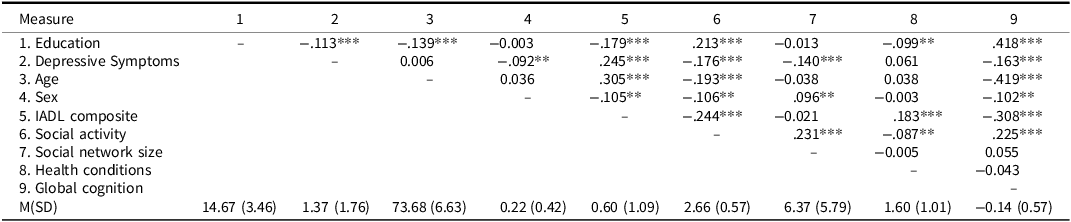
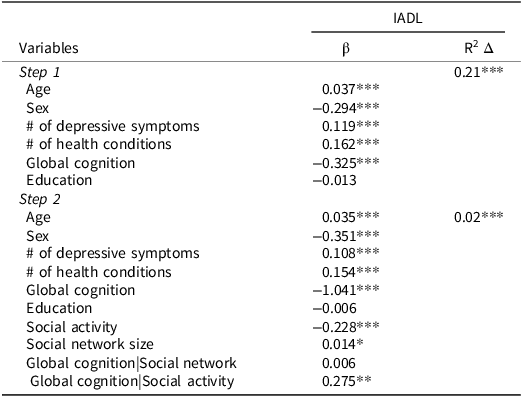
See Table 2 for a Pearson correlation matrix for relationships among variables. IADLs were significantly predicted by neuropsychological, demographic, physical and mental health variables (F(6, 923) = 42.15, p < 0.001, R 2adjusted = 0.21) (Table 3). Higher age, being female, depressive symptoms, and number of health conditions were significantly predictive of higher impairment (b = 0.04, t = 6.99, p < 0.001; b = −0.29, t = −3.81, p < 0.001; b = 0.12, t = 6.43, p < 0.001; b = 0.16, t = 5.13, p < 0.001). Lower global cognitive functioning was associated with higher impairment in IADLs (b = −0.32, t = −4.78, p < 0.001). Years of education was not associated with IADL functioning.
Pearson correlations between demographics, cognition, depression symptoms, and social factors

** Significance at the 0.01 level (2-tailed).
*** Significance at the 0.001 level (2-tailed).
Sex was coded 0 = female 1 = male
Analysis of the effects of demographics, cognition, depression symptoms, social factors, and their interactions with cognition on instrumental activities of daily living (IADL) functioning

Aim 2
After an addition of social factors and their interactions with global cognition, the second model explained significantly more variance than the first model (F(4, 919), = 8.42, p < 0.001, R 2 adjusted = 0.23, R 2 change = 0.02 ). See Table 3. Being female and older remained significantly associated with increased levels of impairment (b = −0.35, t = −4.56, p < 0.001; b = 0.03, t = 6.63, p < 0.001. Also consistent with the first model, increased depressive and physical health symptoms were associated with higher impairment (b = 0.11, t = 5.86, p < 0.001; b = 0.15, t = 4.95, p < 0.001). Lower global cognitive functioning remained associated with higher IADL impairment (b = −1.04, t = −4.12, p < 0.001). Higher levels of engagement in social activities were independently associated with lower impairment (b = −0.23, t = −3.61, p < 0.001). A larger social network size was predictive of higher impairment in IADLs (b = 0.01, t = 2.25, p < 0.05). There was a significant interaction (Figure 1) with engagement in social activities and global cognitive functioning (b = 0.27, t = 2.78, p < 0.01). Low global cognitive functioning was associated with higher impairment in IADLs in those with low social engagement (b = −0.43, p < 0.001), but cognition did not significantly predict IADL functioning in those with high social engagement (b = −0.11, p > 0.05).
Global cognition for high/low social activity.
Note: Effect of perceptual speed at high (1SD) and low (-1SD) levels of social engagement on instrumental activities of daily living (IADL) functioning. Y-axis: higher indicates worse IADL function; X-axis: Positive indicates better cognitive functioning.

Discussion
Levels of functioning across all activities of daily living have previously been associated with pathological aging (i.e., low functioning) and self -reported successful aging (i.e., high functioning) (Montross et al., Reference Montross, Depp, Daly, Reichstadt, Golshan, Moore, Sitzer and Jeste2006; Tomaszewski Farias et al., Reference Tomaszewski Farias, Giovannetti, Payne, Marsiske, Rebok, Schaie, Thomas, Willis, Dzierzewski, Unverzagt and Gross2018). When examining SDH, older Black adults experience a higher prevalence of physical, economic, and cognitive risk factors associated with declines in IADL functioning (Amieva et al., Reference Amieva, Mokri, Le Goff, Meillon, Jacqmin-Gadda, Foubert-Samier, Orgogozo, Stern and Dartigues2014; Miles et al., Reference Miles, Froehlich, Bogardus and Inouye2001; Riley, Reference Riley2012). One way to understand these SDH is through the FCT. The FCT states that fundamental causes (e.g., racism, SES, etc.) drive disparities in health outcomes (Phelan et al., Reference Phelan, Link and Tehranifar2010). The current study had two aims; first to replicate previously established predictors of functioning found in primarily White samples and secondly to examine the relationship between social factors and IADL functioning. Most previously examined associations were also confirmed in an older Black adult sample and our hypothesis that social factors would be ‘flexible resources’ that would mitigate the effects of cognitive decline through the ability to gain access to health care and information was confirmed for engagement in late life social activities but not social network size.
Aim 1
Demographic and health factors
Consistent with previous work, older age and number of illnesses were significant predictors of worsened IADL functioning across all models which may be attributed to age-related risk factors to declines in physical functioning and development of chronic health conditions (CDC, 2009; Chodzko-Zajko et al., Reference Chodzko-Zajko, Proctor, Fiatarone Singh, Minson, Nigg, Salem and Skinner2009; Dunlop et al., Reference Dunlop, Semanik, Song, Manheim, Shih and Chang2005). Health conditions can have impacts on cognitive domains as well. Hypertension has been associated with long-term declines in the Mini-Mental State Exam scores and lower scores in cognitive domains including; processing speed, reaction time, and motor speed (Hudak et al., Reference Hudak, Edwards, Athilingam and McEvoy2013; Streit et al., Reference Streit, Poortvliet, Elzen, Blom and Gussekloo2019). This is particularly salient given the higher prevalence of chronic conditions like hypertension and diabetes in Black communities; often due to systemic disparities in the United States health system (e.g., lack of equal treatment in medical systems, mistrust, and socioeconomic disparities) (Gaskin et al., Reference Gaskin, Thorpe, McGinty, Bower, Rohde, Young, LaVeist and Dubay2014; Musemwa & Gadegbeku, Reference Musemwa and Gadegbeku2017).
Being born a female was associated with increased IADL impairment which may be attributed to gendered IADLs that may influence ratings of disability (Sheehan et al., Reference Sheehan, Domingue and Crimmins2019). Another possibility is that females are more likely to experience an earlier onset of disability and live longer when compared to males, resulting in increased impairment in later life (Gill et al., Reference Gill, Gahbauer, Lin, Han and Allore2013).
While it was hypothesized lower education level would be associated with lower functioning, education was not a predictor in any models. Our results are consistent with some international studies finding that educational levels from less than primary school through post-secondary education were not predictive of late life functioning (Bleijenberg et al., Reference Bleijenberg, Zuithoff, Smith, de Wit and Schuurmans2017; Mograbi et al., Reference Mograbi, Faria, Fichman, Paradela and Lourenço2014). Mograbi and colleagues (2014) did find educational attainment to be moderately correlated to cognitive predictors, positing that education may mediate the relationship between cognition and functioning. In support of a mediating effect of education, other research has found that education is a predictive of functioning status but lost its significance after health-related variables were added (Béland & Zunzunegui, Reference Béland and Zunzunegui1999). In the current study, education shared a weak correlation with IADL functioning, which may have been related to most of the sample receiving more than 12 years of education. The variance education provided to the model may have been subsumed by the effects of cognition given the moderate association between education and cognition.
Depressive symptoms
Increased depressive symptoms were related to decreased functioning across IADLs. Symptoms of depression (e.g., motivational factors) may contribute to impairment in shopping, leaving the home, and preparing meals given research finding depression both independently and confounded cognitive effects for these areas (Kiosses & Alexopoulos, Reference Kiosses and Alexopoulos2005). IADL functioning also shares a reciprocal relationship to depression; with onset of disability being associated with the onset and/or worsening of depression symptoms and that depressive symptomology having a negative effect on functioning (Ormel et al., Reference Ormel, Rijsdijk, Sullivan, van Sonderen and Kempen2002). Older women, Black women even more so, experience depression at a higher rate when compared to men (Girgus et al., Reference Girgus, Yang and Ferri2017; Spence et al., Reference Spence, Adkins and Dupre2011). Taken together, depression may represent a key, modifiable risk factor, particularly for older Black women, given its association with the onset and worsening of IADL functioning.
Cognition
Global cognition was a significant predictor of IADL functioning. Our findings were consistent with a meta-analysis conducted by Raimo and colleagues (2024) where global cognition had a moderate to high association with IADL functioning. These findings are unsurprising as previous work has found multiple cognitive domains to be involved in functioning (Fong et al., Reference Fong, Gleason, Wong, Habtemariam, Jones, Schmitt, de Rooij, Saczynski and Gross2015; Lau et al., Reference Lau, Parikh, Harvey, Huang and Farias2015). For example, in those with MCI, higher memory scores have been associated with increased independence in medication management and meal preparation, key components of IADL functioning (Reppermund et al., Reference Reppermund, Sachdev, Crawford, Kochan, Slavin, Kang, Trollor, Draper and Brodaty2011). Other domains included in the composite score, like visuospatial ability and perceptual speed have been associated with motor abilities, management of finances, judging distances, recognizing people, and driving in those with MCI or dementia (Glosser et al., Reference Glosser, Gallo, Duda, de Vries, Clark and Grossman2002; Nygard et al., Reference Nygard, Amberla, Bernspång, Almkvist and Winblad1998; Reppermund et al., Reference Reppermund, Sachdev, Crawford, Kochan, Slavin, Kang, Trollor, Draper and Brodaty2011). While executive functioning has been found to be a strong predictor of IADL functioning, the current study did not have a specific executive functioning domain (Bell-McGinty et al., Reference Bell-McGinty, Podell, Franzen, Baird and Williams2002). Although, perceptual speed can be viewed as visual processing speed, which shares a strong relationship with executive functioning, and was included in the global cognition composite score (Harvey, Reference Harvey2019). Further research may want to incorporate a stronger domain for executive functions as this may have weakened the relationship between our global cognitive composite and functioning in the current study.
Aim 2
The current results represent one of the first known studies, to our knowledge, to examine the impact of social factors as moderators of cognition in everyday functioning in an older Black adult sample. Most research examining social factors utilize cognitive functioning as an outcome variable. Social functioning and late life activity has previously been found to preserve and improve global cognition, perceptual speed, perceptual orientation, and episodic memory (Pugh et al., Reference Pugh, De Vito, Divers, Robinson, Weitzner and Calamia2021). A meta-analysis found that larger social network sizes and increased social activity were associated with better global cognitive scores while late life social activity alone was found to inconsistently impact various other domains (e.g., visuospatial abilities, working memory, memory, processing speed, and executive functioning) (Kelly et al., Reference Kelly, Duff, Kelly, McHugh Power, Brennan, Lawlor and Loughrey2017).
The current results provide novel information as social factors moderated aspects of cognition on IADLs rather than improve or preserve cognitive abilities. Increased engagement in social activities independently predicted better functioning. Zhu and colleagues (Reference Zhu, Walsh, Zhou and Zhang2023) examined an older Chinese cohort across 10 years and found that engagement in leisure activities (e.g., activities one engages in their free time without economic benefits) was associated with a preservation of IADL functioning. Their findings are aligned with the FCT as they suggested increased IADL functioning comes from both more physical activity (e.g., volunteering, engaging in outdoor community events) but also through exposure to healthy habits and learning new health behaviors (Zhu et al., Reference Zhu, Walsh, Zhou and Zhang2023).
Surprisingly, a larger social network was predictive of increased impairment in IADL functioning. This finding may reflect access to material support from loved ones, as a larger social network has been associated with increased informal care for those experiencing functional impairment (Brito et al., Reference Brito, Nunes, Duarte and Lebrão2018). There was not an interaction between social network size and global cognition. This is consistent with Green and colleagues (Reference Green, Rebok and Lyketsos2008) who did not find social network size to be protective of cognitive status in their longitudinal study.
We also found a significant interaction between late life social activities and global cognition. A lower cognitive composite score predicted impairment in IADL functioning in those with low social activity engagement, but those with high levels did not experience a change in functioning as cognition varied. The current results are consistent with one systematic review examined church attendance, a domain included in the current study, in relation to IADL functioning and found that church engagement preserved IADL functioning compared to their less religious counterparts (Amorim et al., Reference Amorim, Silveira, Alves, Faleiros and Vilaça2017). Theories to how social engagement preserves IADL functioning include concepts of “use it or lose it” meaning that engaging in social activities requires a use of cognitive skills when taking transportation, navigating, and managing finances which help to preserve these functions (Tomioka et al., Reference Tomioka, Kurumatani and Hosoi2017). Other theories draw back to social resources and the FCT. Those who are able to have more contact with others in their community also learn new health information and strategies to diminish the impact of cognitive decline (Cohen, Reference Cohen2004; Freese & Lutfey, Reference Freese, Lutfey, Pescosolido, Martin, McLeod and Rogers2011).
Strengths and Limitations
There were several strengths to the current study. First, we utilized a large sample of Black older adults. As previously discussed, this population is at risk for worse health outcomes, yet is chronically understudied (Matthews et al., Reference Matthews, Xu, Gaglioti, Holt, Croft, Mack and McGuire2019; Pugh et al., Reference Pugh, Robinson, De Vito, Bernstein and Calamia2022). Secondly, everyday functioning has often been discussed in relation to cognitive status. Our results offer novel insights into the role of social engagement on functioning. Lastly, previous work on global cognition has operationalized this construct through brief screening measures (e.g., Mini Mental Status Exam) where the current study utilized a composite score of multidomain cognitive tests (Raimo et al., Reference Raimo, Maggi, Ilardi, Cavallo, Torchia, Pilgrom, Cropano, Roldán-Tapia and Santangelo2024).
There were also several limitations. First, we evaluated IADLs and social functioning as composite scores. Research focused on the specific domains within these larger areas (e.g., specific tasks and activities) have shown more specific relationships that can help guide the formation of interventions (Glosser et al., Reference Glosser, Gallo, Duda, de Vries, Clark and Grossman2002; Reppermund et al., Reference Reppermund, Sachdev, Crawford, Kochan, Slavin, Kang, Trollor, Draper and Brodaty2011). Second, we focused on baseline visits and future research may benefit from a focus on longitudinal changes in IADL functioning and its relationship with the examined factors. Additionally, we utilized self-report measures and associations may have differed with other measurement methods. For example, performance-based measures shown a greater association with IADL functioning when compared to self-reports (Puente et al., Reference Puente, Terry, Faraco, Brown and Miller2014). Lastly, our sample size was majority female underscoring the importance of recruitment of older Black men into aging studies.
Conclusion
Social factors, particularly late life social activity, showed a buffering effect on cognition in relation to IADL functioning. Given support for social factors being uniquely impactful in Black communities, interventions focused on increasing social engagement may be useful in maintaining everyday functioning. For example, the government of Japan opened “community salons” that provided activities (e.g., arts and crafts, bingo, etc.) to promote social engagement (Hikichi et al., Reference Hikichi, Kondo, Kondo, Aida, Takeda and Kawachi2015). Hikichi and colleagues (2015) found that over 5 years, there was a 6% decrease in incidences of IADL impairment.
Competing Interests
There are not any competing interests.
Sources of Financial Support
ROSMAP is supported by P30AG10161, P30AG72975, R01AG15819, R01AG17917, U01AG46152, and U01AG61356. MARS is supported by R01AG22018. AACORE is supported by P30AG10161 and P30AG072975.
RADC resources can be requested at https://www.radc.rush.edu and www.synpase.org.