Introduction
The majority of patient care for those in sudden cardiac arrest (SCA) occurs in the prehospital setting.Reference Nichol, Rumsfeld and Eigel1, Reference Chugh, Jui and Gunson2 Estimates range from 100,000 to more than 300,000 incidents of SCA per year in the United States.Reference Rea, Eisenberg, Sinibaldi and White3-Reference Roger, Go and Lloyd-Jones5 Over 85% of individuals with ambulatory, out-of-hospital, sudden cardiac arrest experience ventricular fibrillation (VF) or pulseless ventricular tachycardia (VT) during the early minutes of their clinical course.Reference Cummins, Ornato, Thies and Pepe6 The treatment for VF/pulseless VT is prompt defibrillation with an electrical countershock and high-quality cardiopulmonary resuscitation.Reference Neumar, Otto and Link7 The time interval between patient collapse and defibrillation is a strong predictor of SCA survival. Defibrillation is most effective when administered within three to five minutes of an SCA event and approaches little to no effectiveness after 10 minutes of SCA.Reference Sanna, La Torre and de Waure8, Reference Valenzuela, Roe, Cretin, Spaite and Larsen9
Since the mid-1990s there has been increasing emphasis on the prepositioning of automated external defibrillators in the community for use by lay rescuers, a process known as public access defibrillation (PAD).Reference Capucci, Aschieri and Piepoli10-Reference Valenzuela, Roe and Nichol14 The effectiveness of a PAD program is directly related to the number of witnessed cardiac arrests as well as to how often and how quickly rescuers can obtain, correctly apply, and activate the automated electronic defibrillator (AED).Reference Weisfeldt, Sitlani and Ornato15 In 2004, Hallstrom et al demonstrated a higher survival rate from sudden cardiac arrest when patients were attended to by trained community volunteers equipped with AEDs compared with those trained only in cardiopulmonary resuscitation (CPR). Other studies have shown similar results.Reference Hallstrom, Ornato and Weisfeldt16, Reference Powell, Van Ottingham and Schron17 It has also been documented that placement of AEDs can be guided by the site-specific incidence of arrest.Reference Becker, Eisenberg, Fahrenbruch and Cobb18 Other studies have analyzed out-of-hospital cardiac arrest (OOHCA) locations in an effort to optimize the placement of public access defibrillators. When stratified by location type, locations identified in the literature as being high frequency (one or more OOHCA in five years) have included public transportation terminals, playgrounds, golf courses, hotels, casinos, physicians’ offices, and private homes.Reference Chugh, Jui and Gunson2, Reference Muraoka, Ohishi and Hazui19, Reference Engdahl and Herlitz20 In one study, the vast majority (65%) of OOHCAs occurred in private homes.Reference Rea, Eisenberg, Sinibaldi and White3 Based upon this battery of work, many public and private officials have made policy and program decisions regarding where public access defibrillators should be placed. Current American Heart Association (AHA) guidelines recommend that PAD programs be established at locations that are likely to have one or more SCA every five years, and where public safety time-to-defibrillation is greater than five minutes. The AHA also recommends placing AEDs at health clubs and venues with a high likelihood of witnessed SCA (airports, casinos, stadiums, shopping malls).
However, despite the recommendations from the AHA, the literature is devoid of an analysis of the location of cardiac arrest events as compared with the location of PADs. Previous cardiac arrest epidemiologic data has been used to predict PAD location, but limited data has been collected to examine PAD placement in relation to cardiac arrest across an entire community. This study analyzed the types of location where cardiac arrests occurred compared with the types of location where PADs were placed in Howard County, Maryland.
Howard County, Maryland is situated in the central Baltimore-Washington corridor and has a population greater than 250,000.21 Emergency Medical Services (EMS) in Howard County are provided through Howard County Fire and Rescue (HCFR). In 2006, HCFR responded to a total 27,621 calls, of which 19,126 (69.2%) were medical emergencies including 107 cardiac arrests. In 1999, the State of Maryland's EMS regulatory agency, known as the Maryland Institute for Emergency Medical Services Systems (MIEMSS), developed a program that permits a business, organization, or association to set up a program for the registration of PADs.22 A core component of the MIEMSS AED program is a database that contains the registered locations of AEDs as well as documentation submitted when one is used. Entities exempt from the Maryland Facility AED program include health care facilities, federal government agencies, jurisdictional EMS operational programs, and commercial ambulance services. In addition, MIEMSS also maintains a larger database of cardiac arrest events that occur out of hospital and to which EMS has responded.
Methods
This study retrospectively examined the location of registered PADs in Howard County, Maryland as compared with the actual location of out-of-hospital cardiac arrests. Locations were stratified by location type as defined by the PAD trial.Reference Hallstrom, Ornato and Weisfeldt16 The following patient populations were excluded from this analysis to remain consistent with the PAD trial: traumatic arrest and pediatric cardiac arrests in individuals eight years of age and younger.Reference Hallstrom, Ornato and Weisfeldt16
Data provided through the Maryland Cardiac Arrest Study Form, a MIEMSS form submitted voluntarily by Howard County Fire and Rescue following a cardiac arrest response, was queried to identify incident locations of cardiac arrest in Howard County, Maryland. Each recorded cardiac arrest was tracked using a study-assigned number. Cardiac arrests were then recorded on a separate data sheet with the unique identifying number and the following information: date of arrest, exact location of arrest, whether or not the arrest was witnessed, and the patient's condition upon arrival to the hospital. The State of Maryland AED Program Database was queried, by location type, for all registered PADs in Howard County. Each arrest location was then manually coded to be consistent with the location nomenclature used in the PAD trail. Data regarding the location of cardiac arrests, whether the arrest was witnessed, location of AEDs, and location type were entered into a Microsoft Excel database and analyzed using SPSS statistical software version 16.0 (SPSS, Chicago, Illinois USA). Descriptive analysis of cardiac arrest and AED locations was performed. Scatter diagrams and linear fit lines with r2 linear statistics were inspected to determine the strength of the relationship. The Johns Hopkins University School of Medicine Institutional Review Board deemed this study exempt from IRB review.
Results
Data were analyzed from the period beginning January 1, 2001 and ending December 31, 2006. In the State of Maryland approximately 4,000 people each year have a SCA event outside of the hospital.22 In Howard County, Maryland approximately 100 people per year have a SCA. During this time, HCFR responded to a total of 714 cardiac arrests, of which 338 were witnessed. The greatest year-to-year variation occurred between 2001 (177 cardiac arrests) and 2002 (67 cardiac arrests). During the study time there were 183 AEDs registered in 141 unique locations in Howard County. Location identifiers were applied to all reported cardiac arrests using nomenclature consistent with those used in the PAD trial. The same location identifiers were also applied to AEDs located in Howard County. Of 49 possible located types, 33 (67.3%) were found to have either an AED or a cardiac arrest event during the study period. Cardiac arrests occurred at 29 (87.8%) of these 33 unique locations types.
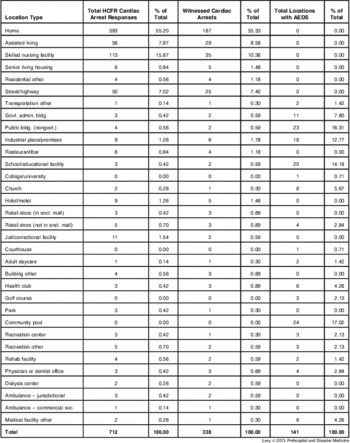
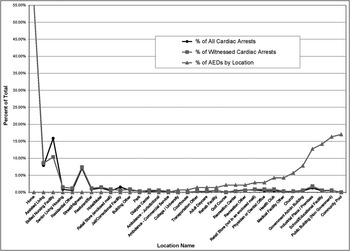
Table 1 shows the total number and percent of total cardiac arrests that occurred in each of these location types as well as the number of AEDs registered to each location type. The majority, 393 (55.2%), of cardiac arrests in Howard County occurred in private homes. Upon further analysis of the “recreation other” category, locations included the fairgrounds, a cemetery, a lake, and a tennis court. The same location filters were then applied to just the witnessed cardiac arrests. During the study period, HCFR responded to a total of 338 (47.5%) witnessed cardiac arrests out of 712 total cardiac arrests. The most frequently occurring location was, again, private residence, with 187 (55.33%) witnessed cardiac arrests. The remaining locations are shown in Table 1. These results were then plotted on a histogram (Figure 1). This plot further illustrates a near-inverse relationship between common locations of AEDs and common locations of cardiac arrests.
Total Number and Percent of Cardiac Arrests and AEDs by Location Type

Abbreviation: AED, automated external defibrillator.
Histogram Showing Cardiac Arrest Event Frequency Compared with Arrest Location and PAD Location
Abbreviation: AED, automated external defibrillator.

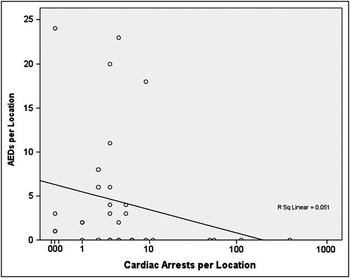
Locations of registered AEDs were then analyzed to identify the most common locations for the placement of AEDs. None of the top five locations where AEDs were most frequently placed correlated with the five most common locations of witnessed or unwitnessed cardiac arrests. The most common location for an AED was a community swimming pool with 24 (17%); followed by public buildings (nongovernment) with 23 (16.3%); and school/educational facility (not a college or university) with 20 (14.2%). Scatterplots were constructed comparing the locations of AEDs placement and locations of both witnessed and total cardiac arrests (Figures 2 and 3, respectively). The r2 values for witnessed cardiac arrests and total cardiac arrests were 0.054 and 0.051 respectively, indicating a weak relationship between AED location and both witnessed and total cardiac arrest location.
Scatter Diagram of AEDs and Total Cardiac Arrests per Location
Abbreviation: AED, automated external defibrillator.

Scatter Diagram of AEDs and Witnessed Cardiac Arrests per Location
Abbreviation: AED, automated external defibrillator.

Discussion
A significant disparity is seen between the location of cardiac arrests and the location of AEDs. This data is useful, as it will aid in selecting future deployment locations for PADs, and in potentially revisiting the current locations of PAD placement. As previously discussed, most people who experience SCA develop VF or pulseless VT within minutes of collapse.Reference Cummins, Ornato, Thies and Pepe6 The sooner (ideally within three to five minutes) that defibrillation can occur for a person with VF or pulseless VT, the greater the likelihood of successful resuscitation.Reference Eisenberg23 Therefore, an understanding of where witnessed cardiac arrests are occurring should be of utility in trying to determine where AEDs optimally should be placed. However, with this study no real difference in location of cardiac arrest, witnessed vs unwitnessed, was observed.
A poor association was observed between the location of cardiac arrests and the location of AEDs in Howard County Maryland, in the form of an inverse relationship between the locations of PADs vs the location of cardiac arrests. These findings serve to effectively disprove the null hypothesis that a strong relationship exists between the locations of PADS and cardiac arrest. Furthermore, these results show no significant difference between the locations of witnessed and unwitnessed cardiac arrests.
Locations with high numbers of AEDs and low numbers of cardiac arrests (swimming pools, schools, public buildings) are the source of much controversy. Ongoing debate exists about whether public law should be passed mandating the placement of AEDs at these facilities. Although the data show low numbers of cardiac arrests at these facilities, strong emotional arguments in favor of AED placement seem to prevail. Another factor to be considered as to why AEDs are placed is the “peace of mind” component perceived by location patrons and occupants. This argument is further strengthened when compiled with recent decreases in the purchase costs of AEDs, devices that require low to no maintenance, and deregulation of earlier requirements for a physician's prescription to purchase a device.
Several theories exist that help to explain the juxtaposition between locations of AEDs and high-cardiac-arrest locations. Multiple studies support this investigation's findings that private homes are almost always the most common location of OOHCA.Reference Rea, Eisenberg, Sinibaldi and White3, 22 However, this does not necessarily mean that placing AEDs in private homes in Howard County will increase survival rates.Reference Bardy, Lee and Mark24 Compared with the high number of homes (thousands) in the county, the overall incidence of cardiac arrest is low. Nursing homes, assisted living facilities, and skilled nursing facilities were also locations with a significant number of cardiac arrests. Yet, there is no regulatory or legal requirement for these facilities to have AEDs onsite. Discussions regarding this issue have already occurred between county officials and the administration of facilities to suggest that AEDs be added. In addition, Howard County Fire and Rescue is engaged in an active citizens’ CPR campaign that has already demonstrated promising results. This campaign will help heighten the public's understanding of cardiac arrest and the importance of early CPR and defibrillation.
Limitations
This study is limited by the voluntary/poorly-enforced registration of AEDs as well as the exclusion of health care facilities, federal government agencies, and commercial ambulance services within the MIEMSS public AED program. Unregistered AEDs are known to exist in Howard County, yet how many there are and where they are located is largely unknown. One such known location, a shopping mall, is believed to have several AEDs on site, but the AED registry has no record of this. Another limitation of the data relating to the Maryland AED registry is that the registry is a running list that does not allow for analysis by year. Although results were examined as a percentage of the whole, the inability to track AED placement does confound the data. It is possible that an AED has been relocated or taken off-line and the database not updated. The authors acknowledge that the study period is greater than five years old (2001-2006). Finally, this study did not examine the rates of survival or return of spontaneous circulation. Therefore, we cannot make conclusions about the effect of these results on survival.
Conclusion
This data demonstrate a poor association between the locations of public access AEDs and cardiac arrests in a countywide EMS jurisdiction. Continued analysis of locations with a high incidence of SCA can help assure the effective placement of public access AED resources to help maximize survival from sudden cardiac arrest. With the full deployment of more effective and reliable wireless emergency phone services through Enhanced 9-1-1 across the State of Maryland and other advances in Geographical Information Systems (GIS), the authors plan future research endeavors that examine in greater detail the GIS mapping of SCA as compared with AED locations.