Interest is booming in the set of obscure raw materials known as rare earths. Rare earth elements (REE) include the 15 metallic elements in the lanthanide series, such as cerium, lanthanum and neodymium, in addition to two elements with similar properties, scandium and yttrium. While abundant in the earth's crust, they are rarely found in concentrations that can be mined economically. During the Sino-Japanese territorial dispute over the Diaoyu 钓鱼 (or Senkaku) Islands in 2010, China seemed to escalate the crisis by instituting a REE trade blockade against Japan. These events drew concern from many countries that rely on the elements and may have led to the United States acknowledging Japan's administration, though not ownership, of the islands. One year later, the United States, Japan and the European Union brought concurrent cases (DS431, DS432 and DS433) before the World Trade Organization's (WTO) Dispute Settlement Body. They allege that China's trade measures concerning rare earths, tungsten and molybdenum are inconsistent with its WTO agreements. China asserts that its sovereign right to environmental regulation and national production quotas is unassailable. This raises the question of whether China is inappropriately using the environment as a defence against allegations that its rare earth policies are in violation of its WTO obligations.
The Dispute Settlement Body (DSB) of the WTO is the formal legal conduit through which those countries that feel their interests are being harmed by a member's violation of WTO policy can take action when diplomatic channels have failed. Soon after joining the WTO, China filed a dispute settlement (252) against US steel import duties.Footnote 1 In most US cases filed against China, the US has been a co-complainant with a number other countries. By contrast, China has unilaterally filed the five disputes it has filed against the US, and in its history has only filed two other disputes against the European Union.Footnote 2 While many of the US complaints ended in a mutually agreed upon consultation, China has won two of the cases where it was the plaintiff, while the others are pending. This demonstrates that China has not been a passive victim of the WTO dispute system, but rather an active and successful plaintiff.Footnote 3
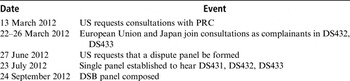
The WTO dispute over rare earths in which the US is the complainant against China (DS431) is still at an early stage. As can be seen in Table 1, the panel has only passed initial consultations and is in the midst of DSB procedures. The argument China will put to the WTO will likely hinge on conservation and environmental protection, along the lines of the defence China put forward in DS394. WTO dispute panels in the past have famously been unsympathetic to environmental protection policies. Nevertheless, as Alan Wolff, a trade consultant and former US trade official, has noted, “A panel would sympathize with a genuine environmental objective.”Footnote 4 The legal burden is on China to show that its measures were not designed to put foreign competition at a disadvantage.
DS431 Panel ProgressFootnote 14

It is important to note that it has never been argued that China's national rare earth production quota or enforcement activities are in violation of the WTO. Greater protection for the rights and safety of workers, pollution restrictions and policy enforcement are in no way controversial within the confines of the WTO. National production quotas are administered by the Ministry of Industry and Information Technology (MIIT), and were set at 119,500 tons in 2010.Footnote 5 If this action were taken alone, there would be no controversy, but the export quota for the same year was 22,512 tons.Footnote 6 The disparity between the two creates a system of discriminatory access. China has been imposing a quota on REE exports since its accession to the WTO in 2001.Footnote 7
Prior to the current rare earth case, the raw materials case DS394 was the first that the WTO heard on the issue of export controls for natural resources.Footnote 8 Just as in the current case, the US Trade Representative, Ambassador Ron Kirk, stated that, “China's policies provide substantial competitive advantages for downstream Chinese industries at the expense of non-Chinese users of these materials.”Footnote 9 In DS394, the complainants argued that China's export quotas, licensing, fees and price requirements violated their commitments under China's articles of accession to the WTO and the General Agreement on Tariffs and Trade (GATT) 1994. Accession Protocol paragraphs 5.1 and 5.2 guarantee all foreign and domestic enterprises and individuals the right to export, and 11.3 stipulates that no export duties may be placed on unstipulated items.Footnote 10 Complaints based on GATT 1994 cited the following articles: VIII:1(a) China must limit export fees and charges approximate to cost of services; X:3(a) the administration of laws and regulations must be uniform, impartial and reasonable; and X:1 the laws and regulations on restrictions or prohibitions must be published promptly.Footnote 11
China's position was that its export quotas and duties were consistent with articles to GATT 1994, namely: XI:2(a), which is designed to prevent a critical materials shortage; XX(g), which ensures the conservation of an exhaustible natural resource; and XX(b), which allows for environmental protection measures.Footnote 12 However, China failed to provide compelling enough evidence that its policies were equally curtailing domestic users – a tall order in the case of a quota system and a key requirement of the conservation argument.Footnote 13 Rulings against China on raw materials were also widely lauded as a rebuke of China's rare earth policies. China's ambassador to the EU, Song Zhe 宋哲, stated, “we are obviously not satisfied with the ruling, with regards specifically to the rare earths […] The fundamental purpose of our policy is to protect the environment because this resource is exhaustible.”Footnote 15 Nevertheless, whatever the outcome of the raw materials case, there is no guarantee of legal precedent in the WTO, as exists in Anglo-American law.Footnote 16
Critically, however, the raw materials that were the subject of DS394, including aluminium and steel, were specifically itemized in China's articles of accession, which clearly stipulate which ones may have a tariff placed on them.Footnote 17 In contrast, rare earth elements are not special case items, but are subject to the broader export tax bans of the articles of accession. This makes the rare earth case in the WTO more clear-cut than the raw materials case. The challenge for China now is to put a more compelling case before the WTO dispute panel than it did in the raw materials case as to why its trade measures for rare earth elements serve environmental protection goals.
Environmental Situation
The environmental situation with respect to the rare earth industry is stark, even in the most well-regulated REE production centre in Inner Mongolia. The industry has provided employment and brought improvement to many people's lives. At the same time, the industry threatens those same lives to which it brings improvement. Silica dusts are a danger to workers in the industry, while radioactive thorium poses dangers to workers and the broader community. Research at the Chinese Centre for Disease Control and Prevention has conclusively linked thorium dust exposure to increased cancer and mortality rates in rare earth miners and workshop workers.Footnote 18 Studies have also found that many rare earth communities are exposed to radiation levels that often exceed national standards.Footnote 19
In Inner Mongolia, the state-run Baogang Group's 宝钢集团 Weikuangba 尾矿坝 tailing pond is the largest in the world and holds over 230 million cubic metres of deadly waste.Footnote 20 By way of comparison, it is roughly 100 times larger than the alumina waste pond in Hungary that collapsed and killed nine people in 2010.Footnote 21 The Baogang Group's environmental protection office estimates that the company adds 7 million tons of liquid waste a year.Footnote 22 The radioactive content of mined minerals may be low, but evaporation concentrates this waste to dangerous levels. Given that it is 31.4 metres above the Huanghe 黄河 (Yellow River), which is less than ten kilometres away, it poses a threat to the water safety of the entire region.Footnote 23 Xu Guangxian 徐光宪, a leading scientist in China's rare earth industry, warned in 2005 that there is a threat of radioactive contamination to both the city of Baotou 包头 and the Huanghe.Footnote 24 Engineers have similarly warned that the bottom of the tailing pond is not properly lined and is leaking into the groundwater.Footnote 25 Additionally, eyewitness accounts in the China Daily report that the reservoir regularly overflows into the Huanghe during the rainy season,Footnote 26 causing radioactive waste to seep into Baotou's farmland and run off back into the river. This, along with the many aforementioned workshops, contributes to elevated thorium levels in the soil around Baotou.Footnote 27
Nearby, the village of Dalahai 打拉亥 has increased levels of cancer, respiratory illnesses and other diseases.Footnote 28 The radiation levels of drinking water for Dalahai significantly exceed national standards.Footnote 29 Even under the best state-run conditions, the industry is damaging. Meanwhile, illegal mining and international smuggling operations, which lack even the most basic safeguards, are expanding. Rather than curbing these activities, trade measures act as an incentive for illegal mining and smuggling operations which exacerbate the pollution problems.
Trade Measures
There are currently three trade measures in place which restrict supply through export reductions: the use of export quotas, export duties, and administrative activities, such as consolidation and licensing. Under the current quota system, the Ministry of Commerce releases two sets of quotas, one for each half of the year. The first half is announced in December of the previous year, and the second half in the summer.Footnote 30 Increased demand in recent years, coupled with reductions in export quotas, has led to a steep rise in the price of export quotas: in 2010, the price to export one ton of REEs reached $40,000.Footnote 31 The combined effect pressures firms short on quotas to shift their metal alloy production to China so they can access the raw materials.
The first trade measure, export quotas, works against China's conservation goals by hastening the export of the rarest forms of REEs. The Ministry of Commerce is concerned that with current rates of production, reserves in medium and heavy rare earth elements, which are the most valuable and unique REEs, may be exhausted in less than 20 years.Footnote 32 Since 2007, the MIIT banned the export of the raw form of dysprosium, terbium, thulium and yttrium, but not their refined forms.Footnote 33 MIIT has also made assurances that it will only place limits on and not prohibit terbium and dysprosium metal exports.Footnote 34 In practice, exporters with a limited supply of quotas will pursue the highest profit by specifically exporting the most valuable materials, which are the heavy rare earth elements. This policy also restricts the availability of light rare earth element supplies in international markets, causing price spikes in recent years that can be difficult for some companies to manage.Footnote 35 Quotas thus act as a discriminatory trade barrier that attracts investment, but is at odds with conservation.
In the second trade measure, the Ministry of Finance levies export duties on rare earth elements. In 2011, tariffs were raised from 15 to 25 per cent on many of the high-demand rare earth elements, and expanded for other previously untaxed REEs.Footnote 36 Similarly, in 2007, the tax rebate programme was ended for raw REEs, but was continued for completed products.Footnote 37 While the policy appears to put an end to the era of low-cost Chinese REEs, its continuation is simply a shift to benefit higher end domestic industries instead.
Under the third trade measure, China limits the export licences which allow firms to operate in the REE business. As opposed to quotas, which are clear trade barriers, licensing falls under the grey area of a technical barrier to trade. From 1997 to 2008, 150 licences were distributed to foreign and domestic firms.Footnote 38 Under China's WTO Accession Protocol paragraphs 5.1 and 5.2, China is required to give all foreign and Chinese enterprises or individuals the right to export;Footnote 39 however, of all the companies with licensing rights, only ten are foreign.Footnote 40
Trade Measures and Smuggling
As China's main defence before the WTO, the restriction of trade must not only be proved to be non-discriminatory, but also that it achieves environmental protection and conservation goals. However, trade measures create an incentive for black markets and smuggling. A black market exists when the illegal costs are lower than the legal costs, and when demand outstrips the legal supply. This is precisely the situation for Chinese REEs, where the current tariff and export quota system drives up the price of legal rare earth elements and creates a lucrative black market. By 2010, the bidding cost of a one-ton quota in rare earth elements had reached US$40,000.Footnote 41 In 2011, the Lynas Corporation reported prices skyrocketing from as high as 70.5 per cent to 557 per cent above Chinese domestic prices.Footnote 42 Illegal mines are also encouraged by these financial incentives, and their products inherently involve smuggling. Activists fighting pollution in villages in Guangdong have alleged that corrupt local officials have at times joined with criminal organizations to operate illegal mines, while the oversight organizations are either unaware or unwilling to investigate.Footnote 43 The full extent of illegal REE mining is unknown, but the widespread nature of smuggling can provide a fair approximation.
One of the highest estimates for local smuggling comes from the assistant director of the Baotou Rare Earth High-Tech Zone, An Sihu 安四虎, who, in 2010, told the China Daily that the amount of REE smuggled out of the city of Baotou alone stood at roughly 40,000 tons.Footnote 44 In 2009, an anonymous official gave Xinhua a figure of 20,000 tons for 2008.Footnote 45 Chen Zhanheng 陈占恒, in a report from the Chinese Society for Rare Earths, estimated total smuggling to be around 30 to 40 thousand tons in 2010.Footnote 46 Aside from these estimates, one can approximate the rate of smuggling from international customs data.
The State Council information office calculated the alarming, if conservative, estimates of total REE smuggling by comparing foreign customs' REE imports with reported Chinese exports. By its calculations, in 2011, reported foreign imports were 1.2 fold over Chinese exports.Footnote 47 The State Council also reported that China seized 769 tons of smuggled rare earth elements and detained 23 suspects in 2011.Footnote 48 However, these estimates are still problematic for two reasons. First, some of the smuggling reported may have been of legally mined REE exported illegally. Second, they only account for illegal exports reported legally to customs at their destination, meaning that the real levels of smuggling are likely to have exceeded this measurement.
Cross-border smuggling, along with the illegal mining and smelting operations that supply it, undermine both the Chinese state's ability to conserve supplies and its capacity to pursue environmental protection goals. Black market operators are attracted to the market because, as one smelter stated, “we sell cheaper than the big companies.”Footnote 49 Large companies have to abide by national policies with regards to workers' safety and proper disposal of materials. Illegal operations cut corners, threatening the safety of their workers and the surrounding community. Smuggling for export also incurs additional intermediaries, costs and risks that larger rare earth firms avoid but which illegal mines are prepared to meet. China's trade policies create an incentive to circumvent costly export quotas and duties, impact negatively on China's rare earth-producing communities and waste one of China's most valuable natural resources.
Chinese Demand Pressures
Given the levels of smuggling and the effect on mining communities, one must look elsewhere for the motivation behind China's rare earth trade policies. While China's reserves have greatly diminished in recent years, domestic demand is quickly surpassing supply. According to the Ministry of Commerce's Chao Ning 晁宁, China's deposits in rare earth elements have plummeted from 43 million in 1996 to 27 million at the end of 2009.Footnote 50 At the same time, China has become the number one consumer of rare earth elements, utilizing more than 50 per cent of the world's REEs by 4.Footnote 51 Between 2002 and 2007, domestic demand tripled from just over 20,000 tons to more than 70,000 tons.Footnote 52 A third of China's rare earth demand comes from its expanding industries and a strong demand for applications for intermediate products, especially in the iron and steel industry.Footnote 53
The domestic manufacturing demand for rare earth elements is quickly surpassing China's export market. Nicholas Curtis from the REE producer, Lynas Corporation, has pointed out that China will soon be a net importer of REEs.Footnote 54 REE consultant Jack Lifton predicts that this will happen around 2015.Footnote 55 This shift may have spill-over effects similar to those experienced during the shifts in China's demand for oil in the 1990s and coal in 2009.Footnote 56 The coal industry faced a wave of government reforms following high profile mining accidents just as China moved away from being an exporter to an importer of coal. The increased demand for REEs in China's economy and increased awareness of its environmental dangers may provide similar pressures for reform today. Additionally, from 1990 to 2006, China's share of global demand went from 22 per cent to 56 per cent.Footnote 57 This shift in importance of rare earth elements in China's domestic economy from a commodity primarily for export to a highly demanded domestic resource creates an incentive for trade protection.
In addition to export controls, the Chinese state appears to be making a concerted effort to acquire foreign mines through state firms. Now that China's demand has rapidly exceeded that of the rest of the world combined, the domestic resources to feed this demand are no longer sufficient. In 2005, China National Offshore Oil Corporation (CNOOC) was blocked in its attempt to purchase the US-based Unocal Corporation, which would have given it full control over the sole US REE mine in Mountain Pass, California, currently operated by the US firm, Molycorp.Footnote 58 Had CNOOC been successful in its bid, the US would have been dependent on China for rare earth production on US soil. Similarly in Australia, China's state REE company, China Nonferrous Metal Mining Company, attempted to buy majority shares in Lynas Corporation.Footnote 59 The Australian government blocked China from becoming a controlling majority shareholder so as to prevent the company restricting supply to non-Chinese buyers. Chinese pursuit of more covert minority shares in diversified mine holdings has been successful, including the acquisition of 25 per cent of Australia's Arafura Resources, and 17 per cent of Canada's Teck Resources.Footnote 60 Ganzhou Qiandong Rare Earth Group 赣州虔东稀土集团 has also invested in a joint venture with the Canadian group, Great Western, giving it access to the South African Steenkampskraal mine that is currently closed.Footnote 61 While perhaps not the direct result of ambitious strategy, these moves suggest that China has been pursuing its own interests in much of the globe's REE production.
Conclusion
China does not appear to be properly using environmental protection as a defence against allegations that its rare earth trade policies are in violation of its WTO obligations. The link that export duties, quotas and administrative barriers have with the goal of environmental protection in this case is not compelling. China has the opportunity to improve environmental protection through enforcement efforts that are in line with its WTO obligations. This would also serve China's resource conservation interests by naturally raising prices, while legal national production quotas could further stem the waste of heavy rare earth elements. Instead, China's rare earth element trade policy discriminates against international competitors in ways that incentivize illegal mining and smuggling, tragically squandering its resources, environment and the health of its people.