Native speakers continuously adjust their language comprehension and production to the properties of the language they encounter around them. For instance, listeners quickly adjust to a speaker's accent (e.g., Kraljic, Samuel & Brennan, Reference Kraljic, Samuel and Brennan2008), take over their interlocutor's way of referring to objects (e.g., Brennan & Clark, Reference Brennan and Clark1996; Brennan & Hanna, Reference Brennan and Hanna2009), or re-use the syntactic structure they just encountered (e.g., Bock, Reference Bock1986). One mechanism that has been proposed for this adjustment is error-based learning, which is a form of implicit learning (Chang, Dell & Bock, Reference Chang, Dell and Bock2006). Under error-based learning, the language user generates predictions concerning the upcoming language input. When these predictions are not borne out, the user's knowledge is updated. This mechanism has also been proposed to underlie first language acquisition (Chang et al., Reference Chang, Dell and Bock2006). Evidence for error-based learning has been obtained from both adult native language users (Farmer, Fine, Yan, Cheimariou & Jaeger, Reference Farmer, Fine, Yan, Cheimariou, Jaeger, Bello, Guarini, McShane and Scassellati2014; Jaeger & Snider, Reference Jaeger and Snider2008; Jaeger & Snider, Reference Jaeger and Snider2013) and first-language learners (Peter, Chang, Pine, Blything & Rowland, Reference Peter, Chang, Pine, Blything and Rowland2015). However, the role of error-based learning in late second-language (L2) processing and learning is not clear. On the one hand, studies on advanced L2 learners suggest that these learners can use information predictively during language processing (Foucart, Martin, Moreno & Costa, Reference Foucart, Martin, Moreno and Costa2014; Hopp, Reference Hopp2013). On the other hand, L2 learners seem to be resistant to adaptation: even advanced L2 learners do not appear to adjust their preferences even though they receive ample evidence from the input that their current knowledge is incorrect (Arnon & Ramscar, Reference Arnon and Ramscar2012; Hopp, Reference Hopp2015). Investigating to what extent L2 learners adapt to the language context and what the mechanisms are underlying such adaptation, if attested, may therefore provide insight in how L2 learners can use the language they encounter to shift their knowledge and processing in the direction of the target language.
The present study investigates adaptation in L2 learners through a syntactic priming paradigm. Syntactic (or structural) priming is the tendency to re-use, or expect, a previously encountered syntactic construction (e.g., Arai, van Gompel & Scheepers, Reference Arai, van Gompel and Scheepers2007; Bock, Reference Bock1986; Ferreira & Bock, Reference Ferreira and Bock2006; Ledoux, Traxler & Swaab, Reference Ledoux, Traxler and Swaab2007). For instance, after encountering a prepositional object ditransitive (PO), e.g., The girl gave the ball to the boy, native speakers of American English are more likely to use the PO construction in their own utterance than the double object ditransitive alternate (DO), e.g., The girl gave the boy the ball. We will use the term immediate priming to refer to priming in response to a structure just encountered. Priming can also be cumulative, that is, a structure that has been encountered often in the context tends to be produced more often (Kaschak, Reference Kaschak2007; Kaschak & Borreggine, Reference Kaschak and Borreggine2008; Kaschak, Kutta & Jones, Reference Kaschak, Kutta and Jones2011; Kaschak, Loney & Borreggine, Reference Kaschak, Loney and Borreggine2006), or becomes easier to parse (Farmer et al., Reference Farmer, Fine, Yan, Cheimariou, Jaeger, Bello, Guarini, McShane and Scassellati2014; Fine & Jaeger, Reference Fine and Jaeger2016; Fine, Jaeger, Farmer & Qian, Reference Fine, Jaeger, Farmer and Qian2013), regardless of whether the immediately preceding trial contains that structure. We will use the term cumulative adaptation to refer to the latter type of priming. Immediate priming and cumulative adaptation effects have been observed in both production and comprehension. This has been taken as an argument that similar mechanisms are operational in production and comprehension priming, although production and comprehension priming may differ in the size of the priming effects, and in the effect of lexical repetition between prime and target (see for an overview, Tooley & Bock, Reference Tooley and Bock2014). In the current study we investigate priming in production only.
Priming and adaptation in native speakers
In native speakers, priming effects are modulated by fine-grained experience. Typically, an inverse frequency interaction is observed: structures that are used infrequently in the language show larger priming effects than their more frequent alternates (e.g., Hartsuiker & Westenberg, Reference Hartsuiker and Westenberg2000; Jaeger & Snider, Reference Jaeger and Snider2008; Jaeger & Snider, Reference Jaeger and Snider2013; Scheepers, Reference Scheepers2003). This holds for abstract structures (e.g., PO ditransitives being less frequent than DO ditransitives in American English), as well as finer-grained representations such as those based on the bias of verbs or nouns. For instance, if a prime trial has a structure that is infrequent given the biases of the prime verb, priming is typically larger than when the prime has a structure that the verb is heavily biased towards (Bernolet & Hartsuiker, Reference Bernolet and Hartsuiker2010; Fine & Jaeger, Reference Fine and Jaeger2013; Jaeger & Snider, Reference Jaeger and Snider2008; Jaeger & Snider, Reference Jaeger and Snider2013). This effect is known as surprisal (Jaeger & Snider, Reference Jaeger and Snider2008). Frequency effects based on long-term experience with the language can be modulated by the short-term exposure to the context of the experiment or dialogue. When the experimental context or dialogue contains sentences of a particular structure, the participants or interlocutors are more likely to produce or expect this structure as they are repeatedly exposed to this structure (e.g., Fine et al., Reference Fine, Jaeger, Farmer and Qian2013; Jaeger & Snider, Reference Jaeger and Snider2008; Kaschak, Reference Kaschak2007). This adaptation effect is largest for structures that are initially infrequent (Fine et al., Reference Fine, Jaeger, Farmer and Qian2013; Hartsuiker & Westenberg, Reference Hartsuiker and Westenberg2000). This cumulative effect may affect the size of the immediate priming effects: priming of initially infrequent structures is larger at the beginning of the study compared to when the participant has been exposed to these structures many times over the course of the experiment (Hartsuiker & Westenberg, Reference Hartsuiker and Westenberg2000). Whether the same mechanisms underlie immediate priming and cumulative adaptation is still a matter of debate, although recent evidence suggests commonalities (Fine & Jaeger, Reference Fine and Jaeger2016). Both immediate and cumulative priming phenomena can be accounted for in terms of error-based learning. Based on experience, the language user predicts upcoming information (Chang et al., Reference Chang, Dell and Bock2006). For instance, given the verb and its subcategorization biases, the next constituent can be predicted. If this prediction is not borne out (i.e., prediction error), the knowledge is adjusted, which in turn affects future expectations. The degree of adjustment is dependent on the size of the prediction error: the more the actual input deviates from the expected input, the larger the adjustment. This accounts for the inverse frequency and surprisal effects, as well as the longer-term adaptation over the course of the experiment (Chang et al., Reference Chang, Dell and Bock2006).
Alternative models have been proposed in which priming is driven by mechanisms other than error-based learning. For instance, in a Residual Activation approach to structural priming (e.g., Pickering & Branigan, Reference Pickering and Branigan1998), the representations of verbs and other lexical items are connected to abstract structural representations. The lexical information in the prime activates the structural information it is connected with. This activation lingers, making it more likely that the prime structure is re-used in the target. This is especially the case when the same lexical items are used in the prime and target (this is known as the lexical boost effect, that is, the observation that priming is larger when the prime and target share lexical items than when they do not, e.g., Cleland & Pickering, Reference Cleland and Pickering2003; Pickering & Branigan, Reference Pickering and Branigan1998). Under the Residual Activation approach, lexically independent structural priming and the lexical boost effect are dealt with in the same way. A problem for this approach is that lexical boost effects have been shown to be shorter lasting than lexically independent priming effects, which suggests that different mechanisms underlie these effects (Hartsuiker, Bernolet, Schoonbaert, Speybroeck & Vanderelst, Reference Hartsuiker, Bernolet, Schoonbaert, Speybroeck and Vanderelst2008). In addition, since the residual activation is assumed to be only transient in nature, this model fails to account for longer-lasting and cumulative priming effects. Reitter, Keller and Moore (Reference Reitter, Keller and Moore2011), on the other hand, propose an ACT-R based model according to which priming can be seen as, first, a learning mechanism adjusting the base-activation of abstract structures in long-term memory, and, second as a lexically-based association mechanism, responsible for short-term priming and the lexical boost effect (for other dual-mechanism accounts, see Hartsuiker et al., Reference Hartsuiker, Bernolet, Schoonbaert, Speybroeck and Vanderelst2008; Tooley & Traxler, Reference Tooley and Traxler2010). This model can account for inverse frequency interaction: the adjustment of the base-activation is larger for infrequent than for frequent structures. However it is unclear how this model, or the Residual Activation approach, can account for prime verb surprisal effects (Fine & Jaeger, Reference Fine and Jaeger2013).
Priming and adaptation in language learners
If syntactic priming and adaptation effects depend on previous experience, we expect priming effects to be different in learners of a language compared with more experienced users of the language in question. Indeed, priming studies in children (Messenger, Branigan & McLean, Reference Messenger, Branigan and McLean2011; Peter et al., Reference Peter, Chang, Pine, Blything and Rowland2015; Rowland, Chang, Ambridge, Pine & Lieven, Reference Rowland, Chang, Ambridge, Pine and Lieven2012) reported larger syntactic priming effects in 3- to 4-year-olds than in older children and in adults. Children showed priming effects regardless of whether lexical items were repeated between prime and target, suggesting they dispose over abstract syntactic forms early in their language development (Peter et al., Reference Peter, Chang, Pine, Blything and Rowland2015; Rowland et al., Reference Rowland, Chang, Ambridge, Pine and Lieven2012; but see Savage, Lieven, Theakston & Tomasello, Reference Savage, Lieven, Theakston and Tomasello2006). Furthermore, children showed larger surprisal effects than adults (Peter et al., Reference Peter, Chang, Pine, Blything and Rowland2015). Peter et al. accounted for the larger surprisal effects by assuming that children are still establishing verb biases. Initially children have a large learning rate, allowing for large changes. Changes become smaller in magnitude later in the learning process in order to stabilize the knowledge and to prevent new information from continuously overwriting old information.
In contrast to first language (L1) learners, late L2 learners show larger within-L2 priming effects with increasing proficiency (Bernolet, Hartsuiker & Pickering, Reference Bernolet, Hartsuiker and Pickering2013). L2 learners can develop native-like priming effects in their L2 (Flett, Branigan & Pickering, Reference Flett, Branigan and Pickering2013; Gries & Wulff, Reference Gries and Wulff2005), and can even show immediate priming effects for structures that do not exist in their L1 (Flett et al., Reference Flett, Branigan and Pickering2013; Shin & Christianson, Reference Shin and Christianson2012). In addition, syntactic priming effects are larger when words are repeated between the prime and the target, at least in lower-proficiency L2 learners (Bernolet et al., Reference Bernolet, Hartsuiker and Pickering2013; Y. Kim & McDonough, Reference Kim and McDonough2008; Matsumoto & Yamashita, Reference Matsumoto and Yamashita2006; Schoonbaert, Hartsuiker & Pickering, Reference Schoonbaert, Hartsuiker and Pickering2007); in more advanced L2 learners, priming is slightly larger without lexical overlap (Bernolet et al., Reference Bernolet, Hartsuiker and Pickering2013). This suggests that, at least when there is no L1 equivalent of the L2 structure, L2 learners initially rely on lexical-specific knowledge, and only later develop more abstract structures (McDonough, Reference McDonough2006).
Results from previous L2 priming studies therefore suggest that L2-learners, like native speakers, are sensitive to the nature of the immediately preceding language context and can adjust their own language use to this context.
On the other hand, there is evidence that L2 speakers have difficulties using the context to adjust their L2 language representations. For instance, in spite of object (accusative)-initial sentences being not uncommon in German, even advanced English L2 learners of German do not appear to use this information to adjust their parsing preferences (Hopp, Reference Hopp2015).
The question addressed in the present study is therefore to what extent L2 speakers show adaptation, and what the nature of priming and adaptation in L2 speakers is. If similar implicit learning mechanisms are operational in native and L2 speakers, both an error-based learning account, and the model proposed by Reitter et al. (Reference Reitter, Keller and Moore2011) would predict that L2 learners as well as native speakers show stronger immediate priming and cumulative adaptation effects for structures that are infrequent to them. The two groups were expected to differ in the size and direction of the effects depending on differences in their pre-existing biases for the structures used. However, only an error-based account would predict that the speakers in both language groups show surprisal effects, that is, priming effects would be larger when the prime contains a structure that is infrequent given the bias of the lexical items used, in this case, the verb.
The present study
The present study was a web-based, written priming study on PO and DO ditransitives (Kaschak & Borreggine, Reference Kaschak and Borreggine2008; Pickering & Branigan, Reference Pickering and Branigan1998). We tested native American English speakers and Korean L2 learners of English, investigating to what extent L2 learners and native speakers adjust their ditransitive production preferences as a function of (1) the number of structures of a certain type encountered (cumulative adaptation to PO and DO structures); (2) the structure of the immediately preceding item (immediate priming by a PO or DO structure); and (3) the unexpectancy of the preceding prime (prime verb surprisal effects). We selected native American English speakers and Korean L2 learners of English in order to investigate the effects of different initial biases for the ditransitive alternation. American English speakers typically prefer the DO structure (Bock & Griffin, Reference Bock and Griffin2000; Jaeger & Snider, Reference Jaeger and Snider2013; Kaschak, Reference Kaschak2007; Kaschak et al., Reference Kaschak, Kutta and Jones2011), whereas Korean L2 speakers of English highly prefer the PO structure (S. Kim, Reference Kim2010; McDonough, Reference McDonough2006; Park, Reference Park2007; Shin & Christianson, Reference Shin and Christianson2012), even though they are familiar with the DO construction (Hinrichs, Reference Hinrichs2015; Shin & Christianson, Reference Shin and Christianson2009). Both an error-based learning, and base-level learning accounts along the lines of Reitter et al. (Reitter et al., Reference Reitter, Keller and Moore2011) predict larger immediate priming and cumulative adaptation effects for the PO structure in American English speakers (Bock & Griffin, Reference Bock and Griffin2000; Jaeger & Snider, Reference Jaeger and Snider2013; Kaschak, Reference Kaschak2007; Kaschak et al., Reference Kaschak, Kutta and Jones2011), and for the DO structure for the Korean L2 speakers of English (S. Kim, Reference Kim2010; McDonough, Reference McDonough2006; Park, Reference Park2007; Shin & Christianson, Reference Shin and Christianson2012). Second, error-based learning, but not activation-based accounts, predict that both native and L2 speakers would show effects of prime verb bias (surprisal) but differ in the pattern of surprisal effects depending on differences in verb biases between the groups.
Participants
Seventy-four American English speaking participants completed the questionnaire, mainly recruited from US college communities. Data from two of these participants were not included in the analysis because English was not their native language or they indicated to be much older (71 years) than the remaining participants. We therefore included data from 72 native English participants in the analysis (age 18–52, mean age 23.7). In addition, 75 Korean second language learners of English completed the questionnaire. The participants were recruited mainly from South Korean college communities. Data from four of these participants were omitted from analysis because of early exposure to English (two participants), long immersion in an English speaking environment (one participant), or not residing in a Korean-speaking country (one participant). After omission of trials with primes that were not completed or completed incorrectly for our purposes (i.e., no direct object was completed in a DO frame, no to-prepositional phrase was completed in a PO frame, see below), data from an additional ten participants were omitted from analysis since they had fewer than two trials remaining in at least one of the three priming conditions. We therefore included data from 61 native Korean participants in the analysis (age 18–27, mean age 20.8). All resided in South Korea. All except one had started learning English after the age of 7 (range 6–20 years; mean age 9.9). Five had spent less than 1 year, and one had spent 1.5 years, in an English-speaking country. Others did not have any immersion experience. Participants read and checked “agree” on an online written informed consent form before starting the study. The protocol was approved by the University of Florida Institutional Review Board.
Materials
Three verbs were used as target verbs (show, hand, and offer); nine different verbs were used as prime verbs (award, bring, give, pay, pass, send, sell, throw, and write) in the main priming study. Verb norms were obtained on the basis of completion data provided by a separate group of 35 native English speaking participants and 34 non-immersed Korean L2 learners of English, drawn from the same populations as the participants in the main study. The norming study was a picture description task, similar to the priming study, except that the sentence fragments only contained the subject and the verb (The boy gave. . .), and that experimental verb trials were always preceded by an intransitive distractor trial. Participants completed one trial for each of the 12 experimental verbs. Three versions of the norming study were conducted, each version having different pictures. Coding of the responses was similar to that described for the main study. Completion data for the 12 verbs are given in Tables S1-3 in the Supplementary materials (Supplementary Materials). Results from the norming study indicated that the prime verbs varied in their biases, at least, in the native English norming data, with award, give, and pay preferring the DO construction, and pass, send, sell, and throw having a preference for the PO construction. As each verb was presented in both PO and DO frames in the main priming study, this variation in prime verb bias was intended in order to investigate surprisal effects. The verbs that were used as target verbs in the priming study were either equibiased according to the native English norms (show), or slightly biased towards the PO structure (hand, offer). We deliberately selected these verbs as target verbs as opposed to more strongly biased verbs to avoid priming effects being obscured by strong target verb biases (Gries, Reference Gries2005).
In contrast to previous written completion studies (Kaschak & Borreggine, Reference Kaschak and Borreggine2008; Pickering & Branigan, Reference Pickering and Branigan1998), we used a picture description task rather than isolated sentence fragments to encourage completions with both the theme and the recipient. Forty-five black-and-white line drawings depicting ditransitive events were either newly constructed (24 pictures), or adjusted from other studies (Bock, Reference Bock1989; Bock & Loebell, Reference Bock and Loebell1990; Bock, Loebell & Morey, Reference Bock, Loebell and Morey1992): nine drawings were prepared for each of the three target verbs, and two for each of the nine prime verbs. The agent and the recipient in the depicted action were always animate, and the theme was always inanimate. Furthermore, nine pictures depicting intransitive events (e.g., a baby crawling) were prepared for baseline trials. We included an additional 46 pictures as fillers, depicting intransitive or transitive events. Most of the filler pictures were taken from the CRL International Picture-Naming Project (http://crl.ucsd.edu/experiments/ipnp/).
Procedure
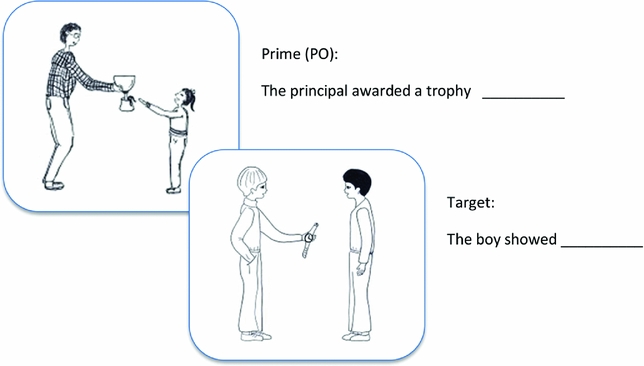
The priming study was a written, web-based questionnaire conducted using Qualtrics. After completing the consent form, the participant was instructed to describe the pictures by completing the sentence fragments provided including all characters visible in the picture. One example trial and example answer was provided (The boy kicked the girl who was kicked by the cat). Each participant was then presented with 100 trials (27 primes; 27 targets; 46 fillers). Trials were presented one at a time, each on a new screen. Prime trials had sentence fragments that either forced a PO completion (The nurse gave the medicine. . .), a DO completion (The nurse gave the patient. . .), or were intransitive (e.g. a picture of a girl laughing, with the fragment The girl . . ..). Target trials directly following the prime consisted only of a subject and a verb (The clown showed. . .), see Figure 1. No nouns or verbs were repeated between the prime and the target. The order of the trials was pseudorandomized, such that a target was separated from the next prime by one to three filler trials.
An example of a PO prime-target pair. Prime and target trials were presented on subsequent screens.

Each participant saw each combination of prime verb and target verb twice, but each time in a different priming condition and with different pictures. Three versions of the experiment were created such that a ditransitive picture was associated with one priming condition in one list, and another priming condition in another list. Collapsed over all three versions of the experiment, each of the three target verbs was combined with each of the nine priming verbs in both the PO and the DO priming conditionsFootnote 1 . Participants were randomly assigned to each of the three lists. After the last trial in the priming study, the participants were asked to answer the questions about their language background.
Scoring
Blank responses and responses consisting of random characters were coded as null responses. Prime and target completions were scored as DO when the indirect object NP (recipient) was followed by the direct object NP (theme); completions were scored as PO when the direct object (theme) NP was followed by a prepositional phrase that started with the preposition to and described the recipient. Responses were coded as Transitives if the verb was followed by a direct object (theme) only (The girl handed a book). “Other” responses included responses in which the theme was missing (The woman showed a handsome guy), or responses with scrambled orders (The boy handed to singer a guitar; The librarian handed a book a boy), sentential complements (The boy showed his mom how well he did on his test), prepositional phrase being the theme (The woman offered the man to bag), the use of for rather than to (The woman offered briefcase for husband business), the use of a different verb than the one provided in the target fragment; and completions that did not fall under any of the above. Responses were classified into the above categories regardless of typographical errors or omission of determiners.
Results and analysis
Target responses
Native English
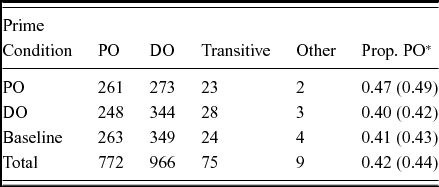
Out of the 1944 total target responses collected from the 72 native English speakers, 20 were null responses and were omitted from analysis. In addition, 102 primes were not completed, or were completed incorrectly for our purposes (i.e., no direct object NP was completed in a DO frame, or no prepositional phrase was completed in a PO frame). These trials were also omitted from analysis. The final data set consisted of 1822 responses. Table 1 gives an overview of the response type for each of the priming conditions. The native English group showed a slight preference for a DO response. Numerically, fewer DO responses were produced after a PO prime than after a DO prime. The native English group produced few Transitive and Other responses, and produced such responses at a roughly equal rate across the priming conditions.
Native English speakers’ target completions as a function of prime condition.

* Proportion of PO completions based on the number of PO, DO and Transitive completions. Number between parentheses is the proportion of PO completions based on the number of PO and DO completions. PO Prepositional object dative; DO double object dative.
Korean learners of English
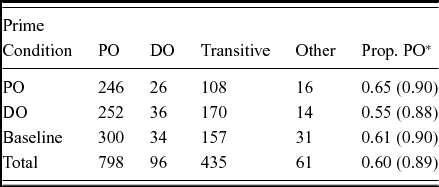
Out of the 1647 total responses collected from the 61 Korean L2 English speakers, we omitted 44 null responses and 213 trials of which the prime was not correctly completed. This yielded 1390 data points for analysis. Table 2 gives an overview of the response type for each of the priming conditions for the Korean L2 English participants. In contrast to the native English group, the Korean learners of English showed a large preference for a PO response, with hardly any DO responses being produced as target completions. The Korean group also produced more Transitive (e.g., The man showed a hat) and Other responses than the native English group. Numerically, more Transitive responses were produced after a DO prime than after a PO or baseline prime. This suggests that the Korean L2 speakers used the Transitive rather than the DO construction as alternating with the PO constructions. Given the small number of DO responses in the Korean group, and their apparent use of the Transitive as alternating with the PO structure, we chose to conduct analyses on the PO responses relative to the DO and Transitive responses. A reduction in the number of PO responses after a DO prime (versus a baseline prime) can be interpreted as sensitivity to the difference between the PO and DO structure. Restricting the analyses to DO and PO responses only may not have captured the learners’ sensitivity to the priming structure. In the Supplementary materials we report an analysis restricted to PO and DO responses only (Tables S7-12 in Supplementary Materials). An additional 16 L2 learners were dropped in the latter analysis because they had fewer than two responses in a particular cell. Analyses yielded similar cumulative adaptation effects for the baseline condition as reported in the main text.Footnote 2
Korean L2 English speakers’ target completions as a function of prime condition.

* Proportion of PO completions based on the number of PO, DO and Transitive completions; Number between parentheses is the proportion of PO completions based on the number of PO and DO completions. PO: Prepositional object dative; DO: double object dative.
Effects of cumulative adaptation and immediate priming
To investigate to what extent the two groups differed in the effect of cumulative adaptation, we included as factor in our analysis the number of DO constructions and the number of PO constructions completed by the participant prior to the target trial. Previous studies (Jaeger & Snider, Reference Jaeger and Snider2008; Messenger et al., Reference Messenger, Branigan and McLean2011) distinguished between constructions perceived as primes and constructions produced as targets to assess across-subject and within-subject persistence. However in our study, perception of the prime cannot be easily distinguished from production of the prime, since the participant was asked to complete the incomplete structure provided by the prime. For this reason, we collapsed across the number of preceding primes and targets, without distinguishing perception from production.
We conducted a logistic linear mixed-effects model using R version 3.2 (R Core Team, Reference Core Team2015) on responses to target trials that were immediately preceded by a DO, PO, or baseline prime. The dependent variable was the type of target response, with PO coded as 1 and DO and Transitive coded as 0. The data set analyzed (including DO, PO and Transitive responses only) included 1813 data points for the English participants and 1329 for the L2 participants. Fixed effects in the model were: prime condition (PO, DO, baseline; treatment coded, with baseline primes as the baseline level), language group (native English, L2; sum-coded), number of prior DO constructions completed by the individual (as prime or target), number of prior PO constructions completed by the individual (as prime or target), the interactions between prime condition and each of the other factors, interactions between language group and each of the other factors, the triple interaction between prime condition, language group and number of prior DO, and the triple interaction between prime condition, language group and number of prior PO. All fixed effects, with the exception of prime condition, were centered around the mean to reduce collinearity and facilitate interpretation of the coefficients. Participant and item (where “item” is each combination of target verb and target picture) were included as random factors. As per Barr, Levy, Scheepers and Tily (Reference Barr, Levy, Scheepers and Tily2013) we started with a maximum random effect structure. However, due to convergence problems, the random effects only included the random by-subject and by-target item intercepts, by-subjects and by-items random slopes for prime condition, and by-subject slopes for the number of prior PO and DO constructions, unless noted otherwise.
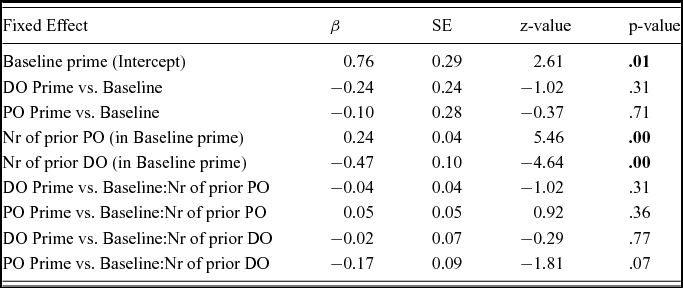
A table with all results from the analysis is presented in the Supplementary materials (Table S4 in Supplementary Materials). Native English speakers produced fewer PO targets than Korean learners of English in the baseline primes (effect of language, β = −1.15, S.E. = 0.43, z = −2.69, p = .01). Of interest to our research question is that language group interacted with the number of prior PO constructions (β = −0.13, S.E. = 0.05, z = −2.82, p = .00). In addition, there were significant or near-significant triple interactions between language group, PO Prime (versus baseline), and the number of prior PO (β = 0.12, S.E. = 0.05, z = 2.24, p = .03) or DO trials (β = −0.15, S.E. = 0.08, z = −1.81, p = .07). To further explore these effects, we conducted separate analyses for each language group. Results are in Tables 3 and 4, and will be discussed below.
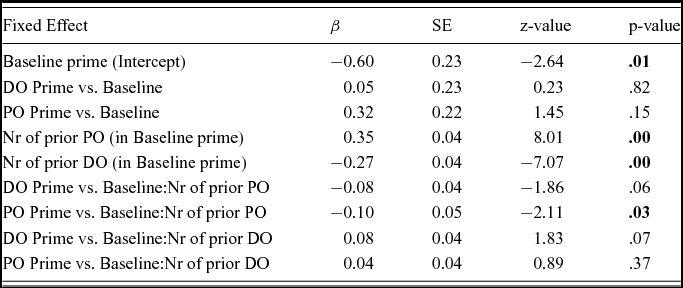
Results from the logistic mixed-effects model on the PO productions for the native English participants.

Based on 1813 data points; Loglik = -801. Interactions are indicated with “:”. Random effects include by-subject and by-item intercepts; Prime as a by-subject and by-items random slope, and Number of preceding PO and DO as by-subject random slopes.
Results from the logistic mixed-effects model on the PO productions for the Korean L2 English participants.

Based on 1329 datapoints; Loglik = -560.4. Random effects include by-subject and by-item intercepts, Prime as a by-subject and by-items random slope, and Number of preceding PO and DO as by-subject random slopes.
Cumulative adaptation
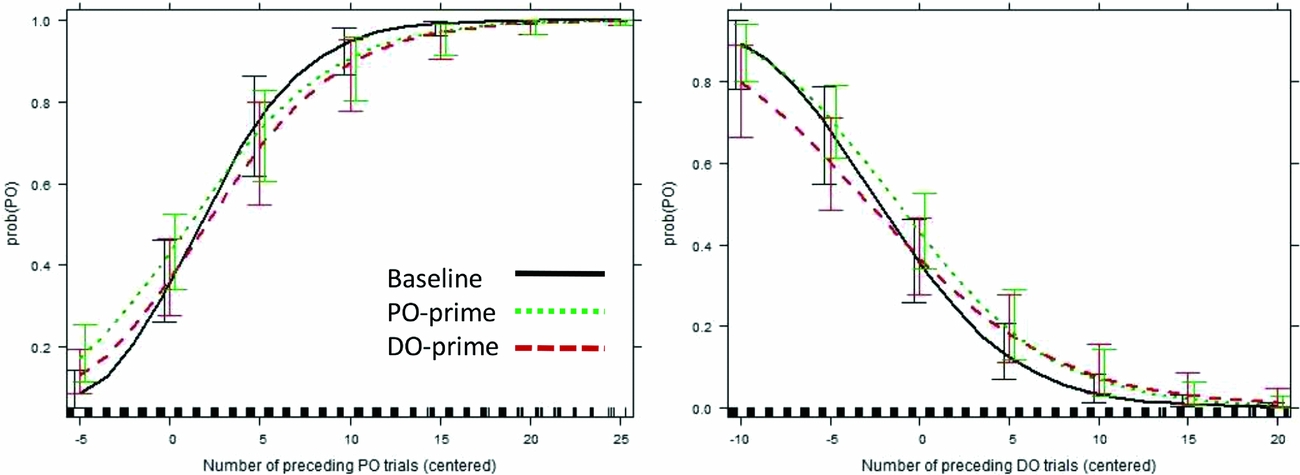
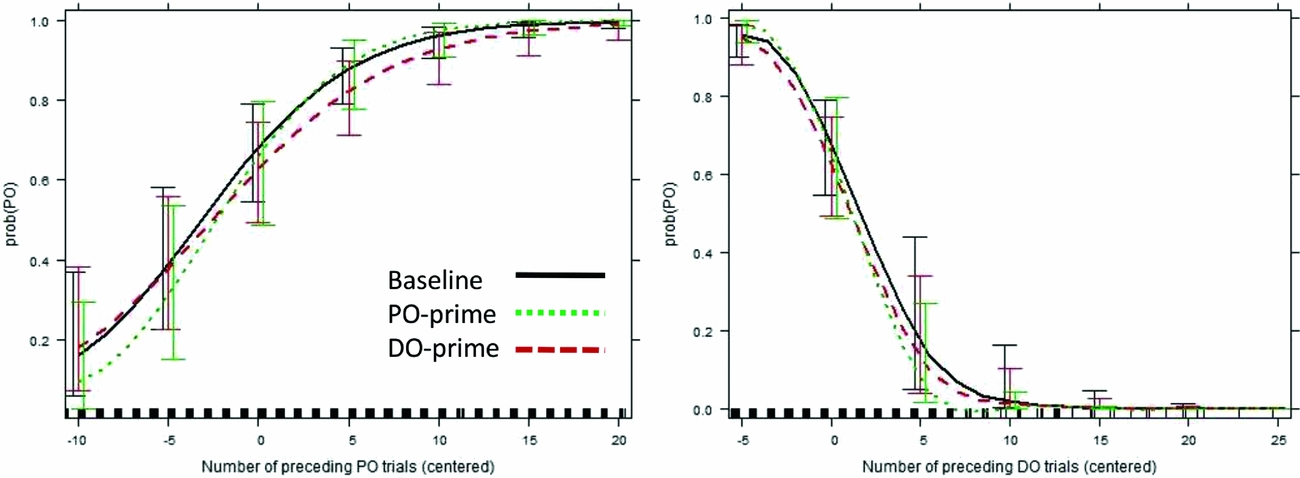
Both groups showed effects of cumulative adaptation: more PO structures were completed in the baseline condition when more prior PO constructions had been encountered; fewer PO constructions were produced when more DO constructions had been encountered (see the baseline condition in Figures 2 and 3). The native English speakers showed a stronger adaptation to the number of prior PO structures than the Korean speakers of English, leading to the interaction of Language by the Number of Prior PO structures in the main analysis. For the native English group (Table 3), the cumulative effect of the number of preceding structures, as indicated by the β coefficient for the number of prior PO and DO structures, was somewhat larger for the PO than the DO structures: for every PO structure encountered, the PO productions increased with 0.35 logits, whereas for every DO encountered the PO productions decreased (that is, the non-PO productions increased) with 0.27 logits. For the Korean learners of English (Table 4), the effect of the number of prior DO structures was larger than that of the number of prior PO structures: for every PO encountered, the PO productions increased with 0.24 logits, whereas with every DO encountered, the PO productions decreased with 0.47 logits. These results suggest that larger cumulative adaptation effects are seen for the structure that is less frequent to the language user, namely the PO structures in the native English speakers, and the DO structures in the Korean learners of English.
Model results for the native English group: Effects of cumulative adaptation of the number of preceding PO structures (left) and DO structures (right) on the probability of producing a PO target. The number of prior structures (x-axis) is centered; logits converted to probability space (y-axis); error bars are 95% confidence intervals.

Model results for the Korean L2 English group: Effects of cumulative adaptation of the number of preceding PO structures (left) and DO structures (right) on the probability of producing a PO target. The number of prior structures (x-axis) is centered; logits converted to probability space (y-axis); error bars are 95% confidence intervals.

However, we need to be careful interpreting the results for the Korean learners of English. Only 12 of the Korean participants produced DO constructions aside from the forced completions in the 9 DO primes. Hence, only very few data points were available for trials with more than 9 preceding DO constructions. To get a better understanding of the cumulative adjustment related to the number of preceding DO structures, we conducted another analysis on the Korean L2 data in which we only considered target trials with fewer than 10 preceding DO structures. Results were similar to those reported for the main analysis: the likelihood of a PO production decreased as more DO constructions were encountered (β = −0.81, S.E. = 0.22, z =−3.60, p < .0001), and this effect was larger than the increase in the likelihood of a PO production as more PO constructions had been encountered (β = 0.55, S.E. = 0.16, z = 3.45, p < .0001). Since the DO constructions are less frequent than the PO constructions in Korean L2 English, this pattern was expected.
Immediate priming effects and cumulative adaptation
The native English speakers showed numerically stronger priming effects for PO primes versus baseline (coefficient (β) 0.32) than for DO primes versus baseline (coefficient 0.05), whereas the Korean L2 English group showed numerically stronger effects of DO primes (coefficient −0.24) than PO primes (coefficient −0.10). Although neither group showed significant effects of immediate priming, the coefficients pattern in the expected directions given that the groups started out with different frequencies of the two constructions. Additionally, the groups differed in the modulation of the immediate priming effects by the number of preceding trials. The PO priming effect in the native English group was affected by the number of PO constructions encountered in the experiment, leading to a significant interaction of PO prime (vs. baseline) by the number of prior POs. This effect is illustrated in Figure 2, left panel: after having encountered only few PO structures, the native English group produced more PO targets after a PO prime than after a baseline prime; when more PO constructions had been encountered, more PO targets were produced after a baseline than after a PO prime (reverse priming effect). The number of preceding DO constructions had less of an effect, although numerically more PO targets were produced after a DO prime than after a baseline prime with more preceding DO constructions (Figure 2, right panel).
The Korean L2 speakers of English did not show strong effects of the number of preceding DO or PO trials on the size of the priming effect (Figure 3).
Summary: cumulative and immediate priming
To summarize, both the native English and the Korean L2 English groups showed effects of cumulative adaptation: both showed an increase in the likelihood of producing a PO construction after a baseline prime as more PO constructions had been encountered in the experiment; both showed an increase in the likelihood of producing a non-PO construction (DO or Transitive) after a baseline prime as more DO constructions had been encountered. The native English group showed a larger adaptation effect for the PO structures than the Korean learners of English. Within each group, the slope of the adaptation effect was steeper for the least frequent structure (PO in the native English group, and DO in the L2 Korean group). These results suggest that both groups have an abstract representation of the PO structure and of the alternate structure, and are sensitive to the frequency with which these constructions are encountered (even though the Korean L2 speakers may collapse the representation of a DO with that of a Transitive, see Discussion).
The groups also differed in the modulation of immediate priming effects by the number of previous constructions seen. The native English group produced more PO targets after a PO prime than after a baseline prime at the beginning of the experiment, but were more likely to produce a PO after a baseline prime when more PO constructions had been encountered, leading to a reverse immediate priming effect. On the other hand, the Korean learners of English produced numerically fewer PO constructions after a DO prime than after a baseline prime, but this was not modulated by the number and type of constructions encountered.
Verb bias and surprisal
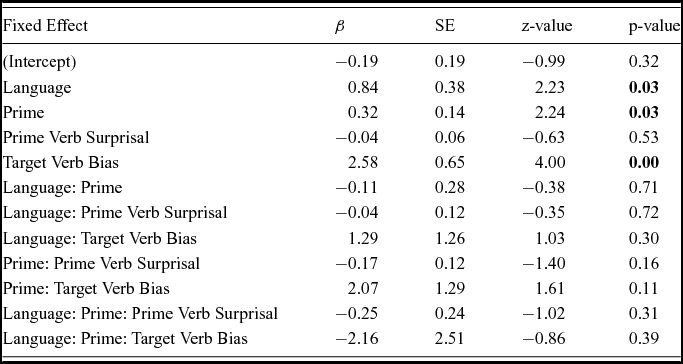
To investigate to what extent native English speakers and Korean learners of English were sensitive to the properties of the verbs, we conducted a logistic linear mixed-effects model on data restricted to trials containing a DO or PO prime. We omitted trials with a baseline prime because the (intransitive, transitive) verbs in this condition did not have any DO or PO bias. Fixed effects were: prime condition (sum coded, DO vs. PO), language group (sum coded, Native vs. Korean L2), target verb bias, prime verb surprisal, and the interactions between prime condition and each of the previous factors, and between language group and each of the previous factors, the triple interaction between prime condition, language group and target verb bias, and the triple interaction between prime condition, language group and prime verb surprisal. The random effects included the by-subject and by-item intercepts (where “item” is the combination of target verb and target picture), and prime condition as a by-subject and by-item random slope. Models with a more complex random-effect structure did not converge. Target verb bias and Prime verb surprisal were estimated using the English norming data (see methods). Prime verb surprisal was computed as the negative base-2 log of the probability that the verb occurred in the (PO or DO) construction used in the prime, relative to it occurring in the alternate ditransitive or Transitive construction (Jaeger & Snider, Reference Jaeger and Snider2013). Larger values on this measure correspond to larger surprisal. Target verb bias was estimated using the log odds of the verb occurring in a PO versus DO or Transitive construction. The larger this number, the stronger the PO bias of the verb (Bernolet & Hartsuiker, Reference Bernolet and Hartsuiker2010). Outcomes of the model are given in Table 5. An analysis using verb bias and surprisal measures calculated on the basis of PO and DO responses only yielded similar effects.Footnote 3
Results from the logistic mixed-effects model on the PO productions as a function of Prime Verb Surprisal and Target Verb Bias for all participants.
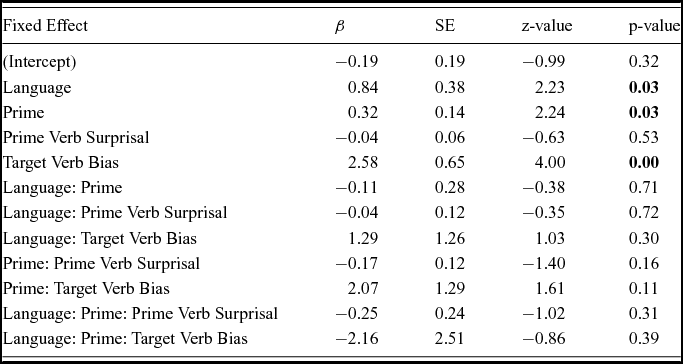
Based on 2050 observations; Loglik = -1061.7. Random effects include by-subject and by-item intercepts, and Prime as a by-subject and by-items random slope.
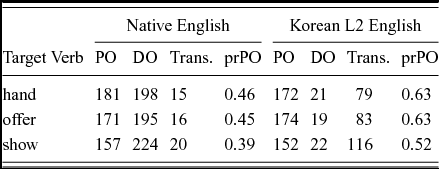
As in the previous analysis, Korean learners of English produced more PO constructions than native English speakers, leading to a significant effect of language group. There was a significant immediate priming effect: PO primes led to a reliable increase in the production of PO constructions versus DO primes. There was no effect of surprisal, that is, the bias of the prime verb had no effect on priming (in contrast to Bernolet & Hartsuiker, Reference Bernolet and Hartsuiker2010; Jaeger & Snider, Reference Jaeger and Snider2008). The bias of the target verb did affect the target production preferences: the stronger the PO bias of the target verb, the more PO responses were produced. Table 6 shows the responses for each of the three target verbs. The verb showed yielded fewer PO responses than the other two verbs. This verb had the weakest bias for a PO construction in the norming results (see Table S3 in Supplementary Materials).
Native English and L2 English speakers’ target completions as a function of target verb, collapsed over DO and PO primes.

prPO: Proportion of PO completions based on the number of PO, DO and Transitive (Trans.) completions.
We had expected the native English and Korean L2 English groups to differ in prime verb surprisal effects, since the two groups may entertain different verb biases. To further explore differences in prime verb surprisal effects we conducted separate analyses on the Korean and the English group, using the verb bias information collected for these specific groups in the norming study. Results from these analyses are given in the Supplementary materials (Tables S5 and S6 in Supplementary Materials). Although the native English group showed a significant immediate priming effect (more PO produced after a PO prime than after a DO prime, β = 0.41, S.E. = 0.20, z = 2.08, p = .04), this priming effect was not modulated by prime verb surprisal (β = -0.09, S.E. = 0.16, z = -0.55, p = 0.59). In the analysis using Korean verb biases, the Korean learners of English showed a weak effect of prime verb surprisal on priming (β = -0.78, S.E. = 0.40, z = -1.94, p = 0.05). However, the direction of the effect is different from what is expected on the basis of error-based learning: priming effects become smaller with larger prime verb surprisal, as opposed to becoming larger. The Korean L2 English learners had a PO preference for the prime verbs, hence surprisal was systematically large in the DO prime conditions. The reverse surprisal effect on priming suggests that L2 Korean English learners tended to complete the target as a PO, even when the PO biased prime verb appeared in a DO frame and was associated with large surprisal in this group.Footnote 4
Summary: Verb bias effects
Participants were sensitive to the bias of the target verb: fewer PO targets were produced when the target verb was less strongly biased for a PO structure. However, neither group showed effects of surprisal: that is, immediate priming effects did not become stronger when the prime verb occurred in a structure that was less typical for that verb.
Discussion
The aim of this study was to investigate to what extent native and L2 speakers adapt their language use to the preceding context, in particular, as a function of (1) the number of structures of a certain type encountered (cumulative adaptation); (2) the structure of the immediately preceding item (immediate priming); and (3) the unexpectancy of the preceding prime structure given the prime verb bias (prime verb surprisal effects). Under both error-based learning, and base-level learning models such as Reitter et al.’s ACT-R model (Reitter et al., Reference Reitter, Keller and Moore2011), differences between the native and the L2 group were expected to be due to differences in pre-existing frequencies of the structures and biases between the groups. Immediate priming and cumulative adaptation effects were expected to be stronger for structures that the participants had encountered less frequently in their daily language use. These predictions were largely borne out: adaptation effects were larger for the PO structures in the native English speakers, and for the DO structures in the Korean L2 English speakers. However, whereas both groups showed significant cumulative adaptation effects to the number of preceding DO and PO structures, immediate priming effects were not significant in the L2 learners, and only attested at the beginning of the study for the native English group. In addition, under an error-based learning approach, priming effects were expected to be larger when the prime structure is infrequent given the prime verb bias (surprisal). We did not find any surprisal effects, however. We will discuss these findings below.
Cumulative adaptation
Results showed cumulative adaptation in both the native English and L2 groups, for both PO and DO constructions. The native English group adapted significantly more strongly to the PO structures over the course of the study than the Korean L2 English group. In addition, based on the size of the coefficients, the native English group showed a slightly larger effect of the number of preceding PO structures than DO structures, whereas the L2 speakers showed a larger adaptation to the DO than the PO structures. Recall that DO structures are typically somewhat more frequent than PO structures in American English, whereas the PO structure is by far the most frequent ditransitive in Korean L2 English. These results suggest that both native speakers and Korean L2 learners have an abstract structural representation of the two ditransitive structures, whose activation changes as a function of the number of times these structures have been recently encountered. This adaptation is strongest for structures that are initially infrequent. Since L2 and native groups start out with different frequency preferences, the patterns of adaptation are slightly different between the groups. This can be explained by error-based learning: language users initially expect the structure that is most frequent for them. When this expectation is not met, the alternative, less frequent structure gets boosted. The results can also be accounted for by base-level learning models (Reitter et al., Reference Reitter, Keller and Moore2011) in which the base-level activation of a structure is increased with each use; infrequent structures benefit more from this boost, resulting in a stronger adaptation effect for the infrequent structures (Hartsuiker, Kolk & Huiskamp, Reference Hartsuiker, Kolk and Huiskamp1999; Hartsuiker & Westenberg, Reference Hartsuiker and Westenberg2000; Kaschak, Reference Kaschak2007; Kaschak et al., Reference Kaschak, Loney and Borreggine2006).
Immediate priming effects
Also in support of frequency-dependent adaptation, the native English speakers showed an effect of immediate priming for the initially infrequent PO constructions; this effect decreased (or even reversed versus the baseline condition) as more PO structures had been encountered in the experiment and the participants started to use more PO structures overall (Hartsuiker et al., Reference Hartsuiker, Kolk and Huiskamp1999; Hartsuiker & Westenberg, Reference Hartsuiker and Westenberg2000; Kaschak, Reference Kaschak2007; Kaschak et al., Reference Kaschak, Loney and Borreggine2006). The L2 group showed a numerically stronger effect of immediate priming for the less frequent structure (non-PO structure) than for the more frequent structure (PO).
In contrast to the cumulative adaptation effects, however, the immediate priming effects were much weaker, and even only numerically present in the L2 learners. Especially given the strong preference for the PO structure in the Korean L2 learners, priming effects for the infrequent DO construction were expected to be very strong under both an error-based learning account and a base-level learning account. The discrepancy between the robust cumulative adaptation effects and the weak immediate priming effects, especially in the L2 speakers, can be accounted for in several ways. We will discuss the underspecification of the structure, weaker predictive processing, and task characteristics.
The cumulative adaptation effects suggest that both native speakers and Korean L2 learners of English have an abstract structural representation of the alternate structures; however, the absence of immediate DO priming effects in Korean L2 English learners in this and other studies can be taken to suggest that Korean L2 English learners lack an abstract representation of the DO structure (S. Kim, Reference Kim2010; McDonough, Reference McDonough2006; Park, Reference Park2007). This discrepancy between the cumulative and immediate priming effects can be reconciled by assuming that the Korean L2 English speakers have an underspecified non-PO ditransitive alternate. The Korean L2 English learners in our study often produced a transitive structure as a target (The clown showed the hat) instead of a DO (The clown showed the cowboy the hat). Judging from Table 2, more transitives were produced after a DO prime than after a PO prime. The observation that DO ditransitives (cumulatively) primed transitives suggests that the Korean L2 English learners treated the DO and the transitive constructions as similar at some level of representation. Our proposal is that the Korean L2 learners entertain a non-PO ditransitive construction of the form [V (NP1) NP2], in which the NP representing the indirect object (NP1) is optional or not robustly represented. This structure is activated each time the participant encounters a DO or a Transitive in a ditransitive event, leading to cumulative adaptation effects.
Assuming an underspecified non-PO ditransitive structure, the weak immediate DO priming effects in the L2 learners can be accounted for as follows. Under a prediction-based approach to priming (Dell & Chang, Reference Dell and Chang2014), the Korean L2 learners strongly expect a PO construction when processing the prime fragment, since the PO structure is the most frequent to them. In such a structure, the NP following the verb is the (typically inanimate) direct object. Hence, when reading The boy threw. . . the L2 parser expects the next phrase to be the ball or another inanimate object. However, in the DO primes in the present study, the verb is followed by an animate, indirect object NP (e.g., his friend in The boy threw his friend. . .). This sequence leads to an error signal, since the participant expects a direct object (inanimate noun phrase, e.g., the ball) to follow the verb. However, this error cannot be used to immediately boost the DO structure, since the animate NP cannot be directly mapped onto the underspecified indirect object NP1 in the [V (NP1) NP2] construction. As a result, immediate priming from the DO prime onto the activation of the non-PO structure is rather weak. Alternatively, one can assume that immediate priming is partly driven by spreading activation, as in the model proposed by Reitter et al. (Reference Reitter, Keller and Moore2011). Since the DO prime structure is underspecified in the Korean L2 learners, the cues provided by the prime do not lead to spreading activation that can strongly boost the target structure. In both models, the non-PO ditransitive structure can increase in activation after the prime trial has been fully processed and completed. This activation may be too weak for a strong immediate priming effect, but does give rise to the cumulative adaptation effect. Obviously, more research is needed to work out such accounts in detail.
A second potential reason why immediate priming effects were weak is that the L2 learners may not have actively predicted the elements after the verb in the prime structure. As explained in the above, prediction is necessary to obtain an error signal. Previous research on predictive processing in L2 learners has shown that L2 learners may not predict, or may not always predict in a native-like way (see for an overview, Kaan, Reference Kaan2014). Under error-based views of priming, the learners will not have received an error signal when encountering a DO prime, and hence will not have adjusted their representations in response to the prime structure. This may account for the weak immediate priming effect, but does not explain the cumulative priming effects.
A third reason why the Korean L2 learners may not have shown robust immediate priming of the infrequent structure is that the completion task may not have enforced deep processing of the prime structure. In contrast to studies in which the participant is asked to repeat the complete prime, or listens to the complete prime spoken by a confederate, the completion task used in this experiment presented only partial primes that the participants had to complete with a direct object or prepositional phrase. Furthermore, the task was not timed, and we did not control how long a break participants could take between their completions. Even in native speakers, written completion tasks have yielded rather weak effects of immediate priming (Pickering & Branigan, Reference Pickering and Branigan1998). Participants’ attention may therefore not have been drawn to the priming structure, resulting in only a weak activation of this structure. In addition, we did not repeat the verb between the prime and the target. Priming effects are typically larger with lexical repetition (Cleland & Pickering, Reference Cleland and Pickering2003; Pickering & Branigan, Reference Pickering and Branigan1998), especially in low-proficient L2 speakers (Bernolet et al., Reference Bernolet, Hartsuiker and Pickering2013). The prime-based increase in activation of the infrequent DO prime structure may not have been robust enough to strongly affect the completion of the target, but was strong enough to lead to accumulation of the activation of the DO structure (or its non-PO ditransitive equivalent) resulting in the cumulative adaptation effect.
Verb bias effects
The third prediction that follows from an error-based learning approach, but not from the model proposed by Reitter et al., is that priming effects are stronger if the prime structure used is infrequent given the biases of the verb used in the prime. Such surprisal effects have been attested in previous studies on native speakers (Bernolet & Hartsuiker, Reference Bernolet and Hartsuiker2010; Jaeger & Snider, Reference Jaeger and Snider2008; Jaeger & Snider, Reference Jaeger and Snider2013). However, neither the native English speakers, nor the L2 learners showed increased priming effects with larger prime verb surprisal in the present study. Only the bias of the target verbs had an effect: regardless of the prime condition, participants were more likely to produce a PO construction with the verbs hand and offer, which were slightly PO biased, than with the equibiased target verb show (for effects of target bias, see e.g., Gries, Reference Gries2005; Peter et al., Reference Peter, Chang, Pine, Blything and Rowland2015). The observation that L2 learners are sensitive to subcategorization biases in L2 is supported by a growing number of other studies showing that L2 speakers can use subcategorization information during L2 processing, although the L2 bias may not always be native-like (Dussias, Marful, Gerfen & Bajo, Reference Dussias, Marful, Gerfen and Bajo2010; Gries & Wulff, Reference Gries and Wulff2005; Lee, Lu & Garnsey, Reference Lee, Lu and Garnsey2013).
The absence of a prime verb surprisal effect in our study, even in the native speakers, was not predicted under an error-based learning approach. However, the absence of prime verb surprisal effects is not unique to this study (see e.g., Peter et al., Reference Peter, Chang, Pine, Blything and Rowland2015), and can be attributed to the specific materials or tasks used, or developmental factors. In support of the latter, Peter et al. (Reference Peter, Chang, Pine, Blything and Rowland2015) reported that the 3 to 4- and 5 to 6-year-old children tested in their priming study showed a much stronger effect of surprisal than adults. Peter et al. (Reference Peter, Chang, Pine, Blything and Rowland2015) speculated that the learning rate is larger in children than in adults. In children, prediction errors therefore result in more rapid changes with respect to the weights associated with knowledge representations. As the children mature, their learning rate gets smaller. Old knowledge can no longer easily be overwritten by new experiences, leading to stabilization of the learner's knowledge (Chang et al., Reference Chang, Dell and Bock2006). The reduced learning rate in adults may explain why the native speakers in our study did not show a surprisal effect. If our results are representative of adult L2 learners, this may suggest that the learning rate is not re-set with the acquisition of a new language, but rather biologically determined. Alternatively, the L2 learners’ learning rate may be smaller because of the presence of their previous (L1) experience, which may then block the acquisition of new alternatives (Arnon & Ramscar, Reference Arnon and Ramscar2012). This issue warrants further investigation. The absence of surprisal effects in the current study is compatible with error-based learning approaches as well as models that do not assume error-based learning.
Conclusions and future research
Results from the present study suggest that L2 speakers are similar to native speakers in adapting their language use to the preceding language context. Both show cumulative adaptation effects which are larger for the structure that is initially less frequent to them. Differences between L2 learners and the native speakers can be accounted for by differences in starting frequency and the nature of the structural representation entertained. The current findings support the view that adaptation occurs through implicit learning, be it error-based learning or through other mechanisms that incorporate a frequency-dependent modulation of activation of structures (Reitter et al., Reference Reitter, Keller and Moore2011).
The observation that adult L2-learners adapt their language use to the surrounding language context has implications for language learning. If adaptation is driven by error-based learning, what kind of input would lead L2-learners to efficiently and quickly adjust their knowledge in the direction of the target language? In order for errors to be informative, L2 learners would need to experience errors (Arnon & Ramscar, Reference Arnon and Ramscar2012), and would need to know what to change, or which structure to boost in response to the errors. We suggested in the above that the Korean L2 learners may experience a prediction error when reading the animate NP following the verb in the DO primes. However, this error cannot serve as a good cue to boost the DO structure, since the indirect object may be underspecified in the Korean L2 learners’ representation of the non-PO ditransitive, and the animate NP cannot be directly mapped into the indirect object slot. An interesting question is then what kind of errors would cue the L2 learners to make the structural representation of the non-PO ditransitive more native-like? Some structures may be tied to some specific lexical items in beginning learners. Learners generalize these constructions to other lexical items as they become more proficient (e.g., Bernolet et al., Reference Bernolet, Hartsuiker and Pickering2013; McDonough, Reference McDonough2006; Tomasello, Reference Tomasello2000). Previous studies report that L2 English speakers use DO structures primarily with pronouns (Hawkins, Reference Hawkins1987; McDonough, Reference McDonough2006). In a corpus study on written essays by Korean learners of English (Yonsei English Learners’ Corpus, Rhee & Jung, Reference Rhee and Jung2014), we also observed that Korean L2 learners of English produce more DO structures with pronouns (75%) than with other noun phrases (25%), whereas PO structures were used overwhelmingly more often with other noun phrases (95%) than with pronouns (5%, Hinrichs, Reference Hinrichs2015). Using priming and adaptation paradigms in which a variety of noun phrases are used may therefore encourage the activation of a more native-English like DO structure. Also, learners with different levels of L2 proficiency are expected to differ in their extent and rate of adaptation. More experience in the L2 may affect the structural representations, and structural and lexical biases, and hence, the ability to use prediction errors to adapt to the preceding language context.
Another question, which we did not investigate in the current study, is to what extent adaptation persists. McDonough (Reference McDonough2006) reports immediate priming effects, but no persistence of the DO structure when the L2 learners are tested in a delayed post-test. If error-based learning and adaptation are considered important mechanisms underlying language learning, it is crucial to investigate what type of paradigms and manipulations yield the strongest persistence.
Supplementary Material
For supplementary material accompanying this paper, visit https://doi.org/10.1017/S1366728916001231