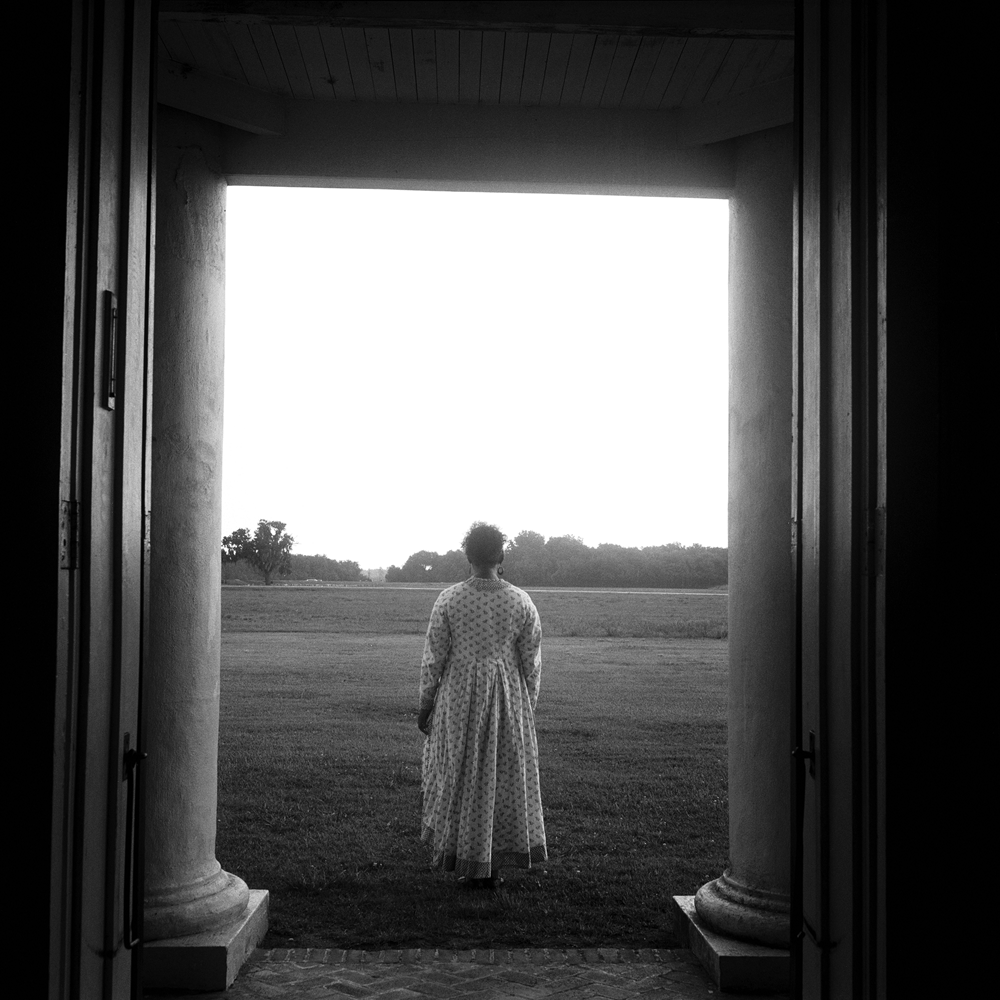
Photographing the American landscape has traditionally been a white, male terrain, a form of capturing the land that bears the legacy of the country's colonial project of white supremacy. Mapping this terrain must therefore attend to how American topographies are permeated with an unfinished history of slavery, violence, and racist oppression against nonwhite bodies – bodies that, as Kimberly K. Smith has noted, have historically been simultaneously forced into close relationship with, and alienated from, the natural environment.Footnote 1
This essay explores how two contemporary black female artists work with written and visual media to develop what we might call, after the famous 1975 American landscape photography exhibition, a new, anticolonial, topographics.Footnote 2 Carrie Mae Weems (b. 1953) is an African American photographic and video artist whose work blends the political and the personal, often to include written and spoken words of anticolonial cultural critique. Claudia Rankine (b. 1963) is a Jamaican American poet, whose last two books, plays, and recent curatorial projects have evinced a politics and poetics of resistance via formal experimentation in word–image combination. Building on these artists’ mutual acknowledgement that their shared aesthetic and political positions unite them as “sisters,”Footnote 3 this essay provides the first critical examination of the works of Weems and Rankine side by side.
The following pages begin to chart how Weems and Rankine challenge Euro-American topographical paradigms of white power by unearthing alternative, anticolonial perspectives on what constitutes a “man-altered landscape,”Footnote 4 thereby dismantling habitually racialized hierarchies of viewing. I read the new topographics of Weems and Rankine as anticolonial, rather than postcolonial, because both artists work in a tradition of recognizing the colonial as an ongoing project of oppression, in which “nations, states and communities, as well as bodies and identities, are engaged as still colonised and resisting the colonial encounter.”Footnote 5 Anticolonial discourse is suggested by Simmons and Dei “as a politics of action” through which one comes to better understand “the lived experiences of the self … beyond the governing ethic of Euro-modernity.”Footnote 6 This discursive tradition in the US, particularly in relation to the country's antiblack racism, begins with W. E. B. Du Bois, and develops through the influence of the French phenomenologist Frantz Fanon, taking more intersectional form in the writings of Audre Lorde, Angela Davis, and bell hooks. Indeed, hooks places Carrie Mae Weems as a key figure in the anticolonial project: an artist whose work “preceded contemporary academic focus on decentering Western civilization.”Footnote 7 hooks's preference for anticolonial discourses extends from her frustration at the way postcolonial perspectives often replace “the image of colonizing oppressive whiteness with that of a newly reclaimed radical whiteness portrayed as liberatory.”Footnote 8 While postcoloniality is a critical location that retains whiteness as “the starting point for all progressive cultural journeying,” avers hooks, anticolonialism works to “decenter, interrogate, and displace whiteness.”Footnote 9
In this anticolonial lineage, embodied narratives of racist oppression are key to confronting the continuation and mobility of white cultural hegemony. For both Weems and Rankine, the effects of living in a landscape from which one continues to be psychologically and physically dispossessed are borne in and by the body, so that to understand colonialism as an unfinished project, one must make visible the normally invisible governing structures of whiteness that determine the trajectory of bodies – black and white – within and beyond the American landscape. To do this, Weems and Rankine, in different ways, address the conditions of erasure, invisibility, and hypervisibility under which the black body continues to suffer. Gesturing toward new ways of orienting both the body and the gaze, Weems and Rankine engage in a visual politics that shifts what hooks calls “the starting point,” to reverse viewing hierarchies: the phenomenological orientations of whiteness become the subject of the picture; the position of the black body becomes the “standpoint.”Footnote 10
The reorientation devices employed by Weems and Rankine thus work by means of disorientation. Both artists revisit, recontextualize, and revisualize locations in the American landscape in which racialized narratives have been inscribed, requiring us to question the processes involved in signification at the site where an event – and a photograph – takes place.Footnote 11 In their landscapes, the black body is either conspicuously present, or conspicuously absent; it moves, often transhistorically, between codes of the visual and the verbal, erasure and visibility. This in-betweenness constitutes a phenomenological threshold – a shifting coordinate from which both artists suggest a new approach to, and motility through, the landscape.
My approach in this essay is similarly along a path of liminality.Footnote 12 I consider “topography” as a word whose two principal definitions are connected by the ways that mapping is a social and cultural practice. Topography is a term employed geographically and cartographically, to describe the arrangement, charting, and study of the natural and artificial features on (or directly beneath) a tract of land. It is also employed anatomically, to describe “the determination of the position of the various parts and organs of the body.”Footnote 13 This essay interrogates the extent to which these two meanings are yoked in Weems's and Rankine's landscapes; how the two artists explore the ways in which geographical and corporeal topographies reveal the inscriptions and erasures of the past on the present.
I draw on Sara Ahmed's work on anticolonial phenomenology to construct my analysis. In her 2007 article “A Phenomenology of Whiteness,” Ahmed critiques what she calls “whiteness as orientation.”Footnote 14 Following Frantz Fanon's explication of racial phenomenology in his groundbreaking Black Skin White Masks (1952; English trans. 1967), Ahmed develops Fanon's postulation that “bodies are shaped by histories of colonialism, which makes the world ‘white’,”Footnote 15 to assert that such histories also shape and delimit the body's motility through the landscape. Arguing that whiteness ought to be considered “as a category of experience that disappears as a category through experience,” Ahmed posits whiteness as a “worldly” condition of living, a habitual background against which the arrival of nonwhite bodies is immediately noticeable. “Whiteness,” Ahmed argues, “could be described as an ongoing and unfinished history, which orientates bodies in specific directions, affecting how they ‘take up’ space.”Footnote 16 As an effect of racialization and an unseen structural system of orientation, whiteness therefore also “shapes what it is that bodies ‘can do’.”Footnote 17
LANDSCAPES OF MEMORY
Carrie Mae Weems's 2003 The Louisiana Project was commissioned as part of the bicentennial commemorations of the Louisiana Purchase.Footnote 18 A multimedia installation, incorporating still photography, recorded narrative, and video projection, the project examines the interwoven histories of New Orleans to reflect on the region's current attitudes toward gender, class, and racial identity. For the purposes of this essay, my interest is in the landscape photographs that form a significant element of the wider picture Weems produces. In these black-and-white images, Weems positions herself within the frame, most often shot from behind. She wanders, as Kathryn Delmez has noted, as “history's ghost,”Footnote 19 a figure in an antebellum shift dress, who directs our look, without ever looking at us, to Louisiana's entrenched structures of white supremacy, embodied most obviously in the striking visual contrast between its pristinely preserved colonial mansions and its industrial landscapes and dilapidated housing projects – areas that, as Claire Raymond has pointed out, “house many of the city's African Americans.”Footnote 20
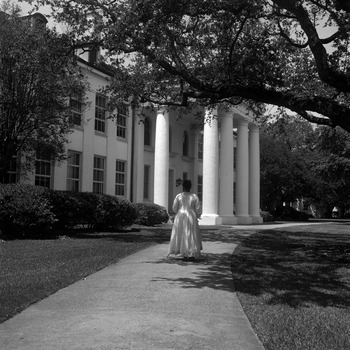
In Untitled (Path to the Manor) (Figure 1), Weems leads us through a landscape in which the physical structures of a colonial past still stand. This is revisitation as cultural remembrance, what Homi Bhabha would call “an insurgent act of cultural translation” that “renews the past, refiguring it as a contingent ‘in-between’ space, that innovates and interrupts the performance of the present.”Footnote 21 Yet by recasting herself as a liminal figure who is both phantasmagorical and fleshly, artist and “muse” (to use Weems's appellation), Weems becomes, in her own words, “a witness and a guide … into circumstances seldom seen.”Footnote 22 She moves beyond postcolonial remembrance to both render noticeable and unsettle structures of whiteness that are historically embedded as largely unseen conditions of everyday orientation.
Carrie Mae Weems, Untitled (Path to the Manor), 2003. © Carrie Mae Weems. Courtesy of the artist and Jack Shainman Gallery, New York.

Weems thus guides the viewer through a landscape plotted by the historico-racial markers of its topography.Footnote 23 Elements of the photograph connote the persistence of slavery's past on the present reality of the black body. Weems's muse is framed by the stark, imposing white pillars of the plantation mansion, the capitals of which are hidden behind another framing device: the live oak tree that branches over the figure's head, casting its shadow across her body and on the ground beneath her feet. Working with the columns to visually contain the figure, the towering oak provides a living reminder of lynching's historical proximity. The path cuts through and snakes out of the photograph, a route connecting the viewer where they stand to a shared, unfinished history of racial oppression, monumentalized on the landscape, and signposted silently by Weems's witness-guide.
“Orientations are about how we begin, how we proceed from ‘here’,” writes Ahmed. “The starting point for orientation is the point from which the world unfolds: the ‘here’ of the body, and the ‘where’ of its dwelling.”Footnote 24 Ahmed's position derives from Husserl's phenomenology: to understand a being's perspectives on and relations to people and objects in the world in ontological terms, it is necessary to consider that being's “zero-point of orientation” in physical terms. From that standpoint, “the differences between ‘this side’ and ‘that side’ matter.”Footnote 25 But as Ahmed implies, Husserl's postulations about his own corporeal “starting point” – his “writing-table” – are shaped by cultural factors of privilege he fails to acknowledge: his gender, his class, his occupation, his able-bodiedness, and his whiteness. (That Husserl's starting point for his philosophizing is a writing table, and not, say, a kitchen table, conveys this point neatly, and brings to mind Carrie Mae Weems's groundbreaking Kitchen Table series.)Footnote 26
Ahmed's contention is that one's “starting point” is plotted by historical factors in advance of one's bodily kinesis, so that the ways in which the world “unfolds” are already mapped: a person therefore encounters “a world that is inherited, or which is already given before the point of an individual's arrival.”Footnote 27 Teasing the “habit” out of “inhabit,” Ahmed suggests that whiteness as orientation – pervasive, dominant, and invisible by dint of its ubiquity – “holds through habits.”Footnote 28 The contours of public spaces are shaped through the habitual actions of bodies, meaning that the spaces take on the qualities assigned to those bodies. The habitual can then be thought of as “a bodily and spatial form of inheritance” that determines how the world “is available as a space for action.”Footnote 29 Whiteness, in other words, self-perpetuates, and contributes habitually to its own invisibility. It allows some bodies to feel the comfort of a space that extends their own bodily characteristics; to others, it disallows the feeling of “home.”
In The Louisiana Project, Weems's ghostly muse, treading the path between presence and absence, gestures to her own perceived incongruity in the landscape. Hers is not a “body-at-home,”Footnote 30 but rather one that revisits a colonial setting to demonstrate the inherited out-of-placeness that her body is still made to feel. This colonial inheritance extends to Weems's subsequent photographic series, Beacon (2005), and Roaming (2006), in which Weems's muse returns, this time in a long black dress, to haunt the city of Beacon, NY and to wander through various European landscapes respectively. “It's been implied that I have no place in Europe,” Weems has said. “I find the idea that I'm ‘out of place’ shocking”:
There's a dynamic relationship between these places: the power of the state, the emotional manipulation of citizens through architectural means, the trauma of the war, genocide, the erasure of Jews, the slave coast, and the slave cabins … I'm trying in my humble way to connect the dots, to confront history. Democracy and colonial expansion are rooted here. So I refuse the imposed limits. My girl, my muse, dares to show up as a guide, an engaged persona pointing toward the history of power. She's the unintended consequence of the Western imagination.Footnote 31
By “pointing toward the history of power,” Weems's muse redirects our gaze to white cultural hegemony. The “unintended consequence of the Western imagination” – an imagination typified by Husserl's unseeing phenomenology of perception and materialized by colonial practices of domination and control – is a body escaped from that imagination's restrictive orientations to wander freely across spatial and temporal borders.
This is an example of what hooks calls Weems's “politics of dislocation” and what I am calling Weems's topographics of disorientation. In this photograph, and others in the series (see Figure 5), Weems's muse functions both to guide and to obstruct the viewer's visual and corporeal orientations; we are drawn toward her and yet she remains unreachable. If, as Ahmed asserts, “whiteness is an orientation that puts certain things within reach,” and if by “things” Ahmed means “not just physical objects, but also styles, capacities, aspirations, techniques and habits,” then Weems upsets colonial paradigms by having her wandering muse embody what is apparently denied to certain human beings. The extraordinary pull that the figure enacts on us visually and corporeally inverts normal racial power relations. “Black people are to be turned away from, not turned toward,” Weems has said. “It's an aesthetic thing; blackness is an affront to the persistence of whiteness … This invisibility – this erasure out of the complex history of our life and time – is the greatest source of my longing.”Footnote 32 By disrupting embedded codes of aesthetic and phenomenological relation, Weems exposes the black absences engendered by colonial structures of whiteness. Her “longing,” throughout much of her work, is to return to an original site of identity construction in order to make terrain for an inclusive, anticolonial standpoint.
The starting point for Claudia Rankine's hybrid book of poetry, prose, and image, Citizen: An American Lyric (2014), is similarly disorienting. “When you are alone and too tired even to turn on any of your devices,” it begins, “you let yourself linger in a past stacked among your pillows.”Footnote 33 In one sense, “devices” are already in use: Rankine's deployment of both the second person and the present tense throughout the book's poemsFootnote 34 engages the reader in a purposefully confusing relation of intimacy and confrontation, of conspiracy and accusation, so that traditional forms of the “lyric” are reconfigured, and established methods of reader recognition are skewed. The “you” is both multiple and singular, witness and subject, a polyvocal personhood represented in a number of memories of racialized encounter (re)collected by Rankine from her own life, and from black friends and acquaintances.
“The second person for me disallow[s] the reader from knowing immediately how to position themselves,” Rankine has explained.Footnote 35 This literary technique of dislocation rejects the centred positionality of the lyric “I,” as well as the dis/identification that the first-person pronoun encourages in the reader: “I was trying to destabilize the immediate ability to say, ‘That's not my experience. That's not me.’”Footnote 36 This perspectival shift awards the pronoun a freedom that, according to Rankine, amounts to a particularly white privilege: “the privilege of mobility.”Footnote 37 Such fluidity of movement transgresses the limits of individual subjectivity to embody what Rankine calls a “community” of perspectives,Footnote 38 so that Citizen’s use of “you” makes it as difficult to turn away from the body evoked as it is to assign that body a specific identity.Footnote 39
Rankine's emphasis on unfettered movement, as well as her reluctance to encourage an autobiographical reading of her work, echoes Weems's insistence that, despite positioning her own body as her wandering “muse” or “alter-ego,” her art moves beyond the confines of the autobiographical. “I use myself simply as a vehicle for approaching the question of power, and following where that leads me to and through,” Weems contends. “It's never about me; it's always about something larger.”Footnote 40 The enquiry for both artists is thus into “who has power, who can stand in that ‘I’ versus who can't.”Footnote 41 Weems and Rankine destabilize traditional standpoints, questioning notions of ownership and address that are usually taken for granted. As Rankine notes, in the States, the “move into the ‘I’ was … a step that had to be taken legally” by African Americans, who “started as property,” chattel to be counted and monetized as part of the land upon which they were enslaved.Footnote 42
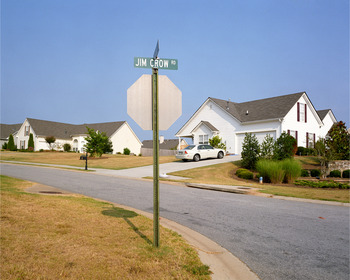
“The route is often associative.”Footnote 43Citizen’s opening passages establish a connection between exhaustion, memory, and racism via a rhizomatic path that leads continually back to a colonial past exemplified by slavery. The book's first recalled memory is set during an examination in a Catholic school, and recounts the narrator having to move her body to accommodate the wish of a white classmate to cheat. Beneath this written memory are two forms of textual silence: a stretch of blank page, and the landscape photograph of a quiet suburban street in Georgia by Michael David Murphy.
Jim Crow Rd. (2008) (figure 2) points to how the topography of the American landscape remains inscribed along lines of racism and white supremacy. As in Weems's Path to the Manor, the viewer stands at the threshold of a route that orients bodies within a habitual and inhabited landscape of a white prosperity enabled by the historical slave economy of the southern States. That the street sign apparently refers to a local man named James Crow, who was known as “Jim” by the residents and hence commemorated thus, speaks to what Ahmed calls “whiteness as orientation” through “habit.” This disregard for, or blindness to, the discomfort of nonwhite bodies is further alluded to via Murphy's photographic composition: the sign's bisection of the visual field neatly emphasizes the serene detachment of the pristine whitewashed houses.
Michael David Murphy, Jim Crow Rd., 2008. © Michael David Murphy.

Like Weems's muse, Rankine's more obvious figure of direction therefore occupies a space between. A street sign doubling as a STOP sign that faces away from us, it both guides and arrests us within the landscape, a mute marker of movement and stasis connecting the present to the past. Sunk into the soil, it functions, in Rankine's words, as history “reconstructed as metaphor”:Footnote 44 an eerie substitute for the lynching tree and a material indication of America's continuing acts of racial segregation. Its placement in Citizen – and Rankine intended the image “to frame the book”Footnote 45 – conducts the text's punctuating pauses, spaces of reflection in which, as Lauren Berlant has noted, “we are left … with the atmosphere of encounter pressuring a disturbance in us.”Footnote 46 In such spaces, the reader is forced to consider their own bodily and spatial inheritance.
Rankine's anticolonial topographics points to the interconnected nature of such associative routes across America. “The school is on a road; here is another road. All these roads make up the country,”Footnote 47 she asserts. Berlant has opined that Rankine's use of Jim Crow Rd. alludes to “the lines that interconnect us in the space of the citizen” (or the noncitizen). Street signs “mark a fork in the road, a decision about the world. In relation to them, we are always in movement, even when we are also stuck.”Footnote 48 As such, they mark the various phenomenological places in our journeying through the world at which we are compelled to decide, in Ahmed's words, “how we proceed from ‘here.’” For Rankine, as for Weems, as I will go on to demonstrate, the word “here” becomes a locus and a nexus, a dual declaration of positioning and giving from which a new cartography of experience might begin.
In an interview in 2009 for Poets.org, Rankine commented that she was “very interested in the landscape in general as the site of living, of a place created out of lives.” Those lives, she contended, are “consciously and unconsciously shaped” according to a “politics of the land” that awards “certain freedoms and ‘unfreedoms.’”Footnote 49 The interview followed the publication of Rankine's genre-defying text Don't Let Me Be Lonely: An American Lyric (2004) and coincided with the production of her interactive travelogue play, The Provenance of Beauty (2009), a bus tour of the South Bronx, combining recorded and live elements, and billed by its production company, the Foundry Theatre, as “a theatrical experience that both responds to and redoubles the landscape, mapping out a poetic cartography of a neighborhood – of any neighborhood – in an eternal state of evolution.”Footnote 50 In both works, Rankine seeks to revisit the American landscape in order to demonstrate how its political and geographic topographies are charted according to unregarded factors governing the orientation of bodies.
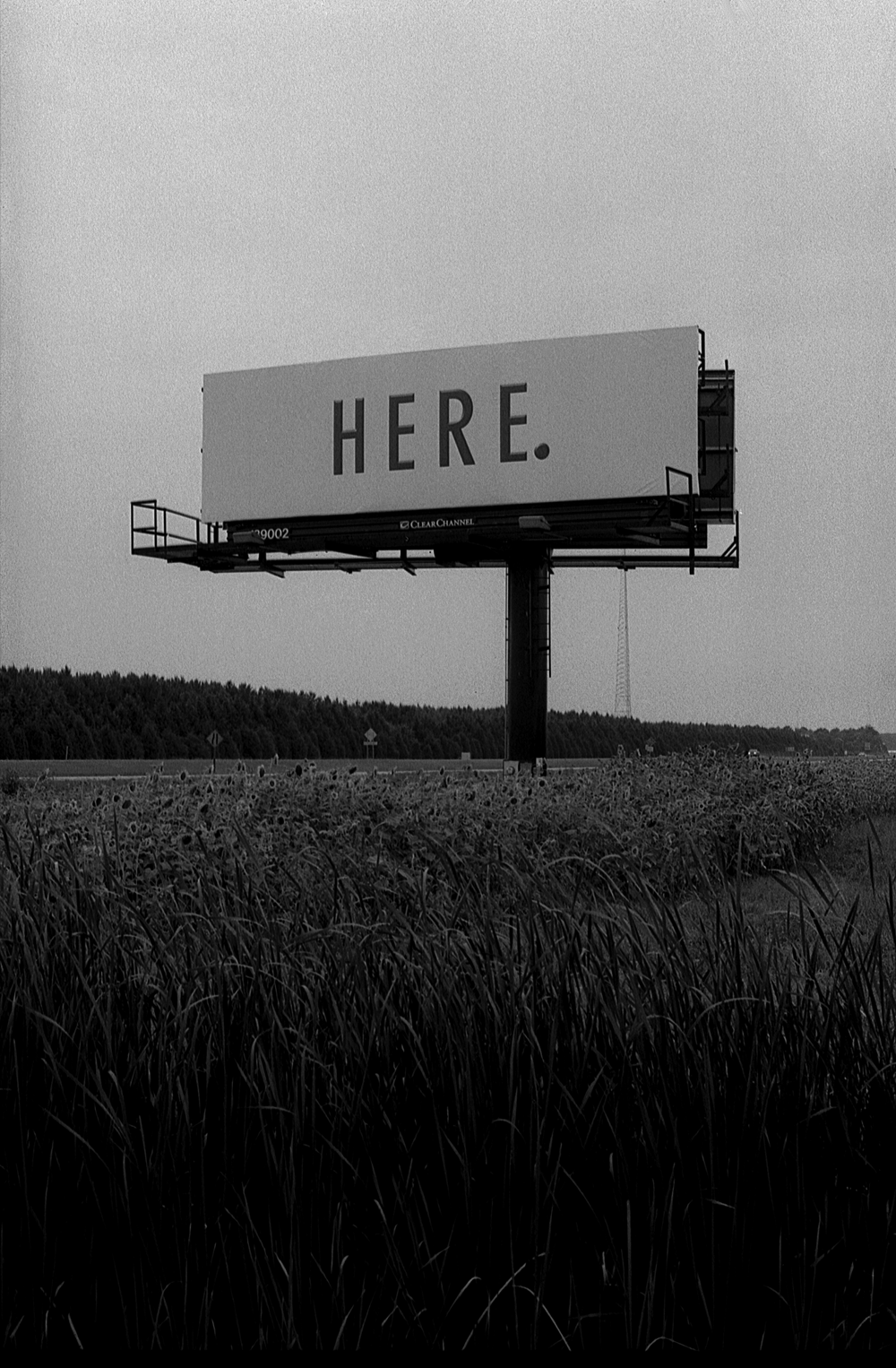
The stream of advertising billboards lining the road on Rankine's bus tour points to the fact that “the landscape is determined by who own[s] it,” by who stands “to gain from it.”Footnote 51 As the Bronx is becoming more gentrified, its original black residents are being forced to relocate. Yet the guiding principle of The Provenance of Beauty is community: a collective feeling of “being here” enhanced by the enclosure of the bus, the intimacy of the poetic voices speaking through headsets to the passengers (the narrators and tour guide are black), and the site-specificity of the “play.” “I am built out of lives,” the narration says at one point along the journey. “I want to make being here all that matters. I want our vehicular flow, the road construction, all accidents and delays to be part of what constitutes ‘here.’”Footnote 52 This guided tour to a communal point of view recalls John Lucas's landscape photography in Don't Let Me Be Lonely, in which “HERE” replaces the text on a giant roadside billboard that rises silently from a field of sunflowers (Figure 3).
John Lucas, Here, 2004. © John Lucas
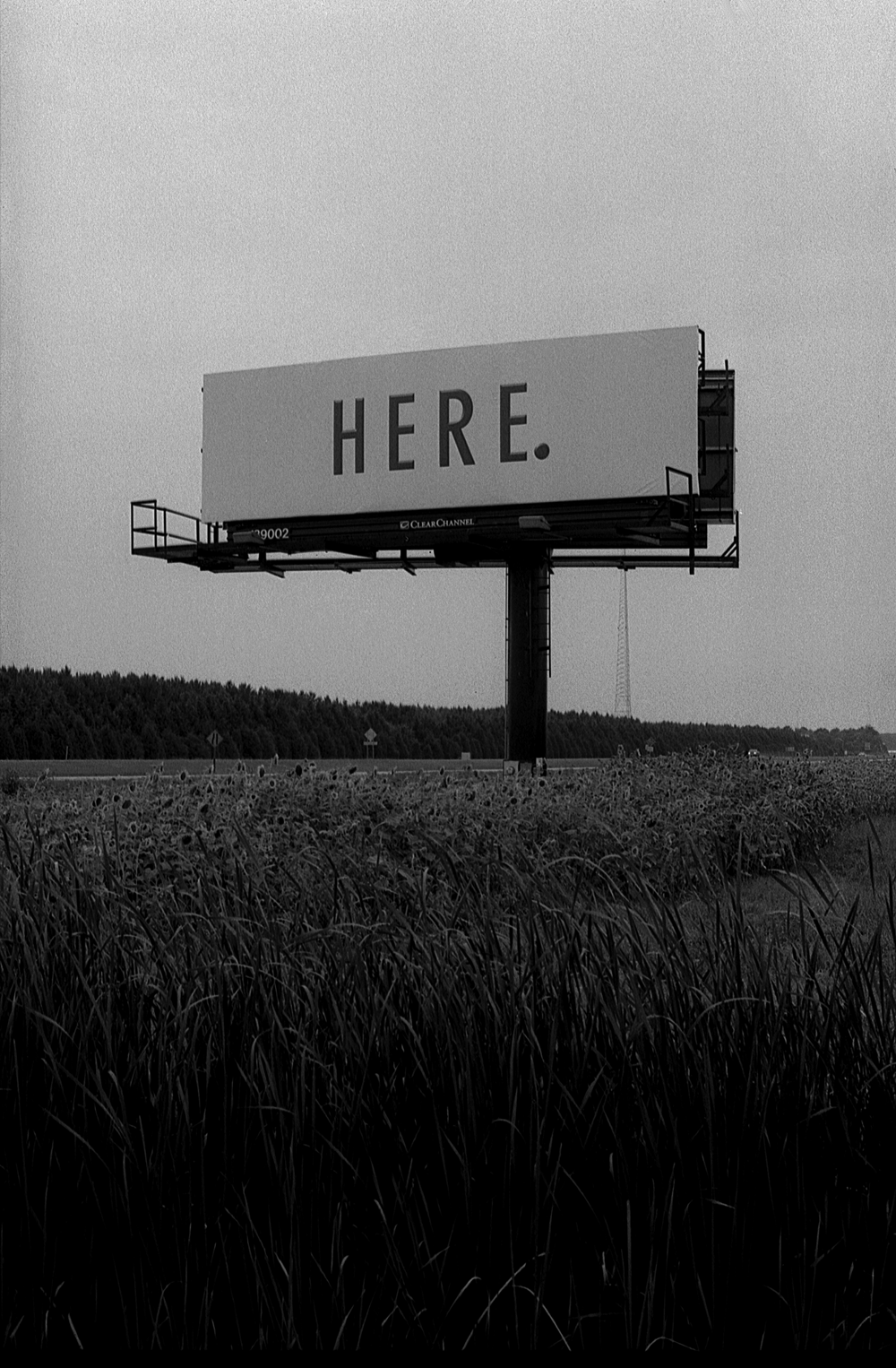
In the paginal space above Lucas's centralized photograph is a small block of text, wherein Rankine recalls Paul Celan's observation: “I cannot see any basic difference between a handshake and a poem.”Footnote 53 Each, concurs Rankine, is a gesture of self-giving and self-assertion – “Here. I am here.” – a conflation of the solidity and offering of “presence” that “perhaps has everything to do with being alive.”Footnote 54 Tana Jean Welch has written that “Rankine offers her ‘American lyric’ as an act of acknowledging the presence of marginalized others.” The book, she argues, “works to counteract American exceptionalism and individualism” by gesturing toward the “material interconnectedness that occurs as agents interact with one another.”Footnote 55Don't Let Me Be Lonely also suggests a (re)cognition of the interconnectedness of geographical and bodily topographies under oppressive regimes of white hegemony.
Opposite, on the final page of poetry in the book, Rankine continues to reflect on the meaning of the word “here”: “Here both recognizes and demands recognition … We must both be here in this world in this life in this place indicating the presence of.”Footnote 56 Such a perspective carries with it a sense of hope; that to ethically reorient ourselves toward others is achievable via an acknowledgement both of our shared landscape and of the necessity of interpersonal relations. This would seem to be indicated further in the “notes” section of the book, by Rankine's reproduction from the OED of the etymology of the word “here,” which “finds its origins in the Gothic prefix “hi,” meaning this”: “The pronouns ‘he,’ ‘him,’ ‘his,’ and ‘her’ also come from this source, as well as the pronouns ‘hither’ and ‘hence.’ From this source the feminine ‘she,’ plural ‘they,’ and neuter ‘it’ all eventually evolved.”Footnote 57
To discover this shared lexical genesis of persons and place, however, the reader must look beyond the body of the book to its contextual and structural foundations. This act of reading between, or below, the lines constitutes a small enactment of the archaeological, archival work Rankine has already done. It is an act of reading that refuses passivity, a type of textual excavation that reveals an undercommons,Footnote 58 and recalls Weems's insistence that to understand where she stands in the world and in history, she needs to “travel, and [go] digging, digging.”Footnote 59 Lucas's billboard, then, like the poem, bears witness to the materiality of the now, as well as indicating the past's cultural relevance, presenting a standpoint from which new anticolonial perspectives might unfold. It points to what Edouard Glissant called a “poetics of landscape,” which Katherine McKittrick has defined as a way of “saying, theorizing, feeling, knowing, writing, and imagining space and place … that ‘awakens’ language, offering intelligible and visible black struggles.”Footnote 60 For Glissant, “our landscape is our only monument: its meaning can only be traced on the underside.”Footnote 61 Both Weems and Rankine engage in excavating the “underside” of the landscapes they guide us through; in the process, they unearth and reframe the ways in which colonial cartographies are drawn on the landscape and on the human body.
CORPOREAL TOPOGRAPHICS
In 1995, Weems worked with thirty-three archival photographs to create the series From Here I Saw What Happened and I Cried. These found images visually attest to the violence, oppression and degradation enacted by whites on African Americans under the laws of slavery and Jim Crow; among them number the slave daguerreotypes commissioned of J. T. Zealy by anthropologist Louis Agassiz in 1850 to support his theory of polygenesis.Footnote 62 Weems rephotographed the images, tinted them red, and iris-framed them behind glass, upon which she sandblasted words addressed to the subjects of the photographs: “You became a scientific profile,” “An anthropological debate,” and “& a photographic subject.”Footnote 63 Although these images are not landscapes, I refer to them here in order to demonstrate the wider project of anticolonial disorientation that has engaged Weems for much of her working life.Footnote 64 Indeed, several of the images in the series, including the slave daguerreotypes, and the famous albumen silver carte de visite of the scourged back of Gordon, a slave from Baton Rouge, Louisiana, figure the body of the slave as a metaphorical topography of white supremacy, upon which the violence of ownership and racist encounter is visibly traced.
Weems's challenge to whiteness as a worldly form of orientation works both visually and textually, and at the intersection of the two. The second-person “you” of the series, like Rankine's use of direct address, contains a community of people that multiply well beyond the number whose stories are briefly represented. Likewise, in the reflective glass of the individual pieces, a viewer encounters the overlap between their own image and that of the “other” “you” being addressed that complicates the seemingly obvious recipient of the second-person pronoun, as well as hints at the passive complicity of the spectator in the ongoing historical representation of the black body as spectacle. While Weems's reproduction of images of racist objectification has led to reproach from some critics, we should note, as Claire Raymond does, that Weems was commissioned by Weston Naef to produce a work for his Getty Museum exhibition Hidden Witness: African Americans in Early Photography.Footnote 65 That Weems created From Here I Saw What Happened and I Cried in response both to notions of photography as witness, and to a buried archive of visual testimony, confuses the phenomenological, ontological, and historical relations between “you,” “I,” and “here.”
Weems's witness-guide is visually figured in this series not by the artist's ghostly “alter-ego,” but by a profile portrait of “Nobosodrou, Femme Mangetu,” a 1925 colonialist photograph for National Geographic by George Specht. The photograph is significantly larger than the red, rondel images in the series, tinted a pale blue, squarely framed, and hung to bookend the series with its titular text: “From here I saw what happened” reads the etching on the first picture pane; “and I cried” reads the last. As Raymond points out, situated thus, Nobosodrou presents “a cool witness figure” to historical atrocities and humiliations.Footnote 66 More than this, however, the pronoun with which she is associated combines with that of Weems and of the viewer to extend and complicate the colonial gaze, especially within the historically white setting – the “here” – of the art gallery.Footnote 67
By destabilizing interpersonal modes of identification, Weems wrests full ownership of the “I” from the spectator, disorienting them in ways that reflect the dispossession of the colonized person's autonomy and self-image. Simultaneously, From Here I Saw What Happened and I Cried emphasizes an almost palpable sense of distance between the viewer and the subjects of the photographs, instigated by the material layers obstructing their visibility (colour tint, wooden frame, glass, text) and by their presentation as historical objects of exhibition. The individual glass inscriptions cast textual shadows on the bodies they describe, alluding to their place in what Allan Sekula has famously called a “shadow archive” – “an archive that encompasses an entire social terrain while positioning individuals within that terrain.”Footnote 68 The series not only points to the ideological and corporeal dangers of photographic methods of human classification, but, as Weems's landscape photographs also do, illuminates methods of ranking and charting “racial” difference according to the Western imaginary.
“When we're looking at these images,” Weems notes, “we're looking at the ways in which Anglo-America, white America, saw itself in relation to the black subject.”Footnote 69 Re-presented thus, Weems's photographs gesture toward the original containment and cataloguing of the persons the images were taken to represent as type. They direct our attention to the unexamined structures of whiteness that enabled these photographs to exist and be read as documentary evidence of racial topographies. As both Raymond and Deborah Willis point out, Weems's project is to disclose the problematic starting point of documentary photography's orientation: “that it presumes a reality when that very subtext must always already in fact be ideological.”Footnote 70 The series thus asks us to question the phenomenological, temporal, and interpersonal precincts of what we understand by the term “here,” revealing it to be, as Ahmed asserts, an inherited perspectival standpoint constructed via a phenomenology of whiteness.
The slave daguerreotypes that Weems reproduces for From Here I Saw What Happened and I Cried were originally intended as scientific spectacle, owned by Agassiz's employer, Harvard, and subsequently buried in the university's archives. In Citizen, Rankine also makes use of an archived image of the black body as spectacle, in this case a public-lynching photograph from 1930. In both cases, the (white) institutions that owned the photographs were resistant to their artistic reproduction.Footnote 71 Weems and Rankine's intentions to reappropriate and reframe the images challenge what Ahmed recognizes as institutional whiteness shaped by habit. “Institutions,” Ahmed writes, “involve the accumulation of past decisions about how to allocate resources, as well as ‘who’ to recruit.”Footnote 72 Weems's photographic series addresses in part the lack of recruitment of people of colour, especially women, by American art institutions, at the same time offering a “screaming and red” indictment of the visual and physical objectification of black people in the States.Footnote 73 Rankine's use of the lynching image, which, like many others of its kind, was originally disseminated in postcard form in celebration of white supremacy, likewise points to how patterns of seeing are shaped by the invisible “habit worlds” of whiteness as orientation.Footnote 74
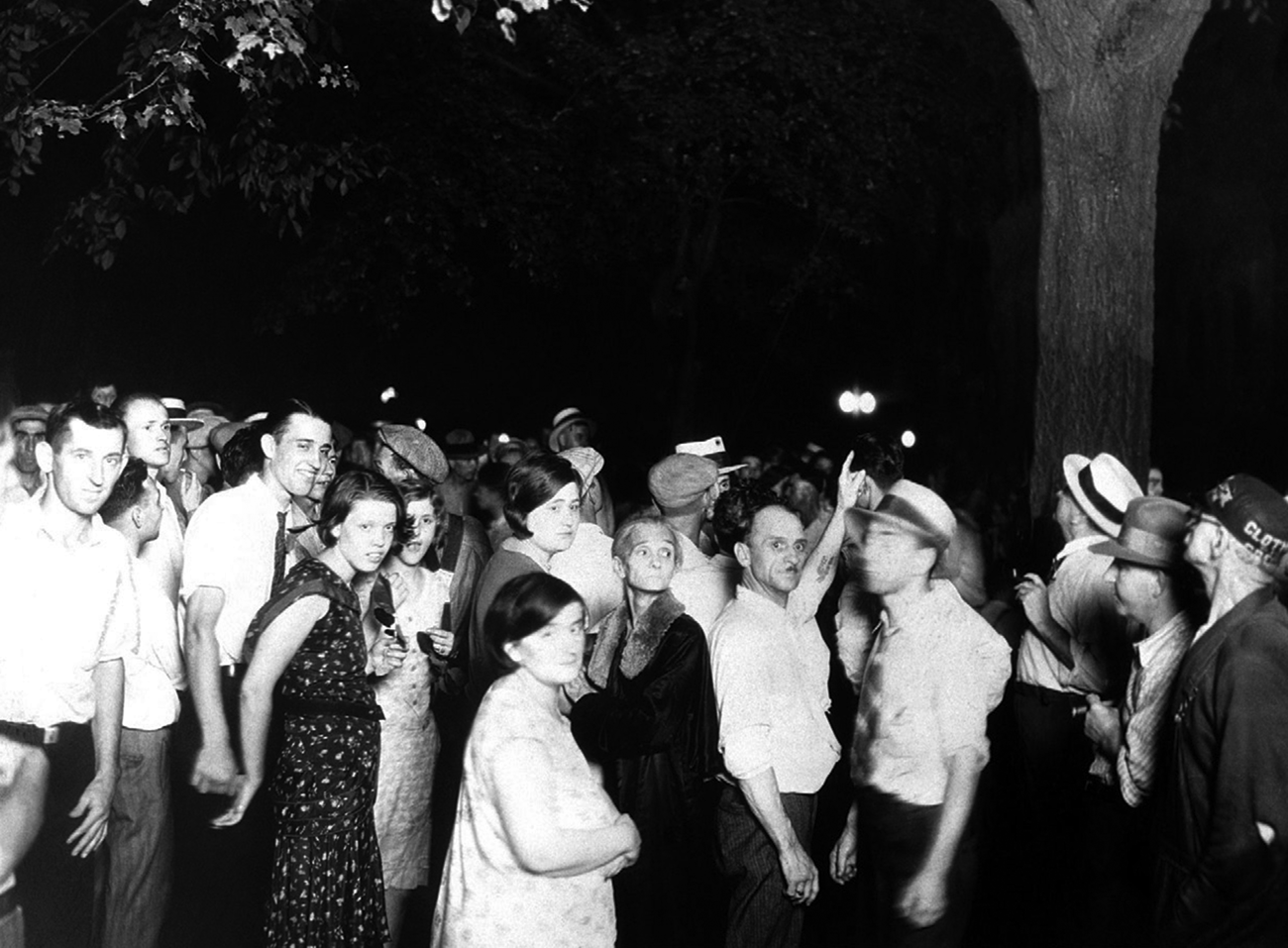
Public Lynching (1930) (Figure 4) is a high-contrast black-and-white photograph that has been altered by John Lucas so that all traces of the murder of Thomas Shipp and Abram Smith have been removed, save the tree from which their bodies were hung, and the flash-lit mob of white spectators and lynchers gathered beneath it, their conglomerate mass crowding out any further view of the landscape. Thus altered, the image recalls Jim Crow Rd., a silent signpost to the American landscape's embedded institutions of white supremacy and racist erasure. The spectacle of the young men's mutilated bodies deleted, visual emphasis shifts to the whiteness of its composite elements, particularly to the man in the foreground, whose gaze meets that of the viewer, his arm raised, his finger pointing upwards to the emptiness of the black sky. In this photograph, the orienting structures of whiteness are made explicitly visible; at the same time, we are directed toward the devastating black absences that such structures have enabled across social, cultural, and archival topographies. As Ahmed reminds us, “white bodies do not have to face their whiteness”;Footnote 75 they are always already at home in the spaces and practices they inhabit. The photograph, however, throws enduring structures of whiteness into relief, recalling and inverting an earlier image, Glenn Ligon's etching, after Zora Neale Hurston, of the repeated words “I feel most colored when I am thrown against a sharp white background.”Footnote 76 Lucas's Public Lynching unsettles the comfort of the white viewer by displacing whiteness from what Ahmed calls “the background to social action” to the subject of critique.Footnote 77 Such strategies, as hooks reminds us, constitute an anticolonial visual politics that “happens only as shifts in standpoint take place.”Footnote 78
Public Lynching, 1930. Hulton Archives via Getty Images (image alteration with permission: John Lucas).

The photograph is printed in Citizen on the bottom of a bright white page, after the script for a collaborative “Situation Video” by Rankine and Lucas “In Memory of Trayvon Martin,” the African American teen who was murdered in 2012 in one of America's numerous contemporary cases of racial profiling.Footnote 79 The script reads in part,
Those years of and before me and my brothers, the years of passage, plantation, migration, of Jim Crow segregation, of poverty, inner cities, profiling, of one in three, two jobs, boy, hey boy, each a felony, accumulate into the hours inside our lives where we are all caught hanging, the rope inside us, the tree inside us, its roots our limbs, a throat sliced through and when we open our mouths to speak, blossoms, o blossoms, no place coming out …
My brother is completed by sky. The sky is his silence.Footnote 80
The accumulation of the past's aggressions on the black body reside like a tumour beneath its surface in the same way that they are driven into the soil of the landscape; the geographical and anatomical topographies unite in the embodied image of the lynching tree. Angela Hume, who convincingly reads Rankine's career-long engagement with the landscape as a type of “antiracist ecopoetics,” notes of this passage that “to risk reckoning with one's black history and life conditions is always to risk becoming destabilized and displaced – imprisoned by the ‘no place’ of one's own historical experience.”Footnote 81 Throughout Citizen, Rankine charts a legacy of racial dispossession, exploring how one might navigate within and through what McKittrick notes are the codes that continue to mark the black body as “ungeographic.”Footnote 82 Dwelling in the American landscape, then, involves for the black subject the paradoxical relation of displacement and hypervisibility, of embodying erasure. This condition is made explicit by Frantz Fanon, whose Black Skin White Masks profoundly influences both Rankine's and Ahmed's thinking.Footnote 83
In “A Phenomenology of Whiteness,” Ahmed draws on Fanon's explication of the “difficulties” a black person has in “the development of his [sic] bodily schema” to consider the ways whiteness works as material and ontological orientation.Footnote 84 If a person's bodily schema is “the slow composition of my self as a body in the middle of a spatial and temporal world,”Footnote 85 argues Fanon, then phenomenology as a mode of understanding our interrelations in the world is quite literally superficial, because black selfhood is shaped and guided by something “below the corporeal schema”: “a historico-racial schema.” This schematic underside is inscribed “not by ‘residual sensations and perceptions primarily of a tactile, vestibular, kinaesthetic, and visual character,’ but by the other, the white man, who ha[s] woven me out of a thousand details.”Footnote 86 For Fanon, the realization of the black body's historical topography occurs when he is contained by the white gaze. Ahmed extends Fanon's argument, to conclude that because a person of colour bears the racial and historical dimensions of their ontological composition “beneath the surface of the body,” their corporeal schema is “already racialized; in other words, race does not just interrupt such a schema, but structures its mode of operation.”Footnote 87 Anatomies remember colonial histories, which in turn “surface on the body, or even shape how bodies surface.”Footnote 88 This dynamic of historico-racial tension between anatomical and geographical topologies runs throughout Citizen.
“I'm speaking,” Rankine has said of her polyphonic American lyric, “from the position of a body that has been present long before this body arrived in the world.”Footnote 89 That body, it is hard to ignore, is not just “tired,” but sick. In both Don't Let Me Be Lonely and Citizen, Rankine not only attends to white constructions and appropriations of black body image, but ruptures surface readings to investigate the damage enacted beneath the skin. The black body is often depicted in these books as deteriorating, dying, and traumatized, its afflictions attributable to the constant pressure of living in a landscape marred by antiblack racism. The examples are too numerous to list, but include, in Don't Let Me Be Lonely, a map-like mammogram image that traces the topographical connections between the systemic mistreatment of African Americans and the illnesses endemic to their populations;Footnote 90 in Citizen, references to the visceral reactions to racist encounter: “Certain moments send adrenaline to the heart, dry out the tongue, and clog the lungs,” “An unsettled feeling keeps the body front and center. The wrong words enter your day like a bad egg in your mouth and puke runs down your blouse, a dampness drawing your stomach in toward your rib cage.”Footnote 91 That these descriptions, and many more like them, communicate an almost unbearable discomfort to the reader attests to the affective power of the text to shift traditional standpoints.
Citizen’s composition does not allow for breathing spaces.Footnote 92 When Weems, in conversation with Rankine, enquired after her motives for including images in the book – one of which is Weems's own work, “Coloured Boy” – Rankine replied that she “wanted the book to have periods of rest that did not allow for escape.”Footnote 93 She reiterates her motive to Berlant: “The images don't exactly recoup or repair, they are a form of recess, which is its own kind of movement, including both the break from and passage back to the unbearable.”Footnote 94 Two pages after Jim Crow Rd., a conversation is remembered about sentences constructed with “yes, and” rather than “yes, but.” “You and your friend decided that ‘yes, and’ attested to a life with no turn-off, no alternative routes,” writes Rankine.Footnote 95Citizen’s pages contain no fewer than fifteen instances of “yes, and,” including “Yes, and you want it to stop”; “Yes, and the body has memory”; “Yes, and who can turn away?”; “Yes, and this is how you are a citizen.”Footnote 96 The dead ends and blocked passageways force the white reader not only to confront but also to experience somatically a fraction of the unrelenting nature of the aggressions that Rankine delineates as part of quotidian black experience in America, as well as the spaces left in conversations, and around black bodies, out of fear, lack of knowledge, of what Rankine calls the “racial imaginary,” and what Weems calls “the Western imagination.”Footnote 97 By repositioning the body's perspectival and phenomenological starting point, Weems and Rankine engage in an embodied anticolonial visual politics, requiring us to consider our position in the world from a fresh point of view. Their topographics of disorientation opens avenues to discussions about the freedom of movement afforded to bodies of colour in a predominantly white landscape.
Whereas Rankine's method of unsettling white comfort involves affectively extending the black body's corporeal discomfort to the reader–viewer, Weems's approach, in The Louisiana Project, Beacon, and Roaming, situates the black subject as able-bodied and in quiet command of the landscape. An air of self-composure emanates from the revenant figure of these photographs, that seems at odds with the choked and collaged composition of the body as it is evoked by Fanon and portrayed in Citizen.Footnote 98 In The Louisiana Project, Weems's witness-guide calmly observes, and walks toward and into, the plantation mansion, moving freely, and even dancing within its spaces. This series of images culminates with Passageway II (Figure 5), in which Weems's muse blocks our view of, and our entrance into, the open landscape. She is framed again by colonial structures, but has wandered through and out of them, and while the horizon slices across the photograph to contain her body within the landscape, her head is raised above it; her countenance, and her direction at this point, are undisclosed.
Carrie Mae Weems, Passageway II, 2003. © Carrie Mae Weems. Courtesy of the artist and Jack Shainman Gallery, New York.
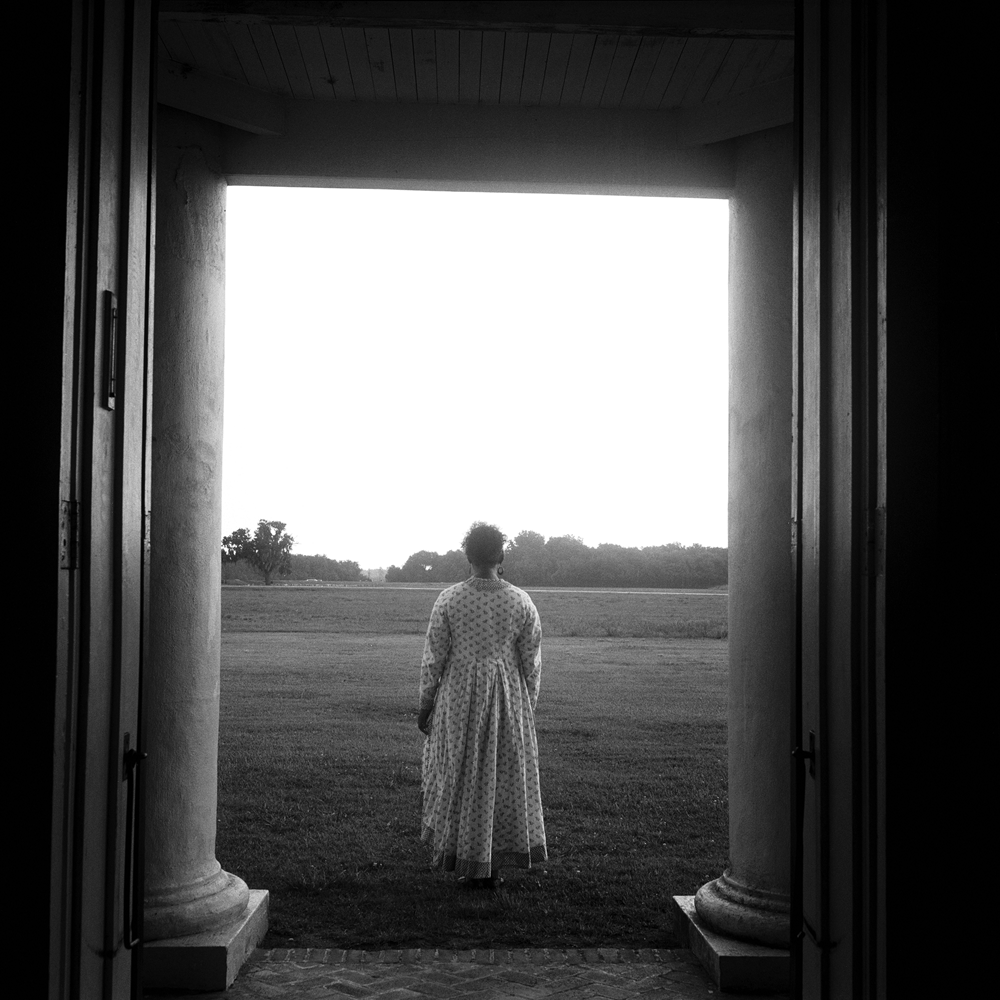
I read the refusal of Weems's muse to turn to face the viewer as a refusal to conform to the reproductive technologies of what Ahmed calls white “habit worlds.” Ahmed builds on Althusser's model of ideology to suggest that white institutions recruit members, and thus compound their power of familiarity, by hailing bodies with a real or metaphorical “hey you there.” The subject is therefore recruited “by turning around, which immediately associates recruitment with following a direction, as the direction that takes the line of an address.”Footnote 99 (We remember Rankine's ode to Martin includes his murderer's possible address, “boy, hey boy.”) Such orientation devices, argues Ahmed, “keep things in place,” and the “affect of such placement could be described as a form of comfort.”Footnote 100 Weems's muse, however, wanders at her own will, and her resistance to being turned around corresponds to a refusal to make space comfortable for the white viewer. Similar to the blocked passages to spaces of rest and comfort in Citizen, Passageway II creates an affect of white uneasiness, denying the viewer an escape route out of the now stifling space of the white mansion.
The shift in perspective and orientation that Weems enacts in this series is akin to the curatorial shifts Rankine performs in Don't Let Me Be Lonely, and especially in Citizen. Speaking of the motives behind Citizen’s hybrid intertextuality, Rankine has quoted Roland Barthes's definition in Theory of the Text of the “classical sign,” “whose closure arrests meaning, prevents it from trembling, or becoming double, or wandering.” The semiotic drift caused by Citizen’s crosscurrents of word and image amounts to “a doubling and wandering” of signification; the book, Rankine asserts, is “traversed by otherness … by forces and desires that are invisible or unreadable to those who see it as … a totalizable collection of signifieds.”Footnote 101 For Rankine, this semiotic disorientation is particularly relevant to a text investigating the visual politics of racial identity in the States, because, she has noted, “the entrance of the black body works like that in the American landscape”;Footnote 102 it disconcerts, it unsettles assumed dynamics of inhabitation, and upsets an ideological white right of way.Footnote 103
The composition of Citizen, then, performs the same act of unrestrained mobility that characterizes Weems's anticolonial aesthetics: both engage in a “wandering” that resists recruitment to the habit worlds of a landscape shaped by whiteness. For Weems and Rankine, wandering becomes a form of resistance to white structures of physical and philosophical orientation because, as Sarah Jane Cervenak has noted, “for bodies under severe constraint, wandering offers other phantasmatic possibilities for unsurveillable movement.”Footnote 104 Both artists begin to chart a new, anticolonial topographics, first by tracing colonialism's “double” legacy of displacement and dis-ease of the black body, then by destabilizing such structures of orientation by opening new terrain, from which the backdrop of whiteness can be seen. Neither artist seeks to “solve” the problem of colonialism, or antiblack racism, but as Ahmed says of her phenomenology of whiteness, this is not the point. The point (and I, like Ahmed, use the word to mean both one's intention and the place from which one's world unfolds) is to disrupt the orientations of white habit worlds – to shift perspectives on the American landscape by gesturing to new phenomenological standpoints. These standpoints, as I have argued in this essay, are not arrivals but points at which to begin. The question, both Rankine and Weems invite us to ponder, is how we proceed from “here.”