Bodily transformations—whether the result of intentional and artificial modification, habitual activity, or developmental change—are often linked to the formation of identity in ritual and mundane settings. Skeletal analysis of these markers yields considerable information about the life histories of those long deceased. Here, however, I document practices that alter bodies after the cessation of life. Narrating individuals' death histories contributes to an expanding body of archaeological and bioarchaeological literature that addresses the symbolic significance and social viability of the biologically dead (Chapman Reference Chapman2000; Fowler Reference Fowler, Hamilakis, Pulciennik and Tarlow2002, Reference Fowler2004; Robb Reference Robb, Hamilakis, Pluciennik and Tarlow2002; Tiesler Reference Tiesler and Behrens2004; Tiesler and Cucina Reference Tiesler and Cucina2007). To narrate death histories effectively, a biographical approach—a study of bodies and the buildings in which they were situated—proves useful.
Processing dead bodies, as Maya scholars have discovered, entailed myriad practices (Becker Reference Becker, Danien and Sharer1992, Reference Becker, de León, de Asís and Perramón1993; Ciudad Ruíz et al. 2003; Cobos Reference Cobos2004; Ruz Lhuillier Reference Ruz Lhuillier and Willey1965, Reference Ruz Lhuillier1968; Webster Reference Webster, Whittington and Reed1997; Weiss-Krejci Reference Weiss-Krejci, Colas, LeFort and Persson2006; Welsh Reference Welsh1988). Notable exceptions notwithstanding (Becker Reference Becker, Danien and Sharer1992, Reference Becker, de León, de Asís and Perramón1993; McAnany Reference McAnany1995, Reference McAnany and Houston1998; Robin Reference Robin1989; Robin and Hammond Reference Robin, Hammond and Hammond1991; Storey Reference Storey and McAnany2004), researchers' discussions about the complicated nature of funerary rituals and extended curation of dead bodies have concentrated on material and/or epigraphic evidence from royal contexts (Bell Reference Bell and Ardren2002; Chase and Chase Reference Chase and Chase1996, 1998; Fitzsimmons Reference Fitzsimmons1998, Reference Fitzsimmons, Colas, LeFort and Persson2006; Sharer et al. Reference Sharer, Traxler, Sedat, Bell, Canuto and Powell1999; Tiesler Reference Tiesler and Behrens2004, Reference Tiesler, Tiesler and Cucina2007; Weiss-Krejci Reference Weiss-Krejci, Ruíz, Sosa and León2003, Reference Weiss-Krejci2004). Certainly, much can be learned from commoners' humble burials in spite of poor skeletal preservation, a dearth of material wealth, and the absence of epigraphic data.
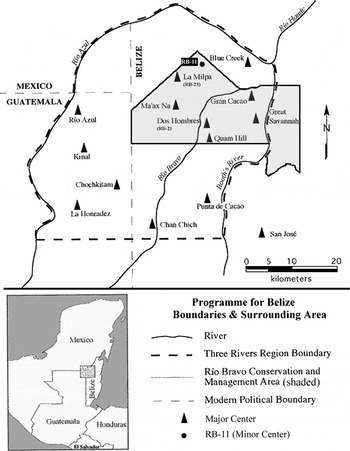
The burial sample discussed here includes every ‘body’ from renowned ruler to humble farmer, yielding a more holistic representation of ancient Maya society. In northwestern Belize's section of the Three Rivers region (Adams Reference Adams1995) excavators recovered 132 individuals from rural house ruins, minor centers, and major centersFootnote 1 (Figure 1). House ruins, while variable in plan, were typically between one and five buildings placed atop rectangular platforms. They simultaneously served as residential and ritual spaces. Building on Bullard's (1960:360) definition, minor centers “may consist of only one large building, but ordinarily they include one or more pyramids, which are assumed to have been small temples, arranged in company with lower buildings around” one to five adjacent plazas. In contrast, major centers were larger and had more elaborate architecture. Structures may have had vaulted roofs and multiple rooms, or were associated with features like stelae, altars, ballcourts, and sacbes connecting adjacent plazas. Major centers served as “nuclei” for Districts, which were functionally, if not geographically, central (Bullard Reference Bullard1960:368). As Ashmore (Reference Ashmore and Ashmore1981:55) has noted, both minor and major centers did not just serve a ceremonial function, but were also arenas for commercial, residential, political, ritual, and intellectual activities. Given sites' varied locations, sizes, and layouts in the Three Rivers region, it follows that decedents' social backgrounds are similarly diverse. What do burials relate about widely shared socio-religious practices, communities' creative responses, and/or decedents' specific circumstances?
Map showing the boundaries of the Three Rivers region (adapted from Houk Reference Houk1996).

To this end, I utilize a multiscalar framework—one that extends from region to community to individual—to consider the becoming and venerating of ancestors. Similar to findings at other Maya sites (Gillespie Reference Gillespie2001, Reference Gillespie, Silverman and Small2002; McAnany Reference McAnany1995; Storey Reference Storey and McAnany2004; Webster Reference Webster, Whittington and Reed1997), noble and commoner communities in the Three Rivers region interred their dead beneath and within the structures they continued to utilize. Such physical contextualization then engendered transformation of liminal corpses to valued ancestors. Comparisons between the noble minority and social majority, however, underscore that the concept ‘ancestor’ is a complex one that should not be homogenized. The Maya conceived of varied types of ancestors, which may have been contoured by social class, circumstance, and/or individual life history.
To illustrate this point, burials from the minor center RB-11Footnote 2 are discussed with special attention paid to the death history of Individual 71. I single out this individual's burial given its idiosyncratic attributes that do not easily accord with populational patterns in the broader sample. A microscale analysis reveals that the commoner community had a protracted engagement with this decedent. One particularly intriguing characteristic of this burial was Individual 71's intentionally fragmented body parts. To understand the significance of and processes involved in such fragmentation, I compare Individual 71's burial to instances of body partibility from other Maya sites. Contingent on the decedent, body partibility served to memorialize, desecrate, revere, or forget. That is, partibility engenders reformation of personhood. For ancestors, whose veneration by the living community reconfirms generational relations, postmortem partibility is connected to dividual personhood. The concept is a highly abstract one, and its relevance to this pre-Columbian Maya case study will be explored. Individual 71 serves as an especially striking example of how a commoner community used partible practices to make a dividual person.
BIOGRAPHIES OF BONES AND BUILDINGS: A MULTISCALAR APPROACH
Interactions between living and dead members of Maya society were pervasive and complex, shaped by religious tenets, cosmological beliefs, and social norms, as well as mourners' personal memories and decedents' life histories. Brought to light by population-based questions, Maya burial samples contain identifiable patterns that indicate shared cultural practices and beliefs. But, they also contain important and at times subtle information for which macroscale analyses of observable patterns cannot account. Much appears peculiar or particular when regarded in light of the patterned. As Rosemary Joyce (Reference Joyce and Chesson2001) has pointed out in her study of Formative burials from Tlatilco, Mexico, examination of particularities in addition to regularities signals mourners' creative responses to individuals' deaths and humanizes the decedents we study.
To flesh out these dialectics—between macro- and micro-scales, structure and agency, society and individual, patterned and particulars—an osteobiographic approach is a useful starting point. Frank Saul's (Reference Saul1972) formulation of osteobiographic analysis set an important precedent, which he and wife Julie Saul have continued to apply in their studies (see Saul et al. Reference Saul, Prufer, Saul, Prufer and Brady2005; Saul and Saul Reference Saul, Saul, Iscan and Kennedy1989). As Jane Buikstra and Rachel Scott (Reference Buikstra, Scott, Knudson and Stojanowski2009:36) have recently remarked, Saul and Saul's understanding of osteobiography primarily stresses methodology. Specifically, it is a forensic methodology, which involves collection of data about demography or functional adaptations (i.e., age, sex, pathology) from individual skeletons (see also Buikstra Reference Buikstra, Buikstra and Beck2006:350). Accordingly, reconstruction of individuals' life histories could, in Saul and Saul's (1989:300) words, be used “to make projections unto the life history of the population.” Conceptually speaking, however, exactly how one gets from Point A (the individual) to Point B (the larger society), is developed minimally in Saul and Saul's understanding of osteobiography. That this approach stresses life history also leaves unexamined decedents' corporeal alterations and social vitality in communities who engaged ancestors on a daily basis. There is no accounting for death histories with this approach.
When revisiting osteobiography more recently, Robb (Reference Robb, Hamilakis, Pluciennik and Tarlow2002) offers worthwhile conceptual expansion by exploring the body's connection to time. Time, as he describes, extends from the experiential to the social to the cosmological. Experiential time is subjectively embodied and pertains to human activities, routine or remarkable ones, at various junctures throughout an individual's life-history. Mediating between the scale of the individual and the cosmos, social time marks age-related shifts in statuses. These statuses, which are often associated with discernible bodily changes, are shared by cohorts and dictate interactions between generations. To narrate a biography then captures the trajectory and experience of statuses throughout the course of individuals' lives. Osteobiography, as expanded by Robb, illumines cultural ideals reproduced by a larger community, as well as deviations from the norm that may be contingent on the decedent's life history, group strategizing, or broader sociopolitical circumstances. Cosmological time extends beyond human lifetimes. It is eternal, according to Robb, and indifferent to mortal meddling.
An individual's death provides the convergence of all three temporalities. Robb (Reference Robb, Hamilakis, Pluciennik and Tarlow2002:159) writes “…one important function of funerary ritual is as a bridge between kinds of time, merging the recently deceased, finishing a story at biographical time, into the immanent order of things existing at cosmological time.” Hence, examining “the history of human remains after death” (Robb Reference Robb, Hamilakis, Pluciennik and Tarlow2002:160)—death histories—helps us to understand how a culture links the experiential to the social to the cosmological. Communities continue to engage with bodies well after an individual's death in a manner that is materially discernible, symbolically meaningful, and culturally nuanced.
Without information about physical context, however, it is challenging to effectively undertake an osteobiographic approach. That is, we must also have information about the architectural spaces in which dead bodies are interred. Such is especially true for Maya studies where tropical environs make for poor preservation of human remains. Physical contextualization augments data sets when information about skeletal materials is otherwise deficient, and it helps researchers make inferences about mourning kin members' mortuary practices and beliefs. To do so, one must collect the following data: information about grave location and type; associated architecture; grave goods; presence of additional decedents; and, if present, the spatial relationship between multiple decedents (or their parts). These burial attributes also aid researchers in reconstructing a building's life history, and thus extend my use of the term biographical.
A life history approach to architecture is one that several archaeologists have found productive for elucidating and sequencing the ritual and mundane activities associated with complex stratigraphic relationships (Bailey Reference Bailey and Samson1990; Gosden and Marshall Reference Gosden and Marshall1999; LaMotta and Schiffer Reference LaMotta, Schiffer and Allison1999; Nanoglou Reference Nanoglou2008; Tringham Reference Tringham, Gero and Conkey1991, Reference Tringham1994; Walker and Lucero Reference Walker, Lucero, Dobres and Robb2000). In Maya studies, a biography of buildings is particularly pertinent since decedents were generally interred beneath structures in which the living continued to reside and renovate (Storey Reference Storey and McAnany2004). Such spatial arrangements highlight the sustained social potency of the biologically dead (Geller Reference Geller, Robertson, Seibert, Fernandez and Zender2006b; Gillespie Reference Gillespie2001, Reference Gillespie, Silverman and Small2002; McAnany Reference McAnany1995; Webster Reference Webster, Whittington and Reed1997). A conjunctive consideration of bodies and the places in which they rested then is best served by describing construction biographies in addition to osteobiographical ones. With this multiscalar model in hand, I now turn to burials from the Three Rivers region, northwestern Belize.
BURIALS IN NORTHWESTERN BELIZE: PATTERNS AND PARTICULARS
The sample from the Three Rivers region is comprised of 132 individuals, the majority (n = 88) of whom lived (and died) during the Late and Terminal Classic periods (a.d. 650–900). Such a small number certainly does not represent the region's total population, a phenomenon that scholars working elsewhere in the Maya world have also noted (Becker Reference Becker, de León, de Asís and Perramón1993:62; Chase Reference Chase, Whittington and Reed1997). Nonetheless, a population approach does allow us to identify broader patterns within northwestern Belize, which I have discussed in detail elsewhere (Geller Reference Geller2004, Reference Geller, Gowland and Knüsel2006a, Reference Geller, Robertson, Seibert, Fernandez and Zender2006b, Reference Geller and Bonogofsky2011a). While excavators encountered burials beneath main plazas and entombed within monumental ceremonial buildings, they recovered the majority of decedents, or 87.1% of the total sample (n = 115), from residential buildings. Interment of decedents in association with domestic structures is especially evocative of the intimate and ongoing relationship between mourners and their deceased kin.
More than half of the sample's decedents (n = 76 or 57.6% of the total sample) were primary interments, or fully articulated. Table 1 contains information about these primary interments' body positions, as well as body conditionsFootnote 3 for the larger sample. In 85.5% of cases (n = 65), mourners had positioned these primary decedents in several variations on the fetal position, one that is highly suggestive of bundling (Reese-Taylor et al. Reference Reese-Taylor, Zender, Geller, Guernsey and Reilly2006). The bodies of 29 individuals (or 22% of the total sample) may be characterized as “secondary.” Burials qualified as secondary if bodies had been accidentally disturbed during ancient construction activities, or if the living intentionally disarticulated bodies. The latter occurred when graves were reentered and decedents removed or additional individuals interred. Partibility, a subset of this type of secondary burial, refers to the intentional selection and interment of body parts in the absence of a whole body, such as a lone finger, scattered teeth, a decapitated skull, or long-bones crossed over each other. In the case of the Three Rivers region sample, partibility applies to the burials of only four decedents.
Body conditions and positions

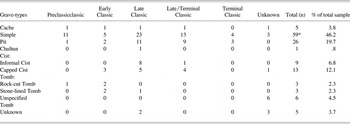
With regard to the graves in which bodies were interred, Table 2 summarizes information according to time period. From the Late Preclassic period onward, “simple graves” predominated, comprising 46.2% of the entire sample. This grave type entailed minimal effort and informal design. Decedents' remains, whether articulated or disarticulated, intermingled with the surrounding building's construction fill. Pits, cists, and tombs, on the other hand, involved exponentially increasing amounts of planning and labor.Footnote 4 Aside from chultuns, caches were the least likely to serve as a decedent's grave type. The sample only contains five caches, or 3.8% of the total burial sample. Human remains cached within ceramic vessels characterize this grave-type. All caches in the Three Rivers region sample are secondary interments.
Grave-types in the burial sample by time periods. *Two Simple graves could not be assigned to a more specific Classic period context and are not included in the table though the total number of Simple graves is 61. For a full description of grave-types see Geller (Reference Geller2004)

In general, the majority of the sample's Classic period decedents were found with few if any grave goods. Caches and tombs provided exceptions, as grave goods were always unearthed in association with these types of interments. Grave goods in the latter were better preserved, plentiful, and diverse with respect to types and materials, however. In the case of 46 individuals, no grave goods were recovered (34.8% of the total sample), and it was not possible to determine whether goods had been interred in 24 decedents' graves (18.2% of the total sample). The graves of 47 individuals contained between one and four different types of objects (35.6% of the total sample); each ceramic vessel was distinguished but groups of objects, like the 19 pieces of mica found in one grave, were counted as one object. For the most part, graves contained ceramic fragments, whole vessels, shell, and obsidian. Found less frequently were granite and chert tools, animal bones, and jade or greenstone. Singular instances of mica, hematite, coral, copal, a stingray spine, and turtle carapace also occurred. If anything, however, individuals' grave goods defied patterns. That is, assemblages appeared specific to each burial and may offer evidence for the more personal aspects of decedents' lives or mourners' remembrances.
Based on patterns in the sample, I believe that certain aspects of burials—grave's location and type, interred body's condition and position, associated architectural features—materialize eschatological beliefs about the afterlife, souls, and sacred aspects of the cosmos, as well as ritual practices involving the becoming and venerating of ancestors (Geller Reference Geller2004, Reference Geller, Robertson, Seibert, Fernandez and Zender2006b). Generally, primary interments whose bodies had been intentionally flexed and situated in association with domestic architecture signaled individuals' ancestral rebirth and invited ongoing dialogue between decedents and their living kin (Geller Reference Geller2004; Reese-Taylor et al. Reference Reese-Taylor, Zender, Geller, Guernsey and Reilly2006). Additionally, as Gillespie (Reference Gillespie, Joyce and Gillespie2000) has argued was the case in other parts of the Maya world, peoples living in the Three Rivers region appear to have utilized benches as repositories for their decedents' bodies, which subsequently functioned as household altars (Geller Reference Geller, Robertson, Seibert, Fernandez and Zender2006b). Nineteen individuals (14.4% of total sample) were associated with benches at various sites throughout the region and thus qualify as ancestors.
Ancestors and Social Variance
It would appear that occupants of the Three Rivers region elected few individuals for ritualized posthumous processing that conferred ancestral identity. Not everyone got to be an ancestor, and just who did remains a query that deserves deeper deliberation. In their analysis of Piedras Negras burials, Houston and colleagues (Reference Houston, Escobedo, Scherer, Child, Fitzsimmons, Ruíz, Ruz and de León2003) have argued that the dead fall into different categories—the poor, “special dead,” and “ancestors”—evidenced by the location of, labor expend on, and quantity of goods within a decedent's grave. They reserve the term “ancestor” for a select group of nobles and royals buried within tombs. According to the authors, these decedents' prestige and power extended generations beyond their mortal existences. Yet, burials from commoner and noble settings throughout the Three Rivers region suggest that processing and venerating the dead as ancestors may not have been restricted to certain classes within Maya society.
Cross-culturally, the category of “ancestor” need not be an undifferentiated one, nor should it be restricted to a certain social stratum (Pelras Reference Pelras, Chambert-Loir and Reid2002; Sellato Reference Sellato, Chambert-Loir and Reid2002). For instance, revisiting Hertz's Borneo case-study a century later, Sellato (Reference Sellato, Chambert-Loir and Reid2002) identified various emic categories reserved for the dead. Ancestors are either exclusive or inclusive. The former are important to the larger society, and their public renown during life endures after death. Inclusive ancestors include the genealogical forebearers of a kin group. Their selection occurs in two ways. While alive, prominent figures may slate themselves for ancestorhood or, contingent upon an individual's deeds, a kin group can impart an inclusive ancestor identity after death. In a similar vein, Pelras (Reference Pelras, Chambert-Loir and Reid2002) describes the Indonesian phenomenon of ancestor gradation for the Bugis of South Sulawesi. Nobles and commoners conceive of and interact with their ancestors in different ways. Amongst the nobility, generational links are made between descendants and their ancestors through the sharing of personal names. The latter's origin point is characterized as temporally distant, divine, and mythical. Such links serve to justify nobles' status and right to rule. Pelras (Reference Pelras, Chambert-Loir and Reid2002:127–128) further distinguishes between noble ancestors as original or ordinary. Original ancestors, like exclusive ones, represent noble progenitors who are widely celebrated, while ordinary ancestors are but a link in the resultant genealogical chain. Each type has distinct material and spatial attributes, a point that should not be lost on archaeologists. In contrast to the nobility, Bugis commoners venerate ancestors as an indivisible group. The temporality, materiality, and spatiality of their commemoration are on a much simpler scale. Genealogical memory is abbreviated, while food offerings, grave visitations, and silent prayers are decidedly more modest.
While contemporary Indonesian communities are culturally and temporally distant from the pre-Columbian Maya, material remains from varied social settings indicate that the latter also recognized different types of ancestors. In the Three Rivers region, decedents were interred in association with monumental architecture at major centers, elite and centrally located residences at major centers, residences from minor centers, and humble house ruins. For instance, beneath the floor of La Milpa's main plaza was the laborious and opulent tomb of Individual 111, a possible male who died between 35 and 50 years of age.Footnote 5 The monumental eastern Structure 1 served as a dramatic backdrop for this Early Classic period interment. Amongst numerous items, the tomb contained a jade pendant in the shape of a vulture head, one of many ways in which ahau, or lord, can be written (Schele and Miller Reference Schele and Miller1986:325–326). Taken together, this evidence speaks to this decedent's identity as a royal and renowned ancestor linked to mythical or supernatural figures. As such, Individual 111 would qualify as an original (or exclusive) ancestor.
Closer consideration of noble burials, however, also reveals differences between original and ordinary ancestors. Individual 65 from the major center Dos Hombres provides a contrast to decedents interred within or beneath monumental temples. This decedent, a possible male 25–34 years old, was situated beneath the eastern Structure B-16 of a noble family's residence.Footnote 6 The residence, which was located in Group B's Courtyard B-4, is about 80 m south of the center's primary Group A. While this tomb was also richly arrayed and Early Classic in date, its location is more suggestive of an ordinary ancestor whose significance resonated on a regional level.
The reduced architectural scale and nominal quantity of interred goods for commoners' graves, while functionally equivalent to those of the nobility (McAnany Reference McAnany1995), suggest that their ancestors' lineage connections were not publicly powerful. The burials at RB-11, in particular Individual 71, illustrate the necessity of a scaled down biographical approach. As we will see, consideration of this decedent's burial relates information about wider social practices and beliefs, as well as the specificities of a commoner community's protracted engagement with the individual in question. Osteological data are admittedly meager, but such is often the case for commoner burials from the Maya lowlands. A contextualized, biographical approach communicates much about practices and beliefs, and works to remedy many years of investigative sidestepping.
RB-11: A Commoner Community
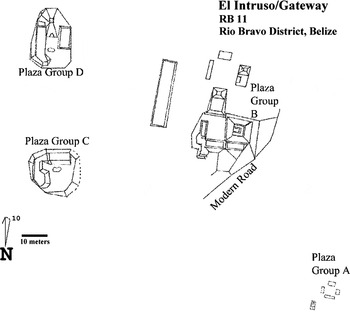
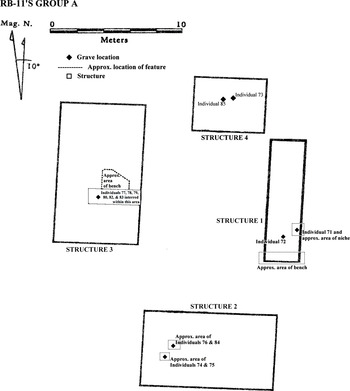
RB-11 is comprised of six distinct architectural groups (Groups A–D, F, and G), and agricultural features surrounded the site to the northeast and the northwest (Morgan Davis, personal communication 2003) (Figure 2). Based on its size, physical configuration, and architectural features, I have characterized RB-11 as a minor center (Geller Reference Geller2004:96). The majority of RB-11's burials, 15 of 16, were found in association with Group A's buildings (Figure 3). Excavators recovered Individual 71 in association with Structure 1, a domestic building located on the eastern side of Group A. Several Maya scholars have contended that eastern structures containing funerary interments served as a community's ancestral shrine (Becker Reference Becker1971, Reference Becker1999; Chase and Chase Reference Chase, Chase, Robertson and Fields1994; Welsh Reference Welsh1988). Given Structure 1's location and the presence of Individual 71, we might surmise a similar function. Hence, Individual 71's burial within a residential structure fits with broader social patterns evident in the Three Rivers region and throughout the Maya world. Yet, a scaled-down perspective reveals that Individual 71's burial diverged from patterns at the regional and community levels.
Plan map of RB-11; Groups F and G, which are located to the north of Group D, do not appear on this map (drawn by Morgan Davis).

Group A at RB-11 with the location of the 14 burials that were documented in detail, as well as notable associated architectural features (adapted from Muñoz Reference Muñoz1997:36).

With respect to the burial's physical context, Structure 1's construction history is rather complex. According to its excavator, Rene Muñoz (Reference Muñoz1997:38), occupants remodeled the building at least four times beginning in the Early Classic and ending in the Late Classic period. One building episode involved the primary interment of Individual 72 within a Late Classic period (a.d. 600–700) capped cist cut through the room's plaster floor. The grave cut was then resurfaced and a bench was built stratigraphically above though just to the south of the cist. As aforementioned, such burial attributes signal the decedent's identity as an ancestor. The only other burial unearthed in Structure 1 was Individual 71. Similar to Individual 72, this decedent's burial was also associated with a major architectural renovation. Sometime in the Late Classic period, Structure 1's occupants erected a rear (east) wall, which penetrated into an Early Classic floor. This wall contained a niche or “constructed hollow,” as defined by Muñoz (Reference Muñoz1997:93). Excavators found no sign that a plaster seal had covered the niche's opening, but post-abandonment, natural and cultural taphonomic processes made it difficult to make a definitive determination (Rene Muñoz, personal communication 2009). Cached within this wall niche, about 1 m above the Late Classic floor, were the remains of Individual 71.Footnote 7
Based on the presence and proximity of a ceramic plate, Individual 71's grave type would at first glance appear to be a cache—one of the five aforementioned caches recovered by investigators working in the Three Rivers region. But, upon greater reflection, Individual 71's designation as such is not without shortcomings. Indeed, the cache grave type is one that has been the subject of much debate and scrutiny. Welsh (Reference Welsh1988:169–170), for instance, has linked caches containing human remains to sacrifice. Conversely, Becker (Reference Becker, Danien and Sharer1992:186; see also Kunen et al. Reference Kunen, Jo Galindo and Chase2002; Mock Reference Mock and Mock1998) has argued that caches were earth offerings, which “had similar cognitive meaning for the Maya, perhaps relating to the death-planting-rebirth cycle.” Caches, however, could include varied skeletal elements, representing individuals of all ages. Elsewhere in the Three Rivers region, for instance, cache vessels have contained the remains of sacrificed infants, as well as bowls with the remains of adults' fingers (Geller Reference Geller, Baadsgaard, Boutin and Buikstra2011b). Similar to these other caches, the context and contents of Individual 71's interment substantiates Becker's notions about regeneration.
Yet, there are attributes of Individual 71's burial that also distinguish it from the region's caches. Caches unearthed elsewhere in the Three Rivers region appear to have been interments that went undisturbed after their initial burial. Individual 71's association with an Early Classic plate in a Late Classic architectural feature, however, reflects dynamism—materially, functionally, and symbolically speaking—as well as the community's sustained interaction with the long dead. An ongoing dialogue between living kin and their ancestor is also suggested by the niched cache's visually prominent location. As such, this architectural feature may have been functionally analogous to a bench. Yet, unlike cache burials sealed within benches, Structure 1's occupants would have been able to easily access the niche's contents.
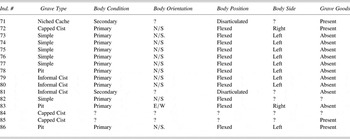
Scaling down, we also see that Individual 71's burial offers a pointed contrast to other interments at RB-11. For the most part, the minor center's decedents were primary interments, which mourners had loosely flexed, oriented north/south, and placed on their left sides (Table 3). Individual 71, however, was incomplete and disarticulated. A inventory of all skeletal elements included: fragments of the frontal bone including its posterior third; most of the right parietal and a smaller fragment of the left parietal with coronal and sagittal sutures; femoral parts (shafts of right and left femora, distal fragment of left femur, fragment of femoral head from unknown side); and the shaft of a right fibula (Saul and Saul Reference Saul1997a). Saul and Saul's skeletal analysis yielded minimal information about Individual 71's life history (see Appendix in Muñoz Reference Muñoz1997:124–134). Open coronal and sagittal sutures suggested that the individual had been 20–34 years of age at the time of death. Long bone metrics and overall robusticity of the remains suggested that Individual 71 was possibly male (M?). No pathology or cut marks (i.e., evidence of mutilation) were visible on the bones recovered, which may be a consequence of poor preservation. A post-coronal depression and parietal bossing hinted at possible cranial shaping resultant from habitual activities like tumpline usage. Such meager data would likely discourage investigators from narrating a life history or answering population-based research queries. Yet, from certain characteristics of the interment we might make inferences about the dynamic activities associated with this individual's death history.
Burials at RB-11

Poor preservation might account for the absence of cancellous bones, but, then, how do we explain the presence of a femoral head? This cancellous skeletal fragment supports the notion that Individual 71's interment was secondary rather than a consequence of taphonomic changes acting on a primary interment. Seeing that the shafts of upper limbs are absent, there is additional support for intentional selection of specific skeletal elements from the lower limbs. And interestingly, femoral and fibular shafts display postmortem rodent gnawing, perhaps due to the more accessible nature of the cache and open niche. Indeed, Individual 71 is the only decedent at RB-11 to display such taphonomic marks.
As far as arrangement of skeletal elements, femora appear to have been intentionally crossed over cranial fragments (Muñoz Reference Muñoz1997:94). Structure 1's ancient occupants then inverted several large fragments of an Early Classic plate over these skeletal remains. Additional items placed within the niche included an unslipped jar, a toad effigy vessel, turtle carapace, and fragments of faunal remains. The toad effigy vessel and turtle carapace are noteworthy, given their singularity within the larger sample from the Three Rivers region. Only one other individual at RB-11, Individual 72, had as many and varied grave goods as Individual 71. Although, the latter's objects, which included drilled marine shell, a shell disk, animal teeth, a bone awl, and an obsidian bladelet, were quite distinctive from those found with the former. Conjunctively, information about grave type, body condition, body position, grave goods, and taphonomic changes highlights Individual 71's distinctiveness among RB-11's other interments—indeed, in comparison to any other burial in the Three Rivers region. Body partibility, in particular, is worth reflecting upon as it offers insights about the identity this individual acquired after death.
BODY PARTIBILITY
Sociologists and sociocultural anthropologists have extensively investigated the dynamic activities that immediately follow an individual's death and continue well after initial interment (Bloch Reference Bloch1971; Bloch and Parry Reference Bloch and Parry1982; Hertz Reference Hertz1960; Metcalf and Huntington Reference Metcalf and Huntington1991; Turner Reference Turner1967; van Gennep Reference van Gennep1960. Above all, they have identified the links between death, ritual practices, bodily transformation, and identity formation. Specifically, corporeal changes set in motion ritual acts that serve to reconstitute decedents' identities. While there are certain guidelines that direct these rituals, the particulars of a decedent's individuality may also contour the living's response. In his eloquent and self-reflective discussion of emotional forces following from a loved one's death, Renato Rosaldo (Reference Rosaldo and Bruner1984) distinguishes between routinized, scripted responses to expected deaths and spontaneous, subjective reactions to the unexpected and often untimely losses of lives. The importance of his analysis is the recognition that contingent upon the individual involved and the manner of death, associated rituals are the intersection of social processes, historical circumstances, and living community members' personal experiences with the decedent. Accordingly, individuals' biographies may be abridged, embellished, censored, or revised after their deaths. Nevertheless, there is an assumption that an account resembles—though may not directly reflect—the life it purports to narrate (at least in the eyes of its narrator). Ascription of identities then act to memorialize, obscure, disparage, or venerate a decedent. To realize these varied ends, body partibility was one of several ritual practices that the Maya utilized to transform individuals' social identities. But, before we can think about the meanings conveyed by partible bodies, like that of Individual 71, we must first isolate the often subtle material markers of such practices.
Desecration
As several scholars have remarked (see contributions in Tiesler and Cucina Reference Tiesler and Cucina2007), the fragmented and fragile nature of Maya skeletal material make it difficult to disentangle taphonomic processes that naturally modify human remains from intentional practices performed by past peoples. Perhaps, confusion also stems from categorizing disarticulated decedents as “secondary” burials. Voicing his dissatisfaction, Becker (Reference Becker, de León, de Asís and Perramón1993:51) has stated that the “term appears inappropriate to the specific archaeological situation in the Maya area.” Indeed, such categorization neither captures the variability of partible practices that the Maya performed, nor does it invite consideration of the multiple stages and often extended duration of these practices.Footnote 8 Analysis of Maya mortuary and skeletal remains then necessitate a conceptual move beyond thinking about burials in terms of either/or; a dichotomous frame obscures the diversity and complexity that characterized Maya peoples' practices.
Yet, Becker's (1993) suggestion that “two-stage burial” would be a more apt descriptor also seems inadequate given archaeological research that documents the repeated re-entry and reuse of grave spaces (Chase and Chase Reference Chase and Chase1996, 1998; Fitzsimmons Reference Fitzsimmons1998, Reference Fitzsimmons, Colas, LeFort and Persson2006). For this reason, a biographical approach to bodies and built spaces is essential for distinguishing the marks of antemortem,Footnote 9 perimortem, and postmortem partibility. These different changes conveyed discrete messages about the living's regard for (de)parted persons. For example, Maya scholars have argued that perimortem practices performed during violent ritual events, like decapitation and flaying, acted to desecrate personhood (Duncan Reference Duncan, Rakita, Buikstra, Beck and Williams2005; Mock Reference Mock and Mock1998).
There is ample evidence that decapitation was common in certain contexts (Houston et al. Reference Houston, Stuart and Taube2006:70–72; Miller and Martin Reference Miller and Martin2004:195). Severed heads representing victims of warfare were prominently depicted in Bonampak's infamous battle scene. Numerous (though sadly unprovenienced) polychrome vessels portray upside down trophy heads affixed to weapons, fashioned into masks, situated in headdresses or other garments, and held as if in offering.Footnote 10 Landa's sixteenth-century chronicling recounted how warriors would ornament themselves with the detached and defleshed jaws of their defeated enemies (Tozzer Reference Tozzer1941:123). And other researchers have identified the interment of skulls as dedicatory sacrifices, most notably at Seibal (Smith Reference Smith and Willey1982:60, 62) and Colha (Barrett and Scherer Reference Barrett and Scherer2005; Massey and Steele Reference Massey, Gentry Steele, Whittington and Reed1997; Mock Reference Mock and Mock1998). Seeing that Individual 71's remains included cranial fragments, it is worth reflecting on the markers of decapitation and the spaces in which isolated skulls were disposed. A biographical consideration of the mass grave from Miramar, Chiapas is illustrative.
At Miramar, excavators unearthed a Late Classic period mass grave located in the main plaza. The grave's date, ca. a.d. 565, coincided with the abandonment of Mirador to the north and Miramar's subsequent population increase (Agrinier Reference Agrinier1978). The partial and complete bodies of 24 individuals were recovered in association with a large ceramic olla and several smaller vessels. No one individual appeared central in the grave, and there was no evidence of bundling. For the most part, decedents' bodies were articulated, if not arrayed awkwardly. Their haphazard arrangements indicated to excavators that during a single event bodies had been stacked atop one another, leaving the limbs of corpses unnaturally akimbo. Evidence that the grave's occupants had been violated is further supported by the presence of three skulls sans bodies. Such body partibility is highly evocative of decapitation. At Miramar, however, skeletal analysis was minimal by the excavator's own admission (Agrinier Reference Agrinier1978:15). Markers of perimortem mutilation or trauma (i.e., cutting or fractures from blunt force) are not mentioned as evidential support for execution. Nonetheless, the location, condition, and arrangement of bodies indicate that desecration and perhaps the production of non-persons was the intent.
In contrast, the context and careful arrangement of Individual 71's remains show postmortem partibility motivated by quite different ends. The absence of cut marks may also offer support that Individual 71's demise was not engendered by violent sacrifice, though we of course consider that poor preservation of the remains may have obscured evidence of violence. Hence, we should not be so quick to conclude that interments comprised of isolated crania or the remains of disarticulated decedents categorically signal desecration of personhood (Berryman Reference Berryman, Cachon and Dye2007; McAnany Reference McAnany1995:63; Weiss-Krejci Reference Weiss-Krejci, Ruíz, Sosa and León2003). The veneration of and ongoing engagement with ancestors, as we will see, also involved body partibility.
Ancestors as Partible Persons
As many scholars have pointed out in cross-cultural considerations of body partibility, corporeal wholeness need not be a precondition for ancestors' potency. Within seminal anthropological literature, Frazer (Reference Frazer1922:36) described “contagious magic” as the sustained association of an individual with his or her body parts (i.e., hair, nails, teeth) long after the latter's detachment. More recently, Strathern's Melanesian case study (1988, Reference Strathern1992, 2005) has offered an evolving consideration of the connection between partibility and personhood. Identities assigned to partible bodies, according to Strathern (Reference Strathern1988:13), can be understood in terms of the ‘individual’ and the ‘dividual.’ Dividual captures a type of personhood that is divisible, shared, plural, and composite, following Marriott (Reference Marriott and Kapferer1976). The notion of the dividual person recognizes that a larger community engenders the single individual and that individuals within the community are intimately imbricated with one another. As she later clarifies, at issue is not individualism but relationism (Strathern Reference Strathern2005:121). In the wake of an individual's death, a family claims bones to create continuity between generations (Strathern Reference Strathern2005:123–124). The selected decedents are defined by their relationship to the living community (i.e., along lines of descent). The detachability and transference of body parts—“bone and flesh or blood and semen”—underscore how “a person's substance may be thought of as body that is part of other bodies” (Strathern Reference Strathern2005:126; see also Busby's [Reference Busby1997] discussion of permeability). An individual's body parts can retain personhood, i.e., a person is partible and such personhood is dividual, or defined by one's dynamic relationship to the group.
Strathern's ideas have a utility beyond her Melanesian case study, specifically with regard to the fragmentation of whole bodies. That decedents can be in/dividual persons applies to (de)parted saints during the Middle Ages. Regarded as both object of worship and active subject, relics were sanctified and adored by peoples throughout Europe (Geary Reference Geary and Appadurai1986). The fact that body parts may not have come from those saints to whom they were ascribed represented a minor detail for the believers who interacted with them (Verdery Reference Verdery1999:28).
Archaeologists studying the European Neolithic period have also offered instances of (de)parted bodies' active social lives (Chapman Reference Chapman2000; Chapman and Gaydarska Reference Chapman and Gaydarska2007; Thomas Reference Thomas, Hamilakis, Pluciennik and Tarlow2002). Especially insightful is Chapman's (2000) discussion of objects' and persons' fragmentation. The latter involved “deliberate deposition of partial skeletons, formed after defleshing, presumably by excarnation” (Chapman Reference Chapman2000:6). This active breaking down of bodies into component parts had a twofold consequence. First, the living members of a group could more easily transport ancestors' fragmented body parts. As such, communities used these mobile parts to redefine a bounded or built space, and concomitantly create a sense of place or identity. Second, selection of specific body parts for curation and circulation highlighted the social viability of the biologically dead as they continued to interact with the living. It is the gifting or exchanging of these fragments that enchained people, whether biologically alive or dead, in social relations.
Fowler's (2004) consideration of Late Mesolithic period Scandinavia further expands on bodily fragmentation. He regards partibility as akin to Chapman's description of fragmentation inasmuch as a person's body can be broken down into component parts and subsequently gifted or exchanged. Bones represented one type of substance—others included garments, exuvia, genetic materials, spiritual beings, and varied animal, plant, or object with which humans come into direct or metaphoric contact—that flowed between people and guided their relationships (Fowler Reference Fowler2004:102–118). He thus sees the concept of dividuality as pertinent in his examination of Mesolithic burials. Scandinavian decedents were buried in cemeteries, cremated, exhumed and disarticulated, interred singly, multiply interred, arrayed with a variety of animals, idiosyncratically decorated, or painted with ochre. These myriad types of corporeal treatments resulted from the complex intertwining of an individual's personal biography, relations with members of the living community, time of and events surrounding death, and links to the landscape.
The Maya and Dividual Personhood
While I recognize that these examples are culturally and temporally distant from the Maya, ethnographic discussions about soul conceptions suggests that notions about dividual personhood and partibility are quite salient. Mam-speakers from Santiago Chimaltenango (Guatemala), for instance, define naab'l as the social soul or a community's particular and proper “way of being” (Watanabee 1989:269). Calvin (Reference Calvin, Kerr and Kerr1997:869) elaborates,
Because each specific Maya community possesses a unique naab'l, its members can recognize each other and distinguish strangers. The concept of naab'l is grounded in the continuities of local ancestry, received tradition, and the features of the environment that are the loci of ritual. Naab'l survives the death of the individual and remains as part of the communal collectivity.
Such a description calls to mind the notion of dividual personhood. Yet, contemporary Maya peoples also believe that individuals possess inner personal souls (Fischer and Hendrickson Reference Fischer and Hendrickson2003; Vogt Reference Vogt and Holt1990; Watanabee 1989). For example, Mam-speakers refer to such souls as aanma (Watanabee 1989:269), and Tzotzil speakers in Zinacantan use ch'ulel (Vogt Reference Vogt and Holt1990:24). While there is a dimension of individuality associated with the inner personal soul, such souls are inherited. Watanabe (Reference Watanabe, Bricker and Gossen1989:263) explains that in planting these souls soon after an individual's conception, ancestral deities “pass down the patriline, drawn from a ‘pool’ of souls previously held by members of the same descent group.” Each new individual is paired with a deceased relative, and a continual recycling of the inner personal soul occurs.Footnote 11 Pertinent to a discussion of (de)parted persons, an inner personal soul resides in specific body parts—an individual's flowing blood, beating heart, detached hair and nail clippings (Guiteras-Holmes Reference Guiteras Holmes1961:140–141). Removal and/or transference of these substances (i.e., persons as partible) link individuals of the present generation to past ones (i.e., persons as dividual).
Archaeological evidence suggests that the pre-Columbian Maya regarded skeletonized body parts as another substance that flowed between the living and their dead kin. Evidence from Cuello, Belize, may offer an early instance of such corporeal treatment. In particular, we may reflect on a Late Preclassic mass grave, Mass Burial 1, encountered beneath the site's main plaza (Robin Reference Robin1989; Robin and Hammond Reference Robin, Hammond and Hammond1991; Saul and Saul Reference Saul and Hammond1991, Reference Saul, Saul, Whittington and Reed1997b). This example is particularly salient as we can compare it to the mass grave at Miramar. According to excavators, the secondary remains of 30 disarticulated individuals accompanied two primary, articulated decedents. The former, which may have been bundled originally, had been placed at the latter's feet and atop their laps. Excavators characterized their findings as sacrificial. More specifically, the mass grave was described as a “holocaust” and several of the disarticulated were deemed “severely mutilated” (Robin and Hammond Reference Robin, Hammond and Hammond1991:211). Such body partibility would then have echoed the violation and desecration of person apparent at Miramar.
Yet, a biographical approach spotlights features of this mass grave that call its designation as desecratory into question. McAnany (Reference McAnany1995:63) observes, “The multiple ‘collar’ linings around the top of the pit indicate that it was opened and resealed several times.” Reentering Cuello's mass grave would have provided the living with an opportunity to purposely rearrange or unintentionally disturb the remains of decedents already contained within. Or, Mass Burial 1's reentry may have resulted from the disinterment of decedents from other locales and their subsequent reinterment in this more central location. Indeed, the excavators have even noted that remains were arranged in a “non-random way” (Robin and Hammond Reference Robin, Hammond and Hammond1991:211), a pointed contrast to the haphazard assemblage of articulated bodies at Miramar. And skeletal analysts have found no evidence for dismemberment (Saul and Saul Reference Saul and Hammond1991), though the absence of cut marks may again be a consequence of poor preservation. That the mass grave's disarticulated decedents represented venerated ancestors is also supported by their bundled states. Throughout the Maya world, and Mesoamerica more broadly, the practice of bundling bodies connoted sacredness, conferral of ancestor status, and deification, and there is evidence of such bundling at sites in the Three Rivers region (Geller Reference Geller2004; Reese-Taylor et al. Reference Reese-Taylor, Zender, Geller, Guernsey and Reilly2006). Finally, we may note the historic period for Mass Burial 1. Like its associated monumental architecture, this mass grave was created around 400 b.c., a time when significant sociopolitical changes were afoot (Robin and Hammond Reference Robin, Hammond and Hammond1991:224). Accordingly, it is possible that community rulers required the physical presence of original ancestors to legitimate their positions of power. In this regard, we may conceptualize these decedents as dividual persons.
INDIVIDUAL 71: PRACTICE MAKES PERSON
Cuello's mass grave, which offers convincing evidence for partibility connected to re-entry and reverence, provides a springboard for thinking about the death history of RB-11's Individual 71. While the scale is reduced, biographical information suggests that treatment of Individual 71's body parts materialized relations between and maintained continuity from generation to generation.
As aforementioned, it appears that Late Classic renovations to Structure 1 provided access to the Early Classic remains of Individual:71. Hence, the decedent's original grave space was later re-entered after initial interment. Following the completion of construction activities, Structure 1's occupants appear to have then placed Individual 71 into a wall niche (Muñoz Reference Muñoz1997:95). Fragments of an Early Classic plate offer additional support for disturbance and re-interment. Skeletal and material remains were not hastily reburied in construction fill, an act suggestive of forgetting, and one which does characterize the secondary remains of six partial individuals in the Three Rivers region sample. Rather, the community fashioned a niche in Structure 1's rear wall into which they placed parts of Individual 71. Epigraphy, ethnohistory, and iconography suggest that inclusion of specific grave goods and selection of cranial and femoral fragments was an intentional and creative response to the disinterment of a person long dead but believed to be a revered kin member.
For instance, the Classic period Maya believed certain body parts, most notably the head, retained aspects of an individual's identity. Houston and colleagues (2006:60) have argued that the Maya regarded the head, or baah, as “the locus of identity…[that] establishes individual recognition and serves logically as the recipient of reflexive action.” Here we are reminded of contemporary Maya conceptions of the inner personal soul. As a historical bridge, sixteenth-century ethnohistoric writings reiterate these ideas about decedents' in/dividuality and partibility.
They used to cut off the heads of the old lords of Cocom, when they died, and after cooking them they cleaned off the flesh, and then sawed off half the crown of the back, leaving the front part with the jaws and teeth. Then they replaced the flesh which was gone from these half-skulls by a kind of bitumen, and gave them a perfect appearance characteristic of those whose skull they were. They kept these together with the statues with the ashes, all of which they kept in the oratories of their houses with their idols, holding them in great reverence and respect. And on all the days of their festivals and rejoicings, they made offerings of food to them, so that food should not fail them in the other life, where they thought that their souls reposed. (Landa, cited in Tozzer [1941:131])
From this passage, we see that processing the head involved several, complicated stages—defleshing, fragmentation, and reconstitution. The decedent's individuality was maintained inasmuch as the external visage was replicated. As a consequence, the skull seemed to represent or memorialize the individual in life. But, the above passage also indicates that these (de)parted ancestors were dividual persons. Processing also reconstituted decedents' identity from biologically alive group member to liminal corpse to biologically dead but socially viable ancestor. Interactions between the living and dead occurred during the course of daily, mundane activities, as well as in the more formal context of special ritual occasions. Consequently, a kin group could actively maintain a dialogue with the dead and use body parts (i.e., heads) to reaffirm social cohesion amongst the living. Such seems to be the case for Individual 71.
Additionally, the placement of Individual 71's femora—carefully crossed over cranial fragments—offers support for the connection between partibility and dividual personhood. Such an arrangement is reminiscent of skull-and-crossbones motifs, which are ubiquitous throughout the Maya world.Footnote 12 Iconographic depictions appear on buildings at Tikal and Uxmal, for example (Houston Reference Houston and Houston1998:520, Note 2). As to the motif's meaning, McAnany (Reference McAnany1995:46–47) contends that skull-and-crossbones are “potent images symbolic of social order and orderly successions, be they transmissions of royal power or of the fields and orchards of wealthy commoners.”
The niching of these remains may also be a symbolic variation on the theme of generational continuity. The sixteenth-century Popol Vuh tells us that just after impregnating Blood Moon with the Hero Twins, the skull of One Hunahpu—while “niched” within a tree—states, “A father's face will survive in his son, even after his own face has rotted away and left nothing but bone” (Tedlock Reference Tedlock1996:37). Hence, successive generations are linked through the separation and transference of substances like bones. That Individual 71's remains were similarly niched might indicate the perdurance of Maya religious beliefs about body parts' social vitality and power from the Classic period into the colonial era.
In addition to Individual 71's body condition, position, and location, the decedent's assortment of grave goods may reiterate notions about this individual and dividual personhood. Rather than assume that the objects directly reflect aspects of Individual 71's social persona in life, focusing on a death history facilitates thinking about the meanings and identity attributed to this decedent by subsequent generations. Certainly, the community's allusion to fauna—in the form of animal bone fragments, a turtle carapace, a toad effigy vessel—was intentional and symbolically charged. Turtles and toads are similar symbolic constructs linked to the Maize Lord. On numerous pottery vessels, for instance, the turtle carapace is depicted as the place from which the Maize Lord is reborn, breaking free from his “grim dry-season prison” (Zender 2006:9–10; see also Taube Reference Taube1988). Likewise, the toad is depicted as the place of rebirth in the Ek Balam façade and on Stela X from Izapa. Perhaps the toad's biological abilities served as a reference point. These amphibians have dry and leathery skin that facilitates water retention in times of scarcity and is shed anywhere from once a week to six times a year (Kennedy Reference Kennedy1982:281). Additionally, many toads in the family Bufonidae have glands behind their ears that excrete toxins with psychotropic effects. Shamans may have consumed these secretions to induce hallucinogenic trances that engendered communication with the supernatural (Dobkin de Rios 1974; Kennedy Reference Kennedy1982:289). The inclusion of these animals' physical and stylized remains in Individual 71's burial perhaps points to this person's role in a community dependent on agricultural production. It is possible that such was the case while Individual 71 lived. Yet, the (re)interment of grave goods may also reveal how subsequent generations regarded their ancestor, and thus narrated this decedent's death history to meet their own ends. Long after Individual 71's death, the community—very much aware of the inconsistent and often extreme wet-dry cycles of the ecological setting—may have re-envisioned this ancestor as a mediator between natural and supernatural spheres.
CONCLUSION
Though unassuming and humble in comparison to the more grandiose burial of noble persons, Individual 71 is significant for several reasons. This decedent's careful interment, subsequent curation of body parts, and prolonged veneration by multiple generations at RB-11 demonstrate that interactions between commoner communities and their dead kin could be temporally deep. Such practices, as I have suggested, may have been designed to produce dividual persons. Yet, particular attributes of this burial have much to tell us about a death history shaped by social class and personal relationships, as well as different types of ancestors within ancient Maya society. Were we to close our ears—treat such variability within communities and throughout regions like so much noise—we would be missing key and intriguing aspects of individuals' lives and deaths. Thus, a multiscalar approach to the Three Rivers region's sample has circumvented a top-down perspective, which often glosses over the nuances of mortuary rituals and ancestor veneration in commoner communities. The fragmentation of bodies, however, did not always sustain generational continuity. Some individuals were venerated, while others may have been victimized, vilified, or simply buried. To distinguish between techniques and meanings, biographical consideration of body partibility—contextualization of bodies and their associated materials within physical space, cultural setting, and historic period—is necessary. Such an approach wedded with a multiscalar frame ultimately facilitates peopling ancient Maya society in a much more vibrant and complex way.
RESUMEN
Al estudiar las alteraciones de los cuerpos, pongo en práctica un análisis biográfico de los restos humanos encontrados. En general, la mayoría de las investigaciones sobre los mayas relatan historias sobre sus vidas, pero también es importante narrar las historias de sus muertes—las prácticas que transforman a los esqueletos después de la muerte. Esta estudio se centra en la costumbre de partición corporal entre los mayas, es decir, la partición del cuerpo para conmemorar, olvidar, deshonrar o venerar al individuo. El tipo de partición corporal proporciona información importante sobre la identidad del individuo. Para entender mejor la evidencia material y el significado simbólico de la costumbre de partición corporal utilizamos teorías relacionadas a la tema de la categoría de persona, especialmente las ideas sobre la persona como ‘dividual.’
Muchos estudios han examinado los cuerpos de la nobleza y su tratamiento prolongado. El énfasis en entierros de los mayas plebeyos complementa los numerosos estudios de la élite y de sus tumbas; de este modo, se aprecia mejor la complejidad de la sociedad maya antigua. Una muestra de los entierros de la región Three Rivers en el noroeste de Belice incluye gente noble y común, y los datos son suficientes para comparar las clases diferentes. Los investigadores de entierros típicamente emplean una metodología demográfica que minimiza idiosincrasias individuales. Por mi parte, reconstruyo la identidad del Individuo 71 enfocándome en la evidencia de prácticas ubicuas y las idiosincrasias del entierro. El Individuo 71, ubicado en el interior de una estructura residencial y rural en el sitio RB-11, refleja un tratamiento cuidadoso de las partes del cuerpo y una adoración continua por parte de las generaciones posteriores. Parece que, a pesar de su muerte biológica y estado desarticulado, el Individuo 71 mantuvo relaciones con el mundo de los vivos, extendiendo su viabilidad social más allá de su muerte. Sin embargo, el entierro también tiene particularidades. Estas sugieren que los mayas reconocían tipos diferentes de antepasados, dependiendo de la clase social, circunstancia o vida personal de los mismos. Por consiguiente, el concepto de ‘antepasado’ es muy complejo.
ACKNOWLEDGMENTS
A much-abbreviated version of this paper was originally presented at a 2004 AAA symposium in Atlanta, and I would like to thank Ken Nystrom for his organizing and coping skills in light of the tribulations from that particular annual meeting. Comments from the original discussants, Lynne Goldstein and Jane Buikstra, offered encouragement and constructive criticism. For the opportunity to participate in the PfBAP and permission to draw on its data, I thank Project Director Fred Valdez and skeletal analysts Julie and Frank Saul. I am also grateful to RB-11's excavators Rene Muñoz and Morgan Davis for their careful attention to detail and generosity with data. Wendy Ashmore, Miranda Stockett, Jane Buikstra, Rachel Scott, and Marcello Canuto have provided valuable feedback on earlier drafts of this paper (though they should not be held responsible for any inadequacies or inconsistencies). Critical comments from Patricia McAnany, James Garber, and several anonymous reviewers were also helpful during the revision process. Time spent at the Library of Congress's Kluge Center as the Kislak Fellow was precious for tracking down additional insights and I offer my thanks to Mary Lou Reker and Arthur Dunkelman, the then Kislak Collection's curator.