Introduction
The Solar System is rich in biogenic elements. A total of some 1011 comets contain 1030 g of material, which is largely comprised of carbonaceous material (organics) mineral dust and water-ice. In the early history of the planetary system, water in the form of liquid would be expected to persist for millions of years within cometary interiors (Hoyle & Wickramasinghe Reference Hoyle and Wickramasinghe2000; Wickramasinghe et al. Reference Wickramasinghe, Wickramasinghe and Napier2009). During this time microbial cells surviving from earlier episodes of planet–comet formation would be vastly amplified, and would be later re-frozen within cometary bodies. Subsequent sublimation at the surface and dynamical evolution leads to both the expulsion of viable microorganisms near perihelion and the sedimentation and concentration of biological structures within the cometary regolith.
Because carbonaceous chondrites are thought to have parent bodies that are comets, the existence of microbial structures in a fossilized form within such meteorites would not be entirely surprising. According to the theory of panspermia, Earth was seeded with microbial life during the epoch of late heavy bombardment that ended 3.8 billion years ago, the earliest geochemical evidence of life being found at precisely this time. However, an initial injection of life 3.8 billion years ago would not have been the end of the story. Comets continue to interact with Earth with some 100 tonnes of comet debris being introduced to Earth on a daily basis even at the present time. Ongoing injections of cometary matter would thus be expected to show evidence of life.
Organic compounds as well as putative microbial fossils discovered in carbonaceous meteorites bear testimony to a possible connection between terrestrial life and comets. These ideas are supported by the results obtained from the isotopic analysis of the Murchison meteorite, showing that the organic compounds do not have a terrestrial origin (Martins et al. Reference Martins, Botta, Fogel, Sephton, Glavin, Watson, Dworkin, Schwartz and Ehrenfreund2008). Similarly, recent studies by Hoover et al. (Reference Hoover2009) that back up a long-standing contention for the presence of microbial fossils in the same meteorite provide further evidence in support of panspermia.
The Tagish Lake meteorite is classified as a type CI2 carbonaceous chondrite (Zolensky Reference Zolensky, Nakamura, Gounelle, Mikouchi, Kasama, Tachikawa and Tonui2002). It has been found in other studies to contain organic globules of sub-micrometre to nanometric sizes (Nakamura et al. Reference Nakamura, Zolensky, Tomita, Nakashima and Tomeoka2002; Hoover et al. Reference Hoover, Jerman, Rozanov and Davies2003). Nanometric to sub-micrometre sized organic granules as well as filaments and trichomes were interpreted as putative microfossils by Hoover et al. (Reference Hoover, Jerman, Rozanov and Davies2003). Similar objects was first reported in meteorite extracts from the 1960s (Claus & Nagy Reference Claus and Nagy1961) and have since been reported in several other carbonaceous chondrites (Garvie & Buseck Reference Garvie and Buseck2006). Initial criticisms that all such structures were modern contaminants appears to have been ruled out by the work of Hans Pflug (see Hoyle & Wickramasinghe Reference Hoyle and Wickramasinghe1982; Wickramasinghe et al. Reference Wickramasinghe, Wickramasinghe and Napier2009) and Hoover (Reference Hoover2009), but their biogenic origin still remains controversial.
Our present work examines the complex microstructure of the Tagish Lake meteorite using both transmission and scanning electron microscopy. In addition, we set out to determine the elemental composition of its contents by X-ray nanoprobe analysis. Our particular interest is concerned with the structural localization of carbon, oxygen and sulfur, the important elements that make up the insoluble organic species localized within granules in the meteorite. Furthermore, we analyse the samples by Fourier Transformer Infrared (FTIR) spectroscopy to confirm the presence of bulk organic compounds in the meteorite.
Materials and methods
Transmission electron microscopy
The Tagish Lake sample (1×2 mm2 fragment) was embedded in LR White resin (London Resin Co. Ltd) in a gelatine capsule for 24 hours at 55°C. The resulting polymerized resin block was cut into 90–100 nm thick sections on a Reichert ultracut microtome (Reichert-Jung, Austria) with a Diatom diamond knife. The thin sections were mounted on a pioloform-coated copper grid and examined using a Philips EM 208 transmission electron microscope operated at 80 kV accelerating voltage.
Scanning electron microscopy
The 1×2 mm2 fragment was attached onto a metal stub with double-sided sticky tape, and coated with a thin layer of gold to protect it from beam irradiation. Ultrastructural examination was conducted in a scanning electron microscope (Philips XL 20 SEM), operated at 10 kV accelerating voltage.
X-ray nanoprobe analysis
The ultrathin sections as prepared above were analysed using a transmission electron microscope (Philips CM10), fitted with an X-ray microanalysis detector (EM-400 Detecting Unit, EDAX, UK). The following operating conditions were maintained constantly throughout the analyses: electron beam size (20 nm), condenser aperture (30 μm), magnification (30 μm) and analysis time (200 cps). The following components of the Tagish Lake meteorite were taken for analysis: mineral chunks, hexagonal bodies, chondrules, granules and the matrix of the parent body. During the analyses, the electron beam was focused onto the materials of interest, and a total of 25 similar objects were randomly taken for measurements. Both qualitative and quantitative analyses of the spectra were performed using the EDAX Genesis software for thin sections.
FTIR spectroscopy
The Tagish Lake sample (0.15 mg) was ground into very fine grains using an agate pestle and mixed thoroughly with potassium bromide (KBr) powder (20 mg). The mixture was transferred into a small blending mill (SPECAmillTM, Kent, UK) for further grinding. The sample was subsequently transferred into the Evacuable Pellet Dies (SPECAC Ltd., Kent, UK) under a pressure of 10 tons to make a KBr disc. The resulting KBr disc was analysed using a FTIR spectroscope (JASCO Model FT/IT 660 Plus series).
Results
Electron microscopy
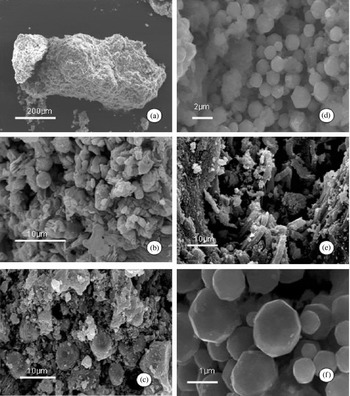
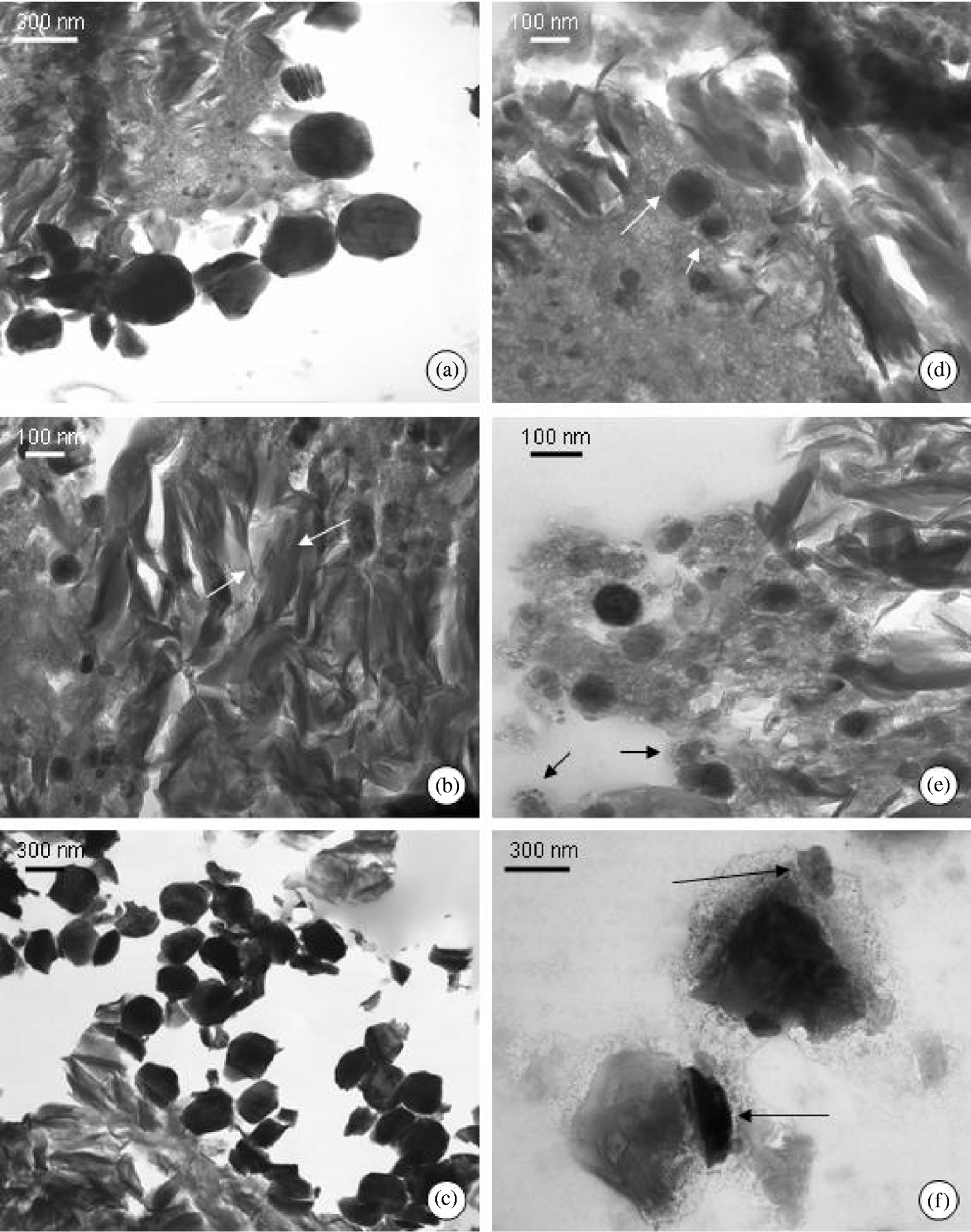
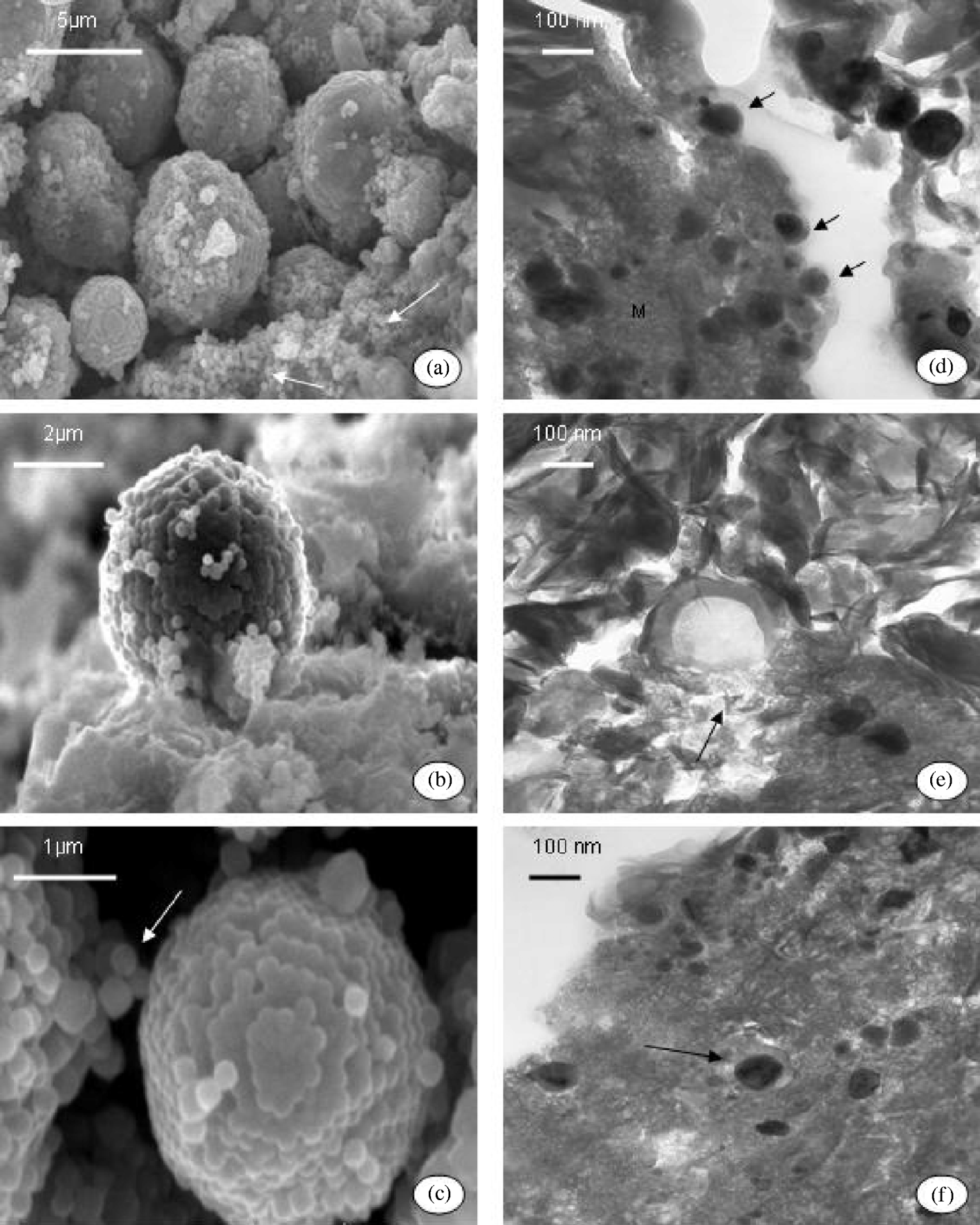
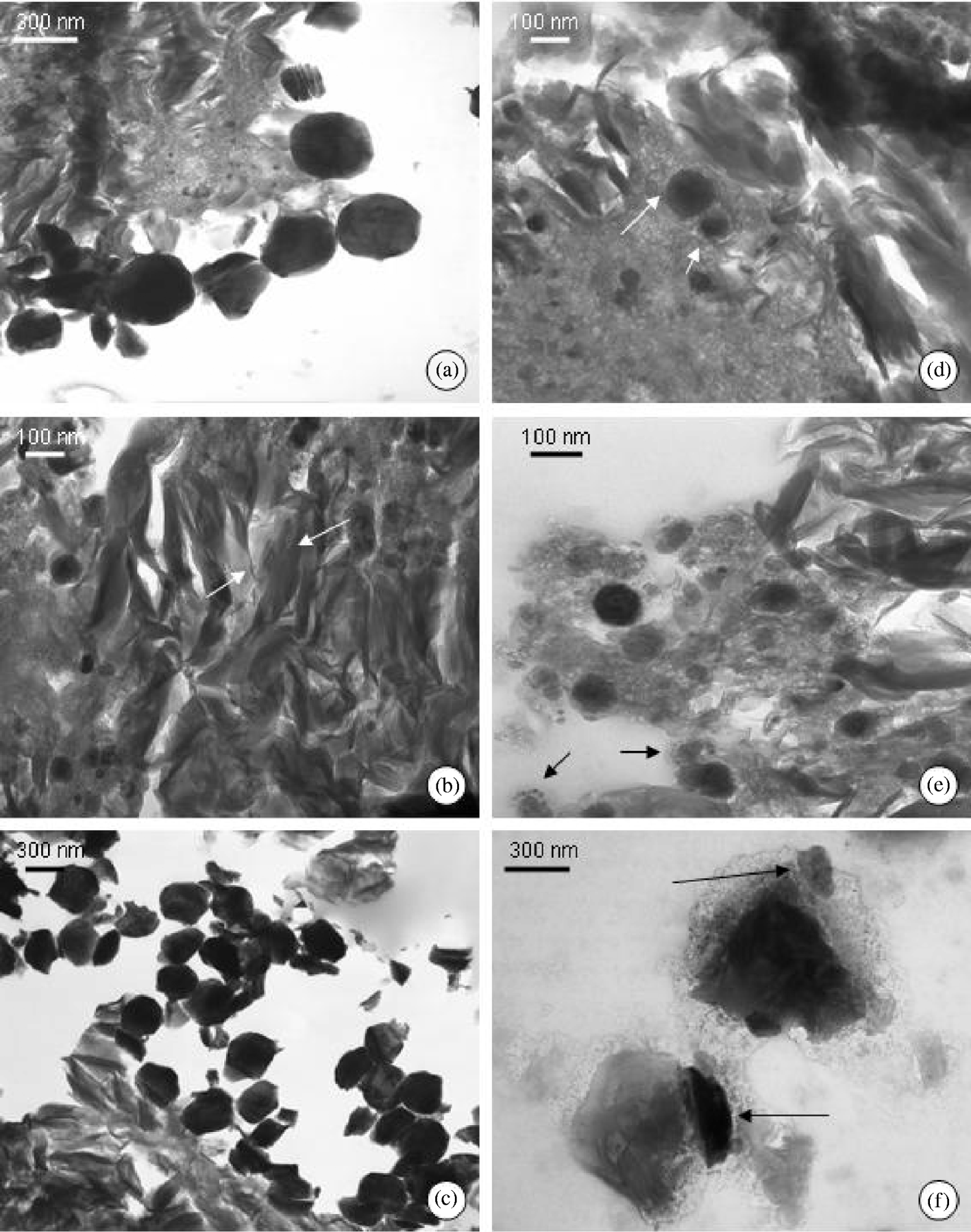
The Tagish Lake meteorite is made up of loosely formed aggregates, making it one of the most friable carbonaceous chondrites found on Earth. High resolution transmission and scanning electron microscopy reveals its complex structure (Figs 1–3). The aggregates are composed of plaquettes or chunks of crystallized minerals, hexagonal bodies and chondrules of globular structure with variable sizes, all of which are embedded in a matrix of fine granules and fibril-like inclusions. Imaging analysis of 90–100 nm thick sections cut from a 1×2 mm2 fragment shows mineral chunks having irregular shapes with sizes ranging from 1 to 10 μm (Figs 1(a) and (b)), many displaying concentric rings (Fig. 1(c)) and layers of crystallized structures (Fig. 1(b)). Chunks of minerals are partially embedded in the matrix of the parent body (Fig. 1(e)). The hexagonal bodies (0.4–2.0 μm in diameter) appear electron black, have no internal structure and are clustered in large groups (Figs 1(d) and (f)), often loosely attached to the granular matrix of mineral-rich carbonates. Many of these bodies have lost their original hexagonal shape to become almost spherical (Figs 2(a) and (c)).
Scanning electron microscopy images of Tagish Lake. (a) A fragment of Tagish Lake. (b) Plaquettes of crystallized minerals. (c) Chunks of minerals showing a concentric and layered structure. (d) A group of hexagonal bodies, some of which appear almost spherical. (e) Plaquettes of crystallized minerals partially integrated into the matrix. (f) High magnification of hexagonal bodies showing a smooth surface, suggestive of metal alloys.

Transmission electron microscopy images of a Tagish Lake fragment. (a) Cross-section of a fragment showing black hexagonal bodies partially attached to the granular matrix of the parent body. (b) Plaquettes of minerals (arrows) embedded into the matrix of the parent body. (c) A group of metal alloys, some showing their hexagonal structure and many others becoming almost spherical. (d) A partial view of the matrix of the parent body showing granules of variable sizes and fibril-like materials, onto which plaquettes of minerals are attached; the arrows show granules with an electron dense core. (e) Plaquettes of crystallized minerals partially integrated into the altered matrix; the arrows show granules with an electron dense core. (f) Diffusion of minerals as a result of hydrothermal reaction; the arrows show diffused minerals.
Scanning and transmission electron micrographs of Tagish Lake components. (a) Chondrules covered with granules; the arrows show granules in the chondrule-free area. (b) A chondrule partially embedded in the parent body. (c) A high-magnification scanning electron micrograph showing a chondrule covered with granules; the arrow shows isolated granules. (d) Granules showing a wall (arrows) and an electron dense core. (e) A hollow chondrule partially embedded in the parent body; the arrow shows leakage of materials into the parent body. (f) The arrow shows a granule in the parent body.
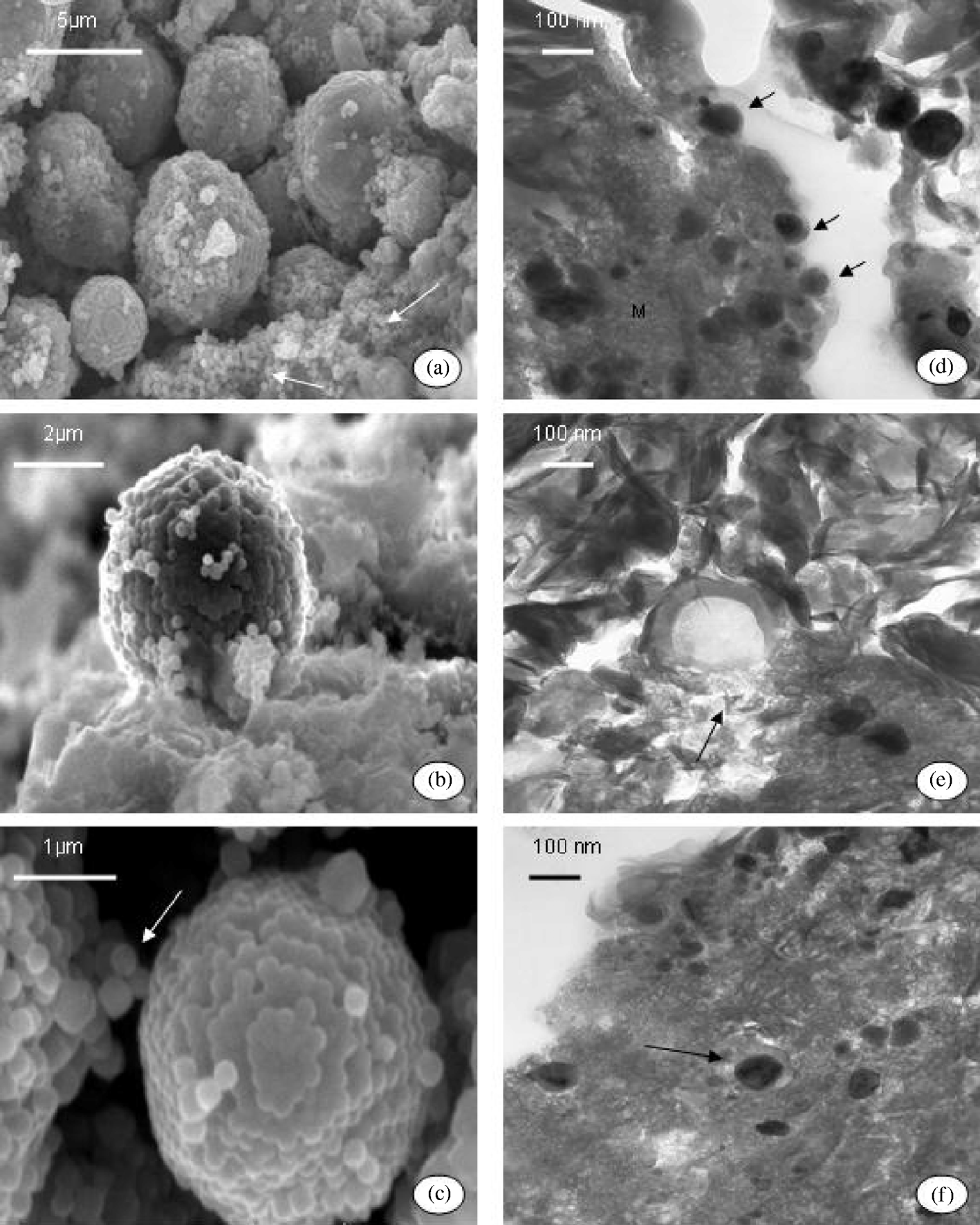
Chondrules with diameters ranging from 3 to 6 μm are either clustered in groups (Fig. 3(a)) or individually attached to the matrix (Figs 3(b) and (c)). However, a large population of them is covered with granules (100–300 nm in diameter) on their surface, making it appear rough and irregular (Figs 3(a)–(c)). Many similar granules also form large clumps in the chondrule-free zones (arrows in Fig. 3(a)). All of these granules show an internal structure consisting of a rim (or wall) with an average thickness of 20–40 nm and a larger core (Figs 2(d) and (e)). While numerous granules have a high electron-dense core, many others also show a hollow interior with their bodies partially embedded into the matrix (Fig. 3(e)). Lateral diffusion of the probably volatile minerals can be seen in many large granules (Fig. 2(f)). The matrix of the parent body appears to be made up of tiny grains with sizes ranging from 5 to 100 nm in diameter and a network of fibril-like materials (Fig. 3(f)), into which are embedded plaquettes of minerals, hexagonal bodies of metal, chondrules and granules of smaller sizes. Chemical biosignatures found in acid-dissolved samples by Pizzarello et al. (2001), and the microstructure analysis of Hoover et al. (Reference Hoover, Jerman, Rozanov and Davies2003), support the speculation that the 5–100 nm grains have a biological origin, probably similar to the nanobacteria claimed to be present in the Mars meteorite ALH84001 (McKay et al. Reference McKay, Gibson, Thomas-Keprta, Vali, Romanek, Clemett, Chillier, Maechling and Zare1996). The indication from our work is that the parent body of the Tagish Lake meteorite underwent intense aqueous alterations in places consistent with the presence of liquid water at some stage of its history (Figs 3(d) and (e)).
3.2 X-ray microanalysis
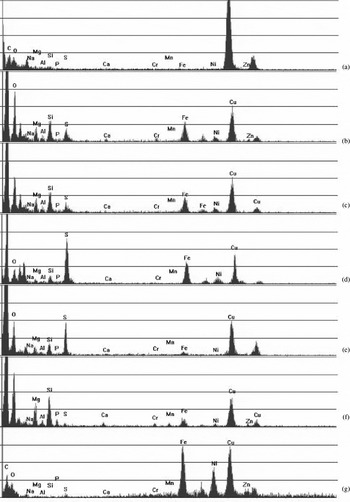
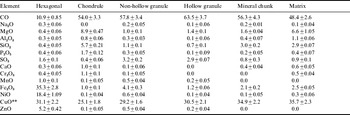
Plaquettes or chunks of crystallized minerals are mainly composed of carbon, oxygen, iron, magnesium and silicon (Fig. 4 and Table 1). Other elements, such as aluminium, sulfur, calcium, chromium and nickel, are also detected, but their relative weight (0.2–1.6 wt%) is much less significant. The hexagonal bodies contain high concentrations of iron, zinc and nickel, but a low amount of carbon, manganese, sulfur and chromium (Fig. 4 and Table 1). Traces (<1 wt%) of magnesium, silicon, phosphorus, calcium and aluminium are also detected in these bodies.
X-ray spectra of chemical elements in the Tagish Lake meteorite. (a) Background of film-coated copper grid. (b) Matrix of parent body. (c) Mineral chunk. (d) Non-hollow granule. (e) Hollow granule. (f) Chondrule. (g) Hexagonal body.

Relative concentrations (wt%) of minerals in the Tagish Lake meteorite

Values ±SD (standard deviations), which were obtained from nanoprobe analysis of randomly selected materials, are shown as means of 25 measurements.
** CuO represents the copper grid used to mount thin sections of the Tagish Lake sample.
Chondrules with a smooth surface are generally rich in carbon, oxygen, iron, magnesium and silicon, but significantly low in sulfur, nickel, calcium, aluminium, phosphorus, manganese and zinc (Fig. 4 and Table 1). The chondrules with granules on their surface are comparable to those with a smooth surface in terms of their chemical composition (Fig. 4 and Table 1). These granules have variable sizes (100–300 nm), mostly with an electron-dense core, and contain a high level of carbon, silicon, magnesium, iron, nickel, sulfur, phosphorus, manganese and zinc. Many of them also form clusters in the chondrule-free regions, and basically have the same chemical composition as those on the chondrules (Fig. 4 and Table 1). A large population of these granules is also integrated into the matrix of the parent body; those with a hollow core show a reduced amount of silicon, magnesium, nickel and iron, but are rich in carbon and sulfur elements, mostly confined to the wall (Fig. 4 and Table 1). The possibility of microfossils cannot be ruled out from our work, but further research is needed to resolve this important issue.
The grains and fibril-like materials that make up the matrix of the Tagish Lake meteorite contain high concentrations of carbon, oxygen and sulfur. A significant amount of iron, silicon, magnesium and nickel is also detected in the matrix, together with traces of calcium, aluminium, manganese, sodium, zinc and chromium (Fig. 4 and Table 1). Again our results are generally consistent with the biological interpretations offered by Hoover et al. (Reference Hoover, Jerman, Rozanov and Davies2003) and Hoover (Reference Hiroi, Zolensky and Pieters2009).
FTIR spectroscopy
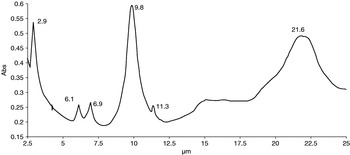
The FTIR spectrum displays five features centred at 6.1, 6.9, 9.8 and 11.3 μm (Fig. 5). The 2.9 feature is indicative of the presence of water. The 9.8 μm band is characteristic of silicates and shows the highest intensity of absorption. The less intense peaks at 6.1 and 11.3 μm correspond to the aromatic nature of carbon, whereas that at 6.9 μm is related to the aliphatic carbon.
FTIR spectrum showing the characteristic bands of the aromatic carbon centred at 6.1 and 11.3 μm (Cataldo & Keheyan Reference Busemann, Young, Alexander, Hoppe, Mukhopadhyay and Nittler2003). A peak at 6.9 μm is attributed to the aliphatic carbon (Papoular et al. Reference Nakamura, Zolensky, Tomita, Nakashima and Tomeoka1993). The band at 2.9 μm confirms the presence of water (Al-Mufti 1985).

Discussion
The Tagish Lake meteorite is composed of minerals loosely intergrown in the granular matrix of a carbonaceous parent body. Most of the hexagonal bodies are bound to each other, suggesting that this formation has taken place before the bodies were integrated into the matrix. Many of the hexagonal bodies within the groups have become almost spherical, this evidence indicating that they may have been subjected to grinding collisions in space. Containing high concentrations of iron, zinc and nickel but having no distinguishable internal structure, these bodies are most likely to be metal alloys. The occasional detection in minute quantity of carbon, magnesium, silicon, sulfur, calcium and aluminium is consistent with biological activity and microbial replication in an aqueous medium within the parent body (Wickramasinghe et al. Reference Wickramasinghe, Wickramasinghe and Napier2009).
Chondrules in general appear to have a smooth surface, and are rich in carbonates, iron, silicon and magnesium, but also contain smaller amounts of sulfur, calcium and aluminium. This mineralogy suggests that the chondrules are not comprised of the same materials as the hexagonal bodies, although both appear similar in size. The most spectacular feature of the chondrules is the appearance of aggregates of granules on their surface (Fig. 3). Although it has been suggested that such granules form by the condensation of interstellar grains on larger planetissimals (chondrules) in the outer regions of the protoplanetary disk, we ourselves consider this unlikely (McSween Reference McSween1989). The size distribution of organic interstellar grains span a wide range from nanometric- to micrometre-sized particles and this is not reflected in the granule layers found in Fig. 3. Many of these granules are also found in clusters in the chondrule-free regions, suggesting that the accumulation took place within the parent body at some stage.
Although most granules appear intact, many others show structural and chemical alterations in aqueous solution before they reached Earth. The granules consist of two layers, an exterior wall and a core. The apparent changes in structure can be seen on the surface and the inside of the granules. A cross-section of the affected granules reveals partial degradation of their wall through which materials appear to leak profusely from the inside into the matrix, eventually leaving the granules with a hollow core. This would be consistent with the dehydration and freeze-drying of a biological culture. Breakdown of the wall and subsequent release of minerals are shown in Fig. 2. These structural characteristics expressed by the affected granules are associated with the matrix of the parent body, and confirm that hydrothermal alteration has occurred, resulting in mass fractionation. Lateral diffusion of the interior materials through the wall, followed by a massive loss of materials, is suggestive of hydrothermal reactions taking place in the parent body. The transformation from the non-hollow to hollow granules gives an indication that the core, which is rich in carbonates and water-bearing minerals, is very susceptible to hydrothermal conditions. The hydrous minerals in the meteorite are similar to terrestrial clay, and are believed to be the products of low-temperature aqueous alterations of pre-existing anhydrous minerals in asteroids (Llorca Reference Llorca2004). The hydrated mineralogy of Tagish Lake and its richness in carbonaceous matter are reminiscent of the expected characteristics of D-type asteroids, which are situated in the outer part of the Kuiper Belt (Hiroi et al. Reference Hiroi, Zolensky and Pieters2001; Grady et al. Reference Grady, Verchovsky, Franchi, Wright and Pillinger2002). The Tagish Lake meteorite also shows characteristics strikingly similar to the Mars meteorite ALH84001 (McKay et al. Reference McKay, Gibson, Thomas-Keprta, Vali, Romanek, Clemett, Chillier, Maechling and Zare1996).
Mineral chunks, including those with concentric structures, are mainly composed of C-O-Fe-Mg-Si elements; their predominance in Tagish Lake reflects that the chondrite is rich in minerals and metals, probably MgSiO3. The formation of concentric rings and layers of crystallized minerals suggests that these materials have been subjected to a cycle of high temperature and rapid cooling processes. Another unique composition of Tagish Lake is that it contains high concentrations of iron-magnesium rich carbonates, but an unusually low amount of high-temperature nebular elements, such as calcium and aluminium, reflecting that these elements are probably altered to form Mg-Fe rich serpentine. These compositional characteristics are also consistent with those of extinct comets including P- and D-type asteroids (Bell et al. Reference Bell, Davis, Hartmann and Gaffey1989).
The X-ray nanoprobe analysis of the granules shows that they are rich in carbon, silicon, magnesium, iron and sulfur, and that most of the carbon, oxygen and sulfur is concentrated in the wall, indicating the existence in these granules of insoluble macromolecular organic material with the general formula C100H60N7O12S2 (Hayatsu & Anders Reference Hayatsu and Anders1981). The presence of organic compounds in Tagish Lake is further confirmed by the results obtained from the infrared spectroscopic analysis. The 6.1, 6.9 and 11.3 μm features of the absorption waveband are all linked to organic/biological species. Those at 6.1 and 11.3 μm are characteristic of aromatic carbon (Cataldo & Keheyan Reference Cataldo and Keheyan2003), whereas that at 6.9 μm is linked to aliphatic character (Papoular et al. Reference Papoular, Ellis, Guillois, Reynaud and Nenner1993). These features match the emission bands of several astronomical objects, in particular the unidentified bands and the protoplanetary nebulae spectrum (Hudgins & Allamandola Reference Hudgins and Allamandola1997; Rauf & Wickramasinghe Reference Rauf and Wickramasinghe2009; Wickramasinghe et al. Reference Wickramasinghe, Wickramasinghe and Napier2009).
The present work confirms early observations that a high proportion of carbon in Tagish Lake derives from organic species (Brown et al. Reference Brown2000) and that the organic material occurs as sub-micrometre, hollow globules (Nakamura et al. Reference Nakamura, Zolensky, Tomita, Nakashima and Tomeoka2002; Nakamura et al. Reference Nakamura, Messenger, Keller, Clemett and Zolensky2006). As reported by Pizzarello et al. (Reference Pizzarello, Huang, Becker, Poreda, Nieman, Copper and Williams2001) and Busemann et al. (Reference Busemann, Young, Alexander, Hoppe, Mukhopadhyay and Nittler2006), over 99% of total organic carbon makes up the insoluble macromolecular group, and only ~100 parts per million constitutes the soluble compounds. The unusually low concentration of soluble organic compounds may be attributed to low-temperature chemical oxidation as proposed by Cody & Alexander (Reference Cody and Alexander2005). It is generally accepted that organic matter in meteorites is introduced into the asteroid belt from interstellar space through radial turbulent mixing in the protoplanetary disk (Wooden et al. Reference Wooden, Harker and Brearley2005). However, their assembly into monodisperse particles resembling nanobacteria and micrococi invites an alternative interpretation in terms of biological activity within aqueous niches of a parent body.
Our microscopic and analytical data reveal that materials with sizes larger than 350 nm are vulnerable to solar hydrothermal reactions, whereas the majority of smaller granules appear unscathed despite severe aqueous alterations on the parent body (Fig. 2). These granules (<350 nm in diameter) are rich in carbon, oxygen and sulfur, the important elements that compose the macromolecular organic material, and such evidence suggests that these granules may be the carriers of large organic species. Here, we report the presence of structural and chemical imprints in Tagish Lake, which are reminiscent of the characteristics of P- and D-type asteroids in the outer belt.