Introduction
Since the 1970s, there has been ample evidence of a shift in the values of ordinary people in affluent Western democracies. Numerous social scientists agree that there is a spreading commitment to individual freedom and self-expression, and that these values increasingly influence political attitudes and behavior (Inglehart and Welzel, Reference Inglehart and Welzel2005; Achterberg and Houtman, Reference Achterberg and Houtman2006; Knutsen, Reference Knutsen2009). However, the desirability of this value shift continues to divide social scientists, mainly into two camps. A long tradition of scholarship interprets an increased focus on freedom as a rise in egocentrism. In this account, a commitment to freedom brings less adherence to rules and solidarity (Lasch, Reference Lasch1978; Putnam, Reference Putnam2000; Flanagan and Lee, Reference Flanagan and Lee2003; Bellah et al., Reference Bellah, Madsen, Sullivan, Swidler and Tipton2008). On the other hand, there are scholars such as Ronald Inglehart, who claim that we are instead seeing a new generation of humanists – individuals who have internalized authority rather than dismissed it altogether (Inglehart and Welzel, Reference Inglehart and Welzel2005; Dalton, Reference Dalton2008).
The present paper challenges the most fundamental assumption in this debate, namely that the two sides represent, as Inglehart calls it, two competing ‘readings’ of what is essentially one and the same empirical dimension of values regarding freedom (Stolle and Hooghe, Reference Stolle and Hooghe2004; Inglehart and Welzel, Reference Inglehart and Welzel2005: 292). My argument is that we are dealing rather with what Isaiah Berlin famously claimed to be two very different dimensions of values: negative and positive freedom.Footnote 1
In the following article, my aim is to contribute theoretically to the debate between scholars who study freedom in terms of mass values, and to provide the first empirical study of the distinction between positive and negative freedom values. In the next section, I recapitulate and briefly examine this debate. I then describe Berlin's distinction between positive and negative liberty, and argue that it provides the debate on mass values with theoretical clarity and nuance, an exercise that yields five new hypotheses. I then present data from the World Values Survey 2005–2006, which allows me to undertake the first empirical test of whether Berlin's distinction can be found in contemporary mass values.Footnote 2 Subsequently, I present the results of confirmatory factor analyses of personal values regarding freedom, and of Ordinary Least Squares regression analyses of how these values relate to attitudes of moral permissiveness and rule abidance. The final section summarizes and discusses the findings.
Two accounts of freedom in mass values
In Democracy in America from 1840, Alexis de Tocqueville famously cautioned against the erosive effects of individual freedom on community spirit (de Tocqueville, Reference de Tocqueville2000). Since then, numerous studies of the values of ordinary people in affluent Western democracies, in particular the United States, have linked mass support for individual freedom to the alleged erosion of solidarity. Although they often recognize that valuing freedom brings unprecedented support for a variety of different lifestyles, they claim that this comes at the cost of increasing indifference towards the well-being of others (Bellah et al., Reference Bellah, Madsen, Sullivan, Swidler and Tipton2008: 23–25, 48). People who value freedom are portrayed as ‘narcissistic’ (Lasch, Reference Lasch1978) and ‘cynical’ ‘loners’ (Putnam, Reference Putnam2000: 258–263). So-called libertarians, whose main characteristic is their ‘belief in freedom of thought and action’, are portrayed as insistent on ‘self-indulgence, pleasure seeking, maximum personal development and self-realization, using work as a means to other ends, weak group loyalties, and putting one's own interests ahead of others’ (Flanagan, Reference Flanagan1982: 441; Flanagan and Lee, Reference Flanagan and Lee2003: 238).
Inglehart and Christian Welzel have found a group of values that they claim ‘overlap heavily’ with libertarianism. They call these values ‘self-expression’, ‘autonomy’, and ‘emancipatory’. They ‘suggest that a humanistic reading – interpreting this as reflecting an internalization of authority – is more accurate than the egocentric reading that Flanagan and his associates propose’ (Inglehart and Welzel, Reference Inglehart and Welzel2005: 291–292). From their perspective, valuing ‘freedom and autonomy as good in and of themselves’ means that authority is transformed from an external phenomenon that demands obedience for its own sake, into an internalized commitment made by one's autonomous self (Inglehart and Welzel, Reference Inglehart and Welzel2005: 271).Footnote 3 Inglehart and his followers also question the notion ‘that everything is tolerated today, in a spirit of postmodern relativism’. Instead, they claim that the new commitment to freedom entails that ‘many things that were tolerated in earlier times are no longer considered acceptable today, particularly if they violate humanistic norms’; for example, sexual discrimination (Inglehart and Welzel, Reference Inglehart and Welzel2005: 291–293). In their account, the new values that idealize freedom do not represent a liberation from ethical concerns altogether, but merely a change in their content (Dalton, Reference Dalton2008: 80–82).
Thus, there seems to be roughly two accounts of freedom in mass values. Using Inglehart's terminology, I shall refer to these as the egocentric and the humanistic, respectively. In contrast to Inglehart and other existing research, however, I suggest that the two sides do not simply offer two competing ‘readings’ or ‘interpretations’ of the same values of individual freedom (Inglehart and Welzel, Reference Inglehart and Welzel2005: 292), or draw different ‘normative’ conclusions from the same empirical results (Stolle and Hooghe, Reference Stolle and Hooghe2004: 154; Dalton, Reference Dalton2008: 81–82). I believe there is a more fundamental disagreement at stake, which this view neglects, a disagreement regarding the very nature of freedom to begin with.
When those on the egocentric side state that a person values freedom, they equate this with valuing a state in which a person is unhindered by external constraints in following her wishes, whatever their nature. For Flanagan and Lee, libertarians are characterized by the wish to ‘remove all restraints on the free exercise of their autonomy’. The authors clearly think of autonomy as the freedom to do whatever one wants, since valuing it means to justify various individual actions, even those that are ‘illegal or injurious to others’ (Flanagan and Lee, Reference Flanagan and Lee2003: 245). If this is what it means to value freedom, then it comes as no surprise that those who value it are expected to condone ‘cheating on taxes, avoiding a fare on public transport, claiming government benefits that they are not entitled to’, and justifying other morally questionable activities, such as lying or adultery (Flanagan and Lee, Reference Flanagan and Lee2003: 242). Putnam (Reference Putnam2000: 258–263) seems to rely on a similar understanding of autonomy when stating that younger generations are ‘insistent on autonomy’ and ‘self-centered’. Bellah et al. (Reference Bellah, Madsen, Sullivan, Swidler and Tipton2008: 23, 25) are similarly concerned by the fact that ‘freedom turns out to mean being left alone by others’, and for each person ‘to be free to strive after whatever he or she happens to want’. In sum, for those sharing the egocentric perspective, valuing freedom or autonomy means valuing the freedom to behave as one wishes – a freedom that may come into conflict with duties, moral certainties, long-term commitments, and concern for other people's well-being.
For the humanistic side, on the other hand, stating that a person values freedom implies that she values a certain spiritual state or identity: to ‘form own opinions’, in Dalton's words; or ‘the capacity to act according to one's autonomous choices’, in Inglehart's (Florida, Reference Florida2002: 93, 105, 135; Inglehart and Welzel, Reference Inglehart and Welzel2005: 31; Dalton, Reference Dalton2008: 8). Inglehart and his colleagues repeatedly state that this is a strictly human capacity (2005: 33, 43, 136–139, 144, 288), which suggests that it has not so much to do with the freedom referred to by Bellah et al. as being able to do what one ‘happens to want’, but rather with being a free person. Inglehart and Welzel (Reference Inglehart and Welzel2005: 290) even refer to autonomy as a theory of secular ‘salvation’ or ‘deliverance in this life’.
In sum, it is misleading to say that the egocentric and humanistic accounts expect different consequences from what are essentially the same values. In fact, they differ already in their conceptualization of these very values, since they implicitly rely on divergent notions of freedom. In the next section, we will see that Isaiah Berlin offers a fruitful theoretical tool for specifying these notions and their purported consequences.
Berlin's positive and negative freedom
In Two Concepts of Liberty, Isaiah Berlin famously distinguished between positive and negative liberty. Half a century later, this remains one of the most influential accounts of freedom in political theory (Berlin, Reference Berlin2008).Footnote 4 Yet, despite its great influence on theoretical discussions of freedom, Berlin's distinction is remarkably absent from empirical value studies. This is because he has often been understood as separating two abstract concepts: the positive freedom to engage in certain activities, and the negative freedom from certain constraints (MacCallum, Reference MacCallum1967). His typology is also sometimes equated with the distinction between an effective and a formal, or an opportunity and an exercise, concept of freedom (cf. Gray, Reference Gray1980; Taylor, Reference Taylor1997; Swift, Reference Swift2001: 54–68).
Nevertheless, recent work on Berlin has shown that these interpretations hardly capture the gist of his argument (Crowder, Reference Crowder2004: 93–94; Christman, Reference Christman2005; Ricciardi, Reference Ricciardi2007).Footnote 5 As these studies point out, Berlin was openly skeptical towards philosophical abstractions ungrounded in political reality. This suggests that his main aim was not to provide two definitions of what it really means to be free, in an objective sense, but to distinguish between two ideals regarding freedom that he believed opened up, historically and psychologically, for very different empirical consequences (Crowder, Reference Crowder2004: 69, 78; Christman, Reference Christman2005; Berlin, Reference Berlin2008: 179). Indeed, Berlin begins Two Concepts by saying that he wishes to study not just any two senses of freedom, but the ‘central ones, with a great deal of human history behind them, and, I dare say, still to come’ (Berlin, Reference Berlin2008: 168–169). He also says that there are two notions of liberty ‘held in the world today, each claiming the allegiance of very large numbers of men’. Throughout the essay, he repeatedly refers to these as two ‘conceptions’, ‘systems of ideas’, or ‘ideals’, and he often describes their nature and consequences in terms of what it means to say ‘I feel free’, or ‘I identify myself with’ ‘the creed of’ one of the two freedoms. At one point, he even speaks of ‘two profoundly divergent and irreconcilable attitudes to the ends of life’ (Berlin, Reference Berlin2008: 178–89, 181, 168, 185, 212).Footnote 6
The upshot of this is that, among the many different and at times incoherent ways Berlin uses negative and positive liberty, one central aspect is to distinguish between two different conceptions of freedom that people may value. This aspect of Berlin's description of both liberties fits well with what psychologists define as a value: the ‘enduring belief that a specific mode of conduct or end-state of existence is personally or socially preferable to an opposite or converse mode of conduct or end-state of existence’ (Rokeach, Reference Rokeach1973: 5). Thus, although Berlin's distinction has not previously been linked to empirical studies of values, doing so may help disentangle the debate over the civic or un-civic nature of freedom in mass values today.Footnote 7
Although Berlin often refers to political liberty when speaking of the negative notion, he also describes it as a personal ideal, a ‘desire not to be impinged upon, to be left to oneself’, and it is this personal side of the negative ideal that is my focus in the present paper (Berlin, Reference Berlin2008: 176). Valuing negative freedom in this sense means valuing the ‘absence of interference’ to pursue ‘our own good in our own way’. Since a person's negative freedom can only exist when no one else is restricting him from acting on his desires, whatever they might be, its very nature is action-oriented and directed at obstacles the person at hand considers external to himself (Berlin, Reference Berlin2008: 169–170). What matters for his negative freedom is the simple possibility to be free from what he sees as external influence in acting upon his will – however inauthentic or unoriginal it may be. The wish to be free from the constrictions of authorities or the shackles of conformity is therefore at the heart of valuing negative liberty (Berlin, Reference Berlin2008: 174–175).Footnote 8
The quest for positive freedom, by contrast, is directed towards obstacles considered not external, but internal to ourselves. In Berlin's description, it also tends to focus on forming one's will freely, as opposed to acting freely upon it. Berlin equates positive liberty with ‘autonomy’, ‘self-direction’, and the notions that man should be ‘critical, original, imaginative’, or strive for ‘self-realization’ and ‘authenticity’ (Berlin, Reference Berlin2008: 175, 179, 180–181). He also links it to humanism and notes that it has affinities with transcendent religion. For believers in positive liberty, he says, ‘the place of the individual soul which strains towards union with Him is replaced by the conception of the individual, endowed with reason, straining to be governed by reason and reason alone’ (Berlin, Reference Berlin2008: 185). I shall thus use the term positive liberty to denote ideals that strive for freedom of thought rather than action, as well as ideals that strive for one part of the self, whether reason, imagination or will, to liberate itself from less wanted parts of the self, such as desire, impulse or fear (Christman, Reference Christman1991; Berlin, Reference Berlin2008: 179–181, 197, 204). Note that, since the goal of this paper is to balance theoretical refinement with making an empirical contribution to the existing debate on freedom in mass values, I leave the exercise of further distinguishing between different types of positive liberty to future research.
Berlin's typology provides us with labels for the two implicit notions of liberty that I found to undergird much of the debate on mass values. As we saw in the previous section, those sharing the egocentric interpretation of freedom in mass values tended to equate it with the notion of warding off external hindrances to individual freedom of action. This seems to be the essence of negative freedom: being unhindered in the pursuit of what Berlin calls ‘our own good in our own way’.Footnote 9 The humanistic interpretation, by contrast, tended to equate a commitment to freedom with belief in the value of individual self-realization. For this side, valuing freedom was not inherently opposed to obeying authorities, but rather to what one believes to violate human dignity. We can now identify this as a positive notion of liberty. Note, however, that this is not to say that negative liberty is egocentric, nor that positive liberty is humanistic. My point is that the side Inglehart and Welzel call egocentric defines freedom in a way reminiscent of negative freedom, while their own, allegedly humanistic notion, relies on a definition of freedom that has great affinities with positive liberty.
Empirical expectations
In the above description, negative liberty is identified, roughly, with the ideals of non-conformity, independence, and insubordination to authority. These ideals strive for freedom of action rather than will formation, and action unhindered by other people as opposed to obstacles perceived as coming from within. We should thus expect people's views on these issues to rely on their attachment to one underlying dimension: negative freedom.
Autonomy, self-realization, and authenticity, on the other hand, are ideals of positive liberty. This is because they focus on setting one's own goals or realizing one's dreams (rather than merely being unhindered by others in acting), or being truly free to live in line with one's ‘true’, inner self (rather than free to act upon whatever wish one happens to have, be it authentic or not). We should thus expect people's views on these issues to stem from their attachment to a second underlying dimension: positive freedom (Berlin Reference Berlin2008: 178–179). In other words, I expect there to be two dimensions of values regarding personal freedom: negative and positive (H1).
A number of possible empirical consequences also derive from valuing either negative or positive freedom, none of which, I should stress, are an inherent part of valuing freedom of a certain kind. Hypotheses 2 to 5 thus simply express the probabilistic empirical expectation that the more a person values negative or positive freedom, the more likely she or he is to also hold certain other attitudes. This has nothing to do with what either conception of liberty logically entails, and only concerns the question of what social attitudes have often in reality been linked to either ideal. For example, Berlin describes negative freedom as closely linked to the idea that every individual should be allowed to live whichever way he or she wishes, as long as this does not infringe on the freedom of others. Indeed, it was precisely from this notion of freedom, he claims, that Mill developed his famous harm principle: that every individual must be free to act upon her wishes, as long as she does not damage anyone else's liberty to do the same (Berlin, Reference Berlin2008: 175). Thus, I expect valuing negative liberty to induce more moral permissiveness towards practices seen as self-harming but also self-regarding, i.e. as harmful for the chooser but no one else (H2).Footnote 10
However, for believers in positive liberty, it should make less sense to speak of the ‘freedom’ to harm oneself, since the imperative of freedom for them is not that persons should be allowed to do what they want, but that they ‘should seek to discover the truth, or to develop a certain kind of character’. Berlin therefore famously warned us that it may be difficult for a person who values positive liberty to accept that other people should be allowed to make certain choices that one believes are not in line with their real, ‘true’, self and therefore do not express freedom in the positive sense (Berlin, Reference Berlin2008: 175). Berlin hereby helps us understand Inglehart's insistence that freedom in mass values leads to acceptance only of a certain kind of ‘humanistic’ moral choices, and to an even stronger rejection of whatever violates humanism, something that remains rather vague in Inglehart's account (Inglehart and Welzel, Reference Inglehart and Welzel2005: 292). Berlin's distinction allows us to see that, since valuing positive liberty does not mean valuing anyone's freedom of choice per se, it need not induce permissiveness about whatever moral choices other people actually make for themselves, but may in fact invite less permissiveness towards whatever is seen as irrational, non-autonomous or inauthentic (Berlin, Reference Berlin2008: 179–181). Hence, I expect valuing positive liberty to lead to less moral permissiveness towards practices seen as self-regarding but self-harming (H3).
If we turn to the issue of rule abidance, Berlin again gives us reason to expect negative and positive liberty to influence a person's position in opposite directions. He repeatedly claims that negative liberty is anti-authoritarian and self-assertive. Because negative freedom implies ‘that all coercion is, in so far as it frustrates human desires, bad as such’, those who truly value it, Berlin proposes, will be reluctant to bend their will to what authority and rules demand. Negative liberty, therefore, is not only at the origins of ‘every plea for civil liberties and individual rights’, but also ‘against the encroachment of public authority’ (Berlin, Reference Berlin2008: 175–176). Of course, in theory, one may well argue that negative liberty presupposes a well-ordered society and compliance with legal norms that hinder us from threatening each other's freedom. However, since human beings are not always logical or provident, they are likely to think that negative freedom justifies disobedience, since, after all, negative as opposed to positive liberty includes the freedom to act in line with one's immediate impulses. I thus hypothesize that the more a person values negative liberty, the more he or she will condone non-compliance with legal norms (H4).
By contrast, since positive liberty does not revolve so much around the freedom to act in line with one's impulses as the freedom to do what is right, it does not seem very far-fetched to assume that the more someone values positive liberty, the more this person is also likely to condemn the disobedience of rules that she considers right. Indeed, both Berlin and Inglehart mention Immanuel Kant, whose commitment to the positive ideal of autonomy led him to insist on an extremely demanding individual dutifulness towards rules dictated by reason (Berlin, Reference Berlin2008: 183; Haerpfer et al., Reference Haerpfer, Inglehart, Welzel and Bernhagen2009: 2). Berlin in fact remarks that for a supporter of positive liberty, ‘I am free if, and only if, I plan my life in accordance with my own will; plans entail rules; a rule does not oppress me or enslave me if I impose it on myself consciously, or accept it freely’ (Berlin, Reference Berlin2008: 190). Whereas he fears this possibility, Inglehart and his associates welcome it, describing it as a process where ‘the innate human potential for autonomous choice becomes an ultimate norm and a moral authority in itself’ (Inglehart and Welzel, Reference Inglehart and Welzel2005: 292, also see 26 and 144). In sum, then, I expect valuing positive liberty to lead to less acceptance of non-compliance with legal norms that one agrees to in principle (H5).
In contrast to much previous research on mass values, the hypotheses presented here rely on the psychological distinction between values – conceptualized as ‘guiding principles in the individual's life’ (Schwartz, Reference Schwartz1992: 17), and attitudes – conceptualized as ‘tendencies to evaluate an entity with some degree of favor or disfavor’ (Eagly and Chaiken, Reference Eagly and Chaiken1993: 155). Much previous empirical work on mass values ignores this distinction and thus includes both values and attitudes in one index, thereby making it true per definition that valuing freedom also entails, for example, moral permissiveness.Footnote 11 This is a common feature in studies of the authoritarian vs. anti-authoritarian personality (Feldman, Reference Feldman2003). Similarly, in a recent study, Christian Welzel collapses survey items about values (e.g. the importance of teaching children independence) with survey questions regarding specific attitudes (e.g. approval of homosexuality) into one and the same index of ‘self-expression values’ (Welzel, Reference Welzel2010: 153). However, the present study argues that the link between valuing freedom and holding certain social attitudes is an empirical question we should open up for scrutiny.
In sum, then, the present study aims to distinguish between values regarding freedom (whether negative or positive) and their potential attitudinal consequences, both in how the hypotheses are formulated, and in the choice of measures with which to test them. Compared to attitudes, which are considered a product of both values and situational factors, among other things, psychologists regard values as more tenacious, less specific, and acquired earlier in life (Kohlberg, Reference Kohlberg1976; Eagly and Chaiken, Reference Eagly and Chaiken1993). It is therefore generally agreed that values affect attitudes, as opposed to vice versa, or that they may be collapsed into one dimension (Trevino and Youngblood Reference Trevino and Youngblood1990; Schwartz, Reference Schwartz1992). This is also what I will assume in the following.
Measures
In the following, I shall use data from the World Values Survey, which is also the data source used by Inglehart, Flanagan, and their co-authors. I should stress that my main aim is not to put forward two new indices with which to measure positive and negative liberty, but to provide a first test of the argument that these two notions should be empirically distinguished to begin with. I readily admit that the data I use do not provide the ideal operationalizations of negative and positive liberty. They do, however, enable a first test of the positive–negative distinction with what is to my knowledge the only large-scale existing data set that, however imperfectly, allows us to probe the existence of such a distinction in contemporary mass values, namely WVS 2005–2006 (World Values Surveys, 2005).
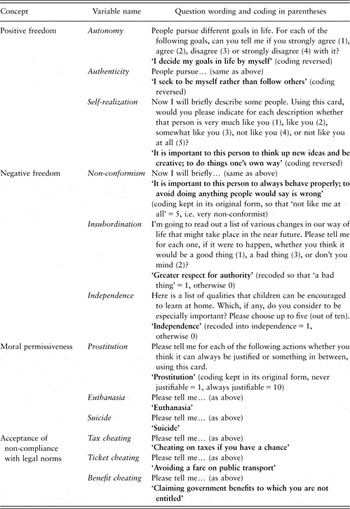
Because the theories I assess primarily concern values in affluent Western societies, I follow Flanagan and Lee in limiting my analyses to respondents from high-income Western countries, as defined by the World Bank in 2006, which were available from this wave of WVS (Flanagan and Lee, Reference Flanagan and Lee2003; The World Bank, 2006: 205). The following analyses are based on the respondents from Australia, Britain, Finland, France, Germany, the Netherlands, Poland, Spain, Sweden, and the United States.Footnote 12Table 1 shows the measures I will use.
Measures: World Values Surveys (2005)

Some readers will notice that I categorize several of Schwartz's personal values items and closely related measures differently (cf. Schwartz, Reference Schwartz1992). This is not because I question the dimensionality Schwartz suggests, but because my argument and specific focus on liberty crosscuts his purpose. Schwartz conceptualizes values as responses to three universal requirements ‘to which all individuals and societies must be responsive’. This leads him to distinguish ten motivationally distinct value dimensions, none of which focuses entirely on freedom (not to mention on distinguishing between negative and positive notions of it), but instead on goals with ‘crucial survival significance’ (Schwartz, Reference Schwartz1992: 4). Schwartz admits, however, that, ‘for some purposes, finer discriminations may be desirable’ (Schwartz and Boehnke, Reference Schwartz and Boehnke2004: 237). I suggest that assessing the true nature of freedom in mass values, the goal of this paper, is precisely such a purpose. By contrast to Schwartz, I do not wish to grasp the general structure of human values, conceptualized as responses to universal challenges crucial for survival – but to understand values regarding one specific and ultimately philosophical issue, namely freedom.
Schwartz constructs a single dimension called ‘self-direction’, a dimension that he argues revolves around both ‘independent thought and action’. He includes setting one's own goals (here: autonomy), doing things in one's own original way (here: self-realization) and independence in one's actions (here: independence) in this one dimension (Schwartz, Reference Schwartz1992: 15). However, since autonomy captures the Kantian ideal of setting one's own goals, and authenticity and self-realization the ideals of being creative and true to oneself, I categorize these as measures of the positive wish to be a self-directed person with a free will, while I suggest independence rather taps the negative wish for freedom of action unhindered by others. I further suggest that non-conformism also captures negative liberty, since it asks about being free to behave as one wishes, independently of what others think, as does insubordination, that is, disagreeing that authorities should be respected more.Footnote 13 My point, then, is that all three negative freedom items differ from the positive ones in that they focus not on the freedom to be true to oneself or to be a self-governing agent, but on the freedom to be unhindered by others in acting as one pleases.
As always, when one uses questions designed by others, a certain gap remains between what one wishes to capture and what the data allow. Autonomy and authenticity ask about experiences rather than desirable end states. Yet, I think the importance one attributes to these values can be inferred from the extent one agrees that one tries to live by them.Footnote 14 One might also object that both independence and insubordination capture an issue-specific attitude rather than a value. However, since the values we believe are important for our children ought to reflect our own values in life, and independence asks about whether the respondent believes independence is an ‘especially important’ quality to encourage in children, I believe we can assume it does tap a value rather than an issue-specific attitude after all. Insubordination, finally, asks not about respect for a certain authority, but towards authority as such, which suggests that it may serve as a measure of the deep-set antagonism towards authority that forms a crucial part of both negative liberty and the ‘egocentric’ conception of freedom in mass values.
The remaining measures will serve as dependent variables in regression models. Since it is unlikely that any single survey item could tap the underlying concepts I am trying to explain, I collapsed these variables into two indices, each ranging from 3 to 30. This also makes my models less sensitive to measurement error in the dependent variables. According to H2 and H3, I expect negative liberty to lead to more, and positive liberty to less, moral permissiveness in relation to what are perceived as self-harming and self-regarding practices.
In the ideal scenario, the practices perceived in this way would of course be known. However, in the absence of such data, I assume that suicide, euthanasia, and prostitution represent choices that are seen as both self-harming and self-regarding. In contrast to, for example, homosexuality or ethnic diversity, suicide and euthanasia undeniably entail physical harm to the person who engages in them, and they are often perceived as choices one cannot make autonomously, things that people do not ‘really’ want, so to speak. Prostitution is also often perceived as harming the persons who engage in it, even if they do not think so themselves. It is, for example, often claimed that the practice hinders prostitutes from achieving true self-realization, or that the very choice to engage in prostitution is the result of inauthentic preference formation – by the prostitute, the customer, or both (Jensen, Reference Jensen1995: 5–6). We may also assume (at least in the secular, individualistic context studied here) that all three practices are mainly perceived as self-regarding, that is, concerning mainly the individual who engages in them.Footnote 15 I thus suggest that, when controlling for religiosity (as I will in the regression models), the extent to which one finds these practices justifiable is an imperfect yet reasonable measure of moral permissiveness about choices that are seen as harmful to those who make them, but no one else.
Finally, according to H4 and H5, I expect valuing negative liberty to raise, and valuing positive liberty to diminish, a person's acceptance of non-compliance with legal norms with which one agrees in principle. I suggest that three such legal norms are: refraining from tax cheating, from avoiding a fare on public transport (ticket cheating), and from falsely claiming government benefits (benefit cheating). I therefore created an additive index from the three items that ask about the justifiability of non-compliance with these legal norms.
Two dimensions of values
My first hypothesis deals with the issue of dimensionality. I will investigate this through factor analysis, the basic aim of which is to find out whether the observed correlations between a certain set of variables can be accounted for by one or several common unobserved or latent variables, also called factors or dimensions. Since H1 already suggests a number of dimensions (two), I will make use of confirmatory factor analysis (CFA). In comparison to its exploratory counterpart, CFA is more adequate for testing a specific hypothesis and also provides a more robust test of different models and their fit to the data (Bollen, Reference Bollen1989: 232).
I will report three complementary model fit indices: the chi-square (χ 2), RMSEA, and BIC statistics. A relatively lower value for all these statistics indicates a more satisfactory model fit for our data. The most important of these indices is the BIC (Bayesian information criterion) statistic, since it balances the need to correctly reproduce the true covariance matrix with the need for parsimony, by ‘punishing’ a more complicated model with smaller degrees of freedom.Footnote 16
Figure 1 shows the standardized parameter estimates and model fit statistics for the CFA models. Models 1a and 2a constrain all measurement error correlations to zero. However, since autonomy and authenticity belong to one question battery in WVS, and self-realization and non-conformism to another, I also include Models 1b and 2b, which estimate the residual correlations between these pairs of indicators. All the results I present here are based on a pooled sample, but I also analyzed each country separately and found largely the same pattern.Footnote 17
Notes: *** indicates significance at the 0.01 level. N = 11,232 in all models. The error terms can be calculated by computing the square root of 1 minus the squared parameter estimate.

What matters most for my hypothesis is the internal difference between the uni- and the bi-dimensional models – the former representing the assumption that we can collapse all the items into one value dimension, and the latter illustrating my hypothesis that we are instead dealing with two dimensions. Indeed, when going from Model 1a to 2a, we first see that the χ 2 statistic drops significantly. The initially high RMSEA also drops from 0.13 to 0.06, which is considered between a ‘reasonable’ and a ‘close’ overall fit with the data (Knoke et al., Reference Knoke, Bohrnstedt and Potter Mee2002: 422), and the BIC value shrinks considerably. Finally, many factor loadings rise in the second model. All this demonstrates that a bi-dimensional solution is no doubt better, even when we punish it for its increased complexity.
This conclusion also holds for the difference between Models 1b and 2b, despite the fact that the model fit indices for 1b all suggest a better fit than for 1a. The uni-dimensional model that allows for correlated measurement errors (1b) still fares considerably worse than its bi-dimensional counterpart (2b). The latter model reveals several much higher factor loadings and, most importantly, it yields even lower model fit indices than any of the other models. For example, the RMSEA has here dropped to 0.04, which is considered to show a ‘close’ fit with the data (Knoke et al., Reference Knoke, Bohrnstedt and Potter Mee2002).Footnote 18 This last model finally shows that the two dimensions have a significant positive correlation of 0.35, which suggests that the two dimensions are related to some extent in people's minds. Nevertheless, as this is far from a perfect correlation, the data still lend clear support for H1: that positive and negative freedom form two separate dimensions.
Admittedly, the factor loadings of autonomy and authenticity in Model 2b are below the standard cut-off point of 0.30, thereby suggesting that if we do not compare this model to its uni-dimensional counterpart, but to the actual data patterns, it could certainly be improved even further. This also suggests that autonomy and authenticity may not be the ideal measures of positive liberty. However, as they and authenticity represent the only possible measures of positive liberty available today in a large-scale data set, I nevertheless suggest that they serve the purpose of providing a first, admittedly imperfect and yet important, step towards understanding the nature and consequences of valuing positive as opposed to negative freedom. The confirmatory factor analyses presented in this section clearly indicate that these should be conceived of as two empirical dimensions rather than one.
The consequences of valuing freedom
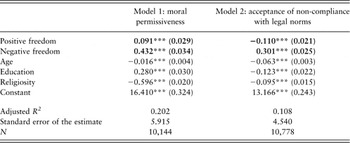
Given that there are two dimensions of values regarding freedom, do they affect moral permissiveness and acceptance of non-compliance with legal norms differently? In order to study this, I computed a positive freedom scale by standardizing and adding together autonomy, self-realization, and authenticity; and a negative freedom scale by doing the same with non-conformism, independence, and insubordination.Footnote 19Table 2 shows the regression results from predicting a person's moral permissiveness and acceptance of non-compliance to rules by how much they value positive and negative freedom. Since age, education, and religiosity correlate with valuing liberty and with the dependent variables, the regression models include these three issues as control variables.Footnote 20
OLS estimates of the determinants of moral permissiveness and non-compliance with legal norms: World Values Survey (2005)

Notes: *** indicates significance at the 0.01 level. Numbers in parentheses are standard errors. All estimates are based on the entire sample (Australia, Britain, Finland, France, Germany, the Netherlands, Poland, Spain, Sweden, and the United States). A dummy variable for each country except one was also included in each model (the coefficients are available on request).
The significant and positive regression coefficient for negative freedom in Model 1 is certainly in line with the hypothesis that negative freedom will have a positive relationship with moral permissiveness (H2). However, since statistical significance is easily achieved by the mere amount of data, we must also assess whether this relationship is substantial. One way is to note that when excluding negative freedom from the model, the standard error of regression increases by 2.2 percent. Leaving age out, in comparison, leaves the model fit virtually unchanged. Another way is to compare two fictitious persons. First imagine an individual, say a Frenchman, of median age, religiosity, and education, who values positive freedom to the same extent as most people, but negative freedom one standard deviation less than the average person. Now imagine another Frenchman who is the same in all other relevant aspects (i.e. also with a median education, religiosity, age, and positive freedom score) except for the fact that he values negative liberty just as much more than the average person. According to Model 1, the second Frenchman would be 1.7 units, or close to 14 percent, more inclined to moral permissiveness, as compared to the first. In sum, then, the data lend initial support to H2: valuing negative freedom does indeed seem to be conducive to moral permissiveness, an effect that appears both statistically and substantially significant.
The results are not, however, in line with H3, which predicts that positive freedom will have a negative effect on moral permissiveness. Model 1 shows that this effect goes in the opposite direction. However, even though this effect is statistically significant, it does not seem to have much substantial significance. Excluding positive freedom from Model 1 makes no real difference when looking at the standard error of regression, while we just saw that excluding negative freedom caused it to rise by 2.2 percent. We could also compare someone who values positive freedom one standard deviation less than the average person with someone who values it one standard deviation more than the average person. If we filter out all other impacts, our model indicates that the latter person will only be 3 percent more morally permissive (whereas, as we saw above, the same amount of change in negative freedom resulted in an expected change of 14 percent in moral permissiveness). Thus, even though the results do not support H3, they suggest something else that is interesting: the effect of positive liberty on moral permissiveness differs from that of negative liberty – not in direction, but size.
H4 suggests that negative liberty leads to the acceptance of non-compliance with legal norms, while H5 predicts that positive liberty has the opposite effect. Model 2 shows that, just as expected, negative freedom leads to more, and positive freedom to less, approval of cheating on taxes, bus fares, or government benefits. Assume this time that the same person for some reason changes her views on negative freedom overnight from one standard deviation below the average, to one standard deviation above it. Her age, nationality, education, religiosity, and views regarding positive liberty remain exactly the same. According to Model 2, such a change would result in her condoning non-compliance with these rules slightly above 14 percent more than the night before. The impact of an equivalent overnight change in positive liberty would cause the same person to condone such behavior 5 percent less than before, holding all else constant. We thus see that negative and positive liberty do have opposite effects on rule abidance, just as hypothesized. We also see, however, that even though both effects are statistically significant, substantially speaking the effect of negative liberty clearly exceeds that of its positive counterpart. The data thus lend clear support to H4, but remain ambiguous when it comes to H5.
These models only represent a first attempt to empirically investigate the consequences of valuing negative and positive freedom. They nevertheless show an interesting pattern. They also give us further reason to believe that negative and positive liberty are indeed two different dimensions. If we were to collapse them, we would overlook the fact that they are differently associated with holding morally permissive attitudes and condoning non-compliance with legal norms.Footnote 21
Conclusions
This paper has sought to shed new light on an ongoing discussion among social scientists: how to interpret the spreading popular support for individual freedom among ordinary people. At the origin of this study lies the observation that those with an ‘egocentric’ view of values regarding freedom and those with a ‘humanistic’ interpretation most often speak of two different types of freedom, respectively, yet without acknowledging it: positive and negative freedom, in the words of Isaiah Berlin (Inglehart and Welzel, Reference Inglehart and Welzel2005: 144).
The results presented in this study suggest that by collapsing questions regarding positive and negative freedom, both in theory and practice, previous research neglects critical differences between what are in fact two separate dimensions in people's minds. Valuing negative liberty is about valuing the possibility of non-conformism and insubordination towards authorities. It has much the same consequences that Flanagan and others that share the egocentric interpretation deem deeply worrying, but that Berlin judges to be the bedrock of liberal permissiveness. Valuing positive liberty, on the other hand, is more oriented to inner freedom, authenticity, and self-realization, much as Inglehart and his followers who share a more humanistic interpretation conceptualize self-expression values. Contrary to my expectations, valuing positive liberty does not, however, invite less moral permissiveness towards practices that clash with it. On the other hand, neither does valuing positive liberty make it much more likely that a person will be more morally permissive towards such choices, as valuing negative liberty clearly does.
We may tentatively conclude that positive liberty does not in fact have such clear political consequences as its negative counterpart. This may partly be due to the fact that positive liberties of different kinds may have different consequences. However, it may also have something to do with Berlin's fear that an excessive focus on positive liberty might lead to what he called ‘the retreat to the inner citadel’, that is, the anti-political attitude that we should not fight obstacles to our freedom of action, but learn to live with, or at least disregard them – because what really matters is our internal freedom (Berlin, Reference Berlin2008: 181–182).
Perhaps, then, positive liberty is not so much illiberal as apolitical. This possibility may, however, be no less worrisome from a democratic perspective. Berlin was convinced that positive freedom was much more popular than its negative counterpart. The present paper has not studied this in detail, but the descriptive data do point in this direction. It is clear that positive freedom exceeds negative freedom in its popularity.Footnote 22 Future research is thus needed to examine cross-national and cross-generational differences in positive and negative freedom, ideally with better measures than the existing ones used in this paper. Given the increasingly value-oriented nature of politics, the extent to which a person values positive and negative liberty may help explain that person's political participation and voting behavior (Goren, Reference Goren2001; Keele and Wolak, Reference Keele and Wolak2006).
Distinguishing between negative and positive liberty may also shed new light on otherwise puzzling cases, such as the finding that the recent spread of individualistic freedom values in China has not been matched by an equal rise in demands for liberal reforms (Wang, Reference Wang2005: 162). If younger generations of Chinese are found to value the internal ideals of positive freedom, such as setting their own goals, being creative and original, but not negative freedom, then perhaps Berlin's distinction and the findings in this paper can help make sense of the fact that their commitment to freedom does not seem to translate into non-compliance with the authorities, nor a demand for greater individual rights.
Acknowledgements
Earlier versions of this article were presented at the 2009 Joint Sessions of workshops organized by the European Consortium for Political Research, Lisbon, Portugal, 14–19 April 2009; and the 2009 Annual Meeting of the American Political Science Association, Toronto, Canada, 3–6 September 2009. I would especially like to thank Russell Dalton, Stanley Feldman, Karl-Oskar Lindgren, Peggy Schyns, Ralph Sundberg, Johanna Söderström, Christian Welzel, Anders Westholm, and three anonymous reviewers for their helpful comments and advice.
Appendix
Descriptive data for the entire sample used here: Australia, Britain, Finland, France, Germany, the Netherlands, Poland, Spain, Sweden, and the United States (World Values Survey, 2005)