Introduction
At 2:46 PM on March 11, 2011, the Great East Japan Earthquake, measuring 9.0 on the Richter scale, hit the northeastern area of Japan. It resulted in more than 18,000 deaths or missing persons, 6,000 injured persons,Reference Tanaka, Okawa and Ujike 1 and 300,000 refugees. 2 In addition to the damage stemming directly from the earthquake, the subsequent tsunami and collapse of the Fukushima Daiichi Nuclear Power Station made the initial disaster much more complex. Disaster Medical Assistance Teams (DMATs) from across Japan, established after the Great Hanshin-Awaji Earthquake in 1995, were deployed to the affected area to provide triage, immediate medical support, and wide-area medical evacuation after the earthquake. Because there were few survivors from the tsunami and DMATs can only operate for 48 hours, they were unable to save many lives.
Disaster-related death is defined as death by illness or deterioration of chronic disease caused by disaster-induced fatigue or psychological trauma, including suicide. Most disaster-related deaths occurred in the sub-acute phase, on or after the third day following the disaster, when DMATs had left the scene. As of March 31, 2015, the total number of disaster-related deaths was judged to be 3,331 by municipal committees comprising clinicians, lawyers, and scholars. 3 This review has already accounted for 15.3% of the total fatalities.Reference Tanaka, Okawa and Ujike 1 After the Great Hanshin-Awaji Earthquake in 1995, the proportion of disaster-related deaths was 14.3% (919 of 6,434 deaths, excluding 17 suicides). 4 Unfortunately, these data suggest that the difficulties experienced by survivors after this earthquake were perhaps even more challenging than in 1995, although the change in the population structure for these 16 years should be taken into account. Considering that 49.9% of 3,331 disaster-related deaths occurred within 31 days after the earthquake, it is essential to reduce disaster-related deaths at an early stage to save as many lives as possible. 3
Many reports state that acute psychological stress caused by major disasters or war is associated with an increased risk of death. 5 - Reference Ogawa, Tsuji, Shiono and Hisamichi 8 Massive stressors may trigger cardiovascular events.Reference Nakamura, Nozaki, Fukui, Endo, Takahashi and Tamaki 9 - Reference Omama, Yoshida and Ogasawara 19 It is also recognized that such stress raises blood pressure (BP) in humans.Reference Aoki, Takahashi and Fukumoto 20 - Reference Saito, Kim, Maekawa, Ikeda and Yokoyama 24 Hypertension (HT) is one of the most important risk factors for myocardial infarction and stroke, which can cause disaster-related deaths. Although previous studies have reported the short-term effect of major earthquakes on BP in patients with treated essential HT,Reference Nishizawa, Hoshide, Shimpo and Kario 23 , Reference Saito, Kim, Maekawa, Ikeda and Yokoyama 24 little is known about the physical status of those living in evacuation shelters in the first 10 days after a major disaster. Furthermore, better compliance with antihypertensive drugs in everyday life reduces the risk of acute coronary syndrome and stroke,Reference Minami, Kawano, Ishimitsu, Yoshimi and Takishita 25 but it is unclear whether this is the case after a major disaster.
This report aimed to determine the importance of continuous antihypertensive medication, even at evacuation shelters during the sub-acute phase after a major earthquake, by investigating the continuity of medication and measuring actual BP of evacuees, when patients cannot attend a clinic because the local infrastructure has been destroyed. It also aimed to establish simple and reliable predictors to detect evacuees with HT, who require clinical examination and treatment at evacuation shelters or in their homes after a major earthquake, by classifying all the evacuees at evacuation shelters as hypertensive or non-hypertensive evacuees, because asymptomatic disaster victims generally may not be subject to clinical examination.
Materials and Methods
Study Design and Setting
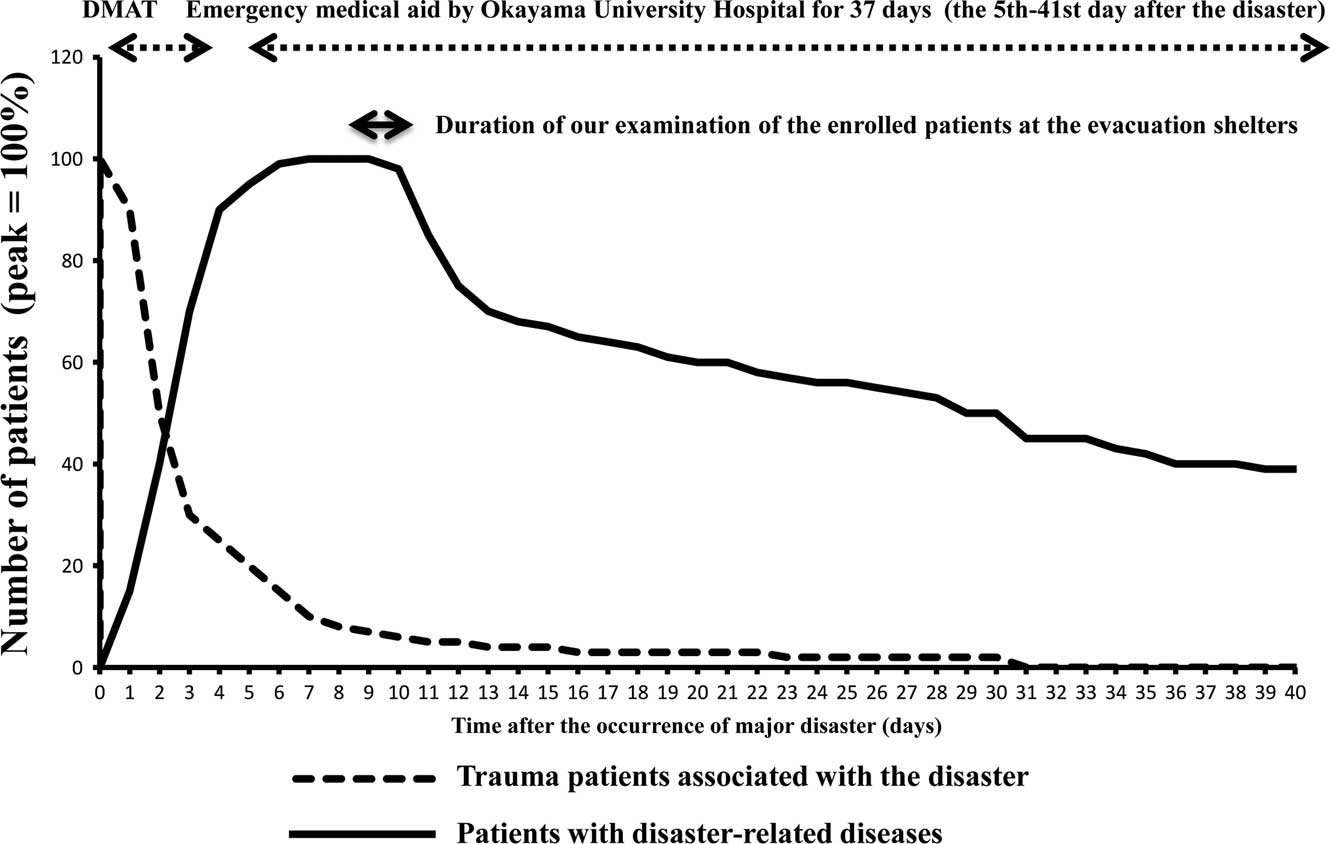
Okayama University Hospital (Okayama, Japan) dispatched 73 staff in 12 disaster-response teams to Iwate Prefecture from March 16 to April 21, 2011 (Figure 1). Personnel included 32 physicians, seven dental surgeons, 14 nurses, 11 pharmacists, seven dental hygienists, and two logistics managers. The second group performed onsite medical rounds for 46 evacuees in the Osabe district of the city of Rikuzentakata in Iwate Prefecture on March 20 and 21, 2011 and kept paper-based medical records. Screening primarily aimed to identify victims who needed further treatment or follow-up, and aimed secondarily to investigate health issues, including HT.
Schematic Figure of Time Course of Change in Patient Numbers after the Occurrence of the Major Disaster. As the incidence of disaster-related diseases is presumed to be highest in the first 31 days (especially in the first seven days) based on the incidence of disaster-related deaths, 3 the establishment of a medical support system for patients during this period, including the intervening period between DMAT activities and the arrival of follow-up medical teams, seems to be an urgent need. Abbreviation: DMAT, Disaster Medical Assistance Team.

Selection of Participants
The Osabe district of Rikuzentakata is a typical coastal area in Iwate Prefecture, which has a ria coast bordered by mountains. The population of Iwate Prefecture and Rikuzentakata was 1,330,147 on October 1, 2010Reference Corrao, Parodi and Nicotra 26 and 24,246 on March 10, 2011. 27 A total of 4,051/8,069 (50.2%) houses in Rikuzentakata were demolished or partially destroyed by the earthquake and tsunami. Sixty-three evacuation shelters were set up and 8,915 refugees were living there when the second group of 12 disaster-response teams of Okayama University Hospital performed onsite medical rounds. 27 , 28 Inclusion criteria were adult (≥16 years) victims, with or without symptoms, living in the evacuation shelters in Osabe Elementary School and the Ushizawa Futsukaichi public hall. Only evacuees with accurate medical records were enrolled in the cross-sectional study. The only exclusion criteria were an age of less than 16 years or inaccurate medical records. Trained staff recorded the systolic and diastolic BP of each refugee and age, sex, the presence of insomnia, other complaints, medical, drug histories, and the extent of house destruction. Cigarette smoking and alcohol intake were not recorded. All subjects agreed to participate after receiving a detailed explanation of the study’s nature and purpose, and each subject gave written informed consent. Parental consent was also obtained for study participants under the age of 20. All data were unlinked and anonymized. Because of the unpredictable nature of an earthquake and the rapid response needed afterwards, prospective approval was waived. The authors inquired of The Committee on Human Subjects in Research of Okayama University Hospital after data acquisition to see if they should seek retrospective approval for the study. The Committee affirmed the anonymization and safety of the protocol and study design and decided that the authors did not need to seek approval because they used only unlinkable, anonymized data.
Methods and Measurements
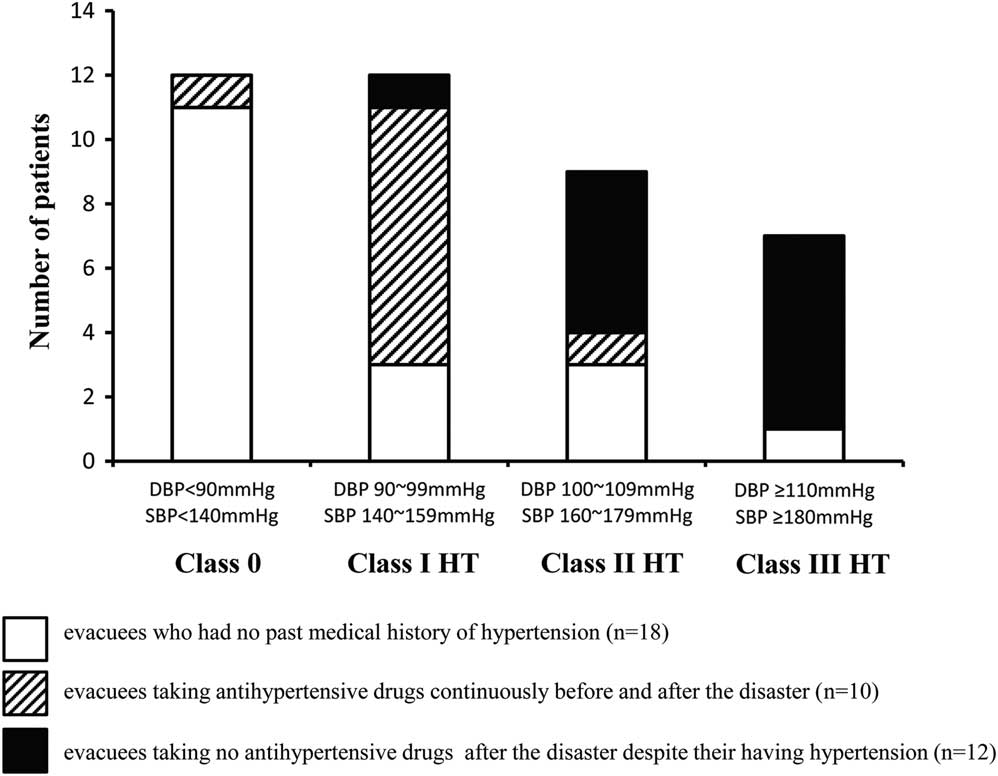
Subjects were examined in the sitting position after they had been seated quietly for at least five minutes. The first and fifth phases of the Korotkoff sound were recorded as systolic and diastolic BP using a mercury sphygmomanometer (FC-110 CC: Focal Corp; Kashiwa, Chiba, Japan). Measurement generally was performed twice; mean values were used. Blood pressures were classified using the 2013 Guidelines for the Management of Arterial Hypertension, published by the European Society of Hypertension (Milan, Italy) and the European Society of Cardiology (Sophia Antipolis, France). 29 Class 0 was defined as systolic blood pressure (SBP) less than 140 mm Hg and diastolic blood pressure (DBP) less than 90 mm Hg, and the optimal, normal, and high-normal categories were combined (Classes I–III; Figure 2). The proportion of survivors in each class within the following three groups were determined: (1) those who had no medical history of HT regardless of the presence or absence of HT, when examined at evacuation shelters; (2) those continuing antihypertensive medication after the disaster; and (3) those discontinuing antihypertensive medication after the disaster.
Distribution of Blood Pressure of Victims Examined at Evacuation Shelters and Effect of Continuous Medication with Antihypertensive Drugs (n=40). The majority (8/10) of evacuees who were able to continue antihypertensive therapy after the earthquake exhibited Class I hypertension, while the vast majority (11/12) of evacuees who discontinued medication after the disaster, despite having HT, fulfilled the criteria for Class II (5/11) and Class III (6/11) HT. Abbreviation: HT, hypertension.

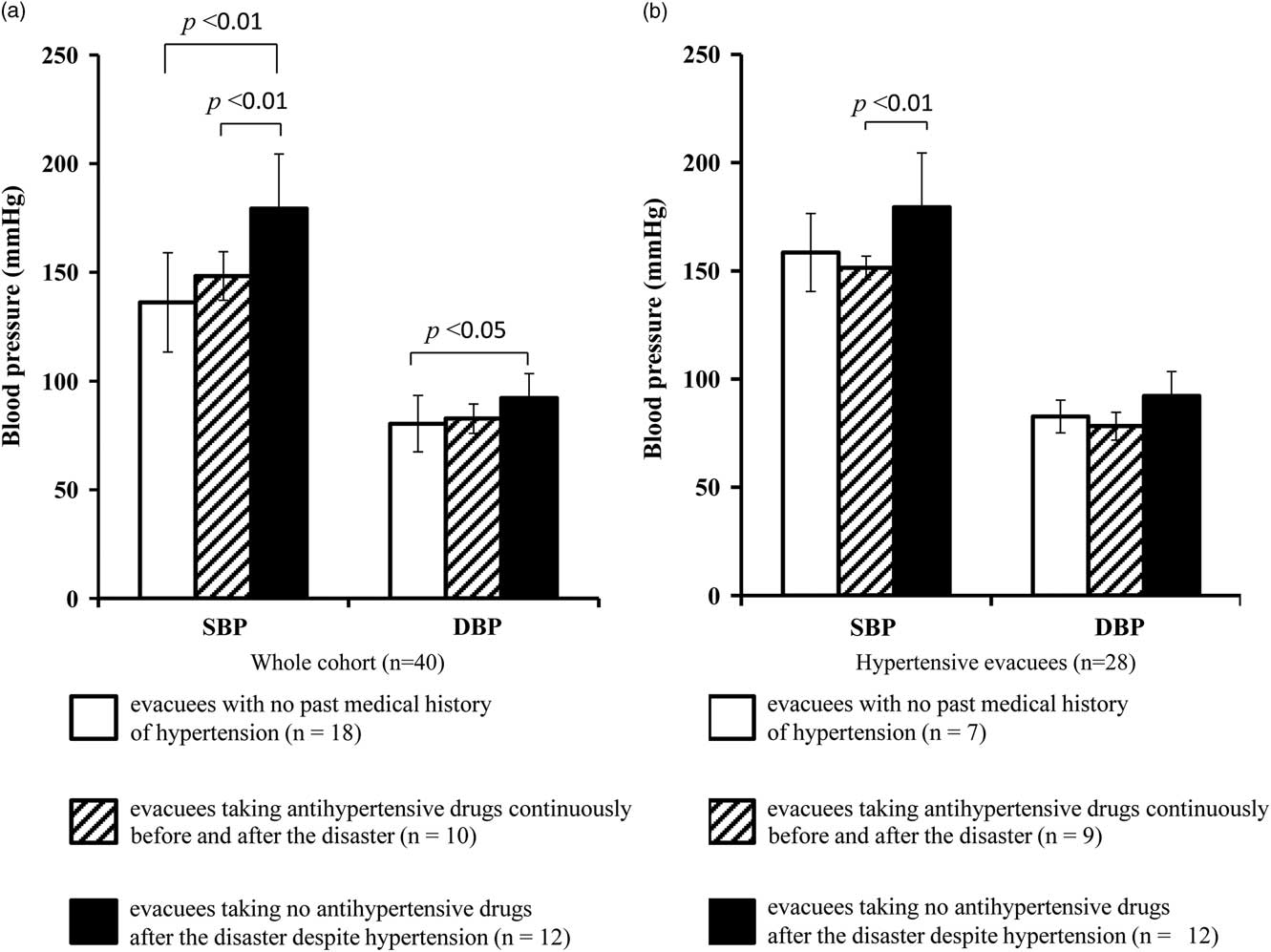
To evaluate the effect of continuous antihypertensive medication on SBP and DBP, all subjects were classified into the groups described above, and SBP and DBP were compared to investigate the effect of maintaining continuity of antihypertensive drugs on all survivors. Perhaps unsurprisingly, the SBP and DBP of the evacuees who had discontinued antihypertensive medications were significantly higher than those of the evacuees who had not been diagnosed with HT before the disaster, because the latter may have included victims who were not hypertensive beforehand. Therefore, hypertensive subjects diagnosed at evacuation shelters (n=28) were also classified into the groups described above, and SBP and DBP were compared to investigate the effect of continuing antihypertensive drugs.
To establish predictors of HT among evacuees, age, sex, medical and drug histories, chief complaints, continuous medication of antihypertensive drug, and the extent of house destruction were compared in those with and without HT at evacuation shelters. Then multiple logistic and linear regression analysis were used to select the combination of variables that best predicted HT at the evacuation shelters using those variables with P values ≤.15 in the bivariate analyses.
Outcomes
The primary outcomes of interest were SBP and DBP (mm Hg). The secondary outcome was the presence or absence of HT (SBP ≥140 mm Hg or DBP ≥90 mm Hg).
Analysis
Evacuees with and without HT at evacuation shelters were compared using chi-square analysis. Fisher’s exact probability test was also used to test for an association when an expected number was less than five. Systolic and diastolic BP data were examined using Bartlett’s test after normal distribution was confirmed. Then, single-factor analysis of variance (ANOVA), or the Kruskal–Wallis test, was performed, followed by a multiple comparison test. Scheffe’s F test was performed for parametric data and the Shirley–Williams test was performed for non-parametric data. The relationship between HT at the evacuation shelter and potential risk factors was validated by using multiple logistic regression. Multivariable adjusted odds ratios (aOR) with 95% confidence intervals (CIs) were reported. All measured variables with P values ≤.15 and sleeplessness (insomnia) were introduced into multiple logistic regression and the multiple linear regression models because it seems to be appropriate for establishment of simple and reliable predictor to verify if not only variables with P≤.10, but also more variables with P value around.15, as they could be predictors. They are age, medical history of HT, lumbar spondylosis, cerebral infarction, hyperlipidemia, chief complaint of cough or sore throat (acute upper respiratory infection), sleeplessness (insomnia), low back or knee pain, headache or head dullness, and diarrhea. The receiver operator characteristic (ROC) curve of the predictor was determined by the results of multiple logistic regression. The area under the ROC curve was also calculated, and the cut-off value for the predictor was determined by calculating the Youden index. Only when ROC curve analysis was performed, subjects ≤15 years old were also included by taking actual circumstances in a time of disaster into consideration. Statistical significance was regarded as P<.05 for all methods. All values are expressed as mean and standard deviation (SD). Analyses were performed using Statcel 3 (OMS Publishing; Saitama, Japan) and SPSS version 17 (IBM; Tokyo, Japan).
Results
Characteristics of Study Subjects
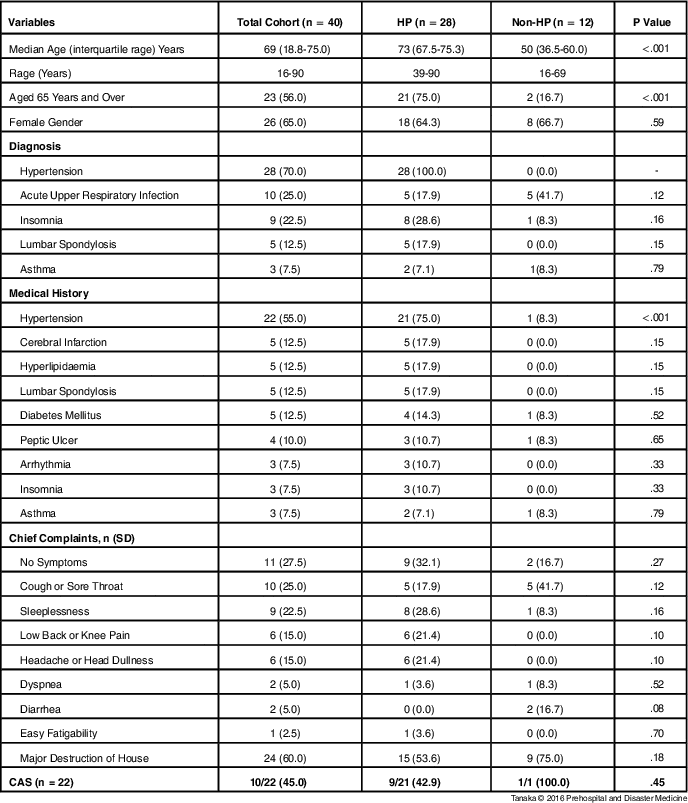
Forty-six evacuees with medical records were assessed for study inclusion, but six were excluded: three were children ≤15 years old and three were adults with incomplete medical records. Table 1 shows the characteristics of the 40 participants: 28 (70.0%) were hypertensive at the evacuation shelter, but only 22 (55.0%) had a history of HT. Ten (25.0%) were found to have symptoms of acute upper respiratory infection, nine (22.5%) reported difficulty sleeping, and 11 (27.5%) were asymptomatic. These data suggest that after a major disaster, there may be numerous survivors with HT, respiratory infection, and insomnia, but also that a large proportion could be asymptomatic at evacuation shelters in the first 10 days after the disaster.
Subjects’ Characteristics and Comparison of Hypertensive and Non-hypertensive Evacuees at Evacuation Shelter

Abbreviations: CAS, continuous antihypertensive medication; HP, hypertensive patients.
Main Results
To investigate the risk factors for HT at the evacuation shelter, hypertensive evacuees were compared with non-hypertensive evacuees (Table 1). The vast majority of evacuees (21/22; 95.5%) previously diagnosed with HT were found to be hypertensive in the evacuation shelters. Nine of 28 patients (32.1%) with HT reported no medical problems at the shelter, whereas nine of 11 (81.8%) with no symptoms were hypertensive and eight of nine with insomnia (88.9%) were hypertensive. Seven of 18 (38.9%) evacuees who had not been diagnosed with HT before the disaster were found to be hypertensive at the evacuation shelters, although it is not clear whether they may have been hypertensive beforehand (Table 1; Figure 2).
Of 10 patients who were able to continue their antihypertensive medication, the drugs could be identified in six patients: three took an angiotensin II receptor blocker (ARB) and a calcium antagonist (CA); two took an angiotensin-converting enzyme inhibitor (ACEI), and one took two CAs. Only one of 10 evacuees (10.0%) able to continue antihypertensive therapy after the earthquake had optimal BP (Class 0; Figure 2); she was taking an ARB and a CA. The majority (8/10; 80.0%) exhibited Class I HT. All 12 evacuees who discontinued medication after the disaster, despite having been diagnosed with HT, were hypertensive on examination in the shelter; five (41.7%) and six (50.0%) fulfilled the criteria for Class II and Class III HT, respectively (Figure 2). Perhaps unsurprisingly, the SBP and DBP of the evacuees who had discontinued antihypertensive medications were significantly higher than those who had no medical history of HT in the entire cohort (P<.01 and P<.05, respectively; Figure 3A), but not higher in the subset diagnosed with HT at the evacuation shelters (Figure 3B). The SBP of the evacuees who had discontinued antihypertensive medication was significantly higher than those able to continue, in both the entire cohort and hypertensive subjects (P<.01 for both; Figure 3A and Figure 3B). These results became insignificant when adjusted for age, as below.
(a) Effect of Continuous Antihypertensive Medication on Blood Pressure of Earthquake Survivors (n=40). The SBP and DBP of the evacuees who had discontinued antihypertensive medications were significantly higher than those who had no medical history of hypertension for the entire cohort (P<.01). The SBP of the evacuees who had discontinued antihypertensive medication was significantly higher than those able to continue in the entire cohort (P<.01). Data are mean (SD). (b) Effect of Antihypertensive Medication on Blood Pressure of Earthquake Survivors who were Diagnosed with Hypertension at the Evacuation Shelter (n=28). The SBP of the evacuees who had discontinued antihypertensive medication was significantly higher than those able to continue in the subset diagnosed with hypertension at the evacuation shelter (P<.01). Data are mean (SD). Abbreviations: DBP, diastolic blood pressure; SBP, systolic blood pressure.

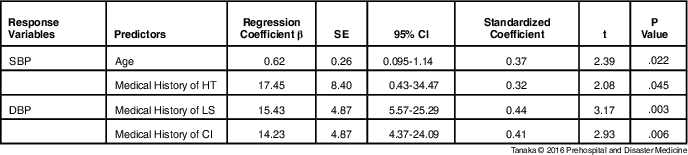
Predictors of HT among evacuees were sought by using multiple logistic and linear regression analyses. Bivariate analyses identified age and a history of HT as significant predictors (P<.05 for both). In addition to nine items with P values ≤.15, except the above two variables, sleeplessness and major destruction of house were introduced into multiple logistic regression models (Table 1). After adjustment for confounding factors, it was found that a history of HT remained a significant predictor of HT in the shelters (aOR 11.40; 95% CI 1.03-126.08; P=.047; Table 2), and independently predicted SBP (P=.045; Table 3). Age was also a significant predictor of HT in the shelters (aOR, 1.10; 95% CI, 1.01-1.21; P=.028; Table 2), and independently predicted SBP (P=.022; Table 3). Lumbar spondylosis and a history of cerebral infarction independently predicted DBP (P=.003 and.006, respectively; Table 3).
Association between Hypertension at the Evacuation Shelter and Other Variables using Multivariate Logistic Regression Analysis

(The multiple logistic regression model was adjusted for age, medical history of hypertension, lumbar spondylosis, cerebral infarction, hyperlipidemia, chief complaint of cough or sore throat (acute upper respiratory infection), sleeplessness (insomnia), low back or knee pain, headache or head dullness, and diarrhea.)
Abbreviations: aOR, adjusted odds ratio; CI, confidence interval; HT, hypertension; SE, standard error.
Multiple Linear Regression Analysis of Predictors of Systolic or Diastolic Blood Pressure in Earthquake Survivors

(The multiple linear regression model was adjusted for age, medical history of hypertension, lumbar spondylosis, cerebral infarction, hyperlipidemia, chief complaint of cough or sore throat (acute upper respiratory infection), sleeplessness (insomnia), low back or knee pain, headache or head dullness, and diarrhea.)
Abbreviations: 95% CI, confidential interval; CI, cerebral infarction; DBP, diastolic blood pressure; HT, hypertension; LS, lumbar spondylosis; SBP, systolic blood pressure; SE, standard error.
Receiver operator characteristic curve analysis using the Youden index found the age threshold for HT in the shelter to be 60 years (sensitivity 0.89, specificity 0.80). It was chosen to adopt a cut-off of 55 years, as it improved sensitivity to 0.93. Although the specificity fell to 0.73, an increased sensitivity would allow better detection of HT among evacuees. The area under the curve of the ROC for age was 0.93 (95% CI, 0.86-1.00). Evacuees aged over 55 years, or those with a history of HT, had a sensitivity of 0.96 and specificity of 0.80.
Discussion
In the current study, it was found that evacuees with a history of HT, with insomnia, and even those with no symptoms, may require additional medical support, because they may frequently show HT (Table 1). It was also found that continuous antihypertensive medication could not prevent HT completely, but could at least prevent serious HT at the evacuation shelters in the first 10 days after a major disaster, if not adjusted for age (Figure 2, Figure 3A, and Figure 3B). Furthermore, it was discovered that evacuees with a history of HT or aged >55 years might be at greater risk of HT after the Great East Japan Earthquake. Lumbar spondylosis and a history of cerebral infarction independently predicted DBP, which could be explained by an association between increased peripheral vascular resistance and chronic pain or arteriosclerosis, although further study is required to evaluate any possible associations. The situation and stress may be different between hypertensive and non-hypertensive evacuees, or the hypertensive patients with and without the continuous hypertensive medication. Although it was found that no other confounding factors possibly related to the stress of evacuees might have caused HT after the disaster, it should be assumed that they might be present and it should be taken into consideration.
The small number of subjects (n=46) resulted in a significantly limited ability to detect differences. Conversely, from a practical standpoint, discovering that HT is more common in people with a known history of HT may seem self-evident, or at least not surprising.
People aged ≥65 years accounted for 55.8% of direct deaths in the Great East Japan Earthquake.Reference Tanaka, Okawa and Ujike 1 Moreover, people aged ≥66 years accounted for 88.9% of disaster-related deaths. 3 In 2010, citizens aged ≥65 years comprised 26.3% of the population of Northeast Japan,Reference Corrao, Parodi and Nicotra 26 which suggests that the elderly are especially vulnerable, particularly at evacuation shelters or in temporary accommodation after major disasters. Tanida studied the aftermath of the 1995 Great Hanshin-Awaji earthquake and reported that the triage of elderly people in shelters by medical teams failed to detect problems, as the elderly tended not to report symptoms unless directly questioned.Reference Mancia, Fagard and Narkiewicz 30 These facts may indicate that even elderly people who have some symptoms tended not to have the medical examination, and much more people who have no symptoms. It is also reported that special attention and continuous care are required for elderly and vulnerable people.Reference Mancia, Fagard and Narkiewicz 30 Indeed, it might be more efficient to measure all survivors’ BP as a matter of course; however, medical teams often do not have sufficient time to find and examine all victims. To further reduce the total fatalities, it is required to establish the most effective and simplest means of detecting patients who need potentially life-saving treatment and evaluate the physical condition of evacuees in shelters. In that context, eliciting a history of HT or identifying those aged >55 years is a very straightforward approach and may be a useful means, or at least the trigger, for detecting evacuees with HT effectively so medication can be started promptly. In the future, it is desirable that similar research will be conducted on a larger number of subjects based on the findings in the present study.
The possible influence of “white coat HT” should be taken into account.Reference Tanida 31 The medical staff performing assessments and measuring evacuees’ BP wore casual clothes while working, and patients were assessed in communal areas. Significant increases in outpatients’ self-measured BP in the morning at home in one of the devastated cities were reported during the aftermath of the Great East Japan Earthquake,Reference Kario, Matsuo, Ishida and Shimada 32 and other major disasters,Reference Nishizawa, Hoshide, Shimpo and Kario 23 , Reference Saito, Kim, Maekawa, Ikeda and Yokoyama 24 reflecting these findings. Therefore, it was thought to be unlikely that white coat HT would have influenced the findings.
It can be inferred that cardiovascular and respiratory diseases are the cause of most disaster-related deaths, likely triggered by hypercoagulability and HT.Reference Mustacchi 21 - Reference Kario 22 In turn, HT is caused by sympathetic nervous system activation and increased salt sensitivity.Reference Satoh, Kikuya and Ohkubo 33 A report that the incidence of heart failure with preserved ejection fraction increased significantly after the earthquake suggests that a sympathetic autonomic response may be the main mechanism of increased BP.Reference Nakano, Kondo and Wakayama 16 The earthquake forced many people to live in shelters under stressful circumstances at the end of winter when aftershocks were frequent, and most had sleep difficulties caused by psychological stress, disrupted circadian rhythms, and likely activation of the sympathetic nervous system.Reference Dimsdale and Moss 34 Consequently, heart rate, BP, and platelet aggregation are likely to have been elevated.Reference Gangwisch, Heymsfield and Boden-Albala 35 Furthermore, the increased plasma concentrations of catecholamines and glucocorticoids, and stimulation of the renin-angiotensin-aldosterone system caused by sympathetic nervous system activation, are likely to have increased salt sensitivity.Reference Matsuo, Suzuki, Kodama and Kario 36 Discontinuation of regular medications, such as antihypertensive and antithrombotic drugs, can also increase the risk of cardiovascular events.Reference Doi, Takahashi and Komatsu 37 Lack of fresh food or consumption of preserved foods with high salt content can elevate BP and exacerbate heart failure,Reference Murakami, Akashi and Noda 38 as can infection.
Many investigators have reported that emotional stressors such as major disasters or the death of a loved one may trigger HT and serious cardiovascular events. 5 , Reference Leor, Poole and Kloner 6 , Reference Nakamura, Nozaki, Fukui, Endo, Takahashi and Tamaki 9 , Reference Aoki, Takahashi and Fukumoto 20 , Reference Satoh, Kikuya and Ohkubo 33 , Reference Yamauchi, Yoshihisa and Iwaya 39 Blood pressure appears to increase significantly, but transiently, in the first four to six weeks after a major disaster,Reference Nishizawa, Hoshide, Shimpo and Kario 23 , Reference Saito, Kim, Maekawa, Ikeda and Yokoyama 24 overlapping with the 31-day period in which the incidence of disaster-related deaths in this disaster was highest (Figure 1). 3 Furthermore, the period also overlapped with that of a significant increase in risk of out-of-hospital cardiac arrest (one to four weeks).Reference Schaeffer and Baum 40 This earthquake-related elevation in BP appears to be significantly attenuated in patients receiving β-blockers compared with those receiving other drugs;Reference Nishizawa, Hoshide, Shimpo and Kario 23 β-blockers might also reduce anxiety caused by the disaster and may contribute to the attenuation of the physiological stress response.Reference Kitamura, Kiyohara and Iwami 41 , Reference Panizza and Lecasble 42 Although any evacuees who had taken β-blockers were unable to be identified, this class of drugs should be considered after major disasters.
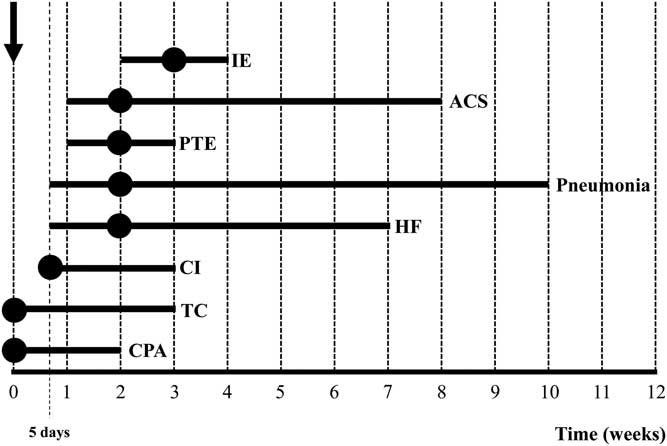
Figure 4 shows timing of the onset, duration, and peak of each disease that could be the cause of disaster-related death based on several studies.Reference Trichopoulos, Katsouyanni, Zavitsanos, Tzonou and Dalla-Vorgia 7 , Reference Schwartz, French and Mayeda 10 , Reference Tsuchida, Kawashiri and Teramoto 12 - Reference Zhang, Chen, Yang, Yan and Huang 15 , Reference Nakamura, Satake and Abe 17 - Reference Omama, Yoshida and Ogasawara 19 , Reference Chierichetti, Moise, Galeone, Fiorella and Lazzari 43 Moreover, there are many causes of cardiopulmonary arrest, including acute coronary syndrome, pulmonary thromboembolism, stroke, rupture of aortic aneurysm, and aortic dissection; HT is a common risk factor for many of these. It is clear that most of diseases have their peak within the first four weeks after the disaster. By addressing HT and hypercoagulability, it may be possible to prevent many disaster-related deaths.
Schematic Figure of Order, Duration, and Peak of Occurrence of each Disease after the Great East Japan Earthquake. CPA and TC occurred mainly on the day of the disaster; CI and HF significantly increased after five days, and peaked at one-two weeks after the disaster, before declining over three weeks and six-seven weeks, respectively.Reference Zhang, Chen, Yang, Yan and Huang 15 , Reference Nakamura, Satake and Abe 17 – Reference Omama, Yoshida and Ogasawara 19 There were also peaks at approximately two-three weeks and then declines in the incidence of pneumonia, PTE, ACS, and IE. CPA, CI, and PTE also show other peaks corresponding to the distribution of the aftershocks.Reference Schwartz, French and Mayeda 10 , Reference Nakamura, Satake and Abe 17 , Reference Omama, Yoshida and Ogasawara 19 Many diseases peak incidence within the first four weeks after the disaster. A black closed circle indicates the peak of the occurrence of each disease. Black arrow indicates time of the occurrence of the Great East Japan Earthquake. Abbreviations: ACS, acute coronary syndrome; CPA, cardiopulmonary arrest; CI, cerebral infarction; HF, heart failure; IE, infectious endocarditis; PTE, pulmonary thromboembolism; TC, Takotsubo cardiomyopathy.

Although many DMATs reached the affected areas in a relatively short time with the help of the Self Defence Forces (Japan) in the Great East Japan Earthquake, most of the follow-up medical teams were unable to approach the affected area before the tenth post-disaster day. The authors’ visit on the ninth day after the disasters was the first visit of a medical team to the Osabe District of Rikuzentakata in Iwate Prefecture. Providing medical support for patients in the intervening period between DMAT activities and the arrival of follow-up medical teams is one of the major problems that needs to be addressed. Early treatment of hypertensive patients within the first month of a major disaster may be important in reducing the total numbers of disaster-related deaths, as the incidence of disaster-related deaths peaks within 31 days (Figure 1). 3 Therefore, it is highly recommended to establish “Urgent Prevention Teams of Disaster-related Deaths,” either independently or as an extension of existing DMAT arrangements. These teams should focus their efforts on evacuation shelters or temporary accommodation, not immediately, but soon after the event (on and after the fourth post-disaster day), undertaking clinical examinations of survivors and prompt provision of drugs such as antihypertensive, anticoagulant, or hypoglycemic medications, to those who need them (Figure 1). Urgent Prevention Teams of Disaster-related Deaths should be made up of experts in chronic and degenerative diseases. It is expected that a centrally organized and administered Urgent Prevention Teams of Disaster-related Deaths system with effective means of detecting patients could, with appropriate timing, save multiple lives.
Limitations
The current study had several limitations. First, it was cross-sectional, and therefore cannot elucidate causal relationships, the effect of the drugs administered, or the time course of improvements, although the design was appropriate under the difficult circumstances encountered after such a major disaster. Second, the number of subjects enrolled was small. The major findings of this study show an aOR of 11.40 (95%, CI 1.03-126.08) for a history of HT; the wide CI makes interpretation of the risk ratio difficult (Table 2). The other major finding that age had an aOR of 1.10 (95% CI, 1.01-1.21) also suggests that there might not be sufficient risk to make this factor very helpful (Table 2). Furthermore, in such research with a small sample size, a large selection bias may exist and the characteristics of patients who died are not included. One of the reasons of the small number of patients that were entered into the study was the duration when onsite medical rounds could be performed is relatively short because most evacuees came to be able to attend temporary clinics, by buses, which were prepared by public support after 14 days. Another reason was that most of medical records of evacuees examined by the first medical-response group were not collected or copied because of the confusion in a time of disaster. Third, even the most basic laboratory tests were not available. Next, some major information was not collected in the current study. Family history is not included in the analysis because patients’ memory of family history was very obscure and it was very difficult for the group to quantify and evaluate it accurately. Obesity evaluated by body mass index is not included in the analysis either because the group could not bring body measuring instruments to the affected area. Last, some researchers may consider it controversial to have excluded smoking and alcohol history from the analysis. Observational studies have documented a direct, dose-dependent relationship between alcohol intake and BP.Reference Watanabe, Kodama and Tanabe 44 , Reference Klatsky, Fiedman, Siegelaub and Gérard 45 Evidence also supports moderation of alcohol intake as an effective approach to lower BP.Reference Xin, He, Frontini, Ogden, Motsamai and Whelton 46 Smoking one cigarette is accompanied by a persistent rise for more than 15 minutes and heavy smoking may be associated with a persistent increase in BP,Reference Appel, Brands, Daniels, Karanja, Elmer and Sacks 47 because nicotine causes a substantial increase in plasma catecholamine concentrations.Reference Groppelli, Giorgi, Omboni, Parati and Mancia 48 Generally, however, BP of smokers shows a tendency toward being lower than those of non-smokers because of smokers’ typically lower body mass index. The 2014 guidelines for the management of HT by the Japanese Society of Hypertension (Tokyo, Japan) state that no broad international consensus exists on the chronic effects of smoking on BP. In addition, the effect of a lack of alcohol and cigarettes on the habitual drinker or smoker at a time of disaster must also be taken into account. It is evident that simple questions about the duration of alcohol intake or smoking (like a pack-years quantity) are unlikely to be accurate, and enforced abstinence complicates matters further. The purpose of this study was to try and identify simple predictors of HT. Consequently, cigarette smoking and alcohol intake were excluded from the questionnaire because these data are difficult to collect accurately and could have introduced bias that might have adversely affected the analysis.
Conclusion
It was found that ensuring the continuity of antihypertensive medication might prevent serious HT at evacuation shelters in the first 10 days after the Great East Japan earthquake. It was also found that evacuees with a history of HT or aged >55 years might be at greater risk of HT after the Great East Japan Earthquake. The authors of this report highly recommend that evacuees fulfilling these criteria be examined by a physician. Although it is difficult to perform a cohort study after the sudden occurrence of major disasters, a large-scale study including longitudinal data is required to validate these results. In future disasters, patients fulfilling these criteria may be prioritized for clinical examination and intervention, if necessary.
Acknowledgments
The authors thank members of the Department of Critical Care Medicine at the School of Medicine, Iwate Medical University, especially A. Endo and Y. Yamada, for their help in the affected areas.