“Stone Texts” and Beyond
The epic and sometimes dream-like quality of paintings and sketches by early European artists in India—often taking the form of endless vistas pierced by lofty arches and majestic domes, devoid of people and activity—might tend to suggest that there was little more than a general aesthetic interest in the “picturesque” Oriental landscapes over which Europeans cast their gaze in the colonial period. For those who were at the forefront of empire on the ground, however—the administrators, judges, and governors actually shaping the quotidian realities of colonial rule—the physical artifices of past civilizations that featured in such pictures contributed to very particular sociologies of knowledge about the unfamiliar populations that they had come to govern. The link between the physical heritage of Islam in India and the East India Company State's newly acquired Muslim subjects is of particular interest since Indian Islam in a myriad of local manifestations had for several centuries provided the grammar of government in many of those parts of the Indian subcontinent into which the Company's political ambitions expanded. This was particularly true of those territories under the erstwhile dominion of the Mughal Empire. What it meant for these Britons to compete for power alongside a host of regional powers that came to great prominence in the eighteenth century against the backdrop of receding Mughal imperial authority, and, latterly, to establish their preeminence and inherit the Mughal mantle almost wholly, was complex. This article seeks to set aside to some extent the “continuity versus rupture” debate that has dominated studies of India's early period of colonization; instead, by offering an extended analysis of an edifice with marked religious and imperial significance, it hopes to draw out some of the subtleties of the colonial relationship with its Indo-Islamic inheritance.
The ability to trace the narrative of the Allahabad Jama Masjid (“congregational mosque”), or Imperial Mosque, over a long period of time gives the case a special significance. It allows us to relate the history of the mosque over a period of some six decades (c. 1797–1858) to the history of colonialism's development in the same period. Indeed, the fortunes of this site, which might otherwise form a mere footnote in a topographical history, can be situated in the context of changing ideologies of imperial rule in the half-century before the abolition of the Company State, changes that were in themselves caused by—perhaps necessitated by—the need to resolve points of imperial tension revealed by this site. One such area of tension was the extensive and fraught encounter between British rule and “native religion”; this encounter has mainly been charted in works that have tended to argue that the Company State was largely indifferent to Indian religions until the pressure of missionary evangelicals, who arrived in India after 1813 following a sustained period of lobbying in the metropole, forced it to disassociate with and condemn them.Footnote 1 In writing about colonialism in practice and its relationship with one particular relic of past Islamic rule still capable of emotional habitation and appropriation, this article will argue for a nuanced reading of the Company's engagement with religion and history, and will further see the management of such sites as a part of the political economy of colonialism.
The important role of the built environment in political economy has been obfuscated to some degree by institutions such as the Archaeological Survey of India (ASI), established in 1861, which continues to this day to interpret legislation introduced in the 1810s for the protection of public endowments, including the large number of religious endowments in India, as “the first ever antiquarian legislation in India,” a symbol of the “cultural renaissance” of the early nineteenth century (ASI 2011).Footnote 2 An investigation of the endowments legislation and its usage reveals, however, that the Company was hardly acting out of benign, “antiquarian” interest in the fabric of India. It took on the authority to protect public endowments out of financial interest on the one hand and, on the other, because of a pervasive belief in the India's social and economic decline, and more ambiguously, a want of civic spirit among its populations. The latter was an accusation that was particularly leveled against those Muslims charged with managing awqaf (religious endowments), who were regularly regarded as abusing their positions and demonstrating why centuries of Muslim rule in India had left such comparatively little publicly useful infrastructure. Armed with this legislation, Company administrators increasingly intervened in the cases of numerous endowments, including those with religious functions. Resisting rising missionary pressure to withdraw all support for native religion in the decades that followed, formal British withdrawal from religious endowments was achieved only in 1863, several years after the formal establishment of Crown rule. As the history of the Jama Masjid of Allahabad demonstrates, the appreciation of the Company and those who worked for it of the significance of religious institutions stretched its interference to even those properties without endowments. Indeed, in this particular case, governmental intervention sought to restore a public and religious function to a building that could not even be conclusively proven to have had such a function at the time of colonial conquest.
The link between the monumental, the religious, and the social was one that was made not only by administrators and men “on the ground,” but by scholars too who drew evocative links between India's populations and the spaces and buildings they erected and inhabited. James Fergusson, the most prominent architectural historian of India during the period in question and one of the founding influences behind the ASI, believed strongly that India's built forms had an ethnographic value as unchanging “stone texts” that could reveal much about the people and religions that had built them (Fergusson Reference Fergusson1876). It is worth remembering that in reality monuments and sites of worship often had syncretic heritages in terms of their locations, materials, styles, and workmanship, as well as the people who frequented them. The taxonomic logic of colonial power, however, sought to designate this building “Hindu,” that monument “Muslim.” In many cases, it created single, coherent constituencies for edifices with complex lives. The construction of these constituencies involved the use of collectivizing terms such as “race,” regularly deployed until much later in the nineteenth century to describe groups as diverse as Rajputs, Bengalis, Sikhs, and Muslims (Pandey Reference Pandey1990). While in metropolitan Victorian thought the category of “civilization” was beginning to become of more interest, the atavistic category of “race” was nonetheless deemed preferable for so-called inferior peoples (Mandler Reference Mandler, Collini, Whatmore and Young2000). Indeed, race was paramount as far as Fergusson was concerned. His treatises helped reinforce the attitudes of a generation of ethnologists for whom the relationship between race and art was part of “a larger subject, the connection of organization with mental manifestations” (Fergusson Reference Fergusson[1867] 1883). Architecture was the physical record of social organization and thus an index to racial type and national character. Based on this, one could scale civilizations.
Although some ethnologists disagreed with Fergusson's science and system of classifications, and emphasized that racial type worked in combination with “circumstances” and “the spirit of successive eras” to modify civilization, it seemed that no one familiar with history and antiquities disputed the enduring link between architecture and race (Anthropological Review 1863, 217, 220). For Fergusson and others, this approach was particularly necessary in India because up until “the Muhammadan invasion in the thirteenth century” the country could be described as having a past but no history (Fergusson Reference Fergusson1876, 6–9). Fergusson's “stone texts” approach, thus understood as an epistemological solution to the problem of an otherwise unsatisfying historical record, had a long tradition in India. Indeed, the most famous of India's early Orientalists had expounded the value of studying India through its visual forms. In a discourse to the Asiatic Society of Bengal, its esteemed founder Sir William Jones expressed deep skepticism about being able to access Indian culture through language and letters alone—sculpture and architecture, sciences and arts, and philosophy and religion together constituted the four mediums key to “satisfying our curiosity” (Jones Reference Jones, Jones and Elmes[1821] 1824, 27).
Although Indo-Islamic relics did not receive the greatest attention in the work of either Fergusson or Jones, their views were implicit in the pervasive understanding among contemporaries that because the Muslim period did not offer up what could be considered adequate histories of itself there arose the need to “read” the physical landscape: Henry Elliot, for example, argued forthrightly that “there is no Native Indian Historian. . . . [B]y them society is never contemplated, either in its conventional usages or recognised privileges; its constituent elements or mutual relations; in its established classes or popular institutions.” Elliot believed Muslim historians of the past had been concerned only with thrones and had thus never penetrated beneath the “glittering surface” to observe the “practical operation of a despotic Government” (Elliot Reference Elliot and Dowson1867, xix–xx). The Muslim kingdoms of the present and the condition of the people under their sway were no better; this key trope—the seamless segue from past to present—within colonial thought was drawing ever-more damning conclusions about the contemporary character of what it called “Indian Musalmans.” Of course those conclusions had an obvious, immediate purpose: to demote those whom the British had superseded in rule. But in fact the justification was not as straightforward as it initially seems.
British rule increasingly over the course of the first half of the nineteenth century aimed to dispossess predecessors of the kind of ideological legitimacy that had earlier, when it was a regional competitor for Mughal authority, been perfectly acceptable as a source for the Company's own self-fashioning. Various attempts to recover India's pasts, and the idea of resurrecting and protecting an “ancient constitution,” for instance, had been crucial in the eighteenth and early nineteenth centuries, but by the so-called “Age of Reform” in the 1830s there came a somewhat decisive attempt to break with the past (Travers Reference Travers2007). Architectural attitudes witnessed parallel shifts; where once it was common to find administrative offices located in lofty mosques and mausoleums—such as in the Jama Masjid of Allahabad for example—increasingly British rule built its own monuments of power, often in stark classical style; Government House in Calcutta can be regarded as one of the earliest prototypes. And yet a fundamental ambiguity remained, for Britons also built in another architectural idiom in the later nineteenth century, an amalgamation of Gothic Victorian and Indo-Islamic forms that was referred to as “Indo-Saracenic.”
The approach to Indian built forms as “stone texts” attesting to racial character and social virtue was problematic in other ways too: for example, it is possible to argue that there was a fundamentally differing value placed on buildings by British commentators and Indians that pervades the sources we now work with to reconstruct the encounter over sites such as the Jama Masjid in Allahabad. In assessing the built fabric of north India in this period, one is forced to look both on the one hand to romantic writings that marveled over the picturesque ruination of once-glittering cities, and on the other at European social commentary that had “come to regard the repair of buildings as a direct manifestation of the health of civic life” by the late eighteenth century (Bayly Reference Bayly and Frykenberg1986, 224). Indeed, the rhetoric on social and moral decline so powerfully creates an image of material decline in Indian cities, that it has obscured what might have instead been a redistribution of “urban capital” in the eighteenth century, from the centers of military and aristocratic Islamic power to qasbahs (towns) in the first instance, and in the longer term into the Hindu agricultural hinterlands. British contemporaries were not necessarily oblivious to the possibility that “masonry and its repair” might hold different cultural implications—William Sleeman, for instance, was greatly impressed by the inscription over Salim Chishti's tomb in Fatehpur-Sikri built by the Emperor Akbar for a favored saint that called men not to build grand dwellings in this life, which was but a bridge to the next after all (Sleeman Reference Sleeman[1844, 1915] 1975, 352–54).
And yet undoubtedly the cultural divide, heightened in European thought, was strong. This is apparent in the urban histories produced in this period too. Earlier history writing organized India dynastically, and monuments were written of as records of particular moments in civilization, and markers of either achievement or decline. In the nineteenth century, British patrons wanted didactic histories that utilized architectural and historical monuments surrounding old imperial cities such as Delhi and Lahore to support British propositions about progress and cultural superiority. The aim was in fact to emphasize cultural disjuncture: old regimes were to be depicted as despotisms, while material works for public betterment were to evince the modern, enlightened rule of Europeans. One of the earliest of these works was Sayyid Ahmad Khan's Asar-us-sanadid (Manifestations of the noblemen), first published in 1847, but it disappointed its British readers for it did not seem to abide by any system of scientific classification over hundreds of pages listing Delhi's monuments. Glover (Reference Glover2008, 186–88) argues that this was because there was a fundamental difference in the cultural value of the urban fabric amongst the British and Indian writers. In the Indo-Islamic tradition, individuals, families, and ancestral lineages were seen as most important. Sayyid Ahmad Khan tried to transpose this old, “genealogical” mode into the new, nineteenth-century style that was searching for a useful past. He wrote the histories of buildings as the history of men of repute, most of them no longer alive. But such accounts, based on the accumulation of affective knowledge, moored society via the human qualities and memories associated with buildings rather than seeking to use them as abstract representations of civilizational health (or lack thereof).
These fault lines in understandings of the value of India's “stone texts” are useful to bear in mind when we turn to the Allahabad Jama Masjid's fate under Company rule below, where the focus is on the intellectual anxieties of those who were actually conquering, settling, and governing India, for they suggest that this was in some senses a story of a thought-world colliding against the unfamiliar. And yet, despite the epistemological fragility of the encounter, Company servants and administrators variously felt sympathy, pity, and even nostalgia in the story that follows. There was a prevailing and proud belief that Indians were susceptible to demonstrations of the inherently more civilized government of Englishmen. When Indians failed to be impressed, a slightly more sinister rhetoric emerged; this article, which is interested in relationships of sympathy, latterly explores what such sympathy implicitly assumed, demonstrating through the Allahabad case how a particular rhetoric of Muslim civilizational poverty had reached a zenith by the time of the Rebellion of 1857.
Anxieties of Rule
Allahabad, quite literally the “abode of God,” was established on the site of the ancient city of Prayag and was an important center in Buddhist and Hindu cosmography for many centuries. The city as the Company found it, however, was of relatively more recent origins; the Mughal Emperor Akbar had refounded a city at the site in the last decades of the sixteenth century, and thereafter built the fort on the banks of the confluence of the Ganges and Yamuna rivers. Akbar named his new city “Illahabas.” The Jama Masjid itself, which lay west of the fort, may not have dated from the period of Akbar's rule; some accounts think it probable that it was built by a celebrated general during the rule of Akbar's grandson, Emperor Shah Jahan, a period when the city began to be referred to as “Allahabad” (Singh Reference Singh1966, 35, 31). The ability of the Mughals to assert control in the region diminished in the early eighteenth century; after passing through numerous hands Allahabad was assigned to the Nawab of Awadh (Oudh) in the 1740s. Following the Battle of Buxar (1764), when the Company emerged victorious over a number of Indian powers, Allahabad was transferred back to the Mughals, to the Emperor Shah Alam II, and the fort was garrisoned by British troops (Singh Reference Singh1966, 36).
The Company, however, sold Allahabad back to Awadh almost immediately following Shah Alam's attempt to grant the territory to the Marathas, the last bulwark to Company dominance in the region. Awadh paid 5,000,000 rupees for the city, in addition to 210,000 rupees for the cost of the Company's troops. The cost of the troops was raised exponentially in the following decades, to some 7,600,000 rupees per annum at one point (Singh Reference Singh1966, 35–36). Payment was often in arrears, and in 1801 by the Treaty of Lucknow Nawab Saadat Ali Khan ceded Allahabad along with various other territories to the Company, a quintessential example of the way the subsidiary alliance system was used to expansionist ends under the governor-generalship of Marquess Wellesley (1798–1805).
The Jama Masjid in Allahabad was described in Reginald Heber's account of his travels through the upper provinces of India in the 1820s as “a solid and stately building, but without much ornament” (Heber Reference Heber1828, 284). Unassuming as it sounded described by one who had recently witnessed the Mughal splendors of Agra, the mosque was nonetheless likely to have been conspicuous in the eyes of the city's new governors since it sat on the banks of the Yamuna bordered by the city on one side and the esplanade before the glacis of the fort on the other. After 1801 a small civil station for British officers grew to the west of the fort, that is, in the direction of the mosque, which was “fitted up first as a residence of for the General of the station, then used as an assembly room” (Heber Reference Heber1828, 284). This kind of material appropriation was widespread during the expansion of Company rule in India and served multiple ends: it was cost-effective to adapt what was already there and, in smaller towns, mosques were often the only “respectable” edifices because they were the only buildings hewn of stone or substantially made of brick. In bigger cities governors drew “visible, material connections between themselves and the communities they ruled” by housing personnel and major state functions in Mughal-era edifices that “closely resonated with Anglo-European notions of civic architectural grandeur” in their size, fine finish, and spatial isolation (Glover Reference Glover2008, 18–25). The effect was to imply not simply familiarity but indeed to some degree imperial continuity; it bears repeating that British rule from the late eighteenth century onward to a great extent cast itself as a successor to the Mughals rather than a force that was alien and different in all respects to Indian society, an attitude that was itself subject to anxious reworking throughout this very period (Wilson Reference Wilson2008).
In 1815 Fort William in Bengal, the seat of the governor-general, disbursed nearly four thousand rupees to meet the estimated cost of restoration work to the Jama Masjid after having talked with civil architects and other public authorities. This work had already been in discussion for some time by 1815. The mosque was first brought to Bengal's attention in 1808 by the officiating judge of the Banaras Court of Circuit, a Mr. Stuart. He ventured in a lengthy letter to the Register of the Nizamut Adalut to describe how one of the principal causes of the contentedness of the natives under British rule was the “perfect toleration and indulgence” shown towards their faiths, a testament, he said, to the wisdom and sensitivity of Company rule. Bearing this in mind, the judge remembered that the Jama Masjid of Allahabad had been converted into the dwelling of an Englishman. Having conversed with some “respectable natives,” it was clear to Stuart that “the appropriation was regarded by them with dissatisfaction and disgust,” and further, that such appropriations were creating a general impression in India that “we are without any religious principles” (BC, 5.2.1808, F/4/581, no. 14152).
Stuart laid out arguments that provide evidence of the political and ideological function of the persona of a religiously neutral arbiter of all faiths that Company rule tried to cultivate in this period. In the strongest terms he stated that “[a]mong ourselves such a use of a building consecrated to the Deity would be regarded as irreverent,” but it was especially more so in the case of Muslims, whose minds were inflamed “with the idea of the temple being profaned by banquets of pork and wine” (BC, 5.2.1808, F/4/581, no. 14152). These feelings were likely to be further aggravated by the knowledge that two governor-generals had also temporarily resided in the great mosque. The judge proposed that the building be restored to the people of Allahabad for worship. This restoration would increase the popularity of British government among Muslims naturally, but also among Hindus, who would be under no illusion as to the sentiment from which it flowed.
In making such a stand in favor of religious conciliation, Stuart had to negotiate suggestions from military quarters that the building should be altogether demolished instead because its proximity to the Allahabad Fort, some 300 yards away, meant it posed a potentially grave strategic danger. The idea of replacing it with a smaller mosque, though less objectionable, was still inadvisable on “military principles” (BC, 29.4.1808, F/4/581, no. 14152). Interestingly, although Stuart forcefully claimed that destruction was unnecessary, he claimed that even this “would be less disagreeable to the people than it continuing to be appropriated to its present use, for if destroyed means might be found to save the religious intention which as learned Mussulmans have observed to me has no connection to the splendour of the edifice” (BC, 5.2.1808, F/4/581, no. 14152). A small mosque posing no danger might then be raised on the present foundations, he continued. The implications of this argument are interesting—“learned” Muslims, however best they could be said to represent the will of the population at large, apparently preferred that the current structure undergo outright destruction than that it continue to exist in a state of desecration, and, moreover, they did not view the sacredness of the space, its “religious intention,” to be intrinsically attached to the material edifice, whatever its “splendour.”
The first European owner of the mosque, Colonel Kyd, contested Stuart's estimation of the impact of the appropriation. Kyd stated with some indignation that he had not been aware that his inhabiting the mosque would be injurious to the Muslim inhabitants of Allahabad since it had not been used as a place of public worship for over half a century previously and had in fact been “appropriated to a great variety of profane purposes” in the interim (BC, 23.4.1808, F/4/581, no. 14152). After Allahabad had fallen to the British after the Battle of Buxar, the mosque had been used for some time as a general hospital, and after that as quarters for several English gentlemen, he said. It was allowed to fall into ruin thereafter; in April 1797 Kyd had found the mosque subdivided into small apartments employed by merchants for storing their goods. One wing of the mosque was even being used for distilling and vending spirits, Kyd claimed. He had asked “the Nabob,” referring presumably to the Nawab of Awadh, if he could remove these people and make it a place of residence: “Here in the first instance a Mussulman prince very much bigoted to his religion saw no profanation in a Christian gentleman residing in a long deserted place of worship” (BC, 5.2.1808, F/4/581, no. 14152). Prominent locals apparently visited Kyd in the mosque, gratified that so fine a building had not been allowed to fall into utter ruin. Kyd's account, in direct conflict with Stuart's, argued that conversion to “profane” uses was not an issue in the period when Allahabad was under the erstwhile rule of Shia Muslim rulers of Awadh.
It is possible that this was a true account, and that the Nawab and locals did not view the mosque's European appropriation as problematic. And yet at the same time it is important to bear in mind that in the wake of the gains of 1801, even Wellesley, who has been seen as having brought a more puritanical bent to the government of India, was keen to avoid any conflict over religious properties, understanding no doubt the potential sensitivity of such sites. He wrote to the British resident to the Awadhi Court in Lucknow in January 1801 to urge “the early adoption of effectual measures for the purpose of conciliating the minds of all persons whose interests or personal considerations may be affected by the dissolution of the existing Government.” As well as advocating the settlement of suitable pensions and stipends upon principal nobles and officers present at the Court of Lucknow, he stated that “no proceeding can be more calculated to conciliate all descriptions and classes of people, than a liberal attention to the religious establishments and charitable foundations of the Country” (House of Commons Parliamentary Papers 1806, no. 20, 145–48). He wanted to know about the public endowments of Awadh, and which were going to be confirmed and even extended by the resident. While he was principally concerned with ameliorating opinion in Awadh in this correspondence, it seems likely that his attitude toward the peoples that Awadh had recently ceded to him in Allahabad would have been similar; at the very least Wellesley was treaty-bound to abstain from any injury or destruction of mosques, tombs, or imambarahs that existed in districts ceded to them (Aitchison Reference Aitchison and Talbot1876, 104–11).
Kyd was in any case adamant that he had not caused any offense. He did not think the mosque should be demolished, but neither did he think that it should be restored, a move that would incur considerable cost in terms of repairs, providing endowments to priests to officiate in it, and keeping the mosque in good condition in the future. Moreover it was his impression that this mosque was not particularly unique in its situation: “[T]housands of mosques all over the country . . . are now devoted to a variety of purposes, amongst others, three at Chunar, two of which are private dwellings and the third a general hospital. . . . In our Western Frontiers, many forsaken mosques have been converted into dwellings by our officers, all of which on the same principle should be restored to their original destination, as well as the mosque at Allahabad.” Nevertheless, Kyd opined that it would be better to destroy the mosque now than at some future date when “re-established in all its sanctity” it would be bound to cause more trouble (BC, 23.4.1808, F/4/581, no. 14152). Though amounting to the same recommendation, this was again completely at odds with Stuart's claim that outright destruction would protect the site from causing further religious offense.
Fundamentally, Stuart and Kyd disagreed about where the sanctity of the mosque was located; whereas Stuart implied that “the religious intention” existed almost independently of the mosque, in the consecrated ground, Kyd believed that the mosque could only gain sacred prominence were worship allowed to resume within it. Kyd's stance indicates an understanding of sacredness similar to that described by Émile Durkheim a century later—sacredness for Kyd, like Durkheim, was something that had to be designated and bound by a moral community through specific actions that distinguished it from the profane (Durkheim Reference Durkheim and Fields[1912] 1995). For Kyd, the mosque's religious character could not exist devoid of a congregation. He felt assured in this view by his interactions with prominent locals. Stuart's divergent opinion also rooted itself in the authority of “local Muslims” with whom he had allegedly been in contact too.
The government in any case decided not to prolong what it saw as the inevitable outcome: the imperial mosque was bought from its present owner—incidentally one of the last and most famous of the English “nabobs,” Colonel Ochterlony—for 12,000 rupees, and orders were sent by the government at Fort William to the magistrate of Allahabad for its destruction. The magistrate of Allahabad was asked, however, to ensure that “every attention” was given “to any wishes which might be expressed by the natives founded on the dictates of their religion regarding the ground or site occupied by the building,” from which we may deduce that the government concurred with Stuart's impression of what was truly sacred in this case (BC, 2.7.1811, F/4/581, no. 14152).
Before this could happen, however, the magistrate of Allahabad wrote back to Fort William to bring to light a petition that had been presented by the Muslim inhabitants of the city subsequent to the order for destruction. They had asked that the mosque might be spared and restored to its original condition with an endowment of two rupees per day for its preservation. The language of the petition was typically heavy with appeals to the beneficence of the government. It began with a reference to “the justice and impartiality of the Company [that] surpasses that of all ancient and modern governments” and ended with an appeal to the logic that “the demolition of holy buildings and sacred shrines is never countenanced by this government, which continues in every way increasing in good works and also in fresh regulations to protect the places of worship.” “Fresh regulations” is likely to have been a reference to the Endowments Act passed in Bengal the previous year. The petitioners' own history of the mosque's ruination stated that it was founded by the Emperor Akbar and that it had been royally endowed for years since, until a time when there was a breach in its superintendence and Kyd had been able to buy it for a pitiful sum, “nothing for a mosque” (BC, 15.10.1811, enclosing translated petition, F/4/581, no. 14152).
It was to the Muslims “evidently improper and contrary to the practices of distinguished gentlemen” that this should have happened, but out of respect and ignorance of “the regulations of this suspicious government,” they did not presume to make a demonstration. Subsequently whenever it came up for sale, they had lacked the financial resources to buy the mosque back. They now wanted all the additions made by Kyd removed and the lower room allowed once again to be used for prayers. In a final flourish, they added that “[t]he fame then of these great and excellent deeds of the powerful government shall like others reach Turkey and Syria; the people of Arabia and Persia remain under obligations for the favours conferred” (BC, 15.10.1811, F/4/581, no. 14152). This was an attempt to draw upon the extensive historical geography of nineteenth-century Islam in order to buttress the significance of Muslims in India, a not uncommon rhetorical trope when dealing with the colonial state. The petition was superfluous in any case. The governor-general had already reconsidered the decision and had instead ordered for the doors and windows of the building to be removed and for it to be allowed to fall into ruin by itself. The instructions from Fort William were that all materials removed on the public account should be sold unless more useful ways to appropriate them could be found (BC, 17.9.1811, F/4/581, no. 14152).
The decision to abandon the mosque was not the final stage in the Jama Masjid's story, however. In 1814, one Mr. Courtney Smith, a judge in the provincial court of Benares, again urged full restoration of the edifice, provoked by another government plan to destroy it (BC, 16.9.1814 and 22.8.1814, F/4/581, no. 14152).Footnote 3 It had then been three years since the building had been hollowed of vestiges of its European occupation. Smith lamented that the mosque had been allowed to decay in the interim and was now populated by livestock and their attendants, and was generally in a state of “defilement” in violation of “public decency.” Local Muslims saw even this degradation as a victory of sorts because the “objects of pollution” had been removed from the building when it was abandoned; according to this interpretation of local opinion, any European mark on the mosque was seen as a violation, which in turn suggested that Muslims in Allahabad had a fundamentally critical attitude toward the incursions of the British into their material world. Smith had in any case formed the impression that it would be more “generous and polite” to restore the edifice as a place of divine worship with a small establishment (BC, 22.8.1814, F/4/581, no. 14152). What constitutes the really striking part of Smith's letter was his description of the significance of the building itself, not just the potential effect that its unnecessary destruction would have on local inhabitants:
By civilised nations such buildings are spared even in the heat of war. . . . ‘For whatever cause a country be ravaged, we ought to spare edifices which do honour to human society and do not contribute to the enemy's power, such as temples, tombs, public buildings, and all works of remarkable beauty. What advantage is obtained by destroying them? He who acts thus declares himself an enemy to mankind, wantonly depriving them of these monuments of art and models of taste.’ (BC, 22.8.1814, F/4/581, no. 14152)
Smith was quoting from Belisarius's representation to Attila King of the Goths—“we still detest those barbarians for destroying so many wonders of art when they overran the Roman Empire”—which had been quoted in turn in Vattel's Reference Vattel1759Law of Nations.Footnote 4 Smith argued that arbitrary destruction during “a state of profound peace and safety” could hardly be sanctioned when it was barely justified in times of war (BC, 22.8.1814, F/4/581, no. 14152). He believed that mankind as a whole benefited from such magnificent edifices, an indication of the importance of sacred heritage in certain visions of what imperial political economy ought to be. Smith drew upon a positive, liberal view of imperialism that counterbalanced the pervasive fear and destructive capacity of the colonial state. While Smith's ideas may be described as humanist, he also displayed a commitment to the importance of property rights. He stated for his superiors in quite audacious terms that the destruction of the mosque would equate to the invasion of the “civil and religious properties and rights” of the people, and undermine the most important of the duties undertaken by government towards its native subjects, a foreshadowing of W. W. Hunter's (Reference Hunter[1871] 1872) infamous lament over the breach of contract between the British and India's Muslims (BC, 22.8.1814, F/4/581, no. 14152).
Although Smith made his most vehement addresses on the point of the role of government in protecting the products of human civilization, the fact that the Allahabad mosque was an Islamic edifice was not overlooked. He urged “compassion for a depressed people, respect for an ancient and remarkable religion, bearing in many points a sisterly resemblance to our own.” Of the mosque itself he described how there was not a Muslim person from Delhi to Calcutta who had not heard of it, “or who does not venerate it as a monument of the splendour and stability which his religion and Government once exhibited, and to which, by a revolution far less wonderful than that which sunk them, they may again be seen to rise” (BC, 22.8.1814, F/4/581, no. 14152). The very intrusion of British rule was seen to have brought about the material ruination of so many of these sacred spaces, moreover spaces that belonged to a “sister” faith. He envisioned all Muslims across the geography of Company territories in India as part of the same community, and furthermore depicted that community as living under the shadow of its fall from greatness; in a startling admission, he predicted that they might even rise again under a peaceful revolution under British rule.
Smith's arguments and his dramatic historical overtures must have been convincing to some extent since it was decided at this point to postpone demolition of the Jama Masjid until further notice. Then, in October 1814, he was informed by Fort William that the government was “prepared to attend to any suggestions . . . with the view of reconsecrating the mosque and rendering it again a place of religious worship for the Mahomedans,” should such a measure be “gratifying” to the community (BC, 25.8.1814, F/4/581, no. 14152). “Reconsecration” is an intriguing concept, particularly when it was to be effected by a power alien in religion and tradition. In the most straightforward sense “reconsecration” entailed the physical restoration of the mosque in 1815 (BC, 5.8.1815, F/4/581, no. 14152), although later commentators were extremely doubtful about “whether, after having been polluted by the introduction of the burra khana or Kafirs, scorners of the prophet and devourers of pork, it [could have been] purified and rendered holy in the eyes of the faithful” at all (Asiatic Journal 1833, 108).
“Reconsecration” was here the logical counterpart to “desecration,” an idea that loomed large in the imagination of the British as they gazed over a land and a people they saw as dominated by religious sensibilities. Though they did not always see it in their own actions, they were acutely aware of it when perpetrated by other, supposedly less benevolent rulers. For instance, colonial writing on Lahore in the period before Punjab's annexation by the East India Company often mentioned that under the despotic rule of the Sikhs led by Ranjit Singh, Muslims “till the ground, and are employed to carry burdens, and do all sorts of hard labour. They are not allowed to eat beef, or to say their prayers aloud, and are but seldom permitted to assemble in the few mosques that have escaped destruction” (Hamilton Reference Glover1828, 115). Edward Thornton's gazetteer of 1857 was more explicit about the attack on Lahore's Muslims perpetrated by the rulers who by this time the British had supplanted and who it was thus ideologically expedient to malign: “Handsome” mosques “have been desecrated by the Sikhs, who killed swine in them, and converted their courts into stables,” Thornton wrote, with no sense of irony given that the new government of Henry Lawrence had already established itself in converted tombs and that in the very year of his writing the principle Anglican church of Lahore was consecrated in the tomb of Sharif un-Nissa, a noblewoman during Emperor Shah Jahan's reign (Thornton Reference Thornton1857, 115).
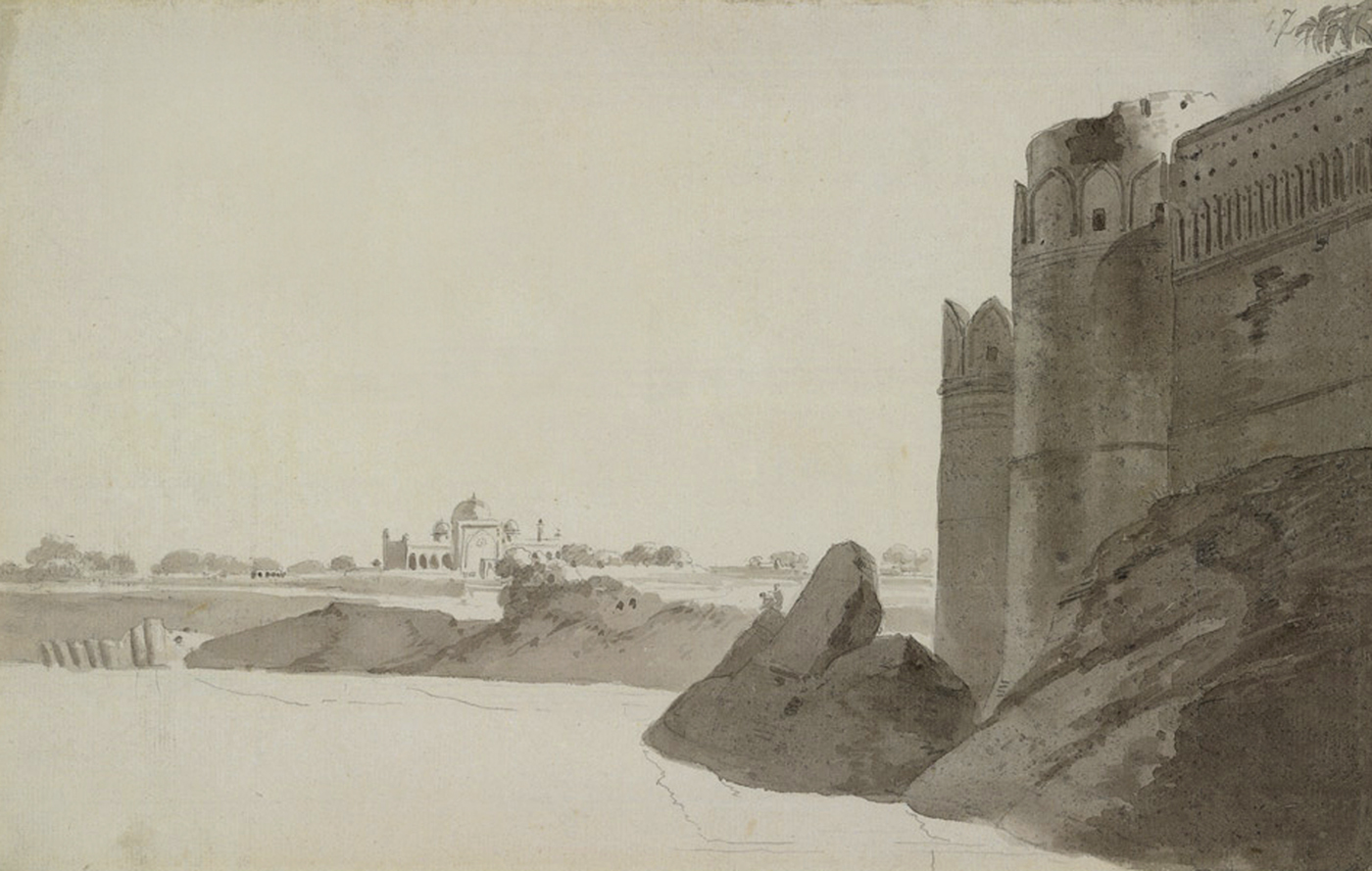
The Jama Masjid of Allahabad's fate in British hands did not end with the decision to reconsecrate in any case. Not very long afterwards, in 1828, the mosque caught the attention of the commander in chief as peripheral to the issue of securing the Allahabad Fort, which by this time had become the principal fort of the region and was being remodeled for this purpose into the 1830s (BC, 3.4.1828, F/4/1275, no. 51155). It was proposed that everything that connected the potentially dangerous mosque to surrounding bazaars and other buildings be leveled, and the entire esplanade of the fort cleared of cultivations and native dwellings, leaving the mosque and other large structures in safe isolation. As this is one of the few government sources to refer to the area around the mosque, it is interesting at this point to compare its description to a pencil and wash drawing of 1789 rendered by two of the most iconic artists of early colonial rule, Thomas and William Daniell (see figure 1).
Thomas Daniell and William Daniell, View of the Bastion of the Fort at Allahabad, and Akbar's Jami Masjid Beyond, November 8, 1789, pencil and wash drawing. Copyright British Library, Asia, Pacific and Africa Collections, WD196. Used with permission.
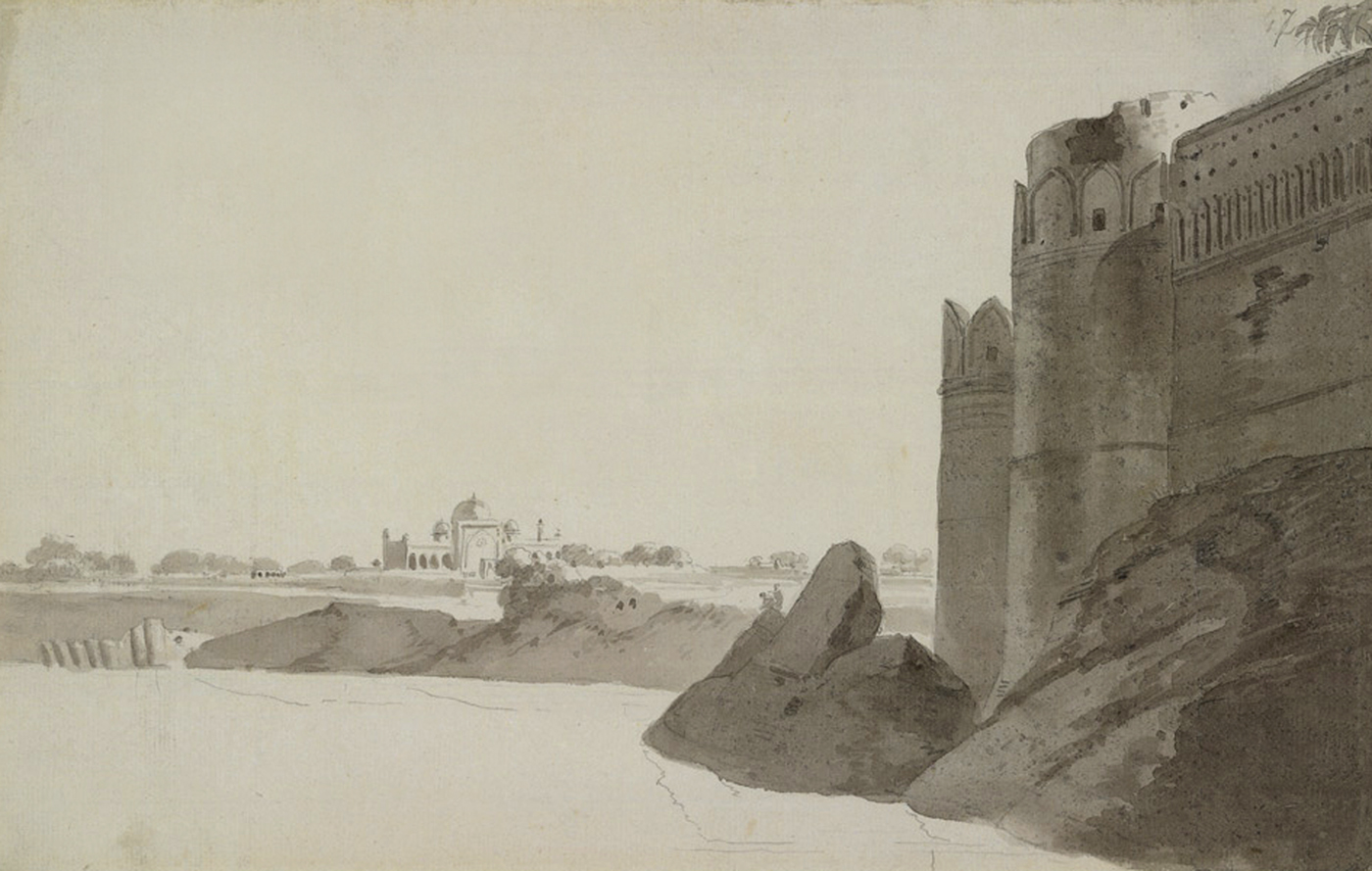
The Daniells' drawing eschewed the usual artistic convention of observing the fort from the confluence of the Ganges and Yamuna rivers and showing it rising up on the banks, sometimes with boats and barges in the foreground, at other times in isolation, but always as the dominant and central subject. Instead, the Daniells' periscopic perspective glanced past the imposing fort to the right of the foreground and looked to that which lay beyond it, the sunlit Jama Masjid, thus foreshortening the distance between the two and placing the mosque in direct line of sight of the fort. Two figures, barely discernable, sitting perched on a rock beside the fort, are the only signs of human life visible. Where are the bazaars, the native dwellings, and the cultivations that worried military authorities less than thirty years later? Were they of very recent development or had the Daniells deliberately erased them—certainly a common practice when composing a “picturesque” scene in this period—from their depiction of the monumental fort and mosque?
By juxtaposing the Daniells' empty, sepia-toned vista of 1789 and the 1828 scheme of “improvement” that conjured an unpopulated landscape as an ideal to be brought about by wilful destruction, one can suggest that while it was certainly true in the case of artistic and literary accounts that a “focus on permanent structures and elaborate monuments isolated them from the landscape of everyday dwellings and bazaars to which they belonged” (Hosagrahar Reference Hosagrahar2005, 8), for those on the ground shaping the fate of these “permanent structures” it was often precisely their location within a wider, inhabited topography that exercised greatest concern. In the end, it was only relatively mundane pecuniary concerns that saved the objects on the esplanade in 1828 and kept the Jama Masjid tied to the fabric of its surroundings.
The next generation of colonial administrators was even less sympathetic to the people and topography of Allahabad. In the heat of rebellion in 1857, they undertook what might be described as a program of deliberate and complete desacralization of the Jama Masjid. During 1857, Brigadier-General James G. S. Neill, Commander at Allahabad, rehearsed a familiar military worry that an enemy that could establish itself in the mosque could “do much mischief.” Neill, in his “Instructions to successors,” proposed an advanced work from the fort that took in the mosque, and if this was not to be the case, he proposed the conversion of the mosque into barracks or a hospital for the British. A public notification issued on June 18 had already announced the conversion of the mosque into barracks as punishment for “miscreant Mussalmans” who had assembled and “publically offered rebellious and seditious harangues against the British Government” there, led by their “recreant” religious leaders (John Kaye's Mutiny Papers, 18.6.1857, H/724a, 159). Neill's description of the distribution of troops in Allahabad revealed a wholesale occupation of the sacred buildings of the town, including the cantonment's church (John Kaye's Mutiny Papers, 16.8.1857, H/726, 251–55). It is simultaneously apposite and ironic that not long afterwards, Lord Charles Canning, the first viceroy of India, announced Queen Victoria's famous proclamation of Crown rule over the Company's Indian territories—which promised among other things greater sensitivity towards the population's religious sentiments—at a grand durbar in the recently pacified “abode of God,” Allahabad, in 1858.
Thereafter there is little mention of the Jama Masjid to be found anywhere, and it has to be presumed that it was deserted or destroyed in the period after Canning declared Allahabad the new capital of the North-Western Provinces, also in 1858. In the decades thereafter, Allahabad was the site of many public works—waterworks, bridges, educational institutions, student hostels, a public hall, courts, a railway station, hospitals, parks, and many new churches and cathedrals—all of them gleaming new works of public utility that were intended to attest to the settled character of civic rule under the Crown and signify a true period of prosperity (Mukerji and Basu Reference Mukerji1910, chap. 4). The need to remain conscious and sympathetic to the historical context in which the Company had intruded had seemingly ceased to cause the kinds of anxieties that had periodically arisen for half a century previously.
The Local Population
The production of built spaces under colonial rule was undoubtedly contingent on interaction between Europeans and Indians, and that of their respective discursive registers; this essential fact has been further supported by recent scholarship on “modern” colonial cities that has found that buildings, space, and society were (re)constitutively constructed (Hosagrahar Reference Hosagrahar2005; Nair Reference Nair2002). So far in this article it has been evident that governmental decision-making with regard to the Jama Masjid was sometimes ambiguously shaped in response to the local population, heard via interlocutors such as judges. Sometimes officials acted as if the sentiments of the population were their predominant concern; more often they thought those sentiments to be a luxury that could be easily disregarded in times of exigency. But the notion that a broader project of “architectural orientalism” was a hermetically sealed, narcissistic discourse, and that locals were only “a phantasy within the work and within the processes of its production” (Crinson Reference Crinson1996, 8), certainly needs some complicating.
The ethnographic eye of Europeans did not fail to muster a natural curiosity “regarding the character and habits of our predecessors in power; now, our subjects” (Sharif Reference Sharif and Herklots1832, vi), although notably this was much later than their “discovery” of Hinduism in India. The year 1832 saw the publication of Qanoon-e-Islam, or the Customs of the Moosulmans of India (Sharif Reference Sharif and Herklots1832), composed under the direction of a European patron, and Mir Hassan Ali's Observations on the Mussulmauns of India (Ali Reference Ali1832). A year before, the French Orientalist Garcin de Tassy published Memoires sur les particularités de la religion Mussulmane dans l'Inde (Notes on the particularities of the Mussalman religion in India, Reference Tassy1831). Together they constituted the first ever near-total study of India's Muslims. But the authors of these studies, which predated the more thorough and geographically wide-ranging investigations of the Imperial Gazetteers of the late nineteenth century, admitted that the difficulty of collecting information for their work probably arose from a wish on the part of Muslims “simply to keep Europeans in the dark, under a vague apprehension that frankness would ultimately prove to their own detriment” (Sharif Reference Sharif and Herklots1832, x–xi; Mujeeb Reference Mujeeb1967, 9–10). This testifies to, if not exactly epistemological violence, then certainly a pervasive problem in the accumulation of “knowledge” about the Muslims of India. This section attempts to go even further to ask why and to what effect was the Jama Masjid, if it was quite as significant as the petition submitted to the magistrate of Allahabad in 1811 claimed, initially abandoned to its unfortunate fate.
A parallel case nearby in Patna is illuminating: “[T]here are many mosques here but none large,” observed an 1828 Company gazetteer. “Some of them are now let by their owners as warehouses, especially the handsomest, built entirely of stone; and although the proprietor has thus debased his mosque, he persevered strenuously in daily calling the faithful to prayer” (Hamilton 1828, 381–82). It seems that in that case of profanation tension was mediated precisely because the owner was a member of the faith and could sustain some semblance of its public, religious function. The desecration of the Allahabad mosque during the British period equated to a qualitatively different act, entailing arguably a desecration of the community to whom it belonged (as it were) as well. The benign or culpable neglect of buildings that lack communities to serve them or with the power to protect them is often a key facet of the story of architecture's role in social conflict (Bevan Reference Bevan2007), but the presence of a foreign power substantially reconfigured the nature of such conflict in colonial India. Such a position is certainly supported by numerous anecdotes in gazetteers, histories, and memoirs that mention local beliefs in holy curses and unholy deaths that had befallen those Europeans who had desecrated sites by either plundering or inhabiting them (Martin Reference Martin1838, 65–66; Sleeman Reference Sleeman[1844, 1915] 1975, 503; Thornton Reference Thornton1857, 555). Similar phenomena have been observed in the Greek and Egyptian contexts (Leask Reference Leask2004, 146–51). Myths of retributive justice meted out by supernatural forces can be interpreted as evidence that these appropriations had a deep and lasting impact on Indian Muslims. Thus, while the narrative sketched above may suggest that British administrators and judges were interested in the form, function, and sacred significance of the mosque, we would do well to remember the ultimate result of their efforts and question the sense of cordial coexistence that the likes of Colonel Kyd were eager to suggest.
As well as causing religious offense, even those sources filtered through the colonial archive indicate a deep alienation of locals from the operation of government in Allahabad. Kyd had presumed indifference in lieu of any vocal protest (BC, 23.4.1808, F/4/581, no. 14152). The petition of 1811, on the other hand, stated that the Muslim population were displeased with his appropriation but had been unable to make a representation because they found the new government of Europeans “suspicious” and were “ignorant” of its opaque rules and regulations (BC, 15.10.1811, enclosed translated petition, F/4/581, no. 14152). If a certain impenetrability and distance of power was a pervasive issue in colonial governance more generally, then it was no less true here; in September 1814 the then magistrate of Allahabad, Thomas Fortescue, furnished a detailed report on the state of his zillah (administrative district) wherein he wrote that the regulations of the government “are but very imperfectly understood by the subjects,” that they were issued with great vapidity and were subsequently often partially or wholly altered in practice, and that, among a population where the majority were illiterate, few could be expected to read the law anyway (HM, 1.9.1814, H/776, 849–52).
This chronic inscrutability might explain why the 1811 petition was so late in coming to the fore. Scholarship on the decline of “affective knowledge” in the decades leading up to the 1840s has suggested that mahzars and surathals (general applications or representations) became sparser over time because of a “demise of the sense of state-fostered moral economy as the old Muslim and Rajput gentry declined, and religious authority was distanced from colonial rule” (Bayly Reference Bayly1996, 166). Petitions containing popular local grievances continued to come to the magistrate's office, but as Fortescue described, this was a system in which expositions were occasionally received and dismissed “on very doubtful grounds” (HM, 1.9.1814, H/776, 851). Other sources bear out Fortescue's impressions: the 1811 Allahabad petition, for example, carried little weight in comparison to Stuart, Kyd, and Smith writing authoritatively about and on behalf of “the Muslims of Allahabad.” Local sentiments were offered second hand, in the abstract, and via interlocutors. Thus, while Muslims were certainly present in the debate, this presence hardly amounted to a true discursive engagement.
British officials often understood this lack of engagement as indeed a problem of moral economy, but rather than place emphasis on the decline of older, more locally rooted moral economies, they regarded the gulf as the inevitable result of bringing an altogether new, higher moral economy to India. The sympathetic Fortescue tellingly claimed that one of the reasons why the regulations promulgated under British rule were so “imperfectly understood” was because “they [contained] principles and rules of conduct contrary to the experience and knowledge of the people” (HM, 1.9.1814, H/776, 850). More generally he made reference to the evil and inconstant “Muhammadan Law” that had been in place previously; this was a deeper, heavily ideologically driven point about the incompatibility of the Indo-Islamic legal and historical heritage with enlightened British rule. Fortescue also had much to say about the people of Allahabad, who were honest and hospitable but whose “general moral character” was not improved under British rule; indeed, it was on the decline (HM, 1.9.1814, H/776, 983–84). Likewise, while the exterior appearance of their houses was improving, the same could not be said of the “internal comforts” (HM, 1.9.1814, H/776, 976). This is revealing of both the real and the metaphorical value of buildings as markers of civilizational, material, and moral progress in colonial thought at all levels.
The endemic alienation of the population was demonstrated further when the Muslim population were informed in 1815 that the mosque had received a reprieve. They offered no formal reply, saying only that they lacked the financial means to contribute to the repairs (BC, 5.4.1815, F/4/581, no. 14152). The task of “reconsecration” was however effectively left up to them: the superintendence of the repairs was to be entrusted to one of the chief Muslims of the area, who, since he was a Muslim, would have a “personal interest” in accelerating the progress of the work and would thus lower the cost of the work. Local Muslims were generously granted convict labor to help with the mosque's restitution. It was estimated that twenty-six convict laborers could be used daily to restore the mosque—rather less than was desirable but the maximum amount practicable given the distance from the jail to the site, the magistrate of Allahabad informed Fort William (BC, 5.8.1815, F/4/581, no. 14152).
It is worth noting that later sources vilified the minimal part that Allahabad's Muslim population had played in the mosque's fate: Heber, after his travels through Allahabad in the 1820s, remarked that “the Mussalmans . . . are neither numerous nor zealous in Allahabad, and seemed to care little about the matter,” though he acknowledged that the restitution was “proper and popular” (Heber Reference Heber1828, 284–85); the 1857 edition of Edward Thornton's Gazetteer claimed that after the edifice was restored, “the Mussulmans . . . regarding it as polluted, displayed a contemptuous indifference on the subject” (Thornton Reference Thornton1857, 23), although the events of 1857 may have inflected these attitudes.
Later in the nineteenth century, the Frenchman Gabriel Charmes pronounced in the Journal des débats (1881) that if Egyptians could not understand the value of restoring and protecting Cairo's historic mosques in order that they might render the kind of national service the Acropolis had for Greek independence, then they did not truly deserve to be independent of those who were “capable of understanding and conserving such works” (Reid Reference Reid1992, 60). Interestingly, just as Charmes's estimation of modern Egyptians in the 1880s was juxtaposed with his praise of the astuteness of modern Greeks, Englishmen in the period of the Allahabad mosque debate were making observations about the barbarous ignorance of modern Greeks, seen increasingly as the degenerate descendants of—if even racially connected at all to—a historically sophisticated civilization of which Western Europe was the only legitimate heir (Hoock Reference Hoock2010, 238). Such characterizations by both Englishmen and Frenchmen furthered European ambitions in the ancient heartlands of Greece and Egypt in the nineteenth century.
It is perhaps therefore unsurprising that similar critiques were leveled at the Muslims of Allahabad in the 1830s–1850s. Allahabad was described in the Asiatic Journal in 1833 as a place distinctly lacking in “those remains of magnificence, which might have been expected in a place favoured by the presence of royalty.” It now retained “few vestiges of the Moghul conquest . . ., its Moosulmanee inhabitants being limited in numbers, and of little importance as regards their wealth, rank, or talent.” To demonstrate the depths of degradation, the commentator observed that the city “is almost wholly given up to idolatry, and has even been celebrated for the pilgrimage of pious Hindoos,” forgetting that the Company was itself deriving substantial revenues from taxing this very pilgrimage (Asiatic Journal 1833, 97). The justification for taxing “idolatrous” pilgrimages in India was that the proceeds could be used to fund those enlightened public projects that Indians themselves had no mechanism (or desire) to fund. Indeed, in the very same year as the Asiatic Journal despaired of the idolatry at Allahabad, Lord William Bentinck defended the controversial pilgrim taxes levied in Juggernauth, Gya, Jutta, and Sooran, as well as Allahabad, partly on the basis that surplus revenue could be used by the government to improve the roads of Bengal (House of Commons Parliamentary Papers 1837, no. 357, 6). Such arguments were made in conflict with a rising missionary outcry over the Company's profiting from so-called corruptive, idolatrous native religions.
It is pertinent when thinking about particularly the “Muslim” public—though there is not enough space to discuss the problems with such a concept here—that it was during this period of colonial rule that the institution of awqaf (religious endowments) was in the colonial imaginary turned into an instrument purely for wealthy Muslims to guard against the division of their estates, when in fact it had historically served other, very different public functions. The Asiatic Journal lamented that Allahabad afforded “a mournful example of the want public spirit in the Moosulman population of its neighbourhood.” The writer exculpated the government's inattention to Allahabad's built heritage, so that when the piece went on to list objects of decay and remark that “their neglect reflects shame upon the carelessness of those who can suffer buildings to sink into oblivion, which, in other countries, would attract crowds of admiring strangers to descant upon the elegance of their design and the splendour of their execution,” it was clear that the onus of the burden was placed upon the Muslims alone (Asiatic Journal 1833, 108). As noted above, such reasoning was a familiar trope that Europeans used against indigenous populations to justify wresting control of the latter's monumental heritage. The link between poverty and neglect seems not to have been made by this writer. It was thus that British opinion by the 1830s, having earlier established that the Muslims of Allahabad were too poor to contribute towards the restoration of the imperial mosque, further argued that it was not in their character to want to repair it. Whereas poverty was earlier pitied, two decades later it was something for which the Muslims themselves were castigated.
A Metropolitan Epilogue
The Court of Directors, the East India Company's executive body based in London, offered its thoughts on Allahabad's Jama Masjid many years after it had become a subject of debate in India; in 1819 it wrote to Fort William to say that it considered providing Muslims with a place of worship at any expense “totally inadvisable,” but concurred with Fort William's judgment, only because “those poor people were unable to contribute anything towards the restoration of this edifice, which it appears had been previously damaged and polluted by some European gentlemen, and on that account only” (BC, 2.2.1819, F/4/1306, no. 51857).Footnote 5 While this was unsurprisingly measured, the Court volunteered another, more striking letter on the subject the following year. The way that letter reconceptualized the issue reveals the importance of property in colonial thought, and also a romantic sympathy with arguments based on civilizational merit. The normally reticent body deployed a deeply historicist argument that quoted Smith, the provincial judge from Benares, verbatim:
The building itself is no obscure edifice, it is supposed to have stood for two hundred years, and if left to itself would stand for ages more. It is the most conspicuous building in Allahabad, or for many miles around; it was the Jummamusjed of the Soobah of Allahabad, a fifteenth part of Akbar's Empire, and mighty monarchs have humbled themselves in prayer within its walls. . . . (BC, 26.4.1820, F/4/1306, no. 51857)
That a dual sense of danger and sacred splendor held sway in British discourse concurrently indicates the anxiety that was produced by such sites of Indo-Islamic heritage. By preserving a building in which earlier “mighty monarchs” had humbled themselves in prayer, it was implied that Englishmen were legitimate heirs to this prestigious heritage and simultaneously conveyed a continuum of power and rule in India in keeping with the prevalent notion that it was a land naturally given to imperial rule. Of course, this genealogy had problematic implications given that the Company was unlike any previous ruler; fundamentally, at least until around the 1830s, it professed no religion of its own and thus could hardly find a place at the head of the indigenous moral economy.
In contrast, Mughal religious patronage was born of the need to affirm their religious credentials as well as to keep prominent men on their side (Kozlowski Reference Kozlowski1995). For the Company State therefore, in London as in India, it was its respect for India's religious traditions that was to be “the character of [its] Government,” the sacral liberal notion of the tolerance of all faiths. The tendency among officials to associate the fame of the Emperor Akbar to the mosque was apt in this regard, since he was the Mughal Emperor under whom they believed religious toleration was at an apex.
By the 1830s and 1840s a more utilitarian approach would come to dominate metropolitan imperial thought, and, partly as a result of persistent missionary pressure in Parliament and in the colony, the government in India was pushed to withdraw from its various entanglements with religious institutions. In practice, however, as may be expected from the survey of the varied fortunes of the Allahabad mosque before 1857, a complex relationship between British rule and sites of Indian heritage continued well into the rest of the nineteenth century and beyond.
Acknowledgments
My thanks to Dr. Shruti Kapila, and to the anonymous reviewers who commented on an earlier version of this article.