Employers, employees, safety managers, trade unions, company insurance funds and politicians are some of the stakeholders who share the objective to improve occupational health and safety. Nevertheless, problems arise when different stakeholders have not a common understanding about occupational risks (Holmes, Lingard, Yesilyurt, & de Munk, Reference Holmes, Lingard, Yesilyurt and De Munk1999; Sadhra, Petts, McAlpine, Pattison, & MacRae, Reference Sadhra, Petts, McAlpine, Pattison and MacRae2002). Differences in the way that experts and non-experts judge risk have been documented in several areas (Kraus, Malform, & Slovic, Reference Kraus, Malmfors and Slovic1992; Lee, Mehta, & James, Reference Lee, Mehta and James2003; Savadori et al., Reference Savadori, Savio, Nicotra, Rumiati, Finucane and Slovic2004). Sjöberg (Reference Sjöberg1999) has eloquently summarized the main crash of ideas: “Experts see the public as misinformed, badly educated and highly emotional (…) while the public suspects that experts know less than they claim and that they are corrupt due to their being hired by the industry or government” (p. 5).
A debate about the convenience to complement “technical” risk research (as done in natural sciences or economics) with social-scientific approaches has been ongoing (Goldstein, Reference Goldstein2005). The logic is that each approach captures a different, and only partial, aspect of the complex and multidimensional reality. Both are needed to produce a comprehensive account of the nature and extent of risk and to help decision makers to make better and more informed decisions. This combination provides the basis for a participatory approach in risk management and risk communication as a way for designing, selecting and implementing policy alternatives that are more likely to be widely accepted by a variety of stakeholders (Mereu, Sardu, Minerba, Sotgiu, & Contu, Reference Mereu, Sardu, Minerba, Sotgiu and Contu2007).
Much risk communication research is formulated at the social or public level and it does not contribute to spread the use of the concepts of risk communication within the organization in order to prevent workplace illness and injury (Real, Reference Real2008). The focus of the present study was on the healthcare workplace. Health services are one of the fundamental sectors of the society and the economy, employing around 10% of all workers throughout the European Union (European Agency for Safety and Health at Work, 2007). Healthcare workers are exposed to biological, chemical, ergonomic, organizational and psychosocial hazards. What makes the health care sector unique is that it not only includes such a complex mixture of hazards, but the fact that there is a link between “customers” and the occupational risks mentioned above. In some situations patients are carriers of risks while in other cases the hazards that healthcare workers encounter also threaten the patients and clients they care for. Many important preventative strategies (e.g., universal precaution to control of infectious diseases) depend on the behavior of the worker, and the hazard-specific risk perceptions are central to many health behavior theories (Brewer et al., Reference Brewer, Chapman, Gibbons, Gerrard, McCaul and Weinstein2007). A resource to cope with the challenges derived to manage occupational risks in healthcare workplaces is the involvement of workers and other employers in the risk assessment process, which entails an understanding of how healthcare workers perceive occupational risk.
Qualitative and quantitative approaches to risk perception have been used in psychology and sociology (Fischhoff, Bostrom, & Quadrel, Reference Fischhoff, Bostrom, Quadrel, Detels, Mc Ewen and Ommen2002). The dominant quantitative psychosocial approach to risk perception has been the so-called “psychometric paradigm” (Aragonés, Moyano, & Talayero, Reference Aragonés, Moyano and Talayero2008; Siegrist, Keller, & Kiers, Reference Siegrist, Keller and Kiers2005). This paradigm comprises:
A theoretical framework that assumes risk is subjectively defined by individuals who may be influenced by a wide array of psychological, social, institutional and cultural factors. The paradigm assumes that, with appropriate design of survey instruments, many of these factors and their interrelationships can be quantified and modeled in order to illuminate the responses of individuals and their societies to the hazards that confront them. (Slovic, Reference Slovic2000, p. 23)
Since the seminal work by Fischhoff, Slovic, Lichtenstein, Read, and Combs (Reference Fischhoff, Slovic, Lichtenstein, Read and Combs1978), the effect of many factors that potentially predict responses to risk has been examined from the point of view of the psychometric paradigm. These studies demonstrate that non-experts’ views on risk are obviously intuitive and less formal and precise than experts' statements; however, their basic conceptualization of risk is much richer than that of experts and reflects legitimate concerns that are usually omitted from expert risk assessments. Psychometric paradigm uses “cognitive maps” to describe risk perceptions and attitudes which relate: (1) quantitative judgment on current and desired riskiness of diverse hazards and the desired level of regulation of each one; (2) benefits that each hazard provides to individuals and to society; (3) hazards’ status on qualitative characteristics that have been hypothesized to account for risk perceptions and attitudes.
In the early psychometric studies nine qualitative risk characteristics were investigated (Fischhoff et al., Reference Fischhoff, Slovic, Lichtenstein, Read and Combs1978): voluntariness of risk, immediacy of effect, knowledge about risk by exposed people and experts, control over risk, newness, catastrophic potential, dreaded consequences and severity of consequences (certain to be fatal). Subsequent studies increase the aforementioned characteristics including others such as their preventability (e.g., Benthin, Slovic, & Sverson, Reference Benthin, Slovic and Severson1993; Slovic, Fischhoff, & Lichtenstein, Reference Slovic, Fischhoff, Lichtenstein, Schwing and Albers1980). The typical finding is that qualitative risk characteristics can be condensed into a small number of factors, usually two or three. The most robust research findings have been: (1) one factor, usually labeled “dread”, that represents the extent to which a hazard evokes feelings of dread, and is associated with lack of control, dreaded consequences, catastrophic potential and fatal consequences; (2) another factor, usually labeled “unknown”, that represents the degree to which a risk is understood, and is associated with knowledge, immediacy of consequences, newness and observability. Several studies show how the characteristic most highly correlated with perceived risk are those related with the “dread” factor (Slovic, Reference Slovic2000, Reference Slovic2010).
At the design level, psychometric studies were first characterized by the use of large and extremely heterogeneous sets of activities and technologically-induced environmental hazards. Kraus and Slovic (Reference Kraus and Slovic1988) later started using this paradigm to describe homogeneous risk domains. This has been followed by numerous studies, including some conducted in the workplace (Coles & Hodgkinson, Reference Coles and Hodgkinson2008; Kobbeltvedt, Brun, & Laberg, Reference Kobbeltvedt, Brun and Laberg2004; Lee et al., Reference Lee, Mehta and James2003), and they extend the main conclusions on the importance of the “dread” construct to characterize risk perception. Another characteristic of psychometric studies is the use of aggregated data (i.e., not raw data, but mean values across participants). Critics have addressed the problems associated with this approach. It has been pointed out that aggregate analysis may distort the range of opinions expressed by individuals (Marris, Langfort, Saunderson, & O'Riordan, Reference Marris, Langford, Saunderson and O’Riordan1997). The more deeply critical are those who question the relevance of structural representations of the risk perceived by an “average person” when the purpose is to improve the risk management in a context where individuals must decide for or against a given option (Harding & Eiser, Reference Harding and Eiser1984; Sjöberg, Reference Sjöberg2000). Different studies in the framework of psychometric paradigm demonstrate the importance of combining the analysis of aggregate data with analysis of individual responses (e.g., Bronfman & Cifuentes, Reference Bronfman and Cifuentes2003; Marris et al., Reference Marris, Langford, Saunderson and O’Riordan1997; Puy, Reference Puy1995; Siegrist et al., Reference Siegrist, Keller and Kiers2005). Although the analysis of individual responses to single hazards from a homogeneous hazard domain extend the seminal questions tackled by psychometric paradigm (i.e., why people perceive different hazards differently), we consider that psychometric perspective Footnote 1 can lead to a valuable and feasible tool for characterizing perceptions of specific hazards in the workplace and thus contribute to improve their management. An approach focused on hazard-specific risk perceptions represents a contribution in relation to more general approaches to occupational risk perception used by safety research (e.g., McGonagle & Kath, Reference McGonagle and Kath2010).
The purpose of this study was to adapt some key elements of psychometric perspective to characterize, at an individual level, the occupational risk perceived by healthcare workers related to three significant types of occupational hazards for them: biological, ergonomic and organizational. We expected that the main conclusion of the psychometric paradigm related to the multidimensional character of risk and the importance of feeling of dread to predict risk perception would be maintained. Data were analyzed from different perspectives with the aim of characterizing the risk perception. Firstly, the overall perceived risk and the ratings given to the qualitative risk characteristics were described. Secondly, the replication of the factorial structure found in most psychometric studies was examined separately for each hazard. The third set of analyses explored the relative weight of risk characteristics to predict the overall perceived risk of each hazard; demographic and occupational variables, which previous studies had related to risk perception in the workplace, were included (Alexopoulos, Kavadi, Bakoyannis, & Papantonopoulos, Reference Alexopoulos, Kavadi, Bakoyannis and Papantonopoulos2009; Jovic-Vranes, Jankovic, Vukovic, Vranes, & Miljus, Reference Jovic-Vranes, Jankovic, Vukovic, Vranes and Miljus2006; Kobbeltvedt et al., Reference Kobbeltvedt, Brun and Laberg2004).
Method
Participants
Participants were employees of a healthcare company with different centers in Catalonia (Spain). The company provides health care at three levels: primary care services, acute hospitals and social and healthcare centers. A total of 850 questionnaires were distributed to all employees in the professional categories with the highest rate of occupational accidents in the company, specifically: registered nurses, nurse assistants, technicians and orderlies. Altogether 313 healthcare workers (rr. 37%) provided the complete information to tackle the objectives of this study. They volunteered to complete the questionnaires and no incentive was given for participation. Most of the participants were women (84%). The employees’ age ranged from 18 to 60 years (M = 34; SD = 8.3) and length of service ranged from 8 months to 37 years (M = 10 years; SD = 7.6 years). They were distributed in the following categories: 56% registered nurses, 30% nurse assistants, 8% technicians and 6% orderlies. The majority (67%) were permanent employees. As regards healthcare level, 10% worked in primary care facilities, 72% in acute hospitals and 18% in social and healthcare centers.
Materials
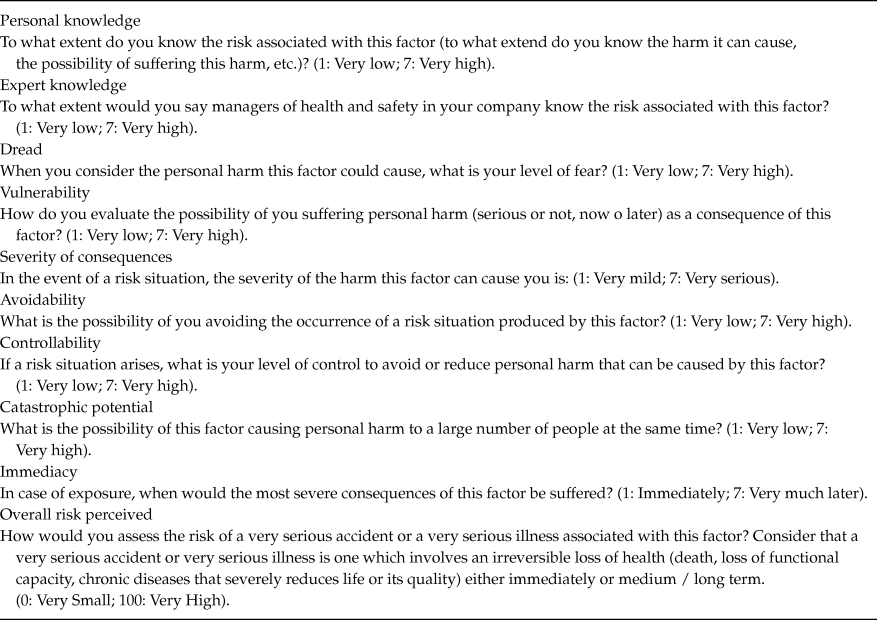
The questionnaire was composed of 10 items based on the questionnaires developed within the psychometric paradigm. The nine risk characteristics were based on those used in the initial study of Fischhoff et al. (Reference Fischhoff, Slovic, Lichtenstein, Read and Combs1978), with the exclusion of “voluntariness” and “newness” and the inclusion of “avoidability” (preventability) and “vulnerability” (personal risk) which had been used in subsequent studies (e.g. Benthin, et al., Reference Benthin, Slovic and Severson1993; Slovic et al., Reference Slovic, Fischhoff, Lichtenstein, Schwing and Albers1980). On the other hand the questions about the expert knowledge were characterized as the knowledge of health and safety managers in the company. The last change was the scope of the question about overall risk, which was not “risk of death” but “risk of very serious accident or very serious illness”. Table 1 shows the scales used to rate each hazard, as well as the questions which have been formulated with the aim of being feasible for different occupational hazards and workplaces. The questionnaire was tested in different stages of the adaptation process for relevance and comprehensibility on academics, occupational health and safety technicians and other workers.
Characteristics on which the occupational risk factors were rated

Note: All questions were asked in Catalan.
The participants were given other materials, including a briefing note of the study, the instructions to fill the risk perception questionnaire and demographic and occupational questions (sex, age, employment stability, length of service, healthcare level and professional category).
Procedure
The first stage was led by the staff of the Occupational Health Surveillance Unit of the company Footnote 2 . The aim was to select the risk factors and to adapt their specification to the questionnaire characteristics. Based on risk assessment, the occupational experts decided to focus on three aspects. The first one was overstrain and musculoskeletal injuries as they were the main cause of accident-related absenteeism. For these ergonomic risk factors, the specific factor selected was “the repetitive manual handling of loads” (RMHL) (Ngan et al., Reference Ngan, Drebit, Siow, Yu, Keen and Alamgir2010). The second one was needlestick injuries which was the main cause of accidents without sick leave. For these biological risk factors, the specific factor selected was “the needle recapping” (NR) (Gershon et al., Reference Gershon, Pearson, Sherman, Samar, Canton and Stone2009). The third one was the perceived risk of “shiftwork, including night work” (SN), as a factor linked to work organization risks (Hopcia, Dennerlein, Hashimoto, Orechia, & Sorensen, Reference Hopcia, Dennerlein, Hashimoto, Orechia and Sorensen2012). From a technical criterion this last risk was considerably lower than the previous ones. The data were collected by one member of the occupational health surveillance unit. The three occupational hazards were rated by each worker on the items shown in Table 1. It took 10 minutes on average.
Statistical analysis
Analyses were performed using IBM SPSS Statistics v19. In order to examine the factor structure of risk characteristics, principal components analysis with VARIMAX rotation was conducted. This analysis looked at the between-subject variability, and the Participants × Risk Characteristics matrix was used. Only components with an eigenvalue higher than 1 were retained, and the Cattell’s scree test for the number of factors was applied. A minimum of 50% of accounted variance was required to select a final model, which should also explain a relevant percentage of variance in comparison with the rejected ones. Items showing cross-loading were allocated to the factor with the highest loading, when the difference with respect to the second highest value (in absolute value) was above .10. In contrast, when the difference between factor loadings was below .10, the contribution of the item to the internal consistency of each scale was taken into account. Theta (θ) coefficient was used to evaluate internal consistency (Carmines & Zeller, Reference Carmines and Zeller1982). Factors were saved as variables and subsequently entered in regressions analysis in order to predict the overall perceived risk. The relationship between ratings for the risk characteristics, demographic variables and occupational variables (predictor variables) and the level of perceived risk (criterion variables) was analyzed using multiple linear regression models. The interaction terms between each of these risk characteristics and gender, age and experience were also included. The final model was selected using a hierarchical backward elimination procedure.
Results
Overall trends
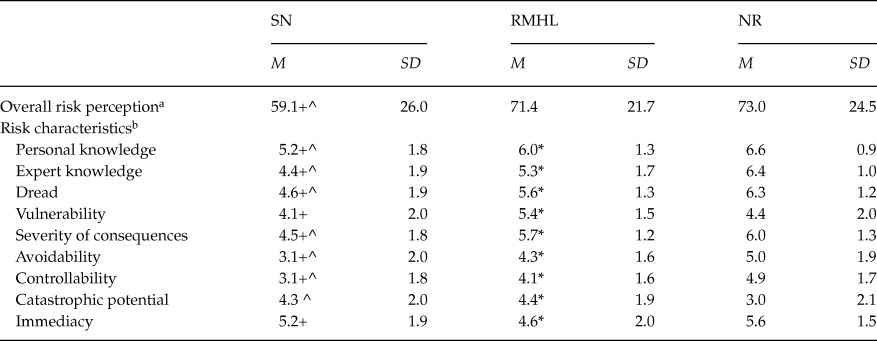
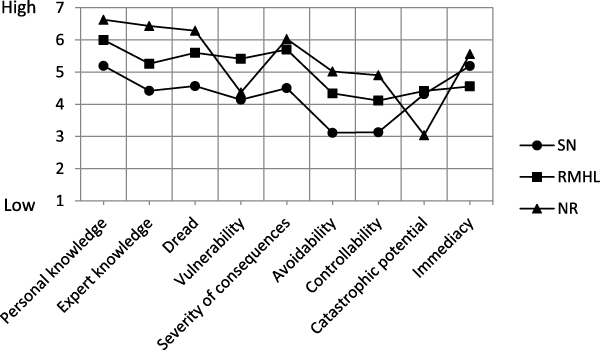
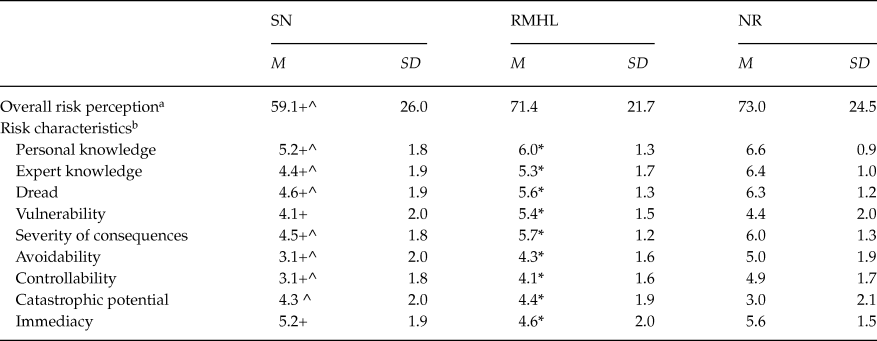
Table 2 presents the mean ratings and standard deviations for the three risk factors on all scales. It also shows the statistically significant differences between pairs of risk factors based on the paired samples t-test applying Bonferroni correction. The lowest overall risk perception was SN, whereas the perceived risk linked to RMHL and NR was quite similar (no statistically significant difference). This pattern of variation between risk perceptions was in keeping with the results of risk assessment in the company. However, when the results for the risk characteristics were examined, then significant differences between RMHL and NR arose. Figure 1 highlights these differences by comparing the mean ratings on the nine risk characteristics. NR had the highest value in all the scales, except for vulnerability and catastrophic potential. The profile for NR suggests that this is the most feared risk, as well as the most well-known, controllable and avoidable. On the other hand, SN is the least feared risk, but it is also the least well-known, controllable and avoidable. RMHL profile regarding these four characteristics was in between NR and SN. One common result for the three hazards was that the mean score for personal knowledge was significantly higher than the score on expert knowledge; so our respondents considered that their knowledge of the risk related to NR (t(305) = 3.99, p < .001, 95% CI [.10, .30]); RMHL (t(302) = 7.14, p < .001, 95% CI [.54, .94]); and SN (t(279) = 5.83, p < .001, 95% CI [0.52, 1.05]) was higher than the knowledge attributed to the occupational experts; although small differences in the wording of the questions hamper conclusions. The personal knowledge question is more specific (i.e. it mentions causes and chances of suffering personal harm) than that of the expert knowledge which is more generic. Under these conditions, observing that the score of personal knowledge is higher than the score of expert knowledge for the three risks seems to be worth mentioning.
Mean scores and standard deviation obtained for overall risk perception and for each of the 9 risk characteristics on each of the 3 risk factors
Note: SN = Shiftwork including night work; RMHL = Repetitive Manual Handling of Loads; NR = Needle Recapping.
a measured on a 1–100 scale; b measured on a 1–7 scale; + significant difference between SN and RMHL; ^ significant difference between SN and NR; * significant difference between RMHL and NR; (+,^,* are significant at Bonferroni adjusted p value of .002).
Profile of qualitative characteristics of perceived risk for each occupational risk.
Note: SN = Shiftwork including night work; RMHL = Repetitive Manual Handling of Loads; NR = Needle Recapping.

Factor structure of risk characteristics
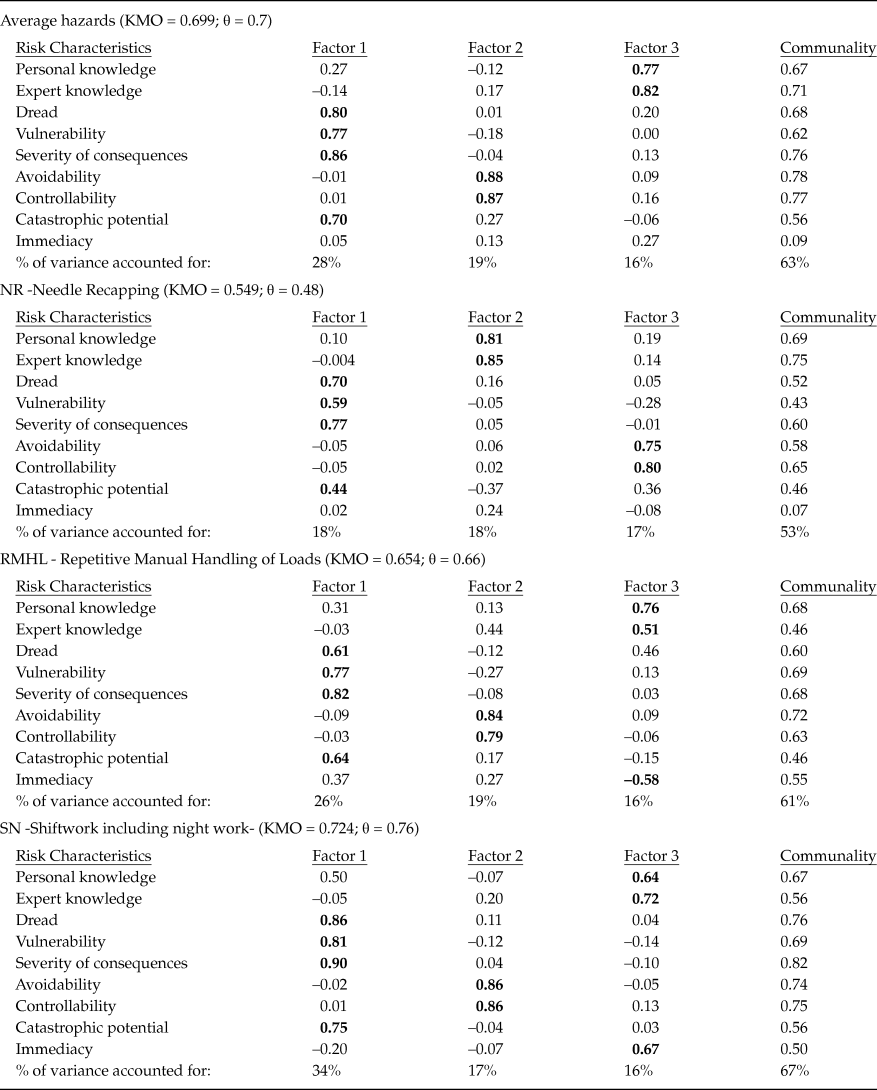
Table 3 shows the results of four principal components analyses with VARIMAX rotation. The first part of Table 3 summarizes the results based on the mean ratings across the three hazards. The rest of the Table 3 summarizes the main results separately for each hazard. The Kaiser-Meyer-Olkin (KMO) index of sampling adequacy was acceptable (from .55 for NR to .72 for SN), and the Bartlett sphericity test was statistically significant (p < .001). Three higher order components provide an acceptable solution for the four analyses. The best adjustment was for SN (accounting for 67% of the raw data) and the worst was for NR (accounting for 53% of the raw data). The first factor explained 18% − 34% of the variance and included dread, vulnerability, severity and catastrophic potential; this factor was labeled “dread evoked”. The second and third factors accounted for 16% − 19% of the variance, and their core pattern of relationship between risk characteristics was the same in the four analyses. One factor was defined by avoidability and controllability; this factor was labeled “controllable damage”. The other one was defined by personal knowledge, expert knowledge and immediacy; this factor was labeled as “knowledge/understanding”. Immediacy was the most unstable aspect of this three-factor solution.
Principal components analysis across nine risk characteristics: Aggregate analysis and separate analysis by hazard

Note: Factor loadings ≥ .30 are reported in bold.
Predicting overall perceived risk
Table 4 lists the standardized regression coefficients and estimates of variance in risk perception explained by the three factors for each hazard and for the average of them. Factor 1 is the most significant for each hazard and for their average. The role of factor 2 and 3 vary as a function of the hazard.
Standardized regression coefficients and estimates of variance in risk perception explained by factors

Note: SN = Shiftwork including night work; RMHL = Repetitive Manual Handling of Loads; NR = Needle Recapping.
* p < .05. **p < .001.
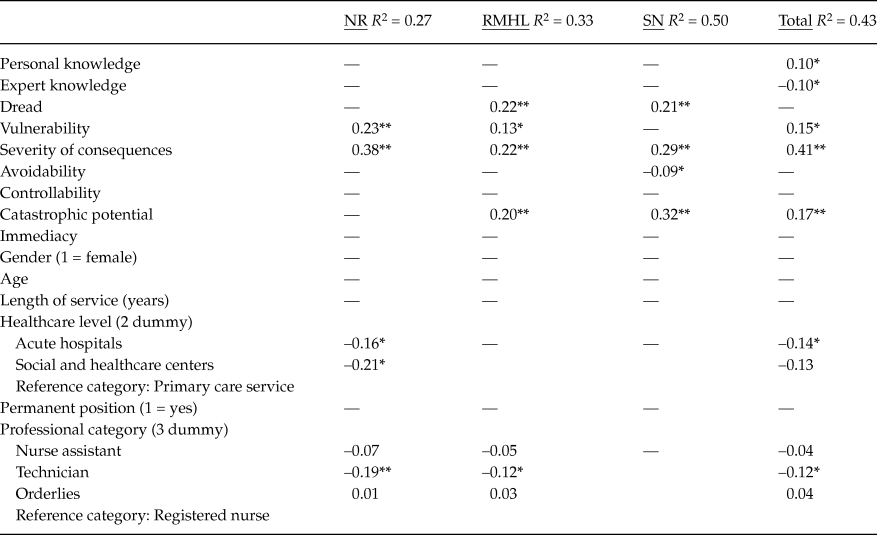
Given the singularities of the three-factor structure for each hazard, we decided to predict the overall perceived risk using the raw data from the nine characteristics. Additionally, demographic and occupational characteristics were included as is shown in Table 5. The multiple R 2 was low (range from 0.27 − 0.50). Perceived risk is relatively well explained by predictor variables in the case of SN and less well explained for NR. There was a great consistency with the severity contribution in predicting the risk perception. There was a partial agreement between the other characteristics included in factor 1, although always in the same direction. Regarding the other factors, only avoidability was a significant predictor for SN. Except for healthcare level and professional category, which are significant just in one or two risk factors, the rest of the subjects' personal characteristics (i.e. gender, age, length of service and permanent position) were not significant contributors to the equations. However the aforementioned difference in the wording of questions about knowledge drives us to go in depth on this issue in future studies. Equations based solely on the risk characteristics accounted for less variance than those including the personal characteristic for NR and SN. Nevertheless these differences were quite small (1% to 6%).
Standardized regression coefficients and estimates of variance in risk perception explained by risk characteristics, demographic and occupational variables
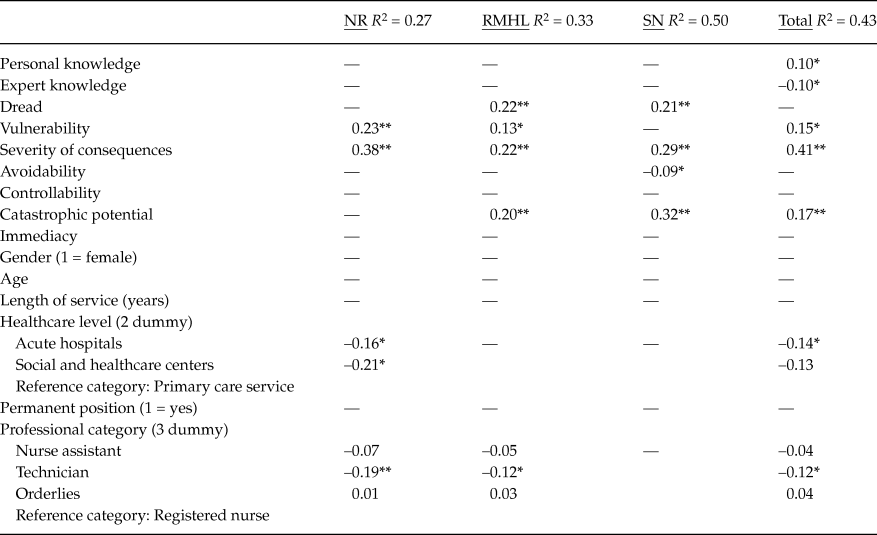
Note: SN = Shiftwork including night work; RMHL = Repetitive Manual Handling of Loads; NR = Needle Recapping. The non-significant coefficients are marked with '—', except for those dummy variables that are part of a set of significant dummy variables, where both significant and non-significant coefficients are presented.
* p < .05. **p < .001.
Discussion
Our study shows the application of a feasible procedure to summarize perceived risk by healthcare workers in a natural and highly demanding setting. It uses an adaptation of the research design used by Slovic et al. (Reference Slovic, Fischhoff, Lichtenstein, Schwing and Albers1980) and replicated in many other studies. However, the two studies differ in a number of factors: (1) our study uses a very small and totally different set of hazards; (2) our participants are Spanish healthcare workers directly exposed to these hazards instead of USA college students; (3) the Slovic et al. (Reference Slovic, Fischhoff, Lichtenstein, Schwing and Albers1980) analysis neglects individual differences in risk perceptions, while our study approaches this problem by analyzing data separately for each hazard, so we are focusing on the individual risk perception process. As we expected, despite these differences, some important results of the psychometric perspective were replicated at an individual level. We organize the discussion around two similarities between our results and those found in many psychometric studies with aggregated data.
The main similarity is that dread is a primary component of factor 1 for each hazard and for the average hazard as well. Factor 1 is quite similar to previous studies in the sense that it includes dread, severity of consequences and catastrophic potential (Bronfman & Cifuentes Reference Bronfman and Cifuentes2003; Kobbeltvedt et al., Reference Kobbeltvedt, Brun and Laberg2004; Puy, Reference Puy1995; Slovic et al., Reference Slovic, Fischhoff, Lichtenstein, Schwing and Albers1980). The “knowledge/understanding” factor retains the essential characteristics included in this factor in previous studies (personal knowledge, expert knowledge and immediacy). Nonetheless there are also some significant differences between the factor structure found in our study and the one that has consistently emerged in previous studies. A primary difference is that the control characteristic is not included in the dread dimension as happened in one study using a homogeneous hazard domain (Kraus & Slovic, Reference Kraus and Slovic1988) or in another one based on a Spanish sample (Puy, Reference Puy1995). The “controllable damage” factor included characteristics that can be related to prevention (to avoid the exposure to the hazard) and protection (to reduce the damage produced by the exposure to the hazard), and it seems to be a reasonable factor in an occupational context.
Although the general factor structure follows a common pattern for all risk factors studied, the immediacy is an unstable characteristic. This characteristic has also shown unexpected changes of loading sign in previous psychometric studies based on aggregated data (Kobbeltvedt et al., Reference Kobbeltvedt, Brun and Laberg2004). Using non-aggregated data, in this study we analyzed the variability across different people who judged the same hazard, instead of the variability across different hazards, and we found that the relationship between knowledge and immediacy perception varied as a function of hazard. With regard to NR, a very low factor loading and communality was obtained for immediacy, whereas a change in loading sign was obtained for RMHL and SN. Therefore, increasing the perception of knowledge about RMHL was associated with an increased belief in the immediacy of the consequences of this risk factor. In contrast, increasing the perception of knowledge about SN was associated with a reduced belief in the immediacy of the consequences of this risk factor. These relationship patterns seem coherent with the information provided on these risk factors by occupational health services. Moreover, when the mean risk ratings of RMHL and SN were compared, the profiles were quite similar to those found in a previous study on the meanings of risk in small construction companies (Holmes et al., Reference Holmes, Lingard, Yesilyurt and De Munk1999). Specifically, the factor more risky was considered the most severe, controllable, known and immediate in their effects.
A second important similarity between our results and the conclusions of the psychometric perspective is that the “dread evoked” factor (and the risk characteristics that define this factor) is the main predictor for all occupational risks analyzed, and always in the same direction. As regards the explained variability, psychometric studies use to find that the dread factor accounted for about 60% (or even more) of the variance of perceived risk (e.g., Kobbeltvedt et al., Reference Kobbeltvedt, Brun and Laberg2004). The use of aggregated data may account for the explanatory power of this approach (Gardner & Gould, Reference Gardner and Gould1989; Marris et al., Reference Marris, Langford, Saunderson and O’Riordan1997; Siegrist et al., Reference Siegrist, Keller and Kiers2005). When perceived risk is regressed on the psychometric factors across respondents, for one hazard at a time, then the overall explained variance is typically about 20% (Gardner & Gould, Reference Gardner and Gould1989; Puy, Reference Puy1995; Sjöberg, Reference Sjöberg2000). This is more or less what happened in our study for NR, while even more variance was explained by RMHL and SN. When we added demographic and occupational variables, the explained variability did not increase substantially. The fact that personal characteristics have a small contribution in relation to the risk characteristics coincides with previous findings (Harding & Eiser, Reference Harding and Eiser1984). Specifically, we observed that demographic variables were not significant predictors of perceived risk, and neither was having a permanent position or the length of experience. The role of the other occupational variables in the prediction of perceived risk varied as a function of hazard. The professional category was a significant predictor for NR and RMHL. If we consider professional category as a proxy of risk exposure, the results for NR and RMHL are consistent with evidence provided by other studies about perception of professional risks (Alexopoulos et al., Reference Alexopoulos, Kavadi, Bakoyannis and Papantonopoulos2009, Jovic-Vranes et al., Reference Jovic-Vranes, Jankovic, Vukovic, Vranes and Miljus2006; Kobbeltvedt et al., Reference Kobbeltvedt, Brun and Laberg2004). However, different results were found for SN.
Personal vulnerability was not a significant predictor of perceived risk for SN; instead, a low perception of protective control (avoidability) was significantly associated with high perceived risk. Moreover, the low Footnote 3 ratings for controllability suggest a fatalism (belief that an accident/incident cannot be prevented). Beyond the individual health effects of SN, the devastating disruptions that can be related to SN at a different levels (Hopcia et al., Reference Hopcia, Dennerlein, Hashimoto, Orechia and Sorensen2012), even at a family level (Monk, Reference Monk and Stellman1998), could be the reason of the high catastrophic rating attributed to this risk factor. Evidence coming from the psychometric paradigm suggests that the catastrophic potential characteristic seems to be relevant mainly for risks beyond individual control, while probability of dying might be considered for personal voluntary activities (Rohrmann, Reference Rohrmann1999). Our results support this statement, if we compare the regression models for SN and NR. However, NR is the hazard more poorly explained by the characteristics of the psychometric perspective, which demands a more detailed examination of the characteristics of this hazardous activity.
NR is a highly non-recommended procedure; nevertheless Gabriel (Reference Gabriel2009) provides data which establish that 51% of needlestick injuries arise from it. Needlestick and sharps injuries carry the risk of infection and are an important occupational hazard for all healthcare professionals involved in clinical care (Wilburn & Eijkemans, Reference Wilburn and Eijkemans2004). For example, percutaneous injury was associated with 89% of documented transmissions of HIV to healthcare workers (CDC, 1998). These circumstances help us to understand why NR is considered the more dreadful hazard; nevertheless this feeling of dread is the least related to perceived risk. The main predictor of perceived risk for NR was the severity and the second one was the vulnerability. In comparison with SN and RMHL, NR is a very specific activity which totally depends on the worker decision. In this sense, it is reasonable that the level of control over this hazard was higher than that associated with SN and RMHL. The fact that NR has the higher ratings in both control and dread is at odds with most psychometric paradigm conclusions based on studies conducted in non-occupational settings; however it is consistent with the findings of Holmes et al. (Reference Holmes, Lingard, Yesilyurt and De Munk1999) obtained from a qualitative approach in construction firms. It was suggested that workplace may be unique compared to other domains because usually control for workplace safety events ultimately resides with management (in terms of financial resources, training, availability of supervision and equipment, etc.; Caponecchia & Sheils, Reference Caponecchia and Sheils2011).
As regards RMHL, it is interesting to take a closer look at the relationship between perceived risk and the knowledge factor. The first regression analysis showed that the knowledge factor had a positive effect (although rather weaker than dread effect) and this is at odds with the usual findings of psychometric perspective (e.g., Slovic et al., Reference Slovic, Fischhoff, Lichtenstein, Schwing and Albers1980). The correlations between overall perceived risk and the two knowledge characteristics revealed that the significant relationship is with “knowledge of those exposed”. A similar result was reported in other studies with aggregate and non-aggregate data (Bronfman & Cifuentes, Reference Bronfman and Cifuentes2003; Marris et al., Reference Marris, Langford, Saunderson and O’Riordan1997; Puy, Reference Puy1995). A possible reason for this disagreement is the specific hazard included in the studies and the relevance of them for the participants. It should be noted that this is not a study on the impersonal knowledge of risk but a self-assessment of knowledge about relevant risks for them. In this situation, perhaps personal knowledge is a consequence of perceived risk and expert knowledge a cause. The second regression analysis showed that the relationship between knowledge and perceived risk disappeared when demographic and occupational variables were included in the regression model. A possible reason for this change could be the relationship between the professional group and personal risk knowledge. A tentative explanation to these RMHL regression results is that the perception of low knowledge from occupational experts increases the perceived risk, and this increases the efforts to improve the personal knowledge. However the motivation to increase personal knowledge may vary as a function of risk exposure, so when the professional category is controlled the relationship between personal knowledge and perceived risk disappear. This issue clearly requires further research.
Our study has several limitations. One limitation is related to the possibility of generalizing the results on the differences between risks due to the participation of healthcare workers and workplaces being on a voluntary basis (i.e. risk may be perceived differently by those who refuse to participate). A second limitation is related to the number of hazards used. Extending the number of hazards might have allowed other multivariate analyses to be used (see e.g., Langford et al., Reference Langford, Marris, McDonald, Goldstein, Rasbash and O'Riordan1999; Siegrist et al., Reference Siegrist, Keller and Kiers2005) and to achieve a more complete comparative insight into the cognitive representation of occupational risks in health care settings. One specific question that we plan to tackle on future studies that extend the number of risks is the interrelationship between the overall risk perception and the construct linked to the first factor. A third limitation is the reduced number of demographic and occupational variables used. Mostly these limitations are related to research constraints in workplace settings (e.g., restricted time to conduct the survey). We consider that the procedure suggested works under these conditions, but their design must be descriptive, not prescriptive. They are intended to unveil views of occupational risks among the workers in a systematic way. One strength of our procedure is that it focuses on hazard characteristics (justified in a psychometric perspective) with application to any agent in any workplace. Nevertheless, this is also associated with a limitation mentioned above, because it supposes that other determinants of risk perceptions linked to cultural, contextual or individual factors are omitted (e.g., injury experience: Rundmo, Reference Rundmo1995; risk sensitivity: Sjöberg, Reference Sjöberg2000; work-safety tension: McGonagle & Kath, Reference McGonagle and Kath2010). In this sense, we think that our procedure (easy to apply in large groups of workers) provides an approach to the complex matter of risk perception in order to help safety managers make informed decisions. Moreover, further research combining this procedure with qualitative approaches (very enriching, but highly demanding and difficult to apply in large groups) is needed in order to improve safety managers’ feedback based on both their assessments and workers’ perceptions. This kind of feedback is a key issue to the success of worker participation process.
Interesting regularities emerge from the comparison of the way that different occupational hazards have been perceived: (1) a stable structure that describes individual differences in risk perception based on the risk characteristics included in the dread evoked factor; (2) the definition of perceived occupational risk based solely on the perceived likelihood of harm has limited applicability; (3) data suggest that workers consider they have more knowledge about risk than experts, however the aforementioned difference in the wording of questions about knowledge drives us to go in depth on this issue in future studies.
As we expected, we observed the centrality of dread evoked factor and its characteristics in all of the analyses. The importance of feelings of dread in order to predict perceived risk combined with the inverse relationship between perceived risk and perceived benefits underpin what Slovic, Finucane, Peters, and MacGregor (Reference Slovic, Finucane, Peters, MacGregor, Gilovich, Griffin and Kahneman2002) termed the “affect heuristic”. Also, the importance of emotions in the assessment of risk had been established by Loewenstein, Weber, Hsee, and Welch (Reference Loewenstein, Weber, Hsee and Welch2001) using the rubric “risk as feelings”, and later it has been demonstrated from a variety of context and methods (e.g., big natural disasters: Västfjäll, Peters, & Slovic, Reference Västfjäll, Peters and Slovic2008; or daily life: Hogarth, Portell, Cuxart, & Kolev, Reference Hogarth, Portell, Cuxart and Kolev2011). Setting emotional activation, in terms of fear, worry, dread or anxiousness, could be the single universal characteristic of risk perception in an otherwise context-dependent risk construct (Kobbeltvedt et al., Reference Kobbeltvedt, Brun and Laberg2004). At this point, it is convenient to highlight that evidence exists that establishes a similar role for emotions in perceived risk by experts (Slovic, Reference Slovic2000). Accordingly, it is improper to use this study of occupational risk perception by healthcare workers as a demonstration of their irrational fears as opposed to supposedly rational expert judgments. In the end, engaging in a participatory process in the workplace implies an interest in understanding the rationality of different stakeholders.
In the field of occupational safety and health there is a widely accepted hierarchy of safety controls (Wirth & Sigurdsson, Reference Wirth and Sigurdsson2008). This hierarchy defines a sequence of procedures in order of preference for dealing with hazards. The first preference is eliminating the hazard through an alternative design; unfortunately, it is not always technologically, economically or ethically feasible to design out hazards in healthcare workplaces. The second preference is guard (e.g., collective or personal protective equipment) and the third line of defense is warning. The success of the last two levels of this hierarchy depends on thousands of single private choices of workers regarding safety behaviors (e.g., seeking safety information, wearing gloves, following ergonomic advice, following universal precautions). Understanding how workers perceive risk and how they self-assess their knowledge about hazards is relevant to manage the consequences of these choices, and risk perception and safety efficacy beliefs are highly context-dependent (Real, Reference Real2008). For this reason it is important that safety managers have feasible, easily adaptable and systematic procedures, like the one used in this paper, to evaluate perceived risk, in different risk contexts. As we mentioned previously, the aim of this procedure is descriptive, not prescriptive. Therefore it is addressed to characterize perceptions of specific hazards and to improve specific participative activities addressed to specific workers in specific workplaces. On the healthcare settings explored in this study the recommendations have been done on two complementary ways. One recommendation is to organize dialogue groups (Bergman, Arnetz, Wahlstrom, & Sandahl, Reference Bergman, Arnetz, Wahlstrom and Sandahl2007) to analyze the profile of NR perceived risk in comparison with RMHL and SN. We suggest the NR profile (with the highest control and a level of vulnerability similar than the less dreaded risk) to be conveyed along with an explanation of the concept of unrealistic optimism and its relationship with protective behavior (Caponecchia & Sheils, Reference Caponecchia and Sheils2011). A second recommendation is about the observed relationship between expert knowledge and personal knowledge. We recommend complementing the communication of risk assessment results with an open communication system (Conchie & Burns, Reference Conchie and Burns2008) that facilitates that: (1) workers understand the evidence used by experts to support the similar prioritizing of RHLM and NR related to the lower priority of SN in many health care context; (2) managers demonstrate their interest for the workers risk perceptions. However, further studies with bigger samples of health care workers from different workplaces, jointly with proper program evaluation designs, are necessary to test the validity of the techniques involved on these recommendations.
We are very grateful for the cooperation of Grupo SAGESSA. We are also grateful for the comments and interest expressed by Etienne Mullet, M. Dolors Solé and Eduard Gaynés. This research was funded in part by grant PSI2010–16270 from the Spanish Ministerio de Ciencia e Innovación. Its contents are solely the responsibility of the authors.