Child behavior problems have been shown to negatively impact a range of developmental, social, and educational outcomes (Masten et al., Reference Masten, Roisman, Long, Burt, Obradovic and Riley2005; Pierce, Ewing, & Campbell, Reference Pierce, Ewing and Campbell1999). There has been substantial progress in understanding the complex relationships between biological, family, and social systems that lead to behavior problems. However, some relationships still require clarification, such as the one between language and behavior problems. Previous studies have reported strong links between language and behavior problems, with children diagnosed with language disorders showing a higher incidence of behavior problems and, conversely, children diagnosed with behavior problems showing a higher incidence of language disorders. However, it is not clear whether deficits in language lead to behavior problems, result from them, or whether the two are independent manifestations of a more general developmental process (Beitchman et al., Reference Beitchman, Wilson, Johnson, Atkinson, Young and Adalf2001; Brownlie et al., Reference Brownlie, Beitchman, Escobar, Young, Atkinson and Johnson2004). This lack of clarity results, in part, from the difficulty isolating language from behavior problems. In previous studies the etiologies of language and behavior difficulties were either not reported or unknown, making it difficult to rule out the effect of a general developmental process underlying both problems (Rescorla, Ross, & McClure, Reference Rescorla, Ross and McClure2007).
Deaf children of hearing parents are unique because the etiology of their language difficulties is known, and results from the mismatch between the communication strategies of the child and parent. Evidence for this comes from deaf children of deaf parents who develop language similar to that of normally hearing children (Schick, de Villiers, de Villiers, & Hoffmeister, Reference Schick, de Villiers, de Villiers and Hoffmeister2007). Previous studies of deaf children of hearing parents have found elevated behavior problems in this population, but the reasons for these difficulties are not known (Mitchell & Quittner, Reference Mitchell and Quittner1996). In combination, the known etiology of their language delays and elevated rates of behavior problems make this population exceptionally well suited to disentangle language from behavior problems. The purpose of this study was to examine the relationship between language and behavior problems in the largest cohort to date of young, deaf cochlear-implant candidates, and children with normal hearing.
Externalizing behavior problems in young children are fairly common, and are often dismissed as a normal developmental phase (i.e., “terrible twos”; Rubin, Burgess, Dwyer, & Hastings, Reference Rubin, Burgess, Dwyer and Hastings2003). However, early behavior problems are a relatively stable risk factor for future behavior problems, poor academic performance, and peer rejection. Children manifesting externalizing problems (e.g., oppositional behavior, aggression, violating societal rules) in early childhood are likely to continue having behavioral difficulties in elementary school (Campbell, Shaw, & Gilliom, Reference Campbell, Shaw and Gilliom2000), early adolescence (Pierce et al., Reference Pierce, Ewing and Campbell1999) and often into adulthood (Moffitt, Caspi, Harrington, & Milne, Reference Moffitt, Caspi, Harrington and Milne2001).
Children with sensorineural hearing loss, in particular, exhibit higher rates of externalizing behavior problems (30–38%; van Eldik, Trefferes, Veerman, & Verhulst, Reference van Eldik, Trefferes, Veerman and Verhulst2004; Vostanis, Hayes, Du Feu, & Warren, Reference Vostanis, Hayes, Du Feu and Warren1997) than children with normal hearing (3–18%; Hinshaw & Lee, Reference Hinshaw, Lee, Mash and Barkley2003). Unfortunately, little is known about why prevalence rates are higher for this population. Some evidence suggests that visual attention and parent communication are related to behavior problems for older children with hearing impairments, but these findings need to be replicated and extended to younger children (Mitchell & Quittner, Reference Mitchell and Quittner1996; Smith, Quittner, Osberger, & Miyamoto, Reference Smith, Quittner, Osberger and Miyamoto1998; Terwogt & Rieffe, Reference Terwogt and Rieffe2004). There is currently no study that directly addresses the potential link between language and behavior problems in deaf children.
In contrast to externalizing behaviors, the stability and predictive power of internalizing behavior problems (e.g., anxiety, social withdrawal, depression) for academic and social difficulties is less clear (Masten et al., Reference Masten, Roisman, Long, Burt, Obradovic and Riley2005). This ambiguity may be, in part because of the methodological difficulties of measuring internalizing behaviors in young children. It is often difficult for young children to reliably report on their own emotional states, and furthermore, because they are not as obvious and bothersome as externalizing behaviors, internalizing behaviors tend to go unnoticed by parents and teachers (Clarke-Stewart, Allhusen, McDowell, Thelen, & Call, Reference Clarke-Stewart, Allhusen, McDowell, Thelen and Call2003). Despite these methodological limitations, internalizing problems have been linked to children's future mood, learning, academic, and conduct problems (Kovacs & Devlin, Reference Kovacs and Devlin1998). Similar to externalizing problems, parents of deaf children report more internalizing problems in their children than parents of normally hearing children (25–38% vs. 2–17%; Albano, Chorpita, & Barlow, Reference Albano, Chorpita, Barlow, Mash and Barkley2003; Hammen & Rudolph, Reference Hammen, Rudolph, Mash and Barkley2003; van Eldik et al., Reference van Eldik, Trefferes, Veerman and Verhulst2004; Vostanis et al., Reference Vostanis, Hayes, Du Feu and Warren1997). Research on both internalizing and externalizing behavior problems has been limited by its reliance on parent-reported behavior problems, which may be biased by the parent's own level of stress and emotional adjustment, potentially inflating or deflating reports of behavior problems (Sawyer, Streiner, & Baghurst, Reference Sawyer, Streiner and Baghurst1998). To reduce these biases, this study included both standardized parent questionnaires and a videotaped measure of negative behavior directed at the parent.
Language plays a central role in development. It is not only the medium for social exchange, but aids in internalizing social norms and the development of behavioral control (Luria, Reference Luria1961; Vygotsky, Reference Vygotsky1962). Consequently, language deficits may contribute to behavior problems by interfering with the understanding and communication of requests and needs to others, and by interfering with emotional and behavioral regulation. The first process is interpersonal and the second is intrapersonal (Gallagher, Reference Gallagher1999). Previous research has linked both of these processes to child behavior problems (Cohen et al., Reference Cohen, Menna, Vallance, Barwick, Im and Horodezky1998; Gallagher, Reference Gallagher1999; Schick et al., Reference Schick, de Villiers, de Villiers and Hoffmeister2007; Terwogt & Rieffe, Reference Terwogt and Rieffe2004). However, most of the work has been done with school-age children. It is currently not known when language deficits begin to interact with behavior problems, and whether they operate primarily through emotional and behavioral regulation or through parent–child communication.
Parent–child communication is essential to children's development and socialization. Hearing-impaired children struggle to communicate with their hearing parents, resulting in frustration on the part of parent and child. Moreover, hearing parents of deaf children tend to be more directive and controlling in their interactions with their children (Vaccari & Marschark, Reference Vaccari and Marschark1997). Not being able to communicate needs and desires or understand parental and societal rules may be one reason for the clinically elevated rates of behavior problems observed in these children. Alternatively, parents who do not understand their children's actions may interpret their behavior as problematic and report it as such on behavior checklists, highlighting the need for observational measures of child negativity.
Sustained attention is an important component of behavioral regulation. Children need to be able to attend to important social and environmental cues to successfully regulate their behavior and fulfill their needs (Murphy, Laurie-Rose, Brinkman, & McNamara, Reference Murphy, Laurie-Rose, Brinkman and McNamara2007). Previous studies have linked poor attention regulation to increased behavior problems and, conversely, linked language delays to poor attention regulation (Beitchman et al., Reference Beitchman, Wilson, Brownlie, Walters, Inglis and Lancee1996; Quittner et al., Reference Quittner, Smith, Osberger, Mitchell and Katz1994). However, the relationships between these systems are still unclear.
In normal-hearing school-age children, the link between executive functioning (i.e., attention regulation, planning, problem solving, response inhibition) and behavior problems is strong (Morgan & Lilenfeld, Reference Morgan and Lilenfeld2000; Snyder, Pritchard, Schrepferman, Patrick, & Stoolbar, Reference Snyder, Prichard, Schrepferman, Patrick and Stoolbar2004). However, little is known about how these skills are related in younger, hearing children (Nigg & Huang-Pollock, Reference Nigg, Huang-Pollock, Lahey, Moffitt and Caspi2003). Two recent studies focused on younger children, but found mixed results. The first study did not find a relationship between sustained attention at 15 months of age and parent-reported behavior problems at 36 months of age (Belsky, Friedman, & Hsieh, Reference Belsky, Friedman and Hsieh2001). However, because attention was assessed during an unstructured, highly engaging task (i.e., free play), the measure may not have been sensitive to attentional processes. Moreover, the outcome was measured solely by parent report. The second study was cross-sectional, but used both parent report and multiple laboratory assessments to look at “effortful control,” a broader construct that subsumes sustained attention, in 3-year-old children (Olson et al., Reference Olson, Sameroff, Kerr, Lopez and Wellman2005). This study did find associations between parent and laboratory measures of attention and concurrent parent and teacher reports of externalizing behaviors. These conflicting results highlight the need for further investigation of the relationship between attention and behavior problems in young children, as well as the need to use a multimethod assessment approach.
In deaf children, visual attention, which is typically used to focus and sustain attention (Ruff & Rothbart, Reference Ruff and Rothbart1996), may play an even more critical role in development of behavior problems because of the loss of auditory input. If children cannot monitor their environment auditorially, they may have to rely on visual monitoring of the world, which places increased demands on visual attention and reduces children's ability to sustain attention (Quittner et al., Reference Quittner, Barker, Snell, Cruz, McDonald and Grimley2007). Previous studies have consistently found marked deficits in visual attention in this population (Mitchell & Quittner, Reference Mitchell and Quittner1996; Quittner, Smith, Osberger, Mitchell, & Katz, Reference Quittner, Smith, Osberger, Mitchell and Katz1994; Smith et al., Reference Smith, Quittner, Osberger and Miyamoto1998), with associated elevations in behavior problems reported by teachers and parents (Mitchell & Quittner, Reference Mitchell and Quittner1996). Beyond the increased demands on visual attention, these children may also struggle because they do not have the language to help scaffold the internal regulation of attention (Bell, Wolfe, & Adkins, Reference Bell, Wolfe, Adkins, Coch, Fischer and Dawson2007). There is currently no study that links language and visual attention deficits in this population. To date, previous studies of visual attention in deaf children have assessed school-age children, providing little information about how early these deficits emerge. Moreover, only one study has examined the relationship between visual attention and behavior problems (Mitchell & Quittner, Reference Mitchell and Quittner1996), and none have examined the broader relations among language, attention, and behavior problems in hearing-impaired children.
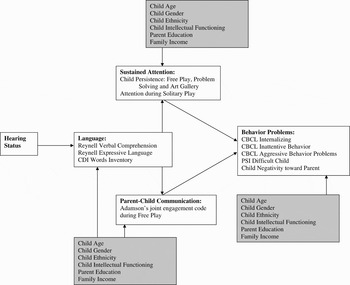
This study enrolled the youngest and largest sample of young deaf children awaiting cochlear implant surgery to examine the relationships between language development, parent–child communication, sustained attention, and child behavior problems. Three hypotheses were tested: (a) hearing-impaired children would show greater deficits in language and sustained attention, spend less time communicating with their hearing parents, and show higher rates of behavior problems than normal hearing children; (b) after controlling for child age, gender, ethnicity, intellectual functioning, parent education, and family income, deficits in language would account for the increased rates of behavior problems in deaf children; and (c) language would influence child behavior problems both through parent–child communication and sustained attention (Figure 1).
A conceptual model of the relationships among language, parent–child communication, sustained attention, and behavior problems.

Methods
Participants
This study analyzed data from a multicenter cohort of deaf and hearing children enrolled in the CDaCI study sponsored by National Institute of Deafness and Other Communication Disorders. The full cohort consists of 188 families of children with severe to profound sensorineural hearing loss (HI) and 97 families of children with normal hearing (NH) between 5 months and 5 years of age. Children in the HI group were recruited over a 2-year period from six clinics across the United States that specialize in pediatric cochlear implantation. Children in the NH group were recruited from preschool settings at two of these sites. These two preschools were chosen because their students were below 5 years of age and employed staff trained in the administration of language tests. Potential participants in both groups were screened by licensed speech/language pathologists and completed institutional review board approved consent forms.
Eligibility criteria for children were as follows: (a) age younger than 5 years, (b) developmental scores on the Bayley Scales of Infant Development Mental Scale or Motor Scale (BSID II) of at least 70 (Bayley, Reference Bayley1993) or a Leiter International Performance Scale—Revised (Leiter-R) score of at least 66 (Roid & Miller, Reference Roid and Miller1997) for children older than 2 years, and (c) ability to be tested on the Reynell Developmental Language Scales (RDLS; i.e., no prohibitive comorbidities, such as multiple handicaps, autism spectrum disorders, or inability to follow directions). Children in the HI group had to be diagnosed with a severe to profound hearing loss (≥70 dB HL) and referred for cochlear implant surgery. Families were eligible for the study if following implantation, parents were committed to training their child in spoken English, could read and complete the measures in English, and would agree to a series of assessments over 3 years. Demographics of the full CDaCI cohort are reported elsewhere and listed in Appendix A (Fink et al., Reference Fink, Wang, Quittner, Eisenberg, Tobey and Niparko2007).
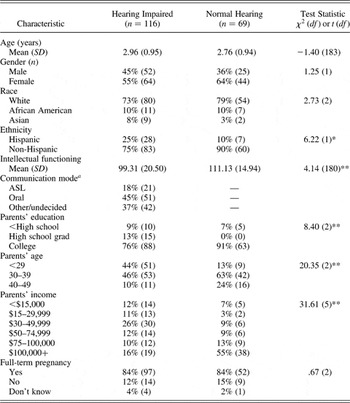
The current study used a subset of the full CDaCI cohort. Preliminary analyses indicated nonlinear changes in language, attention, and behavior problems between older (i.e., >18 months) and younger children (i.e., <18 months); therefore, the sample was truncated at 18 months, which is the age used by our measures to demarcate infancy and toddlerhood. The older subset consisted of 116 familiesFootnote 2 of children with HI and 69 families of children with NH. This older subset was used in all analyses reported in this study. Similar to the full cohort, the older cohort showed differences in the child's ethnicity and cognitive ability, and parents' age, education and income between the HI and NH groups (Table 1).
Demographics

aThe children in this study were cochlear implant candidates and all parents were committed to teach their children spoken English. These parent-reported categories therefore represent the primary communication mode used prior to enrollment in this study.
*p < .05. **p < .01.
Procedures
After an initial medical screening for children in the HI group, a baseline assessment was scheduled for 2 to 4 weeks prior to their surgery date. Thus, the baseline assessment represented preimplant functioning. This assessment was typically conducted during two half-day appointments to lessen fatigue for the child and family. The first day included parent-reported questionnaires evaluating demographic characteristics, the child's medical, hearing, communication, and educational history, and child-completed language measures appropriate for the child's age, a speech recognition hierarchy, and an audiological exam. The second day was devoted to videotaped tasks, psychosocial questionnaires, and parental reports of quality of life. Parents in the HI group received stipends and extended warranties for their children's cochlear implants as compensation for their time and effort; parents in the NH group received $100 annually and a gift certificate to a local book store.
Measures
Language measures
RDLS
The RDLS (Reynell & Gruber, Reference Reynell and Gruber1990) is a commonly used language test for children ages 1 to 7. The test consists of two scales: the Verbal Comprehension Scale and Expressive Language Scale. Both scales have acceptable split-half reliability coefficients across age groups (.74–.93). Because the HI children were cochlear implant candidates and oral language was the primary outcome of the CDaCI study, all children were assessed using the oral administration of the Reynell. Because of floor effects in the HI group, the total number of correct items was used instead of age-based standard scores.
MacArthur–Bates Communicative Development Inventories (CDI)
The MacArthur–Bates CDI (Fenson et al., Reference Fenson, Dale, Reznick, Bates, Thal and Pethick1993) is a widely used parent report measure of children's language. Section I (words) of the words and sentences inventory, designed to assess the vocabulary for children age 16 to 30 months, was used in this study. This inventory has also been used with preschool children who have language impairment (Thal, O'Hanlon, Clemmons, & Frailin, Reference Thal, O'Hanlon, Clemmons and Frailin1999). Words were only recorded if they were understood or spoken orally. The words inventory has good internal consistency (.96).
Parent report measures
Child Behavior Checklist (CBCL) 1.5–5
The CBCL (Achenbach & Rescorla, Reference Achenbach and Rescorla2000) is a well-validated behavior checklist that assesses the intensity of various behaviors. This measure yields two empirically derived composite scales, Internalizing and Externalizing Behavior Problems Scales, and one Sleep Problem Scale. The Internalizing composite consists of four subscales: emotional reactivity, anxious/depressed, somatic complaints, and withdrawn. The externalizing composite consists of two subscales: attention problems and aggressive behavior. All subscales have shown good test–retest reliability (.68–.87). This study used the internalizing composite and the aggressive behavior and attention problems subscales because they have strong psychometric properties and have been used in previous studies of hearing-impaired children. Internal consistency for this study ranged from .65 to .91 for the HI and from .66 to .89 for the NH group.
Parenting stress index
The parenting stress index form (Abidin, Reference Abidin1995) is a shortened version of the widely used and well-validated parenting stress index. The difficult child subscale was used in this study. This scale measures externalizing behavior problems. Internal consistency and test–retest reliability for this scale was good (.85). Internal consistency for this study was .86 for the HI and .88 for the NH group.
Videotaped observational measures
Child persistence and child negativity
Parent–child interactions were recorded across three different tasks: an unstructured 10-min free-play task, a structured 5-min problem-solving task, and a semistructured 5-min art gallery task. The free-play task provided parent–child dyads with an age appropriate selection of toys. Parents were instructed to play with their child as they would at home. The problem-solving task involved an age appropriate easy and challenging puzzle. Parents were instructed to help the child complete the easy puzzle and then focus on the challenging puzzle. In the art gallery, five posters were placed at varying heights around the room. Parents were instructed to discuss the posters with their child and determine which he or she liked best (for more details, see Quittner, Leilbach, & Marciel, Reference Quittner, Leilbach and Marciel2004). For all three tasks, the dyads' behavior was coded using an adaptation of the Mother–Child Structured Interaction Qualitative Rating Scales (36 months) developed for the NICHD Early Child Care Study (NICHD Early Child Care Research Network, 2003). These scales included six parent, four child, and one dyadic score recorded at 5-min intervals on a 7-point scale (0–6) with clearly specified behavioral anchors. Although the original codes differed between 6 and 36 months of age, the adaptation we used added behavioral anchors that were appropriate for children older and younger than 36 months. This adaptation was recommended because the 36-month code was found to be more sensitive than those prepared for younger ages and facilitated comparisons between children of different ages (M. T. Owens, personal communication, July 2005).
Two of the four child ratings were analyzed in this study: child persistence, a measure of sustained attention, and child negativity, a measure of behavior problems. The other child codes, the parent codes, and the dyad code were not included because they did not measure sustained attention, behavior problems, or parent communication.
Child persistence and child negativity were coded by five research assistants. Coders were trained in consensus over 3 months with a lead coder. Supervision was provided in weekly meetings to minimize rater drift. Interrater reliability was assessed for a randomly selected 20% (n = 57) of the tapes. The intraclass correlations were .93 for child persistence and .74 for child negativity. This indicated good interrater agreement.
Solitary play
During this 5-min task, children were asked to play independently with a simple toy set modeled after the work of Bornstein, Selmi, Haynes, Painter, and Marx (Reference Bornstein, Selmi, Haynes, Painter and Marx1999). The toy set consisted of a doll that was gender and race matched to the child, a small pillow, a small blanket, and a wooden block. Although designed to measure symbolic play (i.e., using the block as a bed), the task also measured children's sustained, effortful attention by capturing the amount of time children remained engaged in play with this limited toy set. Solitary play was coded using the Observer 5.0 Video-Pro, which allows for microanalyses of behavior. Children's behavior during the task was continuously coded as “engagement” with the toys versus “disengagement” with the toys. Engagement was further classified as symbolic or nonsymbolic and disengagement with the toys was further classified as active engagement with a nontoy object (e.g., furniture in the room), engagement with the parent, or complete disengagement (i.e., doing nothing). For the purposes of this study only the first classification of engagement versus disengagement was used as a measure of effortful attention. After training to a reliability criterion (Cohen κ = .70), coders were routinely evaluated by the lead coder and required to consensus code a minimum of one tape each week to minimize rater drift. Interrater reliability was assessed for 20% (n = 57) of the randomly selected tapes using Cohen's kappa and percent agreement. Both statistics were calculated on a second by second basis, a method thought to be more stringent than calculating agreement on summary measures (Bakeman & Gottman, Reference Bakeman and Gottman1997); the average κ coefficient for the play task was .71 (SD = 0.14). Average agreement was 82% (SD = 12.33%), indicating acceptable interrater agreement.
Parent–child communication
The amount of time children spent either responding to or engaging their parents during 10 min of free play was coded using the joint-engagement code developed by Adamson, Bakeman, and Deckner (Reference Adamson, Bakeman and Deckner2004). This code consists of 11 mutually exclusive engagement states. A state was defined as period of active interest in people, objects, or events. These states are hypothesized to be of some duration; therefore, coders are instructed to identify the dominant focus of engagement during any given time interval and disregard minor fluctuations in attention. Six of the states involve engagement with the parent. The code parent was given when children were exclusively engaged with the parent; supported engagement was coded when children were sharing an activity with the parent, demonstrated awareness of the parent's involvement in the activity (e.g., turn taking), but were not actively engaging the parent; and coordinated engagement was coded when children were engaged with both the parent and the activity. The remaining three engagement states mirror the previous three except they involve the use of symbolic representations, such as oral language, sign language, and symbolic play. All six of these engagement states include components of communication between children and their parents. This communication ranges from the unspoken coordination of turn taking seen in supported engagement to the explicit use of conversational language seen in symbol-infused coordinated engagement. Because all six states involved some aspect of communication, a composite was created by summing time spent in each of the six states to measure the amount of time children spent communicating with their parents. This strategy ensured a broad definition of communication that included nonverbal and nonlinguistic communication. Of importance, this code only focused on duration, and not quality of parent–child communication. Each tape was coded by research assistants and then reviewed by one of three lead coders. Interrater reliability was assessed for 20% (n = 57) of the randomly selected tapes using Cohen's kappa and percent agreement. Both statistics were calculated on a second by second basis. The average kappa coefficient for the play task was .70 (SD = .18). Average agreement was 87% (SD = 10.70%), indicating acceptable interrater agreement.
Analytic strategy
To clearly address the three hypotheses of this study, two analytic approaches were used. The first approach examined group differences for each variable using structural equation modeling (SEM; Hypothesis 1). Because the measures in this study were assumed to be related, SEM is preferable to traditional multivariate analyses of variance (MANOVA) when examining group differences (Cole, Maxwell, Arvey, & Salas, Reference Cole, Maxwell, Arvey and Salas1993). The second analytical approach used to address the second and third hypotheses was a mediation analysis with latent variables that tested whether language, communication, and attention mediated the relationship between hearing status (HI vs. NH) and behavior problems (Hypothesis 2), and whether communication and attention mediated the relationship between language and behavior problems (Hypothesis 3). Raw scores were used in the modeling instead of age-normed scores because it was unclear how appropriate the normative data were for hearing-impaired children. These analyses were also conducted within the framework of SEM. All analyses were performed using Mplus (Muthén & Muthén, Reference Muthén and Muthén1998) and missing data, which ranged from zero to 11%, were addressed using full information maximum likelihood estimation.
Results
Comparisons of HI and NH children on behavior, attention, and language measures
The first major hypothesis sought to replicate previous findings showing that children with HI have more behavior, attention, and language problems than children with NH. To test this hypothesis, mean differences on all variables were tested using SEM. All variables were regressed on a dummy variable representing hearing status (1 = HI, 0 = NH), and their error terms were allowed to correlate. The test statistic from a multivariate analysis using SEM is created by dividing the parameter of interest (i.e., difference between the means) by that parameter's standard error. It is interpreted using the standard normal distribution (z test). The model testing group differences was just identified (i.e., number of estimated parameters = degrees of freedom), thus precluding evaluations of model fit.
Behavior problems
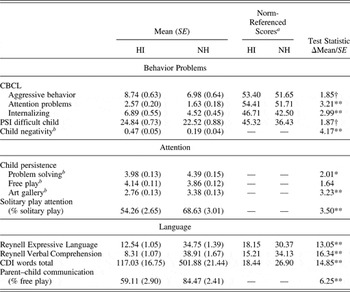
Children with HI were expected to show more behavior problems than NH children. On all measures, HI children evidenced more behavior problems than NH children (Table 2), with statistically significant differences on the CBCL Attention scale (z = 3.21, p < .01), Internalizing composite (z = 2.99, p < .01), and videotaped Child Negativity ScaleFootnote 3 (z = 4.17; p < .01). The CBCL Aggressive Behavior Scale (z = 1.85, p = .06) and the PSI difficult child subscale (z = 1.87, p = .06) showed marginally significant group differences.
Mean differences on observed variables

aWe used T scores for the CBCL scales, percentiles for the PSI, and language age (months) for the Reynell scales; language age for the CDI words total was defined as the age at which 50% of children achieved the reported score.
bA 7-point rating scale was used (0 = low, 6 = high).
†p < .06. *p < .05. **p < .01.
To assess the clinical significance of these elevated behavior problems in the HI group, children were compared against the respective normative samples of the CBCL and PSI and classified as either at-risk for behavioral difficulties or within the normal range (CBCL cutoff: T > 65; PSI cutoff: >85th percentile). Next, a chi-square test for independence was used to determine if the classifications differed between groups. A statistically higher proportion of children in the HI than NH group scored above the at-risk level on the CBCL attention: HI = 10, NH = 1; χ2 (1) = 3.98, p = .05; and CBCL internalizing composite: HI = 15, NH = 1; χ2 (1) = 7.22, p = .01. Moreover, significantly more children in the HI group showed negativity toward their parent during 20 min of play than in the NH group: HI = 70, NH = 27; χ2 (1) = 9.81, p < .01. Although not statistically significant, a larger number of children in the HI group were also at risk on the CBCL Aggressive Behavior Scale, HI = 5, NH = 0; χ2 (1) = 3.06, p = .08; and PSI difficult child subscale: HI = 11, NH = 3; χ2 (1) = 1.63, p = .20.
Attention
Children in the HI group were expected to show poorer sustained attention than children in the NH group. As hypothesized, significant group differences were found on duration of play during solitary play (z = 3.50, p < .01), with HI children engaging in less play than NH children. HI children were also rated lower on child persistence than NH children during the art gallery (z = 3.23, p < .01) and problem-solving (z = 2.01, p = .04) tasks, but not during the free play task (z = 1.64, p = .10).
Language
As hypothesized, the HI group showed profound language deficits on the Reynell verbal comprehension (z = 16.34, p < .01), Reynell expressive language (z = 13.05, p < .01), and CDI total words (z = 14.85, p < .01; see Table 2). In comparison to the normative sample for the Reynell, 68 (67%) children in the HI group performed below the ability of a typical 18-month-old child on the Verbal Comprehension Scale compared to one child (1%) in the NH group, χ2 (1) = 85.77, p < .01. Similarly, on the Expressive Language Scale, 67 (65%) children in the HI group scored below typical the 18-month-old ability compared to two children (2%) in the NH group, χ2 (1) = 76.52, p < .01. Hearing-impaired children also spent less time engaged in joint interactions with their parent than NH children (z = 6.25, p < .01), and fewer children used language in those interactions: HI = 38%, NH = 73%; χ2 (1) = 20.64, p < .01. The type of language used during those interactions also differed between the groups. Hearing-impaired children used both manual language (sign language or gesture) and oral language, with 16% exclusively using manual language, 17% exclusively using oral language, and 5% using a combination of the two. Normal-hearing children exclusively used oral language (73%).
Because the oral language measures used in this study may underestimate the language ability of children using manual communication, the 24 children who used manual language during parent–child interactions were compared on language, attention, and behavior problem measures to the 20 children who only used oral language (children using no language during the interactions were excluded). The two groups were similar on all but one measure: child persistence during art gallery; manual language = 4.50, oral language = 3.55; F (1, 42) = 5.52, p = .02. Because of the similarities between children using manual or oral language, type of language usage was not included in subsequent analyses.
Modeling the relationships between behavior, attention, and language difficulties
The second and third hypotheses evaluated the prediction that increased behavior problems in the HI group would be related to poorer language, parent–child communication, and sustained attention. To test these hypotheses, a path analysis within a structural equation framework was conducted. In addition to the conceptual model proposed in Figure 1, specific components of the proposed model (i.e., attention, language, and behavior problems) were tested separately in both the HI and NH groups to ensure that all elements fit the data. The HI and NH models were then compared to ensure that the variables and constructs related similarly in the two groups.
Model testing proceeded similarly for each component, as well as for the full model. First, the proposed model was tested separately in each group. Modifications to that model were included for each group if the modifications significantly improved model fit and were theoretically defensible. To maintain the confirmatory nature of these analyses, no modifications were made once the model adequately fit the data (see below for fit criteria). Second, the models for both groups were estimated jointly with all parameters constrained to be equal. Third, equality constraints were lifted if their removal significantly improved model fit. Improvement was defined as a change in χ2 of 3.84 per degree of freedom (i.e., p < .05). Fourth, the groups were combined so that tests of mediation could be performed. Indirect relationships between hearing status and behavior problems via language, communication, and attention were tested using the Sobel test (Dearing & Hamilton, Reference Dearing and Hamilton2006). The overall model fit was evaluated using four indices: the χ2 test of model fit (cutoff = p < .05, or χ2/df < 2.0), the standardized root mean square residual (SRMR; cutoff < .08), the Bentler comparative fit index (CFI; cutoff > .95), and the root mean square error of approximation (RMSEA; cutoff < .06; Bollen, Reference Bollen1989; Muthén & Muthén, Reference Muthén and Muthén1998). Because of the large number of parameters estimated in the final model, paths near zero (i.e., p > .30) were constrained to zero to increase the power to detect significant paths. The decision rule of p > .30 was used to protect against constraining potentially meaningful paths to zero. In the interest of space, only the results from the full model will be reported.
Full model
In the full model, behavior problem variables were regressed on the sustained attention, language, and parent–child communication variables, which in turn, were regressed on hearing status. Moreover, sustained attention and parent–child communication were regressed on language so that the mechanisms through which language affects child behavior problems could be tested. Child age, gender, ethnicity, intellectual functioning, parent education, and family income were included as covariates for the behavior problem, attention, language, and communication variables (Figure 1). To improve interpretation and accuracy of parameter estimates, child age was centered at 24 months; child ethnicity was coded as 0 for non-Hispanic and 1 for Hispanic; intellectual functioning was centered at 100, indicating average functioning; parent education was coded as 0 for parents with no college education and 1 for parents with 1 or more years of college education; and income was centered at $50,000. The remaining variables were centered at their respective means for the combined HI/NH cohort.
In the first step, the proposed model was fit for both the HI and NH group. For the HI group, the model fit the data after some modifications: χ2 (97) = 128.24, p = .02; SRMR = .05; CFI = .96; RMSEA = .05. First, the intercepts for the Reynell Expressive Language Scale, child persistence during free play, solitary play, and the PSI difficult child subscale were estimated. Second, the error terms for child persistence during the free play and problem solving tasks were allowed to correlate. For the NH group, the same modifications were made. This model showed adequate model fit: χ2 (97) = 138.26, p < .01; SRMR = .07; CFI = .90; RMSEA = .08.
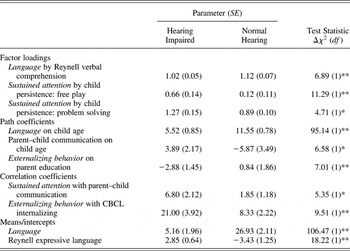
In the second and third steps, the model was compared between the groups. The group models were compared on their factor structures, followed by their structural components (i.e., path and correlation coefficients), and finally on their mean structure (i.e., means and intercepts). The results of the parameters that differed between the groups are displayed in Table 3. After releasing these equality constraints, this model showed reasonable fit: χ2 (268) = 335.22, p < .01; SRMR = .09; CFI = .94; RMSEA = .05. Despite these differences, the final model was generally similar between the two groups, and we decided to combine the groups and proceed with the tests of mediation.
Unstandardized model parameters from the multiple group analyses that differed between HI and NH groups

Note: Latent variables are in italic.
*p < .05. **p < .01.
Direct effects
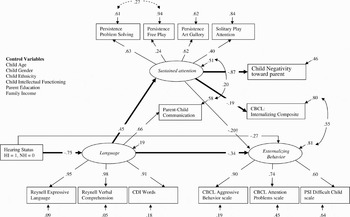
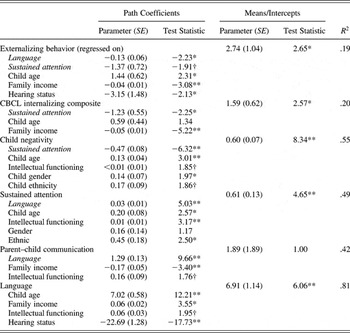
The final combined model fit the data reasonably well: χ2 (144) = 180.07, p = .02; SRMR = .05; CFI = .98; RMSEA = .04 (Table 4 and Figure 2). After controlling for child age, gender, ethnicity, intellectual functioning, parental education, and family income, this model showed significant differences between the HI and NH groups on the language latent variable (group difference [HI-NH] = −22.69; z = −17.74, p < .01). After accounting for language, there were no significant differences between the groups on the sustained attention latent variable (group difference = .27; z = .93, p = .35) or on the amount of time children spent communicating with their parent (group difference = 5.37; z = .93, p = .35). After accounting for language, sustained attention, and parent–child communication, there were no longer any group differences for the CBCL internalizing composite (group difference = −.25; z = −.27, p = .79) and for child negativity (group difference < .01; z = .02, p = .98). There was a significant group difference for the externalizing behavior latent variable, however, this difference was in the opposite direction of the raw mean comparisons, with HI children showing fewer externalizing symptoms then NH children (group difference = −3.31; z = −2.01, p = .04).
The statistically significant standardized parameters for the full structural equation model relating language, parent–child communication, sustained attention, and behavior problems. Dotted lines indicate modifications to the conceptual model and bold lines significant indirect paths. Although included in the model, the control variables were not included in this diagram. †p = .06.

Unstandardized estimates for all means/intercepts and structural parameters not constrained to zero

Note: Latent variables are in italic. Hearing status was coded as NH = 0, HI = 1; gender was coded as male = 0, female = 1; child ethnicity was coded as non-Hispanic = 0, Hispanic = 1; and child age was centered at 2 years. Family income was in $10,000 and centered at $50,000. Intellectual functioning was reported using the standard metric for IQ measures (mean = 100, SD = 15) and was centered at 100. The remaining measures were centered at their respective means for the combined HI/NH group.
†p < .06. *p < .05. **p < .01.
There were significant direct effects from the language latent variable to the sustained attention and externalizing behavior latent variables, as well as parent–child communication (Table 4). There were also significant direct effects from sustained attention to externalizing behavior, CBCL internalizing composite, and the videotaped child negativity code. There were no significant direct effects between amount of parent–child communication and child behavior problems.
Indirect effects
Indirect effects were tested using the Sobel test. There were three significant indirect paths leading from hearing status to child behavior problems. First, the indirect path from hearing status to the externalizing behavior via language was significant (z = 2.22, p = .03, unstandardized (b) = 3.80, standardized (β) = .33), suggesting that deaf children had worse language, which was associated with more parent-reported externalizing behavior. Second, the indirect path to the CBCL internalizing composite via language and sustained attention was significant (z = 2.10, p = .04, b = .71, β = .07), indicating that language deficits in deaf children were associated with worse sustained attention leading to more internalizing behavior. Third, the indirect path to child negativity via language and sustained attention was significant (z = 5.13, p < .01, b = .28, β = .29), again suggesting that language deficits were related to poorer sustained attention, leading to more negativity during play. This model explained 19% of the variance in the externalizing behavior latent variable, 20% of the variance in the CBCL internalizing composite, and 55% of the variance in the videotaped child negativity code (Table 4).
In sum, these results demonstrate that after controlling for child age, gender, ethnicity, intellectual functioning, parent education, and family income, differences in oral language accounted for the differences between the two groups in sustained attention and parent–child communication. Moreover, after accounting for language and sustained attention, there were no longer any differences between the groups on parent-reported externalizing and internalizing behavior problems or observed child negativity during parent–child interactions. The indirect effects from hearing status through language suggested that the language deficits of children with hearing impairments contribute to their difficulties with sustained attention, parent–child communication, and behavior problems.
Discussion
This study evaluated the largest, youngest cohort of cochlear-implant candidates to date to examine relationships among behavior problems, language, parent–child interaction, and sustained attention. Support was obtained for the first hypothesis that hearing-impaired children would evidence more behavior problems and greater difficulties with, oral language, parent–child communication, and sustained attention than hearing children. These results extend previous findings in school-age children by documenting elevated behavior problems in preschool-age children using both parent-report and videotaped data. Not surprisingly, hearing-impaired children in this study showed substantial deficits in oral language, with most of these children evidencing receptive and expressive language abilities below those of a typically developing 18-month-old. These delays translated into less time engaged with their parent sharing an activity.
The findings related to attention showed that deaf versus hearing children have consistent deficits in sustained attention during structured tasks. Previous studies yielded conflicting results. Quittner et al. (Reference Quittner, Smith, Osberger, Mitchell and Katz1994) found evidence of a deficit in visual sustained attention using a continuous performance task (CPT) in school-age children with hearing impairments. The CPT task presented a continuous string of numbers and children were asked to press a button each time they saw the number 9 following the number 1. The task was repetitive and lasted for 8 min, challenging children's sustained attention. In contrast, Mitchell and Quittner (Reference Mitchell and Quittner1996) did not find deficits in sustained attention using the same CPT task in a larger sample of school-age children, but did find deficits in selective attention. The current study evaluated much younger children and found robust deficits in sustained attention across four different semistructured and structured tasks using two coding methods, a global measure of child persistence and microanalysis of children's play. Of importance, no differences in sustained attention were found in the unstructured free-play task. This task appeared to be less sensitive to the underlying sustained attention construct, as evidenced by a low factor loading in the model. During this task, children were presented with a wide array of toys and were free to engage in play that was intrinsically motivating to them, and thus did not require effortful control of attention.
The second hypothesis of this study examined whether or not deficits in language explained the increased behavior problems reported in young hearing-impaired children. Because hearing-impaired children of hearing parents show both deficits in language ability and elevated behavior problems, they provide a unique perspective on the relationships between language and behavior problems in early childhood. The etiology of their language difficulties is known (i.e., severe to profound deafness and mismatch in communication mode between parent and child), and therefore, their language deficits are unlikely to be caused by behavior problems. There was strong support for the influence of oral language on externalizing and internalizing behavior problems. After accounting for the direct and indirect influences of oral language on behavior problems, there were no longer differences between hearing-impaired and hearing children on parent-reported or videotaped measures of behavior problems. This has important implications for deaf children as well as other children with language deficits. These results suggest that language delays lead to more behavior problems in young children. However, future studies using longitudinal designs are needed to confirm the direction of this influence and to test the model in other populations.
The third hypothesis tested whether language, as measured by the Reynell and CDI, influenced behavior problems through parent–child communication or attention. Previous literature suggested that language influences behavior problems by limiting the child's ability to effectively communicate with others, or effects emotional and behavioral regulation (Gallagher, Reference Gallagher1999). This study provided support for the emotional and behavioral regulation pathway (i.e. sustained attention), but was not able to provide clarity on the communication pathway.
In terms of the attention pathway, language accounted for the group differences found in sustained attention, suggesting that it plays an important role in the regulation of attention. Sustained attention, in turn, was related to both internalizing and externalizing behavior problems. Moreover, the indirect effect of language on behavior problems via sustained attention was significant, suggesting that internal regulation is an important mechanism through which language affects behavior problems. In contrast, there were no relationships between the amount of time spent communicating with the caregiver and behavior problems. This lack of relationship may be related to differences between time spent communicating versus the quality of that communication. It is likely that the quality of communication is an important contributor to child behavior problems. For example, children who are unable to communicate their needs to their parents or unable to understand instructions from their parents are likely to exhibit frustration and parents are likely to perceive the child as noncompliant (Gallagher, Reference Gallagher1999). The code used in this study only addressed the amount of parent–child communication and does not address the quality of the communication. Moreover, the strongest effect from language to behavior problems was direct, suggesting there were important mediators not included in this study.
In addition to the lack qualitative communication measures, this study was limited in a few ways. First, the directionality of the relationships between language, sustained attention, and behavior problems were informed by attributes of the population being studied (i.e., the etiology of the children's language delays is known) and by previous theory but could not be confirmed with the current design. Second, there were significant economic and cognitive difference between the hearing-impaired and the normal hearing groups. These differences were primarily due to the sampling of normal hearing children from university affiliated preschools, which drew from highly educated populations. Both economic and cognitive factors have been related to child behavior problems of normal hearing children in previous studies (Benasich, Curtiss, & Tallal, Reference Benasich, Curtiss and Tallal1993; Campbell et al., Reference Campbell, Shaw and Gilliom2000) and were related to behavior problems, language, and visual attention in this study. However, because these factors were included in the statistical modeling, the conclusions drawn in this study are based on findings that remained statistically significant after accounting for group differences on these factors, Finally, language was measured using oral English and did not include the use of sign language. As mentioned previously, a significant portion of the hearing-impaired children used some form of gesture or sign language in interactions with their parent, and language ability for these children may be underestimated by the oral language measures used in this study. This study did not, however, find differences in language, attention, or behavior problems between children who used manual language and those who used strictly oral language during videotaped parent–child interactions. Future studies should include language measures sensitive to oral and manual language to better estimate young deaf children's language ability.
Despite these limitations, this study provides strong support for current theories implicating language and attention in the development of internalizing and externalizing behavior problems in young children. It suggests that language can operate through behavioral regulation (i.e., sustained attention) to impact child behavior problems, and suggests there are other important contributors not included in this study, such as quality of parent–child communication. Future studies should identify and examine these other elements to provide more clarity on the etiology of behavior problems in young deaf children and explore these relationships in other populations. Understanding these mechanisms is important because they have different treatment implications. If language delays operate through poor parent–child communication then treatment should address improving parent–child communication (Chao, Bryan, Burstein, & Ergul, Reference Chao, Bryan, Burstein and Ergul2006; Eyberg et al., Reference Eyberg, Funderburk, Hembree-Kigin, McNeil, Querido and Hood2001). Alternatively, if language delays decrease emotional and behavioral regulation, then treatment should focus on improving building regulatory skills (Southam-Gerowa & Kendall, Reference Southam-Gerowa and Kendall2002). This study provides evidence suggesting the second approach may be effective, but provides little information either for or against the first approach. Moreover, these approaches should be viewed as complementary and likely interrelated, especially considering that improvements in language will likely lead to better parent–child communication and better behavioral regulation.
Appendix A
Demographics of the full CDaCI cohort

aThe children in this study were cochlear implant candidates and all parents were committed to teach their children spoken English. These categories therefore represent the primary communication mode used prior to enrollment in this study.
**p < .01.