INTRODUCTION
The province of Cunene in the south of Angola was left outside urbanisation dynamics for many years. In the rest of the country, urban centres enjoyed a high growth rate, receiving migrants from the rural areas where the civil war was raging. This was mainly due to late colonial penetration and the subsequent devastation caused by war. Nevertheless, the province, which covers roughly one third of the Angola–Namibia border, has witnessed unprecedented urban growth in the last decade. This recent growth was mainly induced by government investment in resettlement and the rebuilding of administrative structures, and by the intensification of cross-border trading. This attracted displaced people living in other provinces during the war, rural inhabitants from the province, and a large number of people from other provinces in the country. Their concentration in Ondjiva, the provincial capital, and in Santa ClaraFootnote 1 has consequently caused substantial economic dynamism and the development of economic activities in increasingly differentiated sectors, principally within the informal economy.
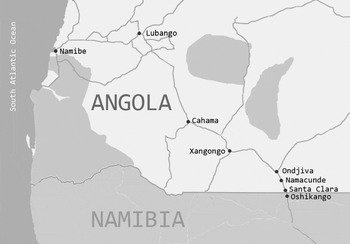
Southern Angola and Northern Namibia.

The forces of post-war state regulation soon began to establish tighter control over deregulated economic activities, especially cross-border trading. This has led to a potentially more formalised and organised administrative base, while simultaneously forcing locally operating traders and entrepreneurs to engage in alternative economic activities. These alternatives are, however, less dynamic and potentially less likely to generate economic growth and, in many cases, have obliged traders and entrepreneurs to move to other locations in search of new opportunities.
Based on analyses of these recent processes and of the region's recent urban and population dynamics, this article seeks to contribute to an understanding of local development and the conditions that determine urban growth and expansion in this context. How can we determine the balanced level of control that contributes to institutional development and, at the same time, allows local entrepreneurial dynamics space to develop? How can both institutional and local entrepreneurial initiatives work together and generate development and growth in such a remote Angolan context? What is the role of entrepreneurial dynamics in the province's urban growth? How does regulation affect the consolidation of these dynamics?
The primary assumption is that informal cross-border trade constitutes an important economic base in the region – and in the context of southern Africa – and regulation may interfere with local dynamics in this respect. This type of trade ‘provides support, income, and direct investment in development to a significant number of people in the region. It also forms an integral part of the regional economy’ (Peberdy Reference Peberdy2000: 217). In a number of sub-Saharan African countries, the informal economy plays an important role in families' economic strategies, and specifically, for instance, ‘informal cross-border trading activities … have succeeded in effecting extensive market integration where state-led initiatives have failed’ (Hashim & Meagher Reference Hashim and Meagher1999: 5).
The theoretical debate regarding cross-border trade and its links with the formal economy and the state raises a number of issues that apply to the current situation on the Cunene–Namibia border. Hashim and Meagher outline important approaches from several disciplinary perspectives. First, there are those that regard informal cross-border trade as a response to excessive state regulation. Second, there is the persistence and flexibility of traditional long-distance trading networks. A third set of issues concerns class formation and the emergence of civil society versus private accumulation of corrupt state officials and their cronies. A final perspective concerns cross-border trade as ‘alternative structures for accumulation and social regulation’ (ibid.: 20). It is easy to relate this discussion to an analysis of the Cunene cross-border trade, as all of these issues are presently at stake in the recent redefinition of border control and cross-border traders' adaptive strategies. As the authors emphasise, not only are the traditional routes and corresponding neighbouring traders and businesses operating in the region being altered, but the networks of state and local officials are also constantly being reshaped. A good example is the growing settlement of Chinese warehouses in Oshikango on the Namibian side (Dobler Reference Dobler2009). Another is the opening of the new business and industrial centre CEK, Centro Empresarial do Kunene (Cunene Business Centre), located between Ondjiva and Santa Clara, a private undertaking with local (and national) government links that comprises a truck terminal to support road trade and will expand to industrial activities. In the future, it will also have a residential area with tourist facilities.
Informal trade, as mentioned above, is a widespread reality in Angola, and several studies have been devoted to this subject. The way in which it operates in the country's border regions has not however been frequently described, mainly because of the duration and intensity of the civil war in Angola, especially in the southern border regions. Narratives often mention the persistence of cross-border trade throughout war periods. This is undoubtedly related to the attraction that border areas have for traders, as they represent ‘opportunity precisely because of their ambiguity’ (Nugent & Asiwaju Reference Nugent, Asiwaju, Nugent and Asiwaju1996: 269), and usually ‘profit from differentials in the prices of crops and consumer goods and in the availability of commodities on either side of the line’ (Nugent Reference Nugent, Dubois, Michel and Soumille1998: 211). Cross-border traders rely on their adaptive capacities to conduct this type of business, managing their networks and relationships both with the state and formal and informal regulations (Fadahunsi & Rosa Reference Fadahunsi and Rosa2002), and with the economic advantages that can be achieved.
The specific conditions of entrepreneurial initiative, however, imply new approaches. The classic perspective of the entrepreneur should be carefully evaluated in the context of ‘latecomer entrepreneurship’,Footnote 2 and of new demands for regulation and placement in the global economy. Although the approach here focuses on the perspectives and strategies of traders operating in the area, it touches on broader issues now considered key from a macroeconomic perspective. Integration into the world economy and the specific recovery of the economy and state regulation in the case of Angola are part of the transformation taking place in the institutional environment, affecting both formal and informal economies (Pedersen & McCormick Reference Pedersen and McCormick1999).
The central discussion in this paper relates the dynamics of cross-border trade to urbanisation and growth. It focuses on urban growth and its characteristics, exploring and describing the complex features of urban growth and population dynamics in the region since the colonial period. One of its goals is to analyse how the political and urban processes have influenced local social and economic dynamics, and how these dynamics have played a role in these processes. It pays particular attention to cross-border traders as agents of economic development and growth, and to state regulation as an important influence in this context. The article includes an analysis of urban growth and its relationship with entrepreneurship, assuming that social and political determinants in the region in recent years have shaped both features in a particular way. It considers not only the recent multiple interconnections, but also short-term perspectives for the region and for cross-border dynamics.
The importance of analysing urban dynamics in Africa lies in the potential socio-economic development underlying them. Although mobility is an important social and economic phenomenon throughout Africa (De Bruijn et al. Reference De Bruijn, van Dijk and Foeken2001; van Dijk et al. Reference Dijk, Foeken, van Til, De Bruijn, van Dijk and Foeken2001, esp. 9–26), it is in urban centres that this social and economic vitality is able to multiply, notwithstanding the myriad negative consequences resulting from it. Despite their size, all cities can be considered places that have innovative and dynamic aspects. This perspective is elucidated in the comparative work by Jennifer Robinson (Reference Robinson2006), who states that, regardless of differences between places that are differentially connected to the rest of the world, modernity is a predominant characteristic of global, middle-range and small cities throughout the world today.
The rapid growth of middle-range towns in Africa results from spontaneous social and economic dynamics, which also have to combine with institutional regulations and the development envisaged by administrative structures and the stimulation of local entrepreneurial initiatives. On one hand, the control and regulation of urban centres like the capital Luanda – which attracted a large number of Angolans because of the widespread war in the country and the sparse economic opportunities elsewhere – is a very difficult task that will take years to accomplish. Nevertheless, the lack of control and regulation has permitted the development and multiplication of economic activities and entrepreneurship. On the other hand, the ease of acting in and regulating smaller urban centres may cause local entrepreneurial initiatives to be restricted and therefore perpetuate the trends of migration towards larger urban centres. How to deal with this contradiction is, therefore, one of the main concerns facing development and urbanisation policies at this stage. Both regulation and the constitution and consolidation of a strong, dynamic entrepreneurial setting are key at this stage in Angola, but there is still no agreement about the possibility and the ways of combining them (see Rocha Reference Rocha1997; Hodges Reference Hodges2001; De Vletter Reference De Vletter2002).
‘City economic viability depends on a continuously proliferating market exchange of imports and exports’ (Bryceson Reference Bryceson, Bryceson and Potts2006: 40), to which infrastructural support should be added. This argument leads to a need to identify the ways in which ‘sustenance and sustainability’ can be fostered and achieved. In the case of Cunene's cities, and bearing in mind their recent history, it is evident that infrastructural support of all kinds – not only physical conditions in the region and cities but also administrative structures – is unable to keep up with the dynamism and development of economic activities that the region has registered in the last decade.
Although the importance and relevance of small urban centres to national economic and urban policy may not be a priority in post-war Angola, the proximity of the border and the economic development in recent years make Cunene cities strategic in the Angolan context. The particular character of smaller urban centres is an analytical framework that highlights social, economic or political issues that characterise the different situations. They help to contextualise, for example, the strong rural–urban linkages (Rakodi Reference Rakodi1997), relations with modernity and development (Robinson Reference Robinson2006), the prevalence of family networks, and the particular features of local governance (Bekker et al. Reference Bekker1997). In the case of Cunene, this analysis also makes it possible to stress the impact of war and the resilience of small urban centres.
The information analysed here derives from different sources at different times, and is therefore very varied. One of the main sources was a survey conducted for the Ondjiva Urban Plan along with interviews in the province, all of them in 2004. The second was a survey of cross-border traders, and interviews and focus groups conducted by the author in 2006.Footnote 3 The former involved 1,089 households, and the latter, which was more specific, surveyed 196 traders. The main characteristics of these traders is the predominance of males (63·2%), aged 21–30 (46·7%), self-employed (76·8%) and of urban origin (82·7%). All this information is supported by and cross-referenced with secondary sources, the most important of which are the Cunene data from the IDR (INE 2001) conducted in Cunene by the National Statistical Institute (4,367 households), and a study of cross-border migration focusing specifically on the Cunene (Santa Clara) circulation of population (Nangulah & Nickanor Reference Nangulah and Nickanor2005). The attempt to achieve a broader view of the relevant socio-economic dynamics by using all of these sources combines here with a strong qualitative approach provided by in-depth interviews and the ‘voices’ of the traders/entrepreneurs.
CUNENE URBAN GROWTH: CYCLICAL RESILIENCE?
Ondjiva, the capital of Cunene province, is located in a municipality that has experienced high population growth in recent years, and the city is now the most populous in the whole province. Although government investment has primarily been channelled to the capital city due to the presence of the administrative structures there, Santa Clara (Namacunde municipality), on the border with Namibia, has been able to attract comparatively more people in the last decade, recording an extraordinary growth rate and reaching half the population of the provincial capital. The strong attraction of border trading for the populations of this and neighbouring provinces, and for other Angolans who have migrated from remote areas of the country to conduct cross-border business, almost exclusively explains this growth.
Population growth in the Kwanhama and Namacunde municipalities

Source: GPC 2005.
This recent growth is unprecedented in the region. Population growth in the province went roughly through three different phases. The first, between 1917 and 1975, initiated after the battles to conquer the Lower Cunene (Baixo Cunene), was marked by the foundation of the administrative hub of Vila Pereira D'Eça (which became Ondjiva after independence), named after the general who led the 1917 Campanha do Cuanhama that defeated Mandume, the last Kwanhama king. From this foundation period on, the Portuguese quickly tried to consolidate their territorial dominance through urban building and settlement in a predominantly rural area (Monteiro Reference Monteiro1994; Neto Reference Neto1963; Padrão Reference Padrão1998). The territory, then and subsequently, had a particular geo-strategic importance which had implications for the insistence on settlement and active administration in a less economically attractive location in the province.Footnote 4
Early attempts to populate the region en masse were not particularly successful. The Cunene Urban Plan of the 1960s aimed at the settlement, which was not achieved, of over 6,000 Portuguese families in the province (Ferreira Reference Ferreira1974). In the mid 1970s, any chances of success in this respect were abruptly erased by the independence of Angola. Until the second phase, which began in 1975 after independence, rural characteristics in the whole province changed little, except in the small urban hub of Vila Pereira D'Eça. With independence, this and other proto-urban hubs were completely emptied, both of Portuguese, who fled the country, and of Angolans, as the whole province was invaded by South African troops and fighting between the MPLAFootnote 5 (the governing party) and SWAPOFootnote 6 in the area lasted until the independence of Namibia. Only the military, now from one side, now the other, remained in Ondjiva and other urban hubs.
The third phase was characterised by a very slow return of the population in the 1990s – now conditioned by the civil war between the Angolan government and UNITAFootnote 7 – and a more accelerated return, migration and rural exodus in the first years of this century. It has been in this last decade that the province's second urban hub, Santa Clara, has acquired an urban character, attracting people from the whole country as cross-border trade has stimulated the local economy, on both the Angolan and Namibian side. These new urban centres are characterised by rapid growth, especially in terms of population and economic dynamism, a phenomenon observed in Africa in relation to other so-called ‘apex cities’ (Bryceson & Potts Reference Bryceson, Bryceson and Potts2006), which is not accompanied by planned infrastructural growth or necessarily by investment in the formal economy.
Throughout these phases, there were considerable shifts in the structure and composition of relevant urban dwellers. A detailed history is still needed of all the dynamics that have affected the area over recent decades, in which uncertainty, war and displacement have been dominant. However, phases of growth, destruction and resilience have characterised the region for many years. Destruction took place on several occasions, each time forcing the population and the administrative structures to restart practically from scratch. An emblematic feature of this cyclical destruction and resilience are the debris of the government building which stands in the centre of Ondjiva as a monument, officially opened by the Angolan president in 1998. Other less official symbols of war and how it connects to the region are the tanks and other military vehicles left abandoned not far from most of the cities.
The colonial movement itself was the earliest form of rupture, destroying the local Kwanhama organisation and imposing a European settlement en masse, which radically transformed the region.Footnote 8 The establishment of the border, dividing the Ovambo population (in which the Kwanhama are included) (Estermann Reference Estermann1961; Lima Reference Lima1977), represented another early disruptive factor, despite the maintenance of social and cultural proximity over the years and over the borderline. After independence in November 1975, the invasion by the South African army forced the population into oshilongo (small villages) until February 1976. The MPLA response, supported by Cuba, meant that the cities were predominantly occupied by the military, and ‘by one or two traders’ who were able to do business, alternately or simultaneously, with both the sides in conflict (Kapaya 2004 int.). The need to keep troops in the cities, and especially in Ondjiva, did not contribute to the return of civilians and only a few families came back, which proved to be the best decision. In August 1981, the second South African invasion was even more intense than the first, penetrating to the north as far as the city of Xangongo. This time, the fight against SWAPO troops concentrated in Angola, and the support provided by the Angolan government, encouraged military occupation. The intensity of the military action was such that it not only obliged the few families and administrative structures in the cities to move away, but also forced a large number of rural families living in the oshilongo into one of the biggest exoduses in wartime Angola. Most of these displaced Cunene people were concentrated in an old colonial village in the province of Huíla, Castanheira de Pêra (though also in Matala and Humpata), and they remained there until the signing of the four-party agreements in 1988 (South Africa, Namibia, Cuba and Angola representing SWAPO). The militarisation of the region for so many years shaped all aspects of life and ruled out any individual initiative.
Until the independence of Namibia, the cities still belonged to the troops and the government's return to them was very gradual: first to Kahama and Xangongo and only later to Ondjiva in 1992, shortly before the national elections. However, at this stage, the Angolan civil war started again and, although government troops tried to keep control of the cities, the concentration of UNITA troops in the east of the province (especially in Chiede, but also in Ionde) did not encourage the population to return. During this period, movement between Xangongo and Ondjiva and Namibia (through Namacunde and Santa Clara) was also difficult, as UNITA controlled the main road and attacks were very frequent. This unattractive context kept the cities in the region militarised and, despite the government's efforts, the population only returned to them in 2002, after the assassination of the UNITA leader, Jonas Savimbi.
In fact, every time the population in the region tried to resettle in the cities and resiliently return to their administrative and economic activities, the political situation changed. This is the main reason why the 1996 appeal of the few administrative staff then relocated in Ondjiva (and in Xangongo, the Ministry of Finance's provincial office) was not sufficient to bring back the majority of the displaced Cunene families. The population's return to the cities in the province only became more evident in 2002 and was massive in subsequent years, accompanied by rural migration and the arrival of other migrants in search of opportunities. Throughout these phases, the return and displacement of the population produced cyclical new beginnings, entailing reconstruction from scratch or rebuilding from what remained in the cities, in physical, social and economic terms.
ADAPTATION TO CHANGE IN CROSS-BORDER TRADE
The main difference in the recent wave of return and settlement is that it is substantially motivated by the intensification of cross-border trade in the region. After the South African invasion and subsequent war, uncertainty and martial rule dominated the region until the end of the war in Namibia in 1989 (Leão & Rupiya Reference Leão, Rupiya and Rupiya2005; Gleijeses Reference Gleijeses2007). During this period, Cunene workersFootnote 9 in Namibia had already developed a very small and limited trading circuit, importing small quantities of goods from Namibia and selling them in Angola. This flow resulted from the unstable supply situation in Angola, and the proximity and contact that people in the region had with Namibia. Immediately after Namibian independence, a few Namibians started to develop small trading sites in Namacunde. The resumption of conflict between the MPLA and UNITA very soon interrupted this investment and greatly affected the trade networks established by Angolans. Between 1990 and 2002, the end of the MPLA/UNITA war, private traders took risks and maintained quite regular cross-border activity, depending on their specific networks.Footnote 10 This was, at times, easier than crossing the intermediate Cunene–Lubango area (to the north, in Angola), as attacks and ambushes were more frequent there. Although less frequent (but still very active) on the Ondjiva–Namibia route, attacks restricted movement for many years, and only a few of those who dared take the road kept up regular business on a small scale. The traders who were prepared to take risks and maintain the routes for Angolan/Namibian products made possible the establishment and development of a significant commercial area right on the border with Angola, in Oshikango. Here, traders operating on the Namibian side of the border set up warehouses to feed the market, thereby avoiding the difficult situation in Angola and protecting themselves from Angolan traders, who were considered dishonest by the Namibians (Dobler Reference Dobler2008). Throughout the periods of conflict and instability in the region, cross-border trade continued, albeit with some restrictions. ‘Cross-border family and ethnic ties, refugee movement from Angola to Namibia, and cross-border trade ensures that cross-border traffic in people and goods continued throughout the decades of instability’ (Nangulah & Nickanor Reference Nangulah and Nickanor2005). In these processes, entrepreneurial risk-taking played a central role, supported by new and existing networks.
At the beginning of the 2000s, however, these trading routes and their flow intensified, and circulation between the two towns of Santa Clara and Oshikango, and between the two countries, became increasingly regular and started to involve a growing number of people in Angola and Namibia. Nangulah and Nickanor (Reference Nangulah and Nickanor2005: 14) claim that the flow was ‘much higher from Angola into Namibia than the reverse’. This was connected to the fact that Namibian traders preferred to open stores and warehouses on their side of the border rather than in Angola, as some had tried to do in the early 1990s. Most of the Angolans crossing the border were young and male, and 55% of them crossed on foot, ‘suggesting a local origin point’ (ibid.: 16). Although the information contained in the report could assess neither unrecorded border crossings nor detailed information about the ramifications of trade to national long-distance destinations, it indicated that the starting points of the traders were mainly Santa Clara and Ondjiva. Most people crossed the border for economic reasons: 34% of the respondents did so to go shopping, and about 23% to do business. In 2003, the Ministry of Agriculture and Rural Development's survey (MINADER 2003: 9) concluded that ‘immigration officials handle more than 500 border crossers each day’. Moreover, access to services such as hospitals and other health care has always been easier in Namibia than in other neighbouring provinces of Cunene, even for the rural population. ‘People take cattle to sell [in Namibia] when they carry the ill to cover hospital expenses' (ibid.: 10). Traffic at this post was thriving according to official figures, as a result not only of social and political shifts but also because the creation of legal and regulatory tools fostered the movement of people and commodities in the region. The creation in the 1990s of a border pass allowing residents in the province to cross to Namibia and to move as far as 30 km from the frontier (a distance increased to 60 km in 2005) made the flow much easier. Tax exemption on commodities not exceeding a certain market value allowed small-scale trading activities to grow.
However, the situation changed after 2003 with more effective control of trade over the Santa Clara/Oshikango border, especially from 2004 when the Angolan government hired the British firm Crown Agents to perform this control (Dobler Reference Dobler2008). The Angolan government, wishing to recover its sovereignty over the country rapidly but having very scarce means, especially human resources, made border and customs control a priority, and counted on Crown Agents services not only to conduct operations but also to provide training to Angolan officials. This contract has proved effective, according to reports and the officials at the Namibe Customs Post (which controls the southern region). It probably raises questions of the state's capacity to perform one of its basic functions and contributes to the debate on the privatisation of the state (Hibou Reference Hibou and Schlichte2005), but its immediate results have surely been unprecedented since Angolan independence. Informal and private control of the economy, as already mentioned (Hashim & Meagher Reference Hashim and Meagher1999), may undermine state control over local economies and resources in some African cases (Reno Reference Reno1995). In view of the failure (technical and inherited from war periods) of border control, outsourcing of the job seems to have been the best choice.
Associated with this control, the supply of goods within Angola has become more intense and organised, as road travel is re-established on both formal and informal routes. Trade flows are being restored to the provinces of Lubango (and from there to the major cities of Benguela and Luanda) and to Namibe. Meanwhile, agricultural activities have been slowly recovering in the area, especially in Ombadja and Cuvelai in Cunene and Matala in Huíla, and this has reduced the need to import certain types of goods from Namibia. In addition, the recently restored industries in Lubango now cover market demand for bottled water, beverages and, on a smaller scale, some other manufactured products. The import of goods from Namibia is increasingly limited to products that are not available internally, or whose prices are more competitive than in Angola. In fact, the increasing number of Chinese warehouses in Oshikango offering low-price products relates directly to the reorientation that the Oshikango market had to effect in order to adapt to the type of demand that has become predominant there.
However, the increased complexity of cross-border trade and its national and international connections is far from being reduced to this visible portion of activity. Links to structured networks of traders, state agents, especially at border posts, larger entrepreneurs, transporters and all other types of agent in charge of providing associated services and/or in charge of bureaucratic procedures are in constant construction and reconstruction, adapting to changing conditions.
ENTREPRENEURSHIP AND STATE REGULATION
The booming growth of small towns like Santa Clara can be explained by the weight that informally regulated (and therefore more lucrative) activities have had during precarious, uncertain contexts and situations. Now that regional markets and administrative and control structures are more organised, cross-border trade has become less attractive and lucrative.Footnote 11 The traders who thrived on the high profit margins owing to the scarcity of certain types of commodities in the domestic market are being replaced by more formal, organised structures that do not, however, have the same growth rate and/or capacity and are somehow smothered by this control.
These changes also led to a containment of the growth of other activities in Santa Clara and even in Ondjiva that had been promising a few years ago, such as accommodation or restaurants to support the intensive trading activities in the area. In Ondjiva, in 2004, about 26% of the formal economy establishments in the city were working in the area of commercial lodging (6·4%) and restaurants or similar activities (19·8%) (Rodrigues Reference Rodrigues2005). Between 2003 and 2004, the number of accommodation units had increased by 59%. Two years later, some of the new projects initiated in 2004, such as the construction of two hotels, were on hold and the demand for lodging in some of the city's larger facilities (like Okapale or Kunene-Africa) had decreased significantly. The general impression that the owners themselves and the city dwellers had was that the slowdown in these very promising activities was due to a significant decrease in the flow between Angola and Namibia. Car imports and the wholesale trade were the most affected due to increasing taxation on them, while small and medium-scale traders had to develop tax avoidance strategies in order to maintain a certain level of activity. Many traders in Cunene say that they had to contract young people or women, who specialised in transporting products across the border under the taxable amounts, while local business people complain about a drastic decrease in the number of clients in hotels, restaurants and similar establishments.
Small/medium-scale opportunity trade and large-scale trade have not completely ceased either in Santa Clara or in the southern border region, although related areas of business, such as hotels or restaurants, have undergone a significant slowdown in recent years. Santa Clara continues to attract people from all over the country, many of them young entrepreneurs who are now starting to look for other opportunities in the region as border trade becomes less appealing or for other forms of doing business in a more controlled context. In Santa Clara, import operations, which are predominantly informal, have taken on new shapes and forms of organisation within this informal, unregulated way of working. Local traders build and support networks involving young people or others with a very low level of capital, such as women. They can get through holes in fences and, as many of them do not have documents or are under age, they cannot legally be prosecuted. They cross the border with products valued at less than the taxable $US50 (about €35), and make small profits from this activity. The traders organising these networks can then keep up a certain level of income and profit, while the small-scale intermediaries, mostly people who come to the region in search of business opportunities, ensure a minimum income. Therefore, illegal/informal activities and tax avoidance are at the root of these traders' profits and way of doing business. Others, within the same principles, opt for exploring new markets and new opportunities and have now started to populate other border points in the south of Angola, such as Rundu-Calai, to the east, or the western borders of Chitado or Ruacaná.Footnote 12 There is, therefore, great interest in finding out more about the social and economic transformations taking place in these new border locations, and their impact on urban growth.
The decrease in cross-border trade in Cunene, in terms of urban dynamics, may influence the way social transformation is taking place in the region, posing some questions on social and cultural transformation (Rodrigues Reference Rodrigues2007). Additionally, it has a direct impact on economic growth and development in the region, influencing traders' dynamism and the potential of the spontaneous informal economy, which faces a lack of formal economic alternatives.
Based on a survey conducted in 2006, the present Cunene traders can be described as predominantly young, self-employed males of urban origin operating in the informal economy. Many of them are under age, although a significant number are aged between 20 and 30, and they come to the border areas for buli, i.e. cross-border porterage.Footnote 13 The fact that the majority live in Cunene with their families (48%) or spouses (25%) suggests that they have settled in the region with the idea of remaining there on a permanent basis, and are not therefore the typical ad hoc single male traders seeking to do business for a short period of time. The origin of the majority of those surveyed is Cunene province itself (21%) and the neighbouring province of Huíla (34%). This trend is also seen in the interviews and follows the 2004 trends for the region (Rodrigues Reference Rodrigues2005). The 2003 survey (Nangulah & Nickanor Reference Nangulah and Nickanor2005) established a similar percentage of cross-border traders whose origin was Cunene province. Of the total number of people crossing the border during the survey period, 25% lived in Santa Clara, 11% in Ondjiva and 8% in the village of Namacunde.
In line with the war–peace dynamics in the region and the boom in trading activities, the highest percentage of traders surveyed in 2006 arrived in the area after 2002 (41%), and a clear majority, including those who came after 2002, had arrived in the province since the 1990s (74%). More than half of these traders (73%) had been doing business in Cunene for less than five years. Although the trader survey was based on a relatively small sample, the lower number of traders arriving in the last year (2006) may point to a slowdown in arrivals in the region. The decrease in the number of traders can also be perceived in the local key respondents' statement that these figures would probably be even lower from 2007 on, as trading opportunities decreased and control increased.
The main areas of trading are food and beverages (47% and 23%, respectively), as is quite visible both in the number of stalls selling such products in the Santa Clara and Ondjiva markets, and in the type of products that the Namibian warehouses in Oshikango have to offer. These were also the predominant trading areas during the wars, according to the interviewees, but there seem to have been quite a few changes in recent years. In 2003, the cross-border trade boom was at its peak and ‘as many Angolans depended on the Namibian markets for goods, transportation of these commodities into Angola (was) very important’ (Nangulah & Nickanor Reference Nangulah and Nickanor2005: 10). The main causes of the decrease in cross-border trading of this type of product appear to be the reopening of domestic roads, the recovery of a national trading dynamic, the competitive prices of products of Portuguese, Brazilian and South African origin, and the increased border control. The 2002 indicators show an astonishing growth in trade between Namibia and Angola (Kahuika et al. Reference Kahuika2003), as compared with the stated sources of supply for the goods traded by the sample surveyed in 2006, in which 52% of the traders bought their products in other Angolan provinces while only 23% did so through border crossings. It is possible to say that the tendency to acquire supplies in Angola is beginning to dominate regional economies. This is gradually becoming more widespread, initially facilitated by the end of the war and the opening of national roads, and subsequently more intensively by the reconstruction of Angolan roads.
While this shift in the circulation of commodities in the region may indicate that national trade is becoming more competitive, and that domestic economic synergies are recovering from long years of inactivity and difficulties, it poses many questions as to what cross-border trade will become. The Angola–Namibia border has for many years been quite permeable. Nevertheless, war played an important role in terms of regulation of all circulation between the two countries, and movement itself was subject of negotiations and competition between the armed parties. The Namibian war of independence and resistance imposed long-lasting and strict control on the border, by both the Angolan and South African governments, and at the same time resulted in more intense circulation of Namibian resistance members and South African troops as combat took place. With the independence of Namibia, however, the Angolan government's control of the area was not effective and the civil war between the government and UNITA then influenced the advance and withdrawal of the Angolan population.Footnote 14 For many years, the border was under military control, both at its official crossing points by road and in remote areas. The non-existence of a fence along most of the border has always allowed movement between the two countries in the uncontrolled areas, provided people crossing it were aware of troop movements. Family ties and trade still keep traffic in the region alive, although the decrease in traffic claimed by local traders and authorities on the Angolan side needs to be confirmed. The Nangulah & Nickanor (Reference Nangulah and Nickanor2005) report already showed a decrease in the number of foreigners arriving in Namibia registered by the Oshikango Border Post in 2004. The rapid increase from 175,189 foreigners in 2000 to 296,813 in 2002 shows that peace in Angola intensified movement in the region, but the slight reduction of number of arrivals of foreigners to 267,504 in the following year suggests that movement was then beginning to decrease. Even though official border statistics can be contested as they only provide information on legal, registered, movement, the local perception of traders and other respondents enables us to corroborate this data from a qualitative point of view.
Although further border statistics should confirm this trend, the perception of traders based in Angola and key respondents in 2006 is that the movement of people and commodities between the two countries via the Santa Clara–Oshikango border has decreased sharply since the 2002 boom. The above-mentioned predominance of ‘shopping’ or ‘business’ reasons for crossing the border into Namibia has decreased, and the number of Angolans crossing the border has probably fallen below the 2003 figures. One of the traders interviewed stated that the main reason for this was that ‘wholesale traders are in the whole province already and going to Namibia to buy products is not worth it any more because there is too much trouble with customs. I only go to Namibia to buy goods or materials that do not exist in the local market’ (M. T. 2006 int.).
The author's 2006 trader survey shows that 38% of traders interviewed bought supplies once a week, and 25% only bought new products twice a month. This frequency depended on the amount of business the traders were individually able to do in the Angolan markets, and therefore largely depended on individual opportunities. The vast majority did business on their own, as 95% organised their own supplies, rarely or never (89%) associating with other traders to buy merchandise, pay for transportation or storage, or pay customs duties or informal fees. Individualism on the one hand and strong family solidarity on the other were also features of the start-up of economic activity. Traders obtained their initial capital either from their own savings (45%) or with the help of relatives (31%). This indicates that local networks and association among traders were very weak, probably resulting from the short development period of the recent commercial flow and of the older ‘individualistic’ sporadic type of networks. In fact, the cross-border trade boom apparently took place over a very short period, did not generate consolidated local networks, and was particularly sensitive to formal regulation measures and market variation, which shows its very unstable character.
STATE REGULATION: HOW TO RULE, LEAVING SPACE FOR ENTREPRENEURSHIP
Throughout Cunene's recent history, the logic of government has been markedly strategic. Colonial power, the military – government and UNITA – and the post-war state recognised the importance of controlling Ondjiva, strategically located on the main southern road and influencing the vast, remote southern areas of Angola. The present situation is, however, different. The colonial effort was not sufficient to attract and settle a significant amount of population in the area, and military control through war was always intermittent and unstable. Recent administrative restructuring and effective settlement of local structures in the province are therefore an unprecedented stage in state regulation and control.
The provincial government, provincial officesFootnote 15 and provincial delegations, which represent specific central bodies in the province, manage all types of regulation locally. The municipal council is responsible for social and economic development and organises community services in the municipality's geographical area. This structure also includes comuna sub-divisions as well as districts and settlements. There has been a great effort to regulate all these structures, but the redefinition of powers, procedures and even the allocation of resources is still incomplete. At district and settlement level, this reorganisation and functioning are further behind as their status is not yet defined.
The municipal council is, among other roles, responsible for several broad issues: urban planning and management, control and orientation of formal organisations and companies, supervision of comuna administration, protection and safety of citizens, social, educational and sanitary services, and a broad range of economic policies and urban services. As in other provinces, the administrative structures have not yet been able to consolidate their presence and sphere of action, due not only to the long-lasting war in the country but also to the lack of investment in capacity building and organisational development in recent decades. In Cunene, the element of uncertainty described above has exacerbated these problems. Nevertheless, the need to control and regulate such a sensitive border, and relatively high government investment in the recovery of infrastructures and administrative structures in the region, have achieved important results in recent years. There was heavy investment in rebuilding the provincial administrative headquarters, which houses most ministries and government services, and other local government buildings. There was also considerable investment in provincial road and airport reconstruction. The urban plan for the region (Ondjiva and Namacunde) was rapidly drafted (GPC 2005). The provincial government invested considerably in the regulation of cross-border trade and movement. All this investment has taken place in the last five years, which shows the particular attention paid by the government to this area of the country. The fact that the war severely affected the province and that reconstruction is being carried out practically from scratch facilitates efforts to regulate and makes it possible to achieve more effective results.
One of the regulatory measures aimed at border control is tighter supervision of the movement of goods. Although since 1991 all Angolans living in border areas have been able to apply for a pass, control over import taxes has increased proportionately. The customs officers are better organised and more able to charge border traders for their merchandise, especially since 2004 with the arrival of Crown Agents. Equally, efforts to regulate trading activities in Santa Clara, and in Cunene province, have increasingly affected the informality that has always characterised trading in this area. Administrative services that regularise imported vehicles (Direcção-geral de Viação, commercial banks, for instance) have opened branches in Santa Clara to make this task easier, although Santa Clara is only 41 km from Ondjiva, where the provincial government is based and these services are provided.Footnote 16 This control has not discouraged small-scale operators, many of whom have continued to engage in their cross-border activities in the same informal fashion. However, it has convinced a significant number of local traders to shift their supply routes, preferring lower-cost sources like local warehouses and national imports.
The survey of traders revealed that most of them were now buying goods from suppliers in local and neighbouring provinces, and that the Namibian route was losing some of its importance and attractiveness. A slow but significant recovery of agricultural and livestock activities in Ombadja and Cuvelai (Cunene) and Matala (Huíla) was now supplying local markets at competitive prices. Interviews showed that the entrepreneurial ability of these traders was quite acute and they rapidly evaluated cost/profit. One woman in Ondjiva stated: ‘Two boxes of oil [bought in Lubango rather than in Namibia] already pay customs duties; so we only buy tomatoes and cabbage in Namibia, which are not taxable’ (O. L. 2006 int.). Control has also pushed pro-formal operators to create their own establishments and to work according to formal/legal requirements (although total compliance with the rules is often relative), and the very few setting up formally in the region tend to opt for nationally distributed goods as well. Many of them, however, say that profits are now lower due to the burden that taxes and compliance with formal rules represent, which is considered unfair compared with informal business.
Regulation of trading activity, however, does not cover all economic activity or all traders and, even less so, their preferences. In Ondjiva, the informal markets in Kachila and Namacunde have by far the largest number of traders and customers, and the newly built formal market in Castilhos is practically abandoned. Of all the traders surveyed, only 38% had a legal licence to trade, but a large number of them had to pay for space in the market places (88%), safety taxes (75%), cleaning and maintenance taxes (97%) and, increasingly, customs duties at the border (90%). On the other hand, those who could avoid taxes often had to weigh up the advantage of avoidance: ‘Traders sometimes pay young people at the border to bring the products from Namibia in small quantities so they do not have to pay duties. But if you do not pay duties, you have to pay the young people’ (O. L. 2006 int.).
Border control is, then, mainly responsible for the decrease in cross-border trading, while local administrative structures have increased their control over urban economic activities and have not developed support services to encourage other production or trading activities. In Ondjiva, the capital, very few companies have been successful since they opened in the early 2000s. The provincial urban plan drafted in 2004 (GPC 2005), based on local surveys, suggested that urban economic development would be sustained largely by cross-border trade and the growth of commercial establishments in Santa Clara and Ondjiva to support it. This is, however, no longer valid, and the clearly decreasing economic dynamism shows that other paths to urban development in this province will have to be considered.
But if the establishment of a regulatory framework for economic activities is seen as desirable in order to successfully integrate them into the global economy (Meagher Reference Meagher2003), the suffocation of the local informal economy shows that the core of economic development, driven ‘from below’, can lead to economic stagnation and the abandonment of a formerly dynamic location by active entrepreneurs. This is a very important issue in developing a country's economic dynamics, and is particularly well illustrated by the Cunene case. All efforts to control and regulate the dynamics of the informal economy should take into account the relevant advantages and disadvantages, both to the sustainability of the administration and formal economy and to the promotion of local entrepreneurship.
The quite successful early penetration of regulation compromises the creation and strengthening of local economic networks. Instability still shapes the organisation and conduct of cross-border trading activities, and increasingly effective regulation and control will probably lead to more entrepreneurs leaving the region in search of better opportunities. While the 2003 Namibian report on trade with Angola emphasised the need to form joint ventures, particularly in the border regions, through a series of recommended mechanisms (Kahuika et al. Reference Kahuika2003), the consolidation of these has not yet been effective. Given the present reduction of trade between the two countries over the Santa Clara–Oshikango border, these recommendations are unlikely to be realised unless other mechanisms to attract and stabilise entrepreneurship are developed. The few years of intense trade in this area have not permitted the consolidation of social and economic networks strong enough to deal with increasing regulation. Important information collected in the 2006 questionnaires concerning low participation in the activities of local organisations and groups shows that of the 196 surveyed, only two belonged to a professional association/union and one to a sports club, while two others worked with a local NGO. Religion, on the other hand, was of interest to twenty-eight of these traders and had a significant role in collective action. The low level of collective organisation of trading activities was connected to individualism and the low degree of trust among people. A significant number of traders disagreed that ‘one can trust most people’ (45%) and 72% agreed that ‘it is necessary to be careful or else someone might want to take advantage of you’Footnote 17. With regard to money, 71% of the traders agreed that people did not trust each other. Additionally, there were quite different opinions on trust in partners of other ethnicities or same ethnicity, in other traders and economic partners – definitely related to personal experiences and specific situations – but the level of trust towards family members was generally high, as 37% completely trusted their relatives, 36% mostly trusted them, and 16% trusted them but with reservations. Members of the same religious group also appeared to be trustworthy, since 40% of the traders surveyed stated that they trusted them or trusted them completely, while only 29% said that they trusted them little or not at all. Concerning state and local administrative structures, especially agents such as customs, police or government service representatives, there was a generalised feeling of suspicion, largely caused by the informal nature of economic activities but also by the complex relations resulting from only partial consolidation of formal procedures and mechanisms. Although regulatory efforts are now very active in the region and the reduced population apparently contributes to more effective action, there are still many areas in which the state is not present. This combination of predominantly informal/family solidarity networks and of state suspicion shows the transitory character of urban growth and economic and entrepreneurial development in the region.
* * *
The factors that have contributed to rapid urban growth in Cunene province are the end of the Angolan civil war and the increase in border trade opportunities. These have attracted a significant number of people, especially to the border town of Santa Clara. People in the region, long used to the cyclical resilience of the economy and social conditions caused by successive waves of war and destruction, soon began to engage in a series of business activities after the end of the war. The development and growth of cross-border trade led to a rise and intensification of the majority of the most active and lucrative activities in the region. This had significant effects on the growth not only of nearby Angolan urban centres, but also those in Namibia, and called for action by the local administrative structures. The ever-sensitive nature of border control led the government to regulate movement and trade between the two countries, thereby influencing entrepreneurial investment in the region and the dynamism recorded in recent years. The options left open to these traders, whose activity relies on the non-regulated informal economy, are gradual integration into formalised economic procedures or, alternatively, a shift to other locations. In this context, it is possible to foresee social and economic effects on the region and urban sustainability. The assessment of the advantages and disadvantages of border control and the regulation of the economy, as well as the assessment of an ‘optimal’ degree to which they should occur, remains one of the main issues upon which local (and national) authorities will have to decide. This issue is of particular importance in developing countries and developing local economies (Nkya Reference Nkya2003).
The impact of regulations results not only from the effectiveness of the measures taken and the degree of penetration of state regulation, but also from the brief, weak consolidation of local sustainable economic networks. This is also affected by the timing of regulatory measures and their impact on local development. One result may be the shifting of local entrepreneurs' strategies vis-à-vis economic activities. These new strategies have many different implications. For example, they may lead to the emergence of new boom-towns elsewhere or, on the other hand, to the stagnation of economic development where it was already generating cumulative effects. The way local traders perceive the development of the local economy does not point to growth and, concomitantly, they do not foresee further urban development in the region. Unless local administrative and policy structures are able to create and promote alternatives, this entrepreneurial capital will increasingly tend to shift to other locations where their capacities and abilities better match the opportunities on offer. Used to cyclical new beginnings, Cunene entrepreneurs, relying on their capacities to act in the informal economy and through their solidarity networks, perceive regulation and control as a signal to search for better sites where they can develop their potential.