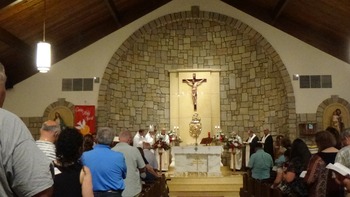
On 6 August 2016, people gathered at Our Lady of Lebanon Maronite Catholic Church in Easton, Pennsylvania, to celebrate the Divine Liturgy (Quddās) and inaugurate the thirty-ninth Annual Heritage Days celebration (Figure 1). The festival, a two-day event, celebrated the traditions of the Lebanese Maronite community in Easton and involved several cultural activities, including live music, dance, and food. It coincided with the feast of the Assumption of the Virgin Mary, the patroness of the church, which is celebrated in Lebanon on 15 August as a national holiday.
Our Lady of Lebanon Maronite Catholic Church, Easton, Pennsylvania. Parishioners and visitors attending the Divine Liturgy celebrated by Maronite Bishop Gregory Mansour and a group of Priests and deacons (photograph by author, 6 August 2016).

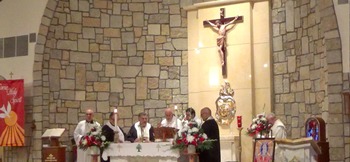
In addition to church members, attendees included people from Easton and neighbouring cities, including Allentown, Lehigh Valley, Philadelphia, from as far away as Rhode Island, and even Australia. The Divine Liturgy, celebrated by Gregory Mansour, Bishop of the Diocese of Saint Maron of Brooklyn, New York, with the participation of four priests and two deacons,Footnote 1 shows the relevance of this event to the larger community (Figure 2).
Gregory Mansour, Bishop of the Diocese of Saint Maron, Brooklyn, New York, celebrates the Divine Liturgy with the assistance of four priests and two deacons (photograph by author).

A choir composed of adults and children served at the Mass with the accompaniment of an organ and the participation of the congregation. All hymns were performed in unison, as is the custom in this musical tradition.Footnote 2 As the bishop entered the church with the priests and altar servers, the choir sang the following entrance hymn in English.Footnote 3
When they arrived at the sanctuary, the bishop and the priests recited, in alternation with the choir and the congregation, the following litany in Syriac, a dialect of Aramaic, Jesus’s native language.Footnote 5

As the Mass proceeded, the language of the prayers and hymns varied between English, Syriac, and Arabic.
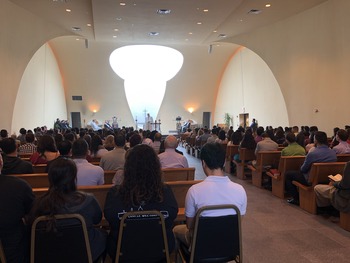
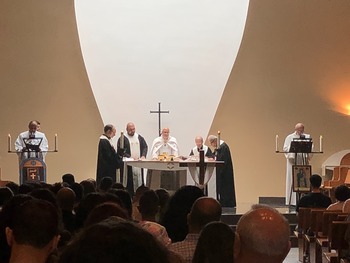
Moving forward to 7 October 2018, people at Our Lady of Lebanon Church in Washington, DC, attended a Mass celebrated by Bishop Mansour following the thirtieth Annual Lebanese Festival, which had taken place the day before, attended by a crowd from the DC area, including Maryland, Virginia, and Philadelphia (Figure 3). The bishop was assisted by five priests, three deacons, and five seminarians.Footnote 7 A choir consisting of adults and one young adult was accompanied by an organ (Figure 4).
Parishioners and visitors from the DC area attending the Mass (photograph by author).

After the following entrance hymn,Footnote 8 sung in Arabic, the bishop and the priests, with the choir and the congregation, recited the litany in Syriac.

As with the Mass in Easton, the language of the prayers and hymns varied between Syriac, Arabic, and English; however, whereas the spoken parts were almost entirely in English, the singing, with the exception of one hymn, was entirely in Arabic.
Bishop Mansour celebrating the Divine Liturgy with five other priests and three deacons (photograph by author).

The entrance hymns in both Masses belong to the same Maronite repertoire, known as Syro-Maronite chant, which is believed to be as old as the church, dating back to the fifth century. The original language of the chants is Syriac, the everyday language of the Maronites, until the Muslim invasion of the Levant during the seventh century, and the official language of the Maronite liturgy until the twentieth century. The chants gradually fell into disuse throughout the centuries, but they underwent a major revival during the second half of the twentieth century, when the texts were translated into Arabic, the everyday language of modern Maronite communities in Lebanon and the diaspora, while retaining the Syriac poetic metre and the original tunes, which therefore allowed them to still sound almost the same as before, but with words now in different languages.
Celebrating a trilingual Mass has become a common practice in almost all Maronite churches in the United States;Footnote 10 however, as evidenced by the two Masses described above, the language of the hymns varies from one parish to another, and from one Mass to another, even within a single church. For instance, during an interview with the choir director at Our Lady of Lebanon Church in Easton, I was told that the repertoire of hymns in the Sunday Mass is mainly in Arabic, noting that the choir consists of both adults and children (Minerva Jacob, interview, 7 August Reference Jacob2016). Many other parishes also continue to sing the chants almost entirely in Arabic, despite recommendations by the clergy and others to include more hymns in English to allow non-Arabic speakers, including American-born Maronites, to participate more fully. The use of Syro-Maronite chant in the Divine Liturgy is welcomed by all parishioners, but the chosen language of the chants sometimes causes disputes among parishioners or between clergy and parishioners, reflecting diverging attitudes towards identity and heritage between church leaders and community members.
This article addresses three points in regard to music, language, religion, and multigenerational dynamics in a diasporic setting. First, I explore the role of the ancient repertoire of chant in the Maronite Church in the United States in delimiting its religious and cultural boundaries while creating a religious space that transcends ethnic and linguistic differences. I show how the adaptation of the chants to the spoken language of the Maronite communities, while maintaining the original tunes and poetic metre, has contributed to the preservation of the identity of the church, and simultaneously has made the chants accessible to other members of the community who do not speak Arabic or Syriac. I address the church’s strategies for survival in the diaspora and the role of its ancient heritage in shaping its contemporary image and assuring its continuity. Second, I examine the role of the chants in creating a “diasporic consciousness” (Brennan Reference Brennan2012) and a sense of belonging among the members of the community while evoking “diasporic imaginaries” (Hornabrook Reference Hornabrook2018) in a multigenerational community. I show how the chants go beyond religious devotion to create a discourse about the ethnic identity and cultural heritage of the church and community between the church and the congregation on one hand, and among member of the congregation on the other hand. Third, I argue that, whereas issues over language use in the liturgy have spurred tensions among church members in some communities, creating what Kay Shelemay calls “communities of dissent” (Shelemay Reference Shelemay2011), the liturgical music has played a major role in the formation of a transnational Maronite Church rooted in the past, embracing the future, and uniting the Maronite communities across different countries with the mother church in Lebanon.
Research Methodologies and Theoretical Framework
Discussing the role of music in the American religious experience, Philip Bohlman notes the dependence of sacred music as a “linguistic system” on the “dialectic” between written tradition, most notably hymnody, and oral tradition, usually in the form of liturgy and ritual; he remarks that hymnbooks not only “anchor tradition in the word,” but become “sites for change and struggles over change” (Reference Bohlman, Bohlman, Blumhofer and Chow2006:9). I draw from Bohlman’s assertion to show how this dialectic between the chants and their use in the liturgy is prevalent in the Maronite religious community. Furthermore, I argue that the attempts of the Maronite Church in the diaspora to preserve its ancient repertoire, while adapting it to the local spoken languages, attests to the role of sacred music in providing the agency through which the identity of the church is negotiated and maintained.
Since this study deals with the old tradition of an indigenous church that has survived for many centuries, the discussion of the religious practices in the church and community must take into consideration what Suzel Ana Reily and Jonathan M. Dueck call “the ground level, embracing both the historicity and the ethnographic present” (Reference Reily, Dueck, Reily and Dueck2016:6). My discussion addresses Syro-Maronite chant in its historical context, as well as its current use in the Divine Liturgy. A synopsis of the history of the Maronite Church and its chant provides a lens into the agency of the old repertoire and its role in the negotiation of identity. As a model of the development of diasporic consciousness, I take into account the rich history of Maronite immigration to the United States, which began in the 1880s and has resulted in the formation of different layers of identity, confirming religion and immigration scholars’ description of multigenerational identities of immigrants as being “many-sided, fluid (shaped by historical and social contexts), and overlapping” (Cadge and Ecklund Reference Cadge and Ecklund2007). I use the Divine Liturgy as the context for my discussion, which allows me to examine Maronite music as a religious practice separate from the everyday lives of the community members, providing, as anthropologist Vicki Brennan argues, an “understanding of diaspora beyond that provided by situated studies of everyday lives of migrants or network-based analyses” (Brennan Reference Brennan2012:5).
The concept of diaspora was originally used by scholars to describe displacement, usually through coercion, from one’s homeland, and settlement in foreign places while maintaining a profound, often mythical, attachment to the homeland (Safran Reference Safran1991). However, the meaning of diaspora has shifted over time. Its current definition focuses, in its essence, on a triadic relationship between the homeland, the host country, and the community of people (Lidskog Reference Lidskog2017:25). In the Maronite Church, the ancient liturgical heritage, more particularly the chants, have contributed to the continuity of this relationship. Unlike early religious communities in America whose music evokes a “sacred journey” that takes the form of exile and exodus (Bohlman Reference Bohlman, Bohlman, Blumhofer and Chow2006:8), the chants of the Maronite Church reflect a diasporic consciousness in which diaspora is seen not as a “product and entity,” but as a “dynamic process of lived experience” (Lidskog Reference Lidskog2017:25). As I shall elaborate below, the adaptation of the chants to different languages and their continuous use in religious rituals, attest to their role in identity formation and the preservation of the church.
This article draws from Kay Shelemay’s notion of communities of descent, dissent, and affinity, in approaching “community” in musical scholarship (Shelemay Reference Shelemay2011). Among the Maronites, communities of descent are generated by shared ethnicity—Syro-Antiochian—with religious and/or national ties to Lebanon. Communities of descent are also generated by the indigenousness of the liturgical heritage and sacred music that date back to the fifth century. Dissent communities, on the other hand, emerge among the Maronites through acts of resistance by individuals or groups against, for instance, the use of certain liturgical practices. Finally, affinity communities among the Maronites emerge from “individual preferences” (ibid.:373) through engagement with the Maronite musical heritage and tradition: individuals from different Christian communities attend the Maronite Mass and join the Maronite Church because of their appreciation of the Maronite music and tradition.
Finally, this article refers to scholars of religion and immigration who have noted that language differences can be a key dividing line among religious communities (Ebaugh and Chavetz Reference Ebaugh and Chafetz2000) and that religious organisations provide a place for members of the second generation of immigrants and beyond to negotiate their religious and ethnic identities (Chong Reference Chong1998; Kurien Reference Kurien2005). They have also suggested the importance of multi-sited research on religious diasporic communities, noting that “comparisons across different U.S. cities between immigrants from the same country who share a religious tradition can show how the contexts of reception shape immigrants’ experiences” (Cadge and Ecklund Reference Cadge and Ecklund2007:370). My longitudinal and multi-sited study allows me to further explore, through musical performance, this issue of multigenerational discourse about ethnicity, religiosity, belonging, and identity.
The Ethnomusicologist as Tradition Bearer
My first encounter with Maronite liturgy and chants was during my childhood in my hometown church in Lebanon during the late 1980s, where I regularly used to attend the Divine Liturgy. I grew up listening to the chants performed by the congregation, with and without musical accompaniment. Since I could play the piano, I was eventually asked to join the church choir, first as the organist and then as the director. However, it was not until I started writing my master’s thesis in the United States in the late 1990s that I realised the importance of the old repertoire of chants in embodying the Maronite Church identity.
For more than twelve years, I studied the attempts by the Maronite Church in the United States to adapt the chants to English with the hope of increasing the participation of non-Arabic speakers. My direct and long-term involvement with the Maronite liturgy has helped me get access to the community and has provided me with my insider perspective, whereas my academic training has supported my outsider perspective. These two viewpoints have informed my work on the Maronite Church in Lebanon and the diaspora and have allowed me to gradually distance myself from the community and gain a good grasp of the liturgy and the religious and social dynamics within the church and the community.
In this study, I draw from archival research and interviews that I conducted in Lebanon in 1998, 2002–2003, and 2015, a multi-sited ethnographic study with numerous interviews with clergy members and parishioners in several Maronite parishes in the United States since 2005,Footnote 11 my personal experience as a Maronite choir director in Lebanon between 1987 and 1995 and later in Millbrae, California, between 1996 and 2013, online research through YouTube and Facebook, and email exchanges with members and clergy from different parishes. I argue that whereas maintaining the old tunes and poetic metre of the chants has helped the Maronite church and community preserve their religious and ethnic identities, the adaptation of the chants to the spoken language of the host country (in this case English) has ensured the continuity of the Maronite tradition in the diaspora.
The Maronite Church at Home and in the Diaspora: A Synopsis
The Maronite Church and Lebanese Identity
The Maronite Church is a branch of the Syro-Antiochian Church and one of the oldest Eastern churches, dating back to the fifth century. Its name derives from the monastery of Bayt Marūn (House of Maron), built during the second half of the fifth century in the valley of the Orontes, near Apameus, in northern Syria. Maronites believe that this monastery, the cradle of their church, was built in honour of Saint Maron (d. 410), an anchorite,Footnote 12 who lived on a mountain in the vicinity of Apameus. During the early centuries of Christianity, conflicts over the relationship that unites the human and divine natures of Jesus Christ led to schisms in the Eastern Church. The Maronites were strong supporters of the council of Chalcedon, which convened in 431 and affirmed that Jesus was both true God and true man. Their stance put them in conflict with other Christian groups. In the year 517, 350 monks from the monastery of Saint Maron were massacred on their way to a pilgrimage to the shrine of Saint Simon the Stylite. Later persecutions of the Maronites at the hands of other Christians, and Persian and Muslim invasions of Syria during the seventh century, forced them into the inaccessible mountains of Lebanon, where they settled and developed as an independent religious community in which secular and clerical powers were combined. Around the first half of the tenth century, after repeated incursions by Byzantine soldiers and Arab warriors, the Maronite patriarchy moved from Syria to Lebanon. It is then that the history of the Maronites became intertwined with the history of Lebanon (Dib Reference Dib and Beggiani1971:7).
Throughout centuries of Islamic rule, including the Ottoman Empire, the Maronites were the only Christian group in the Middle East to have experienced political autonomy (Leichtman Reference Leichtman2013:44). Later on, the French mandate over Lebanon and Syria, which began in 1920 following the collapse of the Ottoman Empire, enabled them to establish what came to be known as Great Lebanon, thanks to the efforts of Elias Howayek, the Maronite patriarch, who, during the peace conference at Versailles, demanded recognition of Lebanon’s right to independence (Labaki Reference Labaki1993:14). Under French oversight, Lebanon became the only Arab country with a Christian head of state.
The Maronites played a major role in shaping Lebanese nationalism, which “overlapped with Christian particularism, further enforcing the distinctive national role of the Maronite Church” (Brand Reference Brand2006; Gualtieri Reference Gualtieri2009; Hartman and Olsaretti Reference Hartman and Olsaretti2003, cited in Leichtman Reference Leichtman2013:44). However, whereas Lebanese Maronite immigrants in the United States retain a strong sense of Lebanese nationalism and show their pride in their national heritage, which they tend to mix with their religious heritage, since around the beginning of the twenty-first century, the Maronite Church in the United States has been trying to emphasise its Syro-Antiochian identity, considering Lebanon its spiritual country and the Maronite Church in Lebanon as the mother church of Maronites worldwide. During my interviews, clergy members and church leaders asserted that the Maronite Church needs to be more inclusive towards non-Lebanese who are joining the church, either through marriage or because of their appreciation of the Maronite liturgy, spirituality, and tradition.
Today, the Maronite Church has approximately four million members, about half of whom have emigrated, or descended from those who emigrated, since the second half of the nineteenth century, to the Americas, Australia, Europe, and various parts of Africa. In the United States, it is a well-established institution, with two eparchies (dioceses), more than eighty parishes and missions, a seminary, a monastery, a convent, and a shrine. It operates, however, under the jurisdiction of the Maronite Patriarchate in Lebanon.
The Maronite Church in the United States
Maronite immigration to the United States started during the second half of the nineteenth centuryFootnote 13 and dramatically increased after 1890. Between 1890 and 1920, more than one-third of the peasants of Mount Lebanon left their villages and moved to the Americas (Khater Reference Khater2001:53–70). The main reasons for emigration were overpopulation, lack of economic opportunities, and religious, political, and social discrimination by the Ottomans (Beggiani Reference Beggiani2003:1; McGuire Reference McGuire1974:1). Maronite emigration to the United States dropped after 1921 because of tighter immigration laws, but increased again after World War II because of lack of employment opportunities, and after 1975 because of the war in Lebanon (1975–1990) (Labaki Reference Labaki1993:59–61).
The early Maronite immigrants worked as peddlers in villages and mining camps (ibid.:53), scattered all over the United States because of the nature of their work. The highest concentration was in industrial areas, especially the New England and the Middle Atlantic states (ibid.:61). Sizable numbers went as far West as Minnesota and Missouri, and as far south as Georgia and Texas; smaller numbers reached California and Oregon (Beggiani Reference Beggiani2003:21). Maronite chorbishopFootnote 14 Seely Beggiani notes: “for these first and second generation Maronites, the Maronite tradition was the source not only of their religious, but also of their national and social identity” (ibid.:80). Their first places of worship were the local Latin churches, but the immigrants quickly petitioned the patriarch to send them priests. Whenever they could obtain a priest, communities were established as parishes. By the beginning of the Great War, at least twenty-two permanent Maronite parishes existed in the United States (ibid.:79). Until 1966, these parishes were under the jurisdiction of the Latin ordinaries.Footnote 15
The early immigrants retained a strong consciousness of community identity characteristic of Lebanese villages (Labaki Reference Labaki1993:84). Early communities consisted mainly of immigrants from the same village in Lebanon. They often settled in the same neighbourhood, where they formed close-knit communities and tended to recreate their village. Today, these communities consist of sixth- and seventh-generation immigrants, with only a few newcomers from Lebanon. Since around the second half of the twentieth century, new communities have been formed by new waves of immigrants, where first- and second-generation immigrants are now mainly found.Footnote 16 Members of the different communities congregate every Sunday for Mass. Some people drive for more than an hour to attend, socialise, and meet friends. Coffee and sweets, both Lebanese and American, are offered after the service, and sometimes lunch is provided by a church group or ministry. Money collected during those social events benefits the church.
Syro-Maronite Chant: Characteristics and Issues of Transmission
Music in the Maronite Mass
Music occupies an important place in the Maronite Mass. In addition to the chants and canticlesFootnote 17 that make up the majority of the event, the celebrant priest intonesFootnote 18 almost the whole canon of the Mass while the congregation responds in a recitative-like style. Footnote 19 In both Masses I mentioned earlier in the article (the Mass at Our Lady of Lebanon in Easton, Pennsylvania and the Mass at Our Lady of Lebanon, Washington D.C.) and in all other Masses I attended or served, the celebrants would intone all the prayers and the congregation would respond in the same manner.
Traditionally, the whole congregation participated in the singing of chants, psalms, and canticles. Lately, most of the parishes have established choirs consisting mainly of volunteers and amateur singers and performers who serve at Mass. The sung repertoire consists of traditional chants or Syro-Maronite chants and canticles or hymns from a more recent repertoire, one that emerged and developed mainly during the twentieth century. The texts of the newly composed hymns are usually taken from the Bible or the Maronite liturgy, and the musical style of the melodies varies between Western and Arabic.Footnote 20 In this article, I limit my discussion to the old chants, which still occupy an important place in the Mass and other religious rituals.
Characteristics of Syro-Maronite Chant
The Syro-Antiochian origins of the church are reflected in its liturgy and traditional chant. The name Syro-Maronite refers to the most ancient group of chants in the Maronite Church, which have a great affinity with the ancient sacred chant of the Syro-Antiochian churches (Syro-Catholic, Syro-Orthodox, Chaldean, and Assyrian) (Hage Reference Hage1995:156). Syro-Maronite chant is found in the Divine Liturgy and other religious rituals, including the Divine Office, Holy Week, and Funeral Offices.
The monastic origins of the Maronite Church have imbued the Maronite liturgy with a monastic character, distinguished by simplicity and austerity (Hage Reference Hage2004:12–13). Lebanese philosopher Charles Malek notes: “the majesty of the Maronite rite” stems from its “popularity, democracy, spontaneity, simplicity, lack of any human majesty, giving the faithful the feeling that this is emanating from him” (Malek Reference Malek1980:27–28). The texts of the chants are ancient; some of them can be traced back to Saint Ephrem in the fourth century. Full of religious symbolism, they embody Maronite theology and spirituality. They are strophic and follow a melody-type system, in which the same tune or melody can be adapted to many strophes having an identical or similar metre (or versification). The model strophe, according to which the metre and the melody of the strophes must be regulated, is called rīsh qolo (pl. rīsh-qole) (rīsh derives from rīsho, “head,” and qolo means “voice,” “verb,” “poem”). The strophes are usually performed in alternation between two choirs or groups; some chants, however, have only one strophe, and rarely, two. The melodies are composed through the process of centonisation, in which preexisting short formulas are juxtaposed (Hage Reference Hage2004:64–65). The text is syllabic, except for the last syllable of a strophe, and sometimes the penultimate syllable, which can be more melismatic. The notes move mainly stepwise, in a range generally limited to a fourth or a fifth—which makes the hymns easy to learn and memorise. Louis Hage, a Maronite monk and musicologist, argues that Syro-Maronite chant is based on an archaic modality, which differs from both the modality of Gregorian and Byzantine chants and the Arabic modal system.Footnote 21
The chants were transmitted orally throughout the centuries. They were first transcribed in Western notation in 1899 by Jean Parisot, a French Benedictine musicologist. A few more transcriptions, which aimed at preserving written versions of the chants, followed Parisot’s notation. However, these transcriptions were excluded from the liturgical books used in religious services. In the 1970s, Hage conducted a comparative study of eight different transcriptions, including one he had transcribed himself and which was based on recordings he had made among different Maronite communities and regions in Lebanon. The study showed some variations among the different transcriptions as a result of the centuries-long history of oral transmission. His musicological analysis led him to propose a notation that he deemed most representative of the chants. His notation was first included in liturgical books published in the 1970s by the Kaslik Reform Committee (see the end of this section). It was adopted by the Patriarchal Liturgical CommissionFootnote 22 and has been included in all the liturgical books published since the 1990s for use in Maronite parishes in Lebanon and the diaspora.
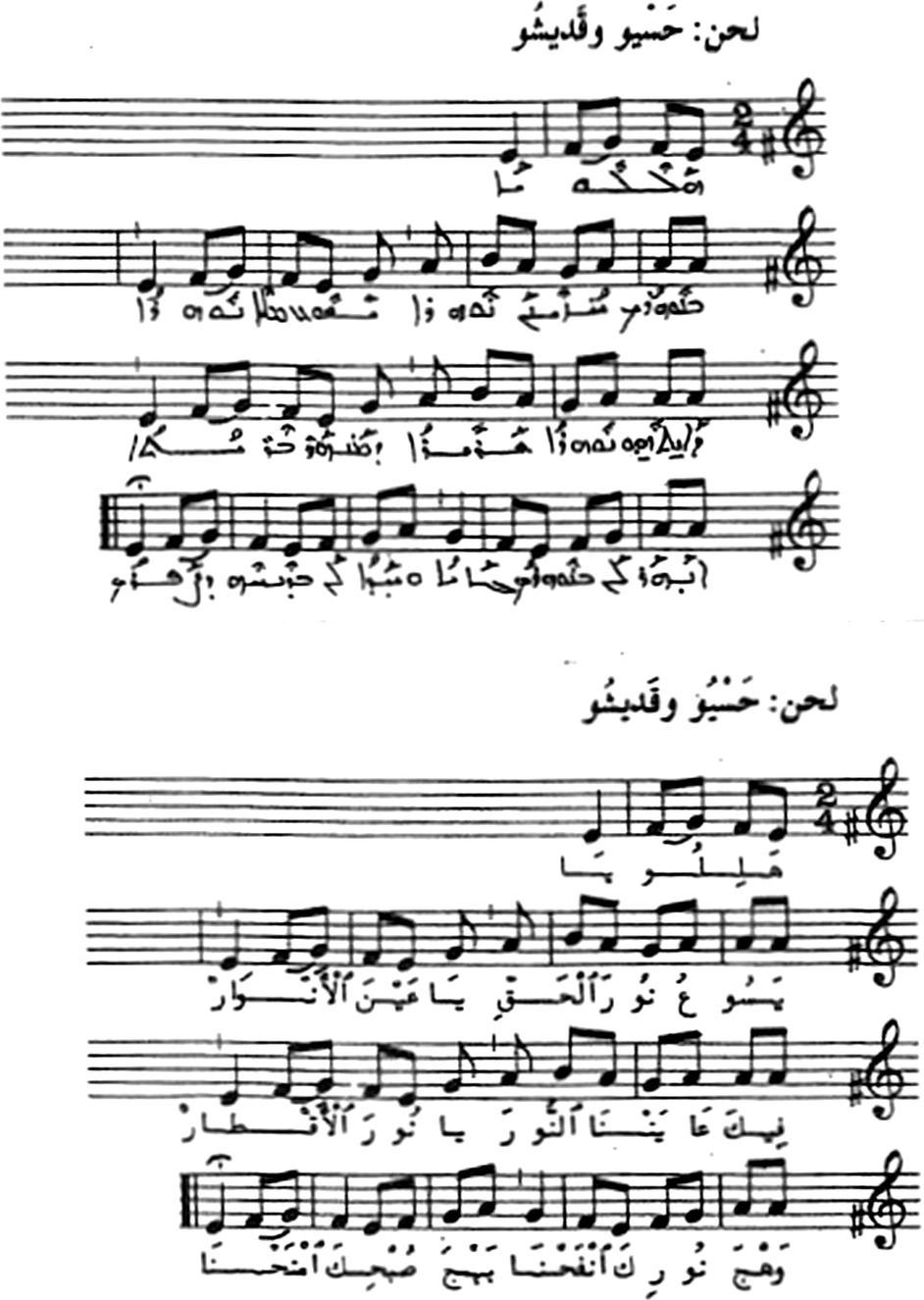
Figure 5 is an example of a music transcription of a Syro-Maronite chant proposed by Hage. It is based on the rīsh qolo known as Ḥasyō w-Qadīsho. The melodic range consists of a fifth, with the lowest note being an EFootnote 23 and the highest a B. The text in the top section is in Syriac, and the text in the bottom section is in Arabic. The music and the texts are written right to left.
Transcription in Western notation of a Syro-Maronite chant realised by Louis Hage. Mūsīqa Alḥān al-Quddās al-Mārūnī (The music of the melodies of the Maronite Mass), 1993:17–18.

Syro-Maronite Chant: Revival and Continuity
Originally, the chants were in Syriac, a dialect of Aramaic. After the Islamic conquest of Syria in 634, Arabic gradually replaced Syriac as the common tongue in Syria and Lebanon, but Syriac remained the official language of the Maronite liturgy until the second half of the twentieth century. This change gradually prevented the faithful from participating as actively in services as they had in the past. The transition from Syriac to Arabic within the liturgy took place through a long, gradual process. It is difficult to determine the exact date of the introduction of these texts; however, manuscripts dating from the fifteenth century contain scripture readings in which karshūni (Arabic written with Syriac characters) readings parallel the Syriac readings. These translations dealt with texts in prose, such as prayers and readings, whereas the traditional chants, which constitute the bulk of the Maronite rituals and Divine Office, remained in Syriac. Even today, Syriac is still used in hymns and parts of the Mass, especially during the Consecration of the Eucharist. Starting in the eighteenth century, new chants written in Arabic entered the repertoire, but they did not replace the traditional chants, which remained in Syriac.Footnote 24
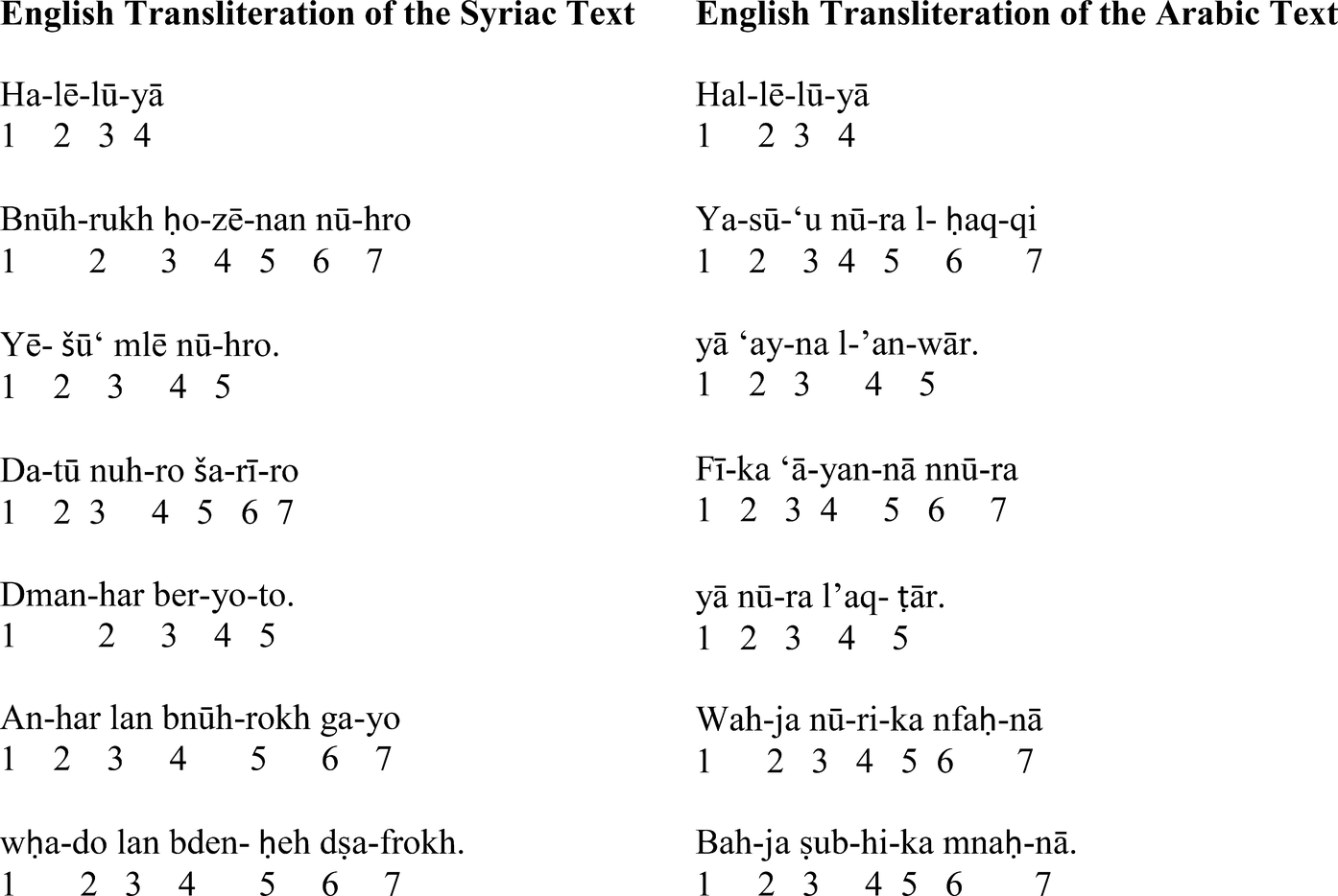
The most significant attempt to overcome the language barrier while preserving the heritage of the church took place in the 1970s at the University and Monastery of the Holy Spirit in Kaslik, Lebanon, through a liturgical reform that became known as the Kaslik Reform.Footnote 25 In this reform, the texts of the hymns were translated into Arabic, retaining the Syriac poetic metre and the original tunes.Footnote 26Figure 6 consists of a transliteration in English of the Syriac and Arabic versions of a Syro-Maronite chant based on the tune Hasyō w-Qadīsho. A comparison of these versions shows that they have the same metric structure; accordingly, the translated version can be adapted to the existing tune and will sound almost the same when sung.
Syriac metric structure: 4 7 5 7 5 7 7
Arabic metric structure: 4 7 5 7 5 7 7
The Kaslik Reform filled a gap in the Maronite liturgy and resulted in the revival and preservation of the Maronite tradition and heritage. The same approach of translating and adapting the old Syriac chants to the existing tunes and Syriac poetic metres was followed in the Maronite Church in the United States and in other churches in the diaspora, including those in Mexico, Cyprus, and France, where the chants are now being translated into Spanish, Greek, and French, respectively.
Comparison of metric structure of Syro-Maronite Chant in Syriac and Arabic.

Syro-Maronite Chant in the United States: Issues of Adaptation and Transmission
Early Reform of the Maronite Liturgy and Chant
The Maronite Church in the United States faced the same challenges as the mother church in Lebanon regarding the language used in the liturgy in general, and in the old repertoire of chants in particular. The multiple-wave immigration and the growing number of American-born Maronites have resulted in the formation of different old and new communities. In my fieldwork, I have found that the lack of command of the Arabic language does not prevent American-born Maronites from enjoying Lebanese food and music and participating in social events at the church, and therefore connecting with their ancestors’ homeland; however, the language barrier becomes problematic in worship and prayer. The flow of new immigrants ensured continuity with the church in Lebanon because the newcomers were bringing with them the liturgical books and hymns that they had been using in their parishes, but this did not solve the language problem. In some old parishes, English hymns from the Latin Church were borrowed to fill the gap; in others, Arabic hymns were written in English phonetics, allowing non-Arabic speakers to participate in the singing. English transliteration of Arabic hymns still occurs today; for many years, I wrote out the hymns in English transliteration for members of my choir as in Figure 7.
English transliteration of a Syro-Maronite chant in Arabic.

The earliest attempts to solve the language issue in the Divine Liturgy and religious rituals took place in the 1970s, when Bishop Francis ZayekFootnote 27 (1920–2010) commissioned Bishop Hector Doueihi (then Msgr Doueihi) (1927–2014), a Maronite theologian and liturgist, to undertake a liturgical reform by translating all the liturgical texts from Syriac to English. Accordingly, Bishop Doueihi provided English versions for the Mass and other rituals, including the liturgies for baptisms, weddings, and funerals. The book of the Mass was published in different volumes according to the Maronite liturgical calendar (Khayrallah Reference Khayrallah2013:43). The commissioning of Msgr Doueihi followed the recommendations of the Second Vatican Council (1963–1965), whose liturgical guidelines included a directive to adapt the liturgy to the culture and traditions of peoples around the world.Footnote 28 Furthermore, concerning the Catholic churches of the Eastern rite, the council announced that each individual church or rite should retain its traditions, and that it should adapt its way of life to the different needs of time and place (Abbott Reference Abbott1966:162).
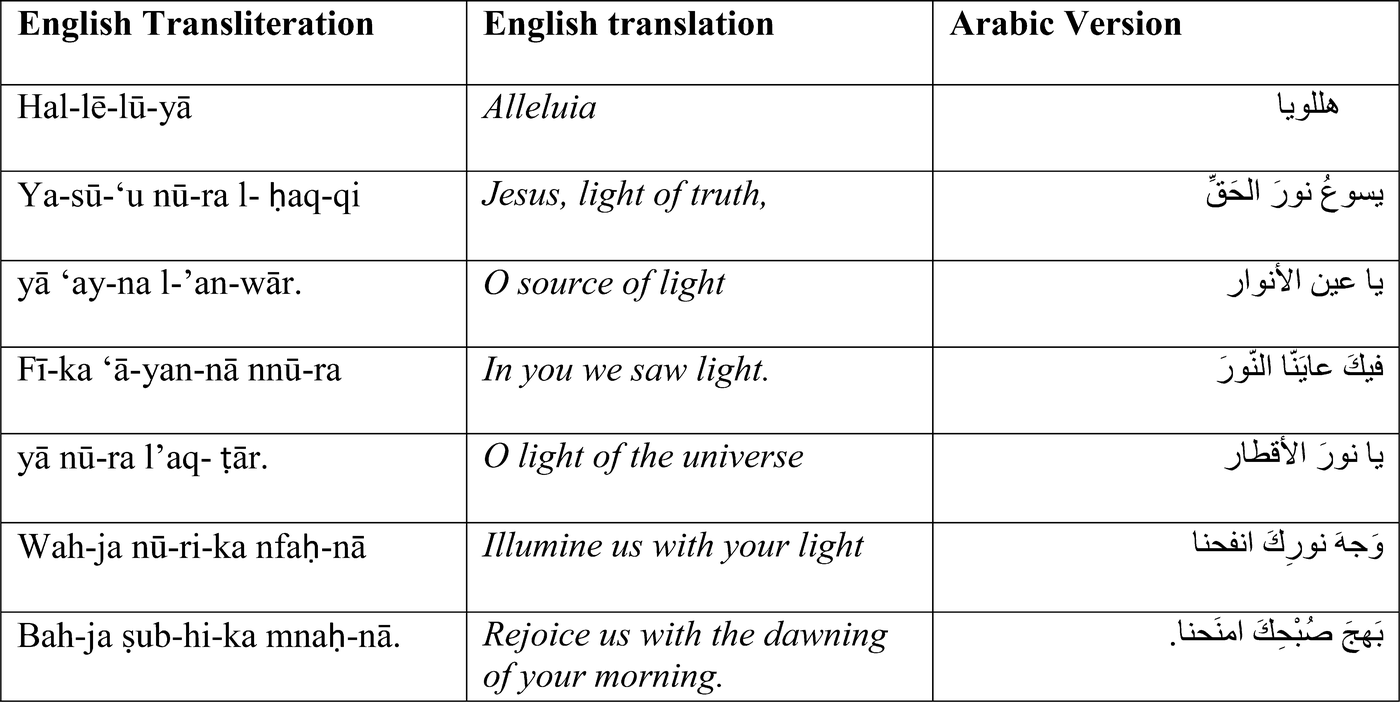
Bishop Doueihi’s work fulfilled an urgent need in the Maronite Church in the United States. In the new books, the original Syriac and/or Arabic texts were included side by side with their English translations, including the chants, as in Figure 8; however, the English chant texts could not be sung because Doueihi’s translation consisted only of giving the meaning of the texts without adapting them to the poetic metre and original tunes. Doueihi admitted that adapting the chants to the original tunes and Syriac poetic metre was outside his area of expertise. He told me in an interview: “I did not touch the chants because this is not my area. I was hoping that somebody will do the work in the future. Our services need to be sung. Without music, our liturgy is dead” (interview, 25 February Reference Doueihi2011). Bishop Doueihi’s motto was “fidelity to the past and openness to the future.” In his work, he did not confine himself to the word-for-word translation (Khayrallah Reference Khayrallah2013:43), but tried to convey the theology and symbolism embedded in the Syriac texts.Footnote 29 He was influenced by Maronite Patriarch Estefan al-Doueihi (1630–1704),Footnote 30 a renowned scholar in the Maronite Church, who believed that the Maronite Church should preserve its past while opening up to the present. The newly published books of Bishop Doueihi’s work included information about the rituals and their symbolism, as well as instructions for their performance.
Syro-Maronite chant put side by side in Syriac, Arabic, and English. The Arabic text is in the middle column. Qurbono: The Book of Offering. The Service of the Holy Mysteries According to the Antiochene Syriac Maronite Church, 1994:2–3.

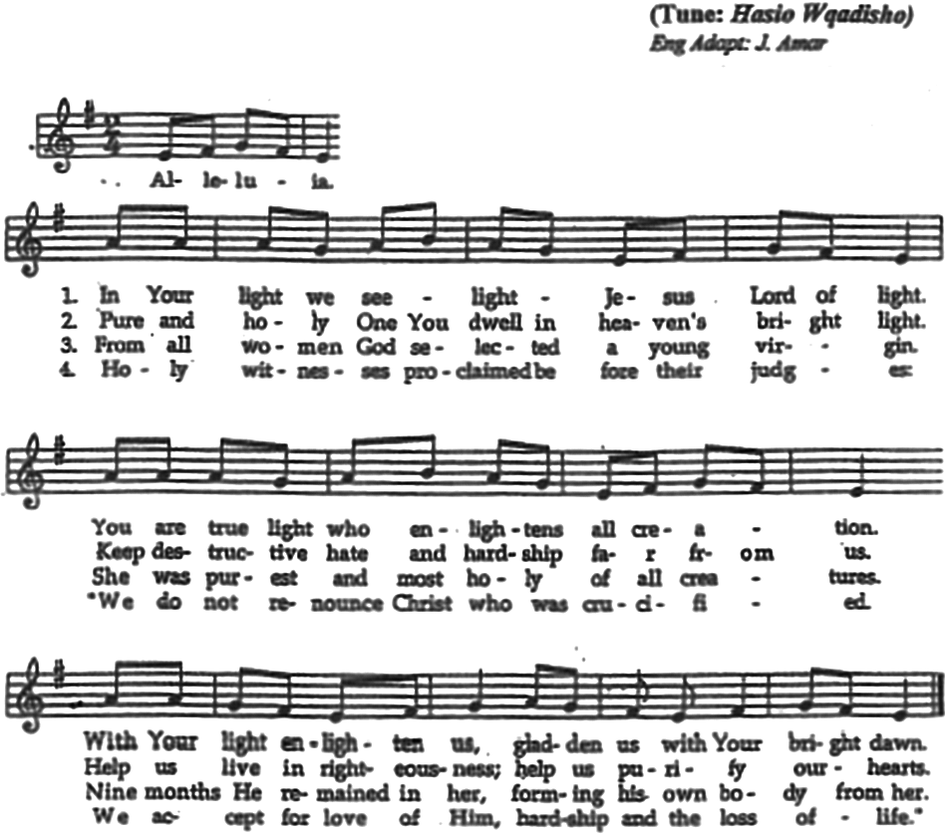
Later on, Bishop Doueihi collaborated with Maronite priest and scholar Joseph Amar, who adapted the chants from Syriac into English following the model of the Kaslik Reform.Footnote 31 In 1997, a revised version of the Mass from the Christmas season was published as an experiment by Saint Maron Publications. It consisted of the texts and the chants printed only in English—except for the parts of the Mass that were still in SyriacFootnote 32—and the music notation of the chants as adapted by Amar. Figure 9 is his adaptation of the chant “Hymn of Light,” based on the tune Ḥasyō w-Qadīsho. His work was not officially published by the church authorities, and therefore his chants did not become available to all parishes in the United States.Footnote 33
Music adaptation of a Syro-Maronite chant to English by Joseph Amar on the tune Ḥasyō w-Qadīsho. Qurbono: The Book of Offering. The Service of the Holy Mysteries According to the Antiochene Syriac Maronite Church, 1997:2.

Cedars of Lebanon Hymnal
Another attempt to fill the need for hymns and canticles in English was made by Mansour Labaki, a Maronite clergyman and composer, who in 1970 published a hymnal titled Cedars of Lebanon. Footnote 34 In it, he translated into English a repertoire of hymns that he had already composed in Arabic and were already being widely used in Lebanon. He dedicated a section of his hymnal to a few Syro-Maronite chants, which he also translated into English. In 2007, he published the third edition of Cedars of Lebanon, blessed by the Maronite Patriarch and endorsed by Maronite Bishop Robert Shaheen (1937–2017), Bishop of the Eparchy of Our Lady of Lebanon, based in Los Angeles (2001–2013). In his endorsement letter to the third edition, Bishop Shaheen notes: “The parishes that adopted the Cedars of Lebanon were far advanced over those that did not, for they were able to have a full liturgical Maronite service in a language able to be understood by us who were born in America” (Cedars of Lebanon, n.p.). Bishop Shaheen commented that the second edition by Labaki was used not only by the Maronite parishes in the United States, but “by many other churches not of our own rite so that they could praise Almighty God with a taste of Eastern Spirituality” (ibid.).Footnote 35 This comment shows the desire of the church to reach people outside the Maronite community as a way of introducing Eastern traditions to the West.
Inter-Eparchial Liturgical Committee and Syro-Maronite Chant
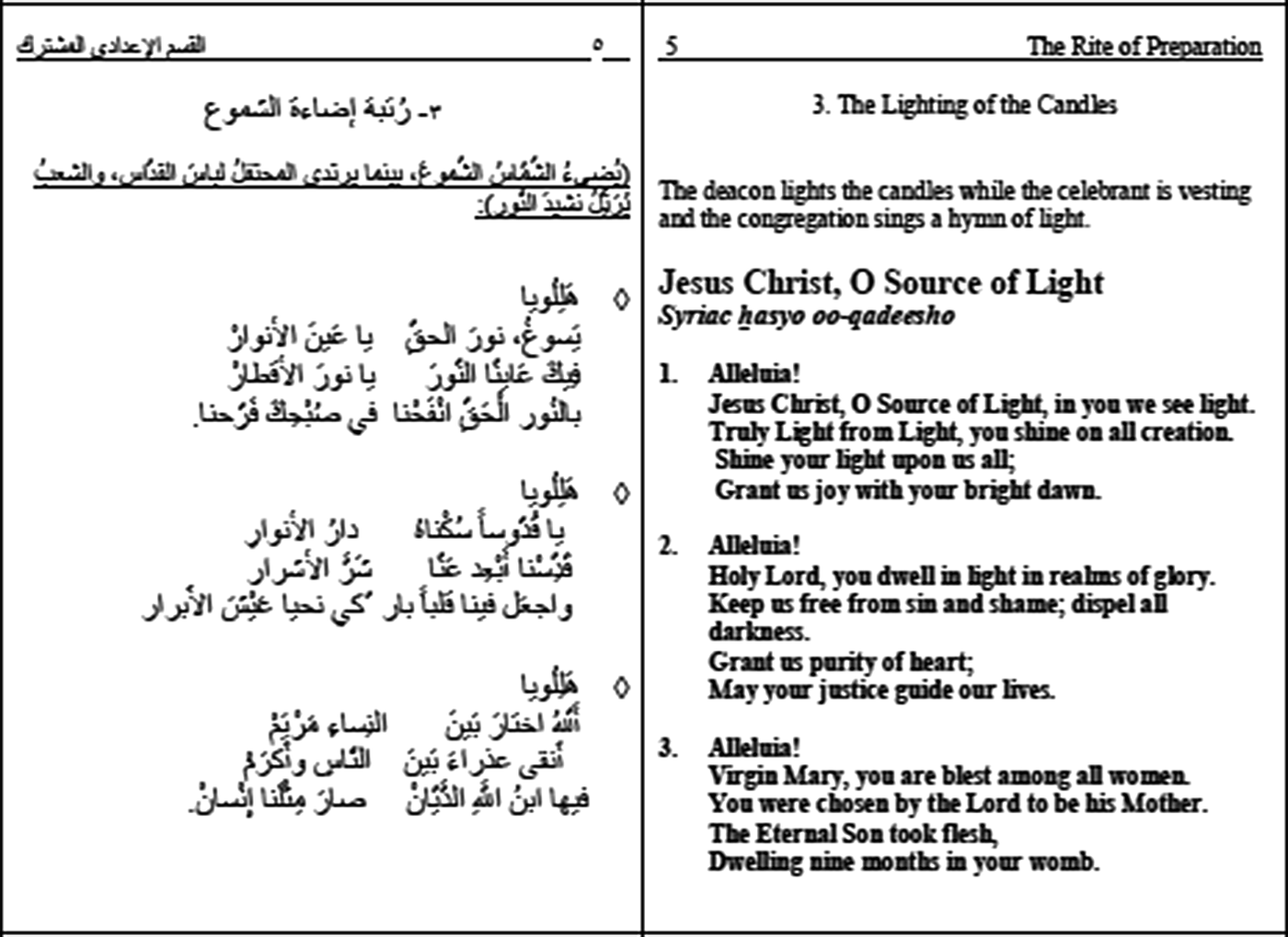
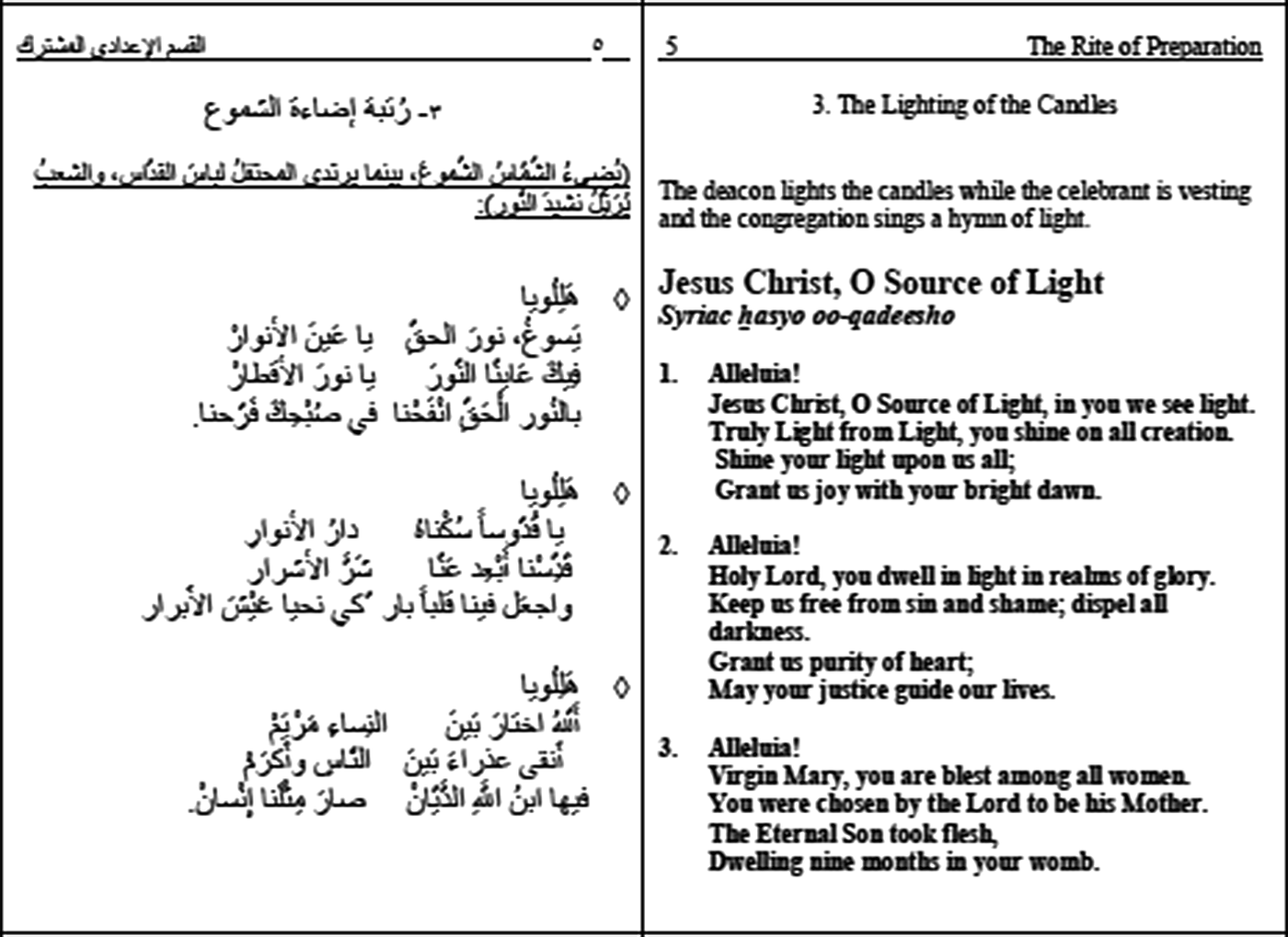
In 2005, the Maronite Patriarchate in Lebanon released a revised version of the Divine LiturgyFootnote 36 with a decree signed by the patriarch ordering the new missal to be used by the Maronites in Lebanon and the diaspora.Footnote 37 In March 2008, the Inter-Eparchial Music Commission was established by the four Maronite bishops of the English-speaking eparchies, including the two eparchies in the United States, that of Saint Maron in Sydney, Australia, and that of Saint Maron in Montreal, Canada. The committee was formed “in response to the decision at the annual Maronite Bishops’ Synod at BkerkeFootnote 38 (Lebanon) to establish an inter-eparchial committee to work on one English translation of the Maronite Liturgical texts.”Footnote 39 The work of the commission aimed mainly at translating the 2005 version of the Mass, referred to as the Book of Offering, from Arabic to English. In addition to the texts in prose, the commission translated the chants from Syriac or Arabic into EnglishFootnote 40 using the Kaslik model. After an experimental period, a new missal, the Book of Offering, was published by the Inter-Eparchial Commission with the texts printed in English and Arabic, with some passages in Syriac (see Figure 10).
Book of Offering According to the Rite of the Syro-Antiochene Syriac Maronite Church, 2012:5–6.
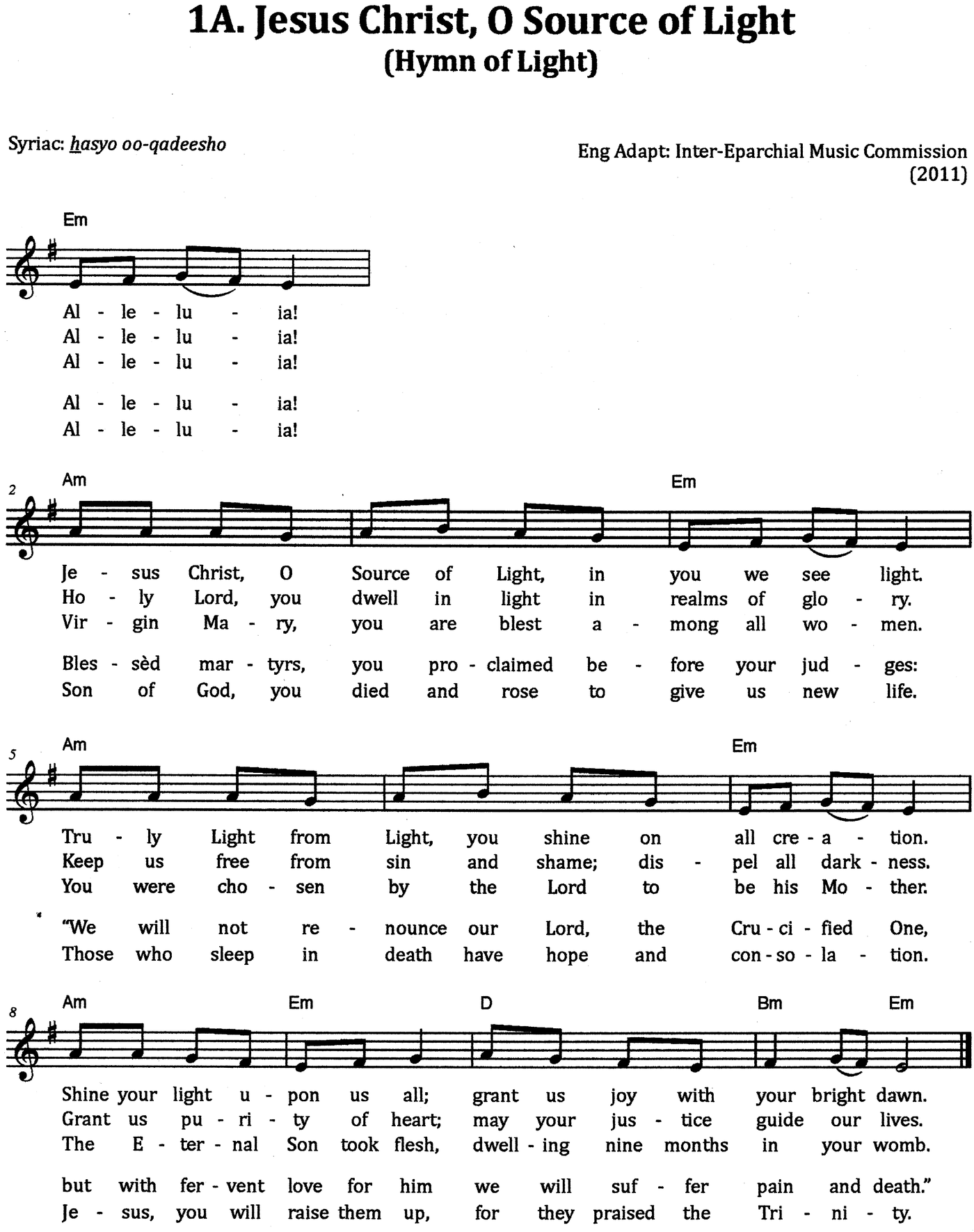
The newly translated missal was accompanied by a hymnal that consisted of the English adaptation of the chants with their music notation. The books were promulgated by the Maronite patriarch, who ordered its use in all English-speaking parishes in the United States, Canada, and Australia. An electronic version of the hymnal was published on the websites of the Eparchy of Saint Maron in Brooklyn and Canada.Footnote 41 It contains copies of the chants performed at the entrance of the Mass, after the prayers of the incense, and before the scriptural readings for the entire liturgical year with their music notation, using the notation realised by Hage as in Figure 11. In addition, audio recordings of the first verse of the chants were provided.Footnote 42
Hymn of Light. 2012. http://www.maronitemusic.org/images/pdf/HYMNOFLIGHT.pdf (accessed 27 September 2018).

In the introduction to the hymnal, Bishop Mansour noted:
With great harmonious joy I announce the new Book of Offering—Music Book which will accompany the new English translation of our beautiful Maronite Divine Liturgy. It has been five years in the making, and that is because we wanted to offer a Liturgy that is fully animated with our Syriac chants in fluent English.Footnote 43
Bishop Mansour’s statement reflects the Maronite Church’s concern for the diaspora to remain faithful to its tradition and heritage; however, in an interview in August 2016, he expressed his dissatisfaction with the 2005 missal in Arabic. He noted: “In America, in the 1970s and 80s, we did a reform that was very good and that was very rich.Footnote 44 Every Sunday had its own prayers, had its own readings. But what we did not do at the time was put the words of all the hymns in a singable form” (interview, 6 August Reference Mansour2016). He added:
So when the 2005 [missal] came out, in America we decided we would now have one liturgy everywhere. We did not want a different liturgy from Lebanon, but we were impoverished by that. The 2005 version is not as rich as ours, but how we made it rich is we took everything that’s singable in Arabic and Syriac and translated it into English, and this is the book that you have today when we celebrate the Mass.
Bishop Mansour’s comments show the importance that the Maronite Church in the United States attaches to its unity with the mother church in Lebanon. It exemplifies the triadic relationship that characterises the current definition of diaspora. The main guidelines of the Inter-Eparchial Liturgical Commission were to keep the Syriac melodies unaltered and the translation of the texts as close to the original ones as possible, without compromising the English language and “syllabication.” According to Fr Geoffrey Abdallah, director of the commission: “the main concern of the Commission was to ensure that the final English version [is] convincing and not awkward” (personal correspondence, 9 May Reference Abdallah2016). For Bishop Mansour, maintaining the melodies of the Syriac chants unchanged and the texts as close to the original Syriac ones as possible were a priority for the commission. He was unhappy with the Arabic adaptation of the chants that had been made in Lebanon, because he thought the texts had been altered from their original version. When I asked him whether the liturgy should be adapted to the present day, he replied:
We don’t want to change it to make it look like us. We want ourselves to be conformed to the liturgy, not the liturgy to conform to us. We love this richness, which is from a different culture, different time. There is nothing wrong with that. It moves us, it makes us greater by engaging in that liturgy because then we feel we’re 1600 years old instead of 20 years old
(interview, 6 August Reference Mansour2016).Bishop Mansour’s opinion regarding the importance of the original texts of the chants has been echoed by Monsignor Peter Azar, the rector of the Maronite Seminary in Washington, DC, who has noted that Bishop Doueihi “was more faithful to the Syriac text.” Regarding the English adaptation of the chants, he has remarked:
The music, I like it, but I am not an expert on translation. I would like to see the theology in it. Our forefathers worked so hard on the Syriac theology. You know, our liturgy is [a] catechism. We learn from it. That’s why there was not in the beginning in our church religious education. We used to learn it from the church. The Mass itself used to teach us
(interview, 9 May Reference Azar2017).The Language of the Chants
In the midst of church leaders’ attempts to keep the Maronite tradition alive and to prevent borrowing from other churches, different opinions have emerged among parishioners regarding the use of the language in religious rituals. Almost no one, including the new immigrants, objects to the English use of the spoken texts and prayers. Disagreement occurs, however, over the language used in the chants and hymns, which play a central role in the Mass and other liturgical services. Here, music invokes collectivities of dissent. First-generation immigrants argue that the chants are more “prayerful” in Arabic. The choir director at the Cathedral of Our Lady of Lebanon in Brooklyn told me: “When I sing in Arabic, I pray with my heart, but when I sing in English, I pray with my lips. I understand English, and I can sing in English, but I relate more to Arabic since this is my native language.”
The issue of language is less prevalent among people from third and fourth generations, for whom Arabic is not a choice, since many cannot understand or speak it; however, they still express interest in singing in Syriac and Arabic and appreciate that they can hear and pray in the language that Jesus spoke. They say that Syriac connects them with their roots, and represents divinity and sanctity. For example, during my interviews in August 2018 with Maronite parishioners in Wheeling, West Virginia, where a church has existed since the 1920s, the parishioners, both Lebanese descendants and Catholics from different ethnic backgrounds, told me that hearing the word of consecration and some parts of the Mass in Syriac is transcendental because it sounds so sacred. In addition, Lebanese descendants appreciate Syriac and Arabic because these were the languages of their ancestors. Robert Harris, a third-generation Lebanese Maronite descendant, told me: “The older songs…have so much feeling to them. The language is so beautiful.” Regarding the English translation of the chants, he remarked that the text and the music do not flow well: “In the Syriac and Arabic, there is a certain natural rhythm to it, and so as a musician, …it seems to flow better, and I feel the music better” (interview, 7 August Reference Harris2018).
Tension has arisen in communities that consist of both newer and older generations of immigrants with regard to the language of the chants. The American-born Maronites rarely get the opportunity to learn Arabic and therefore have difficulty praying in a language they do not understand. Church leaders believe that the language barrier is causing the church to lose the young generation of Maronites, who resist going to church with their parents because they do not relate to the liturgy. Chorbishop Seely Beggiani believes that having the chants in English is important for the Maronite immigrants, even among the children of first-generation Lebanese, because they can relate more to them (interview, 17 May Reference Beggiani2016). He remarked: “When you are a majority church in the country [he is referring here to the Maronites in Lebanon], you don’t have an identity problem. But when you’re a minority church, you do…. We did what we had to do here because we had to define who we are as Maronites…. Maronite identity is not in the language” (italics added by author). Regarding the issue of using English versus Arabic during the Divine Liturgy, Beggiani supports having the chants alternate between Arabic and English. In Our Lady of Lebanon Church in Millbrae, California, which consists of first- and second-generation immigrants, a major debate took place in 2007, when the pastor tried to implement the singing of the chants in English. The proponents of Arabic argued that the English translations of the texts were poor and did not make sense to them. Others maintained that Arabic is their language, and if they lose it, they will lose their identity as Maronites; they insisted that the best way to preserve the language and the Maronite tradition would be to keep the hymns in Arabic. First-generation immigrants identify strongly with the Arabic language and believe that teaching their children to sing the hymns in Arabic is one way of transmitting the Arabic language to them. Lina Srour, a mother of two, dedicates time every Sunday to drive her children to the Maronite church so they can attend choir practice, when they learn hymns predominantly in Arabic. She told me: “I prefer to attend the mass in Arabic. Otherwise, why would I drive for 45 minutes to come to a Mass in English? I can go then to a local American church and save myself a trip to our church” (conversation with author, 28 September Reference Srour2018). When I asked her whether her children prefer to sing in Arabic or in English, she replied that they definitely tend to enjoy more singing in Arabic (ibid).
Supporters of the English language, in contrast, acknowledge discrepancies in the language. The head of the Maronite Youth Organization at Our Lady of Lebanon, Millbrae, commented: “Although the translation of the texts is not fully correct, the value of it is that the youth carry it with them. It hits them inside, whereas the Arabic, they just recite it. You can tolerate poor English to good Arabic because of the understanding.” She agreed, however, that hymns in Arabic should still be included in the Mass to allow Arabic-speaking people to participate more fully. She continued: “It’s the music of the chants, that’s carrying the tradition. You could change the language the way you want it, but the music is the same.”
To avoid further tensions and divisions over language use, some parishes are offering separate English and Arabic Masses, thus giving the community a choice. In other parishes, the priests at Mass shift between Syriac, Arabic, and English to avoid more divisions in the community, and to minimise the inconvenience for families consisting of both the elderly and the young, who could be split between the two services.
Beyond the Language Choice: Multigenerational Identity Discourse
Parishioners from old and new communities do not object to the use of the English language in the prayers and readings, but many object to singing the chants in English and prefer the use of Arabic or Syriac. For the first generation of immigrants, chants are part of their collective memories, and the new language seems to be disrupting the harmonious sound of the tunes. American-born Maronites, who learn the chants by reading the English phonetics of the Syriac or Arabic texts, express a preference for these texts over the English adaptation of the chants. Children and young adults in the choir of Our Lady of Lebanon Church in Easton, Pennsylvania, and members of my choir at Our Lady of Lebanon Church in Millbrae, California, also preferred to sing the chants in Arabic and Syriac, commenting that the English texts sound awkward to them. The English texts lack the poetic flow and the musicality that are perceived in the Arabic and Syriac texts (Sacha Moufarrej, pers. comm., 20 August Reference Moufarrej2018).
In fact, whereas the English texts closely follow the Syriac poetic metre and the original tunes, “the literal translation may limit the choice of the words, which causes the translated chants to sound robotic or inorganic” (Moufarrej Reference Moufarrej2018). Many of my non-Arabic-speaking informants did not differentiate between Arabic and Syriac—which shows the compatibility between the Arabic texts and the tunes. It is this compatibility that simultaneously evokes nostalgic feelings among the new immigrants and helps connect the American-born Maronites with their ancestors. Dolores Monseur, a third-generation Maronite descendant who grew up in the Maronite and the Roman Catholic traditions, commented in reference to the Syro-Maronite chants: “[the music] conveys so much emotion. You know the emotional content of the music: happiness and sadness” (interview, 7 August Reference Monseur2018).
American-born Maronites and non-Maronites, who join the church through intermarriage or by choice, have said that they like to hear and sing the chants in Syriac and Arabic. Robert Harris from Wheeling, West Virginia, who learned Arabic as an adult, noted: “[The Syriac and Arabic texts] convey the spirituality and the love of our Lord. The church is all about love, so when those songs convey love, they are good songs, and I think we should definitely keep them” (interview, 7 August Reference Harris2018). Mark Feghali, a member of the Maronite Young Adult Organization, who fled the war in Lebanon in the 1980s at the age of one, explained:
From the perspective of psychology, there is always the conflict between novelty and familiarity. I stick with familiarity, but also something is lost in translation when you translate something—the original form, not just the words. I mean it is hard to translate the nuances sometimes, but also the vocal intonations. Try to translate poetry or try to translate humor. It’s very hard. Yeah, there is something lost from the original
(interview, 7 October Reference Feghali2018).He adds:
When some songs come up, like “Rabbi Jasaduka”Footnote 45 [Your Body, My Lord] that I know how to sing, I sing this not because I know what the words mean—I mean “rabbi” [My Lord] is obvious, but like it’s because I memorized the songs and I sing along, and I like to sing along. Everybody likes to sing along to the songs that they know.
(ibid.)Feghali’s comments show that one reason for the congregation’s objection to the English language of the chants could be its familiarity with the chants in Arabic. Thus, it appears that the simplicity of the tunes and their embedding in the collective memory of the congregants play a major role in the community’s interpretation of identity and heritage.
Syro-Maronite Chant in Practice: Issues of Performance and Authenticity
Although the church leaders and clergy in the Maronite church strongly value and stress the importance of the traditional repertoire of chant and the need to preserve it, they have given little attention to its performance in practice. Today, the performance does not always reflect the traditional character of the chants. The ancient sounds are being altered, by either the singing styles of the performers—Western or Arabic—or the instrumental accompaniment. The new repertoire of hymns in the Maronite Church reflects the church’s continuing attempts to preserve its heritage while maintaining an openness to its Arabic milieu and to the West (Moufarrej Reference Moufarrej2010). Therefore, different musical styles are heard during the services based on the performers’ musical background and preferences.
Traditionally, the chants were performed unaccompaniedFootnote 46 in alternation between two groups, allowing one group to reflect on the texts while the other is performing. During the 1970s, musical instruments were introduced into the Divine Liturgy. These included Western-derived instruments, such as the organ and the electronic keyboard, and Arabic instruments, including the nay (open-ended flute), qānūn (trapezoidal zither), the ‘ūd (pear-shaped lute), and the kaman or kamanjah (the Arabic name for the Western violin). The introduction of these instruments was aimed at supporting the human voice and at making the traditional chants less monotonous (Louis Hage, pers. comm., 27 November Reference Hage2007). Now, these instruments have become an integral part of the service, and sometimes they overpower the human voices, becoming a tool to display the musicians’ virtuosity. Hage expressed his dismay at the current misuse of the musical instruments in the church: “When we introduced the musical instruments into the service, we had control over their use. Things changed later, and I regret having done that because the service has become secularized and lost its piety and sacredness” (ibid.). The use of the musical instruments has altered the sound of the old repertoire. When accompanied by equal-tempered instruments, such as the organ and the electronic keyboard, the melodies follow the diatonic scale, and instrumentalists and vocalists tend to add harmonies, which further alter the chants. Similarly, when Arabic musical instruments are used, so-called neutral notes, including the “E half-flat” and the “B half-flat,” are performed according to the tempered Arabic musical system, which, according to Hage often results in a rather profane sound that is different from the sacred quality of the chants (ibid.).
In the United States, the organ and the electronic keyboard are mainly used. Instrumentalists tend to add chordal accompaniment, wrenching the chants from their modal moorings and making them sound as if they were based on either a major or a minor scale. The website of the Eparchy of Saint Maron of Brooklyn includes a page on Maronite music that contains audio recordings of the first verse of all the chants that belong to the Mass repertoire.Footnote 47 These recordings were performed by Australian singer Lisa Cooper, accompanied by an organ. In the recordings, Cooper sings in a Western operatic style, a wide variance from the traditional singing style.
Another factor causing an alteration in the traditional sound of the chants is the music notation. The Western notation does not necessarily represent the continuous oral transmission of the chants; therefore, as Hage argues, it should serve only as an aide-memoire to help cantors and performers remember the tunes and metric structures. The notation should be complemented with audio recordings that reproduce the original Syriac tunes. To replicate the sound of the old tunes as “authentically” as possible, the singing of the chants should take the tune as the basic element of performance and let the text flow with the music (ibid.).
Conclusion
In this article, I have examined the role of the ancient heritage of the Maronite Church, represented here by Syro-Maronite chant, in delineating its religious and ethnic boundaries while creating a contemporary image of the church that transcends ethnic and generational differences. The continuous use of the original Syriac chants attests to the Syro-Antiochian roots of the church and supports the church leaders’ distinction between the Syriac and Lebanese roots of the Maronite Church, and their assertion that the church should be inclusive and welcoming to non-Lebanese Maronites and members of other Christian communities. The Church’s self-representation as Syro-Antiochian and its openness towards other Christians have generated “communities of affinity” (Shelemay Reference Shelemay2011) whose members join the Maronite Church because of their appreciation of the Maronite liturgy. During interviews I conducted at Our Lady of Lebanon Maronite Cathedral in Brooklyn, New York, and at Our Lady of Lebanon Maronite Church in Wheeling, West Virginia, church attendees from neighbouring Catholic communities told me that they attended the Maronite Mass because they liked the liturgy and they particularly enjoyed hearing the Words of Consecration and other parts of the Mass chanted in Syriac, the language of Christ.
As this study has shown, the long history of Maronite immigration in the United States has resulted in the formation of old and new communities, and therefore in multigenerational discourse on ethnicity, religiosity, belonging, and identity. This discourse necessitated conducting of research among different Maronite communities, thus echoing scholars of religion and immigration’s suggestions for multi-sited research (Cadge and Ecklund Reference Cadge and Ecklund2007).
Church leaders and lay people agree that the chants are an important part of the Maronite liturgy and tradition and value their incorporation in the Mass and other religious rituals; however, they differ in their opinions on how the chants should evolve to be more inclusive, regardless of nationality, generational differences, and familial Maronite involvement. On the one hand, the clergy believe that translating the texts of the chants into the language of the host country, while keeping the original tunes and Syriac poetic metre, would make the chants more accessible to everyone; on the other hand, community members prefer the chants and hymns in the original Syriac or Arabic languages, even if they understand them less, because they carry the sanctity of the Maronite tradition and connect them with their or their ancestral roots. Further research will evaluate the new translations of the chants. Many informants have suggested that the new translations are too simple and lack the theological depth and symbolism that characterise the Maronite liturgy. Others have remarked that the English texts do not “flow musically” like the Syriac or Arabic versions. Several have argued that with a poor English translation, the sacredness of the music may be lost. The work that was accomplished by the Inter-Eparchial Commission is immense, given the linguistic challenges of translation between two unrelated languages; however, further collaboration among scholars in theology, linguistics, and liturgical studies, with the endorsement of the church hierarchy, will address any issues with the translation to make the chants more adaptable to the original tunes.
Finally, the adaptation of the chants to the spoken languages of the Maronites has assured the survival of the Maronite tradition and identity, both in Lebanon and in the diaspora. In Lebanon, on 23 July 2017, as part of World Maronite Youth Days, which took place from 15 to 25 July, around five hundred young Maronites from Australia, South America, the United States, Europe, Africa, and other Middle Eastern countries, including Syria and Egypt, participated in a Mass celebrated by the Maronite patriarch, and which included Syro-Maronite chants sung in Arabic, Syriac, and English, thus blurring any linguistic and geographic borders.
Through their openness to their milieu and their pride and faithfulness to their heritage, Maronites in the United States and elsewhere in the diaspora have succeeded in connecting with Maronites worldwide and attracting people from outside their community, thus contributing to the formation of a transnational Maronite Church, which transcends nation-state borders and ethnicities.
Acknowledgements
I would like to thank Helen Rees and the anonymous reviewers for their comments on an earlier draft of this paper. I am also grateful to Bishop Gregory Mansour, Chorbishop Seely Beggiani, Monsignor Peter Azar, late Bishop Hector Doueihi, and late Father Louis Hage for their support and valuable information. Finally, I would like to thank all the priests and community members who welcomed me into their parishes and provided me with all the information that I needed.
Glossary
- kaman
(also kamanjah) is the Arabic name for the Western violin, which was adapted to Arab music through tuning and playing technique during the second half of the nineteenth century, replacing the indigenous two-stringed fiddle. Various tunings are used, but the traditional Arab tuning is in fourths and fifths (G3, D4, G4, D5).
- nay
An open-ended, obliquely blown flute made from reed. The nay exhibits a breathy tone. It usually has six holes in the front for the fingers to play and one hole underneath for the thumb. Nays come in different lengths, each one being tuned to a specific pitch and named after the note produced with the first fingerhole open.
- ‘ūd
A pear-shaped, short-necked, fretless instrument. It has five double courses of nylon or gut and metal-wound silk strings. The strings are plucked with a plectrum known as risha (Arabic for feather).
- qānūn
Trapezoidal zither with 26 rows of triple strings whose pitch may be modulated by flipping up or down one of dozen tiny bridges, called ‘urab, which effectively lengthen or shorten the vibrating portion of the string. The strings are plucked with two plectra, one plectrum attached to the forefinger of each hand.
Appendix 1. Eno No Nuhro Shariro
Music Notation of Syro-Maronite Chant based on the Syriac tune Eno No Nuhro Sharīro. Note that the text and the music are written right to left. The title of the tune, known as rish-qolo and the text are in Syriac, a dialect of Aramaic. Recueil de chants syro-maronites, 2001:24.

Appendix 2. Lbaytokh Aloho
Music Notation of the litany chanted in alternation between the celebrant and the congregation at the beginning of the Mass. Note that the text and the music are written from right to left. The text is in Syriac, a dialect of Aramaic. Mūsīqa Alḥān al-Quddās al-Mārūnī (The Music of the Melodies of the Maronite Mass). 1993:19.

Appendix 3. Fšīṭo
Music Notation of Syro-Maronite Chant based on the Syriac tune Fshīṭo. Note that the text and the music are written from right to left. The title of the tune, known as rish-qolo and the text are in Syriac, a dialect of Aramaic. Recueil de chants syro-maronites, 2001:97.