Introduction
The Asian long-horned beetle (ALB), Anoplophora glabripennis (Motschulsky) (Coleoptera: Cerambycidae), is a species native to China and Korea and it is largely polyphagous on woody broadleaf trees. Frequently resulting from the movement of infested wood packaging material associated with international trade (Haack et al., Reference Haack, Hérard, Sun and Turgeon2010), in the last years, ALB has been introduced in many regions of USA (Haack et al., Reference Haack, Cavey, Hoebeke and Law1996, Reference Haack, Law, Mastro, Ossenbruggen and Raimo1997, Reference Haack, Bauer, Gao, McCarthy, Miller, Petrice and Poland2006; Poland et al., Reference Poland, Haack and Petrice1998), Canada (CFIA, Canadian Food Inspection Agency, 2003) and Europe (Tomiczek et al., Reference Tomiczek, Krehan and Menschhorn2002; Cocquempot et al., Reference Cocquempot, Prost and Carmignac2003; Benker et al., Reference Benker, Bogel and Blaschke2004; EPPO, 2008, 2010, 2011; Haack et al., Reference Haack, Hérard, Sun and Turgeon2010; Straw et al., Reference Straw, Fielding, Tilbur, Williams and Inward2015), causing an enormous ecological and economic damage to broadleaf trees of urban parks and gardens (Haugen, Reference Haugen2000; Nowak et al., Reference Nowak, Pasek, Sequeir, Crane and Mastro2001). In June 2009, a population of ALB was detected also in the municipality of Cornuda (Northeast Italy), where eradication programme is still in progress (Faccoli et al., Reference Faccoli, Vettorazzo, Zampini, Zanini, Coppe and Battisti2011, Reference Faccoli, Favaro, Smith and Wu2015a). The pathways of introduction and spreading of ALB in new areas frequently result from the movement of infested wood packaging material associated with international trade (Haack et al., Reference Haack, Hérard, Sun and Turgeon2010).
In Southern Europe, adults of ALB emerge throughout the whole summer, although the main swarming period usually occurs in late June – early July (Faccoli et al., Reference Faccoli, Favaro, Smith and Wu2015a). Newly emerged adults need a maturation feeding period of about 10–15 days carried out on leaf petioles and young bark of healthy trees. After sexual maturation and mating, the female lays eggs singly in characteristic oviposition pits chewed out under the bark of trunk and main branches of the host tree (Faccoli et al., Reference Faccoli, Favaro, Smith and Wu2015a). ALB females are reported to lay 25–40 eggs in natural conditions (Li & Wu, Reference Li and Wu1993), although Keena (Reference Keena2002) estimated that oviposition may vary from 30 up to 178 eggs per female. According to host species, egg mortality has values ranging from 10.5 and 14.5% (Zhao et al., Reference Zhao, Lu, Lu and Wu1993), although for ALB population occurring in Southern Europe Faccoli et al. (Reference Faccoli, Favaro, Smith and Wu2015a) reported a proportion of unhatched eggs lower than 6%. Young larvae initially feed on phloem, while starting from the 3rd instar they bore into the wood where they complete the development. In suitable tree species, larval survival was recorded to about 63.2 and 61.6% for Populus pekinensis and Populus dakuanensis, respectively (Zhao et al., 1993), and 78% on sugar maple trees (Morewood et al., Reference Morewood, Hoover, Neiner, McNeil and Sellmer2004a), while only 6% on unsuitable hosts as the Callery pear tree (Morewood et al., Reference Morewood, Hoover, Neiner, McNeil and Sellmer2004a, Reference Morewood, Neiner, Sellmer and Hooverb). Pupation takes place in a pupal chamber bored in the sapwood, and after a couple of weeks the new adult emerges through a large circular hole (about 10 mm diameter). Important variations in phenology and voltinism may, however, occur according to latitudes (Straw et al., Reference Straw, Fielding, Tilbur, Williams and Inward2015). Unlike most cerambycids, ALB attacks mainly apparently healthy trees, which however may remain asymptomatic for many years before they die (Hu et al., Reference Hu, Angeli, Schuetz, Luo and Hajek2009; Haack et al., Reference Haack, Hérard, Sun and Turgeon2010; Dodds & Orwig, Reference Dodds and Orwig2011).
In general, most aspects of ALB biology and ecology largely change according to climate, latitudes and even continents (Straw et al., Reference Straw, Fielding, Tilbur, Williams and Inward2015). For instance, host preference shown by adults during maturation feeding and oviposition is known to differ between populations (Haack et al., Reference Haack, Bauer, Gao, McCarthy, Miller, Petrice and Poland2006; Hu et al., Reference Hu, Angeli, Schuetz, Luo and Hajek2009). A great variation in the main host trees has been recorded comparing populations from the native Asian regions with those from the North American and European areas of introduction (Hu et al., Reference Hu, Angeli, Schuetz, Luo and Hajek2009; Haack et al., Reference Haack, Hérard, Sun and Turgeon2010). Different ALB populations show different host preference, and tree species heavily infested in one region are not colonized in other localities. For instance, ash trees (Fraxinus sp.) have never been reported as occasional ALB host in Europe (Tomiczek & Hoyer-Tomiczek, Reference Tomiczek and Hoyer-Tomiczek2007; Straw et al., Reference Straw, Fielding, Tilbur, Williams and Inward2015), whereas Fraxinus pennsylvanica (Marsh.) was an attractive tree species in North America (Haack et al., Reference Haack, Bauer, Gao, McCarthy, Miller, Petrice and Poland2006; Hu et al., Reference Hu, Angeli, Schuetz, Luo and Hajek2009). Host suitability may affect insect breeding performance, change the mean development time and increase egg and larval mortality, introducing new aspects of uncertainty about ALB life history and seriously affecting eradication strategies. The wide adaptability of ALB to different hosts – which may strongly affect its phenology, voltinism and breeding performance – makes the biology of this species scarcely predictable without specific studies. Moreover, an accurate knowledge of ALB host preference is of crucial importance for infestation management and the successful application of appropriate eradication plans. Although the scientific literature concerning various aspects of biology and ecology of ALB is extremely rich – see for instance the reviews of Hu et al. (Reference Hu, Angeli, Schuetz, Luo and Hajek2009) and Haack et al. (Reference Haack, Hérard, Sun and Turgeon2010) –no detailed information is available about ALB host preference in Southern Europe and Mediterranean regions.
The main aims of this paper were to investigate the host preference and host colonization of an ALB population occurring in Southern Europe in respect to the most infested tree species.
Materials and methods
Study area and eradication plan
The study was conducted in the small town of Cornuda (45°80′N, 12°01′E) (province of Treviso, Northeastern Italy), where a large ALB infestation has been recorded since June 2009. The study area is located in a hilly landscape at about 160 m a.s.l., closely surrounded by mixed broadleaf forests and riparian habitats occurring along a large river. The region shows temperate climatic conditions, with annual mean precipitations of about 1200 mm concentrated mainly in spring and fall (Faccoli et al., Reference Faccoli, Favaro, Concheri, Squartini and Battisti2015b). In town parks, private gardens and along the main roads there are many trees belonging to both native and exotic broadleaf species susceptible to ALB, according to Hu et al. (Reference Hu, Angeli, Schuetz, Luo and Hajek2009) and Haack et al. (Reference Haack, Hérard, Sun and Turgeon2010).
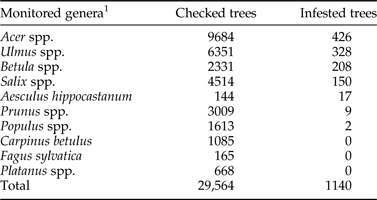
Since June 2009, a specific eradication protocol has been applied against the ALB population of Cornuda (Faccoli et al., Reference Faccoli, Vettorazzo, Zampini, Zanini, Coppe and Battisti2011). The eradication includes the monitoring by ground visual checking of all trees belonging to the main ALB host genera known from the literature (Hu et al., Reference Hu, Angeli, Schuetz, Luo and Hajek2009; Haack et al. Reference Haack, Hérard, Sun and Turgeon2010) growing within 2 km from each infested tree. During the monitoring, performed twice a year in spring and fall, the host-list is progressively updated as ALB is found also on other tree species, and the infestation area is progressively enlarged following the new findings. Large trees or trees showing unclear symptoms are checked with tree-climbers (Faccoli et al., Reference Faccoli, Vettorazzo, Zampini, Zanini, Coppe and Battisti2011). Trees found to be infested, i.e., showing exit holes or oviposition pits, are referenced geographically, recorded in a database (reporting data concerning tree size, position, species and ownership), cut-down, logged, gathered in a safety area and chipped in May to kill mature larvae and pupae just before adult emergence (Faccoli et al., Reference Faccoli, Favaro, Smith and Wu2015a, Reference Faccoli, Favaro, Concheri, Squartini and Battistib). Up to 2013, about 30,000 host trees growing over an infestation area (including core infestation and buffer area) of about 5625 ha were singly checked. Of these, 1140 trees were found to be infested by ALB, including 426 Acer, 328 Ulmus, 208 Betula and 150 Salix (Table 1). Other tree species, such as Aesculus, plum trees and poplars, were infested only marginally (Table 1).
Number of checked and infested trees per genus monitored in the infestation area between 2009 and 2013. Tree species are listed according to the number of infested trees.

1 where only the genus is reported, this may include many different species.
Insect collection and rearing
ALB adults needed for the experiments were obtained from laboratory rearing of infested logs. In late May 2013, several hundred infested logs were collected from trees cut in the infestation area during the application of the eradication plan. The logs (about 35–40 cm long and 15–20 cm in diameter) belonged to different tree species, including mainly Acer pseudoplatanus L., Betula pendula Roth, Ulmus pumila L., and Salix spp. The logs were moved to a field laboratory, and placed singly or in pairs in aerated plastic tubes (50 cm long, 30 cm diameter) to await adult emergence. Both ends of the tubes were covered with a fine metal mesh screen to retain the emerged insects until checking and collection. The tubes were stored outdoors, under a plastic roof protected from rain and direct sunshine, but ensuring good ventilation and thermal exchange. Before being placed in the tubes, the cut surfaces of the logs were sealed with paraffin to reduce drying. The rearing tubes were checked weekly until June for adult emergence. Then, during beetle emergence (June–August), the tubes were checked three times a week and all emerged adults were collected. The newly emerged adults were collected, counted and sexed according to Lingafelter & Hoebeke (Reference Lingafelter and Hoebeke2002), placed in separated transparent plastic boxes (40 × 60 × 30 cm3), and fed upon freshly cut twigs of Acer (A. pseudoplatanus) placed in a glass with fresh water and replaced twice a week. The cages were kept under laboratory conditions at 22°C and 16 : 8 h = L : D photoperiod. Before being tested, the adults were held in the boxes for at least 20 days to ensure their full sexual maturation (Li & Liu, Reference Li and Liu1997; Keena, Reference Keena2002; Smith et al., Reference Smith, Bancroft and Tropp2002). In July, healthy and fully matured adults were collected from the maturation boxes and randomly assigned to the experimental trials.
Polyphagous insects may have higher performance or higher preference for the host tree on which they were reared (Mopper, Reference Mopper1996). However, previous investigations carried on ALB showed that this kind of effects does not occur in this species (Yan et al., Reference Yan, Li, Luo, Xu, Tian and Zhang2008). Moreover, the maturation feeding of adults carried out in the cages on the same host species (Acer) and the random assignment of the adults on the trials should level out such an effect.
Choice experiment
In July 2013, 30 pairs of mature ALB adults (one male and one female) were placed in wire mesh boxes (100 × 100 × 150 cm3) each containing a standing fresh log (about 40 cm long and 10 cm diameter) of each of the four main host genera known to be infested by ALB in the field (Table 1). The species chosen were A. pseudoplatanus, B. pendula, Ulmus glabra and Salix alba. The cut surfaces of the logs were sealed with wax in order to preserve moisture, as proposed by Hajek & Kalb (Reference Hajek and Kalb2007). The experiment was conducted on six replicates, i.e., six boxes, for a total of 24 logs and 5 pairs of ALB adults per box. Every 3 days, the logs were rotated within the boxes to reduce any possible position effect. Because food quality may drastically affect female fecundity, the adults were fed upon freshly cut twigs of Acer (A. pseudoplatanus) placed within the box in a glass with fresh water and renewed twice a week. The boxes were maintained in the laboratory at 22°C and under 16 : 8 h = L : D photoperiod (Faccoli et al., Reference Faccoli, Favaro, Concheri, Squartini and Battisti2015b). As it can occur that adults die after a few days, insects that died within 2 days from the beginning of the experiment were replaced with naïve adults (i.e., adults not been ovipositing before being used and just feeding on foliage). New naïve adults were checked again after 2 days, and then twice a week during maple twig replacement. As final data on female fecundity could be influenced by female lifespan, females showing unusually short lifespan (i.e., shorter than 1 month) were not considered in the data analysis. Adults were held in the rearing boxes for 2 months.
No-choice experiment
Field trials
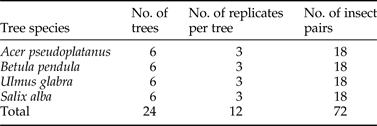
In July 2013, a field experiment was conducted on breeding performance of ALB reared on different host trees. Apparently healthy, that is, with no visible signs or symptoms of infestation, mature trees were chosen randomly in the town centre from hedges, gardens and public parks. Six trees belonging to the four ALB host species investigated in the previous experiment (A. pseudoplatanus, B. pendula, U. glabra, and S. alba) were tested, for a total of 24 trees (Table 2). A pair of mature ALB adults (one male and one female) was placed inside a cage of 0.5 mm wire mesh fixed at about 3 m from the ground. Three cages were set up on different branches (about 15 cm in diameter) of each tested tree, for a total of 144 beetles (72 pairs) (Table 2). The tested tree branches were as similar as possible in size and only reachable from the ground by ladder, to prevent tampering. The cage was constructed as described in Faccoli et al. (Reference Faccoli, Favaro, Concheri, Squartini and Battisti2015b) by wrapping a sheet of wire mesh (100 × 50 cm2) around the branch, stapling the ends to the branch and further sealing the ends with metal ribbon. Each caged branch had also a number of small fresh twigs providing leaves needed for adult feeding. Twigs were changed weekly with new fresh maple twigs. The resulting cage was about 90 cm long and 50 cm in diameter, allowing enough room for the adults to move freely along the branch, feed, mate and lay eggs. Two days later, each insect pair was checked and all dead individuals were replaced with new naïve adults of the same age. Adult mortality was checked weekly during maple twig replacement, and females showing unusually short lifespan (i.e., shorter than 1 month) were not considered in the data analysis. Two months later, the cages were removed, the branches cut from the trees and the resulting logs taken to the laboratory for analysis. Because temperature may have a strong effect on ALB adult reproduction and egg hatching (Keena, Reference Keena2006) the tested trees were selected in sites exposed to a similar mean temperature, located at the same elevation and latitude.
Tree species, number of replicates and insect pairs tested in the no-choice field experiment.
Laboratory trials
In the same month (July 2013), single pairs of mature ALB adults (one male and one female) were placed in ventilated transparent plastic boxes (50 × 40 × 60 cm3) each containing three fresh logs (about 40 cm long and 15 cm diameter) belonging to the same species (either A. pseudoplatanus, B. pendula, U. glabra or S. alba). As previously described, the cut surfaces of the logs were sealed with wax in order to preserve moisture. Six replicates, i.e., six boxes, were set up for each of the four tree species, for a total of 24 boxes and 48 ALB adults (24 males and 24 females). The insects were provided with fresh Acer twigs replaced twice a week. Adults that died within 2 days from the beginning of the experiment were replaced with new ones. Insects were held in the rearing boxes for 2 months, then the logs were analysed for ALB feeding and breeding activity.
Log processing
In both field and laboratory experiments, at the end of the trials the tested logs were debarked and analysed to assess ALB breeding activity, measuring the following parameters:
a) Female fecundity. Total number of eggs laid by the females assessed by dissection of each oviposition pit found in the logs, and corresponding to the number of hatched and unhatched eggs. As females may chew oviposition pits without laying eggs (Smith et al., Reference Smith, Bancroft and Tropp2002), oviposition pits with no eggs (i.e., empty) were not accounted in female fecundity.
b) Egg mortality. Number of unhatched eggs.
c) Larval survival. Percentage of young larvae (1st and 2nd instar) found alive in the phloem (after debarking) in relation to the number of hatched eggs (i.e., alive eggs giving larvae). As the logs were debarked only 2 months after the beginning of the experiment, most larvae were still in the phloem and not in the sapwood. The few sapwood entrance holes were however counted and considered as live larvae.
Although all analysed logs had a standard size (40 cm long and 15 cm diameter), all data were reported as mean values per ALB female, and not per log or log surface.
Statistical analysis
Every single tested tree (field trials) or box (laboratory trials) was considered as a true replicate in the following statistical analysis. Thus, the mean of the data measured from the three logs coming from the same tree or the same box was used as single value for that tree or box. Number of laid eggs (female fecundity), egg survival and larval survival were the variables recorded according to the different host trees. The analysed variables, reported as mean values (±SEM) per female, were singly compared by one-way analysis of variance (ANOVA) (Zar, Reference Zar1999), looking for significant differences among different host trees. Homogeneity of variance was tested by Cochran's test (test C) and normality by the Kolmogorov–Smirnow test (test D). Whenever necessary, data were log−[X' = log(x + 1)] or arcsin−(X' = arcsin√x) transformed to obtain homogeneity of the variance and normality. Where significant differences occurred, Tukey's Honestly Significant Difference multiple comparison test was applied for mean separation (Zar, Reference Zar1999). Non-homogeneous, non-transformable data were analysed with the χ2 goodness-of-fit test using Yates’ correction for continuity, or by the Kruskal–Wallis ANOVA. Differences at the 0.05 confidence level were considered significant. Analyses were performed using Statistica 3.11® for Windows® software (StatSoft Inc., Tulsa, OK).
Results
Choice experiment
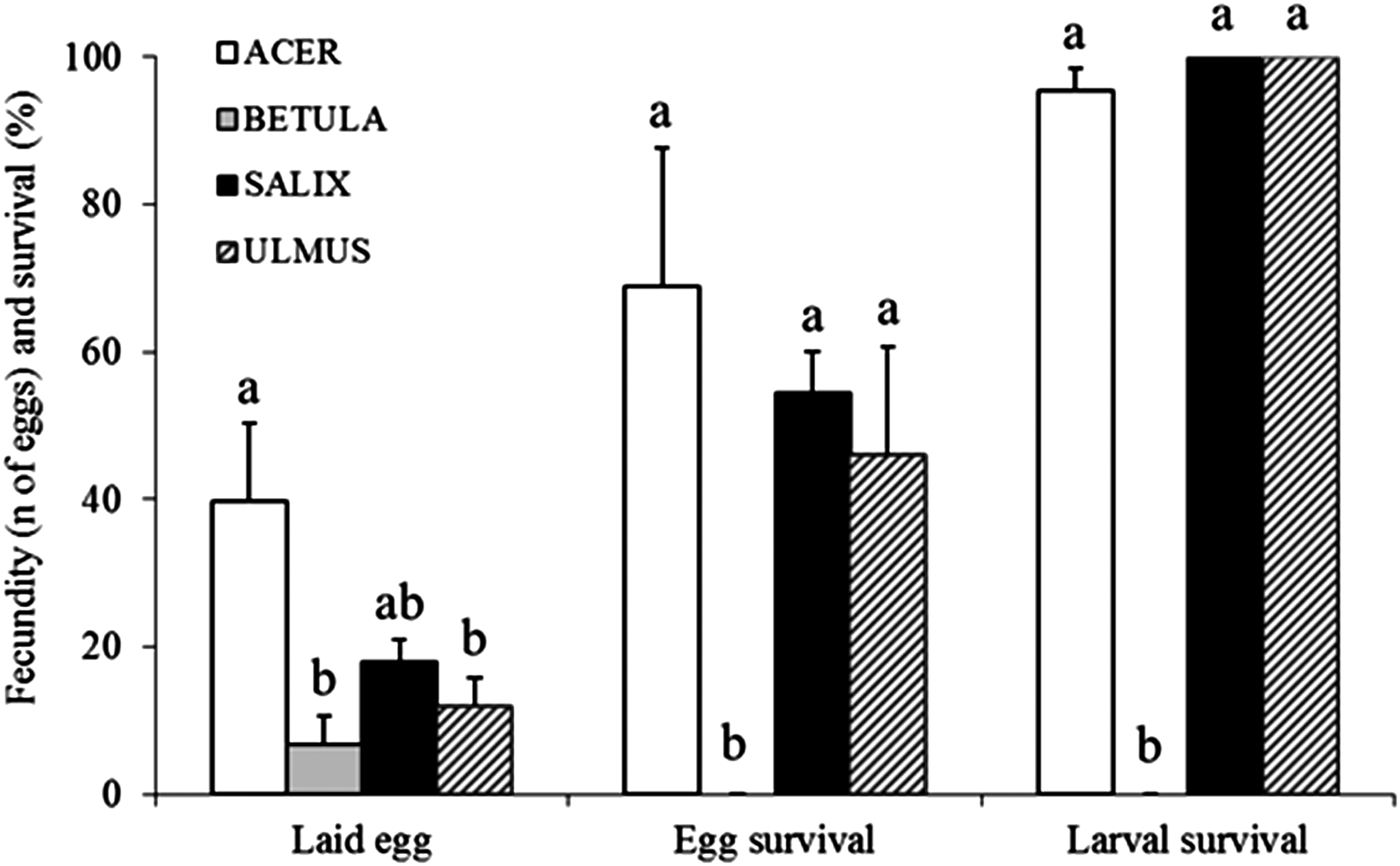
Realized female fecundity (mean number of eggs laid per female) differed among the tested tree species (ANOVA, df = 3; 20, F = 5.45, P < 0.05), with higher values on Acer (39.6 ± 10.7) than Ulmus (12 ± 3.7) and Betula (6.6 ± 3.8). Salix showed intermediate values (18 ± 3.0) (Tukey test, P < 0.05) (fig. 1). Mean egg survival also differed among species (ANOVA, df = 3; 20, F = 5.89, P < 0.05), with Betula showing lower values (no surviving eggs) than Acer (68.8 ± 18.7%), Salix (54.4 ± 5.5%) and Ulmus (46 ± 14.7%) (Tukey test, P < 0.05) (fig. 1). Lastly, larval survival showed significant differences among trees species (ANOVA, df = 3; 20, F = 1125.14, P < 0.001), as Betula had lower values (no surviving larvae) than the other tree species (Tukey test, P < 0.05), with Acer, Salix and Ulmus having 95.5 ± 2.9, 100 and 100% of larval survival, respectively (fig. 1).
Female fecundity and breeding performance (egg and larval survival) of ALB recorded in different host species during laboratory choice test. The analysed variables are reported as mean values of the observed replicates (±SEM). Different lowercase letters indicate a significant difference among host tree species within a given life stage (ANOVA test).
No-choice experiment
Field trials
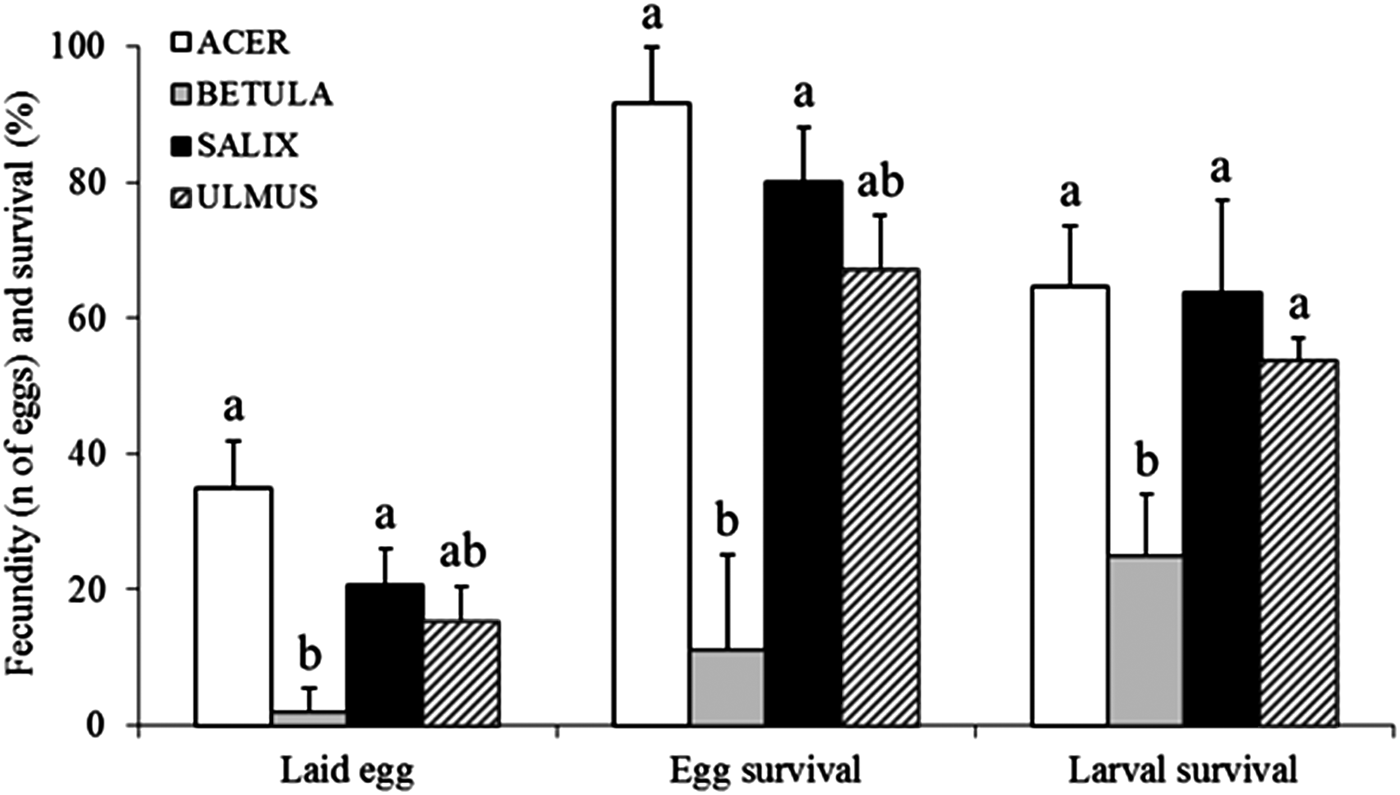
The ALB fecundity tested in a no-choice experiment conducted in the field varied from 0 to 60 eggs per female, with a mean of about 17.4 eggs/female. Female fecundity was affected by the host tree (ANOVA, df = 3; 20, F = 6.66, P < 0.01), with Betula showing significantly lower values (1.8 ± 3.7) than Acer (35 ± 6.9) and Salix (20.7 ± 5.3); Ulmus (15.5 ± 5.0) showed intermediate values (Tukey test, P < 0.05; fig. 2). Egg survival showed the same trend as female fecundity with significant differences among tree species (ANOVA, df = 3; 20, F = 5.01, P < 0.01). Egg survival recorded for Acer and Salix – 91.6 ± 8.3% and 79.9 ± 8.2%, respectively – was higher than Betula (11.1 ± 14.0%); again Ulmus (67.2 ± 8.0%) showed intermediate values (Tukey test, P < 0.05) (fig. 2). Lastly, larval survival was lower in Betula (25 ± 9.0%) (ANOVA, df = 3; 22, F = 1.98, P < 0.05) than in Acer (64.6 ± 8.9%), Salix (63.8 ± 13.5%) and Ulmus (53.7 ± 3.2%) (Tukey test, P < 0.05; fig. 2).
Female fecundity and breeding performance (egg and larval survival) of ALB recorded in different host species during field no-choice tests. The analysed variables are reported as mean values of the observed replicates (±SEM). Different lowercase letters indicate a significant difference among host tree species within a given life stage (ANOVA test).
Laboratory trials
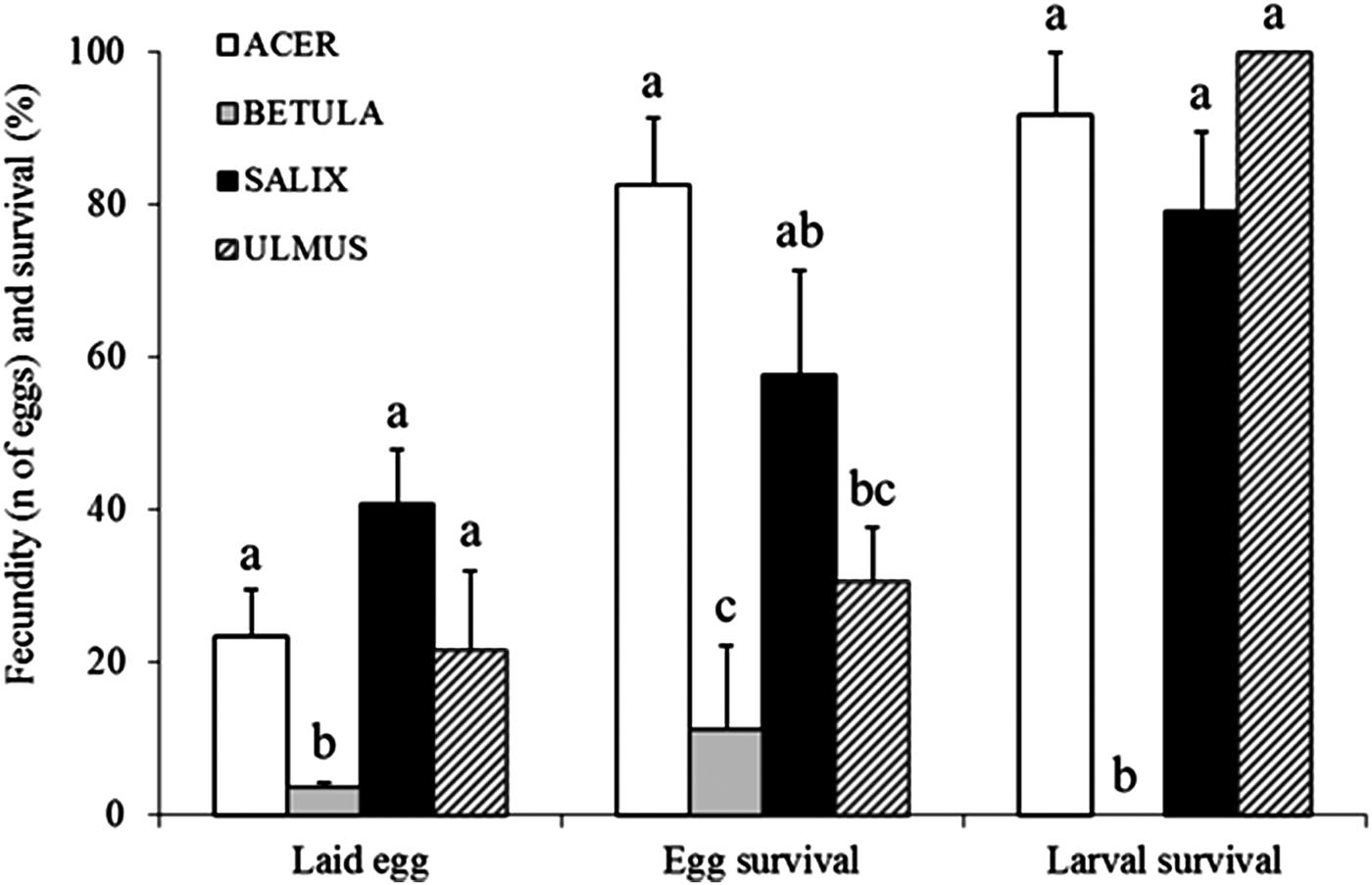
The ALB fecundity tested in the no-choice experiment conducted in laboratory conditions varied from 2 to 60 eggs per female, with a mean of about 25.4 eggs/female. Female fecundity was strongly affected by the host tree (ANOVA, df = 3; 20, F = 4.69, P < 0.01). The lowest fecundity was recorded on Betula with a mean of only about four eggs per female (3.6 ± 0.6), significantly lower than those observed on Acer (23.3 ± 6.1), Salix (40.6 ± 7.1) and Ulmus (21.6 ± 10.2) (Tukey test, P < 0.05) (fig. 3). Egg survival, reported as proportion of hatched eggs on the total of laid eggs, also showed significant differences among host trees (ANOVA, df = 3; 20, F = 8.95, P < 0.001), with Acer and Salix showing a higher egg survival – 82.5 ± 8.7% and 57.7 ± 13.6%, respectively − than Betula (11.1 ± 9.1%); Ulmus (30.6 ± 7.0%) differed only from Acer (Tukey test, P < 0.05; fig. 3). Similarly, larval survival differed among tree species (ANOVA, df = 3; 20, F = 47, P < 0.001), with Betula showing lower values (no surviving larvae) than Acer (91.6 ± 8.3%), Salix (79 ± 10.4%) and Ulmus (100%) (Tukey test, P < 0.05; fig. 3).
Female fecundity and breeding performance (egg and larval survival) of ALB recorded in different host species during laboratory no-choice tests. The analysed variables are reported as mean values of the observed replicates (±SEM). Different lowercase letters indicate a significant difference among host tree species within a given life stage (ANOVA test).
Discussion
This is the first study reporting detailed information concerning host preferences and host colonization of ALB in natural conditions in Southern Europe, not referring only to the number of infested trees. Moreover, host preference recorded in the field was tested also by specific laboratory choice and no-choice experiments. While the general results partially confirm data known from other ALB populations and infestation areas, the main outcomes of the present investigation suggest that the mechanisms of host-selection and host acceptance of ALB are probably extremely complex and affected by both endogenous and exogenous factors that vary between populations.
Infestations of A. glabripennis have been reported in Western countries since 1996 (Haack et al., Reference Haack, Cavey, Hoebeke and Law1996, Reference Haack, Law, Mastro, Ossenbruggen and Raimo1997), and many lists of host plants have been published often showing discrepancies among one another (Hu et al., Reference Hu, Angeli, Schuetz, Luo and Hajek2009; Gaag & Loomans, Reference Gaag and Loomans2014; Straw et al., Reference Straw, Fielding, Tilbur, Williams and Inward2015), with the preferred hosts varying between infestation areas (Haack et al., Reference Haack, Hérard, Sun and Turgeon2010; Straw et al., Reference Straw, Fielding, Tilbur, Williams and Inward2015). In this study, ALB host colonization (i.e., number of laid eggs) results as being strongly affected by host species. Differences among hosts are found in both field and laboratory conditions. Of the four genera tested in the study and known to be susceptible to ALB colonization (Acer, Ulmus, Salix and Betula), in average Acer allows the highest ALB colonization, although with significant differences occurring only with Betula and partially with Ulmus (see figs 1 and 3, for ‘laid eggs’ and ‘egg survival’, respectively). The slight differences found between Acer, Salix and Ulmus, nonetheless, support the previous observations suggesting that the tree species hosting larval development and maturation feeding of the adults (in this case, Acer) may have a scare influence in the next preferences of a highly polyphagous species such as ALB (Yan et al., Reference Yan, Li, Luo, Xu, Tian and Zhang2008). Moreover, the similar results obtained in both field and laboratory trials confirm that the use of cut logs in laboratory trials does not affect beetle performances. Actually, larvae were able to develop even in 2-months old logs, which kept a sufficient moisture content (authors observation). Despite that, we cannot exclude a possible variation or decay of some phloem and sapwood components, but their effects and consequences on ALB performance seem to be negligible.
Our results confirm the observations made in other introduction areas, where Acer are usually the hosts mainly attacked by ALB (Hu et al., Reference Hu, Angeli, Schuetz, Luo and Hajek2009; Haack et al., Reference Haack, Hérard, Sun and Turgeon2010; Straw et al., Reference Straw, Fielding, Tilbur, Williams and Inward2015). Also in two recent works concerning infestation of forest stands, ALB shows a clear preference for Acer trees even if other susceptible genera occurred in the area (Dodds & Orwig, Reference Dodds and Orwig2011; Dodds et al., Reference Dodds, Hull-Sanders, Siegert and Bohne2014). Although, Acer are the most attacked species in the field (426 of 1140 infested trees), the number of infested trees was nevertheless only 4.4% of the Acer trees available in the infestation area (9684 Acer). In this respect, Betula is instead the species most affected by ALB (8.9% of the available Betula trees). The discrepancy between the most infested (Acer) and the preferred host (Betula) is presumably a result of the large availability of Acer trees and lower density of other suitable tree species. In addition, the ALB spreading behaviour may have a major role in host colonization because ALB only spreads slowly and over short distances (Smith et al., Reference Smith, Bancroft and Tropp2002; Favaro et al., Reference Favaro, Wichmann, Ravn and Faccoli2015). Adults may hence simply infest the closest suitable trees occurring in the surroundings, rather than other most preferred species. Betula are usually reported among the main ALB hosts (Hu et al., Reference Hu, Angeli, Schuetz, Luo and Hajek2009), supporting our field observations (208 trees of 1140) carried out within a 2-km radius around each infested tree. Interestingly, for the ALB population established in Kent (Southern England) in 2012, Straw et al. (Reference Straw, Fielding, Tilbur, Williams and Inward2015) report very similar values of Betula infestation (about 8%). However, if compared with the infestation data collected during field monitoring, the low tree colonization observed on Betula during our experimental trials is an unexpected result. When breeding on Betula, ALB shows the lowest values in term of laid eggs, egg and larval survival in both laboratory and field essays. Although a possible explanation might be the log decay in laboratory conditions, the colonization failure even on living trees makes this hypothesis unreliable. The high number of infested trees recorded in the field may instead rely on an overestimation of ALB occurrence on Betula during the tree survey. In this respect, Betula growing in urban parks and gardens are commonly infested by many wood borers, both long-horned beetles such as Lamia textor (L.) (Coleoptera Cerambycidae) or Cerambyx scopolii (Fuessly) (Coleoptera Cerambycidae) (Bense, Reference Bense1995) and cossids such as the Leopard moth Zeuzera pirina (L.) (Lepidoptera Cossidae) or Goat moth Cossus cossus (L.) (Lepidoptera Cossidae) (Heath & Emmet, Reference Heath and Emmet1985). Exit holes occurring on the infested trees usually allowed separating among different wood borers (for instance different species of longhorn beetles and jewel beetles). Moreover, suspect trees were thoroughly checked also by the tree-climbers. Nevertheless, mistakes were supposed to occur on Betula following the large number of wood borer species which may infest this tree in urban environments, producing emergence holes very similar in shape and size to those of ALB. For instance, L. textor and especially Z. pirina were found frequently on felled trees (author's observations). In most cases, the tree survey conducted from the ground by the operators of the Regional Plant Protection Organization is unable to distinguish from infestation symptoms (such as exit holes) caused by other wood borer species. Moreover, following a precautionary policy adopted during the application of the eradication protocol, all trees growing in the quarantine area and showing infestation symptoms potentially attributable to ALB are cut, chipped and listed as effectively ALB-infested trees. Low colonization of ALB on Betula was also reported in a previous study conducted on the same population (Faccoli et al., Reference Faccoli, Favaro, Smith and Wu2015a), in which colonization success of Betula resulted as extremely low when compared with other tree species. Moreover, analysing the overwintering survival of ALB in these four hosts in natural conditions, Betula resulted as being the host genus with the highest percentage of empty oviposition pits and dead larvae in phloem, confirming the scarce ALB performance in Betula (Faccoli et al., Reference Faccoli, Favaro, Smith and Wu2015a).
Some ALB populations are known to be able to fully develop in a specific host species, while the same host is reported to be suitable only for oviposition but not for larval development, or even recorded as unsuitable in other populations. For instance, green ash trees are reported as suitable hosts for complete ALB development in both China and Chicago infestations, whereas in the New York outbreak only oviposition is reported in green ash (Nowak et al., Reference Nowak, Pasek, Sequeir, Crane and Mastro2001). Although for many insect species host plant quality is a key factor affecting quantity and quality of the brood (White, Reference White2014), for others it is not. Sometimes, host choice made by insect females during oviposition can be erroneous in terms of host quality (Larsson & Ekbom, Reference Larsson and Ekbom1995), or they cannot differentiate between hosts on the basis of quality (Rauscher, Reference Rauscher1985). In a study on the susceptibility of four American tree species (Acer saccharum, Acer rubrum, F. pennsylvanica, Quercus rubra), Morewood et al. (Reference Morewood, Neiner, McNeil, Sellmer and Hoover2003) observed a relatively large ALB oviposition on green ash although only a few larvae survived in it. In this respect, – even if not forced – ALB females also accept to oviposit in suboptimal hosts greatly affecting brood survival and development. This reproductive behaviour seems to be a common trait in ALB, which presents different host preferences in different infestation areas (Hu et al., Reference Hu, Angeli, Schuetz, Luo and Hajek2009; Haack et al., Reference Haack, Hérard, Sun and Turgeon2010). Comparing ALB host plants in China, Chicago and New York, Nowak et al. (Reference Nowak, Pasek, Sequeir, Crane and Mastro2001) found that many of the infested tree species were suitable for oviposition only but not for larval development, and that adult emergence was confirmed in just some of them. Moreover, Fraxinus, Malus, Platanus and Tilia resulted to be accepted hosts in one site but not in others (Nowak et al., Reference Nowak, Pasek, Sequeir, Crane and Mastro2001). Even poplars, which are among the main preferred hosts in China (Zhao et al., Reference Zhao, Li and Ge1997; Wen et al., Reference Wen, Luo, Yue and Liu1998; Hu et al., Reference Hu, Angeli, Schuetz, Luo and Hajek2009), were not fully accepted in Chicago and New York. Similarly, of the 1613 poplar trees occurring in our infestation area, only two have been found attacked by ALB.
While some tree species may have effective defences against ALB (Morewood et al., Reference Morewood, Hoover, Neiner, McNeil and Sellmer2004a, Reference Morewood, Neiner, Sellmer and Hooverb) and its symbionts (Geib et al., Reference Geib, del Mar Jimenez-Gasco, Carlson, Tien and Hoover2009, Reference Geib, Scully, del Mar Jimenez-Gasco, Carlson, Tien and Hoover2012; Schloss et al., Reference Schloss, Delalibera, Handelsman and Raffa2006), affecting oviposition (i.e., host-acceptance) or larval development, the large variations in host range shown by ALB may also be regulated by other factors. The preferences expressed by ALB for a specific host species in a particular infestation area, but the avoidance of the same tree species in another one, seems to be the result of specific traits involving both the origin of the founders – i.e., the genetic characteristics of the population – and their adaptation to the local conditions found during the colonization of new areas. In a recent paper concerning the possible effect of habitat and tree suitability on ALB tree colonization, Faccoli et al. (Reference Faccoli, Favaro, Concheri, Squartini and Battisti2015b) demonstrated that the host-selection and reproductive behaviour of ALB largely depend on habitat type and nutritional characteristics of the potential host trees. Same host-tree species growing in habitats having different nitrogen availability allowed ALB colonization only following a mechanism of compensatory feeding of different intensity (White, Reference White2014). Suitability of different trees may instead be due to other factors, such as secondary chemical compounds (Faccoli et al., Reference Faccoli, Favaro, Concheri, Squartini and Battisti2015b). One plausible explanation for the extraordinary host adaptation of ALB was proposed by Morewood et al. (Reference Morewood, Neiner, McNeil, Sellmer and Hoover2003), who argued this behaviour as a strategy maintaining the beetle population in an area for a long time, avoiding long dispersal in favour of the exploitation of all available trees, changing their composition over time. A reduced breeding performance on sub-optimal hosts may therefore be the ecological cost of this broad polyphagia.
In conclusion, host preference and host colonization of ALB in this new habitat show interesting results. Both laboratory and field trials showed the highest ALB colonization on Acer trees, with the highest number of laid eggs and the lowest egg and larval mortality. Ulmus and Salix showed egg and larval mortality with mean values similar to Acer, although with a sensibly lower number of laid eggs during laboratory choice test. On the contrary, Betula showed the lowest beetle suitability in terms of both number of laid eggs and survival. An overestimation of the number of infested Betula occurring in the field may explain the discordance between high number of infested Betula and low beetle suitability. Instead, the large number of infested Acer recorded in the field was probably due to the high abundance of these trees in parks and gardens. Although many studies have been conducted on ALB host preference, a number of molecular, biological and ecological aspects are still unclear. Differences in host preferences, host choice and host suitability are widely reported in the literature, but the underlying host-selection mechanisms remain scarcely understood. Further studies could focus, for instance, on the molecular characterization of ALB populations from various infestation areas in relation to host preference, suggesting interesting findings on the host-selection mechanisms of this extremely invasive pest.
Acknowledgements
The authors thank the foresters of the Regional Plant Protection Organization of the Veneto Region, and the Regional Forest Service of the Treviso district for assistance during field work. Special thanks to Alison Garside for language proofreading. The research was supported by the Italian national project ‘2010−CPDA104007: The study of the response mechanisms to climatic change in model forest insects’, by the University project ‘Effects of climate change and invasive alien species on native forest insects’, and partially supported by the ex-60% projects of the University of Padua.