Before Najla passes me the gourd brimming with yerba mate, she makes sure to wipe the end of the metal drinking straw with the fragrant leaves of a local herb—for the flavor and to clean it she explains in her Venezuela-accented Spanish.Footnote 1 We sit under the welcome shade of a veranda, each taking our turn to drain the gourd and then returning it to Najla to fill once more with warm water from the teakettle. After splashing a pitcher of cold water on the concrete to cool it, her husband offers us a rare privilege: the liberty to ask any question we wish about the Druze religion. The Druze, an offshoot from eleventh-century Shi'a Islam, are endogamous and usually reveal the tenets of their faith only to those born within their community. Though we are speaking a mixture of English and Spanish, we are all guests at the Lebanese mountaintop home of Najla's deceased grandfather, an important Druze warlord during the civil war of the 1970s and 1980s. Najla and her husband are vacationing from their home in the Persian Gulf and staying with her unmarried female cousins, our hosts.
The Druze acquired the habit of drinking yerba mate, a stimulating infusion made from steeping the leaves of a holly-like tree indigenous to South America, as a result of transnational migration to the Southern Cone during the twentieth century. Though Lebanon and Syria are the largest consumers of yerba outside South America, within the Levant it is associated primarily with the Druze. As the interlude with Najla showed, mate consumption follows a highly ritualized performance that retains many elements from its consumption in South America. For example, the word for the drinking straw, bombilla, comes from the Spanish, but instead of the South American term, the Arabic word for “gourd,” qar‘a, is used for the drinking vessel.Footnote 2 For the Druze, drinking mate is at once a leisure and domestic activity. It is taken by women at home during the day while the men of the family are at work, or, as we see from Najla, conducted by women when in mixed company. How a beverage indigenous to South America and, indeed, indexical of Southern Cone identity and largely unknown outside that region, has in the last century come to be widely consumed in the Middle East (and increasingly in North America and Europe) is all the more notable given its origins, and earlier, failed attempts at exporting the leaf.
In 1592, the criollo governor of Paraguay, Hernando Arias de Saavedra, searched the looted bags of indigenous Guaraní defeated in a military campaign. The victors came across a powder the Guaraní called ka'a.Footnote 3 In this manner, Europeans supposedly first encountered yerba mate.Footnote 4 Though this apocryphal account seems to have been invented out of whole cloth by yerba enthusiasts as nineteenth-century propaganda for European consumers, it is true that soon after their 1537 entrance into what is now Paraguay the Spaniards quickly acquired the habit from the natives. In the course of a few decades they expanded the use of yerba throughout the southern part of their empire, from Potosí to Santiago de Chile to Buenos Aires.Footnote 5 At the turn of the seventeenth century two other stimulating infusions, tea and coffee, were still unknown in Europe, and so all three products entered the European world at approximately the same time. All three delivered a hitherto unknown substance, caffeine, which was to change the social, physiological, financial, and imperial face of Europe. But why did yerba not take in the same way as tea, coffee, and cacao?
To the bitter disappointment of South American yerba producers, multiple efforts to introduce yerba to a broader public generally foundered until the later twentieth century. This article examines this recent about-face by linking a diachronic analysis of market to a diachronic analysis of meaning. To do so, I treat secondary documents as primary documents; look at books, pamphlets, and other advertising material oriented toward an audience outside of South America; examine texts meant for a South American audience that speak about yerba's relationship with the rest of the world; and set all of this against a botanical and historical description of yerba. Though I focus on documentary and archival sources, I draw also upon recent ethnographic research consisting of participant-observation of mate consumption among South American expatriates in New York, the Druze in Lebanon, and throughout Paraguay, as well as interviews with yerba vendors in Paraguay and café operators in New York and Lebanon.Footnote 6 Yerba has been critical to the economic and political formation of Paraguay, a subject documented and analyzed in works that uncover its historical significance, most notably by López, Blinn Reber, and Whigham.Footnote 7 Nevertheless, there is a curious dearth of scholarship on the contemporary use of yerba in both South America and the Middle East.
Consumption is the embodied interface of political economy and symbolic significance and it both reveals and complicates the interplay between economic forces and the choices of individuals and groups. Following the analytical model of tracing “commodity chains” beyond national economies suggested in Topik, Marichal, and Frank,Footnote 8 I argue that only by looking at both the historical development of yerba's market and the way yerba has been used can we understand the positioning of yerba toward a wider audience. As it moved beyond the indigenous community to European colonizers, encountered effective barriers in Europe and North America, accidentally adhered to migration between South America and the Middle East, and finally benefited from intentional ventures in the global north, yerba has been re-signified into new representations. These reflect changes in its political economy, shifting from a Spanish crown monopoly product to being a free market competitor with other “drug foods.”Footnote 9 By examining quantifiable factors (economic and institutional) alongside non-quantifiable aspects of cultural contextsFootnote 10 through which people make sense of and give meaning to the product, we can begin to explain why yerba failed for centuries to penetrate the non-Latin American world, and what changes have engendered new possibilities in the present day, as we trace the commodity's path through an alternative consumption/production circuit that evades the global north.
Put simply, “yerba mate” is a different thing in different places, even if the imbibing ritual looks the same (although changes in this are often one clear sign of differences). In this sense yerba is a fetish—not in the sense that it is false, but rather in that it is a changing meeting of social relations and material properties. Furthermore, any implication that the former are malleable whereas the latter are fixed is, as we shall see, erroneous. In considering the way yerba is fetishized differently in its circulation(s), and thus exploring the mystical qualities with which it is imbued as a result of the combination of its chemical composition and its social use, we treat seriously the somatic substance of yerba as we meaningfully connect seemingly disparate social processes across space and time.
A POLITICAL-ECONOMIC HISTORY OF EUROPE'S ENCOUNTER WITH YERBA
The Colonial Encounter
Yerba mate (Ilex paraguariensis) is a small tree native to the humid woodland drained by the Paraná River in eastern Paraguay. Like coffee and tea, yerba contains caffeine as well as other psychoactive alkaloids: theophylline (primarily found in tea, to a much lesser extent in coffee) and theobromine (a non-addictive stimulant which, like chocolate, it contains in greater quantities than either coffee or tea). When raised from seed, whether in its original forest habitat or in today's highly organized plantations, Ilex paraguariensis requires at least four years of growth from the initial planting before the first harvest of leaves and tender branches; after that it may be trimmed every two to four years. At first it yields one or two kilograms of yerba, but after several decades a plant may produce up to one hundred kilograms per harvest.Footnote 11 Harvesters clip, by hand, only the leaves and softer branches, and gather the yerba into a pile that will be dried and processed in the immediate vicinity of the trees. Within twenty-four hours of reaping, the newly cut yerba is flash dried through direct heat (the step called sapecado) and then toasted through indirect heat (the step called secado, traditionally in a specialized oven called the barbacuá), and finally coarsely ground (canchada or mborobiré). Yerba canchada may be consumed as is, but frequently it is aged for at least six months before being more finely ground (molida). At this point the formal processing of the yerba is complete; the remaining steps in Ilex paraguariensis’ journey from plant to drink are taken by the consumer as part of the consumption ritual.
Early-nineteenth-century lithograph of José Gaspar Francia, ruler of Paraguay (1814–1840), mate in hand. Artist unknown. With kind permission from CAV/Museo del Barro, Asunción, Paraguay. Author's photograph.

To prepare (cebar) the beverage, the loose powder is typically steeped in hot water in a drinking vessel, often made from a gourd but also from bamboo or the horns or hooves of cattle, called a mate Footnote 12 or a guampa, and strained through a bombilla, the drinking straw. In Argentina, Uruguay, and the Brazilian state of Rio Grande do Sul, yerba is almost exclusively drunk warm, but in Paraguay's sweltering summer months Paraguayans drink tereré,Footnote 13 yerba mate made with cold water and often mixed with yuyos, herbs and roots used in traditional remedies. Though there is disagreement about this in some of the sources, most historians and archival sources assert that indigenous groups had discovered the plant's uses as a stimulant years before the Conquest. Like users of the more controversial coca to the northwest, they chewed the leaves and also drank it as a liquid brewed from the leaves and stems.Footnote 14 If some Paraguayan accounts are correct, it seems that a pre-colonial trade in yerba existed. Remnants of yerba powder found in Incan tombs suggest the plant was linked to prestige.Footnote 15
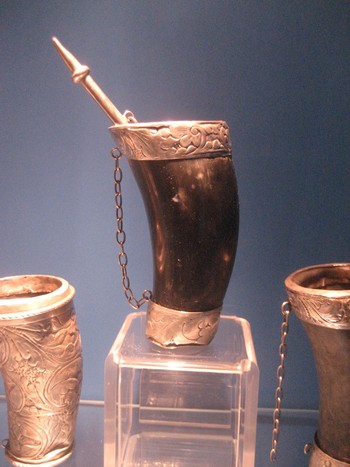
Nineteenth-century cattle-horn guampas with cavalry themed embossing, for use while riding. With permission from Centro Cultural Citibank/Museo del Barro, Asunción, Paraguay. Author's photo.

At the time of European contact, the indigenous people of inland South America already had extensive knowledge about how to locate and harvest the best trees. The many different varietals of yerba were found in the wild in such abundance that the precolonial population did not have to turn to agriculture to supply their needs.Footnote 16 Unlike tea, coffee, and to a lesser degree chocolate, yerba proved much more difficult to cultivate and therefore harder to transplant to other regions more accessible to European and North American markets. According to common colonial wisdom, seeds are encased in a shell so hard that germination is impossible unless the seeds have passed through the intestines of birds, where the acidity wears down the lining to allow the seedling to burst through the case.Footnote 17 Because of Paraguay's soil conditions, tree types, climate, and even processing techniques, its yerba long enjoyed the reputation as the best in the world, to the consternation of the country's neighbors.Footnote 18
Though the Spanish government first encountered the plant, European familiarity with yerba came via the Jesuits, notably through the eighteenth-century accounts of Fathers José Sánchez Labrador and Martin Dobrizhoffer's experiences in Paraguay, as well as through the order's commercial networks. Because Paraguay lacked the mineral wealth, population density, and organized state societies of Peru and Mexico, the Spanish crown was more willing to cede (at least at the beginning) responsibility and authority to various church orders, chiefly the Jesuits.Footnote 19 Shortly after founding Asunción in 1537, the Spanish realized that yerba trade could provide revenue for the crown. Yerba production took the place of gold and silver mining in meeting Spanish tribute requirements (the mita), and yerba even took the place of money in exchange.Footnote 20 This was not merely a convenient substitution—according to Whigham, because yerba sprang from the earth without human intervention, Spanish law treated it as a mineral.Footnote 21 Just as mine labor decimated the Indian population, yerba harvesting disrupted the indigenous social system as workers were forced to leave their communities and relocate into the hinterland to collect it. They were even called mineros (mine workers). Into this stepped the Jesuits. The crown had issued new directives to stave off the population destruction wrought by conquistadores intent upon extracting as much surplus as they could in as little time as possible. (Since wealth acquired in the Spanish New World generally was not inheritable, enjoying the benefits of the conquest frequently involved working the Indians to death.) With this, and with a call to fulfill the moral mandate to instruct the natives in the teachings of the church, the Jesuits set about correcting what they saw as the excesses of a worldly enterprise.
As part of their work in the indigenous communities in that region, in the 1580s the Jesuits endeavored to create an institution tailored to local specificities, both linguistic (e.g., using Guaraní as the official language of their outreach) and geographic. They organized (into reducciones) Guaraní missions under their tutelage and jurisdiction, and thereby exercised control over their labor. Many of these missions turned to yerba production, and later cultivation, in yerbales (yerba orchards) as a source of livelihood. To underscore the advantages they saw in this arrangement, in 1774 Jesuit priest and Spanish naturalist José Sánchez Labrador explained in his memoirs that in the labor system governed by the colonial authorities the Indians found themselves pledged again, “and all the more because the masters make them pay for the knife they lend them to cut the yerba, for the use of the pot in which they cook their food, and so on, such that the miserable workers return to their homes naked and in debt…. With these setbacks, their destitute wives and families live almost entirely without protection.”Footnote 22
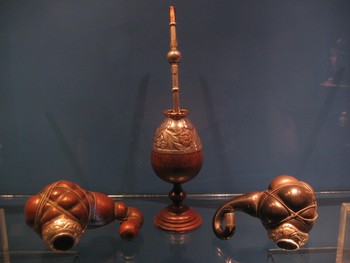
Nineteenth-century mates (made of wood and gourds) capped with embossed metal. With permission from Centro Cultural Citibank/Museo del Barro, Asunción, Paraguay. Author's photo.

It was in the reducciones that yerba was first cultivated, in a process that was at times shrouded in a sort of mystery that speaks to both the worldview of those writing about yerba and to the process and limitations of written knowledge itself. Because yerba grew wild, under the colonial labor system workers left their homesteads and communities and plunged deep into the forests to find new trees that were untouched, a pattern of expedition that separated families and frequently cost the overworked laborers their lives.Footnote 23 In order to prevent this, the Jesuits attempted to create yerba plantations in the reducciones themselves. The general consensus of later writers is that the Jesuits discovered a way to cultivate the plant but that, in keeping with a common secular Spanish suspicion about the order, they guarded the secret closely, and with their expulsion in 1767 their knowledge vanished with them.Footnote 24
Relations between the Jesuits and other colonials in the seventeenth and eighteenth centuries were tense, to say the least. Even as the Jesuits accused encomenderos (the colonials entrusted with administering plots of land and the natives that lived on them) of great neglect and cruelty, they were themselves accused of greedily withholding important secrets. In the past century there has been a general rehabilitation of their reputation, a move that serves to exculpate European intervention in South America while relegating the Jesuits to a distant past. A pamphlet written by the Pan American Union extolling the virtues of the beverage (to an American readership) two decades after yerba was once more successfully grown in plantations explained that the Jesuits, “a very observant and thoughtful class of men,” must have observed the natural germination process and found some way to mimic the softening action of passing through the digestive tracts of birds.Footnote 25 Leon Roger even claims that the Jesuits fed seeds to barnyard birds to wear down the hard casing.Footnote 26 But because they did not divulge this technique, the industry of cultivation was lost when they were expelled “from Brazil.” The story is much the same in Argentina. When economist Ernesto Daumas analyzed the situation of national yerba production, he too asserted that only faint traces remained of the Jesuit yerbales, the tradition of cultivation having been lost in Argentina until 1903.Footnote 27 Brazil had succeeded earlier, in the 1890s, in developing yerba plantations in southern Mato Grosso.Footnote 28
The Business of Yerba
After the Jesuits developed their method of successfully planting yerba orchards, production increased dramatically, as did income from yerba sales. Although Jesuits were accused of protecting their monopoly by selling yerba ground so finely that consumers throughout the Spanish empire would not know what tree the leaves came from, Father Sánchez Labrador's straightforward and botanically detailed memoirs give a different story.Footnote 29 Following a precise description of the yerba tree, in 1774 he gave the same account of yerba harvesting as his fellow Jesuit DobrizhofferFootnote 30 described a few years later: in order to grow yerba from the seed it was necessary to first wash freshly plucked berries in several baths of clean water. This process released a viscous lather that Sánchez Labrador compared to soap. After this, the seeds could be dried and later planted. Without the washings, he explained, the humidity could not penetrate the hard resinous shell and the seeds merely rotted in the soil. To the charge of trade secrecy, he retorted that since all the residents of Paraguay were familiar with yerba trees, used their leaves, and ground them into coarse powder that they later sold, and since the Jesuits had learned about yerba from the Spanish themselves, “It's a good secret, surely—something known in a whole province.”Footnote 31
A more accurate accusation of unfair business practices targeted the Jesuit violation of production limits.Footnote 32 In order to maintain a privileged status that allowed them to avoid most crown tax requirements, the Jesuits had agreed in 1664 to cap their yerba exports at 12,000 arrobas annually (one arroba equaled about 25 pounds, so 12,000 arrobas was about 150 toneladas, or 138 long tons). Colonists, who had to pay many more taxes on yerba, argued that the Jesuits exceeded their limit and gained an unfair competitive advantage. To exculpate themselves, the order had all their records examined in Asunción, proving definitively that at no time from 1664 to 1678 did they exceed the 12,000-arroba ceiling.Footnote 33 The inquiry, however, did not address any trade the Jesuit missions had directly with Buenos Aires since they were located closer to that yerba consuming center, unmonitored by Asunción.
Though yerba was initially raised to meet crown tributary requirements, with the colonial harvesting and the Jesuit yerbal system production increased such that a trade in yerba spread throughout the Spanish New World. Tensions between Jesuits and other colonists came to a head and led to the expulsion of 1767, partly motivated by a desire to get hold of the lucrative yerbales in the Paraná region and seize control of Indian labor.Footnote 34 But because mismanagement and harsher treatment followed, yerba production began to decline in the late eighteenth century as Indians fled reducciones, leaving a population that was only a fraction of that of earlier times. After Paraguayan independence in the early nineteenth century, the new government sought to fill its coffers by taking control of the yerba industry. It did so by “liberating” the indigenous groups from colonial land structures and appropriating the land so that, by 1850, the state of Paraguay owned more than 95 percent of all the national territory.Footnote 35 Here López-Alvez argues, in a Charles Tilly-esque manner, that Paraguayan state formation, alone in Latin America, followed a coercion-intensive model where the lack of a port for revenues meant that the state turned to a kind of state-controlled slavery for income: the indigenous population working in yerbales.Footnote 36 Despite efforts to export to European markets, marked by an 1853 trip to the continent by future president Francisco Solano López, further government mismanagement coupled with the devastation of the War of the Triple Alliance (1865–1870), and the ensuing loss of yerba-producing territory, resulted in a shift in production such that by the end of the nineteenth century Brazil had become the major producer of yerba.Footnote 37 But Brazil turned to coffee production in the early twentieth century and yerba production declined drastically in the 1930s, allowing Argentina to overtake it as the world's top producer and consumer.
Since the “rediscovery” of yerba plantations, Argentina, Brazil, and Paraguay have attempted to expand their markets with renewed vigor. In keeping with Brazil's mid-twentieth-century push to industrialize, Brazilian scientists even sought to promote chemical and industrial uses for the plant beyond its stimulant effect.Footnote 38 Argentina has taken a mildly effective protectionist stance to guard the livelihood of its yerba farmers, who have to compete with cheaper, higher-quality Paraguayan yerba smuggled across the border. With a saturated market in the Southern Cone and with the enticing examples of other “drug foods” such as coffee and tea, the next logical step was to introduce yerba to new markets, namely Europe and the United States. There were multiple attempts to awaken northern interest, culminating in a turn-of-the-century flurry of pamphlets written in French and English, exhibits at conferences, and advertisements and articles in important trade magazines accompanied by supportive letters from consular and medical authorities. But despite these efforts, by the 1930s frustrated marketers were perplexed: “When can we expect an increase in consumption? The United States and France have proven themselves impervious to all temptation.”Footnote 39 Archeologist Ross W. Jamieson can claim, “Yerba mate was never introduced to the European market—perhaps because it only gained commercial prominence in Spanish America after 1700, long after tea, coffee and cacao had become available in Europe.”Footnote 40
But yerba consumption was not wholly unknown or unattractive to Europeans and North Americans; rather it would be better to say that yerba failed to take hold in Europe and North America. For purposes of comparison, chocolate was introduced to Europe in 1544 by Spain, though only in 1634 was the Spanish monopoly broken, resulting in increased production and consumption. Coffee came to Venice in the 1640s, and more than a century earlier in Constantinople. And tea arrived in Amsterdam in 1610, though as late as 1658 it was still widely unknown, since a London coffeehouse could still advertise it as a novel and unheard-of product.Footnote 41 Though both owed their origins and exoticness to “the Orient,” tea was spread primarily through a ritual, whereas coffee was spread through an institution, the coffeehouse, underscoring how commodities may insert themselves into new audiences through a variety of vectors. Coffeehouses, where men gathered to socialize, read, and share news, moved westward from Turkey through Europe, carrying with them a series of products and practices, of which coffee drinking was only one.
Yerba production and export, in fact, coincided neatly with these other stimulant beverages. From both material artifacts and written documents we know that Europe had contact with yerba. Paraguay's Casa de la Independencia, an Asunción museum celebrating independence from Spain, showcases a finely worked silver mate cup and a gold and silver bombilla, both made in Europe in the eighteenth century. Father Sánchez Labrador writes in 1774, “In Spain and in Portugal, many drink yerba … in Italy, with the arrival of the Jesuits, many persons of distinction have [also] drunk it.”Footnote 42 Thomas Ewbank in 1856, writing a mix of travel literature and early ethnography, went so far as to claim that in Europe the knowledge of “tea”-drinking came from South America fully half a century before the “Chinese infusion” appeared.Footnote 43 And even much later, the 1893 World's Columbian Exposition in Chicago featured an exhibit called “Man and His Occupation,” which displayed “methods of collecting and preparing yerba maté [sic] or Paraguayan tea,” including “the different kinds of yerba cups, gourds, calabashes, and bombillas used for drinking the tea,” as well as “methods of preparing guarana, aguadiente [sic], chichi, and other beverages.”Footnote 44
Yerba and other “Drug” Beverages
It was neither for want of promoters nor merely for unfortunate timing that yerba's story differs from those of coffee, tea, and chocolate. Tea and coffee drinking were not cemented as common European practices until the eighteenth and nineteenth centuries.Footnote 45 Both beverages first entered Europe as elite luxury goods rather than as the working class staples they became by the end of the nineteenth century. But other factors help explain why yerba did not catch on in Europe (and subsequently North America) in the way that tea and coffee did. While yerba cannot be understood outside of the context of the other caffeine drinks being introduced to Europe at that time, neither can it be understood outside of the context of empire.
Jankowiak and Bradburd attempt to connect the development of the global capitalist market to the spread of “drugs” that occurred concomitantly with European colonial expansion, and demonstrate that the pairing was more than casual.Footnote 46 They argue that there was a progression as the instrumentality of those drugs changed with different configurations between their physical properties and the labor environment. Whereas in early stages of contact drugs were used to force people into relations of dependency with European trading “partners,” once the ability to control labor could be otherwise secured, the utility of drugs shifted to intensifying the amount of labor extracted from workers. Moreover, as the kind of labor changed from agriculture and mining to industry, there was a shift from numbing drugs (alcohol, marijuana, opium) used to deaden the boredom and physical discomfort associated with hard labor to stimulants (coffee and tea) with the opposite effect of heightening alertness and sobriety.
While this is a useful framework, yerba offers a different perspective. It is not introduced to the population of Paraguay, nor is it replaced by a quicker-growing stimulant—the population does not undergo factory-based industrialization and still suffers under hard physical labor. This raises questions about when it is possible to replace an indigenous stimulant. Here the example of coca may also be instructive since both were stimulants used in Potosí to intensify mine labor after the Spanish Conquest. Though indigenous to the region near Potosí, under the Spanish coca production was increased specifically to meet the needs of exacting mine labor. Yerba use was also introduced, presumably with similar intent, but after time it faded into a memory held only on archival sales receipts, suggesting that a local (and, in this case, faster-growing) stimulant is not easily substitutable by another.
Tea came under the control of monopolistic companies such as the British East India Company, whose internal structures and external orientation were constructed according to a profit-maximizing capitalist logic—hence the move of production from China to India, and the infamous opium trade. Coffee, though it entered Europe through the structure of the coffeehouse, also restructured coffee-producing regions according to a similar logic, as they were incorporated into the world market, this time under a free trade ideology. According to Hobsbawm, coffee was the first of the caffeinated beverages not controlled by a unified colonial or imperial trading bloc.Footnote 47
Within the Spanish empire, yerba was developed first for royal tribute and secondly for local trade, rather than according to the economic directives of investors and shareholders.Footnote 48 Like chocolate, another crown monopoly whose export was severely curtailed by royal decree, prior to independence there would have been strict limitations on the amount it was legal to trade outside the empire. This left smuggling as the only option, one that would have raised the price of a mildly addictive stimulant uncomfortably high. Spanish colonial rule was encumbered differently than that of the British and the French because of its ideological dependence on the church as a justification for rule. Though church and crown were often allied, their sources of legitimation were in practice quite different, and they frequently clashed in ways that had economic effects, for example, over the different taxation structures for Jesuit versus secular yerba exports. Though the colonial government limited the exportation of Jesuit yerba to 12,000 arrobas (150 toneladas) per annum, during the seventeenth and eighteenth centuries production increased steadily until exports evened off at about 600 tons per annum at the time of the Jesuit expulsion.Footnote 49
Economic structures within the Spanish empire combined with features of the European market to stall the market success of yerba. Coffee and tea interests worked to create expanding niches for their products and presumably acted against nascent competition from yerba. Father Sánchez Labrador's apologetic writings on yerba address not only its botanical and the agronomic aspects, but also tackle the competitive discourse about yerba. “They have said in Europe,” he wrote,
that the use of yerba causes a loss of color in the face and tinges them with pallor. Those who hoped to establish the use of Oriental Tea have invented this so that the use of yerba might fall, as it had begun to take flight. And so, the majority of Peru, Chile, Tucumán, all these provinces, as well as many people from Spain and Portugal are accustomed to this drink [i.e., yerba] and they all retain rosy faces and such beauty that the defect of which yerba is accused is purely false. Oriental Tea, Coffee from Turkey, and American Chocolate also have defects. Nevertheless these beverages triumphed over their critics, their praise resting on the continued experience of their good qualities.Footnote 50
Yerba's early market was constrained by a number of factors. Unlike tea, coffee, and chocolate, it did not transplant easily, thus making it harder to grow in territories more accessible to naval transportation. The Spanish empire's economic and political organization differed significantly from that of the British, Dutch, French, and Portuguese empires. As mentioned above, yerba production was primarily oriented toward royal tribute rather than to the streamlining goals of a market economy. And once participating in a market filled with competitors, yerba faced another series of challenges from other rivals, namely that its marketers did not sufficiently distinguish it from coffee or tea but instead positioned it as a mere substitute. By the end of the nineteenth century, coffee and tea had become so fixed in the European and North American diets and the protectorate of entrenched business interests that all efforts to shoehorn yerba into the market failed. Not until the twentieth century did a new market reality arise that created a space for yerba mate.
IN PRAISE OF THE PLANT
Yerba's market cannot be separated from the symbolic significance and moral economy in which it has operated—what I refer to with the shorthand “meaning.” This meaning is by no means homogenous or static. Fernando Coronil, reflecting on Ortiz's masterwork Cuban Counterpoint, complicates the notion of reification.Footnote 52 In treating sugar and tobacco as historical actors, Coronil argues, Ortiz demonstrates that commodities are not merely the results of human productivity but that they are actually forces that bend back upon history, shaping and constraining it. This “counterfetishism” reveals the interwoven nature of commodities as their material qualities (in the case of yerba, its chemical composition) are inextricably linked to economic structures and symbolic interpretations. Mate consumption has been explained and described by its users and producers differently over time, and this is as much due to the changing identities of its users and shifts in its economic context as it is to the changing discourse of yerba's critics. Indigenous subalterns, post-independence merchants, and North Atlantic tourists have had to respond to different value systems and concerns when they speak of yerba and, in so doing, have altered those systems.
When Europeans first encountered yerba, the frame of reference they had for popularly consumed brewed beverages was alcohol, primarily in the form of beer and wine. And so, when they saw that local Indians used yerba habitually (since it contains caffeine, it is chemically addictive in addition to being psychologically habit-forming), they labeled it a vice.Footnote 53 The Indians retaliated by invoking a moral system the Europeans, particularly the Iberian colonizers, could not refuse. They claimed that the apostle Thomas, arrived to the Americas on his evangelistic mission, had discovered yerba and shown the Guaraní how to toast the leaves in order to make them palatable by removing their “noxious” qualities.Footnote 54
Empowered by both the economic potential and this origin myth, natives and European colonizers developed yerba. Much of the southern part of Spain's empire at some point used yerba, and in those places which had no already established widespread stimulant use (like coca in Potosí), it has remained in use to some degree. In Chile, unlike the River Plate region, mate saw its popularity decrease in the century after independence with the expansion of what were by that point “Europeanized” beverages: coffee and tea. To help think through why things changed for yerba in Chile, Orlove and Bauer find it useful to differentiate “the allure of the foreign” from “the allure of the exotic.”Footnote 55 Whereas the latter is part of the acquisitive impulse in Europe behind the use of goods from the Orient and the tropics—the possession and domination of the Other—Latin America's esteemed imported goods were from Europe and were used to signal identification with the metropolis—distancing from the Other. Thus, the rise of coffee and tea and the decline of mate connote an attempt to conduct a European way of and approach to life, as opposed to an indigenized or colonial one. Still, that this is not the case for a place like Argentina, as discussed below, does not negate the power of the allure of the foreign, but rather indicates the complex and variable relationship between taste, aspiration, and self-fashioning.
When advocating for yerba to a public outside of South America, however, early mate apologists did not rely on an apocryphal religious tale. Instead, they extolled yerba's physical properties: namely, the effects of caffeine (even before it was identified and isolated chemically) and other alkaloids. Governor Hernando Arias de Saavedra in the sixteenth century noted that Indians used it to increase their energy and resistance to fatigue when on the move.Footnote 56 From that moment, yerba has been associated with productive labor and, specifically, with the military. Yerba enthusiasts pointed out that troops on all sides of the War of the Triple Alliance depended on the drink to suppress hunger and to combat weariness.Footnote 57 Of his experience during that war, Brazilian general Francisco de Rocha Callado wrote, “I was witness during a period of twenty-two days to the fact that our army was almost exclusively nourished by the mate which we collected in the hervaes [yerbales], the lack of provisions on that occasion not permitting long halts.”Footnote 58
To entice Europeans to adopt mate, its turn-of-the-twentieth-century advocates suggested it as a low-cost replacement for coffee and tea among troops.Footnote 59 For example, commercial literature and advertisements were aimed at convincing military authorities in Great Britain to introduce the use of yerba.Footnote 60 Eben M. Flagg, the U.S. vice-consul in Argentina wrote in 1905: “I have often thought it would be of inestimable value to our army and navy, for the entire outfit of a soldier or sailor would not take up so much room as a cup and spoon, and the beverage could be prepared at any moment of the day or night without a cook. It would cost about one-fifth the price of tea, and would not make the consumer bilious, as coffee is inclined to do.”Footnote 61
Moreover, yerba has been crafted as a morality enhancer for morally questionable populations—the rural and the impoverished.Footnote 62 Frequently it was contrasted with alcohol, with its stimulating and energizing effects opposed to the latter's slowing and enervating ones. One Brazilian writer claimed that yerba “has even been shown to be beneficial to the rural South American communities that use it habitually and on a daily basis, saving themselves from the influence of alcohol, that physical and moral solvent that devastates irresponsible individuals who degrade themselves by its use.”Footnote 63 Even the act of harvesting yerba was seen to have redemptive effects. Writing in 1893 of the laborers in Paraguayan yerbales, Argentine Juan B. Ambrosetti said, “These men, the majority of whom are not of the highest moral standing, are transformed in the yerbales. There they become entirely docile. The troublemaker, characteristic of the northerners, the injured, even the murderer himself, live there working beneath a burning sun, among plaguing clouds of insects, poorly fed, without offering a complaint and without a single thought of rebellion, robbery, etc. crossing their minds.”Footnote 64 Incidentally, the “plaguing clouds of insects” that crowd the morally-sanitizing space of the yerbal carried malaria, among other illnesses, and thus yerba-producing terrain was deemed unsanitary for more educated North American visitors, especially after 1898 when the mosquito's role in malaria transmission was finally proven.Footnote 65 Vice-Consul Flagg opined, “It is fearful to contemplate what the crime and violence would be in a country like Paraguay, where strong rum can be bought for six cents a quart, if the people were deprived of this valuable plant.”Footnote 66
In general, psychoactive substances first entered European consumption in the form of medicine,Footnote 67 part of a larger trend in which the search for local knowledge about plant remedies and botanical technology formed a key component of colonial expansion.Footnote 68 Traditional understandings of health and the body can be seen in how coffee, tea, and tobacco were initially praised (or excoriated) through their effects on the body's humors. Reflecting the increasing importance of laboratory science in the nineteenth century, medical and scientific authorities were invoked to sanction yerba after pharmacological experiments to isolate its chemical compounds. Its early, prescribed medicinal uses included intravenous injection for heart and urine problems,Footnote 69 as a hunger suppressant and to counter malnutrition,Footnote 70 as an antifebric,Footnote 71 as a sedative and a stimulant,Footnote 72 and to regulate the cardiac, nervous, and muscular systems.Footnote 73 This turned out to be a mixed blessing, however, since stubbornly intransigent northern markets and consumers relegated yerba to a mere curative.Footnote 74
Caffeine was identified and isolated in yerba in the nineteenth century, though to this day a myth persists that yerba is caffeine-free and instead contains a similar chemical that is a stimulant but not addictive. In fact, a short-term stopgap for Argentine yerba producers during a mid-twentieth-century under-consumption crisis was to export five thousand toneladas of yerba to a firm in the United States solely for the purpose of caffeine extraction.Footnote 75 This attention to pharmaceutical and pharmacological issues must also be seen in relation to questions of hygiene and yerba. The ceremonial ritual of yerba drinking clashed with European notions of hygiene in ways that neither the coffeehouse nor the eastern tea drinking ceremony did. The perceived violations of cleanliness and the body hindered the expansion of yerba mate practice.
Yerba mate is not merely a beverage made of infused leaves. It is as much the highly stylized ritual of taking the beverage. Returning to the example of coca, Catherine Allen claims that in present-day Peru people communicate cultural loyalties via coca chewing, and that by using correct etiquette while doing so they communicate more deeply what those loyalties are and mean. She argues that chewing creates, maintains, and transmits “a structuring framework for the experience” of being Quechua.Footnote 76 Mate recipes also index wealth, social status, and community identity. Because yerba is placed un-bagged into the drinking vessel—usually the gourd, but sometimes one of wood or animal products—it must be strained. This is done through the bombilla, the straw whose submerged end is capped and perforated. The bombillas used by indigenous groups, the most destitute of the poor in the Southern Cone, are made of bamboo and used with larger wooden guampas that are etched with burned grooves. Filigreed silver bombillas, with intricately worked gourds or metal-plated guampas, are more than merely luxurious showpieces—their use demonstrates wealth and generous hospitality. Scotsman William Parish Robertson, when permanently banished from Paraguay by a furious Doctor Gaspar Rodríguez de Francia in the winter of 1815, was allowed to leave the country with a silver bombilla as an “especial favor” from the dictator.Footnote 77 Even the ingredients added to the yerba belong to an elaborate code, the subject of much poetry, and directly indicate material condition. Mate cocido (boiled), prepared today in urban Paraguay in much the same way it was in nineteenth-century rural Chile,Footnote 78 involves placing hot coals atop a pile of yerba and sprinkling sugar over the flames that erupt when the embers touch the dry leaves, thus caramelizing the sugar, before the whole mixture is poured into boiling water. Today this is extravagant, not only because of the time required in preparation but also because of the additional cost of sugar and coal, which is sometimes prohibitive (fig. 4).
Yerba, mixed with sugar, ignites when burning coals are placed on top, to make mate cocido. Asunción, Paraguay, 2007. Author's photo.

While all this may seem foreign to northern neophytes and while some of the works reviewed for this article address the deleterious health effects of imbibing hot beverages, the salient material barrier was how yerba was drunk. After one drains the steeped liquid from the mate, it is refilled with hot water and passed to the next person. In this way, a whole circle of people will share one bombilla passed from mouth to mouth until the yerba leaf is exhausted and discarded, and the mate refilled. As Enrique Rodríguez-Alegría has shown, food and the utensils to serve it—and in Latin America those particularly marked as indigenous—are both subject to judgments of taste and used in ways that form and transform social relationships.Footnote 79 Use of a shared bombilla is at once a hallmark of authenticity, and particularly Southern Cone identity among yerba drinkers, and yet it reads as traditional, crude, unhygienic, and even barbaric. One tourist to the region in the early twentieth century wrote: “I must confess that it was unpleasant to put into my mouth the unclean tip of the pipe-like stem through which the mate drink was sucked. Except in these circumstances I grew to like mate, and even use it now, long after my return from South America.”Footnote 80 The author of the Pan American Union pamphlet where this quotation is found quickly goes on to assert, “Incidentally, it may be well to mention the fact that yerba mate may be prepared and consumed in a much more genteel fashion. The gourd is not at all a necessary adjunct, nor is the bombilla. It can be made in any teapot, and will taste just as good, if not better, when consumed like any other tea.”
Because the bombilla has proven a barrier, attempts were made in the early part of the century to suppress its use and encourage a more respectable tea-like consumption.Footnote 81 But even today the entrenched use of the bombilla has not given way. Whereas a culture of respectabilityFootnote 82 was built around tea as part of its adoption in Europe, in the Southern Cone, broader gaucho culture has become respectable post mortem. The resilience of yerba use, particularly with the bombilla, presents a curious case of the persistence of an Indian practice in a region that undertook a somewhat successful Europeanizing project. Perhaps the successful ethnic cleansing of the nineteenth century (the “Conquest of the Desert” added to European immigration) sanitized the earlier gaucho pampas cultureFootnote 83—a conquest model distinct from Mexico's or Peru's, which resulted in a different relationship to indigenous practices (polygynous inter-marriage and, in Paraguay, the widespread use of Guaraní). While consumption may be an act of resistance against an imperial elite,Footnote 84 yerba also suggests that different colonial power structures and patterns result in differing cultural habit effects. Writing in the mid-twentieth century, one Argentine agronomist explored the tension there between national identity and modernity: “On the farm and in the house, mate passes from mouth to mouth … there is no one who will replace this beverage…. The system of mate is neither distinguished nor elegant, and this primitive form of drinking is unhygienic and rejected by those unfamiliar with it, but this bad habit from our semi-barbaric customs of the past continues unnoticed in country ranches.”Footnote 85
NEW AFFECTS, NEW MARKETS
Yerba use has spread along the paths of transnational migration to and from the Southern Cone. Its use continues in Argentine country ranches, in the cosmopolitan New York offices of international companies, and in Lebanese mountaintop summer getaways for Persian Gulf elites. Indeed, outside South America, Syria and Lebanon rank as the greatest importers and consumers of yerba, where the use of the shared bombilla has not proven a problem. Perhaps this stems from different notions of the body, of hygiene, and of the social acceptability of passing instruments from mouth to mouth—the broad social acceptance of sharing the arghileh, the hookah, is probably related to this.
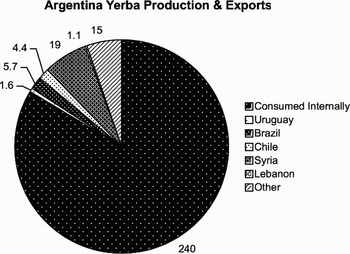
The 1935 creation of the Comisión Reguladora de Producción y Comercio de la Yerba Mate (Regulatory Commission for the Production and Trade of Yerba Mate) in Argentina marked a critical moment in mate as a commodity through the founding of a para-state institution to govern the entire process of mate production and sale. Figure 5 shows export data from the Commission's first six years of record keeping: even at this early date, Syria was at the top of Argentina's yerba destinations.Footnote 86 Though clearly the Middle East is an important market for mate, none of the texts examined for this article ever suggested attempting to expand its presence there. Moreover, the data suggest that exports began significantly earlier than the mid-1930s. Argentina is currently the world's greatest producer, consumer, and exporter of yerba mate (see fig. 6). Though it sells some of its product to other countries in Latin America, especially Chile and Uruguay, Syria alone receives 40 percent of its yerba exports, making the Middle East its chief market. Brazil, on the other hand, has minimal trade with the Middle East, but supplies most of the yerba consumed in Uruguay (fig. 7), the only Southern Cone country that does not contain yerbales and yet which consumes the most mate per capita in the world (about 7 kilograms per person). Paraguay (fig. 8) has struggled to find an external market for its yerba, though a significant amount of it slips into Argentina, off the books. This has begun to change, however, and today most of the mate being imported into the United States is of Paraguayan origin.
Argentina Yerba Mate Exports, in kilograms. Source: Comisión Reguladora de Producción y Comercio de la Yerba Mate.

Distribution of Argentina's average yerba production (2001–2008) and consumption, in thousands of toneladas. Total annual production: 280,000 toneladas. All values are approximations. Sources: http://www.misiones.gov.ar, Senasa.

Distribution of Brazil's average yerba production and consumption (1996–2006), in thousands of toneladas. Total annual production: 187,000 toneladas. All values are approximations. Source: Informações Econômicas, SP.

Distribution of Paraguay's average yerba production and consumption (1997–2002), in thousands of toneladas. Total annual production: 25,000 toneladas. All values are approximations. Note these numbers are from the late 1990s/early 2000s and do not reflect the growing trend to export Paraguayan yerba to the United States. Source: www.bcp.gov.py.

In the Middle East, yerba use is particularly associated with the Druze community in southern Lebanon, and in Syria and Palestine. The practice had begun there by the early twentieth century. But yerba use has not displaced coffee or tea as a stimulant in the region—the earlier example of coca and Potosí speaks to the later difficulty yerba merchants had once the caffeine market had been established—and instead it has carved out a particular social niche. Neither is yerba the only stimulant to have been introduced to the Middle East after an initial push by tea and coffee—qat offers an interesting parallel in Yemen. Qat, too, is a stimulant often taken in gender-segregated groups, and it indexes a distinctive Yemeni identity within the Middle East, used alongside coffee.Footnote 87
Yerba mate functions to distinguishFootnote 88 Druze identity within Lebanon in ways similar to its signaling of Argentine, Paraguayan, and Uruguayan identities within Spanish America, and gaúcho identity in Rio Grande do Sul, Brazil. As a sign of intimacy and diversion among the Druze, it points to community identity and wealth. By passing the gourd around as a moment of leisure (as opposed to laziness), the Druze reference their business acumen, financial success, and cosmopolitan background through a habit acquired during a transnational experience connected to successful wealth acquisition. Their ability to travel internationally to build family wealth, and to return to Lebanon, stands in opposition to the Shi'a, many of who are poor and confined to Lebanon, and who are often spoken of as the greatest threat Lebanese Druze face as both groups uneasily share the southern part of the country. Even Druze female identity is differentiated from an imagined Shi'a female identity, with women empowered in conducting the yerba mate ritual as the feminized counterpart to the masculine, public-sphere consumption of the arghileh (although men and women participate in both). By consuming something that is self-consciously international, with both the leaf and the practice “imported,” the Druze are able to exhibit and re-inscribe their distinct identity in a country divided along sectarian lines.
Yerba's strongly gendered and recreational signification is markedly different from that which it has within the Southern Cone, and this was particularly so in the nineteenth century. Nevertheless, its distinctiveness may once again shift as consumption is commercialized in a new way in Lebanon. In Aley, a mountain vacation destination in Lebanon for summering tourists from the Persian Gulf, “The Maté Factory Café” opened in 2005, offering rental mates (with keep-your-own bombillas) stored next to a wall of arghilehs also for hire. To illustrate how unusual this is, it is important to keep in mind that this does not happen in Southern Cone restaurants or in Argentine steak houses in the United States—though yerba permeates typical cuisine there, restaurants rarely serve it.Footnote 89 Though business slowed during the 2006 Israel-Lebanon war, the Café's owners plan to open more branches in the next two years to take advantage of growing demand. While Aley is a predominantly Druze town, each summer Sunni visitors from the Gulf eager to display their wealth through conspicuous consumption descend on The Maté Factory Café in Aley's restaurant-lined souk (fig. 9).
The Maté Factory Café in Aley, Lebanon. 2007. Author's photo.

In the global North, yerba has also undergone a metamorphosis. From its earlier failed life as a cheaper substitute for tea and coffee oriented toward working classes, it has emerged as a beneficiary of the health food, environmentalist, and new age movements targeted at a global cosmopolitan class concerned with quality and authenticity. “Organic” food consumption reflects not only a concern for health, but also acquiescence to a discourse about the environment and about people and their food.Footnote 90 It serves as a new source of class distinction that lauds knowledge about cuisine and celebrates the virtue of its practitioners as they exercise (hygienic?) discipline regarding what they put into their bodies. Marketing has refurbished yerba's image, but also cultivates clear links to the past. Instead of a mythic origin in itinerant apostles, now it is positioned as the privileged knowledge of indigenous peoples with a special relationship to the earth. Guayaki, a Paraguayan yerba brand aimed at a North American audience, invites worldly and alienated Westerners to partake of the beverage “to feel the good energy.”Footnote 91 In so doing, they learn from and attach themselves to the spiritual connection that the Indians of South America have to “nature.” This present-day instance of “salvation through consuming the primitive” is predicated on a homogenizing and othering discourse that reaffirms the superiority of Western modernity.Footnote 92 Notwithstanding the mystical language, the connections between new accumulation strategies and “nature” are clear in Guayaki's invitation to participate in “market-driven restoration,” a business model combining capitalist economics and sustainable agriculture.Footnote 93
Roseberry linked new class identities in the United States, expressed through the consumption of specialty and gourmet coffees, to a new economic strategy of “flexible accumulation” following the economic crises of the 1970s.Footnote 94 Coffee, which like tea and sugar began as a luxury item, and then became widely consumed and homogenized as a proletarian hunger-killer, has been re-distinguished by looking beyond Fordist forms of mass production and taking advantage of more flexible opportunities fostered by artisanal craftsmanship. Yerba has benefited from this larger trend too; in North America it can now be found both in marginal (Spanish-language) grocery stores catering to immigrants from Latin America, and in high-end (English-language) stores that boast an array of boutique teas and coffees. To make it more accessible to a North American audience, yerba is often treated like tea—now conveniently packaged in individual serving bags or pre-prepared in bottles, with helpful instructions and illustrations in English (and not in Spanish). An acute accent is added over the “e” in mate (which is incorrect in Spanish), rendering the name of the product both more exotic and more pronounceable for its consumers.Footnote 95
And as for its invigorating qualities, though it has been known for more than a century that the crucial ingredient in yerba is caffeine, marketers, teashops, and Buddhist meditation centers continue to position yerba as unique in containing mateine, an exotic and harmless (non-addictive) stimulant.Footnote 96 Even yerba's medicinal properties have undergone a new incarnation: Kiehl's launched a successful “Yerba Maté Tea” skincare product line in the spring of 2007. But concerns about yerba's healthfulness have also been raised anew, this time in studies that claim mate is carcinogenic.Footnote 97 The scare, published in the English-language press, has had enough traction that the newly formed Yerba Mate Association of the Americas (YMAA) has thought it necessary to link (via its English-only website)Footnote 98 to dozens of counter-studies that evaluate the positive medical and health benefits of the plant. Beyond answering yerba's new detractors, many of these counter-claims place yerba in a discourse that has an even greater health resonance today than the organic movement: the promotion of yerba as a hunger suppressant and effective weight-loss aid.Footnote 99 Here, Goodman's connection between drug use and vanity is provocative—if, as he says, European disgust at the distended and stained face resulting from betel nut chewing in South Asia, and at coca chewing, had something to do with the fact that Europeans did not take up these habits,Footnote 100 we are left to consider how the obverse may function, to what extent vanity and concern for personal appearance affect the adoption of once unpopular or unknown substances.
As a commodity that has chiefly circulated outside North America and Europe, a product such as yerba allows us to observe modern financial circuits that have little to do with the global North. Setting aside questions of production, which I have addressed chiefly for the colonial period, yerba illustrates the flexibility and complexity of the capitalist market as it operates within different socio-cultural contexts. What remains to be seen is how resilient these significations and meanings are in light of new market opportunities. We have seen that yerba embeds itself differently as it is fetishized as representing the mystical and empowering in St. Thomas, or the ability to work almost magically without rest or food, or an “organic” connection to nature and the spirit, or national and ethnic identities.
A product such as yerba demonstrates the usefulness of a “commodity chain” approach that allows us to transcend the scale and geographical boundedness of the national economy and the nation-state. Though it challenges the here/there divide, and disrupts discussions that pit “internal” forces against “external” ones, it reaffirms the salience of the local, particularly amidst descriptions of globalization as an indomitable homogenizing force. Since yerba's position outside the Southern Cone has changed only recently, it functions as an excellent lens through which to see the tensions within consumption—between market imperatives, the resilience of taste, government intervention, ideological and moral notions of the good, and biological constraints. While yerba had little success in breaking into the market dominated by coffee and tea, its new entry into the global North and the Middle East points to the powerful effects of new affects—new ways of conceiving and feeling about the body. The possibilities of marketing yerba as an industrial productivity booster, or as a civilizing and domesticating product, were not realized for reasons ranging from personal views of the body to economic structures. Yet as an exoticizing, spiritually recharging substance, or an emblem of community identity, yerba has found access. This illustrates the dialectical link between impersonal economic forces and enactments of the self. In so doing, yerba as a complex cultural construct pluralizes analytical categories by raising questions about modernities, peripheries, capitalisms, and empires.