Introduction
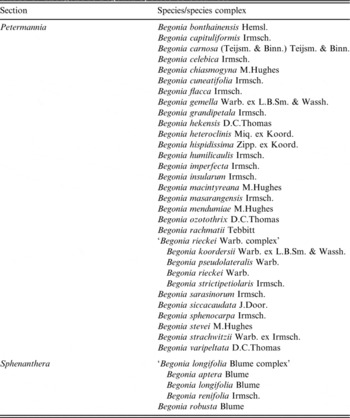
Thirty-two indigenous species of Begonia L. have been reported from the Indonesian island of Sulawesi (Table 1; Hughes, Reference Hughes2008; Thomas & Hughes, Reference Thomas and Hughes2008). A revision of two difficult species complexes containing some widespread taxa, the Begonia longifolia Blume complex and the Begonia rieckei Warb. complex (Table 1), may result in a reduction of the number of currently accepted names in the Sulawesi Begonia flora through synonymy, reduction to infraspecific rank and correction of misidentifications (see discussions on synonymy and species boundaries in these two complexes in Tebbitt, Reference Tebbitt1997, Reference Tebbitt2003; Tebbitt & Dickson, Reference Tebbitt and Dickson2000; Hughes, Reference Hughes2008). However, most species from Sulawesi are local endemics and morphologically very distinct, and a close examination of all available Begonia specimens from Sulawesi from A, B, BM, BO, CEB, E, K, L and SING indicates that there are numerous endemic species awaiting description. The majority of Begonia species from Sulawesi are classified in Begonia section Petermannia (Klotzsch) A.DC. (Doorenbos et al., Reference Doorenbos, Sosef and De Wilde1998; Hughes, Reference Hughes2008) (28 species, including the four closely related or conspecific taxa in the B. rieckei complex). Four species have been classified in Begonia section Sphenanthera (Hassk.) Warb. (including the three closely related or conspecific taxa in the B. longifolia complex, and B. robusta Blume), which was shown to be paraphyletic with respect to Begonia section Platycentrum (Klotzsch) A.DC. (Tebbitt et al., Reference Tebbitt, Forrest, Santoriello, Clement and Swensen2006).
Indigenous Begonia species of Sulawesi

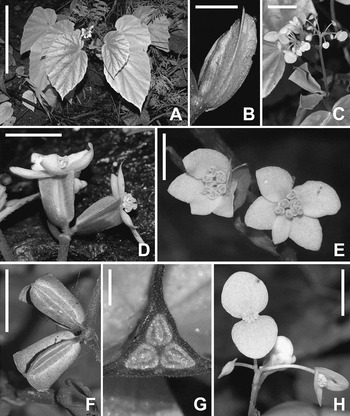
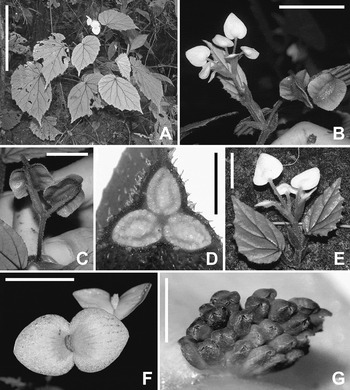
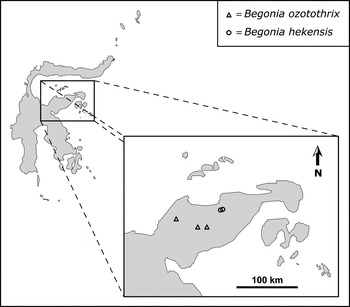
All recent expeditions to Sulawesi organised by the Royal Botanic Garden Edinburgh (RBGE) have brought to light some new species of Begonia (Hughes, Reference Hughes2006; Thomas & Hughes, Reference Thomas and Hughes2008). This is not surprising given that, firstly, the mega-diverse genus Begonia has a centre of diversity in Southeast Asia; secondly, fewer botanical collections have been made on Sulawesi than on any other major island in Indonesia, and from several large regions of Sulawesi only a very small number of specimens has been collected (Kessler et al., Reference Kessler, Bos, Sierra Daza, Kop, Willemse, Pitopang and Gradstein2002; Cannon et al., Reference Cannon, Summers, Harting and Kessler2007); and thirdly, Sulawesi Begonia have never been revised. Two further species collected on a joint expedition of the RBGE and Bogor Botanic Garden are described below. They are classified in Begonia section Petermannia as they exhibit typical characters of the section: protogynous, two-flowered female inflorescences, three-locular ovaries with axile placentation and bilamellate placentae, fruits with equal or subequal wings, and anthers with unilaterally positioned slits (Figs 1, 2). All available Begonia specimens from A, B, BM, BO, CEB, E, K, L and SING have been consulted, and hence it must be assumed, at least until more intensive collecting on Sulawesi may reveal otherwise, that these two species have restricted ranges and are endemic to Central Sulawesi (Sulawesi Tengah) (Fig. 3).
Begonia ozotothrix D.C.Thomas. A, habit (scale bar = 20 cm); B, stipule (scale bar = 12 mm); C, inflorescence (scale bar = 2 cm); D, female inflorescence (scale bar = 2 cm); E, female flowers (scale bar = 12 mm); F, capsules (scale bar = 2 cm); G, ovary, cross-section, three-locular with axillary, bilamellate placentae (scale bar = 2 mm); H, male flowers (scale bar = 10 mm). A, B, C, F, H: D.C. Thomas & W.H. Ardi 08-58; D, E, G: D.C. Thomas & W.H. Ardi 08-53.

Begonia hekensis D.C.Thomas. A, habit (scale bar = 7 cm); B, male inflorescence and infructescence (scale bar = 3 cm); C, infructescence (scale bar = 1.5 cm); D, ovary, cross-section, three-locular with axillary, bilamellate placentae (scale bar = 3 mm); E, male inflorescence with subtending leaves (scale bar = 1.5 cm); F, male flowers (scale bar = 2 cm); G, androecium, anther dehiscing through short, unilaterally positioned slits (scale bar = 4 mm). A–G: D.C. Thomas & W.H. Ardi 08-43.

Species Descriptions
Begonia ozotothrix D.C.Thomas, sp. nov. Sect. Petermannia. Figs 1, 3–5.
Ab aliis speciebus sectionis Petermanniae in caule, petiolis et in laminae facie abaxiali pilos ramosos habenti differt. – Type: Indonesia, Sulawesi, Sulawesi Tengah, Tojo Una-una District, close to Watusongo Village, Gunung Katopas, on wet rock wall at riverbank, 01°10′17.9″S, 121°28′40.5″E, 615 m, 7 v 2008, D.C. Thomas & W.H. Ardi 08-67 (holo E; iso BO, CEB).
Perennial, monoecious, erect herb, to 75 cm tall, hairy with microscopic, c.0.05–0.2 mm long, simple trichomes on all vegetative parts and heterotrichous on the stems, petioles and the veins of the abaxial lamina surface by the addition of a few interspersed multicellular, multiseriate, branched trichomes, c.0.3–1.8 mm long. Stems branched; internodes 2.9–7.9 cm long, hairy. Leaves alternate; stipules 20–32 × 6–20 mm, very asymmetric, oblong to narrowly elliptic, cymbiform with abaxially prominent midrib forming a thin, short appendage at the apex, persistent, abaxially densely hairy; petioles 4.1–18.6 cm long, hairy; lamina basifixed, 14.5–24.8 × 7.2–15.3 cm, very asymmetric, elliptic, base cordate with non- or only very slightly overlapping lobes, apex acuminate, margin dentate, the teeth bristle-pointed, adaxial and abaxial surface hairy, adaxial surface mid green and abaxial surface pale green, or adaxial surface dark green and abaxial surface reddish, venation palmate-pinnate. Inflorescences protogynous; female inflorescences basal to male inflorescences or solitary, 2-flowered, subtending leaves foliose, peduncles 1–5 mm long, bracts (subtending the pedicels of the female flowers) 8–11 × 6–7 mm, ovate to elliptic, abaxially hairy; male inflorescences distal to one female inflorescence, composed of 1–5 strongly compressed, cymose-subumbellate partial inflorescences, subtending leaves bracteose, c.8–11 × 7–9 mm, elliptic, abaxially hairy, peduncles 2–25 mm, hairy, bracts of only the most basal dichotomous branching developed, 3–10 × 2–6 mm, elliptic, abaxially hairy, caducous, each partial inflorescence branching once dichotomously at the base, then 1–2 times dichasially and the lateral branches of the most distal dichasia branching (0–)1–4 times monochasially. Male flowers: pedicels 2–15 mm, hairy; tepals 2, white or pink, 8–11 × 9–12 mm, broadly ovate, base slightly cordate or with convex margins, apex rounded, abaxially sparsely hairy to glabrescent; androecium of c.25–35 stamens, yellow, filaments c.0.4–1.6 mm long, slightly fused at the very base, unequal, longer in the middle of the androecium, anthers c.0.8–1.4 mm long, obovate, dehiscing through unilaterally positioned slits c.1/2 as long as the anther, connective not projecting. Female flowers: pedicels 1–4 mm, hairy; tepals 5, unequal to subequal, the four larger ones ovate or elliptic, 9–14 × 7–9 mm, the innermost obovate or narrowly elliptic, 8–11 × 3–8 mm, white or pale pink, abaxially hairy; ovary 12–21 × 10–18 mm, locules 3, placentation axile, placentae bilamellate, wings 3, narrowly triangular, rounded at the base, widest at the apex, hairy, style fused only in the most basal part, 3-branched, each stylodium bifurcate in the stigmatic region, stigmatic surface a spirally twisted papillose band, the style and stylodia pale yellow, the stigma bands orange. Fruits: capsules cylindric, 19–22 × 4–6 mm (without wings), on stout, erect, 1–4 mm long, hairy pedicels, dehiscent, splitting along the wing attachment, drying pale brown, hairy to glabrescent, wing shape as for ovary, wings 5–10 mm wide at the widest point (at the apex), hairy to glabrescent. Seeds ellipsoidal, c.0.3 mm long, collar cells c.1/2–3/4 of the length of the seed.
Distribution. Indonesia, Sulawesi, Central Sulawesi (Sulawesi Tengah), Gunung Katopas, and the lowland rainforest area between the villages of Bulan Jaya and Uwetangko, and the upland rainforest north of Uwetangko (Fig. 3).
Distribution of Begonia ozotothrix and Begonia hekensis in eastern Central Sulawesi (Tengah), Indonesia.

Habitat. This species grows in the herb layer or on wet rock walls in lowland and upland primary rainforest, often at the sides of rivers or small streams, between c.300 and 800 m.
Proposed IUCN conservation category. LC. This species is locally common and more than 20 populations were observed along a c.40 km walking trail between the villages of Bulan Jaya and Uwetangko, and the upland rainforest north of Uwetangko. Additionally, several populations were observed on Gunung Katopas. While the lowland rainforest area of this species is fragmented by plantations (cacao and others), most of the upland populations were found in areas which are very difficult to access and show no or only slight signs of anthropogenic disturbance by rattan collecting.
Additional specimens examined. Sulawesi. Tengah: Tojo Una-una District, close to Bulan Jaya village, side of track through primary lowland rainforest, at forest margin close to river, 01°17′32.4″S, 121°57′11.6″E, 369 m, 21 iv 2008, D.C. Thomas & W.H. Ardi 08-52 (BO, CEB, E); close to Bulan Jaya village, disturbed lowland rainforest, margin of Theobroma plantation, 01°17′30.7″S, 121°57′02.6″E, 370 m, 21 iv 2008, D.C. Thomas & W.H. Ardi 08-53 (BO, CEB, E); between the villages of Bulan Jaya and Linkasa, on wet rock wall next to small stream, 01°17′24.4″S, 121°56′10.3″E, 364 m, 21 iv 2008, D.C. Thomas & W.H. Ardi 08-56 (BO, CEB, E); close to Uwetangko village, primary lowland rainforest, next to small waterfall, 01°17′09.6″S, 121°48′67.0″E, 322 m, 22 iv 2008, D.C. Thomas & W.H. Ardi 08-58 (BO, CEB, E); Watusongo Village, Gunung Katopas, on wet rock, primary rainforest margin at river side, 01°10′29.3″S, 121°28′36.3″E, 750 m, 11 v 2008, D.C. Thomas & W.H. Ardi 08-72 (BO, CEB, E); Watusongo Village, Gunung Katopas, on vertical, wet rock at the side of a small stream, primary rainforest, 01°10′14.9″S, 121°28′49.3″E, 625 m, 11 v 2008, D.C. Thomas & W.H. Ardi 08-74 (BO, CEB, E).
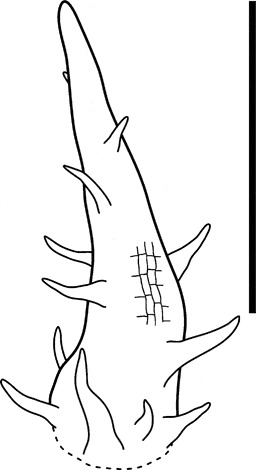
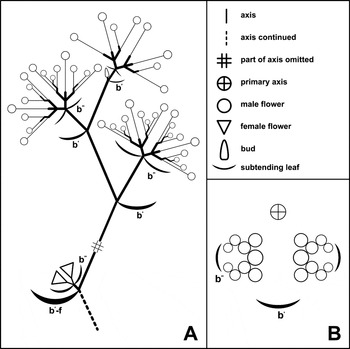
The epithet ‘ozotothrix’ (from Greek ozotos – branched, and thrix – hair) refers to the very unusual branched, multicellular, multiseriate trichomes found on the stem, the petioles and the abaxial lamina surfaces of Begonia ozotothrix (Fig. 4). Begonias with branched trichomes are rare outside of Africa and have not previously been reported for Begonia section Petermannia. Stellate hairs have been described in only two Asian sections, Begonia section Parvibegonia A.DC. (B. sinuata Wall. ex Meisn.) and Begonia section Diploclinium (Lindl.) A.DC. (B. cladotricha M.Hughes). Begonia picta Sm. (Begonia section Diploclinium) has branched, flattened scale-like hairs on the capsules. Begonia calcicola Merr. and B. oxysperma A.DC. (both in Begonia section Diploclinium, although the latter is usually classified in the monotypic Begonia section Baryandra A.DC.) have hairs with a broad and flat stalk divided at the apex into few to several thinner branches on the vegetative parts (Doorenbos et al., Reference Doorenbos, Sosef and De Wilde1998; Hughes, Reference Hughes2007). The morphology of the male inflorescences of Begonia ozotothrix is noteworthy as they exhibit a strong reduction syndrome. The male inflorescence morphology predominantly found in Begonia section Petermannia is characterised by cymose-dichasial branching with only very few or no monochasial branchings in the most distal part, clearly developed axes, and small bracts usually subtending the lateral branches in the cymose inflorescence (Irmscher, Reference Irmscher1914; Doorenbos et al., Reference Doorenbos, Sosef and De Wilde1998). However, Irmscher (Reference Irmscher1914) has already indicated that there are several variations of this typical syndrome in the huge section Petermannia. In Begonia ozotothrix the axes are strongly compressed resulting in a subumbellate appearance of the cymose inflorescences, only the bracts subtending the peduncles and the bracts subtending the lateral branches of the basal dichotomous branchings of the male partial inflorescences are developed, and there are only one or sometimes two basal dichasial branchings and up to four distal monochasial branchings (Figs 1C, 5). Similar compressed subumbellate syndromes have been described for the Sulawesi endemics Begonia siccacaudata J.Door., which shows male partial inflorescences with only one basal dichasial branching and the end flower flanked by two monochasia (Doorenbos, Reference Doorenbos2000), and Begonia mendumiae M.Hughes, which shows male inflorescences with compressed monochasial partial inflorescences (Hughes, Reference Hughes2006). An analysis of herbarium material from Sulawesi (A, B, BM, BO, CEB, E, K, L and SING) shows that similar subumbellate male inflorescences are characteristic for several undescribed species from Sulawesi, and this reduction syndrome might represent a synapomorphy for several species derived from an endemic radiation on Sulawesi. However, phylogenetic analyses of morphological and/or molecular data are needed to test this hypothesis.
Branched, multicellular trichome from the petiole of Begonia ozotothrix (scale bar = 500 μm) (D.C. Thomas & W.H. Ardi 08-58).

Schematic inflorescence branching pattern of Begonia ozotothrix. A. Schematic branching of the inflorescence. The axes of the branches of the cymose-subumbellate male partial inflorescences are elongated in relation to the original in order to illustrate the branching pattern. The sequence of anthesis in the male partial inflorescences is indicated by circle size: the larger the size, the earlier the anthesis. B. Diagram of a male partial inflorescence. b′, bracteose leaf subtending the male partial inflorescence; b′-f, foliose leaf subtending the female inflorescence; b″, bracteose leaf subtending the branches of the male partial inflorescence, or subtending the pedicels of the female flowers.

Begonia hekensis D.C.Thomas, sp. nov. Sect. Petermannia. Figs 2,3.
Begoniae hispidissimae Zipp. ex Koord. similis a qua pedunculis inflorescentiarum feminearum longioribus, pedicellis capsularum valde deflexis differt. – Type: Indonesia, Sulawesi, Sulawesi Tengah, Luwuk District, Bunta Subdistrict, Sumber Agung, Gunung Hek, riverbank near small waterfall, 01°01′72.2″S, 122°11′54.7″E, 1009 m, 12 iv 2008, D.C. Thomas & W.H. Ardi 08-43 (holo E; iso BO, CEB).
Perennial, monoecious, erect herb, to c.100 cm tall, hairy with up to c.1.2 mm long, multicellular, multiseriate, simple trichomes and microscopic, glandular trichomes on all vegetative parts. Stems branched; internodes 2.2–8.3 cm long, densely hairy. Leaves alternate; stipules 8–28 × 2–10 mm, narrowly ovate, cymbiform with abaxially prominent midrib forming a thin, short appendage at the apex, persistent, abaxially densely hairy; petioles 0.7–11.2 cm long, densely hairy; lamina basifixed, 2.5–15.2 × 1.1–8.2 cm, very asymmetric, ovate or elliptic, base cordate with non- or only very slightly overlapping lobes, apex acuminate, margin dentate to serrate, teeth bristle-pointed, abaxial surface hairy, adaxial surface sparsely hairy, adaxial surface mid green and abaxial surface pale green, venation palmate-pinnate. Inflorescences protogynous; female inflorescences basal to male inflorescences or solitary, 2-flowered, subtending leaves foliose, peduncles 2.6–3 cm long (in fruit), bracts (subtending the pedicels of the female flowers) c.16 × 6 mm, narrowly elliptic, abaxially hairy; male inflorescences distal to one female inflorescence or solitary, subtending leaves frondose-bracteose (lamina strongly reduced in size), peduncle 9–12 mm long, bracts (subtending the lateral branches) 4–12 × 1–6 mm, oblong, the basal ones abaxially hairy, the distal ones glabrous, a once-branched dichasium or with one dichotomous branching at the base, and each of the two resulting branches branching once dichasially, sometimes the lateral branches of the dichasia branching once monochasially. Male flowers: pedicels 4–23 mm, hairy; tepals 2, white, 11–18 × 10–18 mm, broadly ovate to subcircular, base cordate or tepal margin convex at base, apex rounded, abaxially sparsely hairy; androecium of c.24–38 stamens, yellow, filaments c.0.4–2 mm long, slightly fused at the very base, unequal, longer in the middle of the androecium, anthers c.1–2 mm long, obovate or oblong, dehiscing through unilateral positioned slits < 1/2 as long as the anther, connective not projecting. Female flowers: unknown. Fruits: capsules ellipsoid, 14–17 × 5–8 mm (without wings), on apically strongly deflexed, 18–24 mm long, hairy pedicels, dehiscent, splitting along the wing attachment, drying brown, hairy, locules 3, placentation axile, placentae bilamellate, wings 3, sublunate, base rounded, widest in the middle to subapical part, subequal, one slightly larger than the other two, 7–8 mm wide in the widest part, the smaller two 6–7 mm in the widest part, hairy. Seeds ellipsoidal, c.0.3–0.4 mm long, collar cells c.1/3–1/2 of the length of the seed.
Distribution. Indonesia, Sulawesi, Central Sulawesi (Sulawesi Tengah), Gunung Hek (Fig. 3).
Habitat. This is an upland species which grows in the herb layer of primary rainforests, often along the sides of small streams, at c.850–1200 m.
Proposed IUCN conservation category. VU D2. This species is known only from Gunung Hek and has a very restricted range in an area which has no legal protection as a national park or nature reserve. Although the forest is in good condition in this area at around 1000 m, there are clear signs of anthropogenic disturbance, especially selective timber harvesting and rattan collection, at slightly lower altitudes. Therefore, the populations are ‘prone to the effects of human activities or stochastic events within a very short time period in an uncertain future’ (IUCN, 2001).
Additional specimens examined. Sulawesi. Tengah: Luwuk District, Bunta Subdistrict, Sumber Agung, Gunung Hek, Sungai Hek, between Cabang Tiga and Agathis Camp, 01°01′10″S, 122°10′30″E, 980 m, 1 iii 2004, Hendrian, M. Newman, S. Scott, M. Nazre Saleh & D. Supriadi 1015 (E); Sumber Agung, Gunung Hek, side of steep track, 01°01′58.2″S, 122°10′90.9″E, 870 m, 10 iv 2008, D.C. Thomas & W.H. Ardi 08-30 (BO, CEB, E); Sumber Agung, Gunung Hek, small isle in Sungai Hek, 01°01′81.2″S, 122°11′35.0″E, 1080 m, 11 iv 2008, D.C. Thomas & W.H. Ardi 08-33 (BO, CEB, E); Sumber Agung, Gunung Hek, side of small tributary of Sungai Hek, 01°01′76.0″S, 122°11′42.4″E, 993 m, 12 iv 2008, D.C. Thomas & W.H. Ardi 08-41 (BO, CEB, E).
The epithet ‘hekensis’ is composed of ‘Hek’, a reference to Gunung Hek where the type material was collected, and ‘-ensis’ (Latin – originating from).
Begonia hekensis is morphologically similar to Begonia hispidissima and Begonia masarangensis Irmsch. These three species exhibit a character combination which differentiates them from most other Sulawesian Begonia section Petermannia species: densely hairy stems and petioles, few-flowered male inflorescences, male flowers with abaxially hairy tepals, and short, hairy ovaries and capsules. However, Begonia hekensis can be easily differentiated from Begonia masarangensis by its ovate to elliptic leaves with a dentate to serrate margin and the compressed, purely, or at least partially, dichasially branching male inflorescences (versus oblong to narrowly elliptic leaves with double serrate margin and purely monochasially branching male inflorescences). Begonia hekensis differs from B. hispidissima by the apically strongly deflexed pedicels of the fruits (Figs 2B–C) and the peduncles of the female inflorescences which may be up to 3 cm long (versus not or only slightly deflexed pedicels and peduncles up to c.1.5 cm long in B. hispidissima).
Acknowledgements
We are grateful to Steve Scott for his excellent care of the Begonia living collections at the Royal Botanic Garden Edinburgh, to Dr Irawati (Bogor Botanic Garden) and Dr Eko Baroto Walujo (Herbarium Bogoriense) for their support of the RBGE expeditions to Sulawesi, and to the curators of A, B, BM, BO, CEB, E, K, L and SING for allowing us access to herbarium material. The support of the first author's PhD project by the M. L. MacIntyre Trust is gratefully acknowledged.