Introduction
With the continuous development of various airlines’ design experience, professional production lines and developed quality control systems, a diversified design trend has been proposed for designing the aircraft cockpit (Causse et al., Reference Causse, Péran, Dehais, Caravasso, Zeffiro, Sabatini and Pastor2013). The main purpose of this movement is to design cockpit interiors for pilots. Communicating with pilots indicates that they often express their emotional feelings about the cockpit. For example, the pilot may like a design very much or a design may be uncomfortable for him. Consequently, it is of significant importance to perform the emotional evaluation of the cockpit. With the improvement of the technical performance of the aircraft cockpit, a good emotional experience can increase the pleasure and comfort of driving. This can be attributed to the satisfaction of the basic operation technology of the cockpit. Currently, the aircraft cockpit evaluation is mainly focused on the comfort evaluation (Kumar et al., Reference Kumar, Mishra and Krishnapillai2019), anthropometric evaluation (Şenol, Reference Şenol2015), human–machine interface evaluation (Hai-yu et al., Reference Hai-yu, An, Zhi-li and Bin2012), and lighting evaluation (Hai-bo and Zhi-sheng, Reference Hai-bo and Zhi -sheng2012). To this end, a relatively complete theory and the methodic system have been formed, and many software and hardware tools have been designed and developed in long-term research and practice. More specifically, the Building Research Establishment (BRE) company's comprehensive test system for human–machine environment, Airbus A320 full-motion simulator, and Boeing 747 engineering simulator (Kraemer et al., Reference Kraemer, Villani and Arjoni2019) have been published so far. These documents are utilized to evaluate the cockpit from ergonomic points of view. To this end, most of the physiological indicators are used to determine the advantages and disadvantages of the cockpit ergonomic design, while emotional recognitions are usually missed. According to the theory of environmental psychology, the positive spatial emotional cognitive effect can make the pilot's nerve center accumulate strength and bring a better operating experience (Jeon et al., Reference Jeon, Walker and Yim2014). Therefore, evaluating the cockpit from emotional aspects is of particular importance.
Kansei engineering is a technology that combines sensibility and engineering. It is a theory and method to design and manufacture products based on the perceptual factors of human beings. Moreover, it is an emerging discipline, which is developed on the basis of ergonomics. It is worth noting that Kansei engineering is more concerned with human emotional factors. Reviewing the literature indicates that the majority of emotional evaluations of the aircraft cockpit are carried out with conventional perceptual engineering research methods, including the Delphi expert consultation (Gbededo and Liyanage, Reference Gbededo and Liyanage2020), focus groups (Axon et al., Reference Axon, Aljadeed, Potisarach, Forbes, DiLeo and Warholak2020), quality function deployment (QFD; Pandey, Reference Pandey2020), and fuzzy evaluation (Chen et al., Reference Chen, Ming, Zhou, Chang and Sun2020). Because these methods rely heavily on the human selection and expert experience for selecting evaluation indicators and preparing the judgment matrix. On the other hand, studies show that the practical operational process is complicated and more time-consuming investigations are required. However, since the evaluation dimension of the aircraft cockpit emotion is relatively high, this procedure cannot be performed for multiple times. If the conventional evaluation method is adopted for a long time, it is easy to cause excessive pressure on the investigator. Moreover, in order to avoid unreasonable value assignment of conventional hierarchical quantitative methods and significantly reduce the subjective arbitrariness of traditional evaluation analyses, it is necessary to establish a set of intelligent evaluation methods that can replace the prediction of expert perceptual data.
Studies show that the neural network can efficiently achieve this purpose. It can be applied to effectively simulate the information processing mechanism of the human brain nervous system to evaluate the emotional experience of the cockpit interior. The characteristics and superiors of the artificial neural network over conventional methods in evaluating the emotion can be mainly reflected from three aspects:
1. Self-learning function (Zhou et al., Reference Zhou, Wang, Jiang, Shao, Choi, Hu, Cao and Meng2017): When performing the image recognition, many different image templates and corresponding results should be implemented into the artificial neural network and then the network slowly learns to recognize similar images through the self-learning function.
2. Ability to find optimized solutions at a high speed: Finding an optimal solution to a complex problem often requires a large amount of calculation. Using an artificial neural network designed for a problem and a high-speed computing system may quickly find the optimal solution (Alam et al., Reference Alam, Samad, Vidyaratne, Glandon and Iftekharuddin2020).
3. Nonlinear processing ability: The thinking method of the human brain is nonlinear, so the neural network simulation of the human thinking should also be nonlinear (Andonovski et al., Reference Andonovski, Mušič, Blažič and Škrjanc2018). This feature helps scholars to deal with nonlinear problems like emotional evaluation. Meanwhile, the neural network has been widely applied in product evaluation and outstanding results have been obtained accordingly.
Studies show that compared with other evaluation methods, the neural network operation method is more efficient. This network can not only simulate experts for quantitative evaluation but also avoids human errors in the evaluation (He et al., Reference He, Ma and Wang2020). Furthermore, since the weights of the model are obtained through the learning, the subjective influence and uncertainty of artificially calculating weights and correlation coefficients are effectively avoided. Therefore, the obtained system has a high degree of consistency with the research requirements.
Single element features are applied for the predictive evaluation of emotions. However, the emotional image has certain subjectivity and complexity. In fact, it belongs to the high-order multi-dimensional comprehensive element. On the other hand, the research object of the present study has a complex engineering field connotation. Therefore, the radical basis function neural network (RBFNN), Elman neural network (ENN), and the general regression neural network (GRNN) are applied to perform the emotional image evaluation, improve the prediction efficiency, and construct the emotional evaluation response model. Then, the emotional image of the aircraft cockpit interior design is evaluated through the representative imagery dimension. In order to introduce the neural network with a better structure and accurate prediction performance, obtained performances from three networks will be compared. Then, the selected method will be applied to perform the emotional prediction evaluation, thereby reducing the cumbersomeness of the conventional investigation and obtaining the emotional results of the evaluated objects more efficiently.
The main contributions of the present study can be briefly described as follows:
• The cockpit emotion of the aircraft cabin is extracted and the main emotional dimension is obtained.
• A nonlinear evaluation model for the emotional prediction is constructed and the neural network is applied to the emotional evaluation of the aircraft cockpit.
• A wide series of experiments are carried out to verify the effectiveness of the proposed method and optimize the best performance of the neural network as the preferred mechanism for the sensation evaluation of the aircraft cabin.
The rest of the article is organized as follows: Section “Related works” outlines the relevant researches, while the specific process of the study, including the extraction of the emotional dimensions of the aircraft cockpit, the establishment of an emotional evaluation data set, and the construction of an evaluation prediction model, is presented in details in the “Methodology” section. Moreover, results of the evaluation experiment for the emotional model and the corresponding descriptions and analyses are presented in the “Experimental” section. Finally, conclusions and suggestions for future works are presented in the “Discussion” section.
Related work
In this section, the theory and the application of Kansei engineering are introduced. Moreover, the linear and nonlinear emotional evaluation models are summarized. Then several typical networks are introduced and analyzed for the nonlinear neural network model. It should be indicated that a comprehensive literature survey about evaluating the aircraft cockpit is carried out in the following.
Kansei engineering
Kansei engineering is a theory and method that uses engineering techniques to explore the correlation between the sensibility of a “human” and the design characteristics of an “object” (Nagamachi, Reference Nagamachi1995). In fact, it is a user-centered ergonomics technology for the product development (Nagamachi and Imada, Reference Nagamachi and Imada1995). Nagamachi used Kansei engineering and performed lots of researches on the product and the service design. In the field of the general product design, Kansei engineering expresses the perceptual imagery of “things” (i.e., existing physical, digital, or virtual products) quantitatively and semi-quantitatively. Moreover, it is associated with product design characteristics (Détienne et al., Reference Détienne, Baker and Le Bail2019). Studies show that since the product design reflects the emotional requirements of a “human”, the products can meet the “human” feelings (Jeon et al., Reference Jeon, Walker and Gable2015). Kansei engineering is considered as the most reliable and effective technical method for dealing with the emotional requirements of users so that this method is promoting worldwide.
Recently, with the development and improvement of the field of big data, cloud computing, and artificial intelligence, Kansei engineering has also made remarkable achievements. Based on theoretical methods, Jiao and Qu (Reference Jiao and Qu2019) proposed extracting perceptual knowledge from online product reviews of Kansei engineering and the computer technology. Then, they analyzed the user perception and understanding, thereby improving the research efficiency of the product's emotional design. Chanyachatchawan et al. (Reference Chanyachatchawan, Yan, Sriboonchitta and Huynh2017) proposed a linguistic variable based on the perceptual data and applied a fuzzy probability to model the proposed variable. They obtained the user's emotional attribute judgment on the product. Wang and Chin (Reference Wang and Chin2017) integrated the Kansei engineering and engineering features to form the basis of market segmentation, thus emotionally subdividing users. In industrial applications, Kansei engineering has been applied to the emotional design of different appliances, including automobiles, communication equipment, and household appliances. However, few investigations have been carried out in the emotional analysis of the aviation equipment and the aircraft cockpit. On the other hand, the Kansei words obtained solely by subjective questionnaire surveys, result in more or less evaluation uncertainties so that it may mislead the design direction based on Kansei engineering (Wang et al., Reference Wang, Li a, Tian, Wang and Cheng2018). Although some attempts using electrophysiology measures, such as eye trackers (Hessels and Hooge, Reference Hessels and Hooge2019) and functional magnetic resonance imaging (Bae et al., Reference Bae, Kang, Kim, Shin, Nam and Han2019), have been conducted to assist the Kansei data acquisition, they require very time-consuming and technically challenging procedures to perform. These findings reveal that some of the existing methods might have limitations in the Kansei word acquisition. Perceptual engineering is currently focused on evaluating existing products in the market and finding the integration lacking through physiological measurements by relying mainly on mathematical models. Therefore, it is of significant importance to use advanced computer technology to establish a systematic framework for performing the perceptual engineering. In other words, artificial intelligence, neural networks, and fuzzy logic can be effectively applied to establish the relevant databases and computer inference systems to improve the efficiency of the data acquisition.
Evaluation model for the emotion analysis
Emotional analysis is a task in the field of the natural language processing (NLP). It is also called the inclination analysis, opinion extraction, opinion mining, emotion mining, and the subjectivity analysis. Furthermore, it is the process of analyzing, processing, summarizing, and reasoning subjective texts with emotions. The evaluation model for the emotion analysis can quantify the user's perceptual knowledge and use the mathematical method to clearly explore the emotional support correlation between users and products.
Moreover, it can help the designers to effectively design products that meet the user's expectations (Schutte and Eklund, Reference Schutte and Eklund2005). Conventional evaluation models for the emotion analysis are often evaluated by methods such as operational research, fuzzy mathematics, and the system engineering models, including quality house evaluation models, fuzzy comprehensive evaluation (FCE) models, grey relational evaluation models, approximating ideal solution evaluation models, Markov evaluation models, and so on.
Bolar et al. (Reference Bolar, Tesfamariam and Sadiq2017) used the QFD scheme to investigate focus areas of the customer from diverse viewpoints such as the economic, social, safety drivers, technology, maintenance efficiency, and environmental viewpoints to anticipate future requirements of the customer. Chen et al. (Reference Chen, Yan and Tran2019) used the FCE theory to evaluate the interface operation mood for subscribers of nuclear power plant users. Wang et al. (Reference Wang, Meng, Zhai and Zhu2013) used the grey relational analysis (GRA) to predict users’ multi-attribute decisions. Lu and Yuan (Reference Lu and Yuan2018) proposed a novel technology for the order preference by similarity to an ideal solution to evaluate the user satisfaction, which could service the credibility evaluation method. Aghdam (Reference Aghdam2019) simulated the user's potential context and used the hidden Markov model (HMM) to predict user preferences. However, the performed emotional evaluation was actually very nonlinear. He showed that the performance of the model based on a simple linear combination is limited. Therefore, in order to improve the accuracy of the model, it is necessary to introduce a nonlinear structure into the model. With the development of methods and techniques such as the deep learning and the cognitive computing in the context of the interdisciplinary research, it is found that the traditional predictive evaluation model has specific limitations so that the neural network sequence model with reasonable intelligence is widely used.
Neural network prediction model
Studies show that the neural network is an appropriate scheme for the emotion analysis and semantic understanding. This originates from the flexible and nonlinear dynamic mapping system of the neural network scheme. Moreover, the application of neural networks to learn abstract features can avoid manual extraction of features and have local feature abstraction and memory functions. With the development of the artificial intelligence technology, scholars applied the neural network scheme through diverse methods such as through sound (Darekar and Dhande, Reference Darekar and Dhande2018), facial expression (Jaina et al., Reference Jaina, Shamsolmoali and Sehdev2019), brain signal (Meza-Kubo et al., Reference Meza-Kubo, Morán, Carrillo, Galindo and García-Canseco2016), and the vision (Ruwa et al., Reference Ruwa, Mao, Wang, Gou and Dong2019) methods, to evaluate the emotional cognition. Currently, different neural network models, including the back-propagation (BP) neural network, Hopfield neural network, adaptive resonance theory (ART) neural network, and the Kohonen neural network, are used for the emotional prediction evaluation.
The feed-forward BP neural network and the error BP neural network are the most commonly used and the most popular neural network models for the predictive evaluation model and emotion analysis, respectively (Guo et al., Reference Guo, Zhang, Xiao, Mao and Liu2015). Wei (Reference Wei2015) constructed a musical emotion model based on the BP neural network to classify music emotions. However, the BP neural network has some shortcomings such as the slow convergence rate and easily falling into the local extremum. The Hopfield neural network model is a cyclic neural network with feedback connections from the output to the input. Yan et al. (Reference Yan, Chen and Chang2009) used the Hopfield network to evaluate products based on the emotional preferences of domain experts. However, there is a problem in how the Hopfield neural network judges whether it is a stable or an unstable network. Meanwhile, the basis of the decision should be determined so that the asymmetric connection is required, while the corresponding computational expense is relatively high. The ART neural network is a self-organizing neural network structure that encodes the environmental awareness. In fact, it is a non-teacher learning network, which can better coordinate the adaptability and complexity requirements in the emotion analysis. Weidong et al. (Reference Weidong, Qiang and Qiulin2008) proposed an assessment method for knowledge requirements based on the ART neural network and the ontological emotional semantic expression. However, studies showed that the ART neural network is sensitive to the numerical conversion, distortion, and scale changes. In other words, when the input has a small variation, the output remarkably changes. Furthermore, Kohonen neural networks use competitive learning to predict the emotion data without supervision. Jude Hemanth et al. (Reference Jude Hemanth, Anitha and Son2018) used deep Kohonen neural networks to accurately identify human emotions. However, when the Kohonen neural network terminates the training, it is a great challenge to evaluate the performance of the network. In summary, reviewing the literature indicates that generalization abilities of the conventional emotion prediction neural networks are poor and some networks have different limitations. In the present study, RBFNN, ENN, and GRNN neural networks are considered to evaluate the cockpit emotions.
The RBF is a feedforward neural network with excellent performance. The RBF network can approximate any nonlinear function with arbitrary precision and obtain global approximation effectively. It has a compact topology and can be applied to fundamentally solve the local optimal problem of the BP network. The structure parameters of the RBF can realize separate learning, fast convergence speed, large-scale data fusion, and high-speed data processing in parallel. On the other hand, the ENN is a typical dynamic recursive neural network. It is established based on the basic structure of the conventional neural network. It adds a bearer layer to the hidden layer as a one-step delay operator to achieve the purpose of memory. Therefore, the system can adapt to time-varying characteristics so that it enhances the global stability of the network. Meanwhile, it has stronger computing power and can also be used to solve fast optimization problems. Furthermore, GRNN is a generalized regression neural network. It is worth noting that the main difference between the GRNN and other two schemes is the existence of an additional summation layer, and the weight connection between the hidden layers, while the output layer is removed. The network finally converges to the optimized regression with a large sample size and sample data. Studies show that the GRNN can be applied reasonable predictions with a low computational expense. Moreover, it can be applied to process unstable data. It is an enormous challenge to efficiently simulate the pilot's emotional cognition and make an accurate evaluation of the interior design of the aircraft cockpit.
Aircraft cockpit evaluation
Aircraft cockpit evaluation is mainly divided into two categories, including subjective and objective evaluations. Subjective evaluation is based on the experience of participants and subjective feelings. It should be indicated that the obtained results are often affected by diverse factors such as participants’ experience and professional level. On the other hand, objective evaluation mainly relies on the relevant professional equipment such as eye trackers, pressure analysis measurement systems, and electromyographs to detect and record the physiological characteristics of the human body during the use. After processing the input data, the relevant data analysis is obtained. When the data is accurate, the simulation environment has a significant influence on the authenticity of the experiment and the number of samples of the experimenter. The main evaluation objects include comprehensive evaluation, accessibility, visibility, layout, display system, and operation comfort evaluation.
Xiao et al. (Reference Xiao, Dongjing, Haiyan, Zhefeng and Dayong2017) established an evaluation index list based on the airworthy regulations for the cockpit human–machine interface evaluation. Thomas (Reference Thomas2018) evaluated the human–machine interface of the aircraft cockpit. Husemann et al. (Reference Husemann, Schäfer and Stumpf2018) proposed the flexibility of flight operations as an evaluation criterion for the aircraft design process. Furthermore, Kumar et al. (Reference Kumar, Mishra and Krishnapillai2019) evaluated the pilot's seat in the cockpit of the aircraft. Han et al. (Reference Han, Kwak, Oh and Lee2020) utilized deep learning networks to evaluate the cognitive abilities of the pilot. Moreover, Brezonakova et al. (Reference Brezonakova, Skvarekova, Pecho, Davies, Bugaj and Kandera2019) evaluated the pilot's visual fatigue. Kraemer and Süß (Reference Kraemer and Süß2015) evaluated the pilot's situational awareness. According to these investigations, it is found that the evaluation of ergonomics is in a relatively mature level, and the pilot's cognitive ability has also been studied in detail. Moreover, it is found that various evaluation methods have been proposed so far. However, the field of the aircraft cockpit emotional evaluation should be further investigated.
Methodology
Selection of cockpit samples
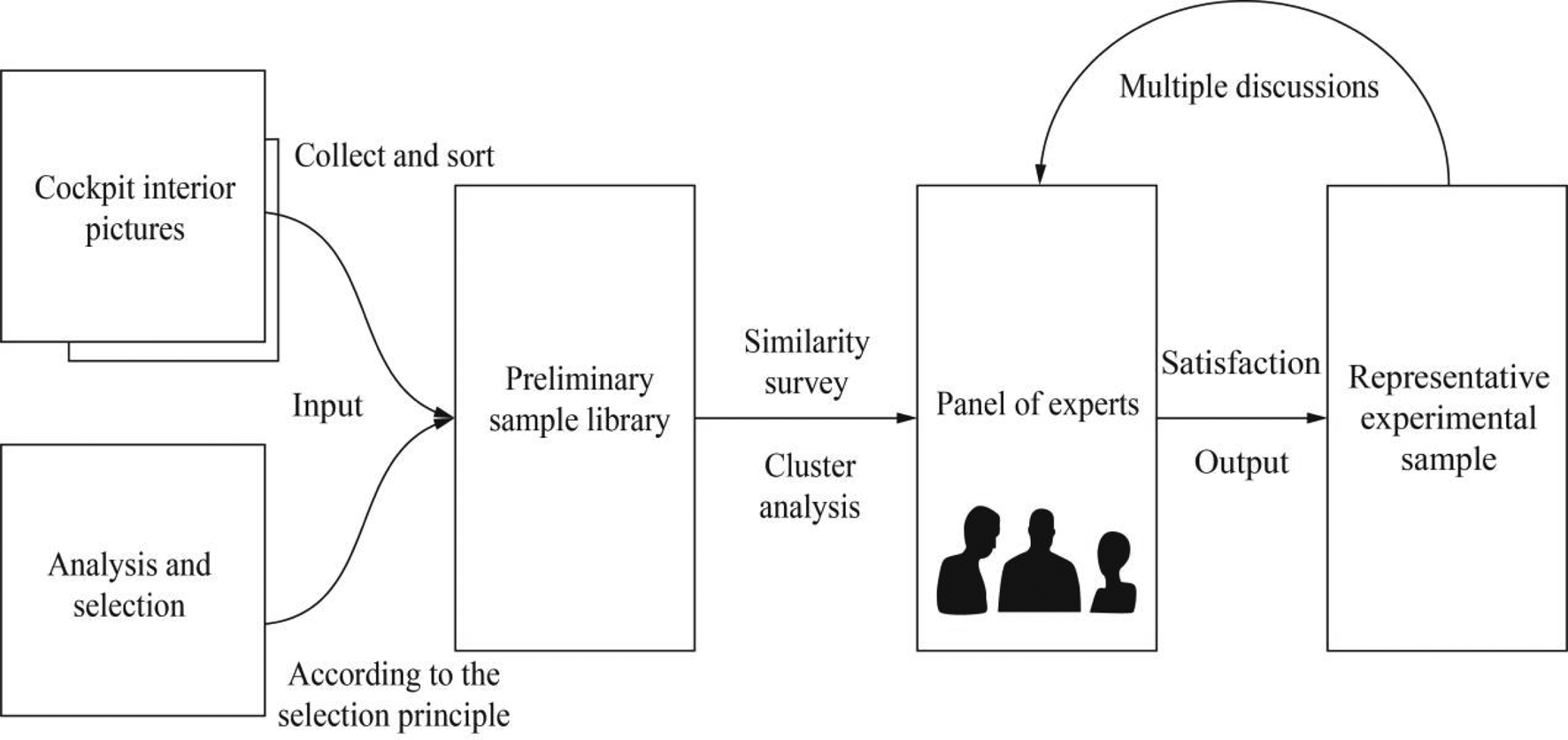
The collection of the cockpit interior samples mainly uses the internet as the medium. To this end, models of the commercial aircrafts that are currently in service are initially extracted. Then, manufacturers that these aircraft models belong to are determined. Finally, a reliable cockpit based on the information released by the manufacturers’ image is selected. Figure 1 shows the operation method in this regard.
Selection process for representative samples.

In order to ensure the validity and usability of the experimental samples, the collected samples should be analyzed and screened through the following principles:
(1) The experimental sample image should have a high resolution.
(2) The elements of each component in the experimental sample should be as clearly visible as possible. There is no occlusion or overlap between component elements, which can be fully displayed in the observer's line of sight.
(3) The interior of the cockpit should be considered as much as possible in the experimental sample, which includes top area, windshield area, sidewall area, T-shaped area, ground area, and cockpit entrance area.
(4) The experimental samples should cover as many models as possible and the similarity between models should be low enough. It is worth noting that after passing the similarity survey, only one representative sample is selected for each type.
(5) The shooting angle of the experimental sample should be unified for the frontal forward shooting and it is recommended to cover the T-shaped area.
The main purpose of the foregoing five basic principles is to reduce the noise in the experimental sample. In order to improve the emotional feeling of subjects brought by the cockpit and minimize the impact of different angles on the evaluation results of the subjects in the later evaluation, the experimental sample set and the relatively pure raw data are obtained.
It is worth noting that there are currently hundreds of commercial aircraft operating worldwide so that the scope of the present study can be effectively reduced through the above-mentioned procedure. Therefore, the existing civil aircraft models and types should be analyzed and screened in this regard. Then, statistical analysis should be performed on the cockpit interior of existing airlines and characteristics of the cockpit interiors of various types of aircraft and their correlation with each other should be studied to obtain the product data of main manufacturers. It should be indicated that major passenger aircraft manufacturers, including Airbus and Boeing, and the main business aircraft manufacturers, including Bombardier, Dassault, and Embraer, are studied in this regard. This information is applied to find the cockpit picture of the corresponding model. Moreover, the cockpit interior experimental sample database is enriched by collecting pictures taken. Finally, according to the situation of the picture collection, the pictures with blurred resolution and obscure design elements are removed, and 200 models are finally determined as samples.
The purpose of this round of screening is to remove samples with high similarity from the 200 sample libraries and reduce the sample size. Then, the remaining pictures are discussed with experts in the aerospace industry and engineers of the aircraft design and research institute. In order to ensure the different feelings of different people with diverse styles, the research software is applied and subjects are grouped to demonstrate their similarity in judging the cockpit shape. Through the investigation of the similarity of the samples, the similarity between the two sample images is obtained, and the similarity matrix is constructed accordingly. Moreover, the cluster analysis is performed on the gathered data to obtain 60 categories of cockpit groups. Each group selects the most representative and independent sample picture, and 60 research samples are finally obtained accordingly. It should be clarified that participating experts have no prejudice against these 60 samples and have reached consensus. Then, the research sample is processed. The color saturation of the picture is initially adjusted to reduce the influence of color. Since some pictures are taken at the airport and other places, there may be a messy background outside the cockpit window. Therefore, the selection tool is utilized to select the cockpit window frame area and remove the irrelevant content on the picture. The final effect removes unnecessary visual interference factors. As a result, the image maintains a similar angle and color as much as possible.
Cockpit emotional image cognition
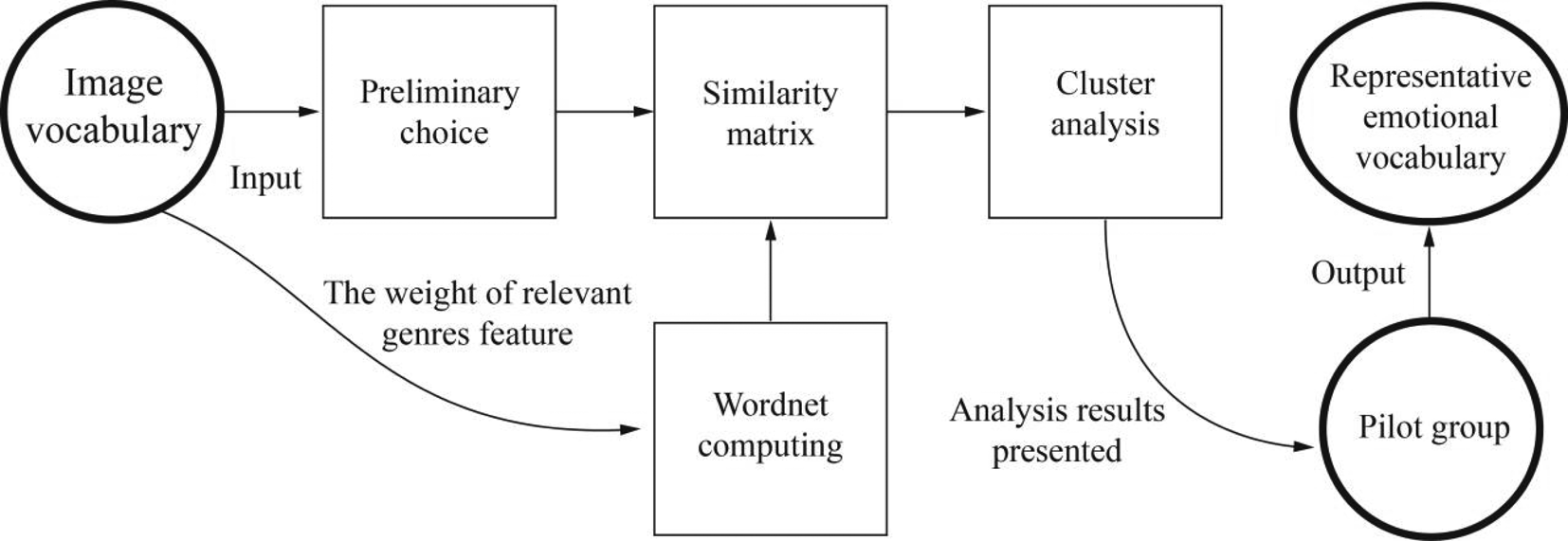
Pilots’ perceptions of different cockpit interiors widely vary from an aircraft to another one. Therefore, prior to the cockpit interior design, designers should initially study the perceptual image perception of the cockpit from the user's point of view and understand the user's emotional preferences and requirements. The operational method is shown in Figure 2.
Selection process for representative vocabulary.

The corresponding emotional vocabulary database that represents the cockpit interior system is collected. It should be indicated that different sources are investigated in the present study. For example, the network, magazines, literature, in-depth interviews and questionnaire surveys for pilots, interior designers, and even cockpit design engineers are studied in this regard. It is found that the usual emotional attributes can be mathematically expressed as follows:
 $$H = f\lpar {w_{{\max}}^ 1 \comma \;w_{{\max}}^ 2 \comma \;\ldots ,w_{{\max}}^n } \rpar,$$
where H and w max are the pilot's emotional expectation satisfaction and the unit's emotional dimension, respectively.
In order to ensure that the collected emotional vocabulary database can effectively represent the user's emotional image preference, the following steps are carried out. Firstly, a preliminary screening of a large number of vocabulary is carried out. Through deep communication with the pilots, a primary vocabulary that can represent the emotional attributes of the cockpit is obtained and a similarity matrix is established accordingly. Then, the natural semantic processing technology (Zhang and Yang, Reference Zhang and Yang2019) is adopted and the big data is combined with the WordNet method to calculate the lexical similarity, as follows:
 $$S_{g \times g} = \left[{\matrix{ {Sim\lpar {1\comma \;1} \rpar } & {Sim\lpar {1\comma \;2} \rpar } & \ldots & {Sim\lpar {1\comma \;g} \rpar } \cr {Sim\lpar {2\comma \;1} \rpar } & {Sim\lpar {2\comma \;2} \rpar } & \ldots & {Sim\lpar {2\comma \;g} \rpar } \cr \vdots & \vdots & \ldots & \vdots \cr {Sim\lpar {g\comma \;1} \rpar } & {Sim\lpar {g\comma \;2} \rpar } & {} & {Sim\lpar {g\comma \;g} \rpar } \cr } } \right],$$
where g and Sim are the numbers of emotional vocabulary and the similarity between the two vocabulary words, respectively.
The method of “WordNet Similarity Calculation” is based on the WordNet to extract synonyms and considers the vector space method for calculating the similarity between two words (Bartusiak et al., Reference Bartusiak, Augustyniak, Kajdanowicz, Kazienko and Piasecki2019). The steps of calculating similarity of two words are listed as follows:
The candidate synonyms from the three sets of WordNet, namely Synset, Class Words, and Sense explanation, are extracted. Then, their features are obtained to calculate the feature(SW) function as follows:
 $$feature\lpar {\bi {SW}}\rpar = \lcub {\lcub {\bi {Ws}} \rcub \comma \;\lcub {\bi {Wc}} \rcub \comma \;\lcub {\bi {We}} \rcub } \rcub ,$$
where {Ws}, {Wc}, and {We} denote the collection of all synonyms for sense W in the WordNet, relevant genres of sense W and the real words in the interpretation of sense W, respectively.
The distance of SWi and SWj in three different characteristic spaces is calculated in the form below to obtain the similarity between them:
Where No(SW) and IDF(wi) denote the order of sense W and the reciprocal of a certain wi document when constructing WordNet from the training, respectively. Moreover, QU and QV define the set of indicators for wi and wj, respectively. Furthermore, the weights of the synonym feature, relevant genres feature, and sense interpretation are set as Ks = 1.5, Kc = 1, and Ke = 0.5, respectively.
The similarity between W1 and W2 in the WordNet is computed based on the function Similarity(SWi, SWj) as follows:
 $$\eqalignno{&Similarity\lpar {\bi W}_1\comma \;{\bi W}_2\rpar \cr & = \displaystyle{\eqalign{\sum\nolimits_{i\in \lcub {1\comma \ldots \comma \vert {{\bi {SW}} _1} \vert } \rcub \mathop {\,j\in \lcub {1\comma \ldots \comma \vert {{\bi {SW}} _2} \vert } \rcub }\limits^{\max } } {\lpar {Similarity\lpar {{{\bi {SW}}_{1}}_i\comma \;{{\bi {SW}}_{2}}_j} \rpar } \rpar } \cr + \sum\nolimits_{i\in \lcub {1\comma \ldots \comma \vert {\bi {SW}_ 2} \vert } \rcub \mathop {\,j\in \lcub {1\comma \ldots \comma \vert {{\bi {SW}} _1} \vert } \rcub }\limits^{\max } } {\lpar {Similarity\lpar {{{\bi {SW}}_{2}}_i\comma \;{{\bi {SW}}_{1}}_j} \rpar } \rpar } } \over {\vert {{{\bi {SW}}_{1}}} \vert + \vert {{{\bi {SW}}_{2}}} \vert }},$$
where SW1 and SW2 denote the sense numbers of w1 and w2, respectively.
Cluster analysis is a discriminant method that seeks (scheme or standard) to determine certain problems (Hofmeyr, Reference Hofmeyr2020). It should be indicated that the K-Means clustering algorithm is mainly applied in the present study. Figure 3 illustrates the described process.
Operation flow of the cluster analysis.

In the K-Means clustering algorithm, all clustering objects should be vectorized. The centroids of n clustering objects can be regarded as the centers of the n vectors. Under this circumstance, the calculation method can be expressed in the form below:
 $$\overrightarrow {\mu \lpar \varpi \rpar } = \displaystyle{1 \over \varpi }\sum\limits_{\overrightarrow x \in \varpi } {\overrightarrow x }.$$
The concept of the variance RSS is described as follows:
 $$\eqalign{\hbox{RS}\hbox{S}_k& = \sum\limits_{\overrightarrow x \in k} {\vert {\overrightarrow x -\overrightarrow \mu \lpar {\varpi_k} \rpar } \vert } ^2, \cr \hbox{RSS}& = \sum\limits_{k = 1}^k {\hbox{RS}\hbox{S}_k} .}$$
The RSSk and RSS denote the distance from each cluster object in the k-class to the centroid and the sum of RSS values of all k-classes, respectively.
Finally, the cluster analysis is carried out to reduce the dimension of the emotional vocabulary so that the representative emotional vocabulary Q, which is the most suitable vocabularies for evaluating the cockpit interior system, is obtained.
Obtaining the cockpit evaluation data set
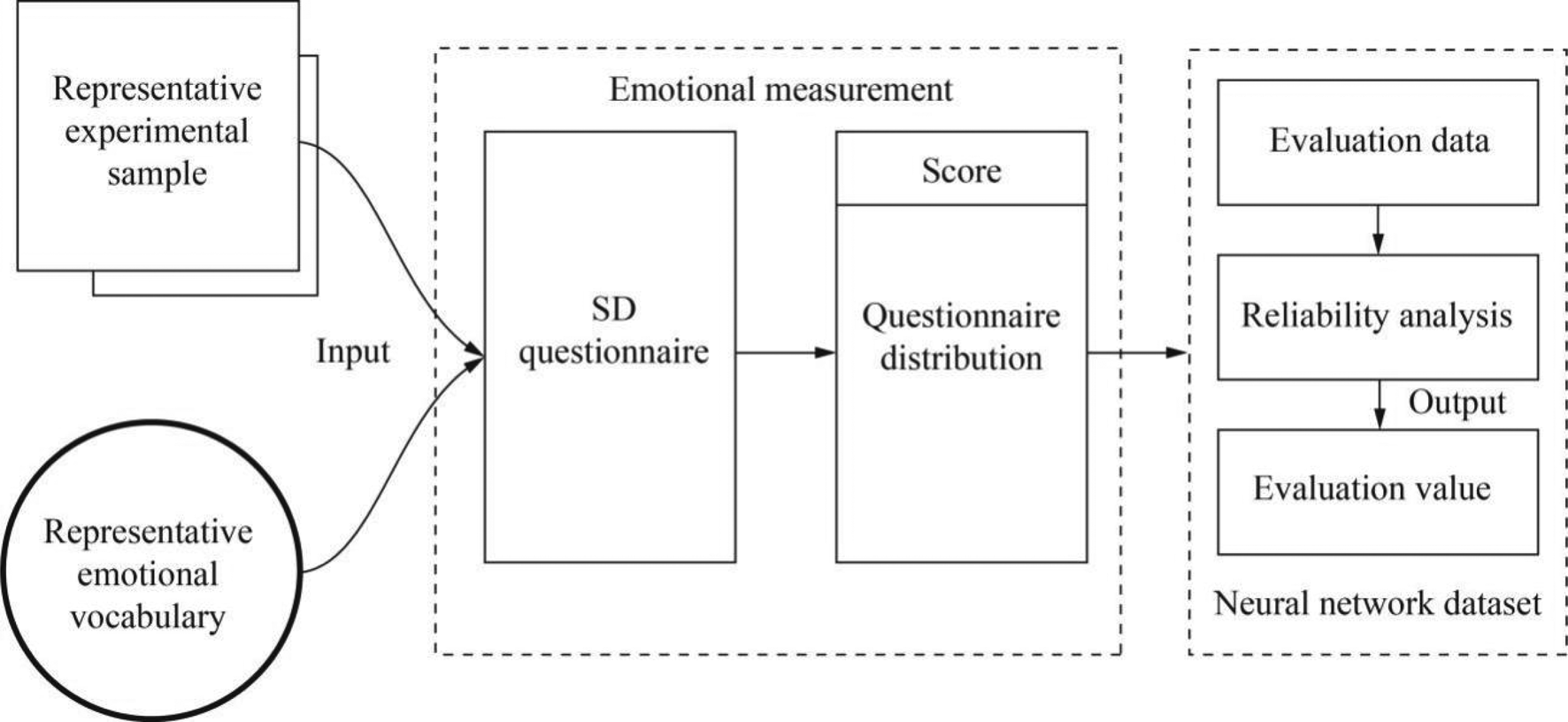
In order to obtain the emotional evaluation data set of the cockpit interior, the representative experimental sample and the representative emotional vocabulary are combined to form an SD questionnaire. Figure 4 shows the operational method.
Sentiment evaluation data of the cockpit.

The principle of the questionnaire survey is introduced in detail at the top of the data questionnaire. The subject is explained in detail before the experiment. The subject should strictly abide by the evaluation principles when filling in the questionnaire. There are three parts in the questionnaire design as follows:
1. Selection of research objects and pilots of different airlines.
2. Adopting the research method and the semantic difference method. Then, the pilot's perception of different emotional vocabulary should be analyzed after observing the extracted cockpit interior pictures.
3. Questionnaire survey. The respondent observes the extracted cockpit interior pictures, and then scores from four perceptual vocabularies. After obtaining the data, they should be analyzed. The number of distributed questionnaires is 30, all of the subjects are male aged 20–50 years old, and the subjects include 20 Chinese pilots and 10 non-Chinese pilots. They all have a bachelor degree or above. All subjects have a cognitive background to the cockpit and an understanding of the design and emotions of the cockpit interior, which makes the emotion evaluation data more accurate.
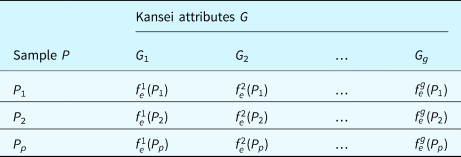
The Likert scale is applied to perform the emotional measurement, while each sample is combined for a single emotion dimension evaluation. The evaluation level can be expressed as a set  $E = \lcub {e_a\vert \langle{ {e_n^- \comma \;e_n^ + } \rangle } } \rcub \comma \;\;a = 1\comma \;2\comma \;\ldots \comma \;n$. It should be indicated that n normally takes 5, 7, and 9 values. Table 1 shows the acquisition method of the questionnaire data.
Kansei database of experimental sample P on G Kansei attributes

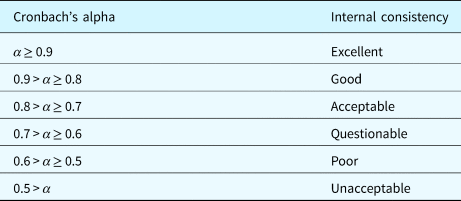
Here  $f_e^g \lpar {P_p} \rpar$ is expressed as the gth emotional attribute and e rating for the pth sample. Then, the original survey data are collected and recorded, reliability analysis is carried out, and the mean value after eliminating invalid data is calculated to obtain the emotional dimension value of the sample. In the present study, the reliability of the experimental data is evaluated by Cronbach's Alpha coefficient (Pinto et al., Reference Pinto, Fogliatto and Qannari2014), which is defined in the form below:
 $$\alpha = \left({\displaystyle{k \over {k-1}}} \right)\left({\displaystyle{{s_t^2 -\sum {s_o^2 } } \over {s_t^2 }}} \right),$$
where α and k denote the reliability coefficient and the number of test questions, respectively. Moreover,  $S_o^2$ and
 $S_t^2$ are the score variation of all subjects on the oth question and the variance of the total scores of all subjects, respectively. Table 2 shows the interpretation for different values of the “Alpha Reliability” coefficients.
Interpretation for different values of Alpha reliability coefficients

Constructing an emotional prediction evaluation model
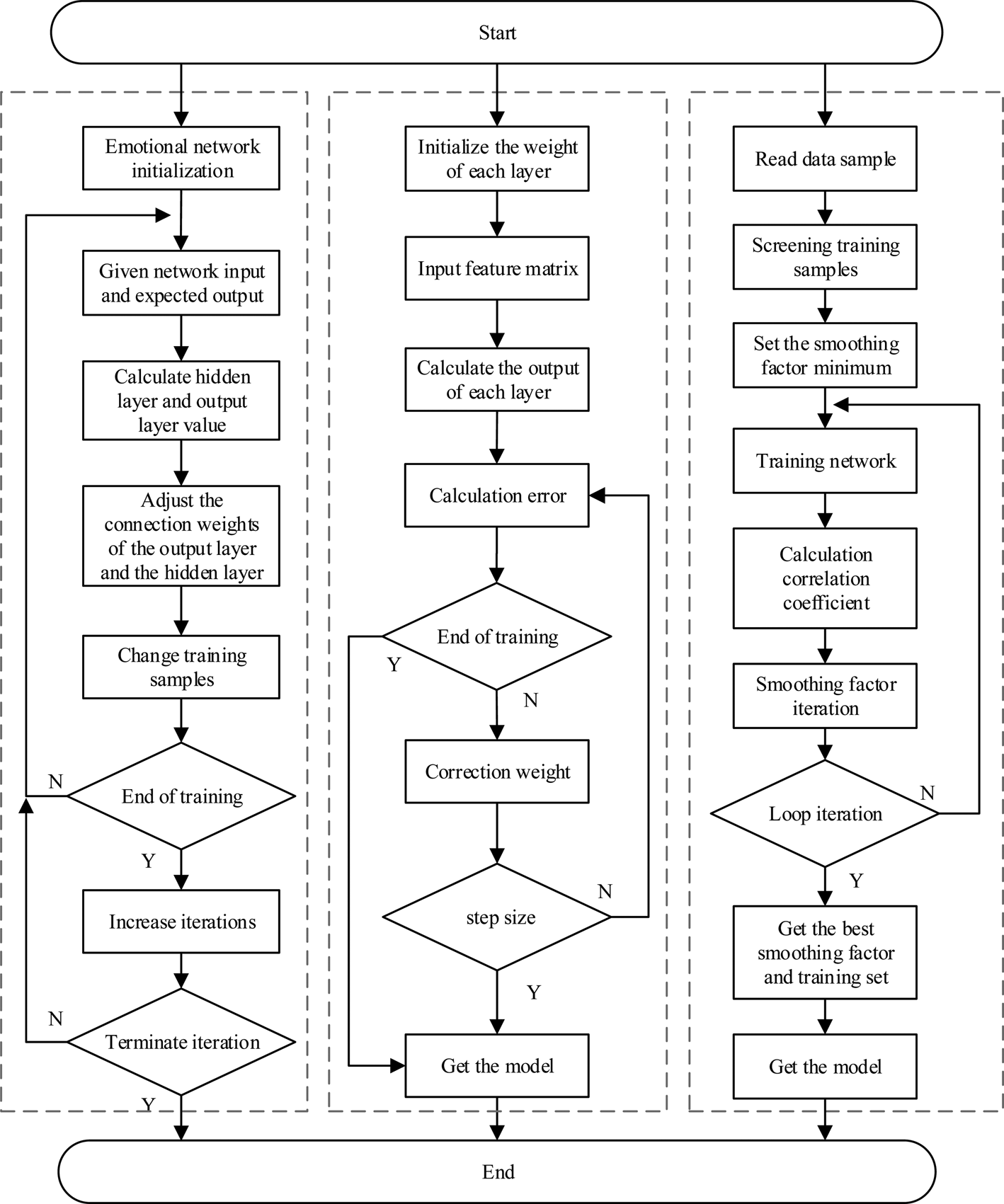
The choice of an appropriate artificial neural network is also one of the keys to modeling. This may be attributed to several factors, including the wide application of RBFNN, ENN, and GRNN, a simple structure of the model, strong abilities of the nonlinear fitting, and the generalization, small sample size and high noise. Therefore, the present study applies these three neural networks to establish a predictive mode and builds the emotion prediction evaluation model for the cockpit interior design. Figure 5 shows the learning flowchart of above-mentioned three networks.
Flowchart of the RBFNN, ENN, and the GRNN predictive models.

Constructing the RBFNN prediction model
RBFNN is an efficient feedforward neural network. It has the best approximation performance and global optimal characteristics that other forward networks in comparison to other methods with a simple structure and fast training. Meanwhile, it is a neural network model that can be widely used in the pattern recognition, nonlinear function approximation, and other fields (Zhou et al., Reference Zhou, Wang, Jiang, Shao, Choi, Hu, Cao and Meng2017).
There are three important parameters in the design of the RBF emotion prediction network, namely the center of the hidden layer basis function, the width, and the connection weight between the hidden and the output layers. RBFNN is a three-layer feedforward network with an input layer, a hidden layer, and an output layer (Dong et al., Reference Dong, Zhao, Liu, Han and Leung2019). Suppose there are P learning samples with input values X = (x 1, x 2, …, x p), and the corresponding output value of Y = (y 1, y 2, …, y p). A function F:Rx → Ry is found to satisfy the emotional prediction evaluation condition y i = F(x i), i = 1, 2, …, P. Design the number of hidden layer nodes in the RBF network, and use the training samples to select the center of the hidden layer. The basis function selects the same extension function, while the function F in this method is represented as follows:
 $$F\lpar x_i\rpar = \sum\limits_{\,j = 1}^N {\phi _{ij}\omega _j} = \sum\limits_{\,j = 1}^N {\omega _j\varphi _j} \lpar {\Vert {x_i-c_j} \Vert } \rpar,$$
where ϕ ij = φ j(||x i − c j||) is the set of radical basis functions and xi is the input to the ith input node. Moreover, c j, φ j( ⋅ ) and || ⋅ || denote the jth center of the hidden layer, activation function of the implicit node and the Euclidean distance norm, respectively.
Let y i = f(x i), Y = (y 1, y 2, …, y n) T, W = (ω 1, ω 2, …, ω n) T and Y = ϕW.
 $$\left[{\matrix{ {\phi_{11}} & {\phi_{12}} & \ldots & {\phi_{1n}} \cr {\phi_{21}} & {\phi_{22}} & \ldots & {\phi_{2n}} \cr \vdots & \vdots & \vdots & \vdots \cr {\phi_{n1}} & {\phi_{n1}} & \ldots & {\phi_{nn}} \cr } } \right]\left[{\matrix{ {\omega_1} \cr {\omega_2} \cr \vdots \cr {\omega_n} \cr } } \right] = \left[{\matrix{ {y_1} \cr {y_2} \cr \vdots \cr {y_n} \cr } } \right].$$
When ϕ ∈ R N×N is reversible, a set of column vectors constituting the R N can be obtained. Furthermore, the output weight can be written as follows:
 $$W = \phi ^{-1}Y.$$
In the present study, the Micchelli's theorem is combined with the actual research object (Pejčev and Spalević, Reference Pejčev and Spalević2014). Then, the Gaussian function is chosen as the radical basis function, where the corresponding equation is expressed as follows:
 $$\phi \lpar r \rpar = \exp \left({-\matrix{ {r^2} \cr {2\sigma^2} \cr } } \right),$$
where σ and r denote the extended constant or width of the implicit layer basis function, and the distance input to the center of the basis function, respectively. Because the conversion input value X = (x 1, x 2, …, x p) of the cockpit training sample P is different, the weight vector W = (ω 1, ω 2, …, ω n) T can be obtained.
Constructing an ENN prediction model
ENN is a typical dynamic recurrent neural network, where the internal state is sorted to have the dynamic feature of the mapping. Therefore, this model has superior characteristics including the ability to adapt to time-varying characteristics and the enhanced global stability. It should be indicated that this model is widely used in the performance prediction and fault diagnosis (Guo et al., Reference Guo, Lu, Tian, Guo and Darvishan2019).
The ENN emotion indicates that the neural network input signal has a significant impact on the initial state of the feedback system. The ENN is composed of an input layer, a recurrent layer that provides the state information, a hidden layer, and an output layer (Hu et al., Reference Hu, Wang, Bai and Liu2019). The ENN model can be mathematically expressed in the form below:
In the input layer:
 $$x_i^0 \lpar k\rpar = x_i\lpar k\rpar, \quad \lpar i = 1\comma \;2\comma \;\ldots, m\rpar .$$
In the hidden layer:
 $$\left\{{\matrix{ {s_i^1 \lpar k\rpar = \sum\limits_{\,j = 1}^m {w_{ij}^0 x_j^0 \lpar k\rpar + \sum\limits_{\,j = 1}^m {w_{ij}^2 c_j\lpar k\rpar \comma \;} } } \hfill \cr {x_j^1 \lpar k\rpar = f_1\lpar s_i^1 \lpar k\rpar + b_i\rpar \comma} \hfill }} \right.\lpar i = 1\comma \;2\comma \;\ldots, n\rpar.$$
In the recurrent layer:
 $$\left\{{\matrix{ {s_i^2 \lpar k\rpar = x_i^1 \lpar k-1\rpar \comma } \hfill \cr {c_i\lpar k\rpar = s_i^2 \lpar k\rpar \comma } \hfill \cr } } \right.\lpar i = 1\comma \;2\comma \;\ldots, n\rpar.$$
In the output layer:
 $$\left\{{\matrix{ {s_i^3 \lpar k\rpar = \sum\limits_{\,j = 1}^n {w_{ij}^1 x_j^1 \lpar k\rpar \comma} } \hfill \cr {y_i\lpar k\rpar = f_2\lpar s_i^3 \lpar k\rpar + b_i^{\prime} \rpar \comma } \hfill } } \right. \lpar i = 1\comma \;2\comma \;\ldots, r\rpar.$$
where m, n, and r denote the number of neurons in the inputs, hidden, and output layers, respectively. It is assumed that k and  $x_i^0 \lpar k \rpar, \;\lpar i = 1\comma \;2\comma \;\ldots \comma \;m\rpar$ are the kth iteration and ith input value in the input layer, respectively. Furthermore,
 $s_i^1 \lpar k \rpar \;{\rm and} \;x_i^1$ denote the ith input and output values in the hidden layer, respectively. While
 $s_i^2$ and ci(k) are the ith input and output values in the recurrent layer, respectively. On the other hand,
 $s_i^3$ and yi(k) denote the ith input and output values in the output layer, respectively. Moreover, f 1 and f 2 are the activate functions in the hidden and output layers, respectively. Finally,
 $w_{ij}^0 \comma \;w_{ij}^2 \;, {\rm and}\;w_{ij}^1$ denote the connection weights in the hidden, recurrent, and output layers, respectively.
Constructing a GRNN prediction model
GRNN has stronger nonlinear mapping ability and faster learning speed compared to other models. Moreover, the corresponding result of the function fitting achieves the global optimization with strong robustness and fault tolerance. This model can be used to address, predict, and control the classification problems. Furthermore, the GRNN model has been widely used in different engineering fields such as signal processes and control decision systems (Xuecai et al., Reference Xuecai, Gui, Yujingyang, Ziqi, Ping, Baojun and Song2019).
The GRNN model consists of four parts, including the input layer, the pattern layer, the summation layer, and the output layer (Han et al., Reference Han, Huang, Zhou and Liu2018). These layers are described as follows.
The input layer: The input layer neuron X = {x 1, x 2, …, x n}T represents the number of input data feature values in the sample, where each unit is a simple linear unit and each unit represents a set of eigenvalues. Furthermore, input variables are passed to the pattern layer.
The pattern layer: The number of pattern layer neurons corresponds to the number of input samples. It should be indicated that different neurons correspond to different samples and the transfer function is defined as follows:
Where X and Xi represent the input variable and the training sample corresponding to the ith neuron. Moreover, pi denotes the output value of the neuron i, which is an exponential form of the exponential square  $D_i^2 = \lpar {X-X_i} \rpar ^T\lpar {X-X_i} \rpar$ of the Euclidean distance square between the input variable X and the training sample data Xi corresponding to the ith neuron.
The summation layer: This layer sums two types of neurons, where the first type of the calculation is expressed as follows:
 $$S_D = \sum\limits_{i = 1}^n {\,p_i} = \sum\limits_{i = 1}^n {\exp} \left[{-\displaystyle{{{\lpar X-X_i\rpar }^T\lpar X-X_i\rpar } \over {2\sigma^2}}} \right].$$
This equation sums the output values of all neurons in the pattern layer. It indicates that the connection weight between the pattern layer and the summing layer is 1.
The second type of calculating expression is to apply the weight function to sum all neuron output values in the network pattern layer. This expression can be written as follows:
 $$S_{Nj} = \sum\limits_{i = }^n {y_{ij}p_i} = \sum\limits_{i = 1}^n {Y_i {\exp}\left[{-\displaystyle{{{\lpar {X-X_i} \rpar }^T\lpar {X-X_i} \rpar } \over {2\sigma^2}}} \right]}, \quad \lpar j = 1\comma \;2\comma \;\ldots, k\rpar.$$
The output layer: The number of neurons in the output layer shows the dimension of the output vector in the sample. The representation function of the output layer is to divide the weighted summation value of each layer of neurons from the unweighted summation value. The corresponding expression is defined as:
 $$y_i = \displaystyle{{S_{Nj}} \over {S_D}}, \quad \lpar j = 1\comma \;2\comma \;\ldots, k\rpar.$$
Model evaluation criteria
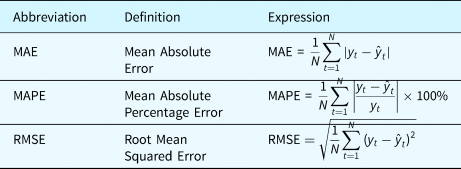
Many performance metrics have been used to verify the prediction performance of different models so far. However, there are no general criteria for the evaluation of results. Three generally adopted error indices, including the Mean Absolute Error (MAE), Mean Absolute Percentage Error (MAPE), and the Root Mean Squared Error (RMSE), are used to estimate the global and local errors of the different forecast models (Yu et al., Reference Yu, Li, Xiang and Zhang2018). Table 3 shows the calculating equations of these seven error indices.
Evaluation criteria and functional expressions for different error indices

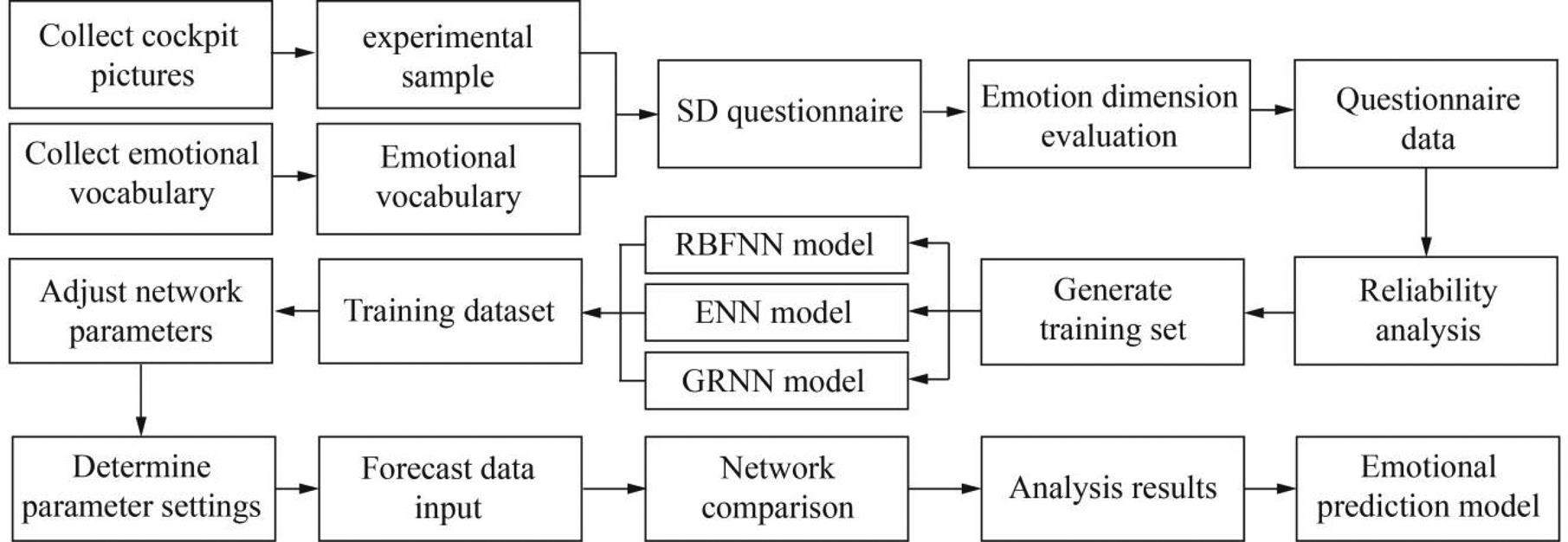
Here yt, ŷt, and N are the raw emotional evaluation data, forecasted emotional evaluation data, and the number of the cockpit interior experimental sample. In the present study, MAE, MAPE, and RMSE indices are combined with the actual research objects to select the evaluation criteria. It should be indicated that as the error decreases, the model performance improves (Fig. 6).
Cockpit emotion evaluation process.

Experimental
Emotional evaluation data set
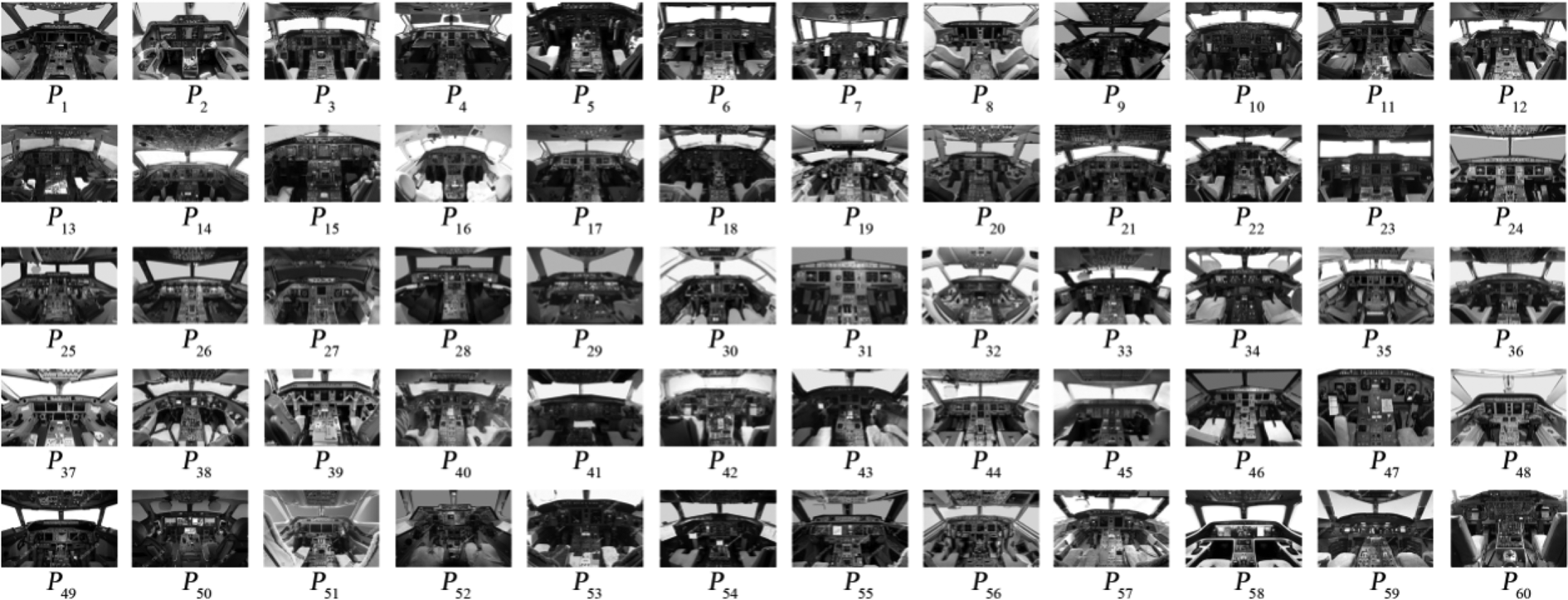
It should be indicated that during the de-doping and grayscale processing of the selected 60 representative experimental samples, effects of color on the image should be avoided and the representative experimental samples should be randomized. Figure 7 shows the experimental sample set P.
Cockpit interior test sample.

The collected 100 emotional vocabularies are used to establish emotional vocabulary sets and 20 preliminary emotional vocabulary sets are obtained through discussion between pilots and experts. Table 4 shows the 20 emotional vocabularies.
20 emotional vocabularies of primary selection

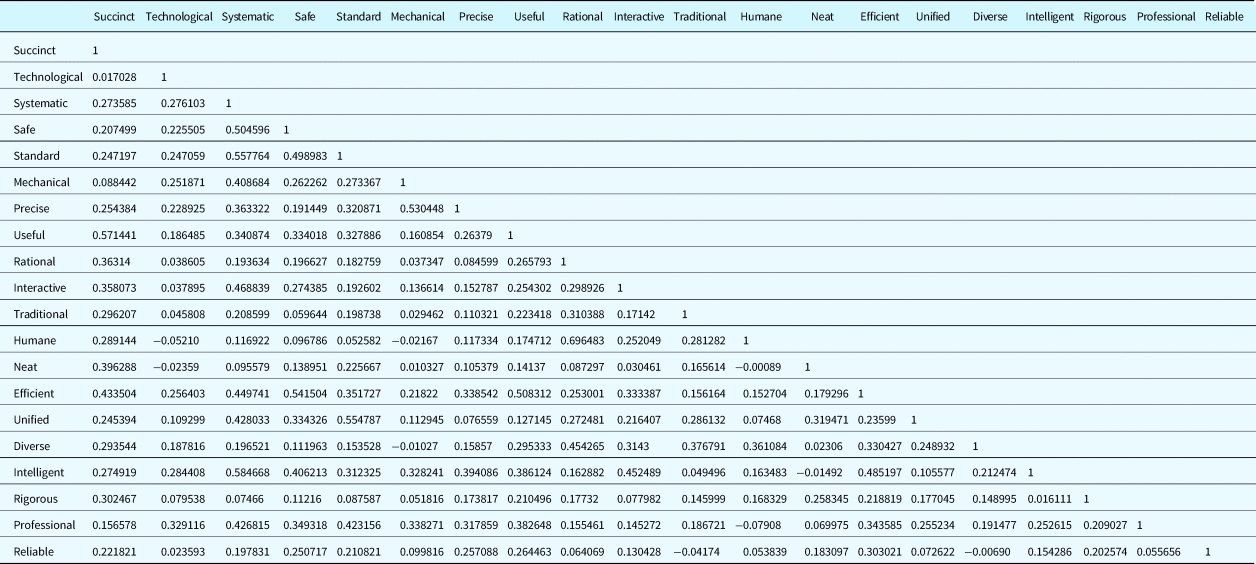
Lexical similarity matrices are constructed for the 20 emotional vocabularies and word Similarity calculation is performed. Table 5 shows the results of word Similarity. Then, the similarity matrix data set is organized and the cluster analysis of emotional vocabulary is performed. Moreover, the clustering results are analyzed and four emotional dimensions representing the emotional requirements of the cockpit are obtained. They are Q 1 “interactive”, Q 2 “precise”, Q 3 “traditional” ,and Q 4 “neat”.
The results of word Similarity

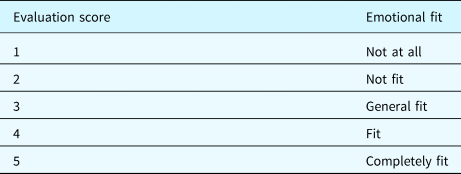
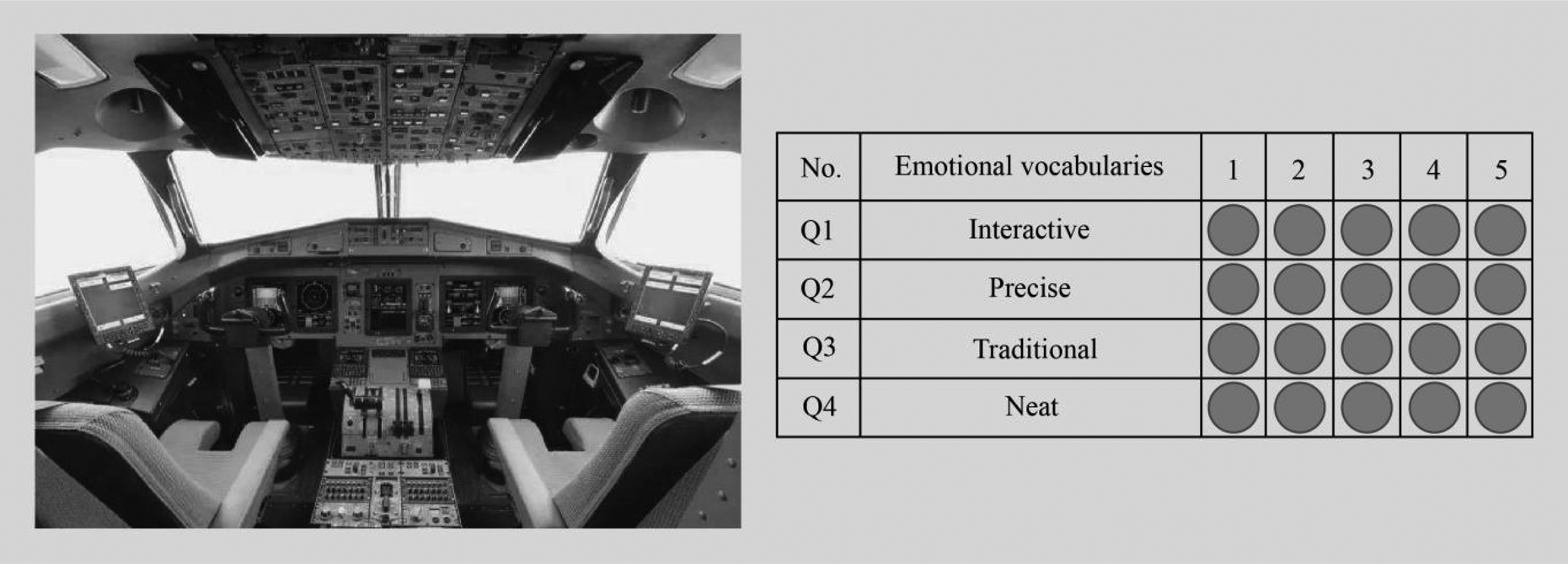
In order to obtain the pilot's emotional cognition process of the cockpit interior modeling. Based on the obtained representative research samples and representative image vocabulary and using the five-level semantic scale of the semantic difference method, a fifth-order SD questionnaire based on the cockpit modeling image is established. The left side of the questionnaire form is the morphological picture of the sample of the investigation and research, while the right side is the scoring grid based on four image words. The investigator fills the evaluation data into the grid. Each investigator scores each research sample separately under four image words. Taking the sense of neatness as an example, “1” means not neat, “2” means a little neat, “3” means generally neat, “4” means neat, and “5” means very neat. Table 6 shows the scoring principle of the evaluation score.
The level of the sentiment expressed by the score

In order to ensure the quality of the questionnaire, the subject is prevented from filling too much data at one time, which may cause fatigue. Therefore, 10 samples of the total 60 samples are extracted for one unit task. The experimental samples are disassembled into six sub-tasks, and the same groups of subjects are distributed intermittently so that they have sufficient time for rest and adjustment. Figure 8 shows an example of the questionnaire content.
Sample questionnaire content.

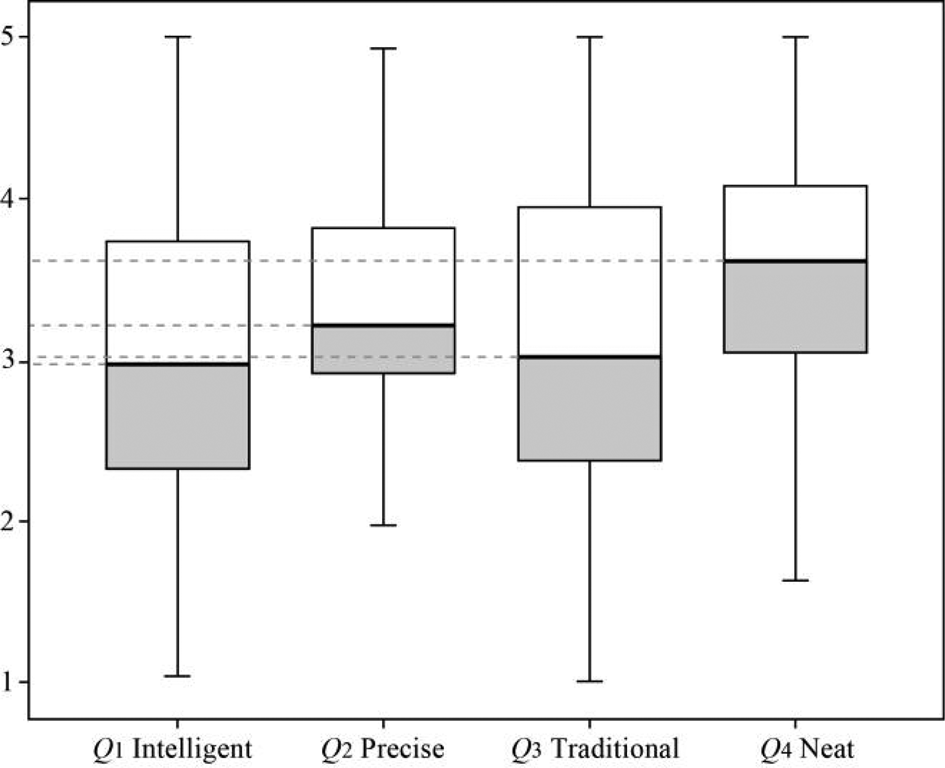
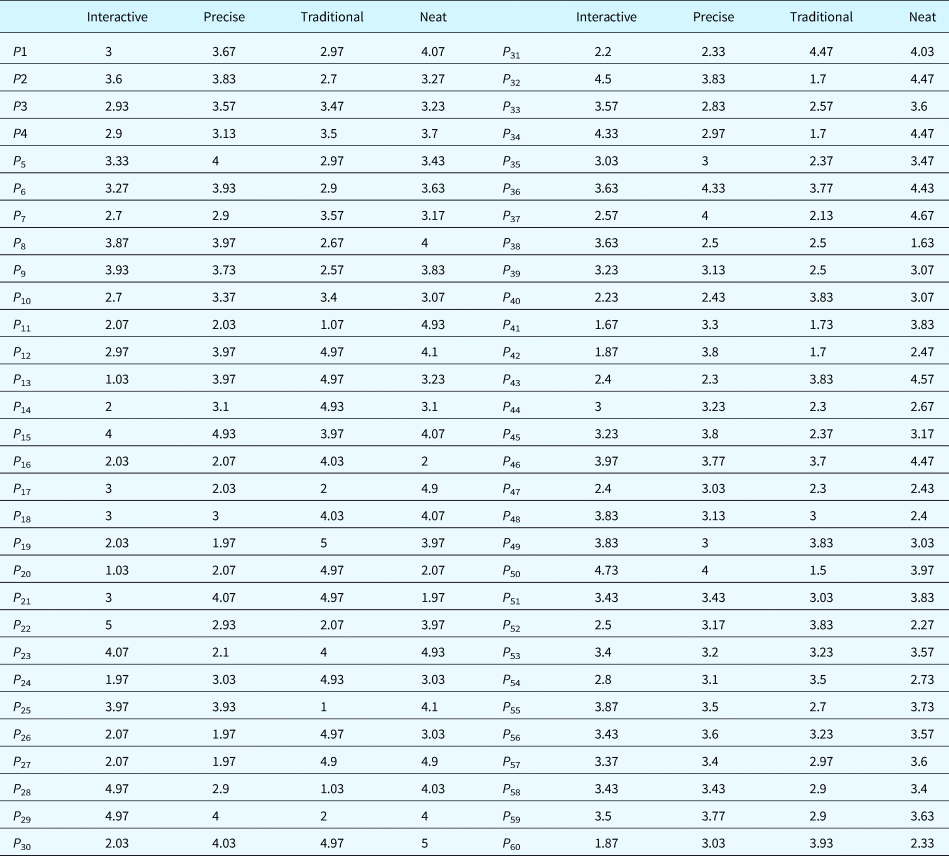
The experiment retrieved 30 questionnaires and tested the processed experimental data with the Cronbach's Alpha coefficient. The overall α coefficient was 0.829, indicating that the sentiment evaluation system has high confidence. Table 7 shows the average evaluation results. Figure 9 shows the distribution of the average of the four-dimensional data.
Score distribution of four emotional dimensions.

The average evaluation results

Figure 9 shows that the median of Q 1 and Q 3 is similar and is at the range of the average level of the evaluation value, while Q 2 is slightly higher than the average value and Q 4 is significantly higher than the other three values. However, the overall trend of the four emotional dimension evaluation values shows stability. Moreover, the data dissemination indicates that the distribution range of Q 1 and Q 3 is large, which spans the range of 1–5 of the evaluation value. This indicates that the experimental sample has obvious differences in the two emotional dimensions, and the minimum of both 1 evaluation, it indicates that the current cockpit interior emotions are insufficient on both sides and airlines need to further improve them. The minimum values of Q 2 and Q 4 are generally higher than those of Q 1 and Q 3, indicating that the evaluation of Q 2 and Q 4 in the current cockpit interior emotions is better, and there are no abnormal values in the four emotional evaluations, indicating that the evaluation data have certain objectivity.
Network structure and parameter design
Structure and parameters are not only the main components of neural networks but also the main influencing factors of learning and generalization performances of neural networks. A “suitable” structure is constructed for the network through the structural design. Then, the network parameters are adjusted and trained through parameter optimization to achieve the satisfactory performance of the network. In the process of applying the emotional network prediction model to explore the cockpit emotion prediction and evaluation, the effective selection of the input variables of the model is the key factor to determine the accuracy of the system decision. Moreover, the data of all aspects should eliminate the dimension influence between the indicators as much as possible and solve the comparability between the data indicators so that the indicators are in the same order of magnitude, which is suitable for a comprehensive and comparative evaluation. Therefore, in the present study, the gray resampling dimension reduction and feature extraction of the experimental sample image are applied. Then, the data are normalized to form the input data set. In the normalization phase, MATLAB is selected as the processing environment. Then, “mapminmax” is applied to carry out line preprocessing and each line of data is standardized to the interval [y min, y max]. The calculation equation is as follows:
 $$y = \displaystyle{{\lpar {y_{\max }-y_{\min }} \rpar \ast \lpar {x-x_{\min }} \rpar } \over {x_{\max }-x_{\min }}} + y_{\min }.$$
When the “mapminmax” function is called, y min and y max parameters are set. Moreover, the normalization interval is set to [0, 1].
Emotional models constructed by the three neural networks are trained through the MATLAB programming. It should be indicated that 55 training data sets and 5 test data sets are obtained.
In the present study, the newrb function is selected to establish the RBFNN. In addition to the input and output parameters, the newrb function also includes a goal, spread MN, and DF. Among them, the “goal” indicates the expected error of the RBFNN, which is a condition for the RBFNN to stop learning. It should be indicated that the final “goal” of this model is 0.01. Moreover, the “spread” indicates the expansion speed of the RBFNN and the “spread” selected for this experiment is the default value of 1. The maximum number of neurons for MN is set to 50. Furthermore, the DF, which is the number of neurons added between the two displays, is set to 100.
The ENN is created by the newelm function. Moreover, the activation function of the network hidden layer is set to the Tansig function, the network training function is the traingdx function, and the network performance function is MSE. After the numerical calculation, the number of hidden layer neurons is set to 8. In the experiment, the maximum number of iterations of the network, the minimum descending gradient and expected error goal are 1000, 1 × 10⁻⁶, and 1 × 10⁻⁶, respectively. Moreover, the maximum number of failures of the validation check is six times.
It should be indicated that the newGRNN function is used to construct the basic structure of the GRNN, and then, the data layer polling cross-checks method of the input layer is used to traverse to find the best smoothing coefficient. Therefore, a cyclic training method is adopted to select the best value and achieve the best diagnostic effect.
Experimental results and analysis
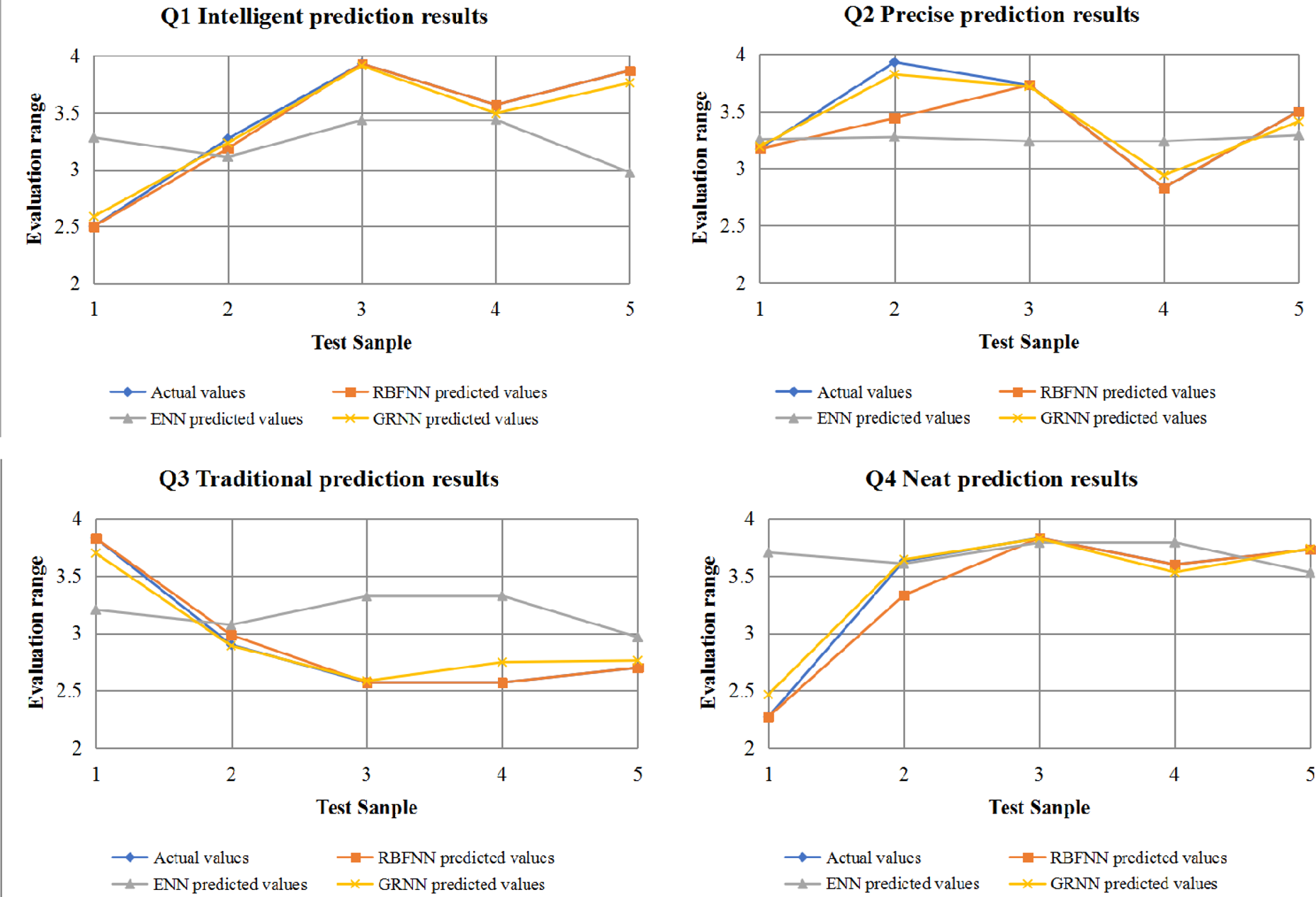
The prediction results of the three emotional prediction evaluation models and the error values are obtained through the training and testing of the three networks. In order to make the data more clear, according to the test data, the ordinate interval is modified to 2–4. Figure 10 presents the predicted output results of each neural network based on the four emotional dimensions. The X- and Y-axes represent five randomly selected samples and the evaluation level 2–4, respectively. It should be indicated that samples No. 56–60 are selected for verification.
Predictive evaluation distribution of four emotional dimensions.

Figure 4 shows that the accuracy of the predicted values of the RBFNN and GRNN is significantly higher than that of the ENN. However, in the prediction result of the Q 2 emotion and the predicted value of test sample 2, the RBFNN has a significant error and the prediction result of this point is similar to the ENN. Moreover, in the Q 3 emotional prediction results, the GRNN shows a slight deviation in the predicted value of the test sample 4. However, the degree of deviation is not significant. Furthermore, in the Q 4 emotional prediction results and the predicted value of the test sample 2, the RBF again shows error. However, this time the ENN prediction results are very accurate.
In order to examine the performance and accuracy of each emotional model, the three models are compared and analyzed by using MAE, RMSE, and MAPE as the evaluation indicators to measure the prediction effect of each model. Table 8 shows the indicator values for each network.
Comparisons among different forecasting models.

It should be indicated that the accuracy of the prediction result is directly affected by the prediction error. Therefore, measuring and analyzing the magnitude of the prediction error is of great significance to the accuracy of the prediction result. Moreover, also it is an important factor for continuously improving the prediction method.
The MAE can better reflect the actual situation of the predicted value error. It is observed that the MAE values of the four dimensions of the ENN are high, indicating that the error between the predicted value and the true value is significant. The minimum value of the RBFNN and the probability of average error are 0.0168 and 0.01, respectively. However, the maximum error is 0.0979. Moreover, the minimum and maximum values of the GRNN are 0.0577 and 0.079, respectively. However, the GRNN is slightly weaker than the RBFNN in a single prediction. Moreover, the overall prediction of the GRNN is accurate, indicating that the GRNN has better stability.
The RMSE can evaluate the degree of change of the data, which can reflect the precision of the measurement. The smaller the RMSE, the stronger its ability to fit the experimental data of the model. In terms of RMSE results, the RBFNN has a better fitting ability than the other two models in the two dimensions of Q 1 and Q 3. However, in the cumulative contribution rate of the four dimensions, the GRNN has the smallest RMSE cumulative value and shows a strong fitting effect.
The MAPE not only considers the error between the predicted value and the true value but also considers the ratio between the error and the true value. The average MAPE results are ENN 14.7485%, GRNN 2.2450%, and RBFNN 1.3095%. It is observed that the MAPE of RBFNN and GRNN are less than 10%, indicating that both are high-precision predictors. However, when compared with the ENN, the difference between the two of them is small.
In general, compared with the ENN, the RBFNN and GRNN have the best predictive performances and high fitting accuracies. It should be indicated that the RBFNN has unstable prediction error and the GRNN has a better stability. Therefore, it is recommended to utilize the GRNN as the core construction mechanism of the emotional prediction model.
Discussion
The deficiencies and parts that need to be perfected are as follows: (1) At present, the emotional prediction model established by using the neural network only adopts the basic network structure. If the improvement and optimization are performed on the results of various basic networks, the effects of each model will increase. (2) The picture uses grayscale processing for avoiding other factors affecting the feeling of the subject. However, the cockpit interior has multiple elements, such as color, material, and lighting. If the multi-factor coupling in the cockpit is further studied, it is more meaningful to decorate the sentiment analysis.
In the field of Kansei engineering, many research methods pre-define a number of perceptual emotional words and product feature words based on the expert knowledge. Then, they use questionnaire surveys and on-site interviews to assess the emotional attitudes of users to different product element combinations to achieve the product design (Liang et al., Reference Liang, Lee, Ho and Chen2019). However, this method relies too much on the subjective cognition of domain experts and there is a certain lag in the investigation time, which cannot meet the requirements of enterprises for user demand analysis in the current competitive environment. Therefore, some scholars, such as Vanhala et al. (Reference Vanhala, Lu, Peltonen, Sundqvist, Nummenmaa and Järvelin2020) began to utilize the text processing to mine user requirements. However, most of these studies focus on the rational needs of users, while they do not pay attention to the perceptual needs of users. The user requirements in the market competition environment are complex and variable. The vocabulary of the field accumulated in the existing research is relatively subjective and the number is small. There may be some deviations in the results of the analysis of user needs. Therefore, utilizing user reviews as a data source, and using wordnet and deep learning methods to generate user emotional sentiment dictionaries may better solve such problems.
The method of Kansei engineering is used to issue a concise and simple inquiry form to the investigator, fill in the comments and suggestions on related issues, and indirectly obtain materials and information (Guo et al., Reference Guo, Qu, Nagamachi and Duffy2020). However, the target of the survey is often the existing products in the market, which limits the imagination and associativity of the investigator to the products that have not appeared. Therefore, it cannot be extended to the inner needs of the investigator. Each standard of evaluation or sensual image level is usually set, and the investigator compares different styling design schemes to find the design styling that best matches the user's emotional intention. Although the advantages and disadvantages of different schemes can be compared at the same time, the design standards are sometimes difficult to control. Moreover, the number of standards should not be too large. The investigation results may have unobjective problems, the investigation process is not in-depth, and it is difficult to exert the investigator's initiative. Furthermore, the interaction link in the design should be increased, the participation rate of the users should be increased, and a user-led design process should be formed.
In the product shape design, by analyzing the correlation between the shape design elements and the user's perceptual image, the product shape is designed according to the user's perceptual needs. Commonly used correlation analysis methods include univariate regression, multiple regression, and gray correlation analysis (Zhai et al., Reference Zhai, Khoo and Zhong2009). This method can intuitively obtain the correlation or hetero-correlation between specific perceptual image factors and specific modeling features. However, quantitative analysis on the basis of the qualitative analysis and random combination of irrelevant modeling elements and perceptual images may lead to false correlation. System engineering (Angelini and Cascini, Reference Angelini and Cascini2016) and neural network and other intelligent association evaluation methods should be used to more comprehensively establish the association between emotional images and shape design.
Normally, a neural network can be divided into the training set and the test set. The former set requires a large number of samples for organization and learning, which are mainly applied to train parameters in the neural network. On the other hand, the latter set is used to evaluate the performance of the neural network objectively. It should be indicated that the ratio of the training set to the test set is appropriately matched based on research objects. For large-scale sample sets, this ratio considerably reduces. This reduction mainly originates from verifying, testing, and evaluating the model performance by a small sample size. Lei et al. (Reference Lei, Chen, Xue and Liu2018) formed a test sample of 50 sets of data and used the remaining sets of data with a ratio of 1:34 as training samples. Accordingly, they used 1676 sets for training. Liu et al. (Reference Liu, Sun, Fu, Zhang, Yang, Gao and Li2020) collected a total of 72 sets of actual engineering test data and experimental data. Among them, 60 sets of data are used to prepare a training set, and the remaining sets of data are considered as the prediction set so that the ratio of about 1:5 is achieved. They randomly split each working sub-database into the training (80%), validation (10%), and testing (10%) sets (Perez-Zarate et al., Reference Perez-Zarate, Santoyo, Acevedo-Anicasio, Díaz-Gonzalez and García-Lopez2019). Moreover, they randomly selected 80% of samples for training, while the remaining samples were used for testing (Rui et al., Reference Rui, Yang, YunHao and Huan2020). Considering special conditions of the present study, a ratio of 1:12 is followed in all experiments. Based on the obtained results, it is concluded that as the number of training and test sets increases, the corresponding accuracy of the neural network model improves. However, further investigations are required in this regard.
Conclusion
The present study proposes an evaluation method for the emotional preference of the cockpit interior of the aircraft. The proposed method combines the techniques of Kansei engineering, emotional computing, and neural network to construct the cockpit interior emotion evaluation model. An emotional model is established through three typical neural networks, including the RBFNN, ENN, and GRNN method. Pictures of 60 representative cockpits are utilized in the experiment. Then, samples are divided into the training set and the test set. Based on calculations with four emotional dimensions, it is found that the obtained results from the GRNN method have better agreement with the experiment. Moreover, it is found that among studied methods, the GRNN method has the best performance from MAE, RMSE, and MAPE points of view. Meanwhile, obtained results show that the overall performance of the evaluation result is more stable. Therefore, it is concluded that the GRNN method is an appropriate scheme for emotional evaluation of cockpit samples. The constructed model has a good predictive effect on the cockpit interior emotion evaluation. Furthermore, experimental results verify the effectiveness of the proposed approach.
Through the cockpit emotional evaluation model, the emotional evaluation value of the cockpit interior can be obtained in a short time. Therefore, objective evaluation assistance is provided for the cockpit interior design in line with the target pilot group emotions in the early stage of the cockpit research and development. The emotional evaluation score of the conceptual scheme can be obtained by inputting the concept rendering image. In other words, the emotional evaluation of the existing cockpit can be performed by obtaining the form of a picture. Moreover, the defects of conventional evaluation methods are solved for the real cockpit or engineering prototype, which have high evaluation costs and long cycles. Furthermore, the fatigue of investigators in the evaluation process is effectively reduced, and the authenticity of the evaluation in the emotional evaluation stage of the design process is improved significantly. It should be indicated that neural network evaluation is an intelligent algorithm that can be utilized in the current intelligent design field. At present, many studies have used genetic algorithms to optimize the design of the cockpit, and neural networks can be well embedded in the intelligent design process of genetic algorithms. This provides a reference for comprehensive and scientific evaluation and screening of the best emotional design solutions. The emotional evaluation method proposed in this study can be applied not only to the field of aircraft cockpit interior but also to other related fields, including the personalized cockpit design of a private aircraft.
Acknowledgments
This research was supported by the Special Funds for Basic Research in Central Universities (No. 31020190504004) and the Key Research and Development Program in Shaanxi Province of China (No. 2019GY-216).
Yanhao Chen (PhD) Key Laboratory of Industrial Design and Ergonomics, Ministry of Industry and Information Technology, Northwestern Polytechnical University.
Suihuai Yu (Professor) Key Laboratory of Industrial Design and Ergonomics, Ministry of Industry and Information Technology, Northwestern Polytechnical University. Academic appointments: Vice President of China Industrial Design Association Director of Expert Committee of “National Strategic Alliance of Industrial Design Industry Technology Innovation”, Ministry of Science and Technology Deputy Director of the Working Committee of “China Excellent Industrial Design Award” of the Ministry of Industry and Information Technology (2012) Vice Chairman of Interaction Design Professional Committee of China Industrial Design Association Deputy Chairman of the Teaching Guidance Subcommittee of the Industrial Design Major of the Ministry of Education
Jianjie Chu (Associate Professor) Key Laboratory of Industrial Design and Ergonomics, Ministry of Industry and Information Technology, Northwestern Polytechnical University. Academic appointments: Deputy Director of Shaanxi Industrial Design Development Center Deputy Secretary-General of Shaanxi Industrial Design Association.
Dengkai Chen (Professor) Key Laboratory of Industrial Design and Ergonomics, Ministry of Industry and Information Technology, Northwestern Polytechnical University. Academic appointments: Executive Chairman of International Conference on Design for Experience and Wellbeing Executive Chairman of International Symposium on Smart Products Through-life Design Vice Chairman and Secretary-General of Industrial Design Branch of Shaanxi Mechanical Engineering Society Vice President of Xi'an Industrial Design Association Deputy Secretary-General of Xi'an Design Federation.
Mingjiu Yu (Associate Professor) Key Laboratory of Industrial Design and Ergonomics, Ministry of Industry and Information Technology, Northwestern Polytechnical University. Academic appointments: Senior member of the Computer Committee of the Chinese Society of Graphics Member of Industrial Design Branch of Shaanxi Mechanical Engineering Society Reviewers of international journals such as “International Journal of Distributed Sensor Networks”