INTRODUCTION
Low- and middle-income countries (LMIC) host most dementia cases (Alzheimer’s Disease International, 2015). In addition, populations living in these countries present a high prevalence of several modifiable risk factors (e.g. cardiovascular risk factors) (Mukadam, Sommerlad, Huntley, & Livingston, Reference Mukadam, Sommerlad, Huntley and Livingston2019; Suemoto, Bittencourt, Santos, Benseñor, & Lotufo, Reference Suemoto, Bittencourt, Santos, Benseñor and Lotufo2017). Therefore, increasing early diagnostic accuracy of cognitive impairment in LMIC is necessary. Adequate normative data for a brief neuropsychological battery is essential to achieve this goal by identifying individuals with the poor cognitive performance considering sociodemographic characteristics. To this end, norms drawn from a population with similar sociodemographic characteristics are required to evaluate individual test performance (Lezak, Howieson, Bigler, & Tranel, Reference Lezak, Howieson, Bigler and Tranel2012; Strauss, Sherman, & Spreen, Reference Strauss, Sherman and Spreen2006).
The ELSA-Brasil is a multicentric longitudinal study of middle-aged and older adults with a diverse socioeconomic background regarding age, education, and race (Aquino et al., Reference Aquino, Barreto, Bensenor, Carvalho, Chor, Duncan and Szklo2012; Schmidt et al., Reference Schmidt, Duncan, Mill, Lotufo, Chor, Barreto and Bensenor2014). Participants have extensive sociodemographic, clinical, and cognitive assessments. In this study, the neuropsychological assessment is an optimized cognitive screening that verifies distinct domains in a short time (episodic memory, language, processing speed, and executive functions) (Passos, Caramelli, Benseñor, Giatti, & Maria Barreto, Reference Passos, Caramelli, Benseñor, Giatti and Maria Barreto2014). These tests are broadly used for having established international and national psychometric properties (Bertolucci et al., Reference Bertolucci, Okamoto, Brucki, Siviero, Neto and Ramos2001; Brucki, Malheiros, Okamoto, & Bertolucci, Reference Brucki, Malheiros, Okamoto and Bertolucci1997). The cognitive protocol includes the word list test (WLD) from the Consortium to Establish a Registry for Alzheimer’s Disease (CERAD) (Bertolucci et al., Reference Bertolucci, Okamoto, Brucki, Siviero, Neto and Ramos2001; Morris et al., Reference Morris, Heyman, Mohs, Hughes, van Belle, Fillenbaum and Clark1989), semantic (animals) and phonemic (letter F) verbal fluency (Fichman et al., Reference Fichman, Fernandes, Nitrini, Lourenço, Paradela, Carthery-Goulart and Caramelli2009; Machado, Fichman, Santos, & Carvalho, Reference Machado, Fichman, Santos and Carvalho2009), and the Trail Making Test – B (Hamdan & Hamdan, Reference Hamdan and Hamdan2009). All tests are available open-access and are easy to administrate. The ELSA-Brasil cognitive assessment already showed satisfactory reliability (Batista, Giatti, Barreto, Galery, & Passos, Reference Batista, Giatti, Barreto, Galery and Passos2013; Passos et al., Reference Passos, Caramelli, Benseñor, Giatti and Maria Barreto2014) and evidence of internal validity (Bertola et al., Reference Bertola, Benseñor, Barreto, Moreno, Griep, Vianna and Suemoto2020). The battery demonstrated a good fit for a two-factor structure (episodic memory and executive function) and to be invariant across age, sex, education, and race groups (16). These properties allow the selected tests to be used under a variety of circumstances, especially in the Brazilian National Health System, to identify patients with possible cognitive impairment in primary care settings.
Despite the efforts, Brazilian normative data for these tests are scarce, based on small and selected samples. For example, Bertolucci et al. (Reference Bertolucci, Okamoto, Brucki, Siviero, Neto and Ramos2001) offered the CERAD WLT norms based on a sample of 85 older adults. Machado et al. (Reference Machado, Fichman, Santos and Carvalho2009) developed phonemic verbal fluency norms only for the sum of the letters F, A, and S based on 345 older adults from an outpatient care clinic. Fichman et al. (Reference Fichman, Fernandes, Nitrini, Lourenço, Paradela, Carthery-Goulart and Caramelli2009) also published norms for semantic verbal fluency (animals) based on 319 older adults from outpatient care units. Hamdan & Hamdan (Reference Hamdan and Hamdan2009) did not publish official normative data for the TMT-B, but showed normative parameters based on 318 participants recruited from the university environment (students and staff). In addition, drugs that could affect cognition were not evaluated in any study.
Considering that studies involving the Brazilian population, and in a larger scale other LMIC population, needs more representative and more accurate normative data, this study aimed to provide these reference data for a brief neuropsychological battery. To this end, we used data from the ELSA-Brasil that provided a unique selection of a cognitively normal subsample based on several clinical variables. We aimed to additionally discuss diagnostic criteria for cognitive impairment to be used in primary care clinical settings since the same subjects provided normative data for all four tests and the intraindividual variability could be taken into account.
METHODS
Participants
The ELSA-Brasil is a longitudinal study of 15,105 participants from public institutions in 6 Brazilian cities (Belo Horizonte, Porto Alegre, Rio de Janeiro, Salvador, São Paulo, and Vitória), comprising 3 geographical regions (Southeast, South, and Northeast) (Aquino et al., Reference Aquino, Barreto, Bensenor, Carvalho, Chor, Duncan and Szklo2012; Schmidt et al., Reference Schmidt, Duncan, Mill, Lotufo, Chor, Barreto and Bensenor2014). The inclusion criteria for the study were active or retired employees from 6 educational and research institutions, of both sexes, aged between 35 and 74 at baseline (2008–2010). The ELSA-Brasil exclusion criteria were the presence of clinically observed severe cognitive or communication impairment (e.g. inability to verbally communicate, inability to accept the invitation, and attend alone the investigation center), intention to quit work at the institution in the near future for reasons not related to retirement, and, if retired, living outside the corresponding metropolitan area. Women currently or recently pregnant were rescheduled so that the first interview could take place at least 4 months after delivery (7). Baseline assessment included sociodemographic information, clinical history, mental health evaluation, lifestyle factors, occupational exposure, and clinical family history. All participants were Brazilian–Portuguese speakers (for a better comprehension of Brazilian race, see Teixeira, Reference Teixeira2018).
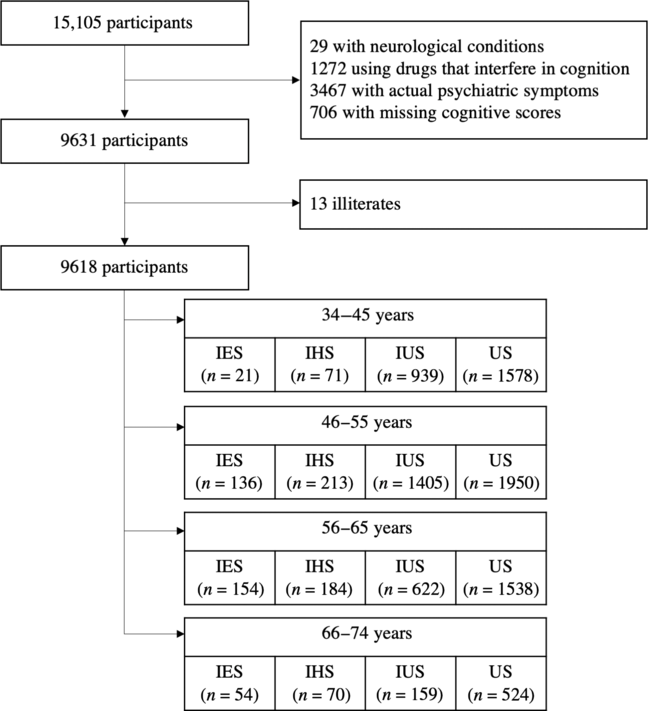
For our study, we used baseline data and excluded participants with self-reported or previously known neurological diagnoses (stroke, concussion, traumatic brain injury, brain tumor, multiple sclerosis, Parkinson’s disease, dementia, and epilepsy), those with sensory or motor impairment, those who were using any medication that indicated the presence of active neurologic or psychiatric diseases (e.g. benzodiazepines, neuroleptics, antiparkinsonian agents, anticonvulsants, sedating antihistamines, lithium, α-adrenergic agonists, tricyclic antidepressants, among others) (Supplementary Material A – Supplementary Table 1), and those who had psychiatric symptoms (Figure 1). For the exclusion of psychiatric symptoms, we used the Clinical Interview Schedule-Revised (CIS-R) 14 sections covering symptoms of common mental disorders [somatic complaints (pain), fatigue, concentration and forgetfulness, sleep disturbance, irritability, worry about physical health, depression, depression ideas, worry, anxiety, phobias, panic attacks, compulsions, and obsessions] that were present in the last week at a level that causes distress and interference in daily activities. We also excluded participants with missing cognitive test scores. We additionally excluded 13 illiterate participants since they had a broad age range and presented a significant discrepancy of cognitive scores when compared to the low educated group, preventing them to be grouped for normative purposes.
Flowchart of the selection of the normative sample. IES – incomplete elementary school; IHS – incomplete high school; IUS – incomplete undergraduate school; US – complete undergraduate school or higher degree.

The final sample was composed of 9618 participants divided into groups based on age (35–45 years, 46–55 years, 56–65 years, and 66–74 years) and education (incomplete elementary school – IES, incomplete high school – IHS, incomplete undergraduate school – IUS, and complete or more than undergraduate school – US). This division resulted in 16 normative groups, once each age group had 4 educational subgroups (Figure 1).
We additionally performed robust normative data based on a subsample of participants that were reassessed 4 years later (only participants with 55 years or more were eligible). Participants that are longitudinally followed and do not demonstrate signs of cognitive decline or impairment provide robust norms. This approach avoids the inclusion of subjects with subtle cognitive impairment at normative groups, and, consequently, increases the norm sensitivity to detect early cognitive changes. Methods specification for this analysis and normative tables are shown at the Supplementary Material B.
To investigate criterion validity, 385 participants with a depressive episode (unipolar and without assessed psychiatric comorbid conditions) according to the Clinical Interview Schedule-Revised (CIS-R) were selected considering the vast literature report of cognitive deficits in individuals with depressive episodes (Shimada et al., Reference Shimada, Park, Makizako, Doi, Lee and Suzuki2014). Depressive episodes (without psychotic symptoms) included in group F32.xx of the International Classification of Diseases (ICD-10) were computed after the application of the CIS-R by trained interviewers, using an appropriated algorithm (Brunoni, Szlejf, Suemoto, Santos, Goulart, Viana, & Benseñor, Reference Brunoni, Szlejf, Suemoto, Santos, Goulart, Viana and Benseñor2019; Lewis, Pelosi, Araya, & Dunn, Reference Lewis, Pelosi, Araya and Dunn1992; Nunes, Alves, Chor, Schmidt, & Duncan, Reference Nunes, Alves, Chor, Schmidt and Duncan2011). These participants composed the clinical group and were selected based on higher sample representation according to age (ranging from 40 to 60 years, comprising 82% of the participants) and education (with more than 11 years of schooling, comprising 87% or the participants). This group had a mean age of 49.12 (SD = 5.39) years and 78% were female. Only 16% percent of these participants were under pharmacological treatment and there were no cognitive differences between them and the 84% that were not under pharmacological treatment (data not shown) We selected a subsample control group for this comparison with similar ranges of age and education.
Neuropsychological Assessment
The ELSA-Brasil has a brief neuropsychological assessment, composed of tasks that can inform about episodic memory, processing speed, executive function, and language. Trained examiners administered the tests in a fixed order during a single session, and all the requirements for the psychometric testing environment were met. The administration takes approximately 15 min. The detailed instructions for administration and scoring in Portuguese can be accessed under request.
CERAD Word List Test
We selected the WLT from the CERAD (Morris et al., Reference Morris, Heyman, Mohs, Hughes, van Belle, Fillenbaum and Clark1989) validated for the Brazilian population (Bertolucci et al., Reference Bertolucci, Okamoto, Brucki, Siviero, Neto and Ramos2001). This task requires the learning, recall, and recognition of a 10-list word. The participant is instructed to read and recall the words three times for the learning trials. Approximately 5 min later (after the administration of two verbal fluency tests), the participant is requested to recall the maximum number of words from the presented list. After the recall trial, the participant is requested to recognize the words previously saw in a 20-word list containing the original 10 words and 10 distracting words. The learning score is the sum of words remembered after each of the three initial trials (0–30 points), and the recall score is the number of words remembered after the 5-min interval (0–10 points). The recognition score is the number of correctly classified words that belonged to the list (0–10 points) with penalization for including distractors (the number of correctly identified existing words minus false-positive errors).
Verbal Fluency
The participants performed the semantic (SVF) and the phonemic (PVF) verbal fluency tasks (animals and letter F, respectively) (Fichman et al., Reference Fichman, Fernandes, Nitrini, Lourenço, Paradela, Carthery-Goulart and Caramelli2009; Machado et al., Reference Machado, Fichman, Santos and Carvalho2009). For each verbal fluency test, the participant was instructed to produce the maximum of words within 1 min. For the category of animals, the participant was instructed to say as many exemplars as possible. At the scoring procedure, if the participants provide a superordinate and a supraordinate (e.g. dog and Labrador), only one of them was considered correct and the other incorrect. Extinct animals were accepted as correct words, but not imaginary animals. For the phonemic fluency, the participant was instructed to say words starting with the letter F, and additionally not to say proper nouns and words that only differ in their final syllable. SVF and PVF scores were based on the number of correct responses produced in 1 min in each task separately.
Trail Making Test – B
Only part B of the Trail Making Test (TMT) was used in the ELSA-Brasil (Hamdan & Hamdan, Reference Hamdan and Hamdan2009). For this task, the participant first performed a learning trial for understanding the test prior to executing the time-recording part. In this learning trial, the participant was instructed to connect the first number with the first letter of the alphabet and then this letter with the next number, and from this to the next letter up to the end. Therefore, at the learning trail, the participant should connect 1-A-2-B-3-C-4-D. Once the participant understood and was able to perform the test, the time-recorded part was presented, with instruction repetition and a page with numbers ranging from 1 to 13 and letters from A to L. TMT score was based on time (in seconds) used to complete the task. If the participant committed an error, the interviewer instructed her/him to return to the last corrected point, without stopping the chronometer, and to continue the task.
Statistical Analysis
First, we conducted descriptive statistics analysis to characterize the sample and subsamples, divided between the Control group and Clinical group. Subsequently, the statistical analysis was divided into (a) Psychometric and normative analyses and (b) Criteria for cognitive impairment. Statistical analyses were performed using the Stata 13 (StataCorp, 2013) and R software (Team, 2019)
Psychometric and Normative Analyses
Correlations of demographic characteristics with the cognitive scores, and within the cognitive scores were investigated using Spearman’s correlation followed by the Bonferroni correction. Since assumptions for linear regression were not met, we performed weighted least squares (WLS) regression to account for heteroskedasticity. WLS regression considered the impact of age, sex, and education on cognitive scores in two distinct models. The first model included age and education; the major variables known to impact cognitive performance. The second model included sex, verifying the independent contribution of this variable to cognitive performance. We extracted the descriptive and percentile normative parameters for the 16 sociodemographic groups. Group comparison (normative sample vs. depressive episode group) was conducted using the Wilcoxon rank-sum test with age and education-corrected cognitive scores.
Criteria for Cognitive Impairment
Neuropsychological normality criteria based on a nomothetic approach were assessed based on the occurrence of spurious results under the adopted cutoff. We verified the percentage of normal adults that revealed spurious cognitive scores when three distinct cutoffs were used. These cutoffs were the most used in the clinic and research on cognitive disorders (Binder, Iverson, & Brooks, Reference Binder, Iverson and Brooks2009; Schretlen, Testas, Winicki, Pearlson, & Gordon, Reference Schretlen, Testas, Winicki, Pearlson and Gordon2008). The 2nd percentile (that corresponds to a Z score of −2), the 7th percentile (that corresponds to a Z score of −1.5), and the 16th percentile 16 (that corresponds to a Z score of −1.0) were used as flexible, recommended, and conservative cutoffs, respectively.
RESULTS
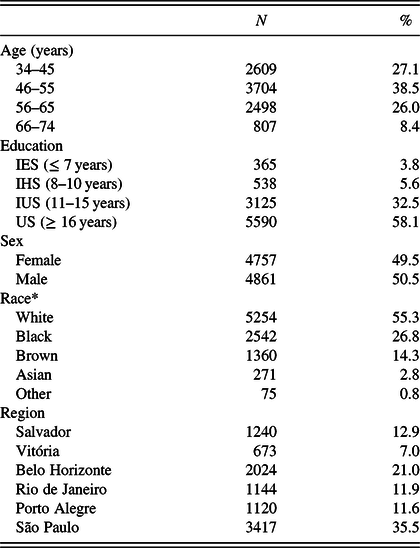
The normative sample composed of 9618 participants was well distributed across the 6 centers, race, and sex (Table 1 and Figure 1).
Descriptive characteristics of the normative sample

Abbreviations: IES, incomplete elementary school; IHS, incomplete high school; IUS, incomplete undergraduate school; US, complete undergraduate school or higher degree.
* Teixeira (Reference Teixeira2018) provide more information about historical Brazilian race classifications (doi: 10.1590/s0104–40362018002601768).
Psychometric and Normative Analyses
Spearman’s correlation revealed that education was more correlated with cognitive scores than age, while sex had weak correlations (data not shown). The correlation pattern across the cognitive scores was in accordance with previous studies with the ELSA-Brasil cognitive data that suggest two major cognitive domains (episodic memory and executive function/speed) (Bertola et al., Reference Bertola, Benseñor, Barreto, Moreno, Griep, Vianna and Suemoto2020; Passos et al., Reference Passos, Caramelli, Benseñor, Giatti and Maria Barreto2014).
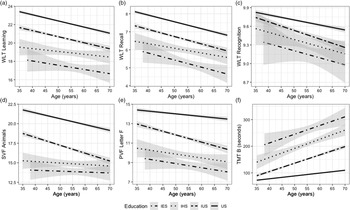
The WLS regression revealed that sex added less than 3% of explained variance only in memory scores (WLT learning and WLT recall) (Supplementary Material A – Supplementary Table 2), not adding variance for the TMT and the verbal fluency scores. Therefore, we calculated coefficients for the test scores according to age and education groups (Supplementary Material A – Supplementary Table 3). We found a greater impact of education on cognitive performance when compared to age. Figure 2 shows the score patterns based on age and the four educational groups. Within the six cognitive scores, recognition had a ceiling effect, with a minimal effect of age and education on this test performance.
Cognitive scores based on age and the four educational groups. IES – incomplete elementary school (dot dashed line); IHS – incomplete high school (dotted line); IUS – incomplete undergraduate school (two dotted lines); US – complete undergraduate school or higher degree (solid line). Note: For all tests scores, higher achievement means better performance, except for the TMT-B where more seconds mean worse performance.

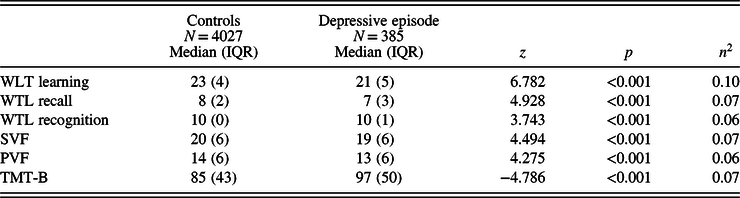
The comparison of the normative subsample with the clinical group with a depressive episode revealed that the latter had lower scores in all six tests when compared to participants without a depressive episode, even though the effect size is modest (Table 2).
Clinical comparison among controls and participants with depressive symptoms

Abbreviations: IQR, interquartile range; WLT, word list test; SVF, semantic verbal fluency; PVF, phonemic verbal fluency; TMT-B, Trail Making Test – B; WLT trials and verbal fluency tests are measured using word units and TMT-B is measured using seconds. All values are raw scores.
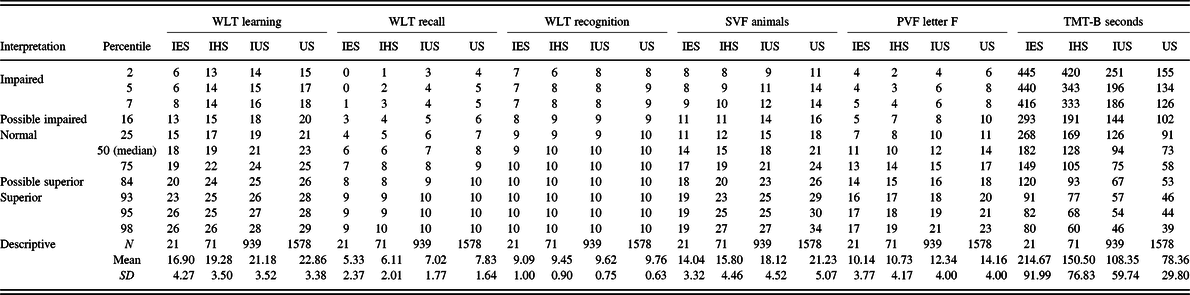
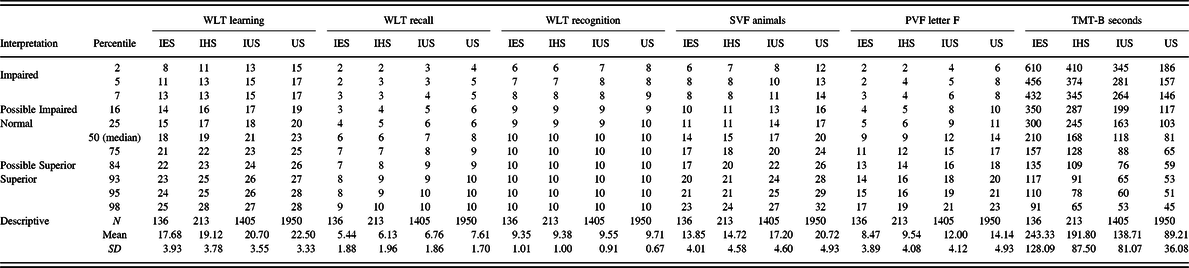
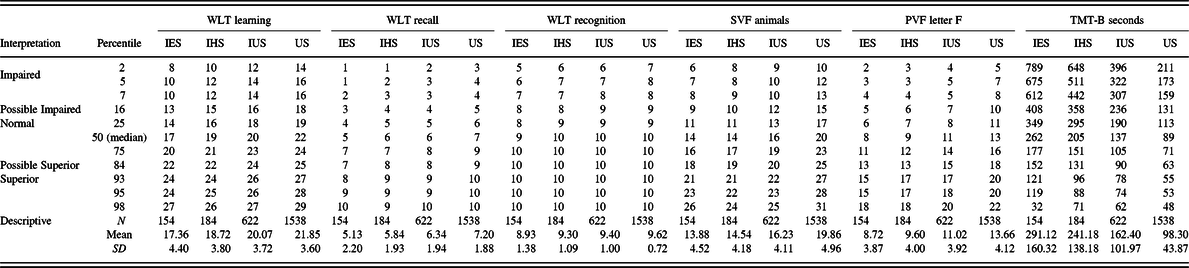
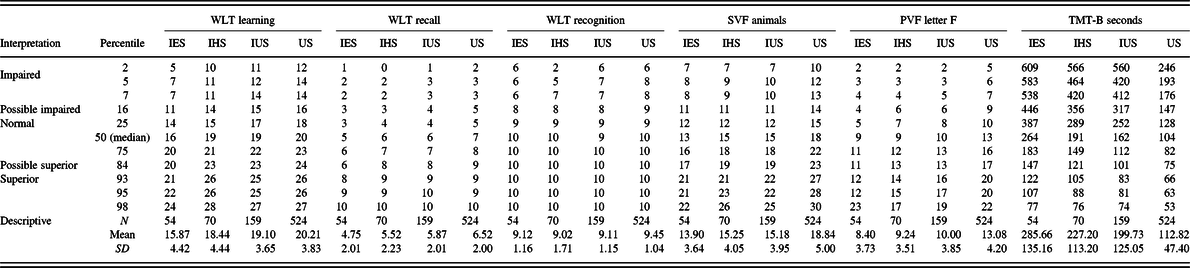
Considering that for most of the 16 normative groups the tests did not reveal a normal distribution (according to visual analysis, Kolmogorov–Smirnov and Shapiro–Wilk tests), we recommend and provide normative data based on percentile for broad clinical use. Tables 3–6 comprehend the normative percentile for each test score. Results from the robust normative sample for subjects with 55 years or more, demonstrated a slightly better performance across the 8 groups based on age and education (Supplementary Material B).
Normative data for 34–45 years according to educational level

Abbreviations: WLT, word list test; SVF, semantic verbal fluency; PVF, phonemic verbal fluency; TMT-B, Trail Making Test – B; IES, incomplete elementary school; IHS, incomplete high school; IUS, incomplete undergraduate school; US, complete undergraduate school or higher degree.
Suggested scores labels: Impaired = Percentile ≤ 7; Possible Impaired = Percentile 16; Normal = Percentile 25–75; Possible Superior = Percentile 84; Superior = Percentile ≥ 93.
Normative data for 46–55 years according to educational level

Abbreviations: WLT, word list test; SVF, semantic verbal fluency; PVF, phonemic verbal fluency; TMT-B, Trail Making Test – B; IES, incomplete elementary school; IHS, incomplete high school; IUS, incomplete undergraduate school; US, complete undergraduate school or higher degree.
Suggested scores labels: Impaired = Percentile ≤ 7; Possible Impaired = Percentile 16; Normal = Percentile 25–75; Possible Superior = Percentile 84; Superior = Percentile ≥ 93.
Normative data for 56–65 years according to educational level

Abbreviations: WLT, word list test; SVF, semantic verbal fluency; PVF, phonemic verbal fluency; TMT-B, Trail Making Test – B; IES, incomplete elementary school; IHS, incomplete high school; IUS, incomplete undergraduate school; US, complete undergraduate school or higher degree.
Suggested scores labels: Impaired = Percentile ≤ 7; Possible Impaired = Percentile 16; Normal = Percentile 25–75; Possible Superior = Percentile 84; Superior = Percentile ≥ 93.
Normative data for 66–74 years according to educational level

Abbreviations: WLT, word list test; SVF, semantic verbal fluency; PVF, phonemic verbal fluency; TMT-B, Trail Making Test – B; IES, incomplete elementary school; IHS, incomplete high school; IUS, incomplete undergraduate school; US, complete undergraduate school or higher degree.
Suggested scores labels: Impaired = Percentile ≤ 7; Possible Impaired = Percentile 16; Normal = Percentile 25–75; Possible Superior = Percentile 84; Superior = Percentile ≥ 93.
Criteria for Cognitive Impairment
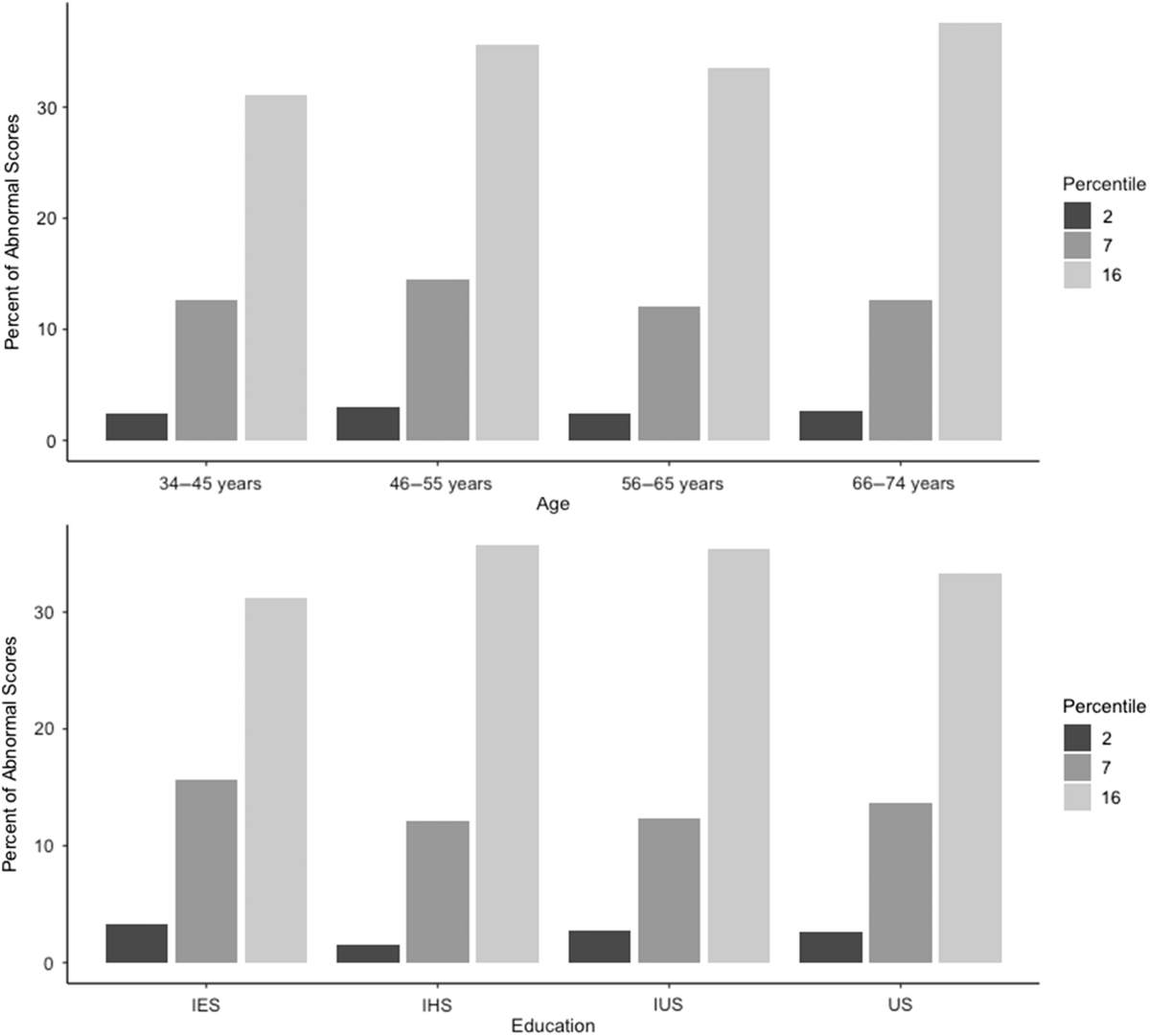
The analysis of possible spurious scores (Supplementary Material A – Supplementary Table 4) revealed that when adopting the clinical cutoff at the 16th percentile, 61% of the normative sample will have at least one score below the expected normality, and 34% will have at least two scores below the clinical cutoff, suggesting that this limit increases false-positive cases for cognitive impairment. When adopting the clinical cutoff at the 7th percentile, 37% of the sample had at least one score below the threshold, and 13% had at least two scores below the clinical cutoff, suggesting that this limit might be suitable when looking for cognitive impairment. When adopting the clinical cutoff at the 2nd percentile, 13% of the sample had at least one score below the threshold, and 3% had at least two scores below the clinical mark, suggesting that this limit might be very conservative when screening for cognitive impairment. The percentage of abnormal scores were similar across age and education groups (Figure 3).
Relative frequency of participants with two or more abnormal test scores (y-axis) as defined by three different cutoffs (percentiles 2, 7, and 16) by age and education groups. IES – incomplete elementary school; IHS – incomplete high school; IUS – incomplete undergraduate school; US – complete undergraduate school or higher degree.

DISCUSSION
In this study, we provided age and education-specific normative data for the brief neuropsychological battery used in the ELSA-Brasil study. Our results suggested the division of normative groups based on age and education and showed minimal sex effect. As found in a previous study, we showed that despite age was associated with cognitive performance, education had the greatest impact (Passos et al., Reference Passos, Giatti, Bensenor, Tiemeier, Ikram, de Figueiredo and Barreto2015). Except for the recognition trial of the WLT, younger age participants with higher education had a better cognitive performance as expected (Lezak et al., Reference Lezak, Howieson, Bigler and Tranel2012; Strauss et al., Reference Strauss, Sherman and Spreen2006). The WLT recognition showed a ceiling effect as previously reported (Beeri et al., Reference Beeri, Schmeidler, Sano, Wang, Lally, Grossman and Silverman2006; Luck et al., Reference Luck, Pabst, Rodriguez, Schroeter, Witte, Hinz and Riedel-Heller2018). Tests designed to be sensitive to cognitive impairment, as the CERAD WLT, usually demonstrate ceiling effects in normal samples (Diniz, Yassuda, Nunes, Radanovic, & Forlenza, Reference Diniz, Yassuda, Nunes, Radanovic and Forlenza2007; Franco-Marina et al., Reference Franco-Marina, García-González, Wagner-Echeagaray, Gallo, Ugalde, Sánchez-García and García-Peña2010; Mioshi, Dawson, Mitchell, Arnold, & Hodges, Reference Mioshi, Dawson, Mitchell, Arnold and Hodges2006).
A recent review concluded that LMIC countries have limited studies about the identification of cognitive impairment in primary care, and most studies used only the Mini-Mental State Examination (Pelegrini, Mota, Ramos, Jesus, & Vale, Reference Pelegrini, Mota, Ramos, Jesus and Vale2019). Our results support the nomothetic clinical use of this cognitive battery in primary care settings due to the shorter time of administration, low cost, and specific cutoffs based on different age and education groups. Also, we provided norms for a battery that will be useful to investigate the early stages of cognitive impairment in individuals with diverse socioeconomic backgrounds (Yokomizo, Simon, & de Campos Bottino, Reference Yokomizo, Simon and de Campos Bottino2014). Of note, Brazil, like many developing countries, faces an aging trend in the last decades, and dementia is one of the top leading neurologic diseases with a huge burden for society.
This study is the first Brazilian study to include a subset of robust norms for subjects with 55 years based on longitudinal data. The exclusion of participants that might have subtle cognitive impairment on baseline according to their follow-up cognitive status increases the norm sensitivity to identify very mild cognitive impairment (De Santi et al., Reference De Santi, Pirraglia, Barr, Babb, Williams, Rogers and de Leon2008; Harrington et al., Reference Harrington, Lim, Ames, Hassenstab, Rainey-Smith, Robertson and Group2017).
We showed evidence of criterion validity using a group of participants with a depressive episode. ELSA-Brasil participants with a depressive episode performed worse than subjects without a depressive episode (Shimada et al., Reference Shimada, Park, Makizako, Doi, Lee and Suzuki2014). The presence of group differences indicates that this neuropsychological battery is sensitive to conditions that affect cognitive performance, like depression. Therefore, the proposed cognitive assessment is probably able to screen cognitive impairment in middle-aged and older adults with different educational levels. The scores decline as a function of older age and increase as a function of higher education also indicates evidence of criterion validity (Hartshorne & Germine, Reference Hartshorne and Germine2015; Strauss et al., Reference Strauss, Sherman and Spreen2006).
Abnormal performance is common in neuropsychological assessment. The rate of subjects with at least two scores below the clinical cutoff is dependent on how many tests were administered and which cutoff was selected. Despite using a six-measure battery while comparative studies usually address this issue with more measures, we might interpret that our rate of abnormal scores is in line with previous studies that reported an estimated rate of 15% when considering a battery with 10 scores and a clinical cutoff of −1.5 standard deviation (Binder et al., Reference Binder, Iverson and Brooks2009; Schretlen et al., Reference Schretlen, Testas, Winicki, Pearlson and Gordon2008). This similarity highlights that spurious results are a common finding in cognitive assessment and should be taken into account when determining the clinical criteria for cognitive impairment. Considering our spurious scores results, the clinical cutoff of at least two scores below the 7th percentile (similar to a Z score of −1.5) revealed an appropriate rate of cognitive impairment. This clinical cutoff suggestion has the limitation of only taking into account the presence of abnormal performance on cognitive tests in healthy subjects and should be adopted jointly with other epidemiological, medical, and functional information for the diagnosis of mild cognitive impairment. This clinical cutoff is in line with previous studies about mild cognitive impairment diagnosis (Winblad et al., Reference Winblad, Palmer, Kivipelto, Jelic, Fratiglioni, Wahlund and Petersen2004).
Our study has some limitations. The use of a single evaluation in time is an important limitation as intraindividual variability in test performance is quite high as shown in previous work (Passos et al., Reference Passos, Giatti, Bensenor, Tiemeier, Ikram, de Figueiredo and Barreto2015). Criterion validity was performed using a clinical group of participants with a depressive episode. We were not able to perform the criterion validity with other neurological conditions (i.e. mild cognitive impairment) because these participants were excluded following the ELSA-Brasil recruitment criteria. Once all ELSA-Brasil participants underwent the same cognitive battery, we were unable to test if participants with depression had expected cognitive impairments related to depressive symptoms (i.e. speed processing, attention deficits, and more executive function abilities). At the recruitment, participants were considered independent in daily activities if they were able to accept the research invitation and were able to attend the investigation center by themselves. Although most of the participants were still actively working at the institutions, the absence of an objective functional assessment is a limitation.
The ELSA-Brasil sample has a large proportion of participants with a higher educational level than the national statistics. This resulted in a smaller number of subjects at the IES and HIS normative subgroups when compared to the others. In addition, we could not generate norms for illiterates. This fact can generate a lower representation of the Brazilian population with these educational backgrounds. We recommend that clinicians must be aware of this fact when comparing subjects with these normative subgroups. Since some cognitive domains were not assessed (i.e. executive function-specific subdomains, language subdomains, attention, and visuoconstruction), the cognitive battery used by the ELSA-Brasil is not complete, and this might result in lower sensitivity for certain neurologic conditions. Nevertheless, to the best of our knowledge, this is the first study with normative data from a large Brazilian cohort sample for these neuropsychological tasks, including auxiliary robust norms.
The strengths of the current study include a sociodemographic diverse sample with a wide range of age span and education. We used a rigorous criterion to exclude individuals with subclinical disease or known risk factors for cognitive impairment that may affect performance on cognitive testing and additionally provided robust norms for subjects with more than 55 years old. The exclusion of these individuals from the normative sample provides increased sensitivity to detect cognitive impairment and addresses a limitation of existing norms that were based mainly on convenience samples.
The growing population of older adults in LMIC highlights the need for appropriate normative data to accurately identify early cognitive impairment and dementia in these populations at higher risk. This study provides age and education-specific normative data for six scores that can be used as an additional option for clinicians and researchers, and especially for primary care professionals in the evaluation of Brazilian subjects. The suggested clinical cutoff of at least two scores below the 7th percentile will help improve the interpretation of performance for the diagnosis of cognitive impairment in older adults with similar demographic characteristics.
ACKNOWLEDGMENTS
The ELSA-Brasil baseline study was supported by the Brazilian Ministry of Health (Science and Technology Department) and the Brazilian Ministry of Science and Technology (FINEP, Financiadora de Estudos e Projetos and CNPq, National Research Council), grants 01 06 0010.00 RS, 01 06 0212.00 BA, 01 06 0300.00 ES, 01 06 0278.00 MG, 01 06 0115.00 SP, and 01 06 0071.00 RJ. S.M.B. and R.H.G are research fellows of the National Research Council (CNPq, grant numbers 300159/99-4 and 301807/2016-7, respectively).
CONFLICT OF INTEREST
The authors have nothing to disclose.
SUPPLEMENTARY MATERIAL
To view supplementary material for this article, please visit https://doi.org/10.1017/S1355617720000880