Introduction
A wealth of research has demonstrated that generalized anxiety disorder (GAD) is a fairly common and impairing condition (for reviews, see Kessler & Wittchen, Reference Kessler and Wittchen2002; Wittchen, Reference Wittchen2002; Lieb et al. Reference Lieb, Becker and Altamura2005; Beesdo et al. Reference Beesdo, Knappe and Pine2009). Across epidemiological surveys worldwide, lifetime prevalence estimates range from 1.8% to 6.9% among adults (Lieb et al. Reference Lieb, Becker and Altamura2005) and from 0.3% to 5.8% among youth (Beesdo et al. Reference Beesdo, Knappe and Pine2009; Merikangas et al. Reference Merikangas, He, Burstein, Swanson, Avenevoli, Cui, Benjet, Georgiades and Swendsen2010). General population samples across age groups have also shown that GAD is marked by relatively high rates of psychiatric co-morbidity and disability (Lieb et al. Reference Lieb, Becker and Altamura2005; Beesdo et al. Reference Beesdo, Pine, Lieb and Wittchen2010; Kessler et al. Reference Kessler, Avenevoli, Costello, Green, Gruber, McLaughlin, Petukhova, Sampson, Zaslavsky and Merikangas2012b ).
Despite scientific consensus regarding the scale and burden of GAD in the general population (Kessler & Wittchen, Reference Kessler and Wittchen2002; Wittchen, Reference Wittchen2002; Lieb et al. Reference Lieb, Becker and Altamura2005; Beesdo et al. Reference Beesdo, Pine, Lieb and Wittchen2010), the diagnostic threshold of GAD continues to pose challenges for investigators and practitioners. For example, data indicate that nearly three-quarters of adults and one-quarter of youth who present for treatment due to clinically significant worry fail to meet GAD criteria by a single criterion, resulting in an anxiety disorder not otherwise specified (NOS) diagnosis (Lawrence & Brown, Reference Lawrence and Brown2009; Comer et al. Reference Comer, Gallo, Korathu-Larson, Pincus and Brown2012a ). Because NOS diagnoses are frequently excluded from clinical investigation (Fairburn & Bohn, Reference Fairburn and Bohn2005), relegation to this category may obstruct evidence-based treatment attempts. Further, investigations that have examined the application of less restrictive diagnostic thresholds, including lowering the required duration from 6 months to 3 months and/or 1 month (Kendler et al. Reference Kendler, Neale, Kessler, Heath and Eaves1992; Carter et al. Reference Carter, Wittchen, Pfister and Kessler2001; Hoyer et al. Reference Hoyer, Becker and Margraf2002; Kessler et al. Reference Kessler, Brandenburg, Lane, Roy-Byrne, Stang, Stein and Wittchen2005b ; Angst et al. Reference Angst, Gamma, Bienvenu, Eaton, Ajdacic, Eich and Rössler2006; Ruscio et al. Reference Ruscio, Chiu, Roy-Byrne, Stang, Stein, Wittchen and Kessler2007; Lee et al. Reference Lee, Tsang, Ruscio, Haro, Stein, Alonso, Angermeyer, Bromet, Demyttenaere, de Girolamo, de Graaf, Gureje, Iwata, Karam, Lepine, Levinson, Medina-Mora, Oakley Browne, Posada-Villa and Kessler2009; Andrews & Hobbs, Reference Andrews and Hobbs2010) or omitting the requirement of excessiveness and/or uncontrollability of worry (Ruscio et al. Reference Ruscio, Lane, Roy-Byrne, Stang, Stein, Wittchen and Kessler2005; Andrews & Hobbs, Reference Andrews and Hobbs2010), have had relatively little impact on the demographic and clinical features of cases. Thus, there is abundant evidence that the strict application of GAD diagnostic criteria may discount a sizeable proportion of individuals who are functionally impaired and phenotypically similar to individuals who meet full criteria for the disorder.
While the subthreshold concept of GAD has received substantial attention among adults, much less work has focused on this concept during the early life course. To date, only one study of which we are aware has examined both threshold and subthreshold forms of GAD in a young community-based cohort (Beesdo-Baum et al. Reference Beesdo-Baum, Winkel, Pine, Hoyer, Hofler, Lieb and Wittchen2011). Results of this investigation indicated that youth with subthreshold GAD defined by a 3-month duration continued to display elevated psychiatric co-morbidity and disability relative to unaffected youth. Thus far, however, no nationally representative studies of youth have also provided a comprehensive examination of the uncontrollability and associated symptom criteria – two criteria that gained particular interest in the revision process for the Diagnostic and Statistical Manual of Mental Disorders, fifth edition (DSM-5) (Andrews et al. Reference Andrews, Hobbs, Borkovec, Beesdo, Craske, Heimberg, Rapee, Ruscio and Stanley2010; Andrews & Hobbs, Reference Andrews and Hobbs2010; Hallion & Ruscio, Reference Hallion and Ruscio2013). Indeed, definitional changes under consideration included a shorter required duration (3 months versus 6 months), exclusion of the ‘uncontrollability’ criterion, and reductions in the array of potential associated symptoms, requiring one of either restlessness or muscle tension. The recent rejection of these proposed changes exemplifies some of the uncertainty that has surrounded establishing an appropriate clinical threshold for the disorder. Yet, there remains a noteworthy lack of information on subthreshold manifestations of GAD in young people.
Related, few studies have examined the clinical features and characteristics of threshold GAD in community samples of youth (Andrews et al. Reference Andrews, Hobbs, Borkovec, Beesdo, Craske, Heimberg, Rapee, Ruscio and Stanley2010). Therefore, relatively little is known about the associated symptoms and clinical course of GAD among adolescents in the general population, and even less is known about how these characteristics may vary across development. Available data from clinical studies suggest that the associated symptoms of GAD differ across age groups (Tracey et al. Reference Tracey, Chorpita, Douban and Barlow1997; Pina et al. Reference Pina, Silverman, Alfano and Saavedra2002). Further, whereas a number of clinical and general population studies have indicated that GAD displays a fairly chronic and persistent course among adults (Kessler & Wittchen, Reference Kessler and Wittchen2002; Wittchen, Reference Wittchen2002), community studies of youth reveal only moderate persistence and stability of the disorder across time (Bittner et al. Reference Bittner, Egger, Erkanli, Jane Costello, Foley and Angold2007; Angst et al. Reference Angst, Gamma, Baldwin, Ajdacic-Gross and Rossler2009; Beesdo-Baum et al. Reference Beesdo-Baum, Winkel, Pine, Hoyer, Hofler, Lieb and Wittchen2011; Kessler et al. Reference Kessler, Avenevoli, Costello, Georgiades, Green, Gruber, He, Koretz, McLaughlin, Petukhova, Sampson, Zaslavsky and Merikangas2012a ). Thus, despite evidence of age-related differences in the associated symptoms and clinical course of GAD, no studies have examined how these characteristics may vary among youth in the adolescent age range.
The goals of the current study were to: (1) examine the prevalence, and sociodemographic and clinical characteristics of threshold and subthreshold forms of GAD in a nationally representative sample of US youth; and (2) test differences in sociodemographic and clinical characteristics between threshold and subthreshold forms of the disorder. In consideration of work that has found associated symptoms and course characteristics to vary across development (Tracey et al. Reference Tracey, Chorpita, Douban and Barlow1997; Pina et al. Reference Pina, Silverman, Alfano and Saavedra2002; Beesdo-Baum et al. Reference Beesdo-Baum, Winkel, Pine, Hoyer, Hofler, Lieb and Wittchen2011), we also investigated differences in these features across age for all forms of GAD.
Method
Sample and procedure
The National Comorbidity Survey Replication-Adolescent Supplement (NCS-A) is a nationally representative face-to-face survey of 10 123 adolescents aged 13–18 years in the continental USA. Information concerning the sampling strategy, participation rates and instruments in the NCS-A can be found in greater detail elsewhere (Kessler et al. Reference Kessler, Avenevoli, Costello, Green, Gruber, Heeringa, Merikangas, Pennell, Sampson and Zaslavsky2009; Merikangas et al. Reference Merikangas, Avenevoli, Costello, Koretz and Kessler2009). The survey was carried out in a dual-frame sample that included a household subsample (n = 879) and a school subsample (n = 9244). The adolescent response rate of the combined subsamples was 82.9%. Minor differences in sample and population distributions of census sociodemographic and school characteristics were corrected with post-stratification weighting (Kessler et al. Reference Kessler, Avenevoli, Costello, Green, Gruber, Heeringa, Merikangas, Pennell, Sampson and Zaslavsky2009).
One parent/parent surrogate of each participating adolescent was mailed a self-administered questionnaire (SAQ) to collect information on adolescent mental/physical health and other family- and community-level factors. The full SAQ was completed by 6483 parents. All recruitment and consent procedures were approved by the human subjects committees of Harvard Medical School and the University of Michigan.
Measures
Diagnostic assessment
Adolescents were administered a modified World Health Organization Composite International Diagnostic Interview Version 3.0, a fully structured interview of Diagnostic and Statistical Manual of Mental Disorders, fourth edition (DSM-IV) diagnoses (Kessler & Ustun, Reference Kessler and Ustun2004). Specific details concerning the diagnostic assessment can be found in previous reports (Merikangas et al. Reference Merikangas, He, Burstein, Swendsen, Avenevoli, Case, Georgiades, Heaton, Swanson and Olfson2011; Burstein et al. Reference Burstein, Georgiades, Lamers, Swanson, Cui, He, Avenevoli and Merikangas2012). Definitions of all psychiatric disorders adhered to DSM-IV criteria; however, diagnostic hierarchy rules were not applied to permit examinations of overlap between GAD and other disorders.
GAD definitions
Adolescents who endorsed DSM-IV/5 GAD criteria, including excessive anxiety or worry, occurring more days than not for at least 6 months, about more than one event or activity, were defined as threshold GAD cases (GAD-6mo). Subthreshold definitions of GAD included: (1) GAD-3mo, for which episode duration was relaxed to at least 3 months; and (2) GAD-3mo, no uncontrollability (GAD-3mo/NOU), for which duration was relaxed to at least 3 months and the uncontrollability criterion was not applied. For the purposes of conducting statistical comparisons between threshold and subthreshold forms of GAD, comparable mutually exclusive groups were also created: (1) GAD-3-5mo cases endorsed symptoms for durations of at least 3 months and less than 6 months; and (2) GAD-3-5mo, no uncontrollability (GAD-3-5mo/NOU) cases endorsed symptoms for durations of at least 3 months and less than 6 months and the uncontrollability criterion was not applied. Past-year cases of threshold and subthreshold GAD included adolescents who met specified criteria and also endorsed extensive or impairing symptoms in the past 12 months.
Clinical features
Associated symptoms
Adolescents were asked if they often experienced any associated symptoms during episodes of worry, including: restlessness, getting easily fatigued, difficulty concentrating, irritability, muscle tension, and sleep disturbance. Associated symptoms were summed to reflect the number of associated symptoms present in each adolescent. Given recent interest in limiting the array of associated symptoms to restlessness and muscle tension (Andrews & Hobbs, 2010), these two symptoms were also examined in isolation.
Course characteristics
Course characteristics included age-of-onset information, obtained from adolescents using an assessment procedure created to enhance retrospective recall (Knauper et al. Reference Knauper, Cannell, Schwarz, Bruce and Kessler1999) and the prevalence ratio (past year of lifetime). Adolescents were also asked about episodes of GAD that were of at least 1 month in duration, including the number of past-year episodes, the number of lifetime episodes, and the longest lifetime episode. The proportion of time in episode since onset was also calculated using this information.
Severity and impairment
Several indices of severity and impairment were included in the current study: ‘severe cases’, defined by higher thresholds that required endorsement of ‘severe’ or ‘very severe’ distress and ‘a lot’ or ‘extreme’ impairment in daily activities (Merikangas et al. Reference Merikangas, He, Burstein, Swanson, Avenevoli, Cui, Benjet, Georgiades and Swendsen2010); ‘past-year impairment’, derived from the maximum degree of disability adolescents reported at home, school/work, in their family relations, or social life, ranging from 0 to 10 (Leon et al. Reference Leon, Olfson, Portera, Farber and Sheehan1997); ‘days out of role’, estimated from the total number of days in the past year that adolescents were completely unable to function because of their worry; ‘GAD treatment contact’, for which adolescents endorsed seeking professional treatment for GAD (e.g. from psychologists, counselors, or other healing professionals); ‘other anxiety treatment contact’, for which adolescents endorsed seeking professional treatment for any other anxiety disorder; and ‘any lifetime treatment’, for which adolescents endorsed receiving services for any emotional or behavioral problem (e.g. mental health specialty, general medical, or school services). More detailed information about treatment contact and the types of services assessed has been described elsewhere (Merikangas et al. Reference Merikangas, He, Burstein, Swendsen, Avenevoli, Case, Georgiades, Heaton, Swanson and Olfson2011).
Statistical analysis
All statistical analyses were completed in the SAS software package version 9.3 (SAS Institute Inc., USA; SAS Institute, 2008). Cross-tabulations were used to calculate estimates of prevalence and clinical features and means were used for continuous clinical characteristics. Age-specific incidence curves were generated using the Kaplan–Meier method. Multivariate logistic regression analysis was performed to examine sociodemographic correlates of the prevalence of GAD definitions. Regression models of associated symptom and course characteristics adjusted for significant sociodemographic characteristics; regression models of indices of severity and impairment and psychiatric co-morbidity adjusted for all significant sociodemographic variables and other psychiatric disorders simultaneously. Adjusted odds ratios (aORs) were the exponentiated values of multivariate logistic regression coefficients. 95% Confidence intervals (95% CIs) of aORs were calculated based on design-adjusted variances. The design-adjusted Wald χ 2 test or F test was used to examine differences between threshold and subthreshold definitions of GAD. Statistical significance was based on two-sided tests evaluated at the 0.05 level of significance.
Results
Prevalence and sociodemographic correlates
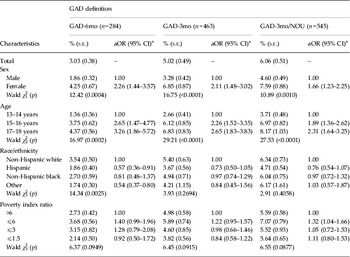
The lifetime prevalence and sociodemographic correlates of GAD are presented by threshold and subthreshold definitions in Table 1. Approximately 3.0% of adolescents met criteria for GAD-6mo in their lifetime, whereas 5.0% of adolescents were affected with GAD-3mo and 6.1% of adolescents were affected with GAD-3mo/NOU. Thus, relaxing the required duration of GAD resulted in a 65.7% increase in prevalence and further relaxing the uncontrollability criterion resulted in an additional 20.7% increase in prevalence.
Prevalence and sociodemographic characteristics of threshold and subthreshold GAD

GAD, Generalized anxiety disorder; DSM, Diagnostic and Statistical Manual of Mental Disorders; GAD-6mo, cases met DSM-IV/5 GAD criteria; GAD-3mo, duration was relaxed to at least 3 months; GAD-3mo/NOU, duration was relaxed to at least 3 months and uncontrollability criterion was not applied; s.e., standard error; aOR, adjusted odds ratio; CI, confidence interval.
a aORs and 95% CIs include all sociodemographic predictors.
The prevalence of GAD-6mo was significantly associated with sex, such that female adolescents were twice as likely to be affected with this condition relative to male adolescents (aOR = 2.26, 95% CI 1.44–3.57). GAD-6mo also increased uniformly with age, demonstrating a 3-fold increase from the youngest to the oldest age group (aOR = 3.26, 95% CI 1.86–5.72). Similar sociodemographic correlates were also observed for subthreshold forms of GAD, and effects were comparable in magnitude and direction. Of exception, race/ethnicity was significantly associated only with GAD-6mo, with both Hispanic adolescents (aOR = 0.57, 95% CI 0.36–0.91) and adolescents of other racial/ethnic minority groups (aOR = 0.54, 95% CI 0.37–0.80) being less likely to meet criteria relative to non-Hispanic white adolescents. Paralleling these results, there were no differences between mutually exclusive GAD groups in sociodemographic correlates including sex, age or poverty. However, adolescents of other racial/ethnic minority groups were more likely to be affected with either subthreshold form of GAD (GAD-5mo or GAD-5mo/NOU) relative to non-Hispanic white adolescents (all p < 0.05; online Supplementary Table S1).
Associated symptom and course characteristics
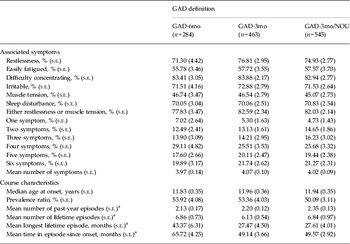
The associated symptom and course characteristics of GAD among threshold and subthreshold cases are presented in Table 2. Among GAD-6mo cases, the most frequently endorsed associated symptom was poor concentration (83.4%), followed by irritability (71.5%) and restlessness (71.3%). By contrast, the least commonly endorsed associated symptom was muscle tension (46.7%). Nearly one-quarter of adolescents who met all other criteria for GAD-6mo failed to endorse either restlessness or muscle tension. Relative to GAD-6mo cases, frequencies of associated symptoms among cases with subthreshold forms of GAD were fairly similar. However, examination of differences in associated symptoms across mutually exclusive definitions of GAD indicated that a higher proportion of GAD-3-5mo cases endorsed restlessness relative to GAD-6mo cases (aOR = 3.00, 95% CI 1.54–5.85; online Supplementary Table S2).
Associated symptoms and course characteristics of GAD among threshold and subthreshold cases

GAD, generalized anxiety disorder; DSM, Diagnostic and Statistical Manual of Mental Disorders; GAD-6mo, cases met DSM-IV/5 GAD criteria; GAD-3mo, duration was relaxed to at least 3 months; GAD-3mo/NOU, duration was relaxed to at least 3 months and uncontrollability criterion was not applied; s.e., standard error.
a An episode was defined as at least 1 month in duration.
With reference to course characteristics, the median age of onset of GAD-6mo was approximately 12 years of age (median = 11.83 years). The condition displayed a moderate level of persistence, with past-year GAD-6mo being present in a little over half of youth who had experienced the disorder in their lifetime (n = 169, 53.9%). On average, adolescents who had met criteria for GAD-6mo experienced two episodes of at least 1 month's duration in the past year (mean = 2.13 episodes) and approximately seven episodes of at least 1 month's duration in their lifetime (mean = 6.86 episodes), with their longest lifetime episode being greater than 3 years (mean = 43.37 months).
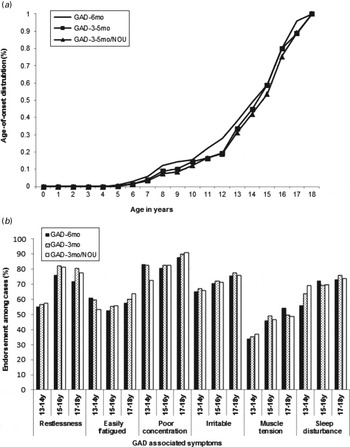
Examination of differences in course characteristics across mutually exclusive definitions of GAD yielded several significant effects. There were significant differences in the survival functions across groups (see Fig. 1 a), indicating that youth with GAD-6mo had a younger age of onset (median = 11.83 years) than did youth with GAD-3-5mo (median = 13.00 years; log-rank test: Wald χ 2 1 = 12 761.43, p < 0.0001) and youth with GAD-3-5mo/NOU (median = 13.00 years; log-rank test: Wald χ 2 1 = 19 617.46.37, p < 0.0001). Thus, although some cases developed GAD as early as 6 years of age, the incidence increased sharply after age 10 years among threshold GAD cases, and after age 12 years among subthreshold GAD cases. In addition, youth with subthreshold forms of GAD displayed shorter lifetime episodes and spent a smaller proportion of their time in episode, while experiencing a greater number of past-year and lifetime episodes, relative to GAD-6mo (all p < 0.0001; online Supplementary Table S2).
(a) Standardized cumulative lifetime prevalence of threshold and subthreshold forms of generalized anxiety disorder (GAD). (b) Associated symptom endorsement among GAD threshold and subthreshold cases by adolescent age group. GAD-6mo, cases met Diagnostic and Statistical Manual of Mental Disorders (DSM)-IV/5 GAD criteria; GAD-3-5mo, duration was ⩾3 months and <6 months; GAD-3-5mo/NOU, duration was ⩾3 months and <6 months and uncontrollability criterion was not applied; GAD-3mo, duration was relaxed to at least 3 months; GAD-3mo/NOU, duration was relaxed to at least 3 months and uncontrollability criterion was not applied; y, years.

There were also a number of significant differences in associated symptoms and course characteristics by adolescent age group (see Fig. 1 b and online Supplementary Table S3). The most consistent effects across age were observed for restlessness and the number of associated symptoms. In particular, among both GAD-3mo and GAD-3mo/NOU cases, a significantly lower proportion of the 13- to 14-year age group endorsed restlessness (56.8% and 57.5%, respectively) relative to the 15- to 16-year age group (82.2% and 81.5%, respectively) and the 17- to 18-year age group (80.5% and 77.4%, respectively; all p < 0.01). Further, among both GAD-3mo and GAD-3mo/NOU cases, the 13- to 14-year age group endorsed fewer associated symptoms (mean = 3.6) than did the 15- to 16-year age group (mean = 4.1) and the 17- to 18-year age group (mean = 4.3; all p < 0.05). With respect to course characteristics, there were significant differences in the survival functions across age groups for all forms of GAD, indicating a linear effect whereby earlier ages of onset were observed among younger cohorts (all p's < 0.0001). Further, among all forms of GAD, the youngest adolescents had a significantly greater number of episodes of at least 1 month in duration in the past year relative to older adolescents, suggesting episodes that occurred with greater frequency (all p's < 0.05).
Severity and impairment
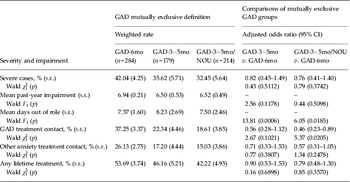
Indices of severity and impairment among the three mutually exclusive GAD groups are displayed in Table 3. On average, adolescents with GAD-6mo reported a degree of disability in the moderate to severe range (mean = 6.94) and indicated being totally unable to function for approximately 7 days out of the last calendar year (mean = 7.37 days). Despite this, only a little over one-third of these adolescents had sought treatment for the disorder in their lifetime (37.25%). In general, indices of severity and impairment were slightly lower in magnitude among subthreshold cases. However, there were few significant differences between threshold and subthreshold forms of GAD, indicating comparable levels of clinical severity and disability across the three groups. Of exception, the GAD-3-5mo/NOU cases were less likely to obtain treatment for GAD than were the GAD-6mo cases (aOR = 0.46, 95% CI 0.23–0.89). Conversely, a significantly greater number of days out of role was observed among GAD-3-5mo (mean = 8.23 days) and GAD3-5mo/NOU cases (mean = 7.50 days) relative to GAD-6mo cases (both p < 0.05). Further demonstrating the clinical significance of subthreshold forms of GAD, cases uniformly displayed significantly higher ratings across almost all indices of severity and impairment relative to unaffected adolescents (all p < 0.05; online Supplementary Table S4).
Severity and impairment across GAD mutually exclusive groups a

GAD, Generalized anxiety disorder; CI, confidence interval; DSM, Diagnostic and Statistical Manual of Mental Disorders; GAD-6mo, cases met DSM-IV/5 GAD criteria; GAD-3-5mo, duration was ⩾3 months and <6 months; GAD-3-5mo/NOU, duration was ⩾3 months and <6 months and uncontrollability criterion was not applied; s.e., standard error.
a Regression models controlled for all significant sociodemographic predictors (sex, age, race) and other psychiatric disorders (but the disorder of interest).
Psychiatric co-morbidity
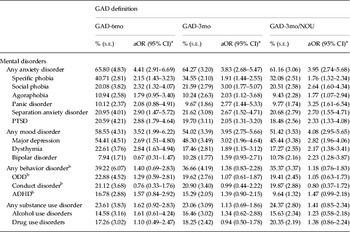
The lifetime co-morbidity of GAD with other psychiatric disorders is presented by threshold and subthreshold definitions in Table 4. GAD-6mo displayed significant associations only with other anxiety and mood disorders, and was most often associated with other anxiety disorders, with nearly two-thirds of these adolescents also affected with another anxiety disorder in their lifetime (65.8%). Among the anxiety disorders, GAD-6mo was most likely to be co-morbid with specific phobia (40.71%), followed by separation anxiety disorder (20.95%), posttraumatic stress disorder (PTSD) (20.59%) and social phobia (20.08%). More than half of youth with GAD-6mo also met criteria for a mood disorder in their lifetime (58.55%).
Associations of threshold and subthreshold GAD with other mental disorders

GAD, Generalized anxiety disorder; DSM, Diagnostic and Statistical Manual of Mental Disorders; GAD-6mo, cases met DSM-IV/5 GAD criteria; GAD-3mo, duration was relaxed to at least 3 months; GAD-3mo/NOU, duration was relaxed to at least 3 months and uncontrollability criterion was not applied; s.e., standard error; aOR, adjusted odds ratio; CI, confidence interval; PTSD, posttraumatic stress disorder, ODD, oppositional defiant disorder; ADHD, attention deficit–hyperactivity disorder.
a aORs and 95% CIs include all significant sociodemographic predictors and other psychiatric disorders (but the disorder of interest).
b Reports based on parent self-administered questionnaire sample (n = 6483).
Associations between subthreshold forms of GAD and other psychiatric disorders were remarkably similar to GAD-6mo and remained circumscribed to the classes of anxiety and mood disorders. However, as is shown, subthreshold forms of GAD tended to display associations with a wider range of anxiety and mood disorders and co-morbidity rates were slightly lower. Analysis of psychiatric correlates by mutually exclusive GAD groups indicated that PTSD, dysthymia and ADHD were less common among subthreshold cases relative to GAD-6mo cases, whereas the reverse was true for bipolar disorder (all p < 0.05; online Supplementary Table S5).
Discussion
Summary of findings
Paralleling prior work among adults (Kessler & Wittchen, Reference Kessler and Wittchen2002; Wittchen, Reference Wittchen2002; Lieb et al. Reference Lieb, Becker and Altamura2005; Angst et al. Reference Angst, Gamma, Bienvenu, Eaton, Ajdacic, Eich and Rössler2006 Reference Angst, Gamma, Baldwin, Ajdacic-Gross and Rossler2009) and a handful of studies among youth (Beesdo et al. Reference Beesdo, Knappe and Pine2009, Reference Beesdo, Pine, Lieb and Wittchen2010), this nationally representative study indicates that GAD is a prevalent condition among adolescents, and one that is characterized by a high degree of psychiatric co-morbidity, disability, and impairment. Furthermore, the current study provides important information on the diagnostic threshold of GAD in this young age group, highlighting both the clinical significance of subthreshold forms of GAD, as well as the continuous nature of the GAD construct. Beyond displaying similar sociodemographic and clinical correlates to adolescents who met full criteria for the disorder, adolescents with subthreshold forms of GAD experienced significantly greater impairment, disability and psychiatric co-morbidity relative to unaffected youth. Thus, given our observation of lower rates of treatment among adolescents with subthreshold forms of GAD, these data indicate that there may be a substantial number of young people who are impaired, but who are not currently recognized or treated due to failure to meet full GAD criteria. Finally, our observation of age-related differences in the associated symptoms and clinical course of GAD further highlights the need for criteria sets that are sensitive to developmental differences in symptom expression.
Prevalence and sociodemographic correlates
We found that approximately 3% of youth in the general population were affected with GAD, and 6% were affected with the broad phenotype of either threshold or subthreshold GAD at some point during their lifetime. The prevalence rate of GAD observed in this study is within the range of estimates of other community-based studies of youth (Costello et al. Reference Costello, Angold, Burns, Stangl, Tweed, Erkanli and Worthman1996; Beesdo et al. Reference Beesdo, Knappe and Pine2009; Merikangas et al. Reference Merikangas, He, Burstein, Swanson, Avenevoli, Cui, Benjet, Georgiades and Swendsen2010), and indicates that even when it is narrowly defined, GAD is a relatively common condition among adolescents. Significant associations between GAD and sociodemographic characteristics including sex and age replicate past studies that have found this disorder to be disproportionately high among females (Lieb et al. Reference Lieb, Becker and Altamura2005; Beesdo-Baum et al. Reference Beesdo-Baum, Winkel, Pine, Hoyer, Hofler, Lieb and Wittchen2011) and to increase in prevalence between childhood and young adulthood (Beesdo-Baum et al. Reference Beesdo-Baum, Winkel, Pine, Hoyer, Hofler, Lieb and Wittchen2011). Although there were no differences in the majority of sociodemographic characteristics across threshold and subthreshold definitions of GAD, adolescents of other racial/ethnic minority groups were less likely to present with threshold GAD due to a failure to meet the 6-month duration requirement. Taken together with general population studies of adults that have found lower prevalence rates of GAD among ethnic minority groups when the 6-month duration criterion is strictly applied (Grant et al. Reference Grant, Hasin, Stinson, Dawson, Ruan, Goldstein, Smith, Saha and Huang2005; Kessler et al. Reference Kessler, Brandenburg, Lane, Roy-Byrne, Stang, Stein and Wittchen2005b ), these findings suggest that individuals of certain racial/ethnic minority groups may experience shorter episodes of GAD. Thus, in addition to the numerous barriers that contribute to racial/ethnic disparities in service use (Wu et al. Reference Wu, Hoven, Cohen, Liu, Moore, Tiet, Okezie, Wicks and Bird2001), the failure to account for alternative manifestations of disorder among minority groups may serve as yet another obstacle.
Associated symptoms and clinical course
Several findings related to the associated symptoms and course of GAD are also noteworthy. Consistent with previous clinical studies of affected youth (Pina et al. Reference Pina, Silverman, Alfano and Saavedra2002; Kendall & Pimentel, Reference Kendall and Pimentel2003; Comer et al. Reference Comer, Pincus and Hofmann2012b ), in this general population sample of adolescents, poor concentration, restlessness, and irritability were the most common associated symptoms of GAD, while muscle tension was the least common symptom. Further, we found that nearly one-quarter of youth meeting all other criteria for GAD failed to endorse either restlessness or muscle tension, indicating that a substantial proportion of youth would fail to be identified if the array of associated symptoms were restricted to these domains. Thus, in line with one study of clinically referred youth (Comer et al. Reference Comer, Pincus and Hofmann2012b ), the current study supports the decision to retain all associated symptoms of GAD in the DSM-5.
This decision is further justified by our observation of differences in the frequency of associated symptoms across adolescent age groups. In particular, while restlessness was one of the most common symptoms of GAD overall, it was significantly less common among younger versus older adolescents, with only about half of youth in the youngest age group endorsing this symptom. Likewise, although irritability was common among youth with GAD in the present sample of adolescents, it was relatively uncommon in a school-based sample of children between the ages of 7 and 11 years (Layne et al. Reference Layne, Bernat, Victor and Bernstein2009), suggesting that irritability may become a more prominent symptom of GAD as children enter adolescence. Finally, in agreement with prior clinical studies of youth that have found the number of associated symptoms of GAD to increase with age (Tracey et al. Reference Tracey, Chorpita, Douban and Barlow1997; Kendall & Pimentel, Reference Kendall and Pimentel2003), younger adolescents had fewer associated symptoms than did older adolescents, supporting the lower threshold of only one associated symptom in children and adolescents. Such results further make a case for criteria sets that yield to age-related differences in symptom manifestation.
With regard to course characteristics, we found that youth developed GAD fairly early in adolescence, with a median age of onset of 12 years. While the age of onset revealed in this study is earlier than other studies involving adults (Kessler et al. Reference Kessler, Berglund, Demler, Jin, Merikangas and Walters2005a ; Beesdo et al. Reference Beesdo, Pine, Lieb and Wittchen2010), it is probable that this is due to the inability of the NCS-A sample to account for incident cases in adulthood. Moreover, the onset of GAD probably follows a bimodal distribution, with core periods of risk in both adolescence and adulthood (Kessler et al. Reference Kessler, Berglund, Demler, Jin, Merikangas and Walters2005a ; Beesdo et al. Reference Beesdo, Pine, Lieb and Wittchen2010). Also of interest, even in their young lifetime, affected adolescents experienced several episodes of GAD of various durations and displayed only moderate persistence of the disorder. Thus, in contrast to the chronic course of GAD that has been observed among adults (Kessler & Wittchen, Reference Kessler and Wittchen2002; Wittchen, Reference Wittchen2002), GAD in young people may be better characterized by an episodic and/or recurrent course, as has been demonstrated by other prospective (Bittner et al. Reference Bittner, Egger, Erkanli, Jane Costello, Foley and Angold2007; Beesdo-Baum et al. Reference Beesdo-Baum, Winkel, Pine, Hoyer, Hofler, Lieb and Wittchen2011) and cross-sectional studies of youth (Kessler et al. Reference Kessler, Avenevoli, Costello, Georgiades, Green, Gruber, He, Koretz, McLaughlin, Petukhova, Sampson, Zaslavsky and Merikangas2012a ). However, it is important to note that individuals with threshold GAD displayed an earlier age of onset and longer episodes than did youth with subthreshold forms of GAD, indicating that threshold GAD may be typified by greater severity and chronicity than subthreshold GAD (Kessler et al. Reference Kessler, Brandenburg, Lane, Roy-Byrne, Stang, Stein and Wittchen2005b ; Lee et al. Reference Lee, Tsang, Ruscio, Haro, Stein, Alonso, Angermeyer, Bromet, Demyttenaere, de Girolamo, de Graaf, Gureje, Iwata, Karam, Lepine, Levinson, Medina-Mora, Oakley Browne, Posada-Villa and Kessler2009; Beesdo-Baum et al. Reference Beesdo-Baum, Winkel, Pine, Hoyer, Hofler, Lieb and Wittchen2011).
Severity, impairment, and psychiatric co-morbidity
In accordance with earlier general population studies of youth (Essau et al. Reference Essau, Conradt and Petermann2000; Beesdo-Baum et al. Reference Beesdo-Baum, Winkel, Pine, Hoyer, Hofler, Lieb and Wittchen2011), adolescents with GAD displayed substantial impairment and disability, and high rates of co-morbidity with other psychiatric disorders. Further, consistent with numerous studies of adults (Kendler et al. Reference Kendler, Neale, Kessler, Heath and Eaves1992; Carter et al. Reference Carter, Wittchen, Pfister and Kessler2001; Hoyer et al. Reference Hoyer, Becker and Margraf2002; Kessler et al. Reference Kessler, Brandenburg, Lane, Roy-Byrne, Stang, Stein and Wittchen2005b ; Angst et al. Reference Angst, Gamma, Bienvenu, Eaton, Ajdacic, Eich and Rössler2006; Ruscio et al. Reference Ruscio, Chiu, Roy-Byrne, Stang, Stein, Wittchen and Kessler2007; Lee et al. Reference Lee, Tsang, Ruscio, Haro, Stein, Alonso, Angermeyer, Bromet, Demyttenaere, de Girolamo, de Graaf, Gureje, Iwata, Karam, Lepine, Levinson, Medina-Mora, Oakley Browne, Posada-Villa and Kessler2009; Andrews & Hobbs, Reference Andrews and Hobbs2010) and one prior investigation including youth (Beesdo-Baum et al. Reference Beesdo-Baum, Winkel, Pine, Hoyer, Hofler, Lieb and Wittchen2011), our findings document the clinical significance of subthreshold forms of GAD during adolescence. In addition to demonstrating similar clinical correlates to youth who met full criteria for the disorder, adolescents with subthreshold forms of GAD exhibited significantly higher levels of impairment, disability, and psychiatric co-morbidity than did youth who were not affected with these conditions. Coupled with the higher degree of persistence experienced by adolescents with threshold GAD, such findings suggest that GAD may be conceptualized as a dimensional or continuous construct, as has been found by previous investigations (Kessler et al. Reference Kessler, Brandenburg, Lane, Roy-Byrne, Stang, Stein and Wittchen2005b ; Ruscio et al. Reference Ruscio, Chiu, Roy-Byrne, Stang, Stein, Wittchen and Kessler2007; Lee et al. Reference Lee, Tsang, Ruscio, Haro, Stein, Alonso, Angermeyer, Bromet, Demyttenaere, de Girolamo, de Graaf, Gureje, Iwata, Karam, Lepine, Levinson, Medina-Mora, Oakley Browne, Posada-Villa and Kessler2009; Beesdo-Baum et al. Reference Beesdo-Baum, Winkel, Pine, Hoyer, Hofler, Lieb and Wittchen2011). While the continuous nature of the condition makes the application of a dichotomous threshold challenging, it is notable that the modifications to criteria that were investigated in the current study continued to distinguish a clinically impaired subgroup of youth.
Limitations and strengths
It is necessary to consider these results in the context of several study limitations. First, the design of the NCS-A study is cross-sectional, and as such, data on course characteristics may be subject to retrospective reporting biases. Although a number of procedures were implemented to improve the accuracy of retrospective recall (Knauper et al. Reference Knauper, Cannell, Schwarz, Bruce and Kessler1999), it is unlikely that these procedures resulted in estimates that are entirely without error. Future prospective studies that investigate threshold and subthreshold manifestations of GAD across time will provide much needed longitudinal information on the course of GAD among youth in the general population. Second, because the age of the NCS-A sample is limited to the period of adolescence, the clinical features of GAD revealed in the current study may not generalize to children of younger ages, and the age-related differences in these features are probably conservative. It will be important for additional work to investigate how clinical features of GAD may vary across the entire early life course. Finally, although this study provides data on the frequency of associated symptoms of GAD, our data do not indicate which symptoms may contribute most to a GAD diagnosis. These limitations notwithstanding, the current study is the first to examine the clinical features and characteristics of GAD in a nationally representative sample of US youth. It is also among the first to investigate the diagnostic threshold of GAD during this early developmental period. In view of the current study findings, it will be important to consider that the distress and impairment experienced by adolescents with subthreshold GAD is often comparable with that of those who meet full criteria for the disorder, and no less worthy of professional or scientific attention.
Supplementary material
For supplementary material accompanying this paper visit http://dx.doi.org/10.1017/S0033291713002997
Acknowledgements
The NCS-A was carried out in conjunction with the World Health Organization World Mental Health (WMH) Survey Initiative. The views and opinions expressed in this article are those of the authors and should not be construed to represent the views of any of the sponsoring organizations, agencies or the US government.
The authors assert that all procedures contributing to this work comply with the ethical standards of the relevant national and institutional committees on human experimentation and with the Helsinki Declaration of 1975, as revised in 2008.
The NCS-A was funded by the National Institute of Mental Health (no. ZIA MH002808-11 and no. U01-MH60220), and the National Institute of Drug Abuse (no. R01-DA016558). This work was supported by the Intramural Research Program of the National Institute of Mental Health.
Declaration of Interest
None.