1. Introduction
“Post-truth,” a term implying that truth is irrelevant, was voted the “Word of the Year” in 2016 by Oxford Dictionaries after a spike in use that year in the context of the EU referendum in the UK and the presidential election in the US.Footnote 1 Post-truth has since become a common expression in political discourse.
The concept of “post-truth” is here applied to Sweden's school system and used as a novel explanation for problems concerning the quality of elementary and secondary education – meaning the provision of essential knowledge and skills, the presence of qualified teachers, and the existence of structure and peace in the classroom. Critical indicators of such problems existing in the Swedish school system are a sharp drop in the status and attractiveness of the teaching profession, a significant decline in knowledge among pupils, and grade inflation. We argue that the cause of these phenomena is a postmodern, social-constructivist view of truth and knowledge expressed in the governing documents of the school system and increasingly implemented in pedagogical practice. Social constructivism is here understood both as a philosophical claim – heavily influenced by postmodern discourse and power analysis – about the nature of knowledge and reality, i.e. that knowledge and reality are constructed, and as a claim about teaching, contending that knowledge cannot and should not be attempted to be transferred from teacher to pupil. While social-constructivist theories about the nature of knowledge and teaching can be distinct and separate theories (Wikforss, Reference Wikforss, Kendeou and Robinsonforthcoming), we argue that they have been applied as connected in the Swedish school system.Footnote 2
The present article is thus a study on how a social-constructivist theory of knowledge and an associated pedagogy of child-centered discovery and experiment have undermined the quality and functioning of the Swedish school system. Our article adds to the findings of previous attempts to study this phenomenon in contexts such as the Canadian province of Québec (Haeck et al., Reference Haeck, Lefebvre and Merrigan2014), the UK (Christodoulou, Reference Christodoulou2014), Finland (Heller Sahlgren, Reference Heller Sahlgren2015a), and France (Hirsch, Reference Hirsch2016).
Sweden offers a unique opportunity to study this subject both because of the country's long tradition of incorporating far-reaching social-constructivist views into the school system and because of the deregulated and marketized character of Swedish elementary and secondary education, which is unique among Western democracies in its commitment to for-profit voucher schools and school competition (Gustafsson et al., Reference Gustafsson, Sörlin and Vlachos2016; Wennström, Reference Wennströmforthcoming). The consequences of combining institutionalized social constructivism with full-fledged marketization of elementary and secondary education have not been previously examined in detail. Our analysis shows that this combination affects the quality of education negatively, suggesting that caution is necessary for countries, notably the United States, that have a tradition of social-constructivist pedagogy (Hirsch, Reference Hirsch2016) and are now considering implementing or expanding market-based school reforms (DeVos, Reference DeVos2018).
Drawing on Kuhn (Reference Kuhn1962), we argue that the Swedish school system suffers from a “paradigmatic” problem. By this, we mean that the decline in the quality of elementary and secondary education emanates from a social-constructivist paradigm that has become widely accepted in the school system. Radical improvement is therefore likely to require a paradigm shift. Advocates of the current system will no doubt claim that this argument ignores other important and complex processes. However, the very fact that the school system is highly complex, involving numerous agents with different agendas, suggests that we should apply the principle of Occam's razor and begin by exploring the simplest and most straightforward candidate for explaining the decline in quality. If schools fail to deliver on their function to impart knowledge, it appears reasonable to conjecture that unless there is a glaring lack of resources,Footnote 3 this failure is due to weaknesses in the content of curricula and the pedagogy used. Indeed, we show how the stipulated view of truth and knowledge – arguably the most crucial institution of the school system – and the design of the system impact on the incentives for the various agents involved: pupils, parents, teachers, principals, school owners, the municipality, the central government, and, ultimately, the general public.
The research question and the various types of evidence we refer to cannot be studied by means of an experimental or quasi-experimental design in the vein of, for example, Hoxby (Reference Hoxby2000) or Jacob (Reference Jacob2005). Therefore, our analysis does not allow us to statistically identify a causal effect from the view of knowledge to teacher satisfaction or pupils’ knowledge level. However, as observed by Ruhm (Reference Ruhm2018: 2), “excessive reliance on such methods may move us away from examining issues that are of fundamental significance but for which unambiguous causal inference is more difficult to obtain.” His concern is that it may “lead us to focus on inquiries that, while clearly identified, may sometimes be of secondary value, whereas other critical issues may be neglected.” Many studies on the effect of school competition on educational outcomes in Sweden show that this concern is warranted: rather than considering the lax institutional framework of the Swedish school system, which we analyze, they focus on outcomes that are easily measured but also lend themselves to corruption and manipulation (e.g. Björklund et al., Reference Björklund, Edin, Fredriksson and Krueger2004; Böhlmark and Lindahl, Reference Böhlmark and Lindahl2015; Sandström and Bergström, Reference Sandström and Bergström2005).
Moreover, in her essay on implications of Bowles’ The Moral Economy (Reference Bowles2016) for economics and policy research, Kranton (Reference Kranton2019: 158–159) stresses, that “[t]o uncover the mechanisms behind any finding, the researcher should further engage both traditional and less-traditional data” and observes, that “a theoretical framework of individual decision making that includes morality, identity, and norms would give structure to the findings.” We follow her prescriptions in this study.
Further evidence, additional references, and extensive quotations substantiating the claims made here are provided in an extended working paper version that is available open-access (Henrekson and Wennström, Reference Henrekson and Wennström2018).
2. The state of Sweden's schools
Elementary school (grundskola) consists of nine years of schooling for pupils aged 7 to 16 years, divided into lower grades (years 1–6) and upper grades (years 7–9). Elementary school is followed by three years of non-compulsory secondary school (gymnasieskola). Academic grades determine whether students will be admitted to the secondary school of their choice and a university program after secondary school.
Following a far-reaching decentralization reform at the beginning of the 1990s, the school system is under the management of Sweden's 290 municipalities. Before the decentralization reform, the school system was managed by the state and heavily regulated – perhaps more so than any other public school system in the world (Lewin, Reference Lewin2014). Within two years after the decentralization reform, in 1992, a voucher system was enacted, offering students a free choice of schools and a public voucher to cover tuition. The voucher reform opened the entire public school system to private providers of all sorts: foundations, parental and staff cooperatives, and for-profit firms. This reform was a radical reversal of the policy in place since the early 1960s that had resulted in a state monopoly on education.
Through the voucher system, independent schools received funding for a minimum of 85% of the average municipal cost per pupil, which was raised to 100% in 1997. This change offered strong economic incentives to private providers, who began to expand rapidly. In the academic year 2015/16, 15% of pupils in elementary education attended one of the 800 independent schools at this level, and 26% of pupils in secondary school attended one of the more than 400 independent secondary schools. Seventy-four percent of independent school students attended for-profit schools (Ekonomifakta, 2018).
Over time, it has become evident that the school system suffers from problems with the quality of education. For example, Sweden has one of the highest levels of absenteeism and late arrivals in the OECD (OECD, 2015). Depression and anxiety among children aged 10–17 also increased by more than 100% from 2006 to 2016. According to the National Board of Health and Welfare (2017), the reasons for this dramatic increase are most likely linked to schooling and the transition from school to adult life. Similarly, physicians have suggested that the soaring prescriptions for ADHD drugs in Sweden, where as many as 9% of boys are medicated for ADHD in some counties (Arbetarbladet, 2016), are related to factors within the school system (Engström and Gustavsson, Reference Engström and Gustavsson2016). However, there are also at least three deeper systemic problems.
The malaise in the teaching profession
There is an acute shortage of teachers, mainly caused by the high dropout rate among students in education degree programs (Svensson and Berlin Kolm, Reference Svensson and Kolm2017). A further crisis component is the selection of applicants. Today, only 5% of Swedish teachers deem that their profession is considered prestigious, and barely half of them would choose the same occupation again (Swedish National Agency for Education, 2014). This fall in teaching's status is reflected in the low number of applicants to the education degree programs and the sizable share of applicants with low grades from secondary school (Bertilsson, Reference Bertilsson2014).
Teachers are one of the least satisfied groups in the Swedish labor market, even though teachers’ relative wages stopped falling in the late 1980s (Persson and Skult, Reference Persson and Skult2014) and have increased sharply in recent years. In a 2006 survey, almost one-fourth of teachers reported being moderately or very unhappy (Stenlås, Reference Stenlås2009), and judging by more recent information, the situation has not improved. More than half of teachers experience stress in the workplace, and sick leave due to psychiatric disorders is more common among teachers than in other professional groups (Swedish National Agency for Education, 2013). Four out of ten active teachers are considering leaving the profession (Swedish National Agency for Education, 2016).
The decline in knowledge
For brevity, we will mention only a few key facts about the decline in knowledge among Swedish pupils, which is possible to document due to the international comparative tests that have existed since the mid-1990s. The most important are the TIMSS (which assesses the mathematics and science knowledge of 4th and 8th graders), the TIMSS Advanced (for advanced mathematics and physics achievement in the final year of secondary school), and the OECD's PISA (for the reading comprehension and mathematics and science knowledge of 15-year-olds in the final year of elementary school).
In 1995, the first year that Sweden participated in the TIMSS, Swedish 8th graders performed far above both the international average and the EU/OECD average in both mathematics and science. However, between 1995 and 2011, Swedish average results deteriorated by 56 points, which was the largest decline among all participating countries (Swedish National Agency for Education, 2012). In the latest cycle of the TIMSS, carried out in 2015, Sweden's average result improved by 17 points. However, because the EU/OECD average also improved, Swedish 8th graders still performed well below the EU/OECD average.
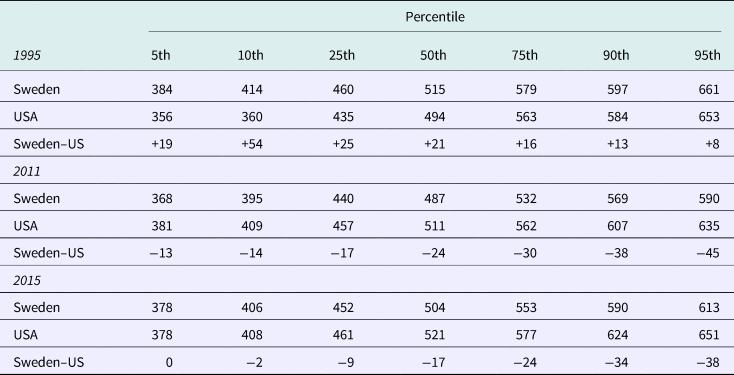
Sweden and the US are relatively similar in terms of culture, level of education, and economic development. However, because of the well-known weaknesses in the American education system and the existence of privately funded schools, we should expect not only a considerable variation in results among US pupils but also that the weakest pupils perform particularly poorly. In fact, Table 1 shows that the weakest US pupils (defined as the fifth percentile in the distribution) performed significantly better than the weakest Swedish pupils on the TIMSS Mathematics 2011. In 2015, the weakest US and Swedish pupils performed identically. In all other percentiles, US pupils outperformed Swedish pupils, and the difference widens as one moves upward in the distribution. In contrast, Swedish pupils outperformed their US peers across the entire distribution in 1995, and the Swedish advantage was larger in the lower half of the distribution.
Comparison between the US and Sweden on the TIMSS Mathematics in 1995, 2011 and 2015, disaggregated by percentile points

Source: Beaton et al. (Reference Beaton, Mullis, Martin, Gonzales, Kelly and Smith1996) and Mullis et al. (Reference Mullis, Martin, Foy and Hooper2016).
Note: To ensure that the Sweden–US differences are statistically significant we applied the Kolmogorov–Smirnov test (e.g. Daniel, Reference Daniel1990: 319–330). The null in this test is that the two distributions are equivalent. We performed the test for three individual years: 1995, 2011, and 2015. The null of equality was rejected for all three tests (p-value < 0.00). Thus, the between-country differences are statistically significant, and a plot of all observations in the two samples in the same diagram clearly shows that all observations for Sweden are above the corresponding US observation in the distribution in 1995, while the reverse is true in 2011. For 2015 the US results consistently exceed the Swedish results from roughly the 9th percentile onwards.
Regarding the TIMSS Advanced, Sweden performed well in 1995 – just above average in mathematics, and at the top in physics together with Norway. The next time Sweden participated, in 2008, the results fell sharply. The average result dropped by 90 points for mathematics and by 81 points for physics. In the latest cycle, in 2015, Sweden improved its result in mathematics but was still second from the bottom of all participating countries. In physics, the results continued to deteriorate (Henrekson, Reference Henrekson and Henrekson2017).
In regard to PISA, Swedish 9th graders have participated since the tests began in 2000. Mirroring the developments observed for the TIMSS and the TIMSS Advanced, Swedish students performed above the international average in the first PISA cycle, but since then, Sweden's results have steadily deteriorated in all three areas of PISA – reading, mathematics, and science – until a low point was reached in the 2012 survey (Henrekson, Reference Henrekson and Henrekson2017). The Swedish overall score was well below the OECD average, and in each area, only three OECD countries performed worse than Sweden. It is noteworthy that another PISA assessment also revealed shortcomings (below the OECD average) in critical thinking, creativity, curiosity, and perseverance (OECD, 2013). Sweden was ranked 20th of 28 countries when this test was administered in 2012.
The latest PISA survey, released in December 2016, showed improvement in all three PISA core subjects. However, a shift to computer-based testing makes comparisons with previous results precarious (Jerrim, Reference Jerrim2018).
Grade inflation
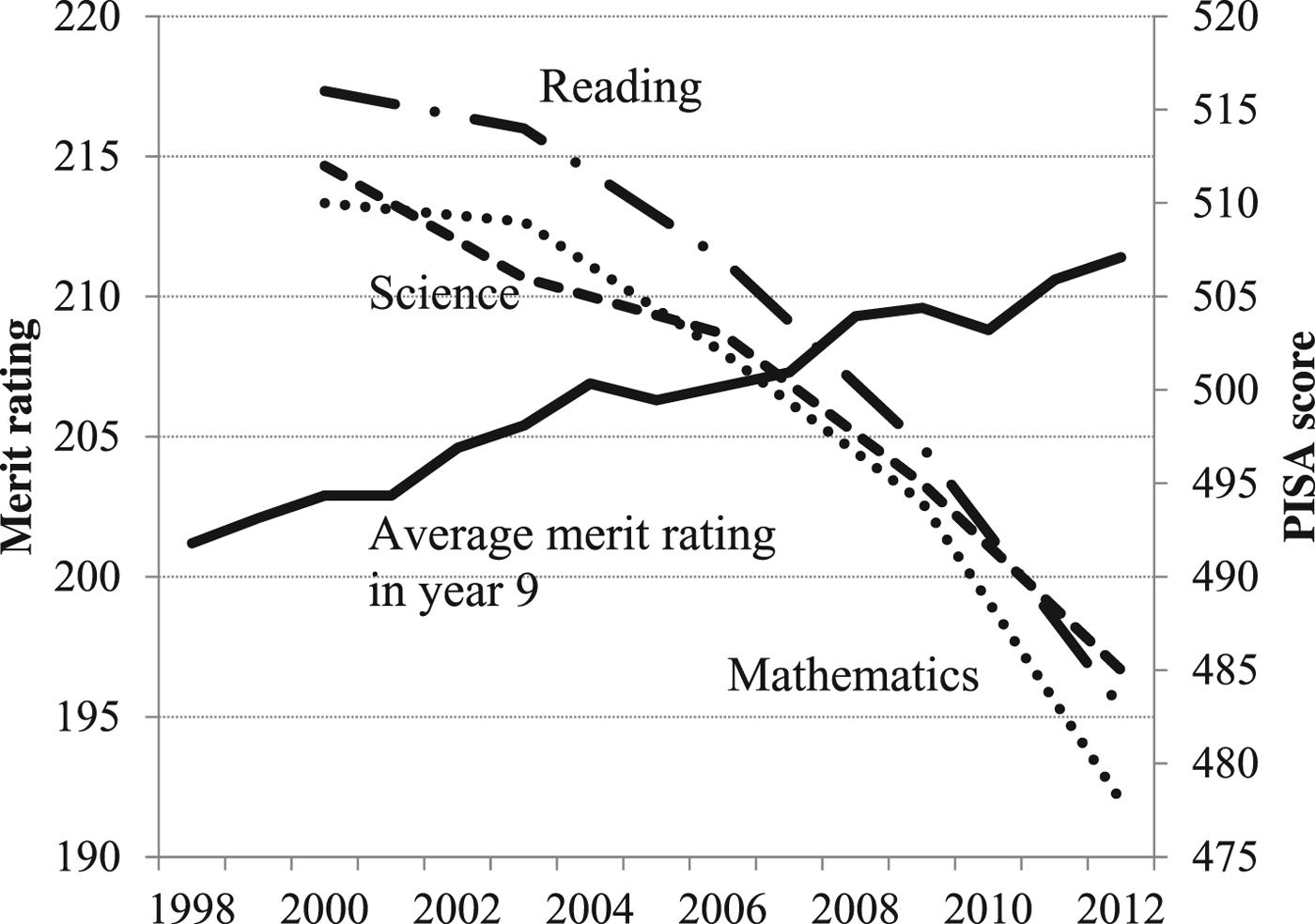
While international assessments in recent decades have indicated a decline in knowledge among Swedish students, final grades paint a different picture. Paradoxically, during the very period that PISA and TIMSS results fell sharply, the average merit rating (based on grades) in the final year of elementary school markedly improved (see Figure 1).Footnote 4
Average merit rating and PISA Score, 1998–2012.

This incongruous evolution of international assessments of students’ knowledge and Swedish grades provides compelling evidence of grade inflation in Swedish elementary schools.Footnote 5
To summarize, this section on the state of Sweden's schools has demonstrated a general malaise in the teaching profession, a substantial decline in knowledge among students, and the existence of grade inflation. In the remainder of this paper, we will argue that the cause of these problems is a postmodern, social-constructivist paradigm. However, to do so, we must first explain what we mean by these terms.
3. Terminology: social constructivism and postmodernism
The mild version of social constructivism holds that many expressions of human thinking and behavior, such as language, gestures, and interpretations of different objects and phenomena, are collectively constructed and influenced by non-universal cultural factors (Berger and Luckmann, Reference Berger and Luckmann1966). We will not delve deeper into this relatively uncontroversial version of social constructivism, as it is beyond the scope of this study. What our analysis of the Swedish school system focuses on, and what we mean when we use the term social constructivism, is a more radical version, which holds that an objective reality does not exist and that the objects and phenomena themselves – and not just our perceptions and interpretations of these phenomena – are socially constructed. As stated by Elder-Vass (Reference Elder-Vass2012: 6; emphasis in original):
Realists divide the world into that which depends on how we (individually or collectively) think about it and that which does not. For realists – and moderate constructionists – only the former can be socially constructed; the latter cannot. Radical constructionists tend to deny any such distinction on the ground that everything depends on the ways in which we think about it, or at least to include in the socially constructed category things that realists would not.
This radical form of social constructivism is heavily influenced by postmodernist thinking (Berger, Reference Berger1992; Linell, Reference Linell, Kylhammar and Battail2006). Postmodernism, in turn, can be understood as a critique of modern Enlightenment ideals, such as the elevation of truth, reason, science, and knowledge (Constas, Reference Constas1998). Postmodernist philosophers have claimed that these ideals are open to question and are, in fact, mere “narratives” and linguistic “discourses” concealing subjective interests and the exercise of power by some authority (Ferraris, Reference Ferraris2014).
Postmodernism brings to social constructivism the belief that “everything is discourse and constructed” and that, for instance, no theory can be separated from discursive practice and valued based on how it corresponds to reality (Linell, Reference Linell, Kylhammar and Battail2006: 159). Emanating from this worldview is a relativistic negation of facts and any knowledge beyond subjective opinion and experience. Knowledge imparting, or indeed the very claim that something is universally true, may even be seen as indoctrination and oppression (Apple, Reference Apple1979; McLaren, Reference McLaren1988; Young, Reference Young1971).
Because a postmodern, social-constructivist perspective rejects the existence of objective facts and knowledge, proponents of this perspective also tend to reject ordered thinking and the structure and hierarchy of knowledge within disciplines. In the context of schooling, this translates, among other things, to freedom of choice for students in their learning, non-hierarchical student–teacher relationships, the mixing or breaking up of disciplines, an emphasis on general skills in contrast to domain-specific knowledge, and curricula that are grounded in everyday experience and culture (Aronowitz and Giroux, Reference Aronowitz and Giroux1991; Doll, Reference Doll1993). In the next section, we demonstrate that step-by-step this notion became emblematic of the Swedish school system.Footnote 6, Footnote 7
4. The ruling paradigm and its effects on school quality
The rise of the postmodern, social-constructivist paradigm was slow but steady. Sweden's first modern school system, established in the late 1800s, was founded on the ideas of the philosopher Johann Friedrich Herbart. Herbart's belief that every child could realize his or her full potential through intellectual self-improvement and character development, brought about by a structured and teacher-led education focused on imparting knowledge, remained a dominant intellectual influence on Swedish schools until after the Second World War (Heller Sahlgren and Sanandaji, Reference Heller Sahlgren and Sanandaji2019). A school commission staffed by prominent Social Democratic thinkers on education was then, in 1946, appointed to redraw the Swedish school system and create a unitary school common for all children.
The purpose of schooling
The school commission ushered in new ideas about the purpose of schooling. Its final report expressed the view that the principal objective should not be to provide a traditional education but rather to contribute to the social development of the child (SOU 1948:27). Therefore, the school commission favored the abandonment of teacher-led instruction, and called for methods that would promote “pupils’ independence and critical thinking, their will to work and to work independently, their sociality and capacity to co-operate,” and allow “pupils to develop activities and initiatives themselves” (5). It also called for a curriculum that was grounded in the pupils’ everyday experiences. Moreover, the school commission compared general skills favorably with domain-specific knowledge and argued that it was “increasingly more obvious how seldom acquired knowledge can be considered fixed” (148), motivating a reduced common core of learning.
The deprecatory view of traditional education became more pronounced in the report from the 1957–1961 school commission, which was appointed to provide the final design for the unitary school system. This report explicitly stated (SOU 1961:30: 150) that “the concept of education must … become subordinate to the concept of nurture. In the following presentation of the goals of school, the term nurture is therefore used in a wider sense, as a common label for nurture and education.” In effect, this view amounted to an amalgamation of values, emotions, and the teaching of facts, and to an emphasis on the subjective over the objective (Ohrlander, Reference Ohrlander1981).
The first two national curricula for the unitary school system reflected these ideas. While in Herbartian philosophy, pupils were believed to mature through the self-disciplined study of domain-specific knowledge, the 1962 curriculum indicated that such traditional teaching was at risk of being dull and stultifying. The curriculum stressed that schools “should work from norms that the pupils accept and rules that they help to develop” (Swedish National Board of Education, 1962: 16). The 1969 curriculum also called for a breakup of the structure of the traditional subject disciplines (Swedish National Board of Education, 1969: 44). Moreover, all types of knowledge measurement were discouraged.
The third curriculum, enacted in 1980 by a center-right government, made further advances toward a more clearly expressed social-constructivist view of schooling. The government bill that proposed the curriculum harshly criticized the differentiation between different subjects, arguing that the natural sciences and technical subjects “cannot be isolated from the social sciences” and that “traditionally structured content” in physics and chemistry should be abandoned (Government Bill 1978/79:180: 76). The bill clarified that the “well-structured mass of knowledge that has accumulated within different traditional subjects can never be a starting point for schoolwork” (80). Instead, the bill called for schoolwork to reflect “the pupils’ view of reality,” which it claimed is inherently different from adults’ perception of reality, and “build on their curiosity and their questions” (80). The curriculum itself stated that both the content of education and the teaching methods used should be adapted to each pupil based on his or her interests since there is “no way of studying that is best for all pupils” (Swedish National Board of Education, 1980: 52).
To summarize thus far, we have argued that the antecedents of the postmodern, social-constructivist paradigm extend back to the 1940s and demonstrated that both political blocs embraced these currents of thought. Against this background, one might wonder why a deterioration of knowledge among Swedish pupils cannot be unequivocally ascertained before the 1990s (Gustafsson et al., Reference Gustafsson, Sörlin and Vlachos2016). We argue that the main reason is that more senior teachers upheld a traditional teaching culture.
The resilience of the old view
According to Pollitt (Reference Pollitt2008: 16), organizational culture is a “constraint from the past,” the endurance of which public sector reformers frequently underestimate. As Wilson (Reference Wilson2000 [1989]: 368) described, “[e]very social grouping, whether a neighborhood, a nation, or an organization, acquires a culture; changing that culture is like moving a cemetery: it is always difficult and some believe it is sacrilegious.” In the case of Swedish teachers, a strong professional ethos and culture was in place that was at odds with the political ambitions to abandon teacher-led instruction in favor of self-directed learning, which indeed took time to dismantle (Sjöberg, Reference Sjöberg and Sjöberg2006; Wennström, Reference Wennström2016b). In fact, little changed from the 1960s to the 1980s regarding the methods used in Swedish schools (Heller Sahlgren and Sanandaji, Reference Heller Sahlgren and Sanandaji2019; Rothstein, Reference Rothstein2010 [1986]).
The Social Democrats acknowledged this state of affairs. For example, at the party congress of 1975, Minister of Schools Lena Hjelm-Wallén said that “we are forced to acknowledge that today's schools to a large extent are characterized by the classical imparting of knowledge, which has been inherited from school system to school system and fashioned on values from a society completely different from ours.”Footnote 8 Social reformer Alva Myrdal, who sat on both school commissions in the 1940s and 1950s, more bluntly stated that the older generations of teachers had to die before the desired changes to the school system could take effect (Ohrlander, Reference Ohrlander1981).
In the early 1990s, something akin to this notion happened. Large groups of older teachers retired and were replaced by younger teachers who had been educated in the social-constructivist ideas that are prevalent in modern teacher-training institutions in Sweden, where concrete training in how to instruct pupils is not given (Linderoth, Reference Linderoth2016). Thus, the previous generations of teachers disappeared, and with them the old view of knowledge.Footnote 9 A new center-right coalition government (1991–1994) then enacted an even more radical national curriculum (Swedish National Agency for Education, 1994).
The 1994 national curriculum
At least two factors made the 1994 curriculum stand out from its predecessors. First, the curriculum did not include a prescribed content to be covered in the form of detailed course syllabi; it merely established a number of goals and objectives that it expected schools to concretize at the local level. One set of goals consisted of general aims that “schools should strive for,” mostly emphasizing the facilitation of critical thinking and self-directed learning and the development of personal opinion, while another set of goals were content-specific objectives for the individual pupil (see Swedish National Agency for Education, 1994: 9–10). Both sets of goals were unspecific and open to interpretation. Content-specific goals included; “masters basic mathematical thinking and can apply it in everyday life”; “is familiar with and comprehends basic terms and concepts within the natural science, technical, social science and humanities knowledge fields”; and “has deepened knowledge within a few subject areas of his/her choosing.”
The second important feature of the 1994 curriculum and a precondition of the first feature was that it was based on an explicit social-constructivist view of truth and knowledge. In 1991, a committee consisting mostly of researchers in pedagogy and education was given the task of drafting the curriculum, and its final report emphasized what it considered as the constructivist and subjective nature of knowledge. The report stated (SOU 1992:94: 63), “what is knowledge in one place is not necessarily knowledge in other places. … In different kinds of societies, the content and form of knowledge are different.” The report also claimed that “there are no ‘pure’ facts,” only facts that take on meaning from what we can see or detect (65). This view of knowledge was summarized as follows (76; emphasis in original):
Theoretical knowledge is not a “reflection” of the world, but a human construction to make the world manageable and comprehensible. Knowledge is hence not true or untrue but something that can be argued for and appraised. Knowledge is up for discussion. To establish such a view of knowledge among the pupils, it is stated in the curriculum that the subjects should be given a historical dimension. This means that knowledge should not merely be taught as set answers, free from a specific historical context, but as answers that have come about in specific contexts under specific circumstances and in specific ways.
In line with these arguments, the report suggested that the “selection of facts can vary locally” and that “not all pupils everywhere need to work with the same facts to reach a common understanding” (77). What was most important in school was instead to facilitate “the activity of knowing” (kunskapande), which is a term for the idea of pupils as participants in a collaborative enterprise of constructing knowledge. The report stressed that an integral part of schooling was allowing pupils to become involved in “the processes that [knowledge] is an outcome of” (67) and insisted on the centrality of theorization and verbal communication to this work.
The 1994 curriculum was the first Swedish curriculum to include a discussion on the concept of knowledge (Wikforss, Reference Wikforss, Kendeou and Robinsonforthcoming). The curriculum stated (Swedish National Agency for Education, 1994: 8):
The task of school to impart knowledge presupposes an active discussion in the individual school about knowledge concepts, what constitutes important knowledge today and in the future, and how knowledge develops. Different aspects of knowledge are natural starting points for such a discussion.
Knowledge is not an unambiguous concept. Knowledge is expressed in different forms … which presuppose and interact with each other. Schoolwork must focus on giving room for different forms of knowledge and learning in which these forms are balanced and become a whole for the individual pupil.
The curriculum also emphasized that pupils should assume successively greater responsibility for their learning. Teachers should “assume that pupils are able and want to assume personal responsibility for their learning and their schoolwork” (14). In fact, the teacher's official responsibilities were all concerned in one way or another with supporting self-directed learning and creating a democratic classroom environment. There are no statements to the effect that he or she was expected to impart domain-specific knowledge to the pupils.
Thus, the 1994 curriculum transferred the responsibility for determining the content of and methods for elementary and secondary education from the state to individual schools and their pupils. This change was motivated in part by the decentralization reform at the beginning of the 1990s. However, the change was also due to the postmodern view of knowledge as subjective and locally constructed that was expressed in the curriculum committee's report (SOU 1992:94). Contrary to what had happened when new curricula were introduced in previous decades, the teaching methods used in schools gradually changed (Granström, Reference Granström and Selander2003). In 2004, the Swedish National Agency for Education (2004:47) reported seeing “an increasingly isolated and individualized education in which pupils are working in isolation from both the teacher and the other schoolchildren.”
In tandem with the 1994 curriculum, a new “absolute,” i.e. criterion-referenced, grading system was enacted. One of the system's defining features was that it eliminated the anchoring function of centrally administered standardized tests and gave individual teachers full autonomy to assign grades.Footnote 10 Teachers were in turn instructed to “utilize all available information about the pupil's knowledge … and arrive at an all-round judgment” when assigning grades (Swedish National Agency for Education, 1994: 16), i.e. not just focus on test results and other traditional and externally verifiable forms of assessment.
Schools were also required to consider the curriculum's goal that the pupils should “develop the ability to evaluate their results and relate their own and others’ judgment to their performance and inherent capacity” (16), which implied some degree of pupil influence over grading. These grading instructions were in line with the social-constructivist view that objectively measurable knowledge does not exist, a conception that was expressed both in the curriculum committee's report (SOU 1992:94) and in the curriculum itself. In effect, these instructions opened the door for arbitrary grading decisions and complaints about bad grades that could be easily dismissed as subjectively determined, leading to de facto negotiations between teachers and pupils or the emergence of a “didactic conspiracy.”Footnote 11
School choice and marketization
The moral hazard problem created by the combination of a social-constructivist curriculum and a subjective grading system was amplified by Sweden's school choice reform enacted in 1992, which opened the education system to private competition from independent for-profit and non-profit schools funded by vouchers. With the changes to the curriculum and the grading system, there were no longer any institutional barriers to school competition in dimensions other than educational quality, including grading (Wennström, Reference Wennströmforthcoming). Indeed, as noted by Vlachos (Reference Vlachos, Dahlstedt and Fejes2019:226), the Swedish school system now “combined market principles such as decentralization, choice, competition, and corporate providers with an evaluation system that is highly trust-based and where teacher-set school grades are high-stakes for the students.” Independent schools seem to have quickly taken advantage of this opportunity, as demonstrated by the fact that independent secondary schools were prone to inflate grades as early as 1997 (Wikström and Wikström, Reference Wikström and Wikström2005).
Most plausibly, the improvement in final grades during the period that PISA and TIMSS results fell sharply is due to this unlikely marriage between social constructivism and a full-fledged marketization of education. The lax institutional framework of the school system, which did not specify in detail what was to be taught or what criteria pupils had to meet to be assigned different grades, allowed independent schools to begin inflating grades. This phenomenon, in turn, gave pupils and parents an incentive to choose independent schools to receive good grades and forced public schools, as well as independent schools with high academic standards,Footnote 12 to gradually adapt to remain competitive. It is now well established that well-functioning systems of school choice and competition presuppose that the state holds schools accountable for their performance by measuring what knowledge their pupils have acquired through, for example, external exit exams (Woessman, Reference Woessman2016). But the regulatory documents issued by the Swedish state had – at least with regard to schooling – already invalidated the very conception of objective knowledge; therefore, both “producers” and “consumers” of education in the marketized school system became susceptible to fraudulent behavior, if not in a strictly legal sense, at least relative to the fundamental purpose of elementary and secondary education.
Since 2008, there is even a supervisory agency whose task is, in effect, to ensure that neither independent nor public schools deviate from the prescribed view of knowledge (which is codified in Swedish law since the curriculum is enacted by Parliament). The Swedish Schools Inspectorate “arrives in schools with the curriculum in hand and ‘ticks off’ whether the teachers and the principals have done precisely what the curriculum prescribes” (Enkvist, Reference Enkvist and Henrekson2017: 113). If teachers and principals are deemed not to have complied, the agency will punish schools, e.g. with threats of closure, and demand that they rectify the identified aberrations.
The Swedish Schools Inspectorate regularly expresses its disapproval of schools that teach in a traditional way and according to a classical view of knowledge.Footnote 13 For example, a recent report on common teaching practices within the natural science disciplines in inspected schools made critical observations about lessons in which “teachers have the most speaking time” and concluded the following (Swedish Schools Inspectorate, 2017: 9):
An education in which the natural sciences are presented as a set of facts becomes misleading since rhetoric and argumentation are central aspects of natural science practice. Pupils need to be given room for active participation in which they have the opportunity to grasp the essence of the questions and develop their arguments. A greater understanding of natural science practice will also help pupils understand that the natural sciences are not about static facts and eternal truths – new discoveries may discard what we hold true today.
The 2011 national curriculum
With the current national curriculum, enacted by the then center-right government (2006–2014) in 2011, the state appears to have reclaimed some of its former regulatory functions. There are now more detailed course syllabi and grading criteria for each school subject. In theory, this change should lead to greater consistency across schools and reduce the undesired side effects of school competition. However, it is as influenced by a postmodern, social-constructivist view of truth and knowledge as the 1994 curriculum was.
It contains an almost identical formulation to that of the 1994 curriculum that the task of schools to “promote learning presupposes an active discussion in the individual school about concepts of knowledge” (Swedish National Agency for Education, 2011: 12). The curriculum also states that a “historical perspective” should be applied in all school subjects (11).Footnote 14 Moreover, the list of teachers’ prescribed duties does not explicitly mention any responsibility to impart domain-specific knowledge (14–16). Like the previous curriculum, the current curriculum asserts that pupils should exercise “increasingly greater influence over their education” and the organization of their schoolwork (17), and extends the same “right to exercise influence” over goals, content and ways of working (10) to parents.
A cursory reading of the 2011 curriculum, which is just under 300 pages, gives the impression of a detailed description of the knowledge content of each school subject. However, a close reading clarifies that the curriculum in fact stipulates that the different subjects should not be taught based on a conception of knowledge as objective and verifiable. For example, the description of the primary purposes of teaching biology (Swedish National Agency for Education, 2011: 105) is emblematic in that it is a general and highly abstract description that does not dwell on the specific biology knowledge pupils are expected to absorb. Instead, the description emphasizes that pupils should ask questions and seek answers based on their own subjective experiences, learn to express their thoughts verbally, and develop a critical mindset.
When this text, almost en passant, mentions “familiarity with the concepts, models, and theories of biology,” the meaning is not clearly defined regarding what pupils should know and how the level of their understanding should be gauged. The reason for this vagueness may be found in the official commentary on the biology course syllabus. The commentary explains that “concepts, models and theories are the result of people's observations and thought,” and “because theories have been developed in social and cultural contexts, they are changeable,” making biology an “open and creative enterprise” (Swedish National Agency for Education, 2017: 8). Hence, according to school authorities, there is no objective knowledge of biology to be acquired and subjected to examination and grading. The same view is stated in relation to physics and chemistry.
Moreover, elements from other subjects are incorporated into biology. For example, the goal that pupils should learn to “manage practical, ethical and aesthetic situations involving health, the use of natural resources and ecological sustainability” seems to belong more in the social sciences than in biology. The goal that pupils should develop their ability to “produce texts and various forms of aesthetic expressions” would appear to be more relevant to the study of their native language and the arts, respectively. Other examples of mixing of disciplines can be found in the subject's “core content” (Swedish National Agency for Education, 2011: 106–109),Footnote 15 which, for instance, prescribes verbal discussions on “current societal issues involving biology.” Furthermore, the statement that pupils should “be able to differentiate between scientific and other ways of depicting the world” and have “insight into the worldview of science with the theory of evolution as a foundation” implies that the facts of biology can be described as a “worldview” competing with other equally valid theories.
The national curriculum presents all school subjects in this ambiguous way. Critical thinking, verbal expression, and discussion are integrated into every course syllabus, usually in combination with social science perspectives. For example, teaching in art includes the analysis of pictures dealing “with questions of identity, sexuality, ethnicity and power relations” (Swedish National Agency for Education, 2011: 24). “Physical education and health” (formerly denoted sports) includes “talking about experiences and outcomes from different physical activities and forms of training” as well as discussions about “how the individual's choice of sports and other physical activities are influenced by different factors, such as gender” (52). Even the teaching of the pupils’ native language is predominantly focused on verbal communication, and civics is almost exclusively restricted to “reflection,” “analysis,” and “expressing standpoints.”
Grading in the 2011 national curriculum
That the knowledge content of each subject is less emphasized becomes evident when studying the grading criteria, which are “based on the view of knowledge expressed in the curriculum” (Swedish National Agency for Education, 2017: 29). The grading criteria are entirely subjective and open to interpretation. Consider, for example, these criteria for a passing grade (E) in physical education in grade 9 (Swedish National Agency for Education, 2011: 54; emphasis in original): “Pupils can participate in games and sports involving complex movements in different settings, and vary and adapt their movements to some extent to activities and context. In dance, and movement and training programs to music, pupils adapt to some extent their movements to beat, rhythm and context.” “To some extent” is replaced with “relatively well” in the criteria for grade C and with “well” in the criteria for grade A. However, the criteria do not state how, and with what legitimacy, teachers should determine whether a pupil adapts his or her movements “to some extent,” “relatively well” or “well.”
This arbitrariness is not exclusive to physical education; it is typical of the grading criteria in all subjects. For instance, the “knowledge requirements” for grade E in biology at the end of grade 9 include the following (112; emphasis in original):
Pupils can talk about and discuss issues related to health, natural resource use and ecological sustainability, and differentiate facts from values, and formulate their views with simple reasoning and describe some of the possible consequences. In discussions, pupils can put questions, and put forward and respond to views and arguments in a way, which to some extent takes the discussions forward. Pupils can search for information on the natural sciences and use different sources and apply simple and to some extent informed reasoning to the credibility and relevance of their sources and information. Pupils can use information in a basically functional way in discussions and create simple texts and other communications with some adaptation to purpose and target group.
The knowledge requirements for grade A in biology use the same vocabulary but with different adjectives, such as “well developed” and “good.” Again, and in line with the social-constructivist view of knowledge, it is not clear on what grounds teachers should determine pupils’ grades. According to the Swedish National Agency for Education (2017: 30), this ambiguity is intentional to ensure that the grading criteria are “manageable” and not unnecessarily strict. However, there is an obvious risk that pupils will attempt to “game” such vague grading criteria, i.e. spend more time trying to determine what their teachers read into the criteria and meeting that subjective standard than on improving their understanding of the subject. Grading conflicts between teachers and pupils are also likely to arise.Footnote 16
Summary of section 4
To summarize this section, we have demonstrated that the Swedish school system is governed by a postmodern, social-constructivist paradigm. The teaching methods used did not change much before the early 1990s, but when they did, it became successively more difficult to deviate from the prescribed view of knowledge and the ensuing teaching methods. Paired with competition from corporate and non-profit providers, a social-constructivist national curriculum incentivizes schools to compete in dimensions other than educational quality. The current national curriculum is merely a more detailed version of the radical 1994 curriculum. The current curriculum does not even once mention the word “truth,” which suggests that “post-truth” schooling remains the official doctrine of the Swedish school system.
5. Concluding discussion
What students do in school and how they react to their experiences during that time predicts long-term life outcomes above and beyond family background, broad traits, and cognitive ability (Spengler et al., Reference Spengler, Damian and Roberts2018). Hence, it is essential that schools be as good as possible and impart the knowledge and skills that are critical for individuals and, ultimately, society.
The structures, techniques, and methods critical for efficient knowledge acquisition and skill development are well established. The most critical factor for pupil achievement – even more important than teacher quality – is a detailed, coherent, and carefully sequenced curriculum organized around subject disciplines. Indeed, “a better curriculum can range from being slightly to dramatically more effective than a better teacher” (Hirsch, Reference Hirsch2016: 39). Furthermore, guidance and repetition are necessary for committing knowledge to long-term memory and not overload the working memory, creating frustration and disruptive behavior (Clark et al., Reference Clark, Kirschner and Sweller2012; Ingvar, Reference Ingvar and Henrekson2017). Teacher-centered direct instruction has been found to be the most effective method for achieving this outcome (Hattie, Reference Hattie2009; Jerrim et al., Reference Jerrim, Oliver and Sims2019; Kirschner et al., Reference Kirschner, Sweller and Clark2006; Mayer, Reference Mayer2004).
Similarly, reading and math skills need to become automated for pupils to become proficient in using these tools. However, because strong reading skills and cross-topic reading comprehension presuppose domain-specific knowledge (Recht and Leslie, Reference Recht and Leslie1988; Willingham, Reference Willingham2009), a well-rounded and knowledge-oriented education provides the basis for proficiency. The same is true of the development of other vital skills, such as critical thinking (Willingham, Reference Willingham2010) and problem-solving skills (Larkin et al., Reference Larkin, McDermott, Simon and Simon1980; Simon and Chase, Reference Simon and Chase1973). Moreover, the psychosocial environment in the classroom plays an important role. A lack of structure and peace causes pupils’ survival instincts to react to perceived dangers and crowds out cognitive capacity for knowledge acquisition (Ingvar, Reference Ingvar and Henrekson2017).Footnote 17 Testing and stringent and consistent grading are other preconditions for learning (e.g. Bonnesrönning, Reference Bonnesrönning2004; Brown et al., Reference Brown, Roediger and McDaniel2014).
Our analysis of the consequences of combining institutionalized social constructivism with extensive marketization of education has demonstrated that the Swedish school system adheres to a philosophy where nurture and the development of the child's personality are considered the primary purposes of schooling. Starting in the early postwar period, official documents including the national curriculum began to call the very existence of objective knowledge into question. This process culminated with the 1994 and 2011 national curricula, which both assert that knowledge is socially constructed, emanating from within the individual, and therefore cannot be transmitted from teacher to pupil through direct instruction. Instead, self-directed learning became the norm not only in theory but also in practice. Measurement of knowledge attainment was discouraged and, paradoxically, was even more discouraged when the education system was opened to competition from private schools in the early 1990s.
We argue that the broader problems of the school system explored in this study are to no small extent a result of this view of knowledge and the ensuing pedagogy. It is unsurprising that a large number of teachers find their job unsatisfactory and want to leave their profession when subject knowledge is secondary and the governing documents confer extensive influence on pupils and parents regarding content and planning. This institutionalized attitude toward knowledge, resulting in a diminished role and influence for teachers, undermines the moral dimensions of the employment relationship that explain why workers commit to their job. As observed by Lopes (Reference Lopes2018: 117), “the perception that authority is illegitimate, or that the employer is disloyal, may damage the perceived meaningfulness of work,” as will the perception that teaching in the classical sense lacks social utility, which is implied in the social-constructivist view. Moreover, teaching students are not trained in how to instruct pupils, likely causing worry about not being able to master the job and leading many to drop out of teacher-training programs. The fact that the academic component of teachers’ work has gradually given way to social responsibilities has likely contributed to the declining status of the teaching profession and a resultant decline in the quality of applicants.
The falling results in international comparative assessments are consistent with the fact that pupils are left to discover knowledge on their own instead of benefiting from being taught according to what have proven to be the most efficient methods.Footnote 18 It is also logical that school competition takes place in dimensions other than educational quality if there is no common core of knowledge requirements and assessment is left to teachers, who are not provided with an external measuring rod to ascertain the validity of their grading. Indeed, the deleterious effects likely became manifest more quickly as a result of school choice and the presence of for-profit schools that saw the school market as any other market and were therefore less reluctant than existing providers to exploit weaknesses in the rules and regulations governing the system. In order to survive, competing schools were forced to follow suit.
The sharp rise in absenteeism, ADHD diagnoses, depression, and anxiety among Swedish pupils is not unexpected in a learning environment that continuously overloads the pupils’ working memory, as they have to piece together information on their own.Footnote 19 Supporting evidence for the view that the postmodern, social-constructivist paradigm has contributed to the increase in psychiatric disorders among Swedish adolescents comes from Québec.Footnote 20 Haeck et al. (Reference Haeck, Lefebvre and Merrigan2014) found that hyperactivity, anxiety, and physical aggression increased among Québecois pupils relative to pupils in the rest of Canada following a school reform in Québec in the early 2000s that was similar to the Swedish reforms.
Sketching an alternative paradigm is outside the scope of this study, but based on this account, it should be clear that the broader problems of the Swedish school system are likely not intractable. A shift to a moderate form of social constructivism, e.g. Dewey's (Reference Dewey1941) concept of “warranted assertibility,” in schools would in all probability result in some improvement. However, a reform strategy including a complete paradigm shift in what is arguably the most crucial institution of the school system – the stipulated view of truth and knowledge – has the potential to yield radical improvement.Footnote 21
Future studies could contribute to developing such a reform strategy in the following ways: First, by increasing the knowledge about the effect of social-constructivist learning approaches, including the less radical forms of constructivism, on educational outcomes by providing additional evidence from other countries. Second, by detailing the measures needed to counter the decline in Swedish school results and the deficiencies in the education systems of countries that have adopted similar reforms. Third, by studying the view of knowledge and the mechanics of grade inflation in individual schools at the micro-level, e.g. by administering surveys to teachers. These directions for future empirical and institutional analysis would add to the findings of this study and broaden our understanding of how to design a new and more efficient approach to elementary and secondary education.
Author ORCIDs
Johan Wennström, 0000-0003-3727-2723.
Acknowledgements
We are grateful for useful comments and suggestions from Viveka Adelswärd, Katarina Barrling, Daisy Christodoulou, Gabriel Heller Sahlgren, Leif Lewin, Johan Tralau, Åsa Wikforss, Björn Tyrefors, and four anonymous reviewers. We also gratefully acknowledge financial support from the Catarina and Sven Hagströmer Foundation and the Jan Wallander and Tom Hedelius Foundation.