In his discussion of sociolinguistic variation, Labov (Reference Labov2001) suggests that it would be surprising if abstract levels of grammar, such as large-scale typological changes in a language, exhibited sociolinguistic patterns found in socially evaluated variables. At the same time, he suggests that stable sociolinguistic variables, which may persist over several generations of speakers, are typically “located at an intermediate level of structure … [like] the use of allophones or allomorphs in a particular structural context” (2001:83).
This article concentrates on these two proposals and examines them using diachronic corpus data. I have two underlying themes that can be outlined as follows. (a) Tackling Labov's notion of sociolinguistic patterns in large-scale changes, I concentrate on one abstract morphosemantic function in English, human indefinite reference in the pronouns he, they, and those. I suggest that the use of the pronominal forms with which this function was coded through time constitutes a change in the typological tendencies in English, and I examine the extent to which one can establish sociolinguistic patterns in its diachronic development. My interest is social diffusion of the variants, which are elaborated below. (b) As regards stable variation, my aim is to show how balanced corpus data allow us to pinpoint stable sociolinguistic variables that are words or even parts of larger linguistic structures, not “intermediate level” elements, as suggested by Labov (Reference Labov2001:83).
The linguistic variable whose diffusion is modeled deals with a well-known linguistic puzzle in English not previously studied from this perspective, the selection of pronoun number, singular or plural, in an epicene (human indefinite) reference in three centuries of Early and Late Modern English (1500–1800) (Baron, Reference Baron1986; Bodine, Reference Bodine and Cameron1990). Balanced corpus data show that a systematic analysis of the epicene function must account for pronoun number realization in two contexts, both of them with the pronoun variants sharing the same property, namely singularity versus plurality. The contexts with their dependent variants are shown below by two contemporaries from the 16th century.Footnote 1 Extracts (1) and (2) illustrate anaphoric references to human indefinite pronouns (hereafter anaphora) with the variants he and they.Footnote 2 Extracts (3)–(5) show the variants he, they, and those in cataphoric personal reference (cataphora), functioning as the antecedents of the following relative clauses.
(1) and as well my selfe as eny other to whom his Highnes thowght the thing to seme other wise, he vsed in his other busynes, abyding (of his abundant goodnes) neuer the lesse graciouse lord vnto eny man, nor neuer was willing to put eny man in ruffle or trowble of his conscience. (Thomas More, 1534; more, 496)
(2) and in the meane while pray for your Grace, it may lyke your Highnes of your accustumed benignite somewhat to tendre my pore honestie and never suffre by the meane of such a bill put forth agaynst me, eny man to take occasion here after agaynst the treuth to slawndre me; which thyng shold yit by the perell of theire awne soulys do theym selfe more hurt than me, which shall, I trust, settle myn harte, (Thomas More, 1534; more, 491)
(3) Sumwhat I shal knowe more by the Quenes facion, which I shal advertise incontinently, and spare noo more the Kinges Majesties purse in postes nowe thenne other doo in ther feate, being everyman disposed to spende with the uttermost, besides them that waste—but I staye here for feare of entryng the matier of victualles, etc. (Stephen Gardiner, 1545; gardiner, 158)
(4) I have lyved soo honnourable a lyfe by the Kinges Majesties goodnesse, duryng whose life, which I trust shal be lenger then myne, I feare not thiese fonde malicious folyes. But whenne those that nowe be yonge shal, with the fraylete of yought, wyne a contempte of religion and conceyve an other opinion of God thenne is in dede trewe, what is like to ensue therof? (Stephen Gardiner, 1545; gardiner, 161)
(5) I entreate this offense oonly worldlye, bycause the capacitie of thoffenders seemeth to stretche noo further. And he that regardith not his obedience to his prince regardith not moch his obedience to God and His truth, which he hath offended in the other. (Stephen Gardiner, 1545; gardiner, 132)
Covering the two contexts for the same function ensures that one no longer deals with individual morphemes or words, but with abstract morphosemantic phenomena. My aim is to show that anaphora and cataphora indeed constitute semantic functions in which pronoun number type can vary considerably.Footnote 3 Diachronic corpus data suggest that the pronoun frequencies underwent a restructuring in which one variant type came to dominate over the other. While establishing sociolinguistic patterns in this development and comparing the sociolinguistic processes in these two contexts, I aim to illustrate that there are linguistic elements involved that remained constant for several centuries.
I will first elaborate on the anaphoric and cataphoric contexts and the dependent pronoun variants in the section entitled “Anaphoric and cataphoric contexts.” The corpora used and the overall data are presented in the section entitled “The diachronic developments in the data.” The empirical part then focuses on cross-tabulating the pronoun variants with a set of external social factors, such as gender and region. Data frequencies permitting, I will make use of a statistical multivariate analysis using the variable rule program (varbrul) (Rand & Sankoff, Reference Rand and Sankoff1990). These varbrul analyses allow us to assess the effect of various sociolinguistic variables, compare them with language-internal factors, and model the social diffusion of variants in these contexts.
ANAPHORIC AND CATAPHORIC CONTEXTS
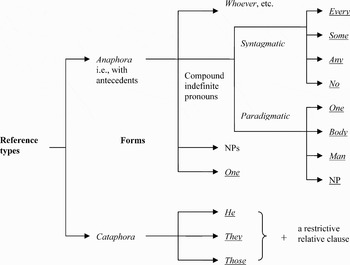
The dependent linguistic variant concerns the selection of pronoun number in a communicative function that expresses an unknown, indefinite reference. As (1)–(5) show, the empirical part of this article involves a heterogeneous set of contexts. To conceptualize the research question, Figure 1 illustrates the two deictic categories, anaphora and cataphora, in which the pronouns are used.Footnote 4 The anaphoric cases (1) and (2) concern the selection of the personal pronouns he and they with various antecedents, most typically grammatically singular compound indefinite pronouns, the underlined forms in Figure 1. The antecedents must be unknown because the linguistic interest lies in whether writers use a singular pronoun or a plural one in cases with no overt number distinction. The dependent variants in cataphora, he /they/those in (3)–(5), function as the antecedents of the following relative clauses (Huddleston & Pullum, Reference Huddleston and Pullum2002:1036–1037). They are similar to the indefinite pronoun antecedents in anaphora, as the entire proposition must be indefinite, and the pronouns do not have a real-world referent.Footnote 5 In both reference types, the interest lies in the writers' selection of pronouns, either he or they in anaphora, or he/they/those in cataphora.
Reference types for human indefinite function.

Because the dependent pronoun variants in both anaphora and cataphora in Figure 1 can be used for similar unknown, indefinite uses, my argument is that these linguistic contexts, with their pronoun variants, are in fact two sides of the same semantic construction. This argument is similar to the way constructionists see syntactic constructions (Goldberg, Reference Goldberg2003). Indefinite expressions are used for a particular communicative function, which may not be strictly predictable from their overt linguistic components but, when interpreted in context, create patterns of form and function used for a propositional content.
My empirical approach to the variant distribution in these two contexts shows that they underwent a grammaticalization process that affected the frequencies of occurrence of these pronouns (Laitinen, Reference Laitinen, Nevalainen, Klemola and Laitinen2006; forthcoming). Their paths of development are markedly similar, but not identical, allowing us to make various generalizations. First, one variant type, the plural, has increased its frequency in anaphora and emerged as the main variant in present-day English (Baranowski, Reference Baranowski2002). There is, however, limited corpus-based research to describe this process in language history (a notable exception appears in Dekeyser, Reference Dekeyser1975). Second, a major restructuring took place in cataphora in Early Modern English, when the demonstrative those replaced the personal pronoun variants, he and they. Previous scholarship is again limited: Rydén (Reference Rydén1966) provides a detailed summary of the synchrony in the early 16th century.Footnote 6 Jespersen comes up with an observation from Shakespeare, showing that the structure was in transition in the Elizabethan period.
(6) God giue them wisedome that haue it: & those that are fooles, let them vse their talents. (Twelfth Night I.v.14, as quoted in Jespersen, Reference Jespersen1949:III.5.15)
Third, because language change is a social process, “taking place in the activities of human users of language in social and situational context” (J. Milroy, Reference Milroy2005:2), we face the task of correlating our linguistic variants with sociolinguistic variables to acquire a more precise picture of language change. The main task, therefore, includes modeling how these changes spread, concentrating on language external social factors.Footnote 7
THE DIACHRONIC DEVELOPMENTS IN THE DATA
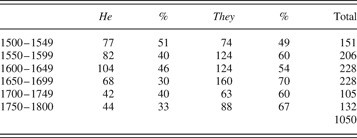
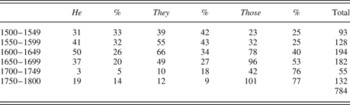
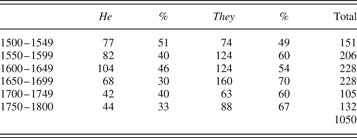
The fact that pronoun selection in anaphora, in particular, is a normative question in present-day English has occasionally blurred diachronic approaches to these pronouns, and scholars have not been able to detect the semantic connections between anaphora and cataphora. Tables 1 and 2 summarize the general findings to provide a bird's-eye view of the diachronic evolution in these pronouns in this sense. They show the overall trend observed in the Corpus of Early English Correspondence and its Extension (the CEEC) (Raumolin-Brunberg & Nevalainen, Reference Raumolin-Brunberg, Nevalainen, Beal, Corrigan and Moisl2007).Footnote 8 The results for the two contexts are presented separately to show the divergence in their diachronic developments.
The anaphoric variants he and they in the CEEC
The cataphoric variants he, they, and those in the CEEC

Table 1 shows that the development of the overtly plural they in anaphora has been slow. Contrary to many studies of social diffusion, the change was not completed during the period examined here. According to the concept of the S-shaped curve, the development covers the midrange (between 36 and 65%) and closes near completion (between 66 and 85%) (Labov, Reference Labov1994:65–83; Nevalainen & Raumolin-Brunberg, Reference Nevalainen2003:54–55). A chi-square test confirms that the development toward the plural was statistically highly significant (p < .005). To put it briefly, the early 16th century pronoun realizations of anaphoric pronouns to indefinite pronouns include significantly more singular third-person he uses than those of the late 18th century. The change in anaphora was not completed, as both variants continue to be in use in present-day English.Footnote 9 The slow shift toward the plural has continued after the 18th century (Laitinen, forthcoming).
Table 2 shows the chronological development leading to the emergence of the demonstrative over the personal pronoun variants. The personal pronouns he and they are the major variants in cataphora in the 16th century, and those gradually replaces them in the course of two centuries. The chi-square values indicate that the change is highly significant (p < .001).
Tables 1 and 2 illustrate that the paths of development of our dependent pronoun variants are chronologically different. The change in cataphora nears completion towards the end of the time frame, whereas the development in anaphora is considerably slower. The pronouns in these two contexts, however, share a common denominator. The emerging variants are perceptually more normal when used in the epicene sense, sharing a larger behavioral potential and involving less structural conditioning, that is, fewer forms for one function (Croft, Reference Croft2003:95–99). Comrie (Reference Comrie, Eckman, Moravcsik and Wirth1986) claims that our tendency to use some forms more frequently than others is ultimately psychological, so that linguistically less formal constructions correspond more closely to our conceptualizations of real-world phenomena (see also Hawkins, Reference Hawkins2004:51). To put it simply, using he in an anaphoric reference to an indefinite entity whose sex (and linguistic number) is inconsequential or indeterminate is less likely than that of a nongendered variant. Similarly, using those in cataphora is more expected, because it is the nonanaphoric (and nongendered) variant.
The corpora used in the next sections provide us with balanced data sets that are stylistically and socially stratified, so that we are able to contextualize the processes of language change and focus on the spread of the emerging variants. Indeed, language-external embedding in grammaticalization is largely unexplored. Nevalainen (Reference Nevalainen, Lindquist and Mair2004) notes that “little is known about the social side of real-time process of language change in general and grammaticalisation processes in particular that only some very broad empirical generalisations may be advanced.” In what follows, I show how the emerging variants, they in anaphora and those in cataphora, spread socially in the correspondence material, concentrating particularly on the role of extralinguistic factors, and the pronoun results are organized according to these independent variables. I then make use of multivariate analysis, a method common in both synchronic and diachronic sociolinguistics (Nevalainen, Reference Nevalainen, Nevalainen, Klemola and Laitinen2006; Tagliamonte, Reference Tagliamonte1998).
GENDER
Exploring pronoun selection and the writers' gender is motivating, because one of the dependent variants in both anaphora and cataphora is the gender-specific he. One could therefore expect to find differences between men and women in adopting the pronouns. At a more detailed level, the pronouns in anaphora offer an interesting field of research. As seen in Figure 1, the paradigmatic level in the antecedents concerns three types of nominal elements; of these -man declined in Early Modern English, and the other two, -body and -one, emerged and continue to be used today. Raumolin-Brunberg and Kahlas-Tarkka (Reference Raumolin-Brunberg, Kahlas-Tarkka, Rissanen, Kytö and Heikkonen1997) have shown that this indefinite pronoun development was brought about by grammaticalization.
The Early Modern correspondence data for men and women is skewed, as women's letters comprise about 20% of CEEC (Nevalainen & Raumolin-Brunberg, 2003:45–49). Similarly, the number of relevant occurrences of the pronoun variables reflects the social representativeness of the data. The total number of pronouns examined in anaphora is 1050, of which 186 (18%) are from women. In cataphora, the women's total is 162, 21% of the total of 784.
The rationale of this section lies in sociolinguistic studies on gender as an independent variable. It has been established that gender differentiation in language use must be combined with our knowledge of the social awareness of linguistic change. Labov's Gender Paradox predicts that in changes from above, women typically adopt prestige forms more quickly than men (diffusion). In changes from below, women tend to use higher proportions of innovative forms (actuation) (2001:293). Recent historical sociolinguistic studies have established that in the late medieval and early modern periods, the role of women was more complex. Nevalainen and Raumolin-Brunberg (2003:131) argue that “late medieval and early modern Englishwomen did not promote language changes that emanated from … out-side their own spheres of ‘being.’” Another aspect of the topic is prestige, the role of grammars and language planning; present-day synchronic research has found that females not only favor prestige forms, but in fact create them (Milroy & Milroy, Reference Milroy and Milroy1993:65; Nevalainen, Reference Nevalainen2000a).
Gender in anaphora
In the early modern period, the situation with the pronouns in anaphora was complex. Neither of the variants can be said to have correctness values, because the first normative statements of the singular versus plural anaphoric pronouns date from the middle to the end of the 18th century (Bodine, Reference Bodine and Cameron1990; Sundby et al., Reference Sundby, Bjørge and Haugland1991:106–113). The corpus data suggest that some writers were at least partly conscious of this construction, as may be the case in (7) and (8), showing an overtly singular antecedent, a generic one in this case, and a plural pronoun immediately following it.
(7) When one does not know what to say they talk of the weather, the sudden change will give me an opportunity to make my letter a little longer (Peter Wentworth, 1708; wentworth, 68)
(8) By the example of Sampson that one might and (if they be not too foolish to live in this world) must speake riddles to theyr frends and try the truth of offred love (Arabella Stuart, 1603; stuart, 130)
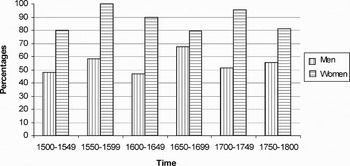
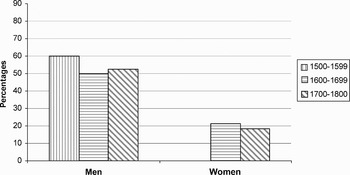
Figure 2 shows the gender differences in anaphora, indicating that women have used the plural variant, they, more than consistently throughout the three centuries of Early and Late Modern English, so that they have in fact heavily disfavored he. The masculine he has never been such a viable option in indefinite anaphora for female writers as it has been for men.
Gender variation in the uses of they in anaphora.

The variable differences between men and women are statistically highly significant in all but the fourth 50-year period (1650–1699) (p < .01). The results indicate that gender was a factor in the pronoun selection in anaphora. Moreover, the patterns of gender variation of this variable remained stable for three centuries, and the epicene uses of they have been socially stratified along the male and female distinction. In this respect, this is a clear case of a stable variable in sociolinguistics (Chambers, Reference Chambers2003:121–126; Raumolin-Brunberg, Reference Raumolin-Brunberg, Raumolin-Brunberg, Nevala, Nurmi and Rissanen2002). An essential difference from Labov's definition of stable variation is that the gender differentiation in the pronoun variants in anaphora deals with the word level of a language. In fact, the uses of epicene he and they must essentially be understood as parts of a larger structure in which the third-person pronouns are anaphorically linked to their antecedents. Huddleston and Pullum's (2002:1453–1461) definition of anaphoric relations suggests that anaphors are interpreted and determined via the interpretation of their antecedents. My suggestion is that the overall shift toward the plural provides evidence of a larger evolution in English pronouns in this sense, which is linked with other closely related changes (i.e., the indefinite pronouns) and is therefore evinced only in larger contexts.
The patterns of pronoun variation accounting for the various antecedents with which the variants are used are as important as the overall data (cf. Figure 1). Nevalainen and Raumolin-Brunberg (2003) have shown that men tended to retain the disappearing -man forms in correspondence later than women. I set out to test whether differences exist between third-person pronouns used to refer to the -man forms, such as (9) and (10):
(9) In the loft at the Wattergat corner, is 43 flecis of ende wull and xvj flecis of clift wull. If anny man lacke anny geleynges, I praie you selle them; ye may let the packer shot owt the sourtes when niead is. (John Johnson, 1545; johnson, 541)
(10) wch (pardon the Preacher) is this reflection; “That every Man must be finaly happy, if he has not by his folly and ill conduct forfeited all title to be so; or otherwise no one can be finaly miserable, whilst it is consistent with infinite goodness to make him otherwise.” (Spencer Cowper, 1745; cowper, 53)Footnote 10
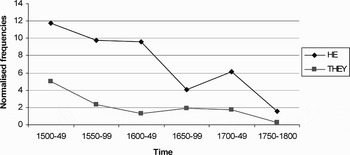
Figure 3 shows the singular and plural pronoun variants by men, illustrating that he was used more frequently with the -man indefinites than the plural they. It also shows that the share of -man compound indefinites decreases toward the end of the time period explored here; this decrease does not affect the proportional distribution of the pronoun variants, because the -man compounds tend to be used more with the singular masculine anaphoric pronouns than the plural one. Women's data are excluded simply because there are only sporadic occurrences of -man compounds followed by anaphoric personal pronouns in the women's subcorpus. All are borderline cases in terms of their indefiniteness, as illustrated in (11)–(13).Footnote 11
Normalized frequencies of anaphoric he and they with -man compounds in the CEEC (per 100,000 words).

(11) you haue set no loer prise then 21 but hee doubts no man will giue so for the mony hee hath receued all as hee saith (Susanne Collett, 1626; ferrar, 243)
(12) when I complained of your coming there contrary to your solemn Promise—that your Visits were not to me but to my daughter; would any Man after so saying expect me to admit him more? (Hester Lynch Piozzi, 1792; piozzi II, 53)
(13) You cannot expect, so thinking, so assured, that I should maintain a Correspondence with any Man, when he neglects his part of it, tho′ that Man should be yourself. (Eliza Draper, 1769; draper, 92)
The results confirm that the singular he with -man compounds correlated with the writers' gender. Even before the rise of prescriptive grammars, and long before the debates on sexism and gender equality of the late 20th century, epicene pronoun use must have been an issue recognized by some writers.
The results with -one and -body compounds corroborate the findings in -man. Figure 4, showing the proportion of he, illustrates that men tend to use both variants with -one and -body compounds in the 17th and 18th centuries.Footnote 12
Percentages of the anaphoric he with -one and -body compounds in the CEEC.

Examples (14) and (15) are from Arthur Capel. In the women's data, the plural variant is favored at statistically significant levels (16). As can be observed in Figure 4, women only occasionally resort to he with -one and -body antecedents.
(14) wherefore if Sir Cyrill Wyche will bring over any one to bee for that use [i.e., a secretary], I will see to do something for East … so as I conceive it may be best for Sir Cyrill Wyche when hee comes upon ye place to see how he likes them. (Arthur Capel, 1676; essex, 73)
(15) but such was ye unhappiness of that time as ye Treasury was quite empty, and ye insurrections in severall parts made every one who had money look to himself and none could bee found to lend to ye publick (Arthur Capel, 1676; essex, 57)
(16) but in Earnest if I once finde any body faulty towards mee, they loose mee for ever … I dare sweare there is noebody soe proude of theire witt as to keep it upon such termes, but would bee glad after they had indured it a while (Dorothy Osborne, 1653; osborne, 18)
In sum, the corpus data suggest stable gender differences in anaphora. The plural remains above 80% in women's data for more than a dozen generations of speakers, making gender stratification in anaphora a convincing candidate for a stable gender variable.
Gender in cataphora
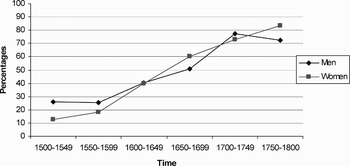
The corpus results for men and women in cataphora, displayed in Figure 5, show the spread of those over the other two variants. They indicate that the change toward the demonstrative has nearly been completed in three centuries of English personal correspondence and is statistically highly significant for both men and women (p < .001).
Gender variation in the emergence of cataphoric personal those in the CEEC.

The pattern of the incoming variant contrasts the gender differentiation exhibited in earlier studies in Early Modern English (Nevalainen & Raumolin-Brunberg, 2003:110–132). No clear gender affiliation can be detected in the spread of those in cataphoric personal reference; the fact that Figure 5 shows men leading the change in its early stages is not statistically significant. The figure also shows that gender affiliation remains consistent throughout the three centuries, as no clear crossover points of statistical significance are found.
Considering the Gender Paradox mentioned above, I have not yet determined the direction of change in the spread of those. I have suggested elsewhere that the comparisons between personal correspondence and the Bible (the Authorized Version of 1611Footnote 13) indicate that the change toward the demonstrative those is from below (Laitinen, Reference Laitinen, Nevalainen, Klemola and Laitinen2006). Table 3 shows the variant distribution in the early modern section 1 (1500–1570) from the Helsinki Corpus Footnote 14 (Kytö, Reference Kytö1996), which suggests that the texts more typical of the oral mode of communication tend to show higher proportions of the innovative those than the more literate genres or the Tyndale Bible of 1534. Those first spread to texts closer to the spoken idiom, confirming the direction of change from below in Labovian terms (1994:78).Footnote 15Table 3 displays the percentages; the absolute number for the oral genres is 31, 81 for the literate, but for the Bible the figure is 68.
Cataphoric he, they, and those in the early modern section E1 (1500–1570) of the Helsinki Corpus

The cataphora results so far are in contrast with the data in anaphora in the previous section, as the innovative variant those diffuses along similar paths for both men and women.Footnote 16 More importantly, the results go against various earlier studies in gender differentiation, because one cannot discern the more active role of women, as suggested by Labov (Reference Labov2001:292–293). My initial suggestion based on these corpus results is that the process was largely driven by language-internal factors, such as the tendency toward a cognitively more unambiguous variant, as argued in the section entitled “The diachronic developments in the data,” and the propensity to avoid personal pronoun forms that require postmodification, as proposed by Denison (Reference Denison2005). In sociolinguistic terms, it is plausible that the innovative form never rose into consciousness, unlike the development toward they in anaphora, which attracted attention in normative grammars in the 18th century (Bodine, Reference Bodine and Cameron1990).
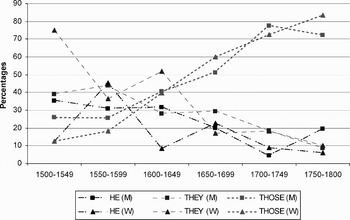
Gendered variant patterns emerge when we examine the entire variable. Figure 6 shows the three centuries of cataphoric personal reference with all three variants displayed. It illustrates that cataphoric variants for men were largely interchangeable in the 16th century, up to the point when those began to spread. Women's data, more infrequent in terms of tokens, indicate that they preferred the they variant in cataphora, which was then replaced by those in the 17th century.
The three cataphoric pronoun variants in men's and women's material in the CEEC.

A microlevel examination of the variants shows that women who were the leaders of change in anaphora, using the plural they consistently, do not necessarily participate in the change toward those in cataphora. A case in point is Arabella Stuart, who has 22 examples of they in anaphora and uses the same form in the majority of her cataphoric cases. She has 13 occurrences of they, see (17) and (18), and only 2 instances of the innovative those.
(17) But do not deceive your selfe so much to thinck I either have or will confesse my pure and innocent selfe guilty of love till you deserve that extraordinary trust (which they who for the saving of theyr soule submitt them selves to Auriculer confession, have all the assurance one mortall man can give or an other possibly require) many waies (Arabella Stuart, 1603; stuart, 165–166)
(18) Theare is no trust in man whose breath is in his nosthrilles. And the day will comm when they thatt judge shall be judged, and he that now keepeth theyr counsell and seemeth to winke at iniquity (Arabella Stuart, 1603; stuart, 157)
Discussion of the role of gender
The findings in the two previous sections not only add to our knowledge of gender as a social variable but also provide new evidence of stable variation and help us distinguish some linguistic characteristics that tend to promote stability. The conclusions are based on a mixed set of results because the corpus data show that the variant use in anaphora was heavily conditioned by gender in early and late modern England (1500–1800), whereas the development of those in cataphora seems to have proceeded independently of the gender of the writers. In anaphoric contexts, women were on the vanguard of the slow long-term development, as they led the stronger tendency toward the plural variant. As illustrated in Figure 2, the pronoun use in anaphora was stratified along gender lines throughout the period examined, and women strongly disfavored the masculine he in anaphoric epicene uses. These results of stable variation in anaphora suggest that one should find similar gendered patterns promoting linguistic stability in those sites in grammar where gender is displayed or where gender is indexed in lexemes or morphemes.
As mentioned earlier, the period examined partially corresponds with the first normative statements in English, which proscribed the break in number concord and promoted the new high prestige form, he. The following quote is from Murray's grammar of 1795 (see also Kirby, Reference Kirby1746:56, 80).
Rule V. Pronouns must always agree with their antecedents, and the nouns for which they stand, in gender, number, and person; … Of this rule there are many violations to be met with; a few of which may be sufficient to put the learner on his guard. “Each of the sexes should keep within its particular bounds, and content themselves with the advantages of their particular districts.” “Can any one, on their entrance into the world, be fully secure that they shall not be deceived?” “on his entrance,” and “that he shall.” “Let each esteem others better than themselves;” “than himself” (Murray, Reference Murray and Nelson1795:95–96).
One might hypothesize that the slow advancement of the plural illustrated in Figure 2 might have led to it rising in the level of social awareness, which in Weinreich et al.'s (1968) terminology leads to “the establishment of a social stereotype.” The results in anaphora show that it was the men's variant that the grammarians selected as the acceptable epicene pronoun, but the variant promoted by women eventually became the prestige variant in the 20th century. Studies focusing on the role of gender in anaphora in present-day English could provide new information not only on prestige forms but also on gendered patterns in stable variables.
Finally, the corpus results indicate that we can use sociolinguistic, correlational methods in our study of larger morphosemantic or even typological changes. This approach includes using balanced corpus material, which allows us access to sociolinguistic information. It also requires carefully defining the linguistic functions and forms that are correlated with robust social categories, such as the gender of the writers. This approach also means integrating the internal dynamism of change, evidenced in cataphora or the variant distributions with the three paradigmatic alternatives -one, -body, and -man, for instance, with external development such as social categories. This type of analysis results in an integrated model of linguistic performance, which allows a scholar to examine the possible interfaces between these two levels. Such an approach in synchronic linguistics has been suggested by Lesley Milroy (Reference Milroy2004) in studies of social dynamics of sound change. In the following sections, I will extend my correlations of the dependent variables to cover additional social categories.
REGISTER
Shifting the attention from interspeaker to intraspeaker variation (Schilling-Estes, Reference Schilling-Estes, Chambers, Trudgill and Schilling-Estes2004), I will discuss the role of situation of use, or register, in pronoun selection. The data in Tables 1 and 2 above were sorted in terms of tenor, writer-addressee relations, according to the model proposed by Halliday (Reference Halliday and Matthiessen2001:631).
My research questions in this section are twofold, depending on the pronominal context. The first one, which concerns the anaphoric structures, tests whether one can find patterns of variation in he/they in Early Modern English correspondence that are similar to those in present-day English registers. I have proposed elsewhere that the informal text types increase the writers' tendency to use the plural, whereas formal texts show a statistically significant increase in the singular (Laitinen, Reference Laitinen2002). This section dynamizes the present-day situation, exploring the origins of such differences in Early and Late Modern English. The data are sorted to see whether it is possible to determine the direction of change of the emerging variant they.
The second question focuses on the spread of the innovative those variant in cataphora in terms of its textual variation. As previously noted, the Helsinki Corpus data in Table 3 supports the idea of its emergence from below. Labov (Reference Labov1994) predicts that most linguistic changes originate in the vernacular, informal varieties of language, only to spread later to the more formal ones. The corpus used here has been coded for sender-addressee relations, enabling research on tenor (Nevalainen & Raumolin-Brunberg, 2003; Palander-Collin, Reference Palander-Collin1999). A detailed discussion of the parameter coding in the CEEC appears in Nevalainen and Raumolin-Brunberg (Reference Nevalainen, Raumolin-Brunberg, Nevalainen and Raumolin-Brunberg1996:39–54). I divided the letter material into two subcorpora, and the dependent variable was then cross-tabulated with these binary categories. My aim is to explore whether Labov's (1994) widely tested observation could be detected in statistically significant pronoun variation if we compared letters written to family members and close friends, representing the more informal situations, with those addressed to all other recipients, that is, the more formal situations of use.
Register variation in anaphora
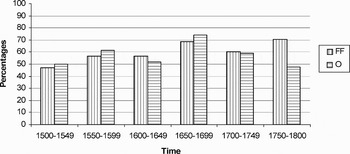
Figure 7 illustrates the proportion of the plural they variant in the CEEC divided according to the situation of use. It depicts the plural pronoun variant in letters to family members and close friends (coded FF) and to other recipients (O). No statistically significant differences in the anaphoric pronoun selection can be detected up to the end of the 18th century. The variant frequencies fluctuate, but in general, the letters written to family members and friends contain roughly equal numbers of the singular and plural pronouns as the other recipients. When one uses the writer-addressee relationship as a binary category in the examination, the figure allows one to conclude that register does not determine the anaphoric pronoun use in Early Modern English. There is, however, one exception that might help us to predict the sociohistorical development of the variant.
The proportions of anaphoric they according to the situation of use in the CEEC.

The corpus results depicted in Figure 7 initially suggest that the epicene they emerged to social awareness in the middle to late 18th century, because the last 50-year period shows register differentiation of statistically significant levels (p < .05).Footnote 17 This remains an initial hypothesis and requires further research. However, if they indeed rose above the level of consciousness as an “incorrect” variant, it could have become restricted more to communicative situations characterized by casual style, as it is often defined in present-day synchronic sociolinguistics (Labov, Reference Labov2001:95ff.). In turn, it would have been avoided in more careful and formal situations that, according to Finegan and Biber (Reference Finegan, Biber, Biber and Finegan1994), tend to contain more frequent uses of elaborate variants, such as he. The corpus results in this section strongly suggest that the origin of this textual distribution is found in the late 18th century.
Register variation in cataphora
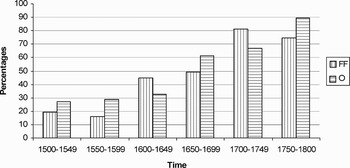
Figure 8 presents the data on the incoming cataphoric those in the two registers, which shows that the situation of use was not a determining factor in the spread of the demonstrative and the eventual demise of the personal pronouns he and they in cataphoric personal reference. The 16th-century data on the new and vigorous stage initially suggests that those was used more in the letters to other addressees (O), but the differences in the absolute numbers are not statistically significant. The change towards those proceeds at equal speed irrespective of register.
The proportions of cataphoric those according to the situation of use in the CEEC.

The fact that no register variation in terms of tenor, writer-addressee relations, is detected does not necessarily mean that no textual variation existed during the three centuries during which those came to replace the other variants. As mentioned above, the Bible and more literate genres present us with an entirely different view of the variant selection. Taking a broader view of the various external factors considered, my suggestion is that the data in Figure 8 only confirms our initial proposition about the rise of those in cataphora. The change probably never rose to awareness and was to some extent driven by language-internal factors.
Considerable microlevel variation is found in the corpus evidence, but there are few writers whose variant use is differentiated along register lines. Most of the informants are writers with mixed variants. Some notable exceptions include Nathaniel Bacon in the 16th century, who uses he with a relative clause in nonfamily or non-close friend letters, (19), and they mainly in family correspondence, as in (20) and (21).
(19) that either you do upholde & maynteyne the right you put over to me or otherwise make restitucion of that which hath ben taken. Yt is a better tyme to complayne now then to have complayned when he who {did you the injury} [dealt thus with you] should have ben your judge. And in my opynion (Nathaniel Bacon, 1591; bacon III, 114–115)
(20) and if it maie [be] compassed without law it shalbe a follie to enterprise the same by suit. You write further that this will make others afrayde what waie to take with the litle they have. The office of trust is a burden to them who will perfourme the same honestlie, and I begg not for the place, and I shalbe content they who do laie such an office upon mee do know that I take them beholding unto mee (Nathaniel Bacon, 1592; bacon III, 219)
(21) For I knowe very well it will be for her benefit especially, & therby for mine also. Yt is no newe thinge that thei which love ther children best, beinge about these yeares that my wife is, seake to place them for a time in some good place from them. (Nathaniel Bacon, 1570S; bacon I, 12)
In the 17th century, the illustrations from John Jones are good examples of microlevel variation in terms of register. He uses the incoming form those mostly in his letters relating to more formal relationships. Jones, a puritan and a member of Cromwell's inner circle, wrote to a large group of addressees, such as a fellow colonel and the member of the Council of State, Philip Jones, in (22).
(22) The suddennesse of the late change, with the occasion and somewhat of the formality of it, doth amuse many precious S'ts in this Lande, and it cannot be rationally expected that there should be soe sudden and cleare an aprobation in it in those that feare the Lord, as there were in them yt were p'sent upon the place, and know the grounds and Reasons of this alterac~on. (John Jones, 1653; jones, 219)
In more informal situations, Jones resorts to the old he and they forms.
(23) I am not sorry for ye Welch Petic~on, the more the Saints are tryed, the more their luster will appeare, it is good to observe what hands promote it, who they be that subscribe it, and to take exact notice what temper they are of, and what kind of ministry they are and would promote. (John Jones, 1652; jones, 210)
(24) If a stone or piece of Earth were placed in the braine and at the heart, how could and heavy would the Speritt be, even such are the affaires of the world (although honest and necessary.) And therefore happy are they that are least incumbred with them (John Jones, 1652; jones, 211–212)
(25) The Lord is pleased to begin to gather a people here at Dublin into a Church fellowshipp, the foundac~ons off 2 Congregac~ons are already laid, ye number of either not many, but he that soweth in this vineyard, will give ye encrease. (John Jones, 1651; jones, 191)
Morgan Lloyd, the recipient of (23) and (24), was Jones's friend in Wales, as was William Stane in (25), a doctor to who Jones reported private matters concerning the life and selected political events in Dublin.
In this section, I have reported the first diachronic results the pronominal variants in cataphoric personal reference addressing variation in writer-addressee relationships. As little previous research on this structure exists, the textual distribution of the variants offers us an interesting field for future research, such as mapping the variant uses in various text types, such as legal texts, pamphlets, and scientific writings.
REGION
The next issue to be considered is the regional variation in the pronoun variables, with the intention of discovering the possible areal origin of the emerging they in anaphora and those in cataphora. The previous sections established that there was a slow long-term shift toward they in anaphora and a much quicker movement of cataphoric those ousting the personal-pronoun variants. The diachronic shift in anaphora in particular included the development in which one variant eventually rose to awareness, as he was selected as the prestige form in the 18th century. The question considered in this section is whether we can pinpoint an area from which the new prestige form in anaphora originates and to recognize any area in which the developing form in cataphora was used at statistically significant levels before other regions.
As I analyze low-frequency items in the study, no very detailed analysis of regional variation can be achieved. This concerns supralocalization of local linguistic items in particular, as suggested by Nevalainen (Reference Nevalainen, Bermúdez-Otero, Denison, Hogg and McCully2000b), and the geolinguistic approaches by Hernández-Campoy and Conde-Silvestre (Reference Hernández-Campoy and Conde-Silvestre2005). The rationale for this section lies in the fact that no earlier diachronic studies accounting for regional variation of the pronouns in indefinite sense exist. There is limited previous scholarship on present-day English; Baranowski (Reference Baranowski2002) has shown that American writers tend to choose the anaphoric they in fewer frequencies than British writers do. Variation is attested in the antecedents in anaphora shown in Figure 1 above. Biber et al. demonstrate that -one forms tend to be more common in British English and -body in American English (Reference Biber, Johansson, Leech, Conrad and Finegan1999:351–353). Taking a diachronic approach to the antecedents in this study, Nevalainen and Raumolin-Brunberg (2003:181) suggest a pattern in which the -body forms predominate in London, the Royal Court, and East Anglia, but not in the North, where -one compounds are favored. The -one indefinites supralocalize in the mid-17th century, but those of -body do not advance to the North. Previous scholarship on cataphora is more limited, as the first account of regional variation in diffusion of innovative pronoun antecedent forms are attempted here. The scholarship has mainly focused on the shifts in the relative pronoun paradigms and less so on the geographic distribution of the variants (Dekeyser, Reference Dekeyser and Fisiak1984; Nevalainen, Reference Nevalainen and Kahlas-Tarkka1987; Rydén, Reference Rydén1966). The most notable exception is Raumolin-Brunberg (Reference Raumolin-Brunberg, Taavitsainen, Nevalainen, Pahta and Rissanen2000), concentrating on the spread of which over the Northern form the which.
For this study of regional pronoun distribution, I have established a three-level distinction that accounts for regional linguistic variability in early modern England proposed in previous historical sociolinguistic studies (Nevalainen & Raumolin-Brunberg, 2003:159–167). First, the threefold distinction here combines the residents of the capital area of London as one group, comprising merchants, lower gentry and occasional noblemen and women in the city. Second, members of the royal household, courtiers, government officials, and diplomats, many of whom lived in Westminster, have been grouped as representatives of the royal court. Contemporary language commentaries of the 16th and 17th centuries show that people of the “better sort” in London and particularly at court enjoyed a position of prestige, which could well be the source of the incoming pronominal forms. The most notable of these opinions is George Puttenham's advice to aspiring poets (Reference Puttenham1589). Third, in order to allow statistical generalizations based on my relatively low-frequency dependent variables, informants from other areas in England comprise the third group. In essence, the three-level distinction used here collapses both geographic and social distinctions to overcome limitations in the overall variant frequency. With the development of even larger historical data sources, it should be interesting to investigate whether pronoun variant distributions and frequencies exhibit similar regional distinctions that have been attested to operate on the north-south axis (Bailey et al., Reference Bailey, Maynor and Cukor-Avila1989; Nevalainen & Raumolin-Brunberg, 2003:177–180). The figures in this section show the variant distribution across two centuries, because the informants' geographic distribution in the CEEC's eighteenth century Extension at the time of the corpus queries was not strictly comparable to the earlier time periods in which the merchant letters in London, in particular, allow a flexible study of their language (see Nevalainen & Raumolin-Brunberg, 2003:157–184).
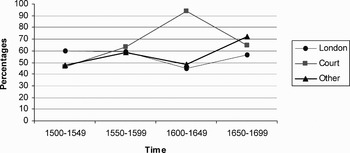
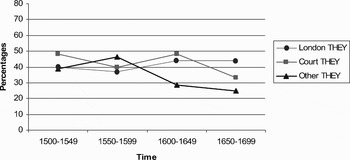
Figure 9 shows that, in the 16th century, the anaphoric they variant was not heavily favored in London, the court, or the other areas. The statistical differences in the absolute numbers between London, which shows a higher proportion of they in the early 16th century, and the court and the other areas are not significant. With a few fluctuations in the frequencies brought about by the small number of tokens at particular periods in certain areas, the 200 years of correspondence result in the situation in which they is on the verge of becoming the major variant in anaphora. The absolute figures show that in the early 16th-century material roughly half of the anaphoric cases are in the singular, whereas the proportion has been reduced to around 30% by the end of the 17th century. The only statistically significant difference in the areal distribution in Figure 9 is found in the other areas. The difference between the two centuries there is statistically highly significant (p < .005). The data from the court seem to follow the trend of the other areas, but low absolute frequencies skew the statistical significance analysis. The peak in the material from the court in the early 17th century is skewed by one individual, Arabella Stuart, whose examples, all in the plural, constitute the majority of the data from the court at that particular period.Footnote 18
The proportion of anaphoric they in three regions in the CEEC.

We are only beginning to understand the anaphora variant distribution. This research indicates that not only is more data needed, but that the possible source of the middle-to-late-18th-century proscription of they in normative grammars was the fact that the plural they in anaphora was dominant in areas other than London, in addition to its predominance in women's writing, as has already been shown.
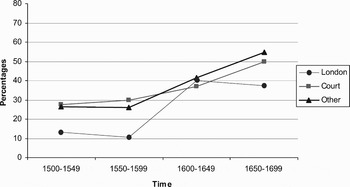
The results in Figure 10 indicate that those was practically nonexistent in correspondence originating from London in the 15th century. The proportions in letters from the court and the other areas are higher; London only reaches these two areas when those reaches the midrange (from 36 to 65%) of the S-curve. The change toward the demonstrative variant proceeds with equal speed in the court and other areas. No statistical significances are attested between them in any of the periods. When the change is at its most rapid in the 17th century, the end of the century in particular, the data indicates that London lags behind. If we elaborate on this detail, an interesting feature of the cataphoric variants is revealed when only the they variant is examined. The reason why those spreads at unequal speed in London is shown in Figure 11, which indicates that London retains the personal-pronoun variant they longer than the rest of the country. The demonstrative only becomes the major variant in London in the following century, whereas at the court they loses its position earlier, and in the other areas even prior to that.
The proportion of cataphoric those in the three regions in the CEEC.

The proportion of cataphoric they in the three regions in the CEEC.

All in all, the three sections have shown that the paths of pronoun diffusion in terms of extralinguistic independent variants were highly dissimilar, depending on the context. The role of women was highlighted in the anaphoric they variant, whereas no statistically significant distribution of gender stratification was observed in cataphora. The data on register variation suggested that sender-addressee relations played a role in anaphora only after they had risen above the level of consciousness, but in cataphora, explanations of the emergence of those must be sought elsewhere. These results also show statistical significance in certain aspects of regional variation. To gain a fuller picture of the variant diffusion, the next section turns our attention to measuring the interplay of some of the external factors discussed in the previous sections.
MULTIVARIATE ANALYSIS
To highlight the role of abstract morphosemantic functions that are expressed using the various pronoun forms, the last part of my article focuses on statistical analyses in which the observed variation in language external factors is compared with the data from one language-internal factor. The corpora used offer sufficient data for studying the interplay between external factors, and the statistical methods allow us to include language-internal factors in the analysis. These include the type of antecedent in anaphoric contexts and the relative pronoun form in cataphora. No direct comparisons between the internal and external variables are made, and the factor weights of the statistical multivariate analysis are given independent of each other. The multivariate analyses are carried out to estimate the relative weight of independent variables on the choice between the pronominal variants. I used the Windows version of GoldVarb 2001, originally developed by Rand and Sankoff (Reference Rand and Sankoff1990).
The varbrul results of anaphoric and cataphoric contexts are presented independent of each other. Following Paolillo's suggestion (2001) for handling sparse data and avoiding knockout values in the cells, the results are divided into centuries, allowing us to analyze linguistic variation of low-frequency items. The main interest lies in the writers' selection of the innovative they over he in anaphora and those over they/he in cataphora, the constraints for the factors being presented in terms of their probability of appearing with the innovative variant. The external, social factors whose interplay is investigated include gender and register as discussed earlier.Footnote 19
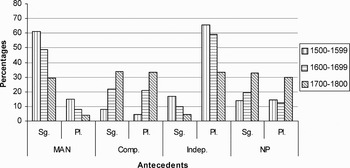
In anaphora, the language-internal factor is the form of the antecedent element, more particularly, the choice between the four paradigmatic alternatives in Figure 1: (a) the compounds in -man; (b) the compound forms of -one and -body; (c) simple, independent indefinite pronouns; and (d) noun phrases of determiners and generic nouns. Figure 12 displays the chronological shifts in the frequencies of he and they with these forms. The figure shows the internal dynamism in anaphoric epicene pronouns brought about by the changes in the antecedents. In the 16th century, -man indefinites were referred to with singular variants, whereas the simple, independent forms received the plural they. The other types of reference were a clear minority. The 18th-century variation is more diverse, as the other antecedent types had increased their proportion, projected in the pronoun variants in Figure 12.
The anaphoric variants singular he and plural they with the different antecedent types.

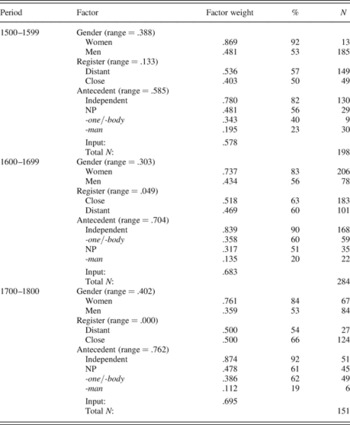
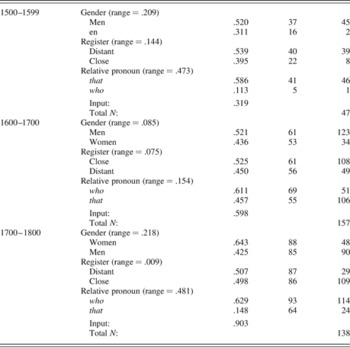
The varbrul results for three centuries of anaphora are in Table 4, which shows the three factors, and the maximum and minimum values for the factor weights, which vary between 0 and 1.Footnote 20 The variation ranges are calculated by subtracting the minimum value from the maximum. The range of variation establishes the relative impact of the independent factors in the slow shift toward they. The pattern emerging from the statistical analysis is clear, corroborating the results in the cross-tabulations above. Table 4 confirms that the slow spread of the they variant is promoted by female writers. Throughout the three centuries, the variation range is considerably higher in gender than in register variation. As to the language-internal factors, Table 4 shows that the independent antecedent types clearly promote the uses of they, an effect which is consistent in the time frame. The indefinite pronouns in -man, on the other hand, inhibit it. The variation ranges of the language-internal factor are indeed greatest throughout the three centuries examined. These results indicate the role of changing antecedent types, the indefinite pronouns, to be highly relevant.
The probability of anaphoric they in the multivariate analysis of the three factors in three centuries (1500–1800).

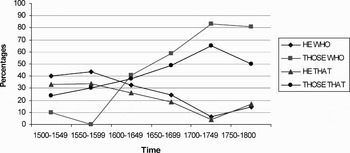
In cataphora, the basis for language-internal factors is the relative pronoun type, the relative pronouns being who and that.Footnote 21 Previous scholarship on relative structures has shown that who as a relative of personal antecedents was introduced later than that (Rydén, Reference Rydén1966). My research question concerns the relative impact of the relativizers along with the social factors of gender and register on the selection of the innovative those. Figure 13 shows that even though who is later than that, he who is more frequent in indefinite reference than he that in the 16th century. When used with the demonstrative pronouns, those that is more frequent than those who at the early stages of its emergence. Those who only picks up after the increase in who in the 17th century. Who gained ground with those in cataphora only once it had been established as the relative for personal antecedents. He who and he that then started to decline in frequency.Footnote 22
The cataphoric variants he and those with the two relative pronoun types.

The three periods show the spread of those first at its new and vigorous stage (the 16th century at 25% level), at midrange (47%), and finally in the 18th century when nearing completion (74%). The constraint probabilities shown in the three tables indicate the strength of those appearing in the data. The factors whose relative weightings have been inspected are gender, register, and the relative pronoun type.
The varbrul results for the three centuries are shown in Table 5, which shows that gender variation is a more significant language-external factor than register variation in the three phases of change. Men favor the innovative form at the early stages of change, and the differences in the midrange are minimal. The table shows that female leadership of this particular change is assumed only when the diffusion of those is nearing completion in the 18th century. The only notable impacts (weightings over .550) in social variables occur in the last period with women clearly promoting the use of those.
The probability of cataphoric those in the multivariate analysis of the three factors in three centuries (1500–1800)

Separating the impact of the relative pronoun variants from gender and register, Table 5 shows that the relatives played a significant role in the adoption of those over they in cataphora. Keeping in mind Figure 13, which indicates that the disappearing he who was the dominant variant in the 15th century, Table 5 shows that the range of variation with the relatives exceeds that of the other factors in the 16th century. The use of that promotes the innovative those at the early stages. Who is used in cataphora in the 16th century, but predominantly with the disappearing he and they variants. The range of variation in the early stages of the diffusion of those with that is greater than in the 17th century when the change is at its midrange phase (.473 versus .154). When those is nearing completion, the variation favoring the relative is once again markedly similar to the situation in the 16th century, but this time the relative is who.
CONCLUSIONS
This article has explored the sociolinguistic patterns of a development that concerns typological tendencies in English. I have focused on three pronoun variants that may be used in a human indefinite function but which can be realized in two contexts: (a) human indefinite anaphora and (b) cataphoric personal reference. Using quantitative corpus evidence, it was argued that the less marked pronoun variants (in terms of gender, number, and linguistic function) assumed an expanded functional role, which is related to a larger change in English pronoun use (cf. Laitinen, forthcoming). My approach in this paper has been inspired by two theoretical proposals. First, the decision to include the pronominal realizations of both anaphora and cataphora was prompted by Croft (Reference Croft2003:271), who proposes that a diachronic study of grammaticalization could benefit from investigating not only individual linguistic elements, but also larger constructions. The study presented here naturally deals with abstract semantic constructions such as realizations of indefiniteness. Second, the framework for the sociolinguistic enquiry comes from the suggestion made by Labov (Reference Labov2001) that more abstract linguistic phenomena do not necessarily exhibit sociolinguistic patterns of socially evaluated variables. The present results are, to my knowledge, the first systematic corpus-based account of anaphoric and cataphoric pronoun realizations in the indefinite sense in Early and Late Modern English in which the pronominal variants are correlated with social variables. More importantly, I hope that the approach adopted here could be repeated with other morphosemantic functions.
My findings can be summed up as follows. The corpus data from CEEC and its Extension strongly suggest that the diachronic evolution in both contexts was highly similar, leading to the diffusion of one variant at the expense of the others. Despite the similarities, the developments were also highly divergent. In anaphora, the corpus data indicate that they in an anaphoric relationship to indefinite pronouns has been in use for centuries. There was indeed a change toward the greater tendency to they, but the shift has been extremely slow, and barely observable even in large corpora. In cataphora, on the other hand, the 1500–1800 period saw the near completion of the change toward the demonstrative those over the personal-pronoun variants he and they.
The three language-external, social variables were gender, sender-addressee relations, and region. The cross-tabulations demonstrate that the writers' gender in anaphora, in particular, turned out to be interesting. The data indicate that women clearly preferred the plural they variant to a degree that represents a clear case of a stable sociolinguistic variable exhibiting long-term variation persisting over several centuries. Women use they in proportions over 80% throughout the three centuries, whereas men are more equally divided between the two variants. The results for register variation also initially suggest that they became a sociolinguistic stereotype in the Labovian sense in the course of the 18th century (Labov, Reference Labov1972:314–315).
In cataphora, the development toward those seems to proceed independently of the social variables, as the corpus data show no clear-cut correlations with any one independent variable. The comparisons with the results from the multigenre Helsinki Corpus indicate that the direction in change was from below. My suggestion is that the process of change in cataphora was partly driven by language-internal factors; the innovative form, those, never rose into consciousness, and the change was allowed to proceed, unlike the development of they in anaphora, which attracted attention in normative grammars.
In broad terms, this article has taken a sociolinguistic approach to grammaticalization. This process has traditionally been seen as language-internally driven, but, as J. Milroy (Reference Milroy2005) argues, language change takes place from person to person. The axis of internal versus external factors has sometimes been seen as a dichotomy in which one excludes the other instead of complementing each other and offering two interrelated views to language change. The article, therefore, introduced a linguistic component into the analysis. A multivariate analysis (varbrul) was carried out to estimate the relative impact of the social variables and the linguistic elements in the immediate cotext of our pronoun variants. This analysis suggested that social variation in terms of gender exceeds register variation, corroborating the implicational scale in Nevalainen and Raumolin-Brunberg (2003:199). The multivariate statistical testing also indicates that in both contexts there was a considerable linguistic component involved in the change. That is to say that the linguistic subsystems in these constructions interacted heavily with the pronoun variants along with the social factors.