


1. Introduction
Astrophysical magnetic fields are observed on galactic, stellar and planetary scales (Brandenburg & Subramanian Reference Brandenburg and Subramanian2005; Jones Reference Jones2011). Some stars even exhibit periodic magnetic cycles. The Earth itself has a dipolar magnetic field that shields it from the solar wind. Dynamo theory studies the mechanisms behind the generation and maintenance of these large-scale magnetic fields by fluid flows at much smaller scales (Ruzmaikin, Shukurov & Sokoloff Reference Ruzmaikin, Shukurov and Sokoloff1988; Brandenburg & Subramanian Reference Brandenburg and Subramanian2005; Jones Reference Jones2011; Rincon Reference Rincon2019). Mean-field magnetohydrodynamics takes advantage of scale separation to make the problem analytically tractable (Moffatt Reference Moffatt1978; Krause & Rädler Reference Krause and Rädler1980).
The turbulent electromotive force, which is determined by correlations between the fluctuating velocity and magnetic fields, plays a crucial role in mean-field dynamo theory. For homogeneous and isotropic turbulence, using the quasilinear approximation, one can express the turbulent electromotive force in terms of the turbulent transport coefficients  $\alpha$ (which is proportional to the mean kinetic helicity) and
 $\eta$ (the turbulent diffusivity, which is proportional to the mean kinetic energy) when the magnetic field is weak (Moffatt Reference Moffatt1978, chapter 7). The contribution of
 $\alpha$, if non-zero, may cause growth of the mean magnetic field, while
 $\eta$ always dissipates it when the turbulence is homogeneous.
Even when the mean kinetic helicity is zero, Kraichnan (Reference Kraichnan1976) found that fluctuations of the kinetic helicity can suppress the turbulent diffusivity. If the fluctuations are strong or long lived enough, the effective diffusivity may become negative, leading to growth of the large-scale magnetic field (Kraichnan Reference Kraichnan1976; Moffatt Reference Moffatt1978, § 7.11; Singh Reference Singh2016). This effect, usually referred to as the ‘incoherent  $\alpha$ effect’, has also been studied in combination with shear (Sokolov Reference Sokolov1997; Vishniac & Brandenburg Reference Vishniac and Brandenburg1997; Silant'ev Reference Silant'ev2000; Sridhar & Singh Reference Sridhar and Singh2014). The ‘incoherent
 $\alpha$-shear dynamo’ has been invoked (Brandenburg et al. Reference Brandenburg, Rädler, Rheinhardt and Käpylä2008) to explain the generation of a large-scale magnetic field in simulations of non-helical turbulence with background shear (Yousef et al. Reference Yousef, Heinemann, Schekochihin, Kleeorin, Rogachevskii, Iskakov, Cowley and McWilliams2008; Singh & Jingade Reference Singh and Jingade2015).
To derive his result, Kraichnan (Reference Kraichnan1976) used a process of double averaging, where one first obtains the mean-field equations at some mesoscale, and then fluctuations of the mesoscale transport coefficients may lead to effects at some larger scale upon subsequent averaging. There are two viewpoints (not mutually exclusive) on the applicability of this method. One is that we require the system to have scale separation, such that the turbulent spectra peak at some small scale, while averaged quantities themselves fluctuate at some mesoscale, and then there exists an even larger scale where a magnetic field can grow (e.g. Moffatt Reference Moffatt1978, p. 178). As an example of a physical system where such a picture may be relevant, we note that, in the solar photosphere, mesoscales can be identified with granulation or supergranulation (for a review on supergranulation, see Rincon & Rieutord Reference Rincon and Rieutord2018). Another viewpoint is to think of multiscale averaging as a renormalization procedure which tells us something about the contributions of higher moments of the velocity field to the turbulent transport coefficients (e.g. Moffatt Reference Moffatt1983, § 11; Silant'ev Reference Silant'ev2000, p. 341). In support of this, we note that Knobloch (Reference Knobloch1977) and Nicklaus & Stix (Reference Nicklaus and Stix1988) (the latter point out some errors made by the former) have used a cumulant expansion to calculate the lowest-order corrections to the quasilinear approximation. In agreement with the results obtained by multiscale averaging, they find that the turbulent diffusivity is suppressed.
Regardless of one's viewpoint, it seems natural to wonder why fluctuations of the helicity should have a more privileged position than fluctuations of the kinetic energy (i.e. the turbulent magnetic diffusivity). Dynamos can be driven or boosted by spatial variations of the microscopic magnetic diffusivity or the magnetic permeability (Busse & Wicht Reference Busse and Wicht1992; Giesecke et al. Reference Giesecke, Nore, Stefani, Gerbeth, Léorat, Luddens and Guermond2010; Pétrélis, Alexakis & Gissinger Reference Pétrélis, Alexakis and Gissinger2016; Rogers & McElwaine Reference Rogers and McElwaine2017; Gressel, Rüdiger & Elstner Reference Gressel, Rüdiger and Elstner2023). Further, in simulations, it is found that fluctuations of  $\alpha$ coexist with fluctuations of
 $\eta$ (e.g. Brandenburg et al. Reference Brandenburg, Rädler, Rheinhardt and Käpylä2008, figure 10). While Silant'ev (Reference Silant'ev1999, Reference Silant'ev2000) has considered fluctuations of the turbulent diffusivity (and found that the effective turbulent diffusivity is suppressed), he has not included the effect of turbulent diamagnetism (expulsion of the magnetic field from turbulent regions); the latter is a natural consequence of spatial variations of the turbulent kinetic energy, and thus cannot be ignored.
Here, we explore the effects of mesoscale fluctuations of the turbulent magnetic diffusivity, with non-zero correlation time, on the evolution of the large-scale magnetic field. The procedure we follow is the same as that of Singh (Reference Singh2016).
In § 2, we derive the evolution equation for the large-scale magnetic field, along with an expression for its growth rate, by using the quasilinear approximation. In § 3, we simplify the expression for the growth rate, assuming the fluctuations of  $\eta$ are isotropic. In § 4, we explain how the growth rate is modified by anisotropy. In § 5, we relate the growth in some regimes to a negative effective turbulent diffusivity. In § 6, we show how to estimate the dynamo numbers in astrophysical systems, taking the solar photosphere as an example. Finally, we discuss the implications of our results and possible future directions in § 7.
2. Derivation of the evolution equation and the growth rate
2.1. Set-up and assumptions
The mean magnetic field,  $\boldsymbol {B}$, evolves according to (e.g. Moffatt Reference Moffatt1978, (7.7))
 \begin{equation} \frac{\partial\boldsymbol{B} }{\partial t} = \boldsymbol{\nabla}\times\left( \boldsymbol{V}\times\boldsymbol{B} + \boldsymbol{\mathcal{E}} \right) + \eta_m \nabla^2 \boldsymbol{B} , \end{equation}
where  $\boldsymbol {V}$ is the mean velocity;
 $\eta _m$ is the microscopic magnetic diffusivity; and
 $\boldsymbol {\mathcal {E}}$, the turbulent electromotive force (EMF), is related to the correlation between the fluctuating velocity and magnetic fields. Since the magnetohydrodynamic equations are nonlinear, the evolution equations for moments of a particular order depend on moments of higher orders. For example, the EMF in (2.1) is a double correlation of the fluctuating fields. To keep the system of equations manageable, one has to truncate this hierarchy by applying a closure. To avoid solving for the fluctuating magnetic field, one requires an expression for the EMF in terms of the mean magnetic field itself. If the mean magnetic field is weak and varies slowly, one typically assumes that the EMF depends only on the mean magnetic field and its first derivatives, obtaining a general expression of the form
 $\mathcal {E}_i = \alpha _{ij} B_j + \eta _{ijk} \partial _j B_k$. Here, and in what follows, repeated indices are summed over. The tensors
 $\alpha _{ij}$ and
 $\eta _{ijk}$ may depend on the statistical properties of the velocity field. The expressions for these tensors depend on the closure used.
One of the most widely used closures in dynamo theory is the quasilinear approximation (also called the first-order smoothing approximation (FOSA); or the second-order correlation approximation (SOCA)) (e.g. Moffatt Reference Moffatt1978, § 7.5; Krause & Rädler Reference Krause and Rädler1980, § 4.3). The quasilinear approximation is rigorously valid only when either the magnetic Reynolds number (the ratio of the diffusive to the advective time scale) or the Strouhal number (the ratio of the velocity correlation time to its turnover time) is small (Krause & Rädler Reference Krause and Rädler1980, p. 49). The former is never small in the astrophysical systems of interest, while it is unclear if the latter is small. Nevertheless, in the context of mean-field dynamo theory, the quasilinear approximation often remains qualitatively correct well outside its domain of formal validity. More complicated closures such as the eddy-damped quasinormal Markovian (EDQNM) closure (e.g. Pouquet, Frisch & Léorat Reference Pouquet, Frisch and Léorat1976) and the direct interaction approximation (DIA) (Kraichnan Reference Kraichnan1977) are extremely difficult to work with.
For weakly inhomogeneous non-helical turbulence, the EMF is given in the quasilinear approximation by (Roberts & Soward Reference Roberts and Soward1975, (3.11))
 \begin{equation} \boldsymbol{\mathcal{E}} ={-} \tfrac{1}{2} \boldsymbol{\nabla} \eta \times \boldsymbol{B} - \eta \boldsymbol{\nabla}\times\boldsymbol{B} , \end{equation}
where  $\eta$ is the turbulent diffusivity (proportional to the turbulent kinetic energy). We note that Silant'ev (Reference Silant'ev1999, Reference Silant'ev2000) did not consider the first term above (Appendix B describes how the absence of this term qualitatively changes the behaviour of the system). Comparing this term with the
 $\boldsymbol {V}\times \boldsymbol {B}$ term in (2.1), we see that the former can be thought of as describing an effective velocity
 $-\boldsymbol {\nabla }\eta /2$ that acts on the mean magnetic field. This transports the magnetic field in the direction in which the turbulent kinetic energy decreases. By analogy with the reduction of the magnetic field in diamagnetic materials, this is usually referred to as ‘turbulent diamagnetism’ or ‘diamagnetic pumping’. For stratified turbulence, or in the presence of small-scale magnetic fields, additional terms arise (Vainshtein & Kichatinov Reference Vainshtein and Kichatinov1983), but we ignore those effects in this work. As mentioned in the introduction, the effect of helical turbulence (
 $\alpha$) has been extensively studied, so we restrict ourselves to turbulence that is non-helical pointwise. The first term of (2.2) may be considered one of many contributions to the off-diagonal components of
 $\alpha _{ij}$. In the literature, such contributions are sometimes described in terms of a vector
 $\boldsymbol {\gamma }$; see Rädler, Kleeorin & Rogachevskii (Reference Rädler, Kleeorin and Rogachevskii2003, (42)). While the calculations we present can be carried out using the
 $\alpha _{ij}$ and
 $\eta _{ijk}$ tensors in their full glory, we use a simpler expression in order to keep the results interpretable.
Although the mean-field approach does not formally require scale separation, we associate averages with length/time scales for clarity of exposition. Let us assume that  $\eta$ fluctuates at length/time scales (henceforth referred to as the mesoscales) much larger than the scales at which the turbulent velocity fluctuates. We employ a double-averaging approach (Kraichnan Reference Kraichnan1976; Singh Reference Singh2016), in which we treat
 $\eta$ (at the mesoscale) as a stochastic scalar field which is a function of both position and time (i.e.
 $\eta = \eta (\boldsymbol {x},t)$). For any mesoscale quantity
 $\Box$, we use
 $\langle \Box \rangle$ and
 $\bar {\Box }$ to denote its averages at the larger scale. We assume this average satisfies Reynolds’ rules (e.g. Monin & Yaglom Reference Monin and Yaglom1971, § 3.1).
If we set the mean velocity to zero, ignore the microscopic diffusivity (which is usually much smaller than the turbulent diffusivity in the systems of interest) and use (2.2), we can write (2.1), the evolution equation for the mesoscale magnetic field, as
 \begin{equation} \frac{\partial\boldsymbol{B}}{\partial t} = \boldsymbol{\nabla}\times\left( - \frac{1}{2} \boldsymbol{\nabla} \eta \times \boldsymbol{B} - \eta \boldsymbol{\nabla}\times\boldsymbol{B} \right) . \end{equation}
In § 2.3, we assume the fluctuations of  $\eta$ are statistically homogeneous, stationary and separable in order to obtain an integro-differential equation for the large-scale magnetic field. In § 2.4, we simplify this equation by assuming the fluctuations of
 $\eta$ are white noise, while in § 2.5, we also keep terms linear in the correlation time of
 $\eta$.
2.2. Evolution equation in Fourier space
We now move to Fourier space with
 \begin{equation} \tilde{f}(\boldsymbol{k},t) \equiv \int \frac{\mathrm{d}\boldsymbol{x}}{(2{\rm \pi})^3}\, {\rm e}^{{\rm i}\boldsymbol{k}\,\boldsymbol{\cdot}\,\boldsymbol{x}} f(\boldsymbol{x},t), \end{equation}
where we have used a tilde to denote the spatial Fourier transform of a quantity. The convolution theorem takes the form
 \begin{equation} \int\frac{\mathrm{d}\boldsymbol{x}}{(2{\rm \pi})^3}\, {\rm e}^{{\rm i}\boldsymbol{k}\,\boldsymbol{\cdot}\,\boldsymbol{x}} f(\boldsymbol{x}) g(\boldsymbol{x}) = \int\mathrm{d}\boldsymbol{p} \ \tilde{f}(\boldsymbol{p}) \tilde{g}(\boldsymbol{k}-\boldsymbol{p}). \end{equation}
Equation (2.3) then becomes (omitting the temporal arguments whenever there is no ambiguity)
 \begin{equation} \frac{\partial \tilde{\boldsymbol{B}}(\boldsymbol{k}) }{\partial t} =\boldsymbol{k} \times \int\mathrm{d}\boldsymbol{p} \left(\frac{\boldsymbol{k}+\boldsymbol{p}}{2}\right) \times \tilde{\boldsymbol{B}}(\boldsymbol{p}) \, \tilde{\eta}(\boldsymbol{k}-\boldsymbol{p}). \end{equation}
Taking the average of the above, we obtain
 \begin{equation} \frac{\partial}{\partial t} \langle \tilde{\boldsymbol{B}}(\boldsymbol{k}) \rangle = \boldsymbol{k} \times \int\mathrm{d}\boldsymbol{p} \left(\frac{\boldsymbol{k}+\boldsymbol{p}}{2}\right) \times ( \langle \tilde{\eta}(\boldsymbol{k}-\boldsymbol{p}) \rangle\langle \tilde{\boldsymbol{B}}(\boldsymbol{p}) \rangle + \langle \tilde{\mu}(\boldsymbol{k}-\boldsymbol{p}) \,\tilde{\boldsymbol{b}}(\boldsymbol{p}) \rangle ), \end{equation}
where we have split the mesoscale fields into their mean and fluctuating parts, i.e.  $\tilde {\boldsymbol {B}} = \langle \tilde {\boldsymbol {B}}\rangle + \tilde {\boldsymbol {b}}$ and
 $\tilde {\eta } = \langle \tilde {\eta }\rangle + \tilde {\mu }$. We write the equation for
 $\tilde {\boldsymbol {b}}$ as
 \begin{align} \frac{\partial \tilde{\boldsymbol{b}}(\boldsymbol{k}) }{\partial t} &= \boldsymbol{k} \times \int\mathrm{d}\boldsymbol{p} \left(\frac{\boldsymbol{k}+\boldsymbol{p}}{2}\right) \times ( \langle \tilde{\eta}(\boldsymbol{k}-\boldsymbol{p}) \rangle \tilde{\boldsymbol{b}}(\boldsymbol{p}) + \tilde{\mu}(\boldsymbol{k}-\boldsymbol{p}) \langle \tilde{\boldsymbol{B}}(\boldsymbol{p}) \rangle\nonumber\\ &\quad +\, \tilde{\mu}(\boldsymbol{k}-\boldsymbol{p}) \,\tilde{\boldsymbol{b}}(\boldsymbol{p}) - \langle \tilde{\mu}(\boldsymbol{k}-\boldsymbol{p}) \,\tilde{\boldsymbol{b}}(\boldsymbol{p}) \rangle ). \end{align}
We now apply the quasilinear approximation, where the equations for the fluctuating fields are truncated by keeping only terms which are at most linear in the fluctuating fields. We then obtain
 \begin{equation} \frac{\partial \tilde{\boldsymbol{b}}(\boldsymbol{k}) }{\partial t} = \boldsymbol{k} \times \int\mathrm{d}\boldsymbol{p} \left(\frac{\boldsymbol{k}+\boldsymbol{p}}{2}\right) \times ( \langle \tilde{\eta}(\boldsymbol{k}-\boldsymbol{p}) \rangle \tilde{\boldsymbol{b}}(\boldsymbol{p}) + \tilde{\mu}(\boldsymbol{k}-\boldsymbol{p}) \langle \tilde{\boldsymbol{B}}(\boldsymbol{p}) \rangle ). \end{equation}
2.3. Homogeneity and separability
To simplify the preceding expression, we assume that the moments of  $\eta (\boldsymbol {x},t)$ are statistically homogeneous and stationary. We can then write, say,
 $\langle \mu (\boldsymbol {x},\tau _1) \mu (\boldsymbol {y},\tau _2)\rangle = C(\boldsymbol {x} - \boldsymbol {y}, \tau _1 - \tau _2)$. Further, we assume that
 $\langle \mu (\boldsymbol {x},\tau _1) \mu (\boldsymbol {y},\tau _2)\rangle$ can be written as the product of a temporal correlation function and a spatial correlation function, i.e.
 $C(\boldsymbol {x} - \boldsymbol {y}, \tau _1 - \tau _2) = Q(\boldsymbol {x} - \boldsymbol {y}) \, S(\tau _1 - \tau _2)$. In Fourier space, these assumptions can be expressed as
 $$\begin{gather} \langle \tilde{\eta}(\boldsymbol{k},t)\rangle = \bar{\eta} \operatorname{\delta}(\boldsymbol{k}), \end{gather}$$
 $$\begin{gather}\langle \tilde{\mu}(\boldsymbol{p},\tau_1) \tilde{\mu}(\boldsymbol{q},\tau_2)\rangle = \tilde{Q}\left(\boldsymbol{p}\right) S(\tau_1-\tau_2) \operatorname{\delta}(\boldsymbol{p}+\boldsymbol{q}). \end{gather}$$
For  $S$, we require
 \begin{equation} 2 \int_0^\infty S(t) \, \mathrm{d} t = 1, \end{equation}
and define the correlation time of  $\eta$ as
 \begin{equation} \tau_\eta \equiv 2 \int_0^\infty t S(t) \, \mathrm{d} t. \end{equation}
We can then write
 \begin{equation} \boldsymbol{k} \times \int\mathrm{d}\boldsymbol{p} \left(\frac{\boldsymbol{k}+\boldsymbol{p}}{2}\right) \times \tilde{\boldsymbol{b}}(\boldsymbol{p}) \langle \tilde{\eta}(\boldsymbol{k}-\boldsymbol{p}) \rangle ={-} \bar{\eta} k^2 \tilde{\boldsymbol{b}}(\boldsymbol{k}), \end{equation}
and
 \begin{equation} \boldsymbol{k} \times \int\mathrm{d}\boldsymbol{p} \left(\frac{\boldsymbol{k}+\boldsymbol{p}}{2}\right) \times \langle \tilde{\boldsymbol{B}}(\boldsymbol{p}) \rangle \langle \tilde{\eta}(\boldsymbol{k}-\boldsymbol{p}) \rangle ={-} \bar{\eta} k^2 \langle \tilde{\boldsymbol{B}}(\boldsymbol{k}) \rangle . \end{equation}
Using (2.13), (2.9) can be written as
 \begin{equation} \frac{\partial \tilde{\boldsymbol{b}}(\boldsymbol{k}) }{\partial t} ={-} \bar{\eta} k^2 \tilde{\boldsymbol{b}}(\boldsymbol{k}) + \boldsymbol{k} \times \int\mathrm{d}\boldsymbol{p} \left(\frac{\boldsymbol{k}+\boldsymbol{p}}{2}\right) \times \langle \tilde{\boldsymbol{B}}(\boldsymbol{p}) \rangle \tilde{\mu}(\boldsymbol{k}-\boldsymbol{p}), \end{equation}
which gives us
 \begin{align} \tilde{\boldsymbol{b}}(\boldsymbol{k},t) &= \boldsymbol{k} \times \int_0^t \mathrm{d}\tau \int\mathrm{d}\boldsymbol{p} \exp({- \bar{\eta} k^2 \left(t-\tau \right)}) \left( \frac{\boldsymbol{k} + \boldsymbol{p}}{2} \right) \times \langle \tilde{\boldsymbol{B}}(\boldsymbol{p}, \tau) \rangle \tilde{\mu}(\boldsymbol{k}-\boldsymbol{p}, \tau)\nonumber\\ &\quad + \tilde{\boldsymbol{b}}(\boldsymbol{k},0). \end{align}
We assume that the initial fluctuations of the mesoscale magnetic field are uncorrelated with  $\mu$. Using the above along with (2.10b), we can write
 \begin{align} \langle \tilde{\mu}(\boldsymbol{q},t) \, \tilde{\boldsymbol{b}}(\boldsymbol{k},t) \rangle &=\boldsymbol{k} \times \int_0^t \mathrm{d}\tau \exp({- \bar{\eta} k^2 \left(t-\tau \right)}) \left( \boldsymbol{k} + \frac{\boldsymbol{q}}{2} \right)\nonumber\\&\quad \times \langle \tilde{\boldsymbol{B}}(\boldsymbol{k}+\boldsymbol{q}, \tau) \rangle \tilde{Q}\left(\boldsymbol{q}\right) S(t-\tau). \end{align}
Putting the above in (2.7) gives us an equation for  $\langle \tilde {\boldsymbol {B}}(\boldsymbol {k}+\boldsymbol {q}, \tau ) \rangle$. However, this is an integro-differential equation which is difficult to solve in general. The resulting equation can be simplified by assuming
 $\tau _\eta$ is small. In § 2.4, we assume
 $\tau _\eta =0$ and simplify the evolution equation for the large-scale magnetic field. In § 2.5, we simplify the evolution equation neglecting
 $O(\tau _\eta ^2)$ terms.
2.4. Evolution equation with white-noise fluctuations
Assuming  $S(t) = \operatorname {\delta }(t)$, we write (2.17) as
 \begin{equation} \langle \tilde{\mu}(\boldsymbol{q},t) \, \tilde{\boldsymbol{b}}(\boldsymbol{k},t) \rangle =\frac{1}{2} \, \boldsymbol{k} \times \left[ \left( \boldsymbol{k} + \frac{\boldsymbol{q}}{2} \right) \times \langle \tilde{\boldsymbol{B}}(\boldsymbol{k}+\boldsymbol{q}, t) \rangle \right] \tilde{Q}\!\left(\boldsymbol{q}\right). \end{equation}
Recalling that  $\boldsymbol {k}\boldsymbol {\cdot }\langle \tilde {\boldsymbol {B}}(\boldsymbol {k}, t)\rangle = 0$, we can use the above to write
 \begin{align} &\boldsymbol{k} \times \int \mathrm{d}\boldsymbol{p} \left(\frac{\boldsymbol{k}+\boldsymbol{p}}{2}\right)\times \langle \tilde{\mu}(\boldsymbol{k}-\boldsymbol{p},t) \, \tilde{\boldsymbol{b}}(\boldsymbol{p},t) \rangle \nonumber\\ &\quad = \int\mathrm{d}\boldsymbol{s} \, \frac{1}{8} \, \tilde{Q}\!\left(\boldsymbol{s}\right) ( 4 k^4 - 8k^2 \boldsymbol{k}\boldsymbol{\cdot}\boldsymbol{s} + 3 \left( \boldsymbol{k}\boldsymbol{\cdot}\boldsymbol{s} \right)^2 + 2 k^2 s^2 - s^2 \boldsymbol{k}\boldsymbol{\cdot}\boldsymbol{s} ) \langle \tilde{\boldsymbol{B}}(\boldsymbol{k},t)\rangle , \end{align}
where  $\boldsymbol {s} \equiv \boldsymbol {k}-\boldsymbol {p}$. Defining
 \begin{equation}
A^{(0)} \equiv
Q(\boldsymbol{0}) ,\quad A^{(1)}_i \equiv \left.
\frac{\partial Q(\boldsymbol{\xi}) }{\partial \xi_i}
\right|_{\boldsymbol{\xi} = \boldsymbol{0}} ,\quad
{\mathsf{A}}^{(2)}_{ij} \equiv \left. \frac{\partial^2
Q(\boldsymbol{\xi}) }{\partial \xi_i \partial \xi_j}
\right|_{\boldsymbol{\xi} = \boldsymbol{0}} ,\quad
A^{(3)}_{i} \equiv \left. \frac{\partial^3
Q(\boldsymbol{\xi}) }{\partial \xi_i \partial \xi_j
\partial \xi_j} \right|_{\boldsymbol{\xi} =
\boldsymbol{0}}, \end{equation}
we write
 \begin{align} & \boldsymbol{k} \times \int \mathrm{d} \boldsymbol{p} \left(\frac{\boldsymbol{k}+\boldsymbol{p}}{2} \right) \times \langle \tilde{\mu}(\boldsymbol{k}-\boldsymbol{p},t) \, \tilde{\boldsymbol{b}}(\boldsymbol{p},t) \rangle\nonumber\\ &\quad = \frac{1}{8} (4 A^{(0)} k^4 - 8 i A^{(1)}_i k^2 k_i - 3 {\mathsf{A}}^{(2)}_{ij} k_ik_j - 2 {\mathsf{A}}^{(2)}_{ii} k^2 + {\rm i} A^{(3)}_i k_i ) \langle \tilde{\boldsymbol{B}}(\boldsymbol{k},t) \rangle.\end{align}
Note that the functions defined in (2.20a–d) depend only on the value of  $Q(\boldsymbol {\xi })$ and its spatial derivatives at the origin. Putting this in (2.7) and using (2.14), we obtain
 \begin{equation} \frac{\partial}{\partial t} \langle \tilde{\boldsymbol{B}}(\boldsymbol{k}) \rangle =( - \bar{\eta} k^2 + g(\boldsymbol{k}) ) \langle \tilde{\boldsymbol{B}}(\boldsymbol{k}) \rangle + {\rm i} h(\boldsymbol{k}) \langle \tilde{\boldsymbol{B}}(\boldsymbol{k}) \rangle, \end{equation}
where
 $$\begin{gather} g(\boldsymbol{k}) \equiv{}- \tfrac{3}{8} {\mathsf{A}}^{(2)}_{ij} k_i k_j - \tfrac{1}{4} {\mathsf{A}}^{(2)}_{ii} k^2 + \tfrac{1}{2} A^{(0)} k^4, \end{gather}$$
 $$\begin{gather}h(\boldsymbol{k})\equiv{}\tfrac{1}{8} A^{(3)}_i k_i - A^{(1)}_i k^2 k_i. \end{gather}$$
We see that  $g(\boldsymbol {k})$ describes corrections to the turbulent diffusivity (along with a
 $k^4$ hyperdiffusive term), while the term involving
 $h(\boldsymbol {k})$ describes advection of the large-scale magnetic field with an effective velocity
 $A^{(3)}_i /8 - A^{(1)}_i k^2$.
To aid the interpretation of (2.22), we note that, if the spatial correlation function of the fluctuations of  $\eta$ is an isotropic Gaussian (see Appendix A), we can write
 \begin{equation} \frac{\partial}{\partial t} \langle \tilde{\boldsymbol{B}}(\boldsymbol{k}) \rangle ={-} \left( \bar{\eta} - \frac{9}{8} \, \beta \right) k^2 \langle \tilde{\boldsymbol{B}}(\boldsymbol{k}) \rangle + O(k^4), \end{equation}
where  $\beta \equiv A^{(0)}/l_c^2 > 0$ represents the diffusivity arising from fluctuations of
 $\eta$ with a correlation length
 $l_c$. Thus, we find that fluctuations of
 $\eta$ reduce the turbulent diffusion of the large-scale magnetic field.
2.5. Evolution equation with non-zero correlation time
We expand
 \begin{equation} \langle \tilde{\boldsymbol{B}}(\boldsymbol{p}, \tau) \rangle = \langle \tilde{\boldsymbol{B}}(\boldsymbol{p}, t) \rangle - \left( t - \tau \right) \frac{ \partial }{\partial t}\!\langle \tilde{\boldsymbol{B}}(\boldsymbol{p}, t) \rangle + O( (t-\tau)^2 ). \end{equation}
The idea is that when we substitute this into (2.17), assume  $t\gg \tau _\eta$ and perform the time integral, the powers of
 $(t-\tau )$ become powers of
 $\tau _\eta$. The convergence of this series requires that the large-scale magnetic field vary on a time scale much larger than
 $\tau _\eta$. Note that on the right-hand side of the above, we can neglect
 $O(t-\tau )$ contributions to
 ${ \partial }/{\partial t}\!\langle \tilde {\boldsymbol {B}}(\boldsymbol {p}, t) \rangle$ and use (2.22). Similarly, we can expand
 \begin{equation} \exp{(- \bar{\eta} k^2 (t-\tau ) )} = 1 - (t-\tau ) \bar{\eta} k^2 + O( (t-\tau)^2 ). \end{equation}
We then write (2.17) as
 \begin{equation} \langle \tilde{\mu}(\boldsymbol{k}-\boldsymbol{p},t) \, \tilde{\boldsymbol{b}}(\boldsymbol{p},t) \rangle = \tilde{Q}\left(\boldsymbol{k}-\boldsymbol{p}\right) \boldsymbol{p} \times \left[ \left( \frac{\boldsymbol{k} + \boldsymbol{p}}{2} \right) \times \boldsymbol{\mathcal{B}}(\boldsymbol{k},t) \right], \end{equation}
where
 \begin{equation} \boldsymbol{\mathcal{B}}(\boldsymbol{k},t) \equiv \frac{1}{2}\langle \tilde{\boldsymbol{B}}(\boldsymbol{k}, t) \rangle - \frac{\tau_\eta}{2} \frac{\partial}{\partial t}\!\langle \tilde{\boldsymbol{B}}(\boldsymbol{k}, t) \rangle - \langle \tilde{\boldsymbol{B}}(\boldsymbol{k}, t) \rangle \frac{\tau_\eta}{2} \, \bar{\eta} k^2. \end{equation}
Using (2.22), we write
 \begin{equation} \boldsymbol{\mathcal{B}}(\boldsymbol{k},t) = \frac{1}{2}\langle \tilde{\boldsymbol{B}}(\boldsymbol{k}, t) \rangle - \frac{\tau_\eta}{2} \, g(\boldsymbol{k}) \langle \tilde{\boldsymbol{B}}(\boldsymbol{k},t) \rangle - \frac{{\rm i} \tau_\eta}{2} \, h(\boldsymbol{k}) \langle \tilde{\boldsymbol{B}}(\boldsymbol{k},t) \rangle . \end{equation}
We note that  $\boldsymbol {k}\boldsymbol{\cdot }\boldsymbol {\mathcal {B}}(\boldsymbol {k},t) = 0$ (since
 $\boldsymbol {\nabla }\boldsymbol {\cdot }\boldsymbol {B} = 0$) and use (2.27) and (2.29) to write
 \begin{align} & \boldsymbol{k} \times \int \mathrm{d}\boldsymbol{p} \left(\frac{\boldsymbol{k}+\boldsymbol{p}}{2}\right)\times \langle \tilde{\mu}(\boldsymbol{k}-\boldsymbol{p},t) \, \tilde{\boldsymbol{b}}(\boldsymbol{p},t) \rangle\nonumber\\ &\quad = \left[ g(\boldsymbol{k}) + {\rm i} h(\boldsymbol{k}) \right] \left[ 1 - \tau_\eta g(\boldsymbol{k}) - {\rm i} \tau_\eta h(\boldsymbol{k}) \right] \langle \tilde{\boldsymbol{B}}(\boldsymbol{k},t) \rangle, \end{align}
where  $h$ and
 $g$ are defined in (2.23). Putting this in (2.7) and using (2.14), we write
 \begin{equation} \frac{\partial}{\partial t} \langle \tilde{\boldsymbol{B}}(\boldsymbol{k}) \rangle = \left[ g(\boldsymbol{k}) + i h(\boldsymbol{k}) \right] \left[ 1 - \tau_\eta g(\boldsymbol{k}) - {\rm i} \tau_\eta h(\boldsymbol{k}) \right] \langle \tilde{\boldsymbol{B}}(\boldsymbol{k}) \rangle - \bar{\eta} k^2 \langle \tilde{\boldsymbol{B}}(\boldsymbol{k}) \rangle + O(\tau_\eta^2) . \end{equation}
2.6. Growth rate of the large-scale magnetic field
Let us now focus on the problem of whether a particular Fourier mode of the large-scale magnetic field grows or decays. We assume  $\langle \tilde {\boldsymbol {B}}(\boldsymbol {k},t) \rangle \propto \exp (\lambda t)$. Plugging this into (2.31) and taking its real part, we find
 \begin{equation} \operatorname{Re}(\lambda) ={-} \bar{\eta} k^2 + g(\boldsymbol{k}) - \tau_\eta [ g(\boldsymbol{k}) ]^2 + \tau_\eta \left[ h(\boldsymbol{k}) \right]^2 + O(\tau_\eta^2) , \end{equation}
where  $h$ and
 $g$ are defined in (2.23). From the fact that, above, only
 $[ g(\boldsymbol {k}) ]^2$ contains a
 $k^8$ term, we can see that the growth rate always becomes negative for large-enough
 $k$ (small-enough scales) as long as
 $\tau _\eta \ne 0$. Note that while in the white-noise case,
 $h(\boldsymbol {k})$ only contributed a drift term, it now affects the growth rate as well.
Since we assumed the large-scale magnetic field varies on time scales much larger than  $\tau _\eta$, our derivation is self-consistent only when
 $\left |\tau _\eta \lambda \right | \ll 1$.
3. Dynamo numbers when the fluctuations are isotropic
If  $Q(\boldsymbol {\xi })$ is isotropic, i.e.
 $Q(\boldsymbol {\xi }) = Q(\left |\boldsymbol {\xi }\right |)$ (see Monin & Yaglom Reference Monin and Yaglom1975, § 12.1), we can write the quantities defined in (2.20a–d) as
 \begin{equation} A^{(1)}_i = 0,\quad {\mathsf{A}}^{(2)}_{ij} = \delta_{ij} \, \frac{ {\mathsf{A}}^{(2)}_{mm} }{3},\quad A^{(3)}_i = 0, \end{equation}
so that
 \begin{equation} h(\boldsymbol{k}) =0 ,\quad g(\boldsymbol{k}) = \frac{ 4 A^{(0)} k^4 - 3 k^2 {\mathsf{A}}^{(2)}_{mm} }{8}. \end{equation}
Equation (2.32) can then be written as
 \begin{align} \operatorname{Re}(\lambda)
&={-} k^2 \left( \bar{\eta} + \frac{3 {\mathsf{A}}^{(2)}_{mm}}{8}
\right) + k^4 \left(\frac{A^{(0)}}{2} - \frac{9 \tau_\eta
}{64} [ {\mathsf{A}}^{(2)}_{mm}]^2 \right)\nonumber\\ &\quad + \frac{3
\tau_\eta A^{(0)} {\mathsf{A}}^{(2)}_{mm} k^6 }{8} - \frac{\tau_\eta [
A^{(0)} ]^2 k^8 }{4} . \end{align}
If we further define
 \begin{equation}
\mathcal{D}_1 \equiv{-}
\frac{3 {\mathsf{A}}^{(2)}_{mm}}{8 \bar{\eta} } ,\quad \mathcal{D}_2
\equiv \frac{9 \tau_\eta }{32} \, \frac{ [ {\mathsf{A}}^{(2)}_{mm}]^2
}{ A^{(0)} } ,\quad l_c \equiv \sqrt{ - \frac{ 3 A^{(0)} }{
{\mathsf{A}}^{(2)}_{ii} } } ,\quad K \equiv k l_c ,\quad T \equiv
\frac{l_c^2}{\bar{\eta}
},\end{equation}
we can write (3.3) as
 \begin{equation} T \operatorname{Re}(\lambda) ={-} K^2 \left( 1 - \mathcal{D}_1 \right) + \frac{ 4 \mathcal{D}_1 K^4 }{ 9 } \left( 1 - \mathcal{D}_2 \right) - \frac{ 32 \mathcal{D}_1 \mathcal{D}_2 K^6 }{ 81 } - \frac{ 64 \mathcal{D}_1 \mathcal{D}_2 K^8 }{ 729 } . \end{equation}
The growth rate at a particular wavenumber is thus determined by two dynamo numbers,  $\mathcal {D}_1$ and
 $\mathcal {D}_2$. Note that if the correlation function attains a maximum at zero separation,
 ${\mathsf{A}}_{mm}^{(2)} < 0$; this implies
 $\mathcal {D}_1 > 0$. In Appendix A, we express the dynamo numbers in terms of more observationally relevant quantities by assuming a particular form for the correlation function
 $Q$. We see that
 $\mathcal {D}_1$ describes how strong the fluctuations of
 $\eta$ are as compared with its mean value, while
 $\mathcal {D}_2/\mathcal {D}_1$ is proportional to the ratio of the correlation time of the fluctuations to the diffusion time scale determined from the mean of
 $\eta$ and the correlation length of its fluctuations.
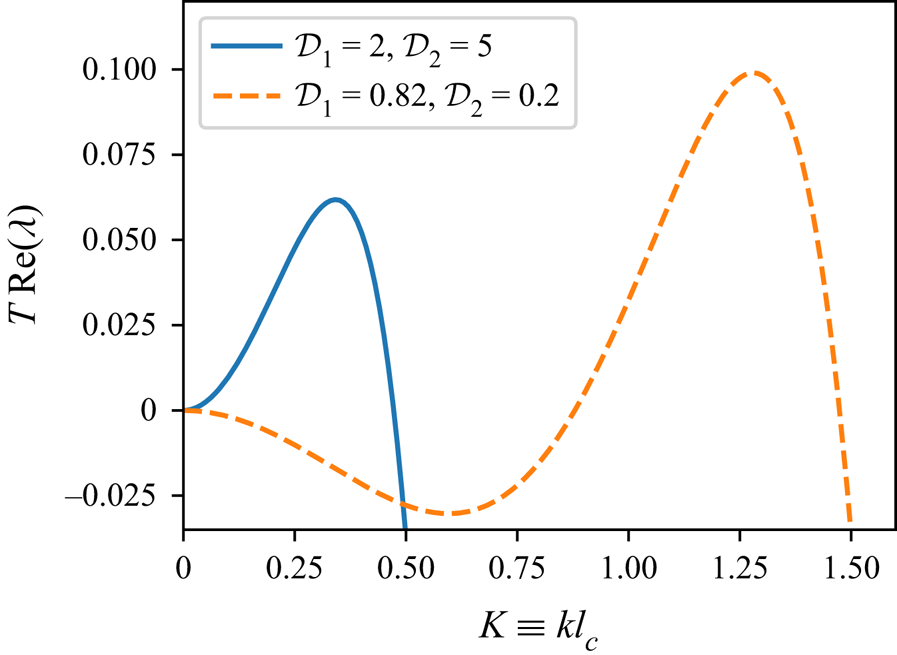
Figure 1 shows the growth rate (3.5) for two sets of dynamo numbers. We see that depending on the parameters, the growth rate may peak at large scales or at small scales.
The mode growth rate ( $T\operatorname {Re}(\lambda )$, (3.5)) as a function of the wavenumber for two combinations of
 $\mathcal {D}_1$ and
 $\mathcal {D}_2$.

To understand the qualitative behaviour of (3.5), we can schematically write it as
 \begin{equation} \operatorname{Re}(\lambda) =\begin{cases} - k^2 - k^4 - k^6 - k^8 ; & \mathcal{D}_2 > 1,\, \mathcal{D}_1 < 1\\ - k^2 + k^4 - k^6 - k^8 ; & \mathcal{D}_2 < 1,\, \mathcal{D}_1 < 1 \\ k^2 + k^4 - k^6 - k^8 ; & \mathcal{D}_2 < 1,\, \mathcal{D}_1 > 1 \\ k^2 - k^4 - k^6 - k^8 ; & \mathcal{D}_2 > 1,\, \mathcal{D}_1 > 1. \end{cases} \end{equation}
In the first case,  $\operatorname {Re}(\lambda )$ is always negative, and so there is no dynamo. In the last two cases,
 $\operatorname {Re}(\lambda )$ is positive for small
 $k$ and becomes negative for large wavenumbers. In the second regime, it seems to be difficult to say anything concrete (depending on the values of the coefficients, one can either have growth in a range of wavenumbers or growth nowhere).
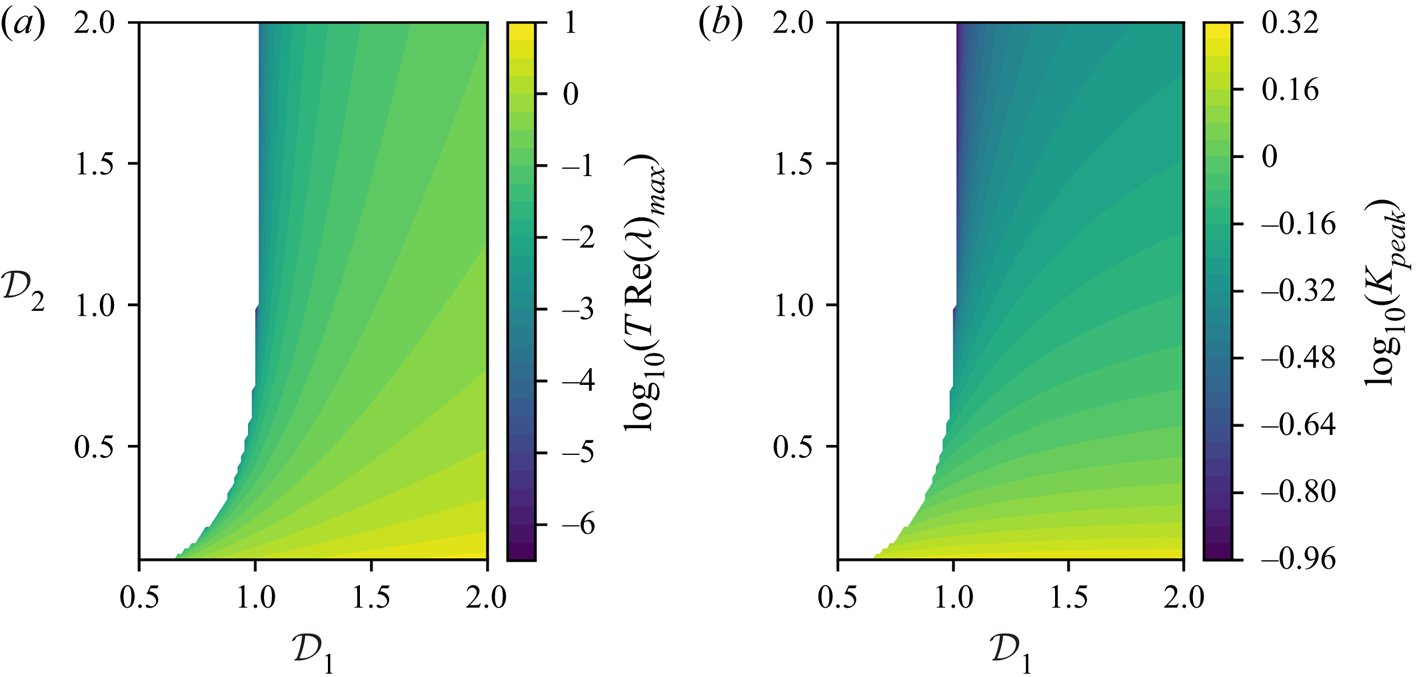
Since (3.5) is a polynomial in  $K$, one can easily solve for its extrema. In figure 2, we show the dynamo growth rate (where positive) and the wavenumber of the resulting large-scale field, as a function of
 $\mathcal {D}_1$ and
 $\mathcal {D}_2$.
(a) The peak growth rate ( $T\operatorname {Re}(\lambda )$, (3.5)). In the white regions, the growth rate is negative for all
 $K$. (b) The wavenumber (
 $K$) at which the growth rate peaks. Recall that, for a mode with wavelength
 $l_c$, the wavenumber would be
 $K=2{\rm \pi} \approx 10^{0.8}$.

If we drop the terms of order  $K^6$ and
 $K^8$ in (3.5) (this does not change the qualitative behaviour when
 $\mathcal {D}_2 > 1$), we can estimate that if
 $\mathcal {D}_1 > 1$, the growth rate attains a maximum value at
 $K_{peak}$, where
 \begin{equation} K_{peak} \approx \sqrt{ \frac{9 \left(\mathcal{D}_1 - 1\right)}{8 \mathcal{D}_1 \left(\mathcal{D}_2-1\right)} } ,\quad \left[T \operatorname{Re}(\lambda) \right]_{max} \approx \frac{9 \left(\mathcal{D}_1 - 1\right)^{2}}{16 \mathcal{D}_1 \left(\mathcal{D}_2 - 1\right)}. \end{equation}
Broadly speaking, there are two kinds of regimes in which the dynamo is excited. One,  $\mathcal {D}_1 > 1$, corresponds to the fluctuations being strong enough that the effective diffusivity itself becomes negative (but the growth itself is still cut off at small scales due to higher-order terms). The other,
 $\mathcal {D}_2 < 1$ (with
 $\mathcal {D}_1$ also
 $< 1$), corresponds to growth with the effective diffusion remaining positive; one can see, however, from figure 2 that this growth happens at smaller scales than in the other regime (but may still be at scales larger than
 $l_c$). While
 $\mathcal {D}_2 \ll 1$ can formally lead to growing solutions regardless of the value of
 $\mathcal {D}_1$, the growth then occurs at scales
 $\lesssim l_c$.
4. The effect of anisotropy
Although we have not done so in the above, it seems natural to assume that the temporal correlation function  $S$, that appears in (2.10b), is even. This would allow one to take
 $\int _{-\infty }^\infty S(t) \, \mathrm {d} t = 1$ and define the correlation time of
 $\eta$ as
 $\tau _\eta \equiv \int _{-\infty }^\infty \left |t\right | S(t) \, \mathrm {d} t$.
Because  $\mu$ is a scalar, assuming its double correlation is invariant under time reversal immediately implies
 $\tilde {Q}(\boldsymbol {k}) = \tilde {Q}(-\boldsymbol {k})$. We then conclude that
 \begin{equation} A^{(1)}_i = A^{(3)}_i = h(\boldsymbol{k}) = 0, \end{equation}
when the fluctuations of  $\eta$ are separable, homogeneous, stationary and time-reversal invariant; this holds even without assuming that the fluctuations of
 $\eta$ are isotropic! We now study the dynamo assuming the double correlation of
 $\mu$ is time-reversal invariant and anisotropic.
Let us choose the coordinate axes  $1,2,3$ to be along the principal axes of the matrix
 $\boldsymbol{\mathsf{A}}^{(2)}$ (defined in (2.20a–d)), with the corresponding eigenvalues being
 $-a_1$,
 $-a_2$ and
 $-a_3$ (such that
 $a_1 \geq a_3 \geq a_2$). By analogy with (3.4a–e), one can define the correlation length along each axis as
 $l_c^{(i)} \equiv \sqrt {A^{(0)}/a_i}$. It is physically reasonable to assume
 $Q(\boldsymbol {\xi })$ attains a local maximum at the origin, and that its correlation length is finite. This means
 $a_1, a_2, a_3 > 0$.
Analogous to (3.4a–e), we define
 \begin{equation} \mathcal{D}_1 \equiv \frac{9 a_3}{8 \bar{\eta} } ,\quad \mathcal{D}_2 \equiv \frac{81 \tau_\eta a_3^2 }{32 A^{(0)} } ,\quad l_c \equiv \sqrt{ \frac{ A^{(0)} }{ a_3 } } ,\quad \boldsymbol{K} \equiv \boldsymbol{k} l_c ,\quad T \equiv \frac{l_c^2}{\bar{\eta} }. \end{equation}
We also define the new quantities
 \begin{equation} \chi_1 \equiv \frac{a_1}{a_3} - 1 ,\quad \chi_2 \equiv 1 - \frac{a_2}{a_3} ,\quad n_1 \equiv \frac{ \left|K_1\right| }{K} ,\quad n_2 \equiv \frac{ \left|K_2\right| }{K}, \end{equation}
and a modified dynamo number
 \begin{equation} \tilde{\mathcal{D}}_1 \equiv \mathcal{D}_1\left[ 1 + \frac{\chi_1}{9} ( 2 + 3 n_1^2 ) - \frac{\chi_2}{9} ( 2 + 3 n_2^2 ) \right]. \end{equation}
Since  $0 \leq \chi _2 < 1$,
 $0 \leq \chi _1 < \infty$ and
 $0 \leq n_1, n_2 \leq 1$, we find that
 $\tilde {\mathcal {D}}_1 > 0$. We write
 $g(\boldsymbol {k})$ (2.23) as
 \begin{equation} T g(\boldsymbol{k}) = \tilde{\mathcal{D}}_1 K^2 + \frac{4\mathcal{D}_1}{9} \, K^4 . \end{equation}
Noting that  $\tau _\eta /T = 4\mathcal {D}_2/(9\mathcal {D}_1)$, one can substitute (4.5) in (2.32) to obtain the following expression for the growth rate:
 \begin{equation} T \operatorname{Re}(\lambda) = K^{2} (\tilde{\mathcal{D}}_1 - 1) + \frac{ 4\mathcal{D}_1 K^{4} }{9} \left(1 - \frac{\mathcal{D}_2 \tilde{\mathcal{D}}_1^{2} }{ \mathcal{D}_1^2 }\right) - \frac{32 \mathcal{D}_2 \tilde{\mathcal{D}}_1 K^{6}}{81} - \frac{64 \mathcal{D}_1 \mathcal{D}_2 K^{8}}{729} . \end{equation}
As expected, this reduces to (3.5) on setting  $\tilde {\mathcal {D}}_1 = \mathcal {D}_1$. Replacing
 $\mathcal {D}_1 \to \tilde {\mathcal {D}}_1$ and
 $\mathcal {D}_2 \to \mathcal {D}_2 \tilde {\mathcal {D}}_1^{2}/\mathcal {D}_1^2$, our comments in § 3 on the qualitative behaviour of (3.5) also apply to this equation. Unlike in the isotropic case, the growth rate now depends on the direction of
 $\boldsymbol {K}$ through the direction cosines
 $n_1$ and
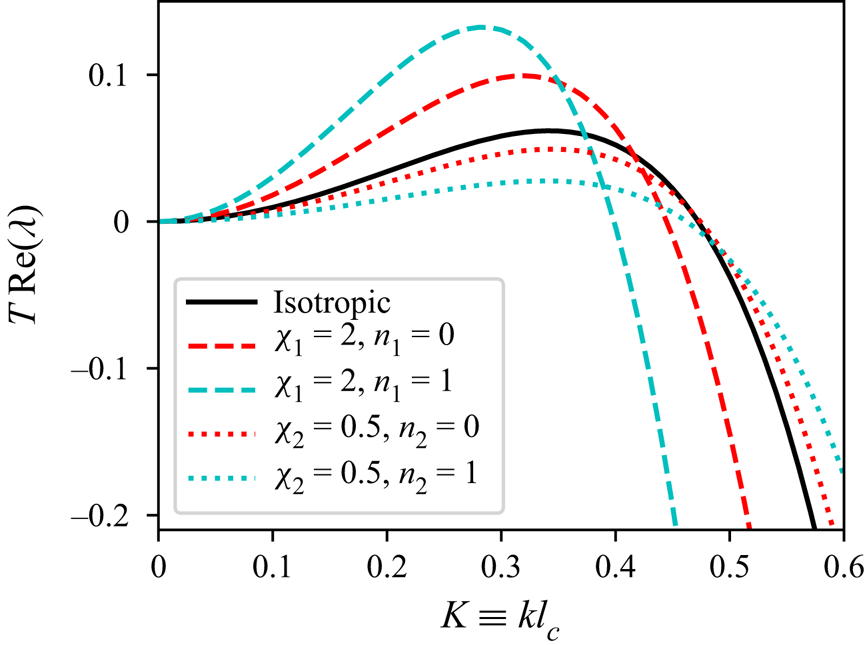
 $n_2$. Figure 3 shows the growth rate as a function of the wavenumber for various parameter values.
The mode growth rate ( $T\operatorname {Re}(\lambda )$, (4.6)) as a function of the wavenumber. In all the cases, we have taken
 $\mathcal {D}_1 = 2$ and
 $\mathcal {D}_2 = 5$. Other parameters not mentioned in the legend have been set to zero.

5. Suppression of turbulent diffusion
Neglecting terms with more than two spatial derivatives of  $\langle \boldsymbol {B} \rangle$, (2.31) can be written as
 \begin{align} \frac{\partial}{\partial
t} \langle \tilde{\boldsymbol{B}}(\boldsymbol{k}) \rangle
&={-} \bar{\eta} k^2 \langle
\tilde{\boldsymbol{B}}(\boldsymbol{k}) \rangle -
\frac{1}{8} ( 3 k_mk_n {\mathsf{A}}^{(2)}_{mn} + 2 k^2
{\mathsf{A}}^{(2)}_{mm} ) \langle
\tilde{\boldsymbol{B}}(\boldsymbol{k}) \rangle\nonumber\\
&\quad + \frac{{\rm i}}{8} \, k_m A^{(3)}_m \langle
\tilde{\boldsymbol{B}}(\boldsymbol{k}) \rangle +
\frac{\tau_\eta }{64} \, k_m k_i A^{(3)}_m A^{(3)}_i
\langle \tilde{\boldsymbol{B}}(\boldsymbol{k}) \rangle +
O(k^3) .
\end{align}
Following the reasoning used in § 4 for  $\tilde {\mathcal {D}}_1$, one can see that the coefficient of
 $\langle \tilde {\boldsymbol {B}}(\boldsymbol {k}) \rangle$ in the second term above is always positive as long as the spatial correlation function of the
 $\eta$-fluctuations attains a maximum at zero separation; the turbulent diffusion is suppressed. This can be seen more clearly in (2.24), which assumes a particular form for the spatial correlation function. The third term just describes advection with an effective velocity
 $\boldsymbol {A}^{(3)}/8$, analogous to ‘Moffatt drift’ (Moffatt Reference Moffatt1978, § 7.11). The fourth term can never be negative, and is non-zero only when the fluctuations of
 $\eta$ are anisotropic and not invariant under time reversal. As noted in § 3, the higher powers of
 $k$ neglected in (5.1) can cause growth of the large-scale magnetic field even when the effective diffusivity is positive. They also ensure that the growth rate becomes negative at small scales.
It may seem counter-intuitive that a dissipative term ( $\eta$) at the mesoscale leads to a dynamo at larger scales. However, it must be noted that, in addition to dissipation,
 $\eta$ also contributes an effective advection term (usually referred to as ‘turbulent diamagnetism’; see (2.2)) when spatial variations at the mesoscale are properly accounted for. Heuristically, it seems possible to explain the suppression of turbulent diffusion by turbulent diamagnetism as follows: turbulent diamagnetism causes the magnetic field to be preferentially concentrated in regions where the turbulent diffusivity is minimal. The effective turbulent diffusivity acting on the magnetic field is then less than what would be inferred by taking an average over the entire system. See Silant'ev (Reference Silant'ev1999, p. 49) for a more general explanation of reduced turbulent diffusion when two scattering mechanisms contribute to the diffusion process.
6. Estimates of the dynamo numbers
Unfortunately, fluctuations of the turbulent diffusivity in astrophysical systems are not sufficiently constrained by observations. The situation in the solar photosphere is comparatively better, as observations of granulation give us an idea of the order of magnitude of various quantities. To make crude estimates, we use (A1a,b), which assumes a specific form for the correlation function of  $\eta$.
Let us assume  $l_c = {3}\ {\rm Mm}$ (peak of the granulation's power spectrum as observed by Roudier & Muller Reference Roudier and Muller1986, figure 2) and
 $\tau _\eta = {400}\ {\rm s}$ (granule lifetime measured by Bahng & Schwarzschild Reference Bahng and Schwarzschild1961). The turbulent diffusivity in the photosphere is a scale-dependent quantity, which is moreover not very well constrained (Abramenko et al. Reference Abramenko, Carbone, Yurchyshyn, Goode, Stein, Lepreti, Capparelli and Vecchio2011, figure 10). For the length scales of interest, it is not unreasonable to take
 $\bar {\eta } = {600}\ {\rm km}^2\ {\rm s}^{{-1}}$. Let us also assume
 $f=0.1$ (
 $\,f \equiv \langle \mu ^2\rangle /\bar {\eta }^2$). We then find
 $\mathcal {D}_1 \approx 6\times 10^{-3}$ and
 $\mathcal {D}_2 \approx 4\times 10^{-4}$. These estimates appear to rule out the operation of such a dynamo in the solar photosphere. However, we note that assuming slightly different values of
 $l_c$ and
 $\tau _\eta$ brings the dynamo numbers to within the regime where a large-scale field can be generated; for example, taking
 $l_c = {300}\ {\rm km}$ and
 $\tau _\eta = {900}\ {\rm s}$ gives us
 $\mathcal {D}_1 \approx 1.4$ and
 $\mathcal {D}_2 \approx 18$. The dynamo numbers are also affected by uncertainties in
 $f$. Further, anisotropy can have a significant effect on the growth rates. Better estimates of the dynamo numbers would require measurements of the spatio-temporal correlation and strength of fluctuations of the turbulent diffusivity (or the kinetic energy) in the solar photosphere.
7. Conclusions
We have used a double-averaging procedure and found that just like helicity fluctuations, fluctuations of the turbulent kinetic energy can drive the growth of a large-scale magnetic field. While Silant'ev (Reference Silant'ev1999, p. 49) has also reported that spatio-temporal fluctuations of the turbulent kinetic energy reduce the effective turbulent diffusion, we are not aware of any detailed studies of this effect that consistently account for the concomitant spatial gradients.
In the white-noise limit, we have found that  $\eta$-fluctuations cause a reduction in the overall turbulent diffusion (in agreement with previous work), while also contributing a drift term which does not affect the growth of the field. We have then explored effects of non-zero correlation times and found the possibility of growing mean-field solutions despite the overall turbulent diffusion remaining positive. When the fluctuations are isotropic, the growth rate of a particular Fourier mode of the large-scale magnetic field depends on the magnitude of its wavevector and on two dynamo numbers. Anisotropy leads to a dependence on, among other things, the direction of the wavevector.
We have studied the conditions under which this new dynamo can operate. However, the lack of precise estimates of the quantities involved makes it hard to conclusively rule out or support the resulting dynamo in various astrophysical scenarios.
Given the prevalence of shear in astrophysical systems, an obvious extension of the current work would be to study the implications, for a large-scale magnetic field, of fluctuations of the turbulent kinetic energy in a shearing background. Since inhomogeneities in the density and in the small-scale magnetic energy also give rise to pumping (Vainshtein & Kichatinov Reference Vainshtein and Kichatinov1983), we expect them to have effects similar to those described here.
Acknowledgements
We thank the anonymous referees for useful comments. We thank A. Elbakyan for facilitating access to scientific literature.
Funding
This research received no specific grant from any funding agency, commercial or not-for-profit sectors.
Software
Numpy (Harris et al. Reference Harris2020) and Matplotlib (Hunter Reference Hunter2007).
Declaration of interests
The authors report no conflict of interest.
Author contributions
K.G. and N.S. conceptualized the research, interpreted the results and wrote the paper. K.G. performed the calculations.
Appendix A. Dynamo numbers for a simple correlation function
To physically interpret  $\mathcal {D}_1$ and
 $\mathcal {D}_2$ (defined in (3.4a–e)), it is helpful to explicitly write them out for a specific functional form of
 $Q$ (see (2.10b)). We take
 \begin{equation} Q(\boldsymbol{\xi}) = C \exp\left( - \frac{ \left|\boldsymbol{\xi}\right|^2 }{2 l_c^2}\right) , \quad S(t) = \frac{1}{2\tau_\eta} \exp\left(- \frac{\left|t\right|}{\tau_\eta} \right), \end{equation}
which gives us
 \begin{equation} A^{(0)} = C > 0 ,\quad A^{(1)}_i = 0 ,\quad {\mathsf{A}}^{(2)}_{ij} ={-} \frac{C}{l_c^2 } \, \delta_{ij} ,\quad A^{(3)}_{i} = 0. \end{equation}
If we define
 \begin{equation} \tilde{\tau} \equiv \frac{\tau_\eta}{T} = \frac{\tau_\eta \bar{\eta} }{l_c^2} ,\quad f \equiv \frac{ \langle \mu^2\rangle }{ \bar{\eta}^2 }, \end{equation}
and use the fact that  $\langle \mu ^2\rangle = C/(2\tau _\eta )$ (recall that
 $\mu \equiv \eta - \bar {\eta }$), the dynamo numbers (3.4a–e) become
 \begin{equation} \mathcal{D}_1 \equiv \frac{9 f\tilde{\tau} }{4} ,\quad \mathcal{D}_2 \equiv \frac{81 f \tilde{\tau}^2 }{16} . \end{equation}
Note that, when  $\tilde {\tau }\to 0$,
 $\mathcal {D}_1$ remains constant, while
 $\mathcal {D}_2\to 0$. Here,
 $f$ represents the strength of the fluctuations of
 $\eta$, while
 $\tilde {\tau }$ is a scaled measure of their correlation time.
Appendix B. What if we did not have turbulent diamagnetism?
Instead of (2.2), let us consider the following expression for the EMF
 \begin{equation} \boldsymbol{\mathcal{E}} ={-} \eta \boldsymbol{\nabla}\times\boldsymbol{B} . \end{equation}
Equation (2.7) is then replaced by
 \begin{equation} \frac{\partial}{\partial t} \langle \tilde{\boldsymbol{B}}(\boldsymbol{k}) \rangle = \int\mathrm{d}\boldsymbol{p}\, \boldsymbol{k} \times [ \boldsymbol{p} \times \{ \langle \tilde{\eta}(\boldsymbol{k}-\boldsymbol{p}) \rangle\langle \tilde{\boldsymbol{B}}(\boldsymbol{p}) \rangle + \langle \tilde{\mu}(\boldsymbol{k}-\boldsymbol{p}) \,\tilde{\boldsymbol{b}}(\boldsymbol{p}) \rangle \} ] . \end{equation}
Equation (2.9) is replaced by
 \begin{equation} \frac{\partial \tilde{\boldsymbol{b}}(\boldsymbol{k}) }{\partial t} =\int\mathrm{d}\boldsymbol{p}\, \boldsymbol{k} \times [ \boldsymbol{p} \times ( \langle \tilde{\eta}(\boldsymbol{k}-\boldsymbol{p}) \rangle \tilde{\boldsymbol{b}}(\boldsymbol{p}) + \tilde{\mu}(\boldsymbol{k}-\boldsymbol{p}) \langle \tilde{\boldsymbol{B}}(\boldsymbol{p}) \rangle ) ] . \end{equation}
Equations (2.13) and (2.14) remain unchanged. Equation (2.17) becomes
 \begin{align} &\langle \tilde{\mu}(\boldsymbol{q},t) \tilde{\boldsymbol{b}}(\boldsymbol{k},t) \rangle\nonumber\\ &\quad = \int_{-\infty}^t \mathrm{d}\tau \exp({- \langle \eta\rangle k^2 \left(t-\tau \right)}) \, \boldsymbol{k} \times [ \left( \boldsymbol{k} + \boldsymbol{q} \right) \times \langle \tilde{\boldsymbol{B}}(\boldsymbol{k}+\boldsymbol{q}, \tau) \rangle ] \tilde{Q}\left( \boldsymbol{q} \right) S(t-\tau) . \end{align}
Assuming  $S(t) = \operatorname {\delta }(t)$ and plugging (B4) into (B2), we obtain the following evolution equation for the large-scale magnetic field:
 \begin{align} \frac{\partial}{\partial t} \langle \tilde{\boldsymbol{B}}(\boldsymbol{k}) \rangle &={-} \bar{\eta} k^2 \langle \tilde{\boldsymbol{B}}(\boldsymbol{k}) \rangle + \frac{1}{2} \int\mathrm{d}\boldsymbol{s} \, \tilde{Q}\left( \boldsymbol{s} \right) ( k^2 \delta_{ij} - k_i k_j ) s_j \boldsymbol{s} \boldsymbol{\cdot} \langle \tilde{\boldsymbol{B}}(\boldsymbol{k}) \rangle \nonumber\\ &\quad + \frac{1}{2} \int\mathrm{d}\boldsymbol{s} \, \tilde{Q}\left( \boldsymbol{s} \right) ( k^2 - \boldsymbol{k} \boldsymbol{\cdot} \boldsymbol{s} )^2 \langle \tilde{\boldsymbol{B}}(\boldsymbol{k}) \rangle. \end{align}
The second term on the right-hand side above is qualitatively different from any term present in (2.22); due to this term, the various components of the large-scale magnetic field may become coupled when the fluctuations of  $\eta$ are anisotropic. This equation (or its extension to the case of non-zero correlation time) may also be used to describe scenarios where the microscopic conductivity itself exhibits stochastic fluctuations. Pétrélis et al. (Reference Pétrélis, Alexakis and Gissinger2016) and Gressel et al. (Reference Gressel, Rüdiger and Elstner2023) have studied such systems.