Introduction
Section 106A was introduced in 2006 as an amendment to the New South Wales (NSW) Children and Young Persons (Care and Protection) Act 1998. The purpose of the amendment was primarily administrative as it allowed the Department of Family and Community Services (FaCS) to make a care application to the NSW Children's Court for a subsequent child and rely on a previous finding that a child had been removed and not restored to the same parents as the subject child. The subject child, given these circumstances, is then automatically assumed to be in need of care and protection. This in turn meant that the Department did not have to present new evidence to confirm that the new subject child, often a new born child, was actually in need of care and protection.
The Children's Court initially functioned on that assumption. A Supreme Court decision determined, however, that the condition met by section 106A does not constitute an independent ground for care proceedings (SB v Parramatta Children's Court (2007) NSWSC 1297, para. 47–50). This means that any care application made that relies on section 106A must also show one of the grounds for establishing care proceedings as specified in section 71(1) of the Act.
Section 71(1) provides:
-
• The Children's Court may make a care order in relation to a child or young person. If it is satisfied that the child or young person in need of care and protection for any reason including, without limitation any of the following:
-
○ There is no parent available to care for the child or young person as a result of death or incapacity or for any other reason.
-
○ The parent acknowledges that they have serious difficulties in caring for the child or young person and, as a consequence, the child or young person is in need of care and protection.
-
○ The child or young person has been, or is likely to be, physically or sexually abused or ill-treated.
-
○ Subject to subsection (2), the child or young person's basic physical, psychological or educational needs are not met, or are likely not to be met, by his or her parents or primary care-givers.
-
○ The child or young person is suffering or is likely to suffer serious developmental impairment or serious psychological impairment or serious psychological harm as a consequence of the domestic environment in which he or she is living.
-
○ In the case of a child who is under the age of 14 years, the child has exhibited sexually abusive behaviours and an order of the Children's Court is necessary to ensure his or her access to, or attendance at, an appropriate therapeutic service.
-
○ The child or young person is subject to a care and protection order of another Stare or territory that is not being complied with.
-
The Supreme Court decision confirms that section 106A has no detrimental effect on the rights of parents because FaCS is still required to produce evidence in regard to at least one of the grounds as in section 71(1).
The finding that a child is in need of care and protection is treated as a threshold issue and the finding must be made before the Court can review evidence to determine what plan for the future is in the best interest of the child. Section 71(1) allows FaCS to produce limited information about current causes for concern about the well-being and safety of a child or young person and gives the Department considerable flexibility in terms of what grounds might be specified. The Department is not limited to the grounds specified in section 71(1) because the grounds are ‘without limitation’.
In matters before the Court, there does not need to be proof of the need for child protection and there does not need to be a thorough examination of the evidence before a finding can be made. The lack of thorough examination of evidence is because the finding is a threshold issue only. The stage of Court proceedings which examine the potential outcomes for a child's future is where the evidence about the parent's child rearing capacities is reviewed. Legally, the decision about the finding of a need for care and protection may potentially be reversed later in the same Court proceedings (Re Alistair (2006) NSWSC 411, 83).
In addition to a presumption of inadequate or inappropriate parenting which arises because of the removal and lack of restoration of a previous child, section 106A obliges the Court to take into account historical material about the parent's child rearing capacity. In some instances, the Court may make a finding about the need for care and protection for the later child, even though section 106A does not apply because the case in relation to the older children has not yet been completed before the new child is born. This is based on a presumption that previous circumstances that arose in relation to the earlier child are likely to arise in relation to the later child even if they are not currently present.
The likelihood test has been considered in previous cases in NSW in the matter of Adam and Michael (2004) and in England in Re O and N (minors) (FC); In Re B (minor) (Case: Preliminary Hearing) (HC) (2003) UKHL18; Re H and R (minors) (Sexual abuse standard of proof [1996] AC 563). These decisions caution against deciding that a child is in need of care and protection only on the basis of a likelihood that they might have been abused or will be abused. Experience in the NSW Children's Court indicates that a decision may be made without evidence of abuse or potential abuse but with a finding that there is a likelihood that abuse may occur, as in the Matter of JR (2015). Even when section 106A is not applied, the evidence required to establish that a child is in need of care and protection can be minimal and it may be said that if the Department of FaCS brings a matter to Court, then regardless of the evidence or lack thereof, the finding will be that the child is in need of care and protection.
Such a situation is an argument that section 106A does not constitute a real detriment to parents in the Children's Court. Whether this is the situation is the focus of this study, which aims to examine the nature and outcomes of section 106A matters in a sample of cases drawn from Children's Courts in metropolitan Sydney.
A further compounding factor is that the rules of evidence do not apply in the Children's Court in NSW (Ainsworth & Hansen, Reference Ainsworth and Hansen2008, Reference Ainsworth and Hansen2010; Bayne, Reference Bayne2003). The consequence is that circumstantial evidence, hearsay, innuendo, rumour and misinformation can all be included in affidavit material submitted to the Court. In the 1987 review of the NSW child protection legislation (Parkinson, Reference Parkinson1987) recommendation 3.14 was that the rules of evidence should normally apply but the legislation when presented to Parliament did not follow the recommendation made by this review.
The Present Study
The motivation for this study was the observation by the authors of the use of section 106Â of the Children and Young Persons (Care and Protection) Act 1998 in cases in the NSW Children's Court. In over one-third of these cases, a child was ‘assumed into care’ by the FaCS under section 44 of the Act shortly after the hospital birth of the child. This is achieved by way of an alert notice that is placed on the mother's medical file by hospital staff when information is obtained while providing prenatal clinical services to the mother, who has had a child previously removed by FaCS from her care. Once the birth has taken place, FaCS are notified by hospital personnel and the assumption of care process is commenced unless FaCS decide that the mother is now considered an adequate parent. An assumption of care order prevents the child being removed from the hospital by either parent. The Department then places the child in temporary foster care and initiates a care application in the Children's Court citing section 106A in support of their application. Section 106A of the Act reads as follows:
106A Admissibility of certain other evidence
-
1. The Children's Court must admit in proceedings before it any evidence adduced that a parent or primary caregiver of a child or young person the subject of a care application:
-
(a) is a person:
-
(i) from whose care and protection a child or young person was previously removed by a court order under this Act or the Children (Care and Protection) Act 1987, or by a court of another jurisdiction under an Act of that jurisdiction, and
-
(ii) to whose care and protection the child or young person has not been restored, or
-
-
(b) is a person who has been named or otherwise identified by the coroner or a police officer (whether by use of the term ‘person of interest’ or otherwise) as a person who may have been involved causing a reviewable death of a child or young person.
-
-
2. Evidence adduced under subsection (1) is prima facie evidence that the child or young person the subject of the care application is in need of care and protection.
-
3. A parent or primary care giver in respect of whom evidence referred to in subsection (1) has been adduced may rebut the prima facie evidence referred to in subsection (2) by satisfying the Children's Court that, on the balance of possibilities:
-
(a) the circumstances that gave rise to the previous removal of a child or young person concerned no longer exist, or
-
(b) the parent or primary caregiver concerned was not involved in casing the relevant reviewable death of the child or young person, as the case may require.
-
-
4. This section has effect despite section 93 and despite anything to the contrary in the Evidence Act 1995.
-
5. In this section ‘reviewable death of a child or young person’ means a death of a child or young person that is reviewable by the Ombudsman under Part 6 of the Community Services Complaints, Review and Monitoring Act 1993.
Importantly, this amendment to the Act reverses the onus of proof whereby the parents of a child now have to rebut evidence that their child is in need of care and protection rather than the Department of FaCS having to present evidence in order to establish this fact. This change in the onus of proof was opposed by the NSW Law Society and the NSW Bar Association. This advice was ignored and the Department obtained Parliamentary approval for this change.
Research Design
Method
Data was collected from reading court files. Permission to proceed with the study was given to the researchers by the President of the NSW Children's Court.
Court files consist of a bench sheet on which a magistrate enters in abbreviated form the date of each court event, the nature of the event and the court outcome plus the date of the next court event and what is to be dealt with on that occasion. The magistrate also enters on the bench sheet the names of the lawyers representing the parents i.e. mother and father of the child, generally separately, the independent or direct legal representative for the child as well as the name of the lawyer who is acting for FaCS. Should there be other parties to the case this will be noted along with the name of the lawyer acting for them.
The file will include a copy of the department's initiating application for an interim care order together with supporting affidavits from the department caseworker responsible for the case. It may include a Children's Court clinic parenting assessment if this has been authorised by the court. If records in relation to the parents of the child have been obtained from the police, health authority or education services these will be in the file. The final departmental documents are likely to be a departmental Care Plan and a draft order setting out the orders, possibly with the undertaking the department is seeking from the court.
The file will also contain affidavit materials submitted by the parents and any supporting documents they regard as relevant, such as character references. If a Guardian ad Litem (GAL) has been appointed for a parent because of intellectual disability or mental illness, a copy of that order will be in the file together with any affidavit material the GAL may have filed on behalf of a parent. In that respect, the court file should contain a copy of all the documents that will be relied upon in the case. If there are other parties to the case, such as grandparents, then their joinder application and any affidavit material that they have submitted to the court to support this application will also be in the court file.
Sample
During the period January–August 2015 files from the three Sydney metropolitan Children's Courts at Glebe, Campbelltown and Parramatta were read by one of the researchers. The files covered all cases that were finalised by the respective courts during the period 1 July and 31 December 2013. This constituted 48 cases at Bidura, 64 cases at Campbelltown and 46 cases at Parramatta, a total of 158 cases. The final sample was 136 because 22 cases had to be removed from the study sample because they involved legal action other than an initial care application. The data was analysed using Statistical Package for the Social Sciences (SPSS) version 23.
Limitations
The limitation of this sample is that it is not statewide and therefore any conclusions cannot be generalised to all 106A cases in NSW. A further limitation is that only one researcher read each file, whereas in some studies files are read by more than one person as a way of ensuring the accuracy of data extracted from files.
Ethics
Permission was given by the President of the NSW Children's Court for access to Court files. No identifying data was collected. All text was recorded in categorical form to allow for statistical analysis.
Data collection
As part of the file reading exercise, a pro-forma data sheet was completed for each case. The data consisted of information about the parents, the subject child and the case outcome.
This included the parents' ages and ethnicity, date of removal/assumption of care of the subject child, place of removal, date of Children's Court initiating care application, data about the parents' legal representation (separately for the subject child's mother and father), date of final hearing, reliance on section 106A. Data about the parents' circumstances included residential address, type of accommodation, occupation and income source (separately for the subject child's mother and father). In addition, data about intellectual disability, physical disability, mental health, substance abuse, domestic violence, criminal history, homelessness and number of children previously removed was extracted from the Court files, again separately for the mother and father of the child.
Also collected were details of children previously removed from either the mother or father of the subject child including age and gender and, if known, their current placement type.
Finally, the legal outcome of the case was recorded. These could include restored to parent/s, not restored to parent/s, kinship care, supervision order, undertakings, parent responsibility contract, parental responsibility to the Minister and contact arrangement (separately for the mother and father), if the subject child was not restored to the parents.
Data analysis
The data was entered into SPSS files and analysed using both descriptive and, where possible, inferential statistical techniques. The later was a chi-square test. This is the standard test used to calculate whether there is a relationship between two nominal variables (Pallant, Reference Pallant2013; Sarantakos, Reference Sarantakos2005).
Results-Descriptive Data
Demographic data relating to the study sample is provided in the following tables.
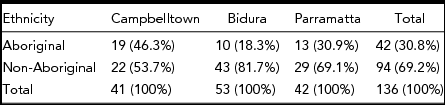
The study sample was made up of Aboriginal and non-Aboriginal families.Table 2 reports on the composition of the sample by Court venue. Aboriginality and non-Aboriginality is used in the analysis of this data as this information has to be entered on the Children's Court care application form. This is so that the Court pays attention to Section 13 of the Act in regard to the Aboriginal and Torres Strait placement principles. No other ethnicity data is systematically collected.
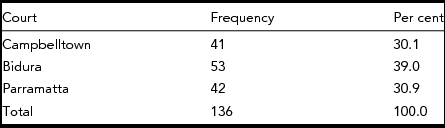
Number of study cases by children's court.

Ethnicity by children's court.

Table 2 shows that in this study 30.8% of the cases involved Aboriginal parents.
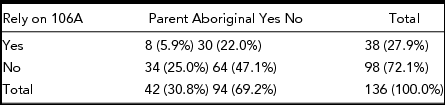
Table 3 details the reliance on section 106A by Aboriginality and non-Aboriginality. It also indicates that only eight (5.9%) of cases that relied on s106A of the Act related to Aboriginal parents even though 42 (30.8%) of cases in this sample involved Aboriginal parents.
Rely on s106A by Aboriginality and non-Aboriginality.

Table 4 reports the place of removal by Aboriginality and non-Aboriginality. This table shows that the most common place of removal of a child from parental care was ‘Hospital’ (52 cases out of 136). Aboriginal parents represent 15 (11.2%) of this total.
Place of child removal by Aboriginality and non-Aboriginality.

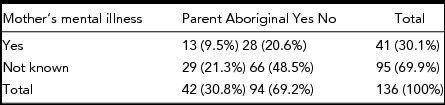
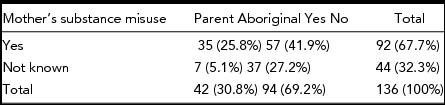
The next two tables (Tables 5 and 6) refer to mother's mental illness and substance misuse, matters that are frequently featured in cases before the Children's Court. Mother's mental illness 13 (9.5%) and substance misuse 35 (25.8%) were factors in a number of cases involving Aboriginal parents.
Mother's mental illness by Aboriginality and non-Aboriginality.

*Does not sum due to rounding.
Mother's substance misuse by Aboriginality and non-Aboriginality.

In a similar manner, Table 6 reports data in relation to mother's substance misuse.
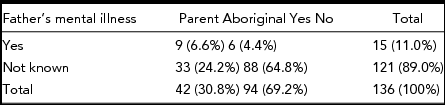
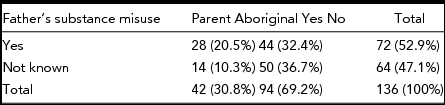
The next two tables (Tables 7 and 8) refer to father's mental illness and substance misuse matters, as mentioned earlier, that often feature in cases before the Children's Court. Father's mental illness 9 (6.6%) and substance misuse 28 (20.5%) was a factor in a number of cases.
Father's mental illness by Aboriginality and non-Aboriginality.

Father's substance misuse by Aboriginality and non-Aboriginality.

*Does not sum due to rounding.
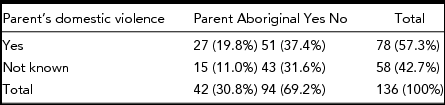
The incidence is higher in non-Aboriginal families 51 (37.4%) than in Aboriginal families 27 (19.8%) in this sample. Table 9 reports the incidence of domestic violence by Aboriginality (19.8%) and non-Aboriginality (37.4%) in the sample.
Parent's domestic violence by Aboriginality and non-Aboriginality.

*Does not sum due to rounding.
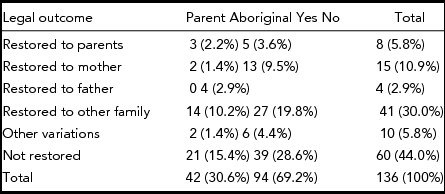
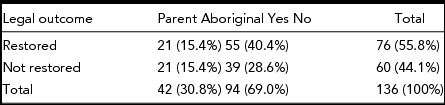
Tables 10 and 11 focus on the legal outcomes and restoration of children to family or kinship care in accordance with s10A of the Care Act. Table 11 reports on the type of restoration (i.e. parent or kin) that was achieved.
Legal outcome by Aboriginality and non-Aboriginality.

*Does not sum due to rounding.
Restoration by Aboriginality and non-Aboriginality.

*Does not sum due to rounding.
Table 11 summaries this data in terms of restoration achieved by Aboriginality and non-Aboriginality. Restoration occurred in 21 (15.4%) of the 42 cases involving Aboriginal parents. For Non-Aboriginal parents, the number was 55 (40.4%) out of 94 cases.
Other restorations may occur at a later point under s90 (Rescission or variation of care orders) of the Act. An application under this section of the Act can be made by either parents, the Department or other specified parties. In a study of 117 s90 applications made in the 12 months 1 May 2006 to 30 April 2007, the findings show that the Department was the most successful applicant with parents succeeding in regaining custody of their child in less than 10% of the cases (Hansen, Reference Hansen2012). The s90 study sample was drawn from the same Children's Courts as the current study, however, the data from this earlier study was not analysed by Aboriginality or non-Aboriginality.
Additional Statistical Analysis
In this sample, 27 (19.9%) of the 136 cases involved the restoration of a child or children to one or both patents and 41 (30.1%) being restored to other family members. In 60 (44.1%) cases, there was no restoration to parents or kin. Another eight (5.9%) were not attributable to either restoration or not.
Restoration
For purposes of analysis, a new variable ‘restoration or not’ was created by combining restoration to parents and restoration to other family members (ignoring Aboriginality) and classifying all these cases as restoration. A further variable that was created was in regard to the Act as ‘106A or not’.
A chi-square test for independence indicated a significant association between the use of 106A and restoration to family, χ 2 (1, n = 136) = 7.755, p = .0005. That is to say that if 106A is cited in Court document, restoration of a child to family is less likely. This was the studies only significant finding. A chi-square test was also conducted in relation to parent characteristics and restoration to family or not. Parent characteristics such as mental illness, substance abuse, domestic violence or criminal history did not produce any significant associations with the outcome ‘restoration to family’.
Court Location and Restoration
A final chi-square test was computed to see if cases from a particular Court (Bidura, Campbelltown or Parramatta (see Table 1)) were associated with restoration to family. There was no significant association between these two variables, χ 2 (2, n = 136) = 5.585, p = .06.
Finally, the analysis did not show any significant relationship between Aboriginality and any of the variables that were examined.
Discussion
Given that in NSW at 30 June 2015, there were 6210 Aboriginal children in out-of-home care by comparison to 10,631 non-Aboriginal children (AIHW, 2016, Table 5.4), a question that might be asked about these findings is – of the children restored, albeit predominantly to extended family rather than to parents, following the assumption of care of a child by the Department, why were only 21 children restored to Aboriginal parents whereas 55 children were restored to non-Aboriginal parents (see Tables 10 and 11). It might be thought that this is evidence of judicial bias about restoring children to Aboriginal parents. In this study, we did not collect case data that would allow us to examine this issue in detail. Given that the data was collected from three different Children's Courts where numerous magistrates hear cases and where cases are decided on individual merit, it seems unlikely that the results reported in this study point to any such bias.
The almost total absence of information about parental occupations, type of family accommodation and level and source of income in the demographic section of the study is alarming. In child protection cases, FaCS presents to the court firstly an initiating application, with supporting affidavit materials and eventually a care plan that sets out how permanency will be achieved for a child. None of the FaCS documents contained in the files read for this study contained this information. Yet, a recent study for the Joseph Rowntree Foundation in England provides important evidence of a high correlation (not a causal relationship) between parental poverty and child abuse and neglect that the Department appears to want to ignore (Bywaters et al., Reference Bywaters, Bunning, Davidson, Hanratty, Mason, McCartan and Steils2016). Confirming this view was postcode data in the files that indicated most parents in these cases lived in an area of significant social disadvantage, yet, the court was not provided with this information. Such disadvantage, may be a product of living in a toxic public housing environment, being long-term unemployed and relying on income support from Centrelink. Such factors, when clustered together, make for an environment that is unsupportive of positive parenting and may contribute to child abuse and neglect (Bywaters et al., Reference Bywaters, Bunning, Davidson, Hanratty, Mason, McCartan and Steils2016; Ghate & Hazel, Reference Ghate and Hazel2002, Weatherburn & Lind, Reference Weatherburn and Lind2001). As a result, the life circumstances of parents are not examined or considered when judgments are made about the future of a child. In fact, the lives of parents are decontextualised and they are held individually accountable for circumstances that are beyond their control.
In addition, a Children's Court clinic assessment of parenting capacity and a parent's ability to change their parenting practises (Miller & Rollnick, Reference Miller and Rollnick1991; Prochaska, DiCemente & Norcross, Reference Prochaska, DiCemente and Norcross1992) do not necessarily remedy this deficiency in accounting for socio-environmental issues.
Conclusion
Indeed, if growing up in foster care can be claimed as mitigating circumstances in criminal law cases when penalties are under consideration (Pollack, Eisenberg, & Sundarsingh, Reference Pollack, Eisenberg and Sundarsingh2012), then social disadvantage must also be accepted as a complex mitigating circumstance when parenting practises are being examined in civil child protection cases. It is essential that family assessments consider social factors that impact on the ability to safely parent a child, including illiteracy and not only on physical disability, mental health and drug misuse issues. This is especially so when child removal from parental care, an even greater penalty than a fine or loss of liberty, is under consideration.