INTRODUCTION
Among the Anomalodesmata Dall, 1889, the Septibranchia Pelseneer, 1888 comprises one of the most intriguing groups of pelecypods. These have developed a series of anatomical and conchological transformations toward a carnivorous and/or saprophagic lifestyle (Morton, Reference Morton1981). Unlike the other septibranchs, the members of the family Verticordiidae Stoliczka, 1871, have a less-muscularized ctenidium, more similar to the lamellibranch condition. In these animals, the adduction of the valves creates the pressure change needed to evert the inhalant siphon during prey capture (Morton, Reference Morton1987). This condition represents a transitional state between the lamellibranch anomalodesmatans and the more-specialized septibranchs of the families Cuspidariidae Dall, Reference Dall1886 and Poromyidae Dall, Reference Dall1886.
The verticordiids arose in the Paleocene (Runnegar, Reference Runnegar1974), probably in the Cretaceous (Harper et al., Reference Harper, Hide and Morton2000). This group occurs worldwide, but except for a few shallow-water species, its members are confined to the deep-sea benthos (Allen & Turner, Reference Allen and Turner1974; Prezant & Smith, Reference Prezant, Smith, Beesley, Boss and Wells1998), where they are not rare, and represent one of the most important taxa in abyssal ecosystems (Clarke, Reference Clarke1962).
Some authors (e.g. Bernard, Reference Bernard1979; Morton, Reference Morton1987) proposed a classification in which several thin-shelled edentate genera of Verticordiidae, e.g. Lyonsiella, Laevicordia and Policordia, were transferred to another family, the Lyonsiellidae Dall, 1895. This opinion was accepted by most recent authors (e.g. Poutiers & Bernard, Reference Poutiers, Bernard and Bouchet1995; Harper et al., Reference Harper, Hide and Morton2000; Dreyer et al., Reference Dreyer, Steiner and Harper2003; Morton, Reference Morton2003; Harper et al., Reference Harper, Dreyer and Steiner2006). In higher classifications, the Verticordiidae has been allocated to several different groups, within Poromyacea or Poromyoidea (e.g. Ridewood, Reference Ridewood1903; Thiele, Reference Thiele1935; Newell, Reference Newell1965; Allen & Morgan, Reference Allen and Morgan1981; Morton, Reference Morton1981), within Pandoracea (e.g. Runnegar, Reference Runnegar1974), or in its own superfamily, Verticordiacea or Verticordioidea (e.g. Bernard, Reference Bernard1974, Reference Bernard1979; Poutiers & Bernard, Reference Poutiers, Bernard and Bouchet1995; Prezant & Smith, Reference Prezant, Smith, Beesley, Boss and Wells1998; Coan et al., Reference Coan, Scott and Bernard2000; Morton, Reference Morton2003). All these authors based their opinions on morphological (anatomical and/or conchological) analyses. Dreyer et al. (Reference Dreyer, Steiner and Harper2003) and Harper et al. (Reference Harper, Dreyer and Steiner2006) added a molecular approach and concluded that the monophyly of the septibranchs is neither supported nor rejected. Nevertheless no new light was shed on the verticordiid situation.
The difficulties involved in collecting material from greater depths, in part explain the still significant number of unnamed species of septibranchs. Even considering the increasing number of reports on the hadal molluscs from the south-western Atlantic (e.g. Absalão et al., Reference Absalão, Miyaji and Pimenta2001, Reference Absalão, Caetano and Pimenta2003; Absalão & Santos, Reference Absalão and Santos2004; Absalão & Pimenta, Reference Absalão and Pimenta2005; Zelaya et al., Reference Zelaya, Absalão and Pimenta2006; Oliveira & Absalão, Reference Oliveira and Absalão2008; Pimenta et al., Reference Pimenta, Santos and Absalão2008), the septibranchs remain poorly known, with still fewer studies from Brazil (e.g. Marini, Reference Marini1974; Oliveira & Absalão, Reference Oliveira and Absalão2007, Reference Oliveira and Absalão2009; Simone & Cunha, Reference Simone and Cunha2008). This contribution is part of a continuing effort to fill the gaps in knowledge of the septibranchs, and reports the results of a taxonomic review of the family Verticordiidae from the Campos Basin, State of Rio de Janeiro, Brazil.
MATERIALS AND METHODS
One hundred and seventeen samples were taken on the continental slope off the State of Rio de Janeiro (22°S 41°W), at depths from 700 to 1950 m, between 2001 and 2003 as part of the programme ‘Environmental Characterization of Campos Basin, RJ, Brazil’ under the auspices of PETROBRAS S.A. The samples were taken with a 0.25 m2 box corer, from the RV ‘Astro-Garoupa’. Each sample was washed through a 0.5 mm2 mesh, and preserved in 70% ethanol. In the laboratory, the residues were examined under magnification and the molluscs picked out. Most of the shells were in a good state of preservation, but no live specimens were found.
Each species was examined and photographed under a scanning electron microscope (ZEISS EVO 40), at the Gerência de Bioestatigrafia e Paleoecologia Aplicada (BPA), of the Petrobrás Research Center (Centro de Pesquisas da Petrobrás—CENPES), and under a scanning electron microscope (JEOL–6390LV) at the Museu Nacional—Universidade Federal do Rio de Janeiro.
The generic characterization was adapted from several authors (e.g. Allen & Turner, Reference Allen and Turner1974; Rios, Reference Rios1994; Poutiers & Bernard, Reference Poutiers, Bernard and Bouchet1995; Simone & Cunha, Reference Simone and Cunha2008). The types of most species treated were examined, except in a few cases when the original illustration and/or description were sufficient to identify the taxon. The material is deposited in the Mollusca collection of the following institutions: Departamento de Zoologia, Instituto de Biologia, Universidade Federal do Rio de Janeiro (IBUFRJ) and Muséum National d'Histoire Naturelle, Paris (MNHN).
RESULTS
DESCRIPTION
Shell small to medium size, umbones central or prosogyrate, outline ovate to trapezoidal, well-marked anterodorsal indentation, usually with radial sculpture, teeth (when present) on right valve, rarely on left valve.
REMARKS
The Verticordiidae shows such strong affinities to the other septibranch families that some genera presently allocated to this family were originally assigned to other families (Soot-Ryen, Reference Soot-Ryen1966). Additionally, some authors have suggested the synonymy or the untenable genus-level of several genera (e.g. Jeffreys, Reference Jeffreys1881; Smith, Reference Smith1885; Soot-Ryen, Reference Soot-Ryen1966; Allen & Turner, Reference Allen and Turner1974; Poutiers & Bernard, Reference Poutiers, Bernard and Bouchet1995) consequently we seldom found the same status level for the generic classification when comparing two or more authors.
Table 1 summarizes the characters of Verticordiidae treated here.
General characters of the species of Verticordia and Spinosipella. H, height; L, length; dash line, absent.

GENERIC DESCRIPTION
Shell fragile, inflated, umbones prominent, prosogyrate, extending above a deep concavity formed by the indentation of the anterodorsal margin, outline usually cordiform, usually ornamented with radially oriented granules, pustules, or spines, often with several radial lines; concentric lines can also be present. Hinge plate usually with a cardinal tubercle on the right valve, occasionally with a posterior lateral tooth.
REMARKS
This genus was first proposed to accommodate a single fossil species, and soon gave rise to a long and confused taxonomic history (e.g. Seguenza, Reference Seguenza1860; Heilprin, Reference Heilprin1881; Jeffreys, Reference Jeffreys1881; Dall, Reference Dall1886; Fischer, Reference Fischer1887; Thiele, Reference Thiele1935; Grassé, Reference Grassé1960; Soot-Ryen, Reference Soot-Ryen1966; Allen & Turner, Reference Allen and Turner1974; Poutiers & Bernard, Reference Poutiers, Bernard and Bouchet1995). In a revision of the genus, Seguenza (Reference Seguenza1860) recognized only three species of Verticordia: V. cardiiformis (Sowerby, 1844), V. acuticostata Philippi, Reference Philippi1844, and a new species, V. granulata Seguenza, Reference Seguenza1860. Heilprin (Reference Heilprin1881) provided an extensive historical review of the genera Hippagus, Verticordia and Pecchiolia Meneghini, 1851 (non G.O. Sars, 1872), and suggested that Verticordia and Pecchiolia could be very closely related forms, although he found insufficient evidence to synonymize the two genera. Smith (Reference Smith1885), although he did not formally synonymize these taxa, used the name Verticordia instead of Pecchiolia. This opinion was not followed by Jeffreys (Reference Jeffreys1881), who stressed the use of Pecchiolia rather than Verticordia. Dall (Reference Dall1886), basing his opinion mainly on characters of the hinge, recognized the subgeneric status of Pecchiolia (non G.O. Sars, 1872), Verticordia s.s., Trigonulina, Euciroa, Haliris Dall, Reference Dall1886, and Lyonsiella M. Sars, 1872, and allocated these taxa to the genus Verticordia. Subsequently, Fischer (Reference Fischer1887) subdivided Verticordia into three sections—Verticordia s.s., Trigonulina d'Orbigny, 1846, Euciroa Dall, 1878—and one subgenus—Pecchiolia (non G.O. Sars, 1872). Nowadays, most of the taxa proposed by Dall (Reference Dall1886) are treated at genus level, and even allocated to separate families (Allen & Turner, Reference Allen and Turner1974; Poutiers & Bernard, Reference Poutiers, Bernard and Bouchet1995).
Poutiers & Bernard (Reference Poutiers, Bernard and Bouchet1995) and Allen (Reference Allen2008) recognized seven Verticordia species from the Atlantic Ocean: V. granulifera (Verrill, 1885); V. quadrata Smith, Reference Smith1885; V. woodii Smith, Reference Smith1885; V. perversa Dall, Reference Dall1886; V. seguenzae Dall, Reference Dall1886; V. triangularis Locard, 1898 (as Vertambitus triangularis in Poutiers & Bernard (Reference Poutiers, Bernard and Bouchet1995), but treated as Verticordia by Allen (Reference Allen2008)), and V. guineensis Thiele, 1931. Of all of these species, only V. woodii is recorded from Brazil.
Although Knudsen (Reference Knudsen1982) and Poutiers & Bernard (Reference Poutiers, Bernard and Bouchet1995) treated Cuspidaria monosteira Dall, 1890 as a member of Verticordia, this species is considered here in its original combination. The presence of a rostrum at the posterior margin and two radial keels, as well as the absence of a lunule (erroneously reported as present by Knudsen (Reference Knudsen1982)) do not support the allocation of this species to the genus Verticordia. Similarly, Verticordia ornata (d'Orbigny, 1853) and Verticordia fischeriana Dall, 1881, recorded for Brazil by Marini (Reference Marini1974) and Rios (Reference Rios1994), are considered here, following Poutiers & Bernard (Reference Poutiers, Bernard and Bouchet1995), in other combinations: Trigonulina ornata d'Orbigny, 1853, because of the presence of a series of prominent radial ribs and the crenulation of the posteroventral margin; and Haliris fischeriana (Dall, 1881), because of the presence of a series of small radial ribs, equally spaced over the entire shell. All of these taxa are not compared against our species of Verticordia. The Brazilian records of a third species V. acuticostata (Philippi, Reference Philippi1844), by Marini (Reference Marini1974) and Rios (Reference Rios1994), are misidentifications, and will be discussed below.
(1) Verticordia woodii Smith, Reference Smith1885. External view, left valve. Holotype BMNH. (2–4) Verticordia woodi Smith, Reference Smith1885, IBUFRJ 18064. (2) External view, left valve; (3) hinge detail, left valve; (4) external surface detail. (5) Verticordia quadrata Smith, Reference Smith1885. External view, left valve. Holotype BMNH 1887.2.9.2743. (6–9) Verticordia quadrata Smith, Reference Smith1885. (6) External view, left valve, IBUFRJ 18077 (the figure was mounted from two different photographs); (7, 8) hinge detail, left (IBUFRJ 18077) and right valve (IBUFRJ 18067), respectively; (9) external surface detail IBUFRJ 18077. Scale bars: Figure 9: 50 µm; Figure 4: 100 µm; Figures 7–8: 1 mm; Figures 2–3, 5–6: 2 mm; Figure 1: 4 mm.

DESCRIPTION
Shell fragile, brown, large (height 3–10.5 mm, length 3–11 mm), inequivalve, right valve slightly bigger than left valve, inequilateral, very inflated, umbones large, outline somewhat rounded. Dorsal margins almost straight, posterodorsal margin gently curved downwards, anterior and posterior margins merging slightly, with a rounded ventral margin. Ornamented externally with approximately 30 fine, raised, axial threads that intercalate with sets of 7–10 closely set radiating series of delicate spines, which extend over the entire shell. Each spine is a polyhedral column that tapers toward its distal end, which bears a stellate, usually hexagonal, structure. A few, hardly visible growth lines can be present. Internally, ornamented with indistinct radial striation, not an exterior sculpture showing through the shell. Hinge of left valve with a thickened hinge plate, placed anteriorly to the umbo; posteriorly a very small thickened projection lies just above a deep groove, which is visible only when the shell is strongly inclined; hinge plate of right valve strong, with a small socket that receives the projection of the left valve. Anterior muscle scar well marked; posterior muscle scar and pallial line less evident.
TYPE LOCALITY
Smith, Reference Smith1885: HMS ‘Challenger’ Station 122 (off Pernambuco, Brazil, 640 m); Station 24 (off Culebra Island, West Indies, 713 m).
GEOGRAPHICAL RANGE
Atlantic Ocean: north-western Atlantic (Poutiers & Bernard, Reference Poutiers, Bernard and Bouchet1995); Gulf of Mexico and West Indies (Smith, Reference Smith1885; Abbott, Reference Abbott1974; Rios, Reference Rios1994). South-western Atlantic: Brazil, off Pernambuco (Smith, Reference Smith1885; Rios, Reference Rios1994), off Campos Basin, Rio de Janeiro (present study). Bathymetry: from 180 m (Poutiers & Bernard, Reference Poutiers, Bernard and Bouchet1995) to 1938 m (Abbott, Reference Abbott1974).
MATERIAL EXAMINED
IBUFRJ 18063 (22°26′28″S 39°58′53″W, 1050 m), 20.VI.03 (2 valves); IBUFRJ 18064 (21°52′51″S 39°48′12″W, 1350 m), 26.VI.03 (1 valve); IBUFRJ 18065 (22°38′01″S 40°17′26″W, 900 m), 18.V.02 (1 valve); IBUFRJ 18096 (22°31′28″S 40°03′50″W, 1050 m), 19.XI.02 (3 valves); IBUFRJ 18097 (22°04′32″S 39°54′11″W, 750 m), 30.VI.03 (1 valve).
REMARKS
The original illustration of V. woodii (Smith, Reference Smith1885, figures 7 & 7b) does not adequately represent this species. Smith's figure shows an umbo projecting above the posterodorsal margin and a slight indentation of the posteroventral margin; these features are not present in the holotype (Figure 1).
Although V. woodii shows the typical cordiform outline of Verticordia, this species has a set of features that easily distinguishes it from the other congeners from Brazil. It has a deep posterior groove that is visible only by inclining the view of the hinge; a strongly marked anterior muscle scar, visible even with the naked eye; and, although less evident, a distinct posterior muscle scar and pallial line. Additionally, our specimens show a gradient of convexity that is more pronounced in larger individuals.
DESCRIPTION
Shell white, large (height 0.8–7 mm, length 0.6–8 mm), inequivalve, right valve slightly bigger than left valve, inequilateral, very inflated, umbones large, outline quadrangular, all margins almost equal in length, except the anterodorsal margin, which is shorter and has a deep indentation. Ornamented externally with a radial series of small spines covering the entire shell. Each spine is a polyhedral column that tapers toward the distal end, which has a stellate, usually hexagonal, structure. A few widely spaced concentric growth lines can be present. Internal sculpture is not conspicuous. Left valve edentate, hinge of right valve with a strong cardinal tubercle. Posterior groove of each valve hardly visible. Muscle scars and pallial line hardly visible.
TYPE LOCALITY
Smith, Reference Smith1885: HMS. ‘Challenger’ Station 85 (off Palma, Canaries, 2057 m).
GEOGRAPHICAL RANGE
Atlantic Ocean: north-western Atlantic: along a line from Woods Hole to Bermudas (Allen & Turner, Reference Allen and Turner1974; Knudsen, Reference Knudsen1982; Allen, Reference Allen2008), Saba Bank, Caribbean Sea (Knudsen, Reference Knudsen1982), off Barbados (Allen & Turner, Reference Allen and Turner1974; Knudsen, Reference Knudsen1982). South-western Atlantic: Mid-Atlantic Ridge (Allen & Turner, Reference Allen and Turner1974; Knudsen, Reference Knudsen1982; Allen, Reference Allen2008), off Campos Basin, Rio de Janeiro (present study), off Uruguay (Allen & Turner, Reference Allen and Turner1974; Knudsen, Reference Knudsen1982; Scarabino, Reference Scarabino2003; Allen, Reference Allen2008). South-east Atlantic: Angola (Allen, Reference Allen2008). North-east Atlantic: Guinea-Bissau (Allen & Turner, Reference Allen and Turner1974; Allen, Reference Allen2008), off Palma, Canaries (Smith, Reference Smith1885; Allen & Turner, Reference Allen and Turner1974; Knudsen, Reference Knudsen1982), off Brest, west of France, north-west of Ireland (Allen, Reference Allen2008). Bathymetry: from 630 m to 4980 m (Allen & Turner, Reference Allen and Turner1974).
MATERIAL EXAMINED
IBUFRJ 18067 (21°52′44″S 39°40′45″W, 1950 m), 11.XII.02 (15 valves); IBUFRJ 18068 (22°37′02″S 39°56′20″W, 1950 m), 23.XI.02 (4 valves); IBUFRJ 18069 (22°28′49″S 39°53″24a″W, 1650 m), 17.XI.02 (2 valves); IBUFRJ 18070 (21°57′26″S 39°40′33″W, 1950 m), 11.XII.02 (1 valve); IBUFRJ 18071 (21°52′41″S 39°46′17″W, 1650 m), 11.XII.02 (3 valves); IBUFRJ 18072 (22°36′03″S 39°57′54″W, 1650 m), 16.XI.02 (5 valves); IBUFRJ 18073 (22°30′35″S 39°51′45″W, 1950 m), 23.XI.02 (4 valves); IBUFRJ 18074 (22°11′16″S 39°43′44″W, 1950 m), 25.XI.02 (2 valves); IBUFRJ 18075 (22°04′46″S 39°43′02″W, 1950 m), 24.XI.02 (1 valve); IBUFRJ 18076 (22°04′33″S 39°52′04″W, 1050 m), 24.XI.02 (1 valve); IBUFRJ 18077 (22°33′10″S 39°54′22″W, 1950 m), 23.XI.02 (2 valves); IBUFRJ 18078 (22°48′05″S 40°06′38″W, 1950 m), 15.XI.02 (3 valves); IBUFRJ 18079 (22°41′35″S 40°00′45″W, 1950 m), 22.XI.02 (3 valves); IBUFRJ 18080 (22°11′04″S 39°47′04″W, 1650 m), 25.XI.02 (1 valve); IBUFRJ 18081 (21°52′41″S 39°46′17″W, 1650 m), 26.VI.03 (8 valves); IBUFRJ 18082 (21°52′43″S 39°40′41″W, 1950 m), 26.VI.03 (1 valve); IBUFRJ 18083 (22°04′45″S 39°41′58″W, 1950 m), 27.VI.03 (1 valve); IBUFRJ 18084 (22°10′53″S 39°52′18″W, 1050 m), 01.VII.03 (1 valve); IBUFRJ 18085 (22°33′08″S 39°54′21″W, 1950 m), 15.VI.03 (2 valves); IBUFRJ 18086 (22°10′54″S 39°52′19″W, 1050 m), 10.XII.02 (2 valves); IBUFRJ 18087 (22°3′034″S 39°51′44″W, 1950 m), 16.VI.03 (1 valve); IBUFRJ 18088 (22°04′33″S 39°52′05″W, 1050 m), 30.VI.03 (2 valves); IBUFRJ 18089 (22°41′18″S 40°14′05″W, 1100 m), 15.V.02 (1 valve); IBUFRJ 18090 (22°39′34″S 40°08′22″W, 1200 m), 15.V.02 (1 valve); IBUFRJ 18091 (22°06′52″S 39°44′13″W, 1930 m), 08.V.02 (2 valves); IBUFRJ 18092 (22°09′10″S 39°44′50″W, 1930 m), 08.V.02 (2 valves); IBUFRJ 18093 (22°04′52″S 39°49′04″W, 1330 m), 09.V.02 (4 valves); IBUFRJ 18094 (22°05′11″S 39°42′40″W, 1930 m), 08.V.02 (1 valve); IBUFRJ 18095 (22°03′27″S 39°45′07″W, 1730 m), 08.V.02 (2 valves).
REMARKS
It is usual to find specimens of V. quadrata with a layer of mud and sediments attached to the shell among the dense spines, particularly on adult specimens. The young specimens exhibit the typical outline of verticordiids, but adult specimens are easily distinguished from other species by the proportions of the shell, with each margin being almost the same size, except for the anterodorsal margin which is the smallest.
With regard to the geographical distribution, Knudsen (Reference Knudsen1982) following the data provided by Allen & Turner (Reference Allen and Turner1974: 531), recorded this species for Argentina; this occurrence, actually off Uruguay, has been corrected by Scarabino (Reference Scarabino2003). Allen (Reference Allen2008) recorded the occurrence of this species in the Brazilian Basin, analysing the same stations as Allen & Turner (Reference Allen and Turner1974); but Allen & Turner (Reference Allen and Turner1974) recorded V. quadrata for the Mid-Atlantic Ridge (Station 155: 00°03′S 27°48′W; Station 156: 00°46′S 29°28′W) which is not in the Brazilian waters. Additionally, Allen (Reference Allen2008: 80) recorded V. quadrata for the Guinea Basin, but this record is not corroborated by his stations listed in his Appendix 3 (pp. 161–163). So, until this question is clarified, this record must be viewed with caution.
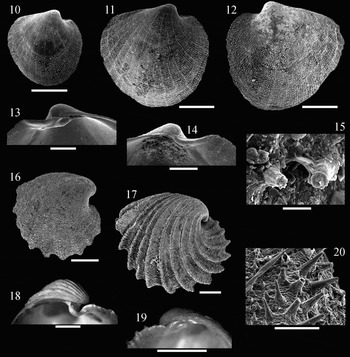
(10–15) Verticordia ouricuri sp. nov. (10) External view, right valve, paratype MNHN; (11) external view, right valve, holotype IBUFRJ 18102; (12) external view, left valve, IBUFRJ 14789; (13, 14) hinge detail, right (holotype IBUFRJ 18102) and left valve (IBUFRJ 14789), respectively; (15) external surface detail, IBUFRJ 18102. (16–20) Spinosipella tinga Simone & Cunha, Reference Simone and Cunha2008. (16) External view, right valve, IBUFRJ 16920; 17–19 (IBUFRJ 18066); (17) external view, right valve; (18, 19) hinge detail, left and right valve, respectively; (20) external surface detail, IBUFRJ 16920. Scale bars: Figure 15: 20 µm; Figure 20: 100 µm; Figures 13–14, 16: 500 µm; Figures 10–12, 17: 1 mm; Figures 18–19: 2 mm.

DIAGNOSIS
Very fragile, little inflated, ornamented externally with approximately 15 axial threads that intercalate with sets of approximately 7 radiating series of delicate spines. Posterior groove deep.
DESCRIPTION
Shell very fragile, white, opaque, small (height 1.2–3.5 mm, length 1.2–4.5 mm), inequivalve, right valve slightly bigger than left valve, inequilateral, little inflated, umbones slender, outline cordiform. Antero- and posterodorsal margins straight, posterodorsal margin oblique (descending), ventral margin U-shaped. Ornamented externally with approximately 15 fine raised axial threads that intercalate with sets of approximately 7 close-set equidistant radiating series of delicate spines. Each spine is a polyhedral column that tapers toward the distal end, which bears a stellate, usually hexagonal, structure. Irregular concentric growth lines present, more visible at ventral margin. The shell region close to the posterodorsal margin shows less-dense and somewhat irregularly distributed spines. Left valve edentate; hinge of right valve with very strong rounded tubercle below the umbo pointing posteriorly, markedly opposed to the umbo. Posterior groove deep, easily noticeable in each valve. Anterior muscle scar marked; posterior muscle scar and pallial line hardly visible.
ETYMOLOGY
This species is named in honour of the complex ritual with dances and songs, called ritual of Ouricuri, practised by Brazilian Fulniô Indians. The name is employed as a noun in apposition.
HOLOTYPE
IBUFRJ 18102 (22°37′54″S 40°13′36″W, 1000 m), 19.V.02 (1 valve).
PARATYPE
MNHN (22°39′44″S 40°15′44″W, 1000 m), 19.V.02 (1 valve); MNRJ 14685 (21°57′26″S 39°40′33″W, 1950 m), 11.XII.02 (3 valves).
MATERIAL EXAMINED
IBUFRJ 14789 (21°57′0″5S 39°49′58″W, 1200 m), 24.IX.01 (1 valve); IBUFRJ 18099 (22°37′02″S 39°56′20″W, 1950 m), 23.XI.02 (1 valve); IBUFRJ 18100 (21°52′43″S 39°40′41″W, 1950 m), 26.VI.03 ([1 valve); IBUFRJ 18103 (22°0′504″S 39°50′01″W, 1230 m), 09.V.02 (1 valve).
REMARKS
This species changes its outline with growth: the posterodorsal margin becomes more extended in larger specimens, which can develop a small indentation at the middle of the posterior margin. The larger right valve exhibits a more extended posterodorsal margin and less-marked axial threads (Figure 12).
The most similar species to V. ouricuri sp. nov. is V. woodii, but the latter is very inflated, with a circular outline, and is ornamented with approximately 30 fine axial threads that intercalate with sets of 7–10 close-set radiating series of spines; whereas V. ouricuri sp. nov. is less inflated, with a cordiform outline, more elongated in height than in length, and ornamented with approximately 15 axial threads that intercalate with sets of approximately 7 closely set equidistant radiating series of spines. The anterior muscular scar is strongly marked in V. woodii, and less evident in V. ouricuri sp. nov. The hinge of V. ouricuri sp. nov. has an easily visible posterior groove, i.e. it is not necessary to incline the shell, as would be done with V. woodii. This feature strongly indicates that the lithodesma of the former species is straighter, whereas it would be U-shaped in the latter species. Also, V. woodii is internally ornamented with indistinct radial striation, which is not visible at V. ouricuri sp. nov.
Although the differences in size (V. ouricuri sp. nov. is smaller than V. woodii) could suggest that such divergence on the characters of the shell could be explained by the different growth stages, when one compares several specimens with the same size-class from both species it is clear that this disparity is not related to growth.
GENERIC DESCRIPTION
Shell robust, very inflated, umbones prosogyrate, strongly projected and enrolled, outline somewhat triangular, ornamented with strong radial ribs that corrugate the ventral margin, externally ornamented by granules or spines. Right valve with a cardinal tooth; left valve with a smaller, broad tooth.
REMARKS
Although it is routinely treated as a subgenus of Verticordia (Allen & Turner, Reference Allen and Turner1974; Abbott & Dance, Reference Abbott and Dance1982), new data reinforce the genus level of Spinosipella (Poutiers & Bernard, Reference Poutiers, Bernard and Bouchet1995; Mikkelsen & Bieler, Reference Mikkelsen and Bieler2008; Simone & Cunha, Reference Simone and Cunha2008). This genus is easily distinguished from Verticordia, mainly by the strongly projected radial ribs, the enrolled umbones, and the inflation of the shell, which is usually more developed in adult specimens.
At present, there are five species in this genus: S. acuticostata (Philippi, Reference Philippi1844), S. agnes Simone & Cunha, Reference Simone and Cunha2008, S. costeminens (Poutiers, 1981), S. deshayesiana (Fischer, 1862), and S. tinga Simone & Cunha, Reference Simone and Cunha2008. Only S. agnes and S. tinga occur in the Atlantic Ocean (Simone & Cunha, Reference Simone and Cunha2008), and both species are reported for Brazil.
DESCRIPTION
Shell robust, brown and large (height 1.5–10.5 mm, length 2–10 mm), equivalve, inequilateral, very inflated, umbones large, outline rounded. With 12 to 15 strong ribs, which extend from near the umbo to a corrugated ventral margin. Covered externally with spines, mainly in the inter-ribs region; each spine is a polyhedral column that tapers toward the distal end, which bears a stellate, usually hexagonal, structure; on the ribs are elongated and pointed spines, with no stellate structure. Hinge of each valve with a posterior groove; left valve with a broad, low, tooth and a thickened hinge plate, right valve with a strong protruded cardinal tooth. Muscle scars and pallial line hardly visible.
TYPE LOCALITY
Off Albardão, Rio Grande do Sul, 33°29′S 50°44′W, 200 m (Simone & Cunha, Reference Simone and Cunha2008).
GEOGRAPHICAL RANGE
Atlantic Ocean: south-western Atlantic: Brazil, from Rio de Janeiro to Rio Grande do Sul (Simone & Cunha, Reference Simone and Cunha2008), off Campos Basin, Rio de Janeiro (Simone & Cunha, Reference Simone and Cunha2008; present study). Bathymetry: from 100 m (Simone & Cunha, Reference Simone and Cunha2008) to 1050 m (present study).
MATERIAL EXAMINED
IBUFRJ 16920 (22°10′53″S 39°52′18″W, 1050 m), 01.VII.03 (1 valve); IBUFRJ 18066 (21°52′59″S 39°55′32″W, 750 m), 29.VI.03 (4 valves).
REMARKS
Spinosipella acuticostata (Philippi, Reference Philippi1844) was originally described in the genus Hippagus, from a fossil from the Pliocene of the Calabria region in Italy. Subsequently, this species was allocated to Verticordia by Woodward (Reference Woodward1854), a combination retained by Seguenza (Reference Seguenza1860) in a revision of the genus Verticordia. The allocation to the genus Spinosipella is somewhat recent (e.g. Poutier & Bernard, 1995; Simone & Cunha, Reference Simone and Cunha2008).
Philippi (Reference Philippi1844: pl. 14, figure 19a–c) described for this species 13 axial ribs, nevertheless, the original illustration shows two left valves, one in external view with 14 axial ribs (Philippi, Reference Philippi1844: figure 19b), and another in internal view with 12 axial ribs (Philippi, Reference Philippi1844: figure 19c). Thus, we conclude that the number of axial ribs (13) formally described (Philippi, Reference Philippi1844: 42) is the mean of these two observations, and, actually, this species shows a variation between 12 and 14 axial ribs.
Subsequently, various authors reported S. acuticostata for the Recent fauna of the Atlantic Ocean (a complete list is given in Simone & Cunha, Reference Simone and Cunha2008). However, Simone & Cunha (Reference Simone and Cunha2008) corrected these Atlantic records and stressed that they actually represent two new species, S. agnes and S. tinga. The diagnostic character that differentiates these species, in our opinion, is the presence of a posterior cardinal tooth on the left valve of S. agnes (Simone & Cunha, Reference Simone and Cunha2008: 61, figures 4, 27 & 28), which is absent in S. tinga (Simone & Cunha, Reference Simone and Cunha2008: 62, figures 20, 25).
The relationship between the number of axial ribs (12–15) and the size of our specimens (up to 10 mm) contrasts with that presented by S. acuticostata (12–14 axial ribs and 24 mm) and by S. agnes (15–17 axial ribs and 22 mm). The number of axial ribs is very variable, usually overlapping among species. Although S. agnes seems to be more convex than S. tinga (Simone & Cunha, Reference Simone and Cunha2008: 63, figures 30 & 31), the lack of statistical analysis provided by these authors prevents us from assessing the taxonomic limits of this character. Thus, until now, the only diagnostic character that discriminates the two species is the presence of a posterior cardinal tooth on the left valve in S. agnes. Because this character is absent in our specimens, we can only classify them as S. tinga.
DISCUSSION
Concerning the shell ornamentation, all of the species treated here (V. woodii, V. quadrata, V. ouricuri sp. nov. and S. tinga) have at least one kind of external ornamentation in common, a spine composed of a polyhedral column, usually hexagonal, with a stellate structure near its distal end. This character can vary in some respects, mainly in: (1) length: some spines have a more elongated column; (2) number: some parts of the shell, usually the posterior and ventral margins, have a dense mesh of spines; (3) geometry: although the column is usually hexagonal, some spines have a more circular column; and (4) stellate structure, which can grade from a less-marked lobed star to a very pointed star. All these variations can be observed in different species, or even in different parts of the same specimen. This structure was already signalled for some anomalodesmatans under the name of spicules (Aller, Reference Aller1974) or spinules (Prezant, Reference Prezant1979) and Harper et al. (Reference Harper, Dreyer and Steiner2006) suggested that the occurrence of such structure within the anomalodesmatans is a plesiomorphic condition. Although it has been lost in several taxa (Harper et al., Reference Harper, Dreyer and Steiner2006), it seems to be a conservative character in each genus treated here, we suggest its use as an additional taxonomic character for the septibranchs, or at least for verticordiids, possibly even at suprageneric level.
ACKNOWLEDGEMENTS
Our thanks are to Dr John Allen (University Marine Biological Station) for his critical information on all aspects of this work, to Dr Luiz Simone and Dr Carlo Cunha (both from Universidade de São Paulo) for the exchange of ideas about the genus Spinosipella; to Dr Janet Reid for the final English revision of this manuscript, to PETROBRAS (Brazilian Petroleum Co.) for making this material available and for SEM support. This research was partially supported by fellowships from FAPERJ (Fundação de Amparo a Pesquisa do Estado do Rio de Janeiro) and CNPq (Conselho Nacional de Desenvolvimento Científico e Tecnológico).