Introduction
The concept of the stock unit is essential to fisheries science and management because it is the basic unit in which population dynamics models have been applied to know a population's condition and take appropriate measures to guarantee its sustainability, and its determination involves the identification of self-sustaining components within natural populations (Abaunza et al., Reference Abaunza, Murta, Campbell, Cimmaruta, Comesaña, Dahle, García-Santamaría, Gordo, Iversen, MacKenzie, Magoulas, Mattiucci, Moloy, Nascetti, Pinto, Quinta, Ramos, Sanjuan, Santos, Stransky and Zimmermann2008). McQuinn (Reference McQuinn1997) stated that stocks may exhibit differences in spawning season, location and life-history parameters. In addition, Mosegaard & Madsen (Reference Mosegaard and Madsen1996) noted that stocks that spawn in separate locations often mix in nursery and feeding areas due to larval dispersal and adult migration, and this causes uncertainty in their management.
One of the most widely used phenotypic characters established to discriminate between stocks based on phenotypic characteristics is otolith shape, which readily determines the measure of identification that is species-specific. Therefore, otolith shape has been used in numerous stock discrimination and management studies, with classification success levels that have ranged from 60–95% for inter-stock separation, depending on the species (Stransky et al., Reference Stransky, Baumann, Fevolden, Harbitz, Høie, Nedreaas, Salberg and Skarstein2008). Indeed, otolith morphometrics provides a phenotypic based-assessment since the variation in these measurements is potential evidence, characterizing geographic areas that have been partially inhabited during the life history of the fish (Casselman et al., Reference Casselman, Collins, Crossman, Ihssen and Spangler1981). Therefore, geographic variation in otolith shapes may result from population differences (Stransky, Reference Stransky2005). Recent studies have shown that the otolith shape can vary within and among species due to the combined effects of ontogenetic, genetic and environmental factors, such as temperature, salinity or light regime and food availability (quality and quantity) (Hüssy, Reference Hüssy2008; Capoccioni et al., Reference Capoccioni, Costa, Aguzzi, Menesatti, Lombarte and Ciccotti2011; Berg et al., Reference Berg, Almeland, Skadal, Slotte, Andersson and Folkvord2018; Ferri et al., Reference Ferri, Bartulin and Škeljo2018; Ben Labidi et al., Reference Ben Labidi, Mejri, Shahin, Quignard, Trabelsi and Ben Faleh2020a; Więcaszek et al., Reference Więcaszek, Nowosielski, Dąbrowski, Górecka, Keszka and Strzelczak2020) or by sex, growth, maturity and pattern of fishery exploitation (Begg & Brown, Reference Begg and Brown2000), or by individual genotype (Berg et al., Reference Berg, Almeland, Skadal, Slotte, Andersson and Folkvord2018; Jawad et al., Reference Jawad, Gnohossou and Tossou2020) or the physiological state (Campana & Neilson, Reference Campana and Neilson1985), and the separation of populations in both time and space (Lombarte & Lleonart, Reference Lombarte and Lleonart1993). In addition, the microstructural increments within otoliths have been used to elucidate the link between sex-change and growth history (McCormick et al., Reference McCormick, Ryen, Munday and Walker2010), since once the deposition of increments has been appropriately validated, the width of increments can be used as a proxy for somatic growth (Campana, Reference Campana2001).
Bilateral asymmetry in morphological traits has been identified earlier into fluctuating asymmetry (FA), directional asymmetry (DA) or anti-symmetry (A) according to their distributions within and among populations (Van Valen, Reference Van Valen1962). Of these types of asymmetry, FA is defined as small random deviations from the ideal bilateral symmetry (Palmer & Strobeck, Reference Palmer and Strobeck1986) and has been hypothesized to increase developmental instability in response to both genetic and environmental stress experienced by the population (Trokovic et al., Reference Trokovic, Herczeg, Ab Ghani, Shikano and Merilä2012). Previous studies on the otolith shape have shown that these three types of asymmetries can be attributed to both genetic and environmental factors, such as water temperature, salinity, depth, substrate type, food availability and pollutants (Panfili et al., Reference Panfili, Durand, Diop, Gourene and Simier2005; Al-Mamry et al., Reference Al-Mamry, Jawad and Ambuali2011; Jawad et al., Reference Jawad, Sadighzadeh and Al-Mamary2012a, Reference Jawad, Al-Mamry and Al-Mamary2012b, Reference Jawad, Gnohossou and Tossou2020; El-Regal et al., Reference El-Regal, Jawad, Mehanna and Ahmad2016; Kontaş et al., Reference Kontaş, Bostanci, Yedіer, Kurucu and Polat2018; Yedier et al., Reference Yedier, Bostancı, Kontaş, Kurucu and Polat2018a; Mahé et al., Reference Mahé, Ider, Massaro, Hamed, Alba, Patricia, Aiketerini, Angelique, Chryssi, Romain, Zohir, Mahmoud, Rachid, Hélène and Bruno2019; Ben Labidi et al., Reference Ben Labidi, Mejri, Shahin, Quignard, Trabelsi and Ben Faleh2020b; Mejri et al., Reference Mejri, Trojette, Jmil, Ben Faleh, Chalh, Quignard and Trabelsi2020; Geladakis et al., Reference Geladakis, Somarakis and Koumoundouros2021). However, the probable cause of the intra-individual variation, notably the asymmetry in shape between the right and left sides of the otoliths, has been poorly defined (Mille et al., Reference Mille, Mahé, Villanueva, De Pontual and Ernande2015). As a rule, the three orthogonal semi-circular otoliths at both sides of the head are morphologically symmetrical under normal conditions (Panfili et al., Reference Panfili, De Pontual, Troadec and Wright2002), although some inter-specific modifications in the size and shape (Popper & Lu, Reference Popper and Lu2000), as well as the weight difference, i.e. mass asymmetry, between masses of the left and right otoliths, have been observed (Yedier et al., Reference Yedier, Bostancı, Kontaş, Kurucu and Polat2018b).
As far as is known, the external contour or shape of otoliths has been studied by using several techniques, including univariate descriptors such as shape factors that include roundness or circularity (Tuset et al., Reference Tuset, Lozano, Gonzalez, Pertusa and Garcıa-Dıaz2003), geometric morphometrics (Ponton, Reference Ponton2006), wavelet functions (Parisi-Baradad et al., Reference Parisi-Baradad, Lombarte, García-Ladona, Cabestany, Piera and Chic2005; Ferri et al., Reference Ferri, Bartulin and Škeljo2018), curvature scale space (Mapp et al., Reference Mapp, Hunter, Van Der Kooijc, Songer and Fisher2017), and growth markers (Benzinou et al., Reference Benzinou, Carbini, Nasreddine, Elleboode and Mahé2013) and geodesic methods (Benzinou et al., Reference Benzinou, Carbini, Nasreddine, Elleboode and Mahé2013). However, elliptical Fourier analysis (EFA) remains the most widely used method for describing and characterizing outlines, capturing outline information in an efficient and quantifiable manner (Lord et al., Reference Lord, Morat, Lecomte-Finiger and Keith2012), describing the variation of the otolith shape between fish species in stock discrimination, and analysing population structure of diverse species (Ben Labidi et al., Reference Ben Labidi, Mejri, Shahin, Quignard, Trabelsi and Ben Faleh2020b).
The geographic location of the Tunisian shore as a border region between the basins of the eastern and western Mediterranean means that it possesses many lagoons, including the Bizerte and Ghar El Melh, which are 40 km apart. The location of these lagoons makes them important ecological niches that provide more potential biodiversity for the Tunisian coast (Kaouèche et al., Reference Kaouèche, Bahri-Sfar, Hammami and Hassine2017). Earlier ecological studies at these lagoons showed that environmental characteristics, such as temperature, salinity and currents, differed in these locations (Béjaoui et al., Reference Béjaoui, Harzallah, Moussa, Chapelle and Solidoro2008, Reference Béjaoui, Ferjani, Zaaboub, Chapelle and Moussa2010; Dhib et al., Reference Dhib, Frossard, Turki and Aleya2013a, Reference Dhib, Ben Brahim, Ziadi, Akrout, Turki and Aleya2013b, Reference Dhib, Fertouna-Bellakhal, Turki and Aleya2015; Khedhri et al., Reference Khedhri, Afli and Aleya2017). Anthropogenic pressures including urbanization, uncontrolled discharges of domestic and industrial wastes, raw sewage, naval and commercial shipping harbours, and organic chemical and heavy metal pollution also differed among the lagoons (Barhoumi, Reference Barhoumi2014). These environmental changes among these lagoons were expected to induce variation in fish phenology to permit adaptations to environmental changes by adjusting fish physiology and behaviour to the effects of environmental variation, which would lead to changes in morphology, reproduction and survival (Meyer, Reference Meyer1987).
The common two-banded seabream Diplodus vulgaris (Geoffroy Saint-Hilaire, 1817) is the most commercially important species of the Sparidae family in the Mediterranean Sea (Kaoueche, Reference Kaoueche2019). To our knowledge, no recent data are available on the total landings of this species in Tunisian waters, but in 2006 this family accounted for 12.7% of the total fish landings in Tunisia, with about 19–20% for the genus Diplodus (Anonymous, 2006). Due to the economic importance of D. vulgaris as one of the artisanal fisheries species, as well as its considerable importance in aquaculture because of its outstanding eating quality, several studies have been conducted on its reproductive biology and growth in the Mediterranean Sea, including Tunisian waters, as well as in the Atlantic and Adriatic Seas. In Tunisian waters, the otolith shape has been investigated in some sparid species, such as Diplodus annularis (Trojette et al., Reference Trojette, Ben Faleh, Fatnassi, Marsaoui, Mahouachi, Chalh, Quignard and Trabelsi2015), Pagellus erythrinus (Mejri et al., Reference Mejri, Trojette, Allaya, Ben Faleh, Jmil, Chalh, Quignard and Trabelsi2018, Reference Mejri, Trojette, Jmil, Ben Faleh, Chalh, Quignard and Trabelsi2020) and Boops boops (Ben Labidi et al., Reference Ben Labidi, Mejri, Shahin, Quignard, Trabelsi and Ben Faleh2020a, Reference Ben Labidi, Mejri, Shahin, Quignard, Trabelsi and Ben Faleh2020b). In addition, Khedher & Fatnassi (Reference Khedher and Fatnassi2018) examined the relationship between total fish length and otolith parameters (length, width and weight) in D. vulgaris populations collected from the Boughrara and El Bibane lagoons in southern Tunisia. Despite this latter study, the characteristics of the otolith shape have not yet been studied. So, this study was conducted for the first time on D. vulgaris individuals collected from two localities, the Bizerte and Ghar El Melh lagoons, located in north-east Tunisia to (1) examine the specific inter- and intra-individual variation in the otolith shape using elliptical Fourier analysis (EFA) combined with measures of length (LO), width (WO), and area (AO); (2) use the otolith shape and size analysis as a phenotypic-based approach to discriminate the stock structure of this species in the two localities to investigate whether they represent two separate stocks for management purposes; and (3) test for biases resulting from potential fluctuating asymmetry (FA) in the otolith shape on the discrimination of stock structure.
Materials and methods
Study area and sampling
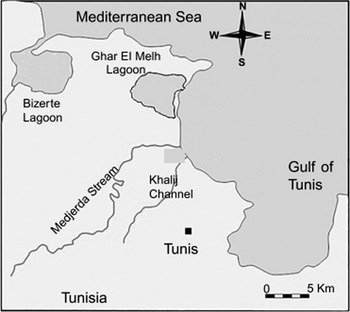
A total of 120 adult individuals (60 individuals from each lagoon) of Diplodus vulgaris were collected between March and May 2015 from the Bizerte (37°8′–37°14″N 9°46′–9°56″E) and Ghar El Melh (37°06′–37°10″N 10°08′–10°15″E) lagoons (north-east Tunisia; Figure 1). All individuals were caught alive by gillnets using coastal boats measuring from 5 to 13 m in length. Since the first sexual maturity in this species showed significant changes in growth size due to several environmental factors, fishing pressure and mortality rates (Mouine et al., Reference Mouine, Francour, Ktari and Chakroun-Marzouk2012; Hadj Taieb et al., Reference Hadj Taieb, Ghorbel, Ben Hadj Hamida and Jarboui2013; Tsikliras & Stergiou, Reference Tsikliras and Stergiou2014), the sexual maturity status of each individual was examined macroscopically immediately after capture to ensure that all individuals chosen for this study were fully mature. The total length (TL; mm) and total weight (TW; 0.01 g) were both recorded (Table 1).
Map of the Bizerte and Ghar El Melh marine lagoons from which the individuals of Diplodus vulgaris Geoffroy Saint-Hilaire, 1817, were collected in Tunisia.

Range and mean ± standard deviation (SD) values of the total length (TL) and weight (TW) of Diplodus vulgaris individuals examined in this study

Otolith extraction
The sagittae, the largest of the three otolith pairs, were removed, cleaned with distilled water, air-dried, and stored in Eppendorf tubes according to the method described by Mejri et al. (Reference Mejri, Trojette, Allaya, Ben Faleh, Jmil, Chalh, Quignard and Trabelsi2018). Otoliths were placed under a dissecting microscope at 40× magnification with a black background and digital images were captured using a Samsung HD camera with a resolution of 16 megapixels.
Otolith shape analysis
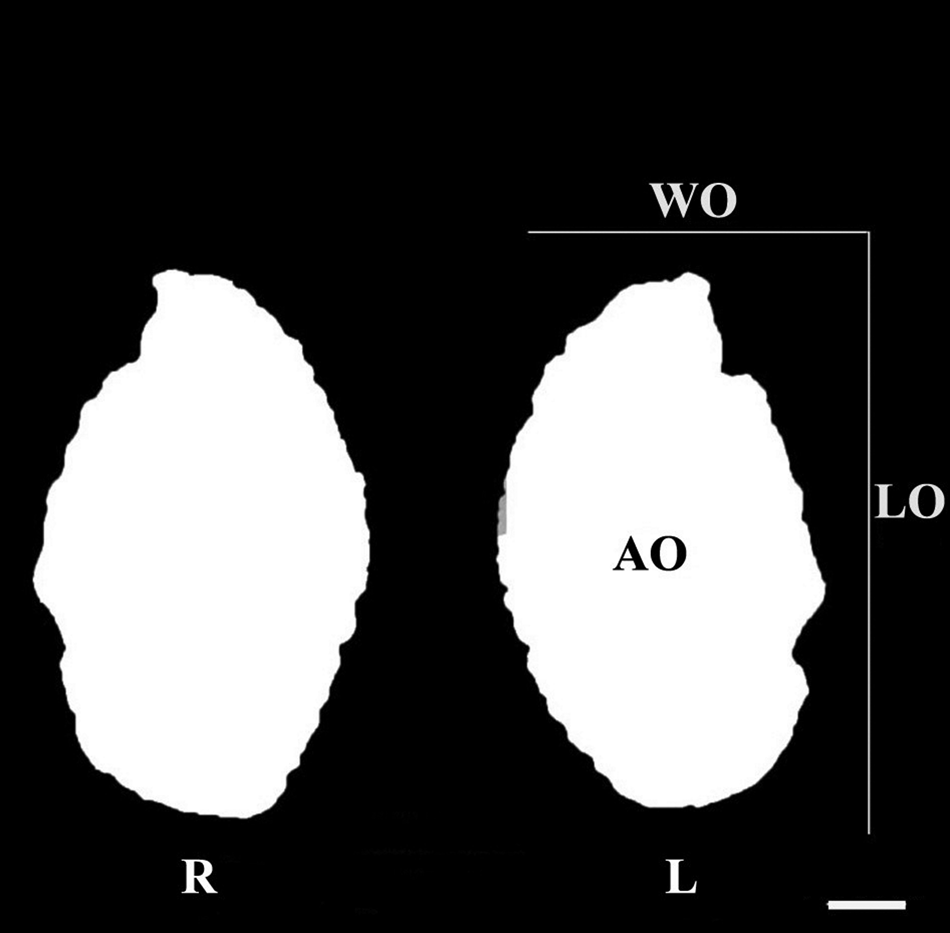
The images of the otoliths were processed with Adobe Photoshop CS6 software, which transforms the original image of the otolith into a binary image (Figure 2). Afterwards, the images of shapes were analysed using the software SHAPE Ver. 1.3. The outlines of the contour shape of each otolith were evaluated using EFA as previously described by Ben Labidi et al. (Reference Ben Labidi, Mejri, Shahin, Quignard, Trabelsi and Ben Faleh2020a, Reference Ben Labidi, Mejri, Shahin, Quignard, Trabelsi and Ben Faleh2020b). In the EFA, the method of elliptical Fourier descriptors (FDs) was used, whereby the chain-coding algorithm was used and calculated based on the binary contour projection of each otolith using SHAPE software. The chain-coder provided the normalized EFDs coefficients through a discrete Fourier transformation (DFT) of the chain-coded contour. The FDs technique described the outline based on harmonics and generated 20 harmonics for each otolith. Each harmonic consisted of four coefficients (A, B, C and D), corresponding to the values of the sine and the cosine part of the variation in the x and y coordinates and resulting in 80 coefficients per otolith generated by projecting each point of the outline onto the axes (x) and (y). The four FDs were normalized with the first harmonic to make them invariant to changes in size, location, rotation and starting point. After the transformation, the three first FDs of the first harmonic were fixed at constant values and thus were not taken into account in the analysis. Therefore, each sample was represented by the subsequent 77 coefficients. The required number of harmonics for the best reconstruction of the otolith outline, the Fourier power (FPn), the percentage Fourier power (FP%), and the cumulative percentage of the Fourier Power (FPn% cumulative) were calculated according to the following formulas:
 $${\rm F}{\rm P}_n = ( A_n^2 + B_n^2 + C_n^2 + D_n^2 ) /2$$
where An, Bn, Cn and Dn are the Fourier coefficients.
 $$\eqalign{&{\rm Cumulative}\;{\rm percentage}\;{\rm of}\;{\rm Fourier}\;{\rm power}\;{\rm PF\% } = 100{\rm P}{\rm F}_n\cdot \cr &( \Sigma _1^n \;{\rm P}{\rm F}_n) ^{\ndash 1} {\rm P}{\rm F}_n\% = \Sigma _1^n \;{\rm P}{\rm F}_n\% } $$
Binary images of the right and left otoliths showing the biometric parameters examined among individuals of Diplodus vulgaris Geoffroy Saint-Hilaire, 1817, collected from the Bizerte (left) and Ghar El Melh (right) marine lagoons in Tunisia: length (LO), width (WO) and area (AO). Scale bar: 1 mm.

The power of the cumulative Fourier average was then calculated to fix the number of harmonics. The threshold of 99.99% of the total power was chosen to determine the number of harmonics required.
Data analysis
Firstly, analysis of variance (ANOVA) was performed to evaluate the significance of differences in the mean values of the total length (TL) and weight (TW) among individuals of the two localities, and the values were tested for the homogeneity (equality) and the normal distribution using the Levene's and Shapiro-Wilks’ λ tests, respectively. Secondly, the differences in the contour shape of otoliths from individuals of the two localities were analysed through the non-parametric generalized discriminant function analysis (DFA). The effect of locations on the elliptical Fourier descriptors was first tested by Multivariate analysis of variance (MANOVA). Subsequently, all shape variable values were checked for normality; if the values did not follow the normal distribution, a transformation of Box-Cox (Box & Cox, Reference Box and Cox1964) was performed. Finally, the Levene's and Shapiro-Wilks’ λ tests were applied to assess the homogeneity (equality) and the normal distribution of the variance in the values of the variables for the shape of otoliths, respectively. The DFA was performed with the normalized elliptical Fourier descriptors coefficients (77 coefficients per otolith) to illustrate the similarities and differences among individuals either in the same locality and/or in both localities. The objective of DFA is to investigate the integrity of pre-defined groups of individuals belonging to the given geographic population or locality and the percentage of their correct classification, by finding linear combinations of descriptors that maximize the value of Wilks’ λ. The Wilks’ λ test assesses the performance of the discriminant analyses. This statistic is the ratio between intra-group variance and total variance and provides an objective method for calculating the corrected percentage chance for agreement. The Fisher distance was also calculated to characterize the differences in the otolith shape among and within individuals of both localities. All these statistical analyses were performed using XLSTAT 2010.
Biometric parameters
Biometric parameters of the otoliths, including length (LO), width (WO) and area (AO), were determined using ImageJ software (Figure 2). Before statistical analyses, one-way ANOVA was used to determine whether there were any significant differences between the mean values of LO, WO and AO for the right and left sides of the otoliths. In addition, a two-way ANOVA was used to check whether there was a correlation between the otolith's morphometry and the geographic origin of the individuals. The mean values of the three parameters were analysed by the Student's t-test to determine the differences between the left and right otoliths among individuals of each locality and between the left-left and right-right otoliths among individuals of the two localities.
Fluctuating asymmetry (FA) measurements
The FA is characterized by a normal distribution of Ri−Li with a mean equal to 0. The variance of |ri−li| represents a measure of the instability of development. Fluctuating asymmetries are extremely subtle, being on the order of 1% of the character size or less, and thus require great care to be detected (Palmer & Strobeck, Reference Palmer and Strobeck1986). The FA between the right and left sides of the otoliths was calculated among individuals of the two localities for each biometric parameter per individual i by applying the following formula given by Palmer & Strobeck (Reference Palmer and Strobeck1986) and was estimated as the FAi index:
 $${\rm F}{\rm A}_i = {\rm \sigma }2\;r-l$$
where r and l are the values of the traits on the right and left sides, respectively.
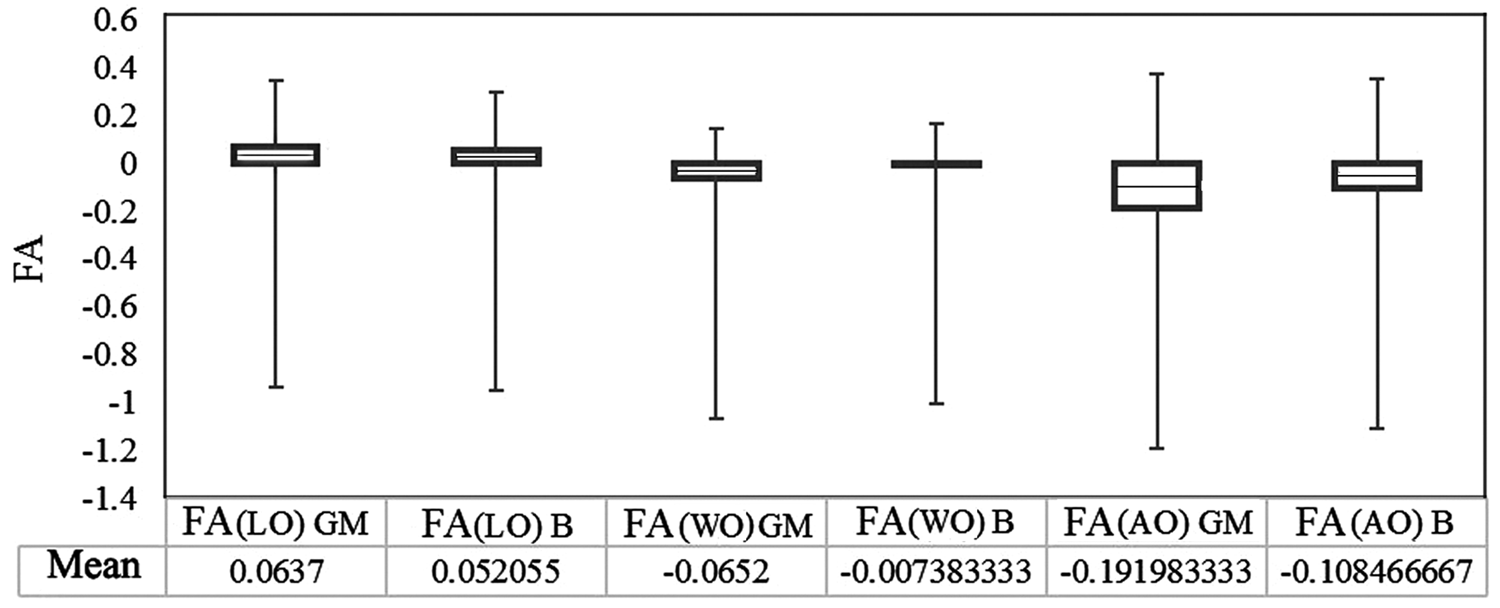
The inter-locality differences of the mean values of the FA between the right and left sides of the otolith size parameters among individuals of the two localities were tested using MANOVA and the distribution and signs of skewness of the mean values were visualized with a box plot chart (Figure 3).
Box plots showing the distribution and signs of skewness of the mean values of fluctuating asymmetry (FA) of the right and left length (LO), width (WO), and area (AO) of the otoliths among the Bizerte (B) and Ghar El Melh (GM) lagoons in Tunisia. The central line is the median, the boxes indicate the first and third quartiles, and the whiskers indicate two standard deviations. Outliers are those outside the median ± 0.2–0.6 SD.

Results
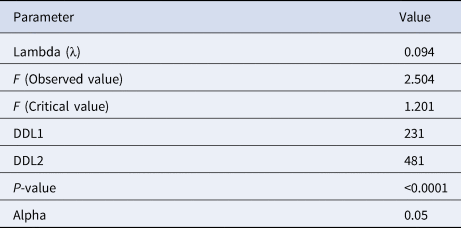
As a general rule, it is noteworthy that all individuals examined in this study were sexually mature at the total lengths recorded, showing that D. vulgaris displays a wide range of variation in growth rate in Tunisian waters depending on the local environmental conditions. The Levene's and Shapiro-Wilks’ λ tests confirmed that all values of the shape variance were equally and normally distributed with a P-value > 0.05. In addition, the Wilks’ λ test showed statistically significant differences (P < 0.0001), i.e. there was an asymmetry, between the right and left otoliths of the Bizerte and Ghar El Melh localities (Table 2). Similarly, the Fisher distances also showed significant asymmetry (P < 0.0001) in the otoliths’ shape within and among individuals in the two localities. The Fisher distances between the left and right sides of the otoliths among individuals within each locality were 2.269 for the Bizerte and 1.526 for the Ghar El Melh. However, by comparing the left-left and right-right sides of the otoliths among individuals from both localities, it was found that the Fisher distances were 3.226 and 3.258, respectively, while the mean of distances between the left and right sides among individuals from both localities was 2.786.
Wilks’ Lambda (λ) test of the distance approximation among Diplodus vulgaris individuals collected from the Bizerte and Ghar El Melh marine lagoons in Tunisia

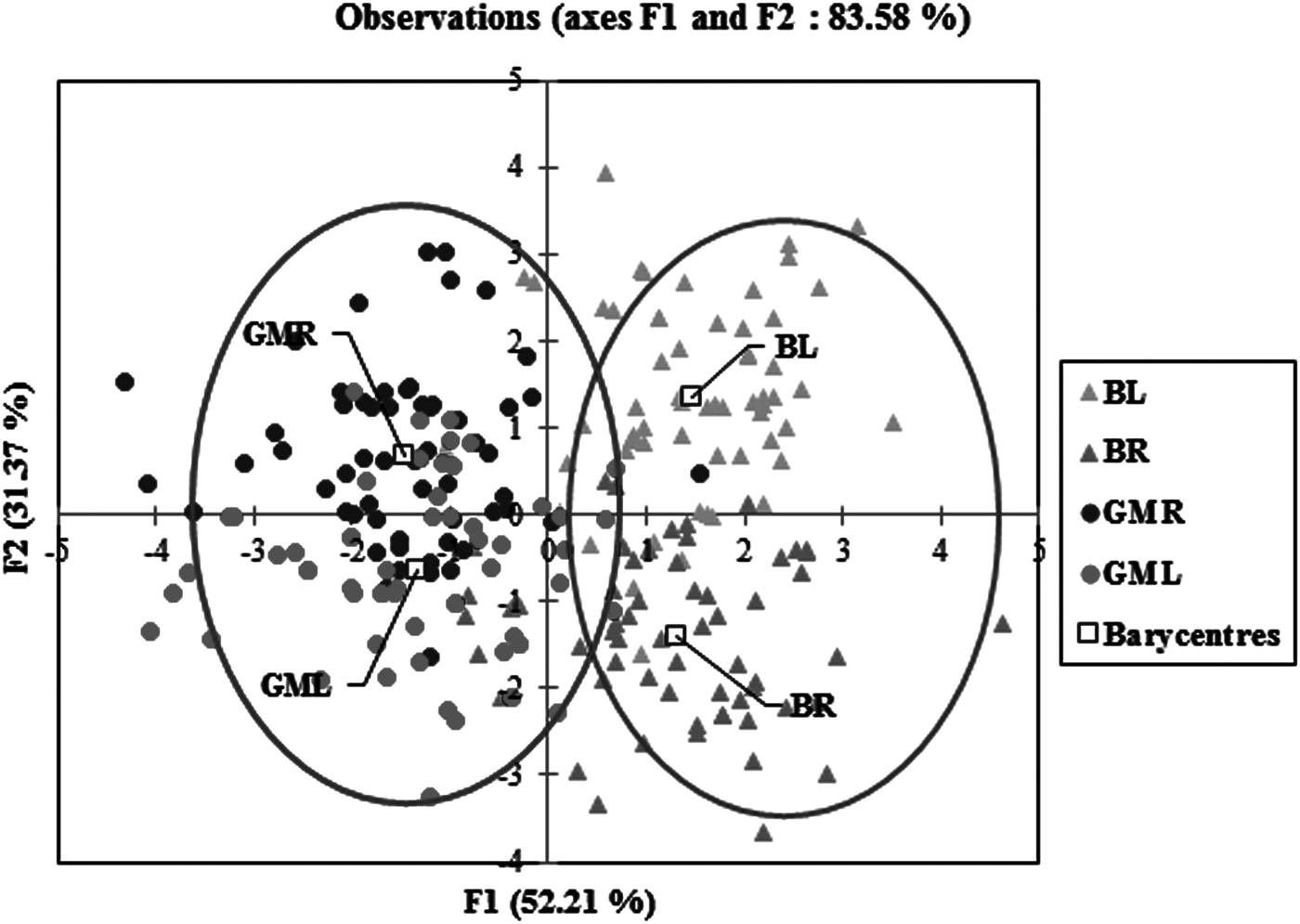
From the EFA, the first 17 harmonics obtained 99.2% of the cumulative power and contributed 96.4% of the total shape variation. On this basis, the five principal components computed from corrected shape values revealed that the two first principal components explained 83.58% of the total variance and confirmed the existence of shape variability between the left and right sides of the otoliths of the two localities, i.e. the presence of two differentiated groups or populations of otoliths corresponding to the two localities. Similarly, the DFA showed the barycentre projection of the individuals on the first two axes F1 and F2. The first axis explained 52.21% and the second 31.37%, showing that otoliths of the individuals tended to segregate along the F1. Thus, the two axes accounted for 83.58% of the total variance and clearly showed the presence of two differentiated groups of otoliths corresponding to two populations of individuals from the Bizerte and Ghar El Melh localities (Figure 4). In addition, the F2 axis separated the left and right sides of the otoliths of the Bizerte locality in the positive part and those of the Ghar El Melh locality in the negative part. Moreover, the DFA showed that the percentages of correctly classified individuals to the Bizerte and Ghar El Melh localities were 99.17 and 99.33%, respectively.
Diplodus vulgaris Geoffroy Saint-Hilaire, 1817, Discriminant function analysis (DFA) showing the barycentre projection of the left (L) and right (R) shape values of the otoliths collected from individuals of Diplodus vulgaris Geoffroy Saint-Hilaire, 1817, from the Bizerte (B) and Ghar El Melh (GM) marine lagoons in Tunisia.

Biometric analysis
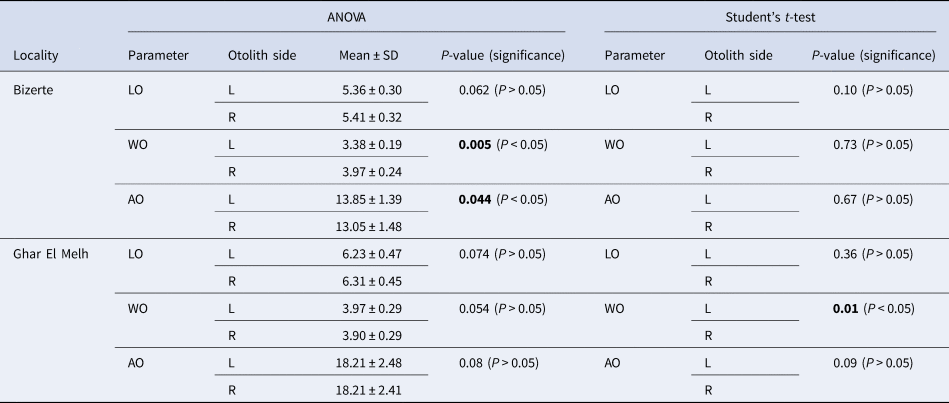
The one-way ANOVA indicated statistically significant differences (P < 0.05), i.e. there was asymmetry, in the mean values of WO and AO between the right and left sides of the otoliths and no significant differences, i.e. there was symmetry, in the mean values of LO among individuals of the Bizerte locality. However, no significant differences (P > 0.05), i.e. there was symmetry, were found in LO, WO and AO between the right and left sides of the otoliths among individuals of the Ghar El Melh locality (Table 3). Similarly, the Student's t-test showed significant symmetry (P > 0.05) in the mean values of LO, WO and AO between the left and right sides of the otoliths among individuals of the Bizerte locality. Also, a significant symmetry (P > 0.05) in the mean values of LO and AO was detected between the left and right sides of the otoliths among individuals of the Ghar El Melh locality. However, a significant asymmetry (P < 0.05) was found in the mean values of WO (Table 3). Moreover, no significant differences (P < 0.0001) were found in LO, WO and AO between the left and right otoliths among individuals of the two localities. On the other hand, the two-way ANOVA confirmed that there was a significant correlation between the LO, WO and AO measurements of the otoliths and the geographic origin of the individuals from the two localities (P < 0.001).
One-way ANOVA and Student's t-test of the mean values of the left (L) and right (R) otoliths’ length (LO), width (WO) and area (AO), and P-values among individuals of Diplodus vulgaris collected from the Bizerte and Ghar El Melh marine lagoons in Tunisia

SD, standard deviation; values marked in bold are statistically significant (P < 0.05).
Fluctuating asymmetry (FA) analysis
Estimates of the mean FA values of LO, WO and AO between the right and left sides of the otoliths among individuals of the Bizerte locality were 0.052 ± 0.2, −0.007 ± 0.2 and −0.108 ± 0.5, respectively, while they were 0.064 ± 0.3, −0.065 ± 0.2 and −0.192 ± 0.6, respectively, among those of the Ghar El Melh locality. The distribution of the mean values and signs of skewness among the two localities was shown by a box plot chart (Figure 3). Additionally, the MANOVA revealed statistically significant differences between the mean values of FA between the right and left sides of the otoliths among individuals from both localities (Wilks’ λ = 0.82, F = 1.91; P = 0.001).
Discussion
Elliptical Fourier analysis (EFA) of the otoliths’ contour shape revealed an apparent variation, i.e. asymmetry, either between the left and right sides or between the same sides (left-left and right-right) within and among individuals of the two localities. Similar results have previously been reported in a range of sparids, including D. annularis (Trojette et al., Reference Trojette, Ben Faleh, Fatnassi, Marsaoui, Mahouachi, Chalh, Quignard and Trabelsi2015), Oblada melanura (Barhoumi et al., Reference Barhoumi, Khoufi, Kalai, Ouerhani, Essayed, Zaier, Jaziri, Ben Meriem and Fehri-Bedoui2018), Pagellus erythrinus (Mejri et al., Reference Mejri, Trojette, Jmil, Ben Faleh, Chalh, Quignard and Trabelsi2020) and B. boops (Ider et al., Reference Ider, Ramdane, Mahe, Dufour, Bacha and Amara2017; Ben Labidi et al., Reference Ben Labidi, Mejri, Shahin, Quignard, Trabelsi and Ben Faleh2020a). Such asymmetry of otolith shape has also been found in a range of other fish taxa elsewhere in the world, including Gadus morhua (Campana & Casselman, Reference Campana and Casselman1993), Clupea harengus (Turan, Reference Turan2000), Lophius piscatorius (Cañás et al., Reference Cañás, Stransky, Schlickeisen, Sampedro and Fariña2012), Haemulon plumieri (Treinen-Crespo et al., Reference Treinen-Crespo, Villegas-Hernández, Guillén-Hernández, Ruiz-Zárate and González-Salas2012), Sicyopterus species (Lord et al., Reference Lord, Morat, Lecomte-Finiger and Keith2012), Xiphias gladius (Mahé et al., Reference Mahé, Evano, Mille and Bourjea2014), Thunnus thynnus (Brophy et al., Reference Brophy, Haynes, Arrizabalaga, Fraile, Fromentin, Garibaldi, Katavic, Tinti, Karakulak, Macías, Busawon, Hanke, Kimoto, Sakai, Deguara, Abid and Santos2016), Albatrossia pectoralis (Rodgveller et al., Reference Rodgveller, Hutchinson, Harris, Vulstek and Guthrie CM2017), Solea lascaris (Chakour & Elouizgani, Reference Chakour and Elouizgani2018), and Engraulis encrasicolus (Khemiri et al., Reference Khemiri, Gaamour, Ben Abdallah and Fezzani2018).
In relation to the environmental characters of the study sites, it has been reported that the temperature ranged from 11.18–26.12 °C (Béjaoui et al., Reference Béjaoui, Harzallah, Moussa, Chapelle and Solidoro2008) and 11–26.9 °C (Dhib et al., Reference Dhib, Fertouna-Bellakhal, Turki and Aleya2015), and the salinity varied from 20–40‰ (Béjaoui et al., Reference Béjaoui, Ferjani, Zaaboub, Chapelle and Moussa2010) and 27–48‰ (Dhib et al., Reference Dhib, Frossard, Turki and Aleya2013a, Reference Dhib, Ben Brahim, Ziadi, Akrout, Turki and Aleya2013b) between the Bizerte and Ghar El Melh lagoons, respectively. In addition, it has been well documented that fish species are very sensitive to a temperature change of about 0.03 °C (Rebaya et al., Reference Rebaya, Ben Faleh, Allaya, Kheder, Trojette, Marsaoui, Fatnassi, Chalh, Quignard and Trabelsi2017). Moreover, it has been found that the variation in the otolith composition is related to differences in fish responses to the influence of salinity reaction on temperature and the concentration of some common elements, such as Cl, Mg, K, Na and Ca (Martin & Wuenschel, Reference Martin and Wuenschel2006). Consequently, minor differences in the environmental characteristics of the two sites (e.g. salinity) may directly affect the habitat and indirectly affect the chemical composition and shape of the otoliths in D. vulgaris. These interpretations are consistent with those proposed earlier by Lombarte & Lleonart (Reference Lombarte and Lleonart1993), Martin & Wuenschel (Reference Martin and Wuenschel2006), Hüssy (Reference Hüssy2008) and Capoccioni et al. (Reference Capoccioni, Costa, Aguzzi, Menesatti, Lombarte and Ciccotti2011).
Besides, some authors have reported that differences in age and sex may lead to a significant difference in the otolith shape in fish stocks (Simoneau et al., Reference Simoneau, Casselman and Fortin2000). Regarding sex, D. vulgaris has been assigned as a protogynous hermaphrodite with a sex-change from female to male (Hadj Taieb et al., Reference Hadj Taieb, Ghorbel, Ben Hadj Hamida and Jarboui2013). Thus, in agreement with McCormick et al. (Reference McCormick, Ryen, Munday and Walker2010), Mahé et al. (Reference Mahé, Evano, Mille and Bourjea2014), Mejri et al. (Reference Mejri, Trojette, Allaya, Ben Faleh, Jmil, Chalh, Quignard and Trabelsi2018) and Ben Mohamed et al. (Reference Ben Mohamed, Mejri, Ben Faleh, Allaya, Jmil, Rebaya, Chalh, Quignard and Trabelsi2019), we can suggest that the difference in the otolith shape among individuals from the Bizerte and Ghar El Melh localities can be potentially attributed to the effect of the hermaphroditism in some individuals from these two localities separated by a distance of 40 km, which may lead to this higher discrimination in the otolith shape. Moreover, Ferri et al. (Reference Ferri, Bartulin and Škeljo2018) found that the otolith shape was significantly different in juveniles than in adults due to differences in hearing function. In this study, it is worth noting that the sampling was only restricted to adult individuals to eliminate the confounding effect of allometric growth (Cardinale et al., Reference Cardinale, Doering-Arjes, Kastowsky and Mosegaard2004) and sexual maturity (Campana & Casselman, Reference Campana and Casselman1993) on the otolith shape. Furthermore, D. vulgaris feeds on a wide variety of prey items, including crustaceans (amphipods), echinoderms (ophiuroids and echinoids), hydrozoans, polychaetes, molluscs, foraminiferans, green algae and fish (El-Maremie et al., Reference EL-Maremie, Abdalnabi and El-Mor2015), whose availability may be different between the Bizerte and Ghar El Melh lagoons due to the variation in the environmental parameters, especially water temperature, salinity and pollutants (Béjaoui et al., Reference Béjaoui, Harzallah, Moussa, Chapelle and Solidoro2008, Reference Béjaoui, Ferjani, Zaaboub, Chapelle and Moussa2010; Louiz et al., Reference Louiz, Kinani, Gouze, Ben-Attia, Menif, Bouchonnet, Porcher, Ben-Hassine and Aït-Aïssa2008; Dhib et al., Reference Dhib, Frossard, Turki and Aleya2013a, Reference Dhib, Ben Brahim, Ziadi, Akrout, Turki and Aleya2013b, Reference Dhib, Fertouna-Bellakhal, Turki and Aleya2015; Khedhri et al., Reference Khedhri, Afli and Aleya2017). So, we can suggest that there may be differences in the diet composition and nutrition of this species between these lagoons, potentially leading to the current difference in the otolith shape among individuals of the two localities, as suggested in other comparable studies (Cardinale et al., Reference Cardinale, Doering-Arjes, Kastowsky and Mosegaard2004; Fernandez-Jover & Sanchez-Jerez, Reference Fernandez-Jover and Sanchez-Jerez2015; Jmil et al., Reference Jmil, Ben Faleh, Rebaya, Allaya, Ben Mohamed, Trojette, Chalh, Quignard and Trabelsi2019).
On the other hand, the examination of the biometric dimensions of the otoliths showed an obvious symmetry in LO, WO and AO between the left and right otoliths among individuals from the two localities. However, ANOVA showed significant asymmetry only in WO and AO between the left and right sides among individuals of the Bizerte locality and Student's t-test revealed significant asymmetry only in WO among individuals of the Ghar El Melh locality. Similar asymmetry in WO has also been found in Tunisian waters in P. erythrinus (Mejri et al., Reference Mejri, Trojette, Jmil, Ben Faleh, Chalh, Quignard and Trabelsi2020) and B. boops (Ben Labidi et al., Reference Ben Labidi, Mejri, Shahin, Quignard, Trabelsi and Ben Faleh2020b), as well as elsewhere in LO and WO in Rastrelliger kanagurta (Al-Mamry et al., Reference Al-Mamry, Jawad and Ambuali2011), Sardinella sindensis and Sillago sihama (Jawad et al., Reference Jawad, Sadighzadeh and Al-Mamary2012a), Lutjanus bengalensis (Jawad et al., Reference Jawad, Al-Mamry and Al-Mamary2012b), Chlorurus sordidus and Hipposcarus harid (El-Regal et al., Reference El-Regal, Jawad, Mehanna and Ahmad2016), Merlangius merlangus (Kontaş et al., Reference Kontaş, Bostanci, Yedіer, Kurucu and Polat2018), Trachurus mediterraneus (Yedier et al., Reference Yedier, Bostancı, Kontaş, Kurucu and Polat2018a), and Sarotherodon melanotheron and Coptodon guineensis (Jawad et al., Reference Jawad, Gnohossou and Tossou2020).
In addition, MANOVA showed significant FA between the right and left sides of the otoliths’ parameters among individuals from both localities. This significant FA in the biometric dimensions of the otoliths may be largely attributed to the hypothesis that the vulnerability of individuals under conditions of stress may develop asymmetry on both sides of the otoliths (Jawad & Al-Sadighzadeh, Reference Jawad and Al-Sadighzadeh2013). This is because it has been found that there is a direct correlation between environmental stress and asymmetry in the morphology of the otolith in fish species (Ben Labidi et al., Reference Ben Labidi, Mejri, Shahin, Quignard, Trabelsi and Ben Faleh2020b; Mejri et al., Reference Mejri, Trojette, Jmil, Ben Faleh, Chalh, Quignard and Trabelsi2020). This environmental stress can arise from the pollution of seawater and sediments by heavy metals, organic matter and hydrocarbons found in these lagoons (Boulajfene et al., Reference Boulajfene, Strogyloudi, Lasram, El Mlayah, Vassiliki-Angelique and Zouari-Tlig2019). Moreover, the bilateral asymmetry found in the otolith dimensions among individuals from the two localities can be a result of abnormal swimming activity and interference with correct sound localization, resulting in the inability of the individuals to integrate with the environment in which they live (Helling et al., Reference Helling, Hausmann, Clarke and Scherer2003; Lychakov & Rebane, Reference Lychakov and Rebane2005).
Indeed, previous studies have shown that the Bizerte lagoon is more polluted than the Ghar El Melh (Béjaoui et al., Reference Béjaoui, Harzallah, Moussa, Chapelle and Solidoro2008, Reference Béjaoui, Ferjani, Zaaboub, Chapelle and Moussa2010; Louiz et al., Reference Louiz, Kinani, Gouze, Ben-Attia, Menif, Bouchonnet, Porcher, Ben-Hassine and Aït-Aïssa2008; Dhib et al., Reference Dhib, Frossard, Turki and Aleya2013a, Reference Dhib, Ben Brahim, Ziadi, Akrout, Turki and Aleya2013b, Reference Dhib, Fertouna-Bellakhal, Turki and Aleya2015; Khedhri et al., Reference Khedhri, Afli and Aleya2017) because it suffers from many industrial effluents, including chemical, petrochemical, metallurgical and cement production that lead to chemical contamination by various toxic compounds and lower the pH of the water (Dellali et al., Reference Dellali, Romeo, Gnassia-Barelli and Aïssa2004), which promotes the solubility of trace metals (Sunda & Cai, Reference Sunda and Cai2012). Therefore, we can assume that the short and big otoliths of D. vulgaris in the Bizerte locality may be associated with a narrower range of hearing compared with the long and small otoliths in the Ghar El Melh locality that offer the best hearing and highest survival. Accordingly, the state of pollution that is present in the two lagoons may be responsible for this asymmetry that has appeared in WO and AO in the Bizerte locality and WO in the Ghar El Melh locality.
In addition, in concurrence with Panfili et al. (Reference Panfili, Durand, Diop, Gourene and Simier2005) and Mejri et al. (Reference Mejri, Trojette, Jmil, Ben Faleh, Chalh, Quignard and Trabelsi2020), we can suggest here that the intra-individual FA variation among individuals from the two lagoons could result from intra-individual genetic variation, but this assumption needs to be further investigated due to the lack of genetic data from these two lagoons.
In conclusion, a significant asymmetry was detected between the right and left sides of the otolith shape within and among individuals of D. vulgaris collected from the Bizerte and Ghar El Melh localities. Besides, significant asymmetry was found in WO and AO among individuals within the Bizerte locality and in WO only within the Ghar El Melh locality. Moreover, FA was found between the right and left sides of the otoliths among individuals of the two localities. This asymmetry in the otolith shape confirms the presence of two separate otoliths groups corresponding to two stocks representing the Bizerte and Ghar El Melh localities. Generally, we can suggest that this asymmetry could be attributed to the instability of development caused either by environmental stress associated with the variation in water temperature, salinity, depth, feeding conditions and pollutants that have led to abnormalities in the development of individuals or by the presence of poor living conditions for the larvae resulting from unfavourable environments. Consequently, the D. vulgaris stocks from the two lagoons were discriminated from each other and, thus, should be managed separately. These results contribute largely to the knowledge of the otolith shape and size data which was recently considered a very important tool for identifying and discriminating fish stocks. However, further studies involving examination of other shape indices, such as shape factor, ellipticity, circularity, rectangularity roundness, as well as microchemical and genetic analyses will be required to better understand the origin of the fluctuating asymmetry between pairs of the otoliths in D. vulgaris from Tunisia. Additionally, the present results highlight the importance of accounting for potential otolith FA in otolith shape-based stock identification.
Acknowledgements
The authors are grateful to all the people and fishermen who helped us collect the D. vulgaris individuals from the two lagoons, the Bizerte and Ghar El Melh. We also thank the three anonymous reviewers who reviewed our paper for their very useful and informative comments.