Introduction
Maya archaeologists are often asked what happened to the Maya who lived in the ruins in southern Mexico and upper Central America. This is a perplexing question for those of us who have worked and travelled among the estimated five million Maya people living in Mexico and Central America today. Yet the reality remains that many people's entire knowledge of the Maya comes from stories of the Classic period collapse (c. AD 850–900) or the Spanish conquest (c. AD 1520–1700), both of which perpetuate the myth of the ‘Vanishing Indian’ (Restall Reference Restall2003).
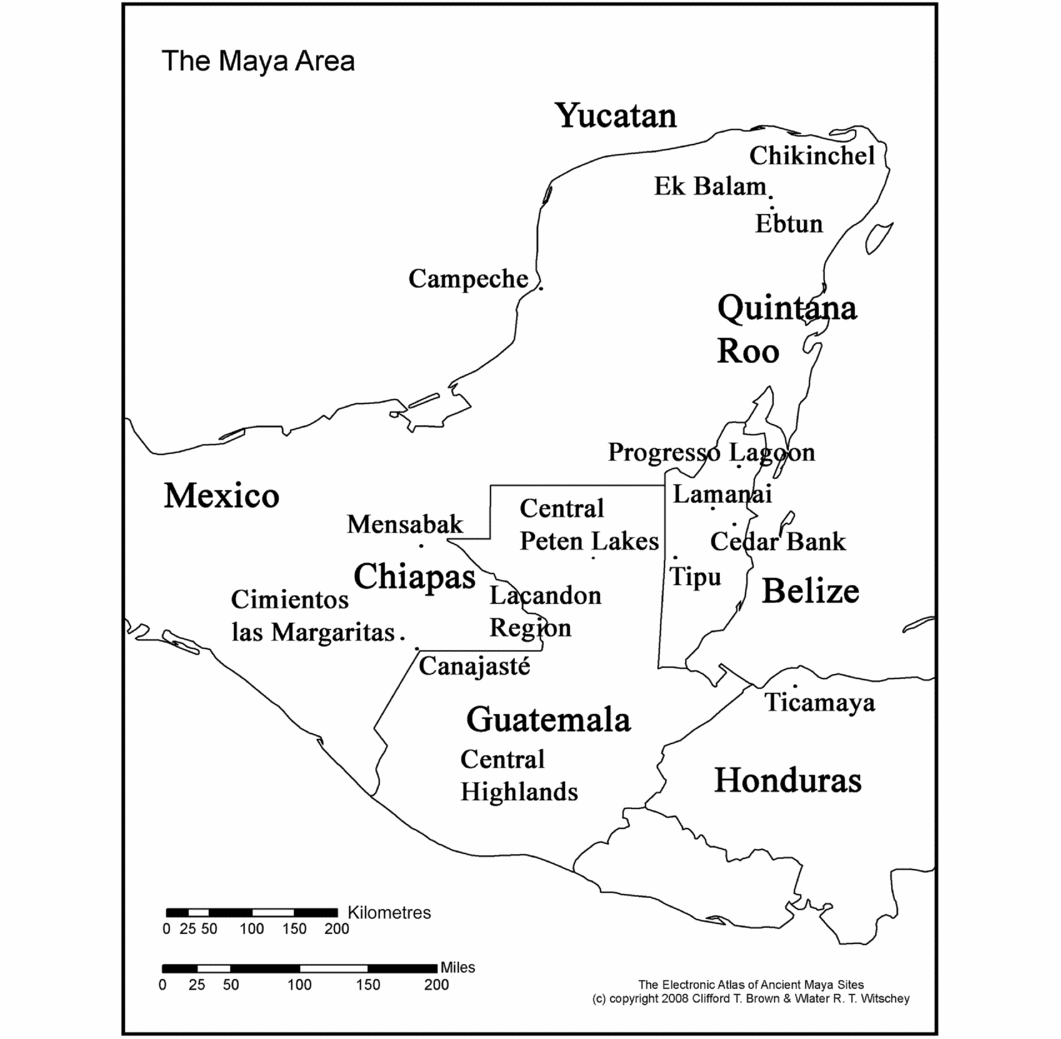
During a time of great cultural change at the end of the Classic period, Maya people abandoned their cities in the states of Yucatán, Chiapas and Tabasco in Mexico and in the countries of Belize, Guatemala, El Salvador and Honduras. Economic shifts, political reorganisation, transforming religious beliefs and environmental change were all factors in the transition from Classic to Postclassic Maya civilisation. The Maya, however, maintained settlements throughout the region, organised complex political networks and engaged in Mesoamerica-wide trading networks (De Vos Reference De Vos1988; Smith & Berdan Reference Smith and Berdan2003; Rice & Rice Reference Rice and Rice2009). Spanish conquistadors encountered a political and economic landscape that was highly localised. Some Maya people were experiencing a cultural and demographic resurgence, while others were in the midst of reorganisation after the collapse of regional city-states (Figure 1).
Map showing location of sites and regions mentioned in the text.

Here, we focus on the archaeology of indigenous Maya cultural transformations during the Spanish conquest and Colonial periods. The early Colonial period represents an important link between the complex dynamics of the Postclassic Maya world (c. AD 1000–1520) and the arrival of Europeans, their material culture and the broader global network of European contact. Recent work (since 2000) on the period of contact and early Spanish colonialism (from AD 1520 until the early 1700s) allows us to examine the ways that new theoretical perspectives and material data have been used to situate the Spanish conquest and the colonial experience within the long and continuing history of Maya life, rather than as the end of the Maya people.
We have divided up the archaeological literature into colonial zones of contact: ‘conquered zones’—areas that were controlled by the Spaniards and organised into congregaciones (new Spanish settlements inhabited by relocated Maya), with forced labour, re-organisation of domestic and social space, forced religious conversion and the oversight of friars and Spanish officials; ‘peripheral semi-conquered zones’—organised into encomiendas (conquistador control over regional units of Maya labour), with visita missions, but administered primarily through indirect rule by existing elites; and ‘unconquered zones’—beyond the Spanish colonial periphery and able to survive the historic period without colonisation.
Certainly there are overlaps and exceptions to each of these categories. There are good reasons to claim that Maya from conquered zones were never truly conquered—they may have been able to retain ritual Maya beliefs and worldviews, political offices and other traditions within private homes or couched within new Spanish institutions (see Quezada Reference Quezada2014). Some of the Maya in semi-conquered zones adopted Spanish material culture and religious practices despite a limited Spanish presence (Graham Reference Graham2011; Oland Reference Oland2014). Even the Maya from unconquered zones were affected by colonial processes, as they absorbed refugees from colonised areas and foreign material culture via trade (Palka Reference Palka2005). Nonetheless, different structural constraints existed in each zone, resulting in different processes of subjugation, autonomy and culture change.
Scales and rates of depopulation caused by disease probably also varied. Cook and Borah (Reference Cook and Borah1971) estimate that the native population of Yucatán fell from 800 000 to 140 000 due to a combination of pandemics and famine. Although disease certainly spread throughout the Maya area, we cannot assume that its effects were the same in areas heavily populated by Europeans as they were in unconquered and semi-conquered zones. Similarly, although droughts are well documented in Maya and Spanish documents from Yucatán (Gill Reference Gill2000), it is not clear whether the same conditions existed in more distant and forested regions (Iannone Reference Iannone2014).
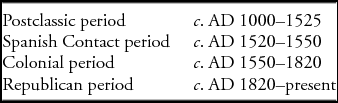
Breaking up the research into zones allows us to reconsider the traditionally monolithic meaning of the ‘colonial’ Maya. Archaeological research in each zone (and in some cases geographic areas within zones) requires different questions and considerations of material culture, cross-cultural interaction and population dynamics. General chronological periods substantiated by a large database of archaeological and historical research are shown in Table 1. These periods are not represented at every site or sub-region in the different zones, but they allow general comparison of artefacts and cultural change throughout the Maya region. Problems with chronologies and grand periods do, however, exist: Postclassic Maya material culture and behaviours changed in some areas before the Spanish invasion, whereas they continued for centuries afterwards in others. In certain areas, the Spanish conquest continued throughout the entire Colonial period.
General chronological periods in this article.

The studies highlighted here challenge our assumptions about the structural constraints of colonialism, the degree and nature of cultural change, and the motivations of Maya people in their interactions with Spanish colonisers. Maya people negotiated colonial changes and structural constraints within their own worldviews and long-term histories. Many retained indigenous religious traditions, preserved their social organisation and pursued their economic interests, which explains why millions of Maya inhabit their original territories today. This focus on indigenous strategy, agency and history broadly mirrors trends in the archaeology of the colonial Americas (e.g. Palka Reference Oland2009; Scheiber & Mitchell Reference Scheiber and Mitchell2010; Van Buren Reference Van Buren2010; Liebmann & Murphy Reference Liebmann and Murphy2011; Oland et al. Reference Oland, Hart and Frink2012; Ferris et al. Reference Ferris, Harrison and Wilcox2014).
Conquered zone
Recent research on conquered zones in Yucatán and Guatemala has focused on understanding the ramifications of colonial structures on Maya culture, religion and political economy. These studies most clearly connect the Maya to the emerging world system, yet they present challenges to the dominant models of capitalist expansion. Maya people adjusted to colonialism in innovative ways and maintained their indigenous culture while accepting certain aspects of colonial life and rejecting others.
In congregación settlements, Maya residents from outlying areas were clustered into a residential zone around a Christian church by Spaniards. Many congregaciones remain visible in the landscape today, along with churches, monastery buildings, wells and other colonial structures. Surveys of colonised areas use these physical markers to document the changing landscape and society throughout Maya history (Andrews & Robles Castellanos Reference Andrews, Robles Castellanos, Targa and Fournier García2009; Alexander Reference Alexander2012).
Alexander's (Reference Alexander2012) survey work traces the long-term evolution of the post-fifteenth-century landscape in Ebtun, and seeks to understand landscape changes as active post-colonial negotiations of indigenous politics, economics and identity. Her archaeological data show that Maya residents were not disconnected from their native lands, but that ties to places shifted with events such as population relocations, armed conflict and agrarian reform. Maya families and communities continue to maintain their native identities and territories through connections with their agricultural lands, religious beliefs, civic structures, lived pasts and socially constructed places.
Hanson's (Reference Hanson2008) study of artefacts from different Maya households at Colonial period Ek Balam (Figure 1) traces the community's introduction to the early capitalist system of the sixteenth century in Yucatán. A recent analysis of faunal remains from that site indicates that Maya residents reduced their hunting and consumption of indigenous faunal species, while adding several Eurasian species to their diet (deFrance & Hanson Reference deFrance and Hanson2008). These data suggest that colonial authorities restricted the mobility of Maya residents and redirected their economic activities towards the production of commodities such as salt, lime, pottery and indigo. Maya dietary adjustments, economic shifts and the exploitation of new animal species helped Maya communities survive drastic population and economic changes.
Other scholars have challenged conceptions of the Maya as mere victims of colonial and capitalistic forces. Recent analysis of salt production illustrates that the Maya of Chikinchel (Figure 1) were engaged in a competitive and commercialised economy, equivalent to that of Europeans (Kepecs Reference Kepecs and Kepecs2005). Economic development of this Maya region was set back by Spanish demands, population loss and colonial controls on movement. Nevertheless, Chikinchel's residents maintained a system of production and exchange that crossed political boundaries.
Pezzarossi (Reference Pezzarossi2014) challenges traditional conceptions of capitalism in early Colonial Highland Guatemala by examining domestic organisation and material culture. Maya residents at the rural community of Aguacatepeque, in the central highlands of Guatemala (Figure 1), clearly desired Euro-American pottery, which made them increasingly market-dependent. Yet Pezzarossi (Reference Pezzarossi2014: 324) argues that what appears to be the forces of capitalism driving market consumption is in fact the result of “unequal and coercive relations of production (i.e. colonial antimarkets)”, based in Spanish colonisation as well as in pre-Columbian, pre-capitalist and feudal practices. Aguacatepeque residents had a long history of acquiring pottery through market engagement. Requirements to pay taxes, tribute and debt in colonial currency reoriented native labour and time to market production, and away from subsistence activities. Pezzarossi argues that the Aguacatepeque Maya adapted to colonial economic transformations by acquiring foreign goods, such as decorated pottery, within a framework of existing indigenous aesthetics and exchange practices.
Recent work at Tayasal (Pugh et al. Reference Pugh, Sanchez and Shiratori2012), in the central Petén lakes region, focuses on mission settlements established after the Spanish conquests of the Itzaj and Kowoj Maya in central Petén, Guatemala, in 1697 (Figure 1). In the early 1700s, Spanish conquerors and clergy formed the small visita mission settlements of San Bernabé and San Miguel on the Tayasal peninsula. The construction of Colonial-period buildings and churches, in addition to the presence of European artefacts, indicate Spanish resettlement practices and Maya participation in the colonial economy. As at other early missions, however, the Maya that were resettled at Tayasal continued to practise indigenous rituals, including the caching of Maya objects in mission buildings and showing reverence for Maya spiritual forces and ancestors at shrines. They also continued making native pottery and stone tools well into the historic period, which calls standard historic chronologies into question.
The sources cited here struggle with the extent to which Maya populations in conquered zones were changed by the capitalist world system, colonial social structures and religion. These studies can often take advantage of standing colonial architecture and a rich archival record but use archaeological data to challenge or confirm the narrative of forced change and cultural erasure. The study by deFrance and Hanson (Reference deFrance and Hanson2008) uses faunal data to indicate colonial restrictions on economic labour. Other studies, however, illustrate that much of Maya life continued to be structured by Maya rituals, aesthetics, ties to land, a resilient cultural core and native economic priorities.
Peripheral semi-conquered zones
Archaeology in the semi-conquered zone reveals complex and complicated histories that intersect with colonial policies and processes, but which are not always directly influenced by them. Jordan's (Reference Jordan, Gaimster and Majewski2009) concept of ‘colonial entanglement’ applies well to this zone of contact. Maya communities were living within a colonial milieu, and interacted with colonisers intermittently (sometimes in violent confrontations), but were not fully controlled. Spanish settlements existed in the area, and peripheral indigenous populations were affected by conflict, disease and shifting trade patterns. In most cases, indigenous leadership remained in place (Quezada Reference Quezada2014). In these types of colonial entanglements, “it is hard to tell who (if anyone) has the upper hand” (Jordan Reference Jordan, Gaimster and Majewski2009: 32).
One region of colonial entanglement was ‘the Belize Frontier’, an area known for coordinated resistance against Spanish colonisers (Jones Reference Jones1989). This zone includes the present-day nation of Belize and the southern part of the Mexican state of Quintana Roo (Figure 1). Northern Honduras represents another semi-conquered zone, of peripheral interest to the Spaniards but important to both Maya and European pirates as a coastal area. Regions on the edge of newly established Spanish towns in the eastern Chiapas highlands present additional case studies of frontier Maya populations.
Graham's (Reference Graham2011) Maya Christians and their churches in sixteenth-century Belize revisits the archaeology of the sites of Tipu and Lamanai, originally excavated in the 1980s and 1990s, and it presents new excavations that she led near church and household sites at Lamanai in 2007 (Figure 1). Both of these sites were visita missions, meaning that churches were built at the communities but were visited only sporadically by travelling priests. Graham uses archaeological evidence to conclude that the churches were built with Franciscan oversight, but that Christianity took on a life of its own with Maya practitioners. For example, the church graveyard at Tipu was used for Maya burials long after the church had been abandoned. At Lamanai, caches of Maya objects were placed in the church after the 1638–1641 revolts.
Updating older theories of resistance and syncretism, Graham argues that Franciscan conversion efforts were filtered through a Maya worldview, and she dismisses the concept of ‘religious change’ for the colonial Maya of the Belize region. Instead, she urges us to look at Maya religious belief and behaviour in this period as part of a suite of socio-cultural changes, including changes in the power structure, wealth accumulation, practices of warfare and complexities of religious ideology from a native perspective.
Other work at Lamanai has addressed the political economy of the colonial community. Simmons and colleagues (Simmons et al. Reference Simmons, Pendergast and Graham2009; Simmons & Shugar Reference Simmons, Shugar, Shugar and Simmons2013) have focused on copper alloy metallurgy at elite residences in the vicinity of the colonial church at Lamanai. Artisans associated with these households created copper bells, axes and other objects using the lost-wax casting technique, as evidenced by production debris and miscast pieces. Chemical analyses reveal that objects from Contact-period contexts were made by melting down older Postclassic objects imported from western Mexico. These data suggest that control over the production and consumption of this metal was an important aspect of elite Maya power at the end of the Postclassic and into the Colonial period.
Some Late Postclassic- to Colonial-period commoner households at Lamanai contained sherds of Spanish pottery; others did not, despite apparently contemporary occupation (Wiewall Reference Wiewall2009, Reference Wiewall, Douglass and Gonlin2012). Wiewall concluded that while pre-contact and colonial houses could not be distinguished, a shift in labour practices and resource allocation could be observed through a movement towards expediency in lithic and faunal exploitation, and a continued reliance on local clay sources for pottery production.
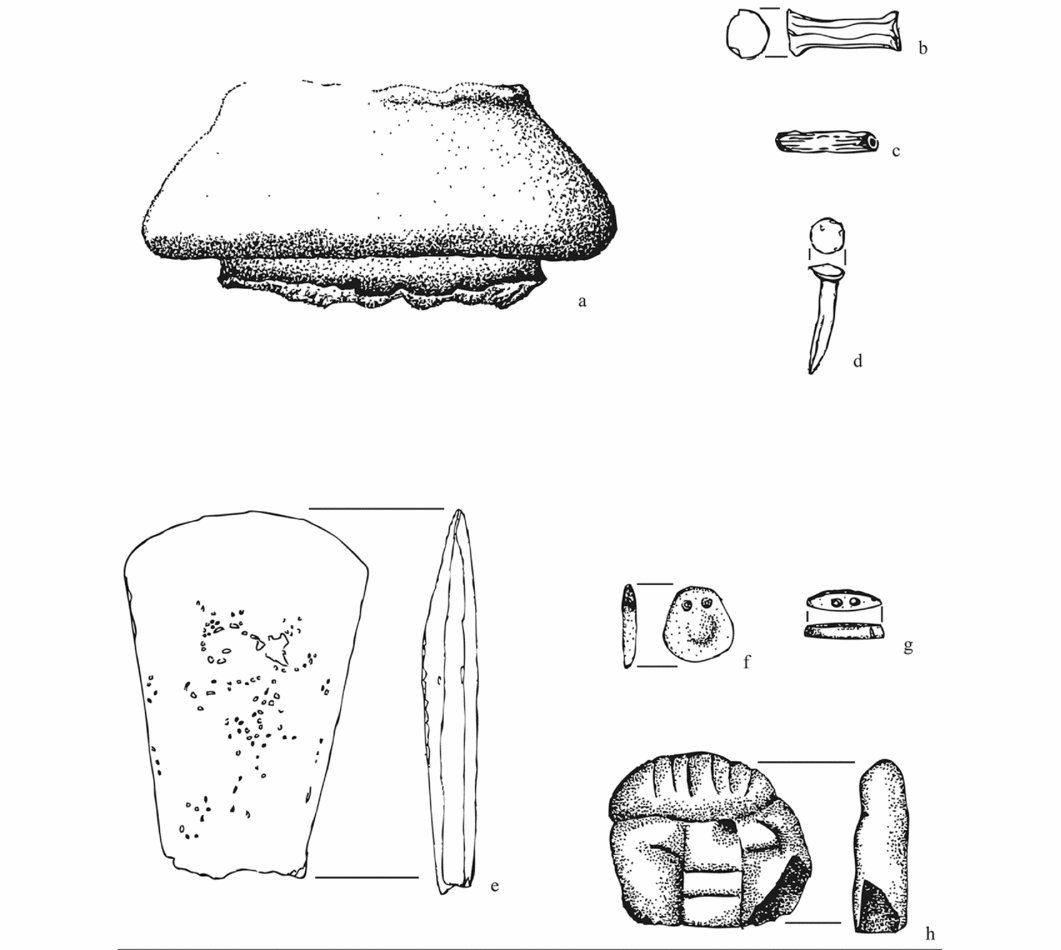
Oland (Reference Oland2009, Reference Oland, Oland, Hart and Frink2012, Reference Oland2014, in press, n.d.) has written about the changing political economy at the Maya community on the western shore of Progresso Lagoon, a site thought to be the Colonial-period encomienda of Chanlacan, mentioned in Spanish historical records (Figure 1). Spanish artefacts at Progresso Lagoon were restricted to the primary elite residence, where they were part of an assemblage of specialised elite consumption that included copper axes and feasting remains (Figure 2). Some Spanish artefacts were used in Maya rituals, evidenced by a sherd of olive jar that was buried beneath an altar in the shrine attached to the primary elite residence.
European and exotic indigenous artefacts found at the primary elite residence on the west shore of Progresso Lagoon, Belize: a) rim of a Spanish olive jar; b) bronze rivet; c) Nueva Cadiz glass trade bead; d) bronze nail; e) indigenous bronze axe; f–g) shell beads; h) Preclassic diadem pendant with failed attempts at drilling (drawings by Peter Vamosy).

Oland argues that colonial interactions should be understood within the context of a fifteenth–seventeenth century Maya cycle of political disintegration and efforts at re-integration, rather than merely as responses to conquest. Significant political, economic and ritual changes occurred in the fifteenth century after the collapse of the Late Postclassic capital of Mayapán and the subsequent collapse of Maya political and economic networks in the Maya lowlands. It is clear that Progresso Lagoon's elites manipulated Spanish material culture in their efforts to remain relevant and consolidate power in uncertain times.
Other isolated finds in Belize offer tantalising hints about the complexity of colonialism on the semi-conquered frontier. For example, Morandi (Reference Morandi2010) excavated an elite Maya residence at the Cedar Bank site in the Sibun River Valley (Figure 1), which revealed a dense and varied deposit of Spanish artefacts. Spanish artefacts have been found cached in caves in western and central Belize; they include a sixteenth-century sword and whole and fragmented olive jars (Peterson Reference Peterson2006; Awe & Helmke Reference Awe and Helmke2015). These finds echo the use of Spanish artefacts in Maya rituals in northern Belize (Oland Reference Oland2014, n.d.) and Petén (Pugh Reference Pugh2009).
Blake (Reference Blake2010) investigated Maya households at the site of Canajasté, between the Maya highlands and the lowlands of eastern Chiapas (Figure 1). A large Maya community thrived there until the early Colonial period, and inhabitants participated in a regional exchange network, acquiring obsidian from Guatemala, copper bells from central or western Mexico and marine shell ornaments from the Pacific coast (Blake Reference Blake2010). The site was protected by a large defensive wall, demonstrating the escalation of indigenous conflict in the region prior to the Spanish conquest. The Maya abandoned Canajasté during the Spanish conquest of the Chiapas highlands, perhaps due to disease, forced relocation to colonial towns or warfare (Lee & Hayden Reference Lee and Hayden1988). It is also possible that some of the inhabitants chose to relocate to other Maya settlements, or avoided conquest by fleeing to unconquered Maya territory to the north.
At the site of Cerro de los Cimientos, west of Canajasté (Figure 1), Maya constructed their settlement on a hill in a swamp, which provided a defensible location (Lowe & Alvarez Asomoza Reference Lowe, Alvarez Asomoza, Lowe and Pye2007). Archaeologists at Cerro de los Cimientos recorded obsidian from Guatemalan and Mexican sources, copper artefacts from central and western Mexico, and amber ornaments from Chiapas, as well as an iron nail and a Spanish olive jar. These data indicate Maya participation in changing regional trade networks during the Late Postclassic and Colonial periods. The Spanish probably relocated the Maya to nearby colonial towns, but the population may also have been reduced by disease and warfare, left for nearby Maya or Spanish sites or escaped into the unconquered lowlands to the north.
Finally, archaeological evidence from northern Honduras shows that the Maya of Ticamaya (Figure 1) acted strategically as they interacted with the Spaniards and other Europeans (Blaisdell-Sloan Reference Blaisdell-Sloan2006; Sheptak et al. Reference Sheptak, Joyce, Blaisdell-Sloan, Liebmann and Murphy2010). Although Ticamaya was peripheral to Spanish colonial interests, it maintained political and economic ties to other Maya communities throughout the Colonial period, and took on the role of defender of the coast from other European pirates. Blaisdell-Sloan (Reference Blaisdell-Sloan2006) argues that this defensive role created changes within Ticamaya society, including a new definition of masculinity based in warfare (see also Sheptak et al. Reference Sheptak, Blaisdell-Sloan, Joyce, Voss and Casella2012)
Semi-peripheral communities lacked sustained contact with and control by Spanish authorities, allowing us to see the continued importance of Maya political and economic goals within the colonial milieu. Archaeologists have discovered defensive structures and disruptions to economic networks, which reflect Maya political instability in the decades before and after the Spanish conquest. Other data suggest that the conquest created opportunities for Maya political leaders to consolidate power and rebuild socio-economic networks. An intermittent Spanish presence allowed some Maya to adopt colonial material culture and religion strategically, and to alter social structure in ways that reflected Maya priorities rather than Spanish ones. Yet in other areas, Maya communities fled into the interior to escape Spanish demands and political unrest.
Unconquered zone
The Spanish conquest of territory along the coasts, highlands and lowland rainforests of the Maya region affected adjacent, non-subjugated indigenous populations found in the interior. The largest patches of unconquered Maya lands were found in southern Yucatán, northern Guatemala, western Belize and eastern Chiapas, although pockets of settlement free from colonial rule existed in the entire Maya area. Archaeological projects have located Maya populations who lived beyond the direct reach of the Spanish colonists but who were touched by colonialism and reacted to changes in their lifeways according to indigenous practices. The Spanish invasion of the highlands of Guatemala and Chiapas, in addition to military forays into the lowland rainforest frontier from around AD 1525–1700 (de Villagutierre Soto-Mayor Reference De Villagutierre Soto-Mayor1983; De Vos Reference De Vos1988), resulted in drastic culture change for unconquered Maya.
Investigators led by Palka (Reference Palka2014) at archaeological sites in habitation areas and pilgrimage shrines at Lake Mensabak in the sierras of eastern Chiapas (Figure 1) have excavated Maya sites from the Late Postclassic to the early Colonial periods with dates based on indigenous pottery styles, metal weapons trauma, and radiocarbon dates (Deeb et al. Reference Deeb, Kestle and Palka2011; Nuñez Ocampo Reference Nuñez Ocampo, Juárez, Deeb and Palka2013). The population at Lake Mensabak increased dramatically at this time. The presence of a large number of small sites rather than one, or a few larger, examples supports the notion of extensive immigration to the lake area. It is possible that Maya people came from regions affected by conflict with other indigenous groups and the Spanish colonisers.
The Maya at Mensabak remained free of Spanish rule, which was centred at the distant towns of Palenque and Ocosingo in Chiapas. In the Colonial period, Maya buried their dead at the base of a ritual cliff at a shrine called Sak Tat by contemporary Lacandon Maya (Figure 3). Their remains show violent deaths, such as a machete or sword cut to the face that cleanly removed the left side of a lower jawbone, a machete cut to a leg, a fall or blunt force trauma to the head, and scalping or flesh removal on the head with a metal knife (Cucina et al. Reference Cucina, Tiesler and Palka2015). This violence probably stemmed from local indigenous conflicts over the shifts in trade and the acquisition of metal tools, demarcation of agricultural land in a contested region, changes in demography and social organisation and political transformations following economic and demographic changes during the Spanish Colonial period (Hill Reference Hill1996). It is possible, however, that Spanish soldiers killed some of these Maya in armed conflicts. Burials at this and other shrines at the lake from the Late Postclassic to the Colonial period were undertaken by the resident Maya to create ancestral lands and ties to territory (Palka Reference Palka2014). The rituals carried out by protohistoric Maya at the shrines with the bones of their ancestors enabled them to communicate with the gods through deceased human intermediaries. Participants in the ceremonies probably sought to obtain balance and protection in the midst of dramatic social, economic and demographic changes in their world during the Colonial period.
Burials at the Sak Tat shrine, Lake Mensabak, Chiapas (photograph by Joel Palka).

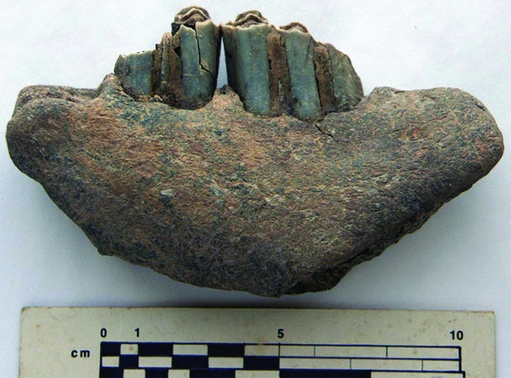
Excavations of public architecture, religious shrines and households have shown that Kowoj Maya at the site of Zacpeten, in the central Petén lakes region of northern Guatemala (Figure 1), incorporated objects associated with the Spanish into ceremonial deposits in elite contexts (Pugh Reference Pugh2009). Kowoj religious specialists placed iron tools, a white clay pipe, a lead musket ball, and a worked cow jawbone (Figure 4) in indigenous ritual deposits together with Maya objects associated with public and elite residential buildings. During the time of these rituals, from around AD 1525–1700, the Kowoj Maya remained free from Spanish rule. They did, however, have intermittent contact with Spaniards, and traded with other unconquered Maya groups in the region and with Maya living in colonial settlements to the north and east. As Pugh (Reference Pugh2009) argues, Kowoj Maya elites obtained Spanish material culture to use in rituals to harness the power of the Europeans.
Modified cow mandible recovered from a ritual deposit at Zacpeten, in the central Petén lakes region of northern Guatemala (photograph used with permission of Timothy Pugh).

Lacandon Maya in Petén and Chiapas also obtained large quantities of foreign manufactured trade goods, including metal tools, white earthenware pottery and glass bottles, from colonial times to the early twentieth century (Palka Reference Palka2005; Figure 5). Although the Lacandon still maintained autonomous settlements in indigenous territory in the lowland rainforests, they actively sought trade with outsiders in local towns and logging camps to acquire things that became necessities in their daily lives. Subsistence practices, trade patterns and social organisation altered by centuries of cultural contact and change resulted in a reliance on foreign objects that the Lacandon Maya could not manufacture. Unconquered Maya areas experienced colonialism indirectly, in the form of immigration, the disruption of trade routes and political networks, and the introduction of new material culture. All of these contributed to the increase in violence seen in interior regions. There is evidence that the Itzá Maya of the Petén lakes attempted to integrate the semi-peripheral settlements of Belize into their sphere of influence in the sixteenth and seventeenth centuries (Jones Reference Jones1998). Skeletal data from Lake Mensabak show the way that metal tools contributed to violent conflicts even when Spaniards were not present. In the nineteenth century, the larger number of foreigners entering this unconquered Maya region resulted in greater attempts at eliminating, removing or assimilating Lacandon populations. The heightened cross-cultural interaction at this time was also fuelled by the desire of outsiders to trade with the Lacandon Maya for food, beeswax, animal skins and fine tobacco, which became important goods in the regional economy. Following this colonisation of the unconquered lowlands, Lacandon Maya moved deeper into the forests to avoid contact with outsiders and the negative effects that they brought with them, such as conflict, disease, religious changes and political subjugation.
Foreign trade goods obtained by the Lacandon Maya of Petén: a) sherd from a Blue Willow pattern plate (blue and white designs); b) white earthenware bowl with green, red and black stripes; c) white earthenware teacup with white slip; d) clear glass medicine bottle; e) metal machete and axe file; f) green glass wine bottle; g) metal scissor; h) metal cooking pot; i) metal machete.

Discussion
Colonialism often implies a jarring and drastic change. Although this is true in the long term—that the Maya were drawn into a capitalist, Eurocentric world system of modern nation states—an examination of early colonial studies suggests that there was huge variation in the ways and rates that this occurred. Archaeology allows us to comprehend variation in local indigenous adaptations to long-term changes in colonial life.
In part, colonial variation was ecological and economic. Spaniards tended to avoid the uncomfortably hot and humid lowlands, preferring to conquer (and inhabit) the drier coastal regions of Yucatán, and the highland communities of Guatemala. Spanish conquistadors earned income from tribute collected from encomiendas (grants of Indian labour), such as cotton cloth, maize and turkeys. They did seek out forest products, such as cacao, tobacco, wax and honey, but some of this could be obtained through continued Maya trade with unconquered regions. Less palatable regions, known for rebellious Indians, British and Dutch pirates and poor climate, were typically conquered by Spaniards of lower status who stood to gain a title from the Spanish crown for their labours. Salamanca de Bacalar, one such peripheral outpost, was more valuable as a port of colonial trade (some of it illegal) than for its meagre encomienda tribute (Jones Reference Jones1989: 69). Outposts such as Bacalar and Ticamaya were also valuable for defending Spanish territory from British and Dutch encroachment.
Variation in contact also led to far different rates of conversion to colonial ways of life and thought. Hanks (2010) illustrates that many colonising ideas were lost in the translation between Spanish and Maya languages. He argues, however, that the process of combining the two languages was integral to the conversion of the Maya, and to the creation of a new Maya conceptual ordering of the world, based in both Maya and Christian ideologies. It follows that more conversion occurred in areas of intense interaction, where Maya and Spanish individuals worked hard to make themselves understood.
At the same time, many conflicts stemmed from Maya and Spaniards talking past each other, rather than simple mistranslation. Some archaeological examples of cross-cultural conflict may be better understood through the lens of double mistaken identity, a concept developed by James Lockhart (Reference Lockhart1999) and applied to the Maya by Matthew Restall (Reference Restall2003). Both the Spaniards and Maya acted rationally within their own worldview, without full knowledge or understanding of the motivations and historical trajectory of the other. For example, Spaniards did not fully understand Contact-era Maya political organisation, interethnic and lineage conflict, or the tenuous and fragmented network of alliances that existed across conquered and unconquered areas. Neither the Spaniards nor the Maya understood the long-term implications of colonisation or the ways that Maya villages would be drawn into a European, capitalist world-system. Spaniards remained focused on personal opportunity, as well as the role of Spanish colonies in the larger sphere of European expansionist politics. Maya political leaders continued to act with local and lineage politics as their primary concern, with the Spaniards incidental to these interests.
Through long-term historical studies, multi-scalar analyses, large-scale settlement survey and attention to everyday life, the studies considered here emphasise the complexities and variation of Maya life in the early Colonial period. In situations of clear domination, they clarify how these constraints structured everyday Maya lives, the ramifications of the introduction of a capitalist world-system, foreign rule and Christianity to the Maya world. Even in unconquered areas, these approaches make it clear that new people, material culture, conflicts and disease arrived in autonomous Maya regions, even if the Spaniards themselves did not. They show that the Maya people strategised according to their own political and economic interests, social organisation, land tenure and religious ideology. These studies are important for shifting the narrative of the Maya people from one of collapse and conquest, to a more continuous story in which change is understood within a much longer framework of Maya life. These approaches do not deny the horror and violence that accompanied much of the Indigenous colonial experience, but seek instead to situate it within a perduring set of cultural values, practical political and economic goals, and religious worldviews.