INTRODUCTION
Generics are of interest to scholars from a broad range of disciplinary backgrounds, including linguistics, philosophy, psychology, anthropology, and machine learning. Although the evidence and methods may differ, what these different approaches share is a fascination with the paradoxes posed by generic language: How do such ordinary, unremarkable, seemingly simple expressions so deeply resist any easy characterization? Why is it that their semantics defy the analytical tools of formal logic? How is it that young children who are first learning how to talk express abstract concepts with ease? What assumptions and implicit messages do generics convey, and why do they have such power to offend? Puzzles such as these are inherently interesting. But also, the promise of solving them holds hope for revealing important truths about language, social interaction, and the mind.
In this article, I lean into the interdisciplinarity of generic scholarship to examine two questions in parallel: (i) What does a consideration of language as embedded in social context contribute to contemporary theories of generics? and (ii) What questions from the contemporary work on generics—asked or intimated—may be promising directions to investigate or theorize, for those with interests in language as a fundamental aspect of social life? I argue that there are fruitful opportunities for influence in both directions. I offer my perspective as a psychologist who has been engaged in the study of generics for over two decades, with a focus on children and parent-child conversations (Pappas & Gelman Reference Pappas and Gelman1998; Gelman Reference Gelman2003, Reference Gelman, Geoffrey Hall and Waxman2004, Reference Gelman and Pelletier2010; Gelman & Meyer Reference Gelman, Meyer, Brooks and Kempe2014; Gelman, Leslie, Gelman, & Leslie Reference Gelman, Leslie, Gelman; and Leslie2019).
The article is structured as follows. First, I articulate some of the richness of the insights provided by the study of generics in social interactions. Then, in the following three sections, I focus in turn on three key themes that motivate the study of generics: They are a window onto human concepts, they provide a mechanism of social transmission, and they pose a challenging learning puzzle. For each, I discuss how a sociolinguistic or anthropological approach enriches our understanding, and what might be promising new directions for this work to take. I then take a step back to consider how generics are used not in everyday social interactions, but rather in academic writing. Finally, I conclude with a few general points for the future.
GENERICS IN SITU
What is striking about the articles in this special issue is that they richly reveal how generics function in meaningful, culturally embedded interactions. That generics are set within larger contexts may be a given to many readers of this journal, but this assumption stands in stark contrast to standard treatments of generics, which typically consider generic statements as isolated propositions, devoid of context, often regarding arcane facts, and analyzable in terms of propositional logic.
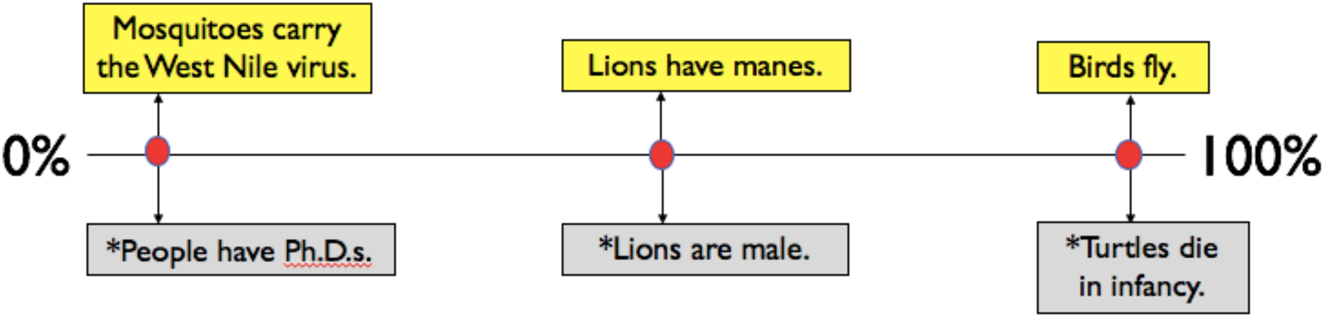
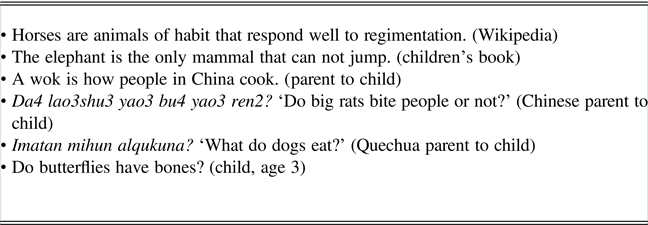
To emphasize just how unusual it is to examine generics in context, consider a typical manner in which generics may be introduced. Table 1 and Figure 1 are slides I often use when discussing generics with an academic audience. Sources for these and other discussions of generics include: Lawler (Reference Lawler1973); Dahl (Reference Dahl and Keenan1975); Carlson & Pelletier (Reference Carlson and Pelletier1995); Gelman, Coley, Rosengren, Hartman, & Pappas (Reference Gelman, Coley, Rosengren, Hartman and Pappas1998); Gelman & Tardif (Reference Gelman and Tardif1998); Prasada (Reference Prasada2000); Cohen (Reference Cohen2004); Gelman, Taylor, & Nguyen (Reference Gelman, Taylor and Nguyen2004); Leslie (Reference Leslie2007, Reference Leslie2008); Mannheim, Gelman, Escalante, Huayhua, & Puma (Reference Mannheim, Gelman, Escalante, Huayhua and Puma2011); and Tessler & Goodman (Reference Tessler and Goodman2019).
Approximate frequency of predicates within generic statements (e.g. % of mosquitoes that carry the West Nile virus). The statements in yellow boxes are acceptable generics; those in gray boxes are infelicitous.

Sample generics.

As can be seen, these examples are isolated propositions, drawn from widely varying sources, devoid of context or speaker. Debates in the literature often focus on a small set of favorite examples. My goal is not to criticize these examples, or the authors (including myself) who discuss them to convey notable aspects of generic language. When gathered and presented in this manner, isolated examples serve an important purpose. They illustrate the breadth and ubiquity of generic language—ranging in content, form, languages, speakers, and media. They remind the audience that even young children hear generics, and generate new generic utterances that they are unlikely to have heard before. They highlight some of the puzzling features of generics, for example, that we can say that ‘Mosquitoes carry the West Nile Virus’, even though less than 1% of mosquitoes do so (Leslie Reference Leslie2007). They draw our attention to seeming inconsistencies, for example, that we can say ‘Birds lay eggs’, even though only female birds lay eggs, yet we reject the statement ‘Birds are female’, even though all egg-laying birds are female (a point appreciated by even young children; Brandone, Cimpian, Leslie, & Gelman Reference Brandone, Cimpian, Leslie and Gelman2012). These are significant observations about generic language that raise provocative questions about the cognitive foundations underlying their use.
Nonetheless, this standard approach is limited in taking as the object of study a set of isolated propositions—isolated from one another, isolated from their (conversational or written) context, and isolated from any but the barest of information about speakers and their goals.
As illustrated by the articles in the present issue, a consideration of social context differs from this standard approach by shifting the focus of attention from the generic as a linguistic object, to interactions that include generic language. This move also involves shifting from an exclusive focus on the form and content of generics, to include a serious consideration of the ways that generics function for speakers and listeners. There is subtlety, complexity, and even contradiction in how people use generics in everyday interactions. As we can see in these articles, generics in conversation serve powerful pragmatic purposes—including to stereotype, essentialize, dehumanize, self-fashion, and negotiate. And not coincidentally, people aren't just listing facts about remote entities, such as lions or elephants; rather, generics are deployed to discuss kinds that are deeply and personally meaningful, including types of people or moral categories.
This perspective gives us an opportunity to consider the limits posed by studying generics as disembodied entities, and conversely the new insights afforded by the more difficult but ultimately necessary approach of examining generics in their linguistic and cultural contexts. I consider some of these points in the remainder of this article.
THEME 1: GENERIC LANGUAGE AS A WINDOW ONTO GENERIC CONCEPTS
One key theme that motivates the study of generics is that generic language provides a window onto the nature of generic concepts (Prasada Reference Prasada2000). An important contribution of the present articles is their thoughtful analysis of the ways that generics can function to stereotype, essentialize, and dehumanize members of a social group (see also Hammond & Cimpian Reference Hammond and Cimpian2017). Janet McIntosh (this issue) richly documents the painful dehumanization that military epithets—derogatory labels that make reference to kinds, and that can readily enter into generic expressions—can express. A person characterized with epithets is no longer ‘somebody's dad, somebody's son, somebody's uncle, somebody's brother’—instead, they simply are one (replaceable) instance of an undifferentiated group. Jack Sidnell (this issue) similarly talks of dehumanization, making the important point that by treating concepts like ‘Vietnamese’ or ‘American’ as if they are ‘natural kinds’, generics are likening people to species of animals (see also Rothbart & Taylor Reference Rothbart, Taylor, Semin and Fiedler1990).
An important unresolved question is why and how labels and generic language function in this way. To what extent is this the province of generics? Any label (even a specific label) places an individual into a category, and as McIntosh insightfully notes, generic types do not always entail generic reference. It thus remains an empirical question whether generic reference uniquely amplifies the stereotyping and dehumanizing so powerfully revealed in these articles, above and beyond generic types per se (but see Gelman, Ware, & Kleinberg Reference Gelman, Ware; and Kleinberg2010; Rhodes, Leslie, & Tworek Reference Rhodes, Leslie and Tworek2012; and Rhodes, Leslie, Bianchi, & Chalik Reference Rhodes, Leslie, Bianchi and Chalik2018 for experimental support for generic reference playing a causal role). To the extent that generics are more powerful than specifics is the problem due to the content of generic statements—problematic generalizations that are then assumed to apply broadly to individuals, regardless of their particular circumstance? Or are generics per se pernicious, even if the content is non-existent or positive? In other words, is dehumanization baked into the semantics of generics, which gloss over difference? Do generics applied to a person necessarily strip them of their particular history, place, context—in other words, their individuality?
A further complexity is the seemingly contradictory point that generics can also be the source of wisdom, perspective, and meaning-making. Jack Sidnell's article provides a glimpse of this function, where proverbs are expressed generically. Consider the timeless truth of wise sayings that are passed down from one generation to the next, such as, ‘Rich eyes, hard hands’. Similarly, proverbs in English often take generic form (e.g. ‘As you sow, so shall you reap’; ‘Better the devil you know than the devil you don't’; ‘If you lie down with dogs, you will get up with fleas’; ‘You can't get blood out of a stone’; ‘You can't teach an old dog new tricks’; ‘You win some, you lose some’). Framing an idea generically may make it more ‘portable’, applicable to others, and resonant (Orvell, Kross, & Gelman Reference Orvell, Kross and Gelman2020).
My collaborators and I have found that when English speakers in the US are asked to make meaning out of a difficult experience, they often take a generic perspective, by means of the generic pronoun ‘you’ (meaning ‘one’ or ‘anyone’) (Orvell, Kross, & Gelman Reference Orvell, Kross and Gelman2017). (A variety of languages employ ‘you’ in the generic sense, including Dutch, German, Gulf Arabic, Hindi, Mandinka, Saliba-Logea, and Duna; for some examples, see Kitagawa & Lehrer Reference Kitagawa and Lehrer1990; Creissels Reference Creissels, Bakker and Haspelmath2013; de Hoop & Tarenskeen Reference de Hoop and Tarenskeen2015; and Margetts Reference Margetts2015.) We employed an expressive writing task, in which participants were asked to write continuously for ten minutes about a recent personal experience. We found that participants were much more likely to include generic you in their reflections when asked to write about a negative experience than when asked to write about a neutral experience, and were also much more likely to include generic ‘you’ when asked to make meaning out of a negative experience than when asked to relive a negative experience. Examples of generic you statements in their reflections included: ‘You can actually learn a lot from others who see things differently than you’ or ‘Sometimes people don't change, and you have to recognize that you cannot save them’.
We found a similar result in a study with small children, who heard short stories about a character undergoing a negative experience (e.g. being excluded from a game; having their sandcastle stepped on by another child), and were asked to say what the character had learned from the experience (Orvell, Kross, & Gelman Reference Orvell, Kross and Gelman2019). Children were much more likely to spontaneously use generic you in their responses in this meaning-making condition, as compared to a control condition where they were asked to say how the character felt. Sample generic-you statements regarding the character included: ‘That you can't play with people all the time and you have to make new friends’; ‘That you should be kind to one another’; and ‘That sometimes people won't let you play’.
These findings suggest that generics can be flexibly used for a wide range of functions: to provide distance, to enforce norms, to teach, to persuade, to rationalize. In this sense, we need to avoid genericizing the pragmatic effects of generics. Framing an idea with a generic does not stipulate or constrain its functionality. An important future direction is to reconcile these seemingly contradictory impulses. When do generics dehumanize and when do they open up a space for wisdom or compassion? When do generics create walls, and when do they create connections? What is it about the content, form, or context of use that shifts these functions?
THEME 2: GENERIC LANGUAGE AS A MECHANISM OF SOCIAL TRANSMISSION
A second key theme that motivates the study of generics is that they provide an important mechanism of social transmission. In his article in this issue, Bruce Mannheim characterizes generics as ‘social replicators’ that transmit concepts across populations and over time. This point is a thread throughout the articles in this issue. For example, Charles Zuckerman notes that essentializations do not just exist out there in the world; rather, they must be expressed and passed along from one person to the next. Similarly, Sidnell suggests that generics may play a role in articulating and reproducing ideology. Although all of language serves a social transmission function, generic claims are arguably especially powerful in the assumptions and concepts transmitted (Gelman & Roberts Reference Gelman and Roberts2017). For example, consider the simple statement that a parent provided when talking to a twenty-month-old child: “Bats live in caves” (Gelman et al. Reference Gelman, Coley, Rosengren, Hartman and Pappas1998). This simultaneously asserts that there is a kind (bats) about which generalizations can be made, attributes a predicate to that kind (they live in caves), and suggests that the kind has a reality and stability consistent with essentialism (as discussed in the section above; see also Gelman et al. Reference Gelman, Ware; and Kleinberg2010). Thus, even the simplest of generic claims goes well beyond a simple narration of what may be observable through other means (e.g. the location of an object; its shape or color).
But what gives generics their power? I suggest that the answer lies not only in what they express, but also in part in what they do not express. Here we need to consider the notion of a ‘placeholder’ concept, a concept discussed in consideration of essentialism (Medin & Ortony Reference Medin, Ortony, Vosniadou and Ortony1989). A placeholder is a skeletal expectation that has not (yet) been filled in with content (see also Putnam Reference Putnam and Putnam1975). In the case of essentialism, a placeholder concept is an expectation that a kind has some sort of causal essence, prior to knowing what that essence might be. For example, a child who essentializes sex differences may believe that there is something deep, internal, and inherent that distinguishes boys from girls, long before knowing anything regarding chromosomes (Gelman Reference Gelman2003). Such a child has a placeholder concept—the notion that there is some causal essence to gender, with details to be filled in later, if at all.
The claim here is that generics—like essentialism—are more placeholder than fully articulated. Rather than expressing a precise logical or statistical relation between subject noun phrase and predicate, a generic more loosely gestures to the predicate being somehow importantly relevant to the kind. Exactly how it is relevant is open for debate, and some theorists have suggested that there may be multiple factors that render a predicate relevant for generic expression (e.g. Prasada & Dillingham Reference Prasada and Dillingham2006, Reference Prasada and Dillingham2009; Leslie Reference Leslie2007, Reference Leslie2008). My working hypothesis is that a variety of cues are relevant, including prevalence, distinctiveness, danger or threat, and biological folk theories. Furthermore, generics have implications that are unspoken, and speakers may not even be aware of these implications. They presuppose rather than state directly. It is difficult to refute an implication when one is not even aware that it exists. It is difficult to question an ontology that is presupposed, and so invisible. This makes generics difficult to refute. In brief, the placeholder status of generics may make them resistant to counter-evidence.
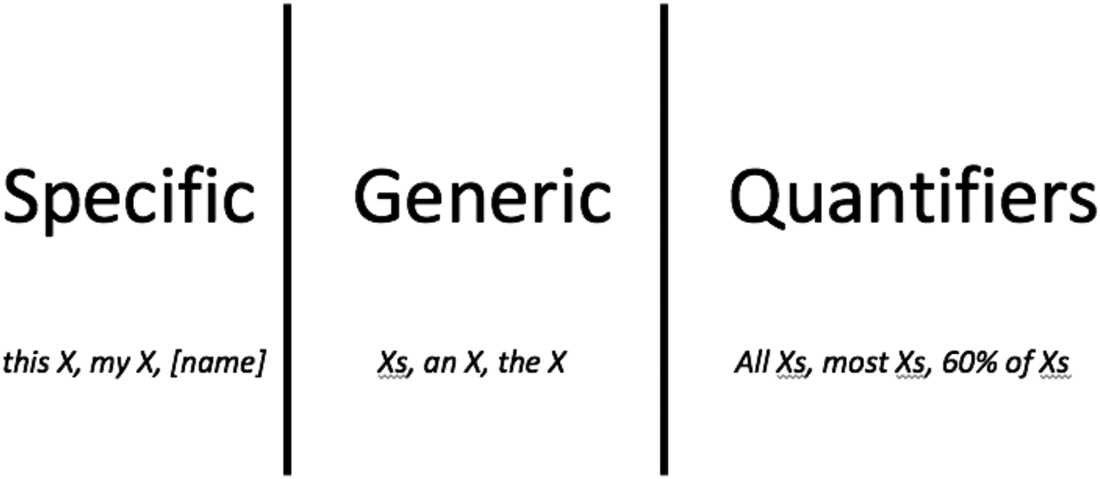
To appreciate this point, consider that generic noun phrases (NPs) (e.g. Dogs bark) contrast not only with specific NPs (e.g. That dog barks; He barks; Fido barks) but also with quantified NPs (e.g. Most dogs bark; some dogs bark; 50% of dogs bark) (see Figure 2). Although at first glance generics may seem comparable to quantified statements with ‘most’ or ‘all’, there are important differences, revealing how differently generics and quantifiers function. Compare, for example, the implications of how a harmful stereotype about girls and math is expressed: ‘Girls don't like math’ (generic) versus ‘All girls don't like math’ (quantified). Whereas even a single counter-example (one girl who likes math) refutes the universally quantified statement, it is almost impossible to refute the second, generic statement. No matter how many math-loving girls are identified, a person could maintain that ‘Girls don't like math’ is still true—that the exceptions are mere exceptions that don't undermine the basic truth that disliking math is a core property of girls, part of their intrinsic nature, an aspect of how they should be (Prasada & Dillingham Reference Prasada and Dillingham2006, Reference Prasada and Dillingham2009). (Consider again that we believe that mosquitoes carry the West Nile virus, and that sharks attack swimmers, despite most mosquitoes not carrying the West Nile virus, and most sharks not attacking swimmers.) Examples such as these support the view that generics express properties that are core to membership in the kind, in contrast to quantifiers, which express a strictly statistical regularity (Gelman & Bloom Reference Gelman and Bloom2007; Cimpian & Markman Reference Cimpian, Gelman, Brandone and Markman2009; Hollander, Gelman, & Raman Reference Hollander, Gelman; and Raman2009; Cimpian, Gelman, & Brandone Reference Cimpian, Gelman and Brandone2010; Wodak, Leslie, & Rhodes Reference Wodak, Leslie and Rhodes2015).
Generic NPs contrast with specific NPs and quantified NPs.

Sometimes the explicit and the implicit come into direct conflict. In our research, my collaborators and I have seen this in how parents talk to their young children about gender. Some years back, we conducted a lab-based study where seventy-two parents and their young children (two, four, and six years of age) looked through a book depicting a range of stereotypical (e.g. male firefighter) and counter-stereotypical (e.g. female truck driver) occupations and activities, and were encouraged to talk about the images in the books (Gelman et al. Reference Gelman, Taylor and Nguyen2004). The highly educated parents in this study resided in the liberal college town of Ann Arbor, Michigan, USA and overtly championed gender equality. They rarely expressed explicit stereotypes, they were as likely to point out counter-stereotypical properties as stereotypical properties in speaking with their children, and they typically endorsed highly flexible attitudes when asked whether various occupations, activities, and traits were more appropriate for men or women. Nonetheless, they often expressed generics about girls and boys (“Can girls deliver newspapers?”; “I think boys can help bake cookies, too”), thus implicitly transmitting the idea of gender as distinct types. Note that the latter example sounds anti-essentialist on the surface, but (I would argue) implies a gender duality—that boys are the more normatively firefighters (see also Chestnut & Markman Reference Chestnut and Markman2018). In other words, the content expressed in the generic statement may be beside the point. The setting forth of generic types about which propositions can be stated, may be what's doing most of the work here. An open question for the future is determining the relative roles of generic content and generic form in introducing and confirming stereotyping.
THEME 3: GENERICS AS A PROBLEM OF INDUCTION
A third key theme is that generics pose a challenging learning puzzle, what we may call a problem of induction, à la Goodman (Reference Goodman1973). Consider a simple generic statement, such as ‘Rabbits hop’. The referent ‘rabbits’ in this sentence refers to a kind, which is fundamentally abstract and unobservable. You can point to individual rabbits, but you cannot point to rabbits as a category (rabbits past, present, future, and hypothetical); no amount of empirical evidence will bridge the gap between individual experience (concrete, visible, in-the-moment) and the abstract kind. So how is it that young children learn generics, when experience itself is specific and rooted in the moment, particularly when young children are often characterized as relatively ‘concrete’ in their thinking (Inhelder & Piaget Reference Inhelder and Piaget1964; Sloutsky, Kloos, & Fisher Reference Sloutsky, Kloos; and Fisher2007; Boucher, Chouinard-Leclaire, Muckle, Westerlund, Burden, Jacobson, & Jacobson Reference Boucher, Chouinard-Leclaire, Muckle, Westerlund, Burden, Jacobson and Jacobson2016)? Of course Quine (Reference Quine1960) tells us that even concrete reference is indeterminate based on ostension alone (e.g. saying ‘gavagai’ while pointing to a single rabbit fails to convey its meaning). The point here is not to underestimate the inductive challenge of individual reference, but rather to note that inductive challenge is considerably more severe in the case of generic reference. Given that children understand and produce generics by about two to three years of age (Gelman, Goetz, Sarnecka, & Flukes Reference Gelman, Goetz, Sarnecka; and Flukes2008; Graham, Gelman, & Clarke Reference Graham, Gelman; and Clarke2016), they must have some means of resolving this challenge.
In prior research I have suggested that this puzzle can be resolved if we assume that children treat generics as a linguistic default (from Gelman & Brandone Reference Gelman and Brandone2010:229):
In contrast to the associative learning view, the generics-as-default view posits that generics are learned not by means of direct associative links between linguistic contexts and object properties. Instead, on this view, utterances are deemed generic if there is no evidence that they are specific. This view rests on the observation that, although there are no clear ways to mark an utterance as generic, there are numerous, relatively unambiguous ways to mark an utterance as specific. Such indications include number (e.g., ‘two balloons’), possession (e.g., ‘my children’), tense (e.g., ‘ducks waddled’), aspect (e.g., ‘rice is cooking’), temporal indicators (e.g., ‘yesterday’), deictics (e.g., ‘this boy’), and gestures (e.g., declarative pointing). In the absence of such indications, children may judge an utterance to be generic. Another way of saying this is that generics are unmarked linguistically; that is, that they are a default. Note that this view requires a prior conceptual distinction between individuals and kinds (which, as noted previously, infants seem to honor at least by 12 months of age), as well as an assumption that any newly encountered individual must belong to some kind. Thus, the generics-as-default view has both an innate or early-emerging component (the conceptual distinction between kinds and individuals) and a learning component (learning the various ways that specificity is marked in one's particular language).
A consideration of social context complicates the learning puzzle and brings it into even sharper relief. The subtlety and complexity of the pragmatic inferences are stunning. For example, in Zuckerman's article in this issue, ‘gambling for beer’ and ‘gambling for money’ are generically distinct and opposing moral types, but the particular instantiations of gambling in context were much messier, and often fell in a gray area that could not be cleanly placed in one bucket or another. And yet people used these types in specific, communicatively meaningful ways, to express norms, make judgments, exert persuasive force, and effect behavior change.
One question this raises is whether the pragmatic uses of generics were always intended, and likewise, whether the speaker's interpretations were the same as those of the person hearing the generic. It raises the possibility that what we think of as a stable, shared meaning may be somewhat illusory.
A further very interesting implication of the examples discussed in Zuckerman's article is that ‘generics are never as timeless as their content’—that is, despite the abstractness of the message, speakers are alert to what their stances on these generics may imply about themselves, and may then feel the need to embrace or distance themselves from the generic type. This is an important insight that complicates the semantic analysis of generics. In this sense, then, generic utterances are never purely generic, ‘but rather indexically anchored to the people who produce or are held responsible for them’. But by the same token, one could argue that specifics are also rarely purely specific, because despite the context-sensitivity of the messages, the speaker is always alert to the potential for an underlying generic framing—a hidden generic message, as it were, or an ‘inferred syllogism’, as Zuckerman puts it.
This ever-present possibility of a generic framing would be consistent with how speakers often ‘jump scale’, as Sidnell discusses, flexibly shifting between specific and generic. Somewhat astonishingly, we see this even in young children. In the following examples (from Gelman et al. Reference Gelman, Goetz, Sarnecka; and Flukes2008:14), reference to a specific individual (in example (1), to Adam's baby brother, Paul; in example (2), to the child herself, Naomi) shifts to reference to a generic kind to which the individual belongs (in example (1), to babies; in example (2), to the invented kind of ‘Naomis’).
(1) (Adam: age 3 years, 6 months)
Adam: Why Paul keeps going over here?
Mother: He thinks he's grown a little.
Adam: Why he can't play with children?
Mother: H'm?
Adam: Why babies can't play with children?
Mother: Because they're just babies.
(2) (Naomi: age 3 years, 2 months)
Naomi: I'm not ticklish.
Mother: You're not ticklish?
Naomi: No.
Mother: didn't know you weren't ticklish. Well, I won't tickle you any more if you're not ticklish.
Naomi: Naomis are not ticklish.
Mother: Naomis aren't?
Mother: Oh.
In English and other languages, a particularly salient example of jumping scale can be found in speakers' pronoun shifts. Earlier I noted that speakers of English use ‘you’ as a generic pronoun (comparable to ‘one’) when reflecting on, and making meaning from, their own personal negative experiences. Perhaps not surprisingly, in these cases, speakers often shift back and forth between specific (‘I’) and generic (‘you’) perspectives—not just in a narrative, but also within a sentence or even within a phrase (Orvell, Kross, & Gelman Reference Orvell, Kross and Gelman2017, Reference Orvell, Kross and Gelman2019). Here is an example from an article by Stirling & Manderson (Reference Stirling and Manderson2011:1596), who analyze narratives of cancer patients.
But still you got—I still gotta be very careful in—in um, how I—how you—how I do things around the house, gardens and, in the kitchen you know, you've still got to be very careful in how you—cut you know, you don't cut yourself and all those sorts of things… You can never—you can never be—you can never not be careful with your body anymore [once] you have cancer…
It seems the speaker catches herself saying ‘you’ and then self-corrects to ‘I’, but ultimately settles on ‘you’ to express her concerns about cancer. See also Koven (Reference Koven2016) for a rich analysis of scale shifts in young Luso-descendant women in France. Much remains unknown about what provokes these shifts, what functions they serve (for speaker or listener), and whether people are even aware that they are engaged in these language choices. Examination of these shifts holds promise to enriching our understanding of generic language. Again, these are questions that fall outside the scope of analyzing disembodied sentences outside of their context of use.
GENERIC LANGUAGE IN ACADEMIC COMMUNICATION
To this point I have focused on generics as used in ordinary speech, drawing on the important articles in this special issue, that all turned the lens outward to look at generics as something that others do. But of course we ourselves also use generics, in both casual and formal speech—including in the very articles in this journal. I turn now to what generics might tell about ourselves, as academics.
I have recently collaborated with Jasmine DeJesus, Maureen Callanan, and Graciela Solis (DeJesus, Callanan, Solis, & Gelman Reference DeJesus, Callanan, Solis and Gelman2019) on a project where we examined the use of generics in psychology articles. We hypothesized that researchers would fall prey to the same sorts of linguistic biases we observed in our observational and experimental studies of generic language. That is, we suspected that in scientific writing, authors would display a tendency to produce generics on the basis of limited empirical evidence, much as in ordinary speech one might declare ‘Sharks attack swimmers’ or ‘Boys don't cry’. More specifically, our goals were to determine how often authors characterized their findings in terms of broadly general statements, whether the tendency to do so was supported by a stronger evidential basis (e.g. more generics when sample sizes were larger), and whether framing a result as generic encouraged readers to interpret the findings as more general or more important.
We analyzed the titles, highlights, and abstracts of 1,149 research articles, comprising all empirical articles published in eleven top journals over a two-year period (2015 and 2016). We focused exclusively on sentences that reported novel empirical results from the research reported in the paper (N = 13,978). By limiting our focus to results, we provided a conservative estimate of the use of generic language, as this method excluded generics produced when reviewing the literature or discussing the implications of the findings. Each results sentence was coded as either generic or non-generic. Generic sentences characterized a finding in timeless, universal terms (e.g. ‘Socially excluded people alter the self to gain social connection’; ‘Juvenile male offenders are deficient in emotion processing’), whereas non-generic statements situated a finding as rooted in space and/or time (e.g. ‘Mortality salience increased self-uncertainty when self-esteem was not enhanced’; ‘Differences in telomere length were not due to general social relationship deficits’). Examples of the widely varied concepts that were expressed in generic format included: people, women, children, adults, people with schizophrenia, self-promoters, early bilinguals, dysphorics, adolescent earthquake survivors, the brain, the human orbitofrontal cortex, statistical learning, mortality salience, parental warmth, social exclusion, zero-sum beliefs, emotion regulation, effortful control, and human decision-making.
There were several notable results. First, generics were highly frequent, with 89% of articles including at least one generic when reporting results. Second, generics were significantly more frequent for shorter than longer segments of an article. Psychology journals typically ask participants to include not only an abstract but also an even briefer set of bulleted points, severely limited in length, to convey the key conclusions. Given that non-generic sentences require more verbiage than generic sentences, it is perhaps not surprising that when authors are forced to constrain their reporting in this way, they resort to generic language. This is an example of how editorial choices may have unintended consequences for how scientific results are interpreted and conveyed. Third, most articles did not specify participants’ race/ethnicity (73%), socioeconomic status (79%), or language background (74%), meaning that generic statements were often unaccompanied by any meaningful consideration of the sample that contributed the data. Fourth, generics appeared at a lower rate for articles that specified participant socio-economic status, but at a higher rate for articles that specified participant language, suggesting that use of generics is sensitive to other aspects of authors’ decisions (though what the mechanisms are remains unclear). Fifth, generic frequency was not correlated with study sample size, suggesting that generics were not related to the evidentiary strength of the findings. And finally, in a set of four studies that asked online participants to judge a variety of research summaries for which the wording was experimentally manipulated and content was controlled (N = 1,578), summaries with generic wording were judged to be more important and more generalizable.
Given what we know about generics—that they essentialize, stereotype, and gloss over exceptions—I find these results to be troubling. A key challenge is how to talk about generalizations without falling into some of these traps. I would welcome a parallel investigation of research findings in anthropology, as well as suggestions for how to balance the scientific goal of reaching general conclusions while respecting the variability and limitations of any individual dataset. Indeed, the implications for anthropology may be substantially deeper and more far-reaching than even that of psychology, given the reliance on informants’ generic propositions both as ethnographic evidence and even as ways of framing research questions (see Zuckerman's article in this issue for discussion).
CONCLUSIONS
Generic language has tantalized researchers from multiple, disparate fields. This should not be surprising, given that generics are linguistic expressions that can be found in any natural language dataset, they have interpersonal and psychological consequences, their meaning requires an appreciation of the cultural contexts in which they are produced, and they pose deep philosophical and learning puzzles regarding the nature of reference and theories of learning. As such, an understanding of generics—and of the aspects of mind, brain, and society on which they depend and with which they engage—can only be understood by a range of approaches that take seriously multiple levels of analysis.
By broadening the perspective in which generics are considered—by treating generics not only as isolated propositions but as living elements in a social exchange—there is tremendous potential to enrich contemporary theories of generics, as illustrated by the articles in this special issue. Most notably, a sociolinguistic perspective, in the broadest sense, stands in contrast to much prior research, which has assumed a decontextualized approach, treating generic statements as isolated propositions, devoid of context, often regarding arcane facts, and analyzable in terms of propositional logic. At the same time, sociolinguistic and anthropological studies would benefit by consideration of a range of new questions, arising from recent psychological studies of generics. These include, for example, the question of when and why generics serve not just negative functions (such as stereotyping) but also positive functions (such as meaning-making), how generics gain their power from what is unstated as opposed to stated, and how generic language permeates and distorts how academics frame their own research findings. I look forward with great anticipation to new studies and analyses that can speak across disciplinary boundaries.