Introduction
Sweetpotato [Ipomoea batatas (L.) Lam.] ranks fifth in terms of commodity sales among organic vegetable crops in the United States (USDA-NASS 2020). Roughly 3,695 ha of land dedicated to organic production and a total of 401 organic sweetpotato farms generated a value of $77.1 million in 2019 (USDA-NASS 2020). When compared with conventional production, profitability can be up to 52% higher in organic production systems (Nwosisi et al. Reference Nwosisi, Illukpitiy, Nandwani, Arebi and Nwosisi2021). Despite the value added, lower sweetpotato yields in organic production are to be expected compared with a conventional system (Nwosisi et al. Reference Nwosisi, Illukpitiy, Nandwani, Arebi and Nwosisi2021) because of weed management challenges. Weed management is the number one priority of organic farmers (Cerruti et al. Reference Cerruti, Leslie and Guihua2015).
Integrated weed management (IWM) programs are based on a combination of preventive practices and various control methods, including crop rotation, variety selection, cultivation, and proper use of herbicides (Harker and O’Donovan Reference Harker and O’Donovan2013; Scavo and Mauromicale Reference Scavo and Mauromicale2020). The integration of such methods is adjusted according to a given site and situation. Weed infestation, soil characteristics, climatic conditions, farming operations, and resources are some of the factors to be considered when developing IWM strategies (Scavo and Mauromicale Reference Scavo and Mauromicale2020). In sweetpotato, cultivation has remained an important practice in managing weeds in both conventional and organic production (Haley and Curtis Reference Haley and Curtis2006). However, cultivation can only be accomplished through midseason before vines start to overlap. Hand weeding is the primary weed control practice in organic sweetpotato fields, but it requires expensive physical labor (Cerruti et al. Reference Cerruti, Leslie and Guihua2015). Cover cropping is a practice that can reduce weed population significantly and, consequently, reduce labor for hand weeding. Cover crops can increase the amount of nutrients in the soil and increase organic matter content, while also harboring beneficial organisms (De Laune et al. Reference De Laune, Mubvumba, Lewis and Keeling2019). Legume cover crops, such as vetches (Vicia spp.) and clovers (Trifolium spp.), are particularly beneficial for soil properties and can provide substantial fixed nitrogen (N) (Finch Reference Finch1993; McKinlay et al. Reference McKinlay, McCreath and Armstrong1996). For example, crimson clover (Trifolium incarnatum L.) can fix 78 to 168 kg N ha−1 when grown as a winter annual and terminated at bloom stage (Clark Reference Clark2007). Leguminous crops have a low C:N ratio and quickly decompose in the field, allowing for rapid availability of fixed N (Power Reference Power1994). Conversely, grass cover crops have a high C:N ratio, and N contained in its biomass is released slowly and may not be available to the current crop. The advantages of grass cover crops are their high biomass production and generally high allelopathic potential, which help greatly in weed suppression (Davis Reference Davis2010; La Hovary et al. Reference La Hovary, Danehower, Ma, Reberg-Horton, Williamson, Baerson and Burton2016; Mirsky et al. Reference Mirsky, Ryan, Teasdale, Curran, Reberg-Horton, Spargo, Wells, Keene and Moyer2013).
In reduced-tillage sweetpotato systems, cover crops are seeded on raised beds in the fall and sweetpotato slips are transplanted directly into the cover crop residues (chemically desiccated, mowed, or crimped) the following spring (Smith et al. Reference Smith, Jennings, Monks, Jordan, Reberg-Horton and Schwarz2021). Cover crop residues that provide adequate amounts of surface residue can reduce loss of moisture through soil evaporation, keep the soil temperature cooler early in the growing season, and reduce the amount of light reaching the soil, which is required for germination by some weed species (Haynes and Tregurtha Reference Haynes and Tregurtha1999; Rice et al. Reference Rice, McConnell, Heighton, Sadeghi, Isensee, Teasdale, Abdul-Baki, Harman-Fetcho and Hapeman2001; Teasdale and Mohler Reference Teasdale and Mohler1993). In this manner, cover crop residues not only reduce weed emergence but also alter the germination behavior and seedling growth of weed species (Teasdale and Abdul-Baki Reference Teasdale and Abdul-Baki1998). The adoption of a reduced-tillage system can be challenging for weed control because of the effective use of cultivation in organic weed management. Weed-suppressive sweetpotato cultivars could be used as a tool for IWM. Tolerance to weed interference is affected by the growth habit of the sweetpotato plants. Generally, crops with vigorous growth that reduce the quality and quantity of light beneath the crop canopy are the most competitive (Buhler Reference Buhler2002). Specific characteristics that tend to influence the competitive ability of crops include leaf morphology, canopy closure, and rapid biomass accumulation (Balyan et al. Reference Balyan, Malik, Panwar and Singh1991; Cudney et al. Reference Cudney, Jordan and Hall1991; Konesky et al. Reference Konesky, Siddiqi, Glass and Hsiao1989). In a study comparing the effect of two distinctly different growth habits on weed suppression, plants with more vigorous initial growth and shorter and more upright branches had higher tolerance to weed interference (Harrison and Jackson Reference Harrison and Jackson2011). ‘Beauregard-14’, which has long vines and more open shoot growth (i.e., smaller leaves spaced farther apart on the vine), was highly susceptible to weed interference, because its growth habit allows high light penetration through the canopy. Conversely, ‘Carolina Bunch’, which has short vines but a dense and taller canopy (i.e., leaves with long petioles closely spaced along the vine), was more effective at suppressing weed growth.
The objectives of the study were to evaluate the benefits of cover crops and identify a potentially weed-suppressive sweetpotato cultivar and their interaction related to weed suppression and marketable yield in an organic sweetpotato production system. We hypothesized that winter cover crops provide sufficient suppression of weed growth during the sweetpotato growing season, especially if paired with weed-suppressive cultivars. We also hypothesized that some sweetpotato cultivars, whether by allelopathy or competition, can withstand weed pressure while maintaining their yield potential.
Materials and Methods
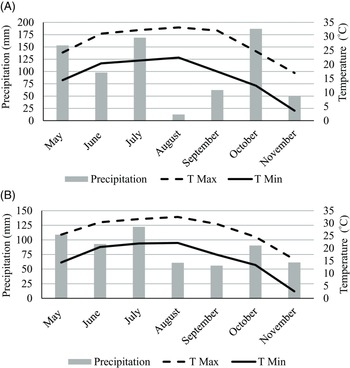
Field experiments were performed at the Vegetable Research Station (35.38°N, 94.24°W), near Kibler, AR, and at an organic farm (35.29°N, 91.29°W), near Augusta, AR. Total monthly rainfall ranged from 12 to 187 mm at Kibler and from 56 to 122 mm at Augusta (Figure 1). Experimental plots in Kibler received approximately 150 mm of overhead irrigation throughout the growing season. The organic farm in Augusta was not irrigated. Over the entire cultivation period, the average temperature was 22 and 21 C in Kibler and Augusta, respectively. Soil samples were collected by cover crop treatment and sent to the Agricultural Diagnostic Laboratory at the University of Arkansas, Fayetteville, AR, for analysis (Table 1).
Monthly precipitation (mm), minimum temperature (C), and maximum temperature (C) in Kibler (A) and Augusta (B), AR, USA, 2021.

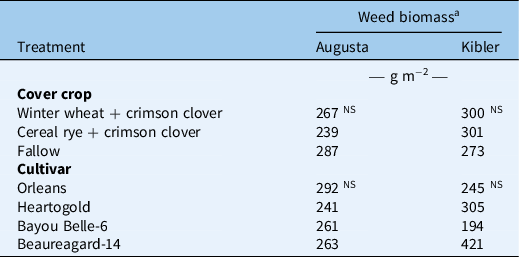
Effect of cover crop and sweetpotato cultivar on weed biomass in Augusta and Kibler, AR, USA, 2021.

a NS = not significant based on Tukey’s honestly significant difference test at P ≤ 0.05.
The experimental design was a randomized complete block, split-split plot with four replications. The treatments consisted of (1) weeding (whole plot), (2) cover crop (split plot), and (3) sweetpotato cultivar (split-split plot). Cover crop treatments included fallow, winter wheat (Triticum aestivum L.) + crimson clover, and cereal rye (Secale cereale L.) + crimson clover. Three sweetpotato cultivars (‘Heartogold’, ‘Bayou Belle-6’, and Beauregard-14) and a commercial standard cultivar ‘Orleans’ were included. Sweetpotato slips were produced in the greenhouse approximately 3 mo before transplanting. The whole-plot size was three rows, each 0.9-m wide and 12-m long, which were then subdivided into split plots consisting of one row 0.9-m wide and 12-m long. The split-split plot was 0.9-m wide and 3.0-m long (Supplementary Figure S1).
Cover crops were planted in the fall of 2020. Before planting, the field was double-disked, and 91-cm-wide raised beds were formed by using a hipper. A field cultivator was used across the top layers of the beds to loosen soil for planting. Winter wheat and cereal rye were planted at a seeding rate of 90 kg ha−1, and crimson clover was planted at 11 kg ha−1. Cover crops were drill planted at the organic farm near Augusta and broadcast seeded in Kibler. Cover crops were terminated in the spring of 2021 by flail mowing to the soil surface, and residues were left on the field. Sweetpotato cuttings (20- to 30-cm long) were transplanted manually on May 31 and June 4 of 2021 in Augusta and Kibler, respectively. Six slips were planted per plot in a horizontal position with two nodes buried, 46 cm apart in the row. Weed-free plots were hand-weeded once every other week until 12 wk after transplanting (WATr), and native weeds were allowed to grow unchecked in the weedy plots.
Cover crop biomass was quantified by collecting aboveground portions of all plant material in a representative 0.25-m2 area of each split plot unit 1 wk before cover crop termination. Samples were oven-dried at 70 for 72 h and weighed. The canopy height and length of the longest vine from two middle plants were measured at 5 and 8 WATr. Weeds were counted by species at 5 and 8 WATr from a 0.25-m2 quadrat in each split plot to assess weed composition and distribution across locations. Weed shoot biomass was collected from 0.25-m2 randomly placed quadrats 2 wk before harvest. All weeds in the quadrat were collected. Samples were then placed in a forced-air drier for 120 h at 70 C and weighed. The phytosociological parameters relative frequency (RF), relative density (RD), relative abundance (RAb), and importance value index (IVI) of weeds in weedy plots were assessed with the following equations (Mueller-Dombois and Ellenberg Reference Mueller-Dombois and Ellenberg1974):
 $${\rm{Frequency\;}}\left( {\rm{F}} \right) = {\rm{\;}}{{{\rm{number\;of\;samplings\;in\;which\;the\;species\;were\;found\;}}} \over {{\rm{total\;number\;of\;samplings}}}}$$
 $${\rm{Relative\;frequency\;}}\left( {{\rm{RF}}} \right) = {\rm{\;}}{{{\rm{frequency\;}} \times {\rm{\;}}100} \over {{\rm{total\;species\;frequency}}}}$$
 $${\rm{Density\;}}\left( {\rm{D}} \right) = {\rm{\;}}{{{\rm{number\;of\;plants\;found\;for\;the\;species}}} \over {0.25{\rm{\;}}{{\rm{m}}^2}}}$$
 $${\rm{Relative\;density\;}}\left( {{\rm{RD}}} \right) = {\rm{\;}}{{{\rm{density\;of\;species\;}} \times {\rm{\;}}100} \over {{\rm{total\;species\;density\;}}}}$$
 $${\rm{Abundance\;}}\left( {{\rm{Ab}}} \right) = {\rm{\;}}{{{\rm{number\;of\;plants\;found\;for\;the\;species}}} \over {{\rm{total\;number\;of\;samplings\;in\;which\;the\;species\;was\;found}}}}$$
 $${\rm{Relative\;abundance\;}}\left( {{\rm{RAb}}} \right) = {{{\rm{abundance\;}} \times {\rm{\;}}100} \over {{\rm{total\;species\;abundance}}}}$$
 $${\rm{Importance\;value\;index\;}}\left( {{\rm{IVI}}} \right) = {\rm{RF}} + {\rm{RD}} + {\rm{RAb}}$$
where RD, RF, and RAb are the number of species, their distribution, and relative abundance with respect to other species in the sampled area, respectively. IVI indicates the most important species in the study area. Total frequency, density, and abundance were obtained from the sum of the relative number of each of the parameters.
All sweetpotato plants in the plot were harvested at 153 and 141 d after transplanting in Augusta and Kibler, respectively. The harvested roots were graded into jumbo (8.9 cm in diameter), no. 1 (≥4.4 cm but <8.9 cm), canner (≥2.5 cm but <4.4 cm), and cull (misshapen roots) (USDA 2005), then weighed by grade. Total yield includes jumbo, no. 1, and canner grades.
Statistical analyses were performed using JMP® 17 (SAS Institute, Cary, NC). Data from Kibler and Augusta were analyzed separately. Split-split plot analysis included three treatment factors, weeding (two levels), cover crop (three levels), and cultivar (four levels). The analysis was performed using Standard Least Squares in the Fit Model platform to determine significant influences of each factor level and its interactions on the response variables weed biomass, vine length, canopy height, and sweetpotato yield. A separate analysis was conducted for each evaluation time for vine length and canopy height. The whole-plot effect of weeding, the split plot effect of cover crop, the split-split plot effect of sweetpotato cultivar, and their interactions were considered fixed effects. The replications within locations and the error associated with the whole-plot and residual error were considered random effects. If a treatment effect was significant, Tukey’s honestly significant difference (HSD) test was used for pairwise comparisons of three or more treatment means; Student’s t-test was performed for comparisons of two treatment means. Treatments were considered significantly different at P ≤ 0.05. Pearson’s correlation analysis was performed based on the average data from Kibler and Augusta to determine the relationship between the variables weed biomass, cover crop biomass, vine length, canopy height, and sweetpotato yield grades. Significant effect was assumed at P ≤ 0.05. For the phytosociological parameters, data were subjected to one-way ANOVA followed by Tukey’s HSD test at P ≤ 0.05.
Results and Discussion
Weed Composition in the Field
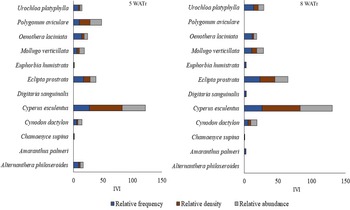
The weed community in both locations was composed of broadleaf species, sedges, and grass species (Figures 2 and 3). A total of 12 weed species were identified at Augusta (Figure 2). Yellow nutsedge (Cyperus esculentus L.), prostrate knotweed (Polygonum aviculare L.), and eclipta [Eclipta prostrata (L.) L.] were the most important weed species at 5 WATr (Figure 2). Cyperus esculentus and P. aviculare contributed the most to weed abundance at 5 WATr at 39% and 20%, respectively. The most frequent weed species were C. esculentus (RF = 27%) and E. prostrata (RF = 17%). In terms of population density, C. esculentus was the most numerous (RD = 55%) species at 5 WATr. Cyperus esculentus remained the most abundant (RAb = 48%) species and had the highest density value (RD = 56%) at 8 WATr. Eclipta prostrata had frequency, density, and abundance values of 23%, 22%, 19%, respectively.
Characterization of weed composition in Augusta, AR, USA, 2021. Relative frequency (RF), relative density (RD), relative abundance (RAb), and importance value index (IVI) of weeds assessed at 5 and 8 wk after transplanting (WATr).

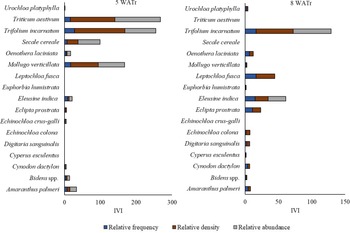
Characterization of weed composition in Kibler, AR, USA, 2021. Relative frequency (RF), relative density (RD), relative abundance (RAb), and importance value index (IVI) of weeds assessed at 5 and 8 wk after transplanting (WATr).

Seventeen weed species were identified at Kibler, of which volunteer winter wheat, volunteer crimson clover, and carpetweed (Mollugo verticillata L.) had the highest importance at 5 WATr (Figure 3). Crimson clover occurred in higher density (RD = 141%) than winter wheat (RD = 124%) and M. verticillata (RD = 77%). Likewise, crimson clover had the highest frequency (RD = 28%) compared with winter wheat (RD = 16%) and M. verticillata (RD = 17%). Winter wheat was the most abundant (RAb = 127%) species at 5 WATr. Crimson clover, goosegrass [Eleusine indica (L.) Gaertn.], and bearded sprangletop [Leptochloa fusca (L.) Kunth spp. fascicularis (Lam.) N. Snow] were the primary species at 8 WATr. Crimson clover had the highest density (RD = 56%) and abundance values (RAb = 57%). Eleusine indica and L. fusca had similar frequency, density, and abundance values ranging from 15% to 30% at 8 WATr.
Canopy Development
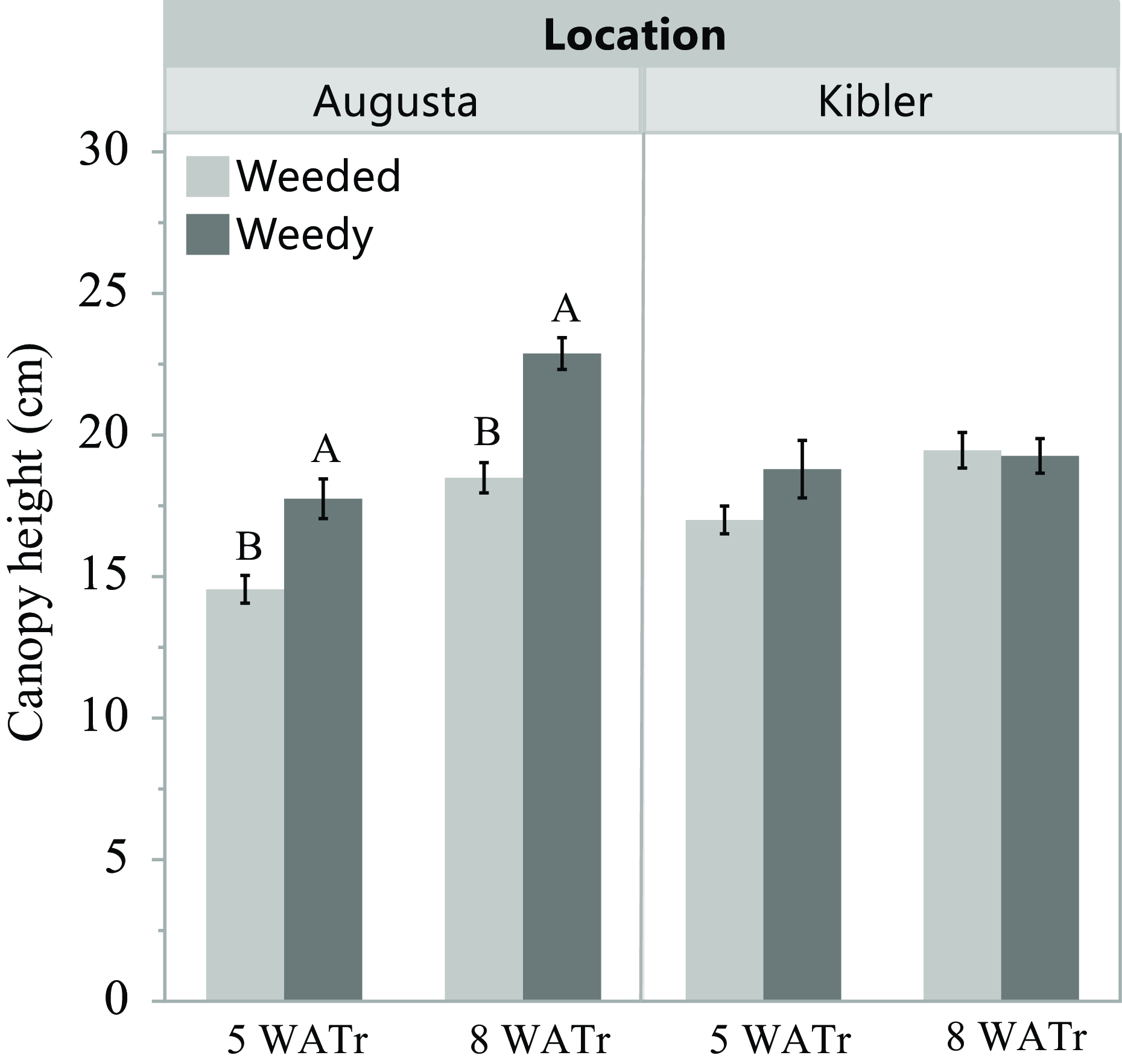
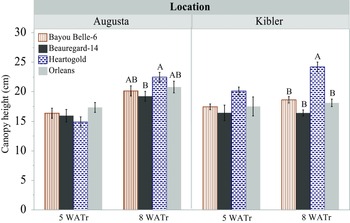
The interaction effect between cover crop, weeding, and cultivar treatments on vine length and canopy height was not significant at both location sites (P ≥ 0.05). The main effect of weeding was significant on canopy height at 5 WATr (P = 0.0230) and 8 WATr (P = 0.0003) in Augusta (Figure 4). Averaged across cultivars and cover crops, the canopy was taller under weedy conditions, with about 20% increase compared with the weeded treatment at both evaluation times. Amaranthus spp., sedges, and grasses were particularly aggressive and produced vigorous, dense growth in weedy plots in our study. Plants tend to grow taller when surrounded by other plants as a shade-avoidance mechanism. Shade avoidance is a response of plants to light signals provided by neighboring plants that tend to reduce the intensity and quality of light (Casal Reference Casal2012; Keuskamp et al. Reference Keuskamp, Keller, Ballaré and Pierik2012). Plants use specific photoreceptors to perceive changes in the red (R) to far-red (FR) wavelength ratio and blue light (Ballaré et al. Reference Ballaré, Scopel and Sánchez1990; Keuskamp et al. Reference Keuskamp, Keller, Ballaré and Pierik2012). A low R:FR balance is an indicator of future light competition, while blue light depletion is perceived as actual shading (Ballaré et al. Reference Ballaré, Scopel and Sánchez1990). As a response to these light signals, phenotypic responses are induced to increase the likelihood of light capture (Keuskamp et al. Reference Keuskamp, Keller, Ballaré and Pierik2012). In our study, the increase in canopy height allows sweetpotato to reduce competition for light by extending leaves above the canopy of adjacent weeds. This resource allocation is reflected in an increased shoot:root ratio, meaning that negative effect can be expected in root yield. At 8 WATr, canopy height differed across cultivars in Augusta (P = 0.0230) and Kibler (P ≤ 0.0001) (Figure 5). Heartogold had the tallest canopy (22.5 cm) in Augusta, similar to Orleans (21 cm) and Bayou Belle-6 (20 cm). Similarly, Heartogold had the tallest canopy (24 cm) in Kibler and was on average 6-cm taller than Bayou Belle-6 and Orleans and 10-cm taller than Beauregard-14.
Sweetpotato canopy height (cm) averaged across cultivar and cover crop treatments in weed-free and weedy conditions in Augusta and Kibler, AR, USA, 2021. Means that do not share the same letter are significantly different from each other within location and within the same week after transplanting (WATr) according to Student’s t-test at P ≤ 0.05. Bars represent standard error.

Canopy height (cm) of sweetpotato cultivars averaged across weeding and cover crop treatments at 5 and 8 wk after transplanting (WATr) in Augusta and Kibler, Arkansas, USA, 2021. Means that do not share the same letter are significantly different from each other within location and within the same time of evaluation according to Tukey’s honestly significant difference test at P ≤ 0.05. Bars represent standard error.

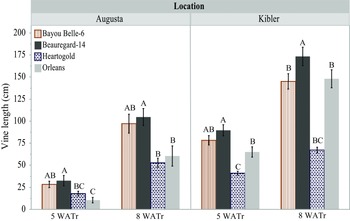
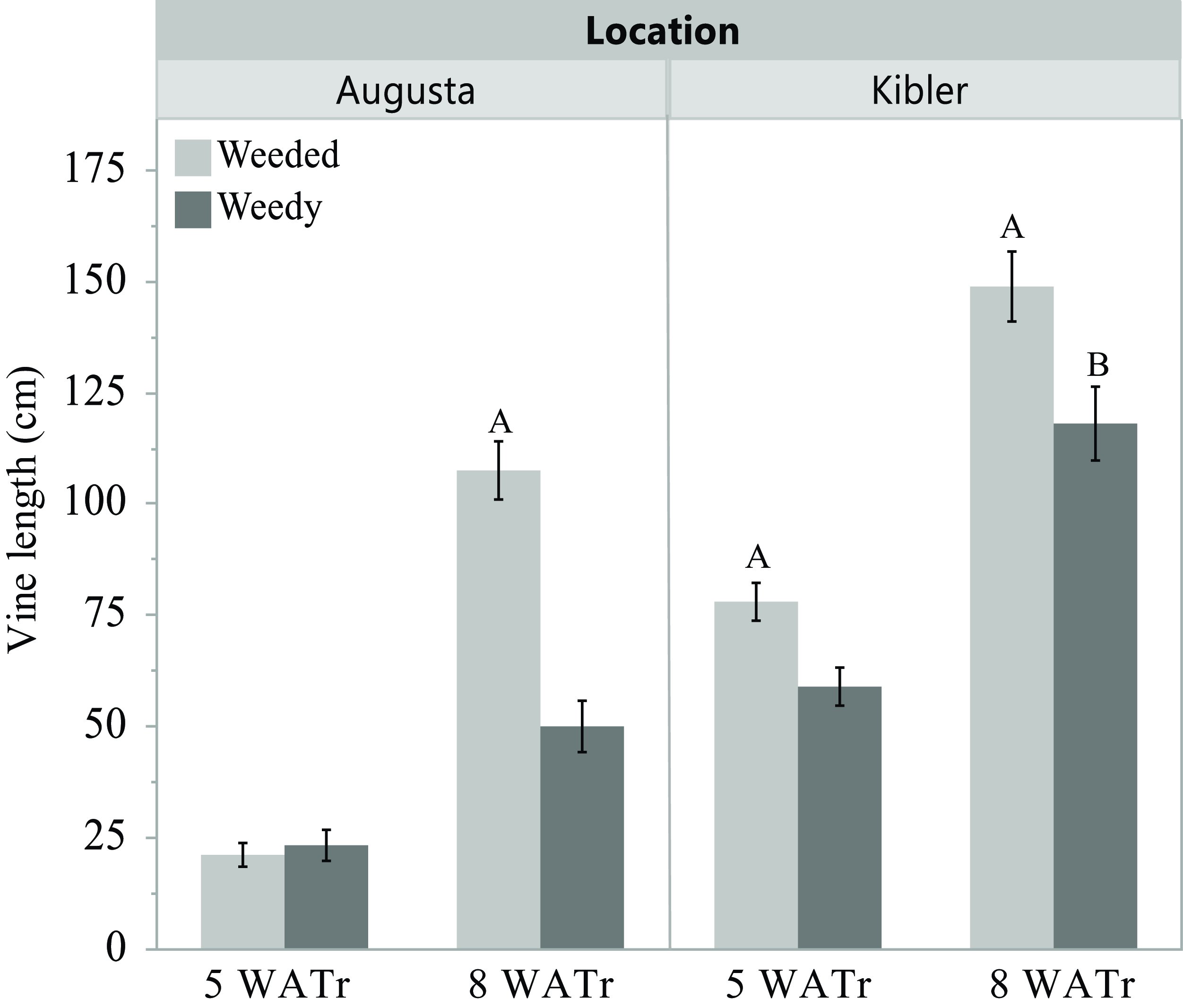
Vine length differed between cultivars at 5 (P = 0.0005) and 8 WATr (P ≤ 0.0001) in Augusta (Figure 6). Beauregard-14 and Bayou Belle-6 had the longest vines, with 33 and 28 cm at 5 WATr and 105 and 97 cm at 8 WATr, respectively. The effect of weed interference on sweetpotato growth was reflected on the length of vines (P = 0.0002) at 8 WATr. Overall, vine length was reduced from 107 cm in weed-free plots to 50 cm in non-weeded plots in Augusta (Figure 7). This is consistent with other studies that indicate a 53% reduction in sweetpotato vine mass in weedy treatments (La Bonte et al. Reference La Bonte, Harrison and Motsenbocker1999). In Kibler, vine length differed between cover crops, weeding, and cultivar treatments at 5 and 8 WATr (P ≤ 0.05). As in Augusta, Beauregard-14 (90 cm) and Bayou Belle-6 (78 cm) had the longest vines at 5 WATr. Beauregard-14 had the longest vine (173 cm) at 8 WATr, which was approximately 25-cm longer than those of Orleans and Bayou Belle-6 and 100-cm longer than that of Heartogold. At 5 WATr, longer vines (80 cm) were recorded in plots with cereal rye + crimson clover compared with winter wheat + crimson clover (64 cm) and fallow (62 cm). At 8 WATr, vine length was similar in cereal rye + crimson clover (149 cm) and winter wheat + crimson clover (142 cm) treatments and roughly 30-cm longer than the fallow treatments (data not shown). Vine length was about 20-cm shorter with weed interference at 5 and 8 WATr at Kibler (Figure 7).
Vine length (cm) of sweetpotato cultivars averaged across weeding and cover crop treatments at 5 and 8 wk after transplanting (WATr) in Augusta and Kibler, AR, USA, 2021. Means that do not share the same letter are significantly different from each other within location and within the same time of evaluation according to Tukey’s honestly significant difference test at P ≤ 0.05. Bars represent standard error.

Sweetpotato vine length (cm) averaged across cultivar and cover crop treatments at 5 and 8 wk after transplanting (WATr) in Augusta and Kibler, AR, USA, 2021. Means that do not share the same letter are significantly different from each other within location and within the same time of evaluation according to Student’s t-test at P ≤ 0.05. Bars represent standard error.

Cultivar and Cover Crop Ability to Suppress Weed Growth
Weed biomass did not differ statistically between cover crop treatments in Augusta (P = 0.8050) and Kibler (P = 0.9526) (Table 1). Similarly, there were no significant differences between sweetpotato cultivars for weed biomass in Augusta (P = 0.5425) and Kibler (P = 0.2430). The interaction between cover crop and cultivar was not significant in Augusta (P = 0.0530) and Kibler (P = 0.5820). The highest weed biomass was recorded in plots with Orleans (292 g m−2) in Augusta, and the lowest weed biomass was obtained in plots with Heartogold (241 g m−2). Orleans is one of the commercial standard cultivars. Plots with cereal rye + crimson clover (241 g m−2) and winter wheat + crimson clover (267 g m−2) had lower weed biomass compared with those without a cover crop (287 g m−2) in Augusta. In Kibler, weed biomass was the highest in plots with Beauregard-14 (421 g m−2), and the lowest with Bayou Belle-6 (194 g m−2). Total weed biomass of 301, 300, and 273 g m−2 was recorded for cereal rye + crimson clover, winter wheat + crimson clover, and fallow treatments, respectively.
Collectively, our studies demonstrate that cover crops can inhibit weed growth, but the performance of cover crops varies with climate, soil type, management systems, and many other factors. In this experiment, a reduced-tillage system was used, in which the cover crop residues remained on the soil surface after termination. In studies comparing cereal rye residues in reduced-tillage and conventional systems, the conventional-tillage system had a 20% higher total yield than the reduced-tillage system (Smith et al. Reference Smith, Jennings, Monks, Jordan, Reberg-Horton and Schwarz2021). Other studies also suggested superior weed suppression when cereal rye and rapeseed (Brassica napus L.) residues were tilled into the soil, resulting in up to a 27% reduction in weed density (Kaluwasha et al. Reference Kaluwasha, Kremer, Mihail, Lin and Xiong2019).
Previous research has shown that when cover crop residues remain on the soil surface, weed seed germination is inhibited because of a change in the soil microenvironment as well as physical impediment of seedling emergence (Teasdale and Mohler Reference Teasdale and Mohler1993). The cover crop residues reduce solar radiation reaching the soil surface and alter thermal conditions or release phytotoxic compounds that reduce weed emergence (Brennan and Smith Reference Brennan and Smith2005). Cereal rye is a typical fall-planted cover crop that releases secondary metabolites (i.e., alkaloids, organic acids, sulfides) that accumulate on the soil surface and inhibit the germination of weed seeds. Benzoxazinoid compounds present in cereal rye shoots are known to be allelopathic to giant foxtail (Setaria faberi Herrm.), common lambsquarters (Chenopodium album L.), pigweeds (Amaranthus spp.), horseweed [Conyza canadensis (L.) Cronquist], and barnyardgrass [Echinochloa crus-galli (L.) P. Beauv.] (Burgos and Talbert Reference Burgos and Talbert1996; Przepiorkowski and Gorski Reference Przepiorkowski and Gorski1994).
The differences observed in soil total nitrogen (N), total carbon (C), and organic matter via loss on ignition (LOI) between cover crop and fallow treatments were not significant in this experiment (Table 2). This result can be attributed to the time of soil sampling, as soil analysis was performed only at 15 WATr following cover crop termination. Several factors can influence the rate of nutrient release and biomass decomposition, including residue input and quality, soil type, soil management, rainfall, and temperature (Chinta et al. Reference Chinta, Uchida and Araki2020; Clark Reference Clark2007; Power Reference Power1994; Roberts et al. Reference Roberts, Ortel, Hoegenauer, Wright and Durre2018). The breakdown of cover crop biomass is directly associated with C:N ratio (i.e., proportion of carbon to nitrogen) of the residues. A high C:N ratio (C:N ≥ 25:1) results in low amounts of N (kg N ha−1) that would be slowly available, while a low C:N ratio (C:N < 20:1) increases the speed of N release from the biomass following termination. Grasses, such as cereal rye, typically have high C:N ratios, whereas legumes such as crimson clover have low C:N ratios (Ashford and Reeves Reference Ashford and Reeves2003; Kuo and Jellum Reference Kuo and Jellum2002). For instance, vetch residues in no-till or tilled systems were completely decomposed after a 3.5-mo period. In the same length of time, less decomposition of cereal rye residues occurred, with approximately 20% in no-till and 52% in conventionally tilled fields (Collier Reference Collier2017). Adding a legume component to a grass cover crop is expected to reduce the C:N ratio and improve the nutrient mineralization rate after cover crop termination. In our study, an initial rapid decomposition could have been favored by the low C:N ratio of the grass cover crops mixed with crimson clover. Furthermore, high rainfall volume and warm air temperature likely promoted N loss from cover crop residues in the first 3 mo after cover crop termination. The combination of climatic factors and chemical composition of cover crop shoots is important in modifying biomass decomposition and nutrient release (Varela et al. Reference Varela, Barraco, Gili, Taboada and Rubio2017).
Selected chemical properties of soil collected from the cover crop studies at 15 wk after transplanting sweetpotatoes, Kibler and Augusta, AR, USA, 2021. a

a The soil analysis included pH (1:2 v/v soil:water ratio), Mehlich 3 extractable nutrients, phosphorus (P), potassium (K), calcium (Ca), magnesium (Mg), sulfur (S), sodium (Na), iron (Fe), manganese (Mn), zinc (Zn), copper (Cu), and boron (B), total nitrogen (N), total carbon (C), and organic matter via loss on ignition (LOI).
Sweetpotato Yield
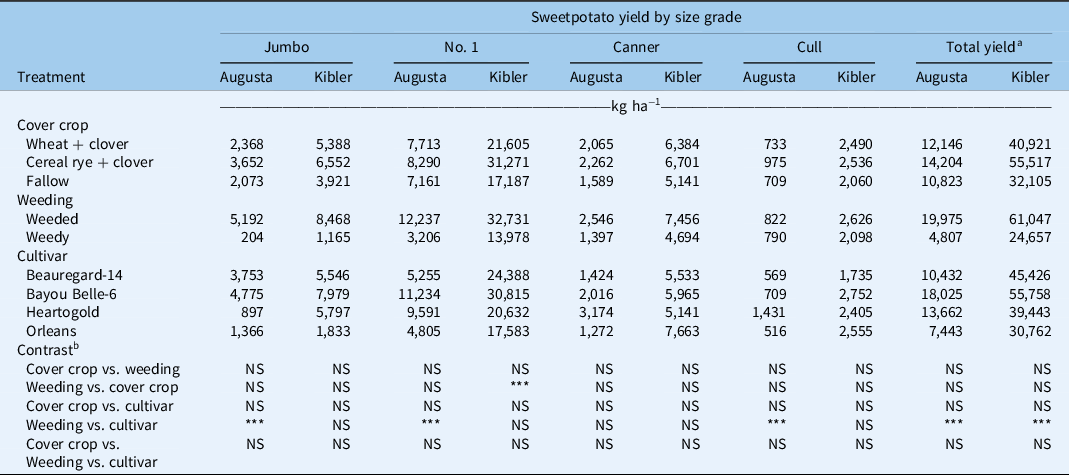
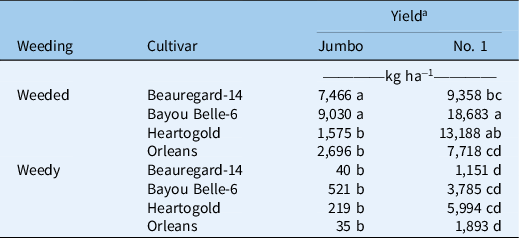
A significant weeding by cultivar interaction (P = 0.0013) was observed on jumbo root yield in Augusta (Tables 3 and 4). In Kibler, the main effect of cultivar (P = 0.0033) and weeding treatment (P = 0.0346) on jumbo root yield was significant (Tables 3 and 5). Jumbo yield was affected the most by weed interference, and yield ranged from 5,192 kg ha−1 in weeded plots to 204 kg ha−1 with weed interference in Augusta, and from 8,468 in weeded plots to 1,165 kg ha−1 with weed interference in Kibler (Table 3). Averaged across weeding treatments, the greatest jumbo yield (7,979 kg ha−1) was obtained with Bayou Belle-6 in Kibler, which was similar to Heartogold (5,797 kg ha−1) and Beauregard-14 (5,546 kg ha−1) (Table 3). In Augusta, Bayou Belle-6 (9,030 kg ha−1) and Beauregard-14 (7,466 kg ha−1) had the highest jumbo yield in weed-free plots (Table 4). Bayou Belle-6 also had the greatest jumbo yield (521 kg ha−1) in weedy plots. The greatest losses in jumbo root yield are due to the inability of sweetpotato roots to grow to their full size under weed pressure as a result of resource limitation. In previous studies on Palmer amaranth (Amaranthus palmeri S. Watson) interference in sweetpotato, jumbo grades were reduced the most due to shading caused by A. palmeri plants. The reduction of jumbo grades indicates a reduction of photosynthate transported to the storage roots (Meyers et al. Reference Meyers, Jennings, Schultheis and Monks2010).
Cover crop, weeding, and cultivar main effects and interactions on sweetpotato yield by grade in Augusta and Kibler, AR, USA, 2021.

a Total marketable yield is the aggregate of jumbo, no. 1, and canner grades.
b Significance:
*** = significant interaction at P ≤ 0.05; NS = nonsignificant interaction.
Jumbo and no.1 yields across cultivars in weedy and weed-free plots in Augusta, AR, USA, 2021.

a Means followed by the same letter in a column are not different based on Tukey’s honestly significant difference test at P ≤ 0.05.
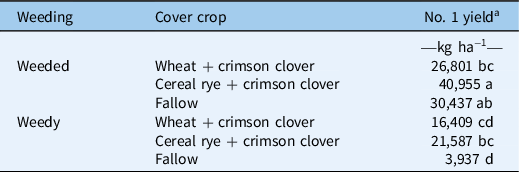
Sweetpotato no.1 yield as affected by cover crop treatments in weedy and weed-free plots in Kibler, AR, USA, 2021.

a Means followed by the same letter in a column are not different based on Tukey’s honestly significant difference test at P ≤ 0.05.
A significant interaction between weeding and cultivar treatments was observed for no. 1 root yield in Augusta (P = 0.0155) (Table 4). In weed-free plots, Bayou Belle-6 had the highest no.1 yield (18,683 kg ha−1) followed by Heartogold (13,188 kg ha−1). Orleans and Beauregard-14 had the lowest yields in weedy conditions. A cover crop by weeding interaction (P = 0.0228) was observed for no. 1 yield in Kibler (Table 5). The highest no.1 yield (40,955 kg ha−1) was recorded in plots with cereal rye + crimson clover when maintained weed-free during the growing season. The lowest no. 1 yield (3,937 kg ha−1) was obtained with fallow weedy treatments.
Canner root yield differed across weeding (P ≤ 0.0001) and cultivar treatments (P ≤ 0.0001) in Augusta (Table 3). With weed interference, canner yield decreased 1,149 kg ha−1 when compared with the weed-free treatment (2,546 kg ha−1). Heartogold had the highest canner yield (3,174 kg ha−1), which was similar to Bayou Belle-6 (2,016 kg ha−1). Orleans had the greatest canner yield in Kibler, which was significantly affected by weeding treatments ranging from 4,694 to 7,456 kg ha−1 with and without weed interference, respectively. The greatest number of cull yield was found with cultivar Heartogold in Augusta.
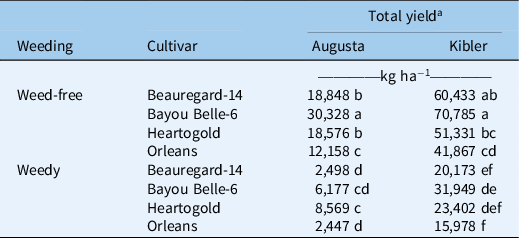
Total yield was calculated as the sum of jumbo, no.1, and canner root yields (Table 6). A significant weeding by cultivar interaction was observed for total yield in Augusta (P = 0.0005) and Kibler (P = 0.0329). In Augusta, total yield ranged from 2,447 to 8,569 kg ha−1 in weedy plots and from 12,158 to 30,328 kg ha−1 in weed-free treatments. In Kibler, total yield ranged from 15,978 to 31,949 kg ha−1 with weed interference and 41,867 to 70,785 kg ha−1 without weed interference. In the absence of weed interference, the most productive cultivar was Bayou Belle-6 in Kibler and Augusta. Smith (Reference Smith, Jennings, Monks, Jordan, Reberg-Horton and Schwarz2021) also reported the high yield potential of this cultivar, with ‘Bayou Belle’ having 53% and 66% greater marketable yield than ‘Covington’ and ‘NC15-0650’, respectively.
Sweetpotato total yield as affected by cultivar in weedy and weed-free plots, Kibler and Augusta, AR, USA, 2021.

a Total yield is the aggregate of jumbo, no. 1, and canner grades. Means followed by the same letter in a column are not different based on Tukey’s honestly significant difference test at P ≤ 0.05.
The lower yields recorded in Augusta were likely due to the high C. esculentus densities. Weed species composition certainly affects the degree of interference, as competitive ability varies among species (Clark Reference Clark1971). Meyers and Shankle (Reference Meyers and Shankle2015) reported that C. esculentus densities of 5 to 90 shoots m−2 can reduce sweetpotato marketable yield 18% to 80%. We also speculate that the difference in soil nutrient levels between the locations contributed to the lower yields in Augusta. Despite a higher level of phosphorus (P) and potassium (K) encountered in this location, the low levels of secondary macronutrients, including calcium (Ca) and magnesium (Mg), can result in reduced yields. Low levels of secondary macronutrients such as Mg and sulfur (S) are known to cause yield loss in sweetpotato (Halliday and Trenkel Reference Halliday and Trenkel1992). Nevertheless, the higher yields obtained in Kibler could have been due to sufficient water throughout the growing season provided by overhead irrigation as needed. The experiment in Augusta was not irrigated.
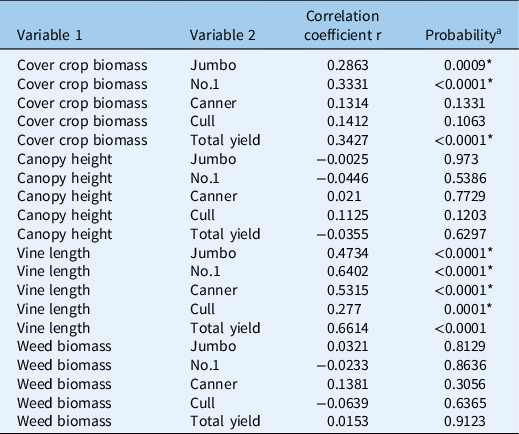
Sweetpotato yield was related to vine length and cover crop biomass. A correlation analysis was performed combining data from Augusta and Kibler. Weed biomass and sweetpotato yield were not significantly correlated (P > 0.05). The coefficients showed significant correlations between cover crop biomass, vine length, and sweetpotato yield (Table 7). Positive correlations were recorded between vine length and jumbo (r = 0.4734; P < 0.0001), no.1 (r = 0.6402; P < 0.0001), canner (r = 0.5315; P < 0.0001), cull (r = 0.2770; P = 0.0001), and total sweetpotato (r = 0.6614; P < 0.0001) root yields. Nwosisi et al. (Reference Nwosisi, Nandwani and Hui2019) reported that yield components in ‘Beauregard’, including marketable yield, number of storage roots, weights, and sizes, are correlated with cultivar canopy structure, particularly length of vines. Furthermore, positive correlations were observed between cover crop biomass and root size; jumbo (r = 0.2863; P = 0.0009) and no.1 (r = 0.3331; P < 0.0001) roots increased with cover crop biomass, resulting in greater total yield (r = 0.3427; P < 0.0001). In direct-seeded pumpkins (Cucurbita pepo L.), larger pumpkins were produced in no-till plots with flail mowed residues of winter wheat and cereal rye compared with bare-ground pumpkins (Walters and Young Reference Walters and Young2010).
Pearson’s correlation between any two variables in the cover crop × weeding × sweetpotato cultivar studies across two locations (Augusta and Kibler, Arkansas, USA), 2021.

a Significance:
* = significant correlation at P ≤ 0.05.
Weed management is a challenge in organic sweetpotatoes, as the use of synthetic herbicides is not an option. The limited number of registered herbicides for use in conventional sweetpotato production further necessitates the implementation of IWM strategies (Monks Reference Monks, Jennings, Meyers, Smith, Korres, Korres, Roma-Burgos and Duke2019). Here we explored the potential of four sweetpotato cultivars in an organic, reduced-tillage system with the cover crops cereal rye + crimson clover and winter wheat + crimson clover, as well as fallow treatments. Cyperaceae, Poaceae, and Amaranthaceae species were found in Kibler and Augusta and are among the troublesome weeds that infest sweetpotatoes (Meyers and Shankle Reference Meyers and Shankle2015; Monks et al. Reference Monks, Jennings, Meyers, Smith, Korres, Korres, Roma-Burgos and Duke2019; Webster Reference Webster2014). Bayou Belle-6 was the top-yielding cultivar in weed-free culture and maintained its productivity under weedy conditions. Sweetpotato canopy height and vine length did not relate to weed biomass suppression. However, vine length was positively correlated to sweetpotato yield. Although cultivar and cover crop treatments did not differ in their ability to suppress weeds, plots with cereal rye + crimson clover generally had lower weed biomass than plots with winter wheat + clover and fallow plots in Augusta. The use of a grass–legume mixed cover crop appears to be a better option for growers in terms of improving sweetpotato yield. Cereal rye + crimson clover is better than winter wheat + crimson clover and no cover crop. A cost–benefit analysis of the utilization of this mixed cover crop would reveal the economic benefit of this system to growers.
Supplementary material
To view supplementary material for this article, please visit https://doi.org/10.1017/wsc.2023.14
Acknowledgments
The authors thank the Agriculture and Food Research Initiative (award no. 2019-51300-30247) for funding this research. The authors also thank Shawn Peebles, of the Peebles Farms, Augusta, AR, for collaborating on this project, providing land and associated resources to conduct the on-farm component of this experiment. The authors declare no conflicts of interest.