Composed between 1832 and 1843, William Sterndale Bennett’s six piano concertos constitute an important corpus of works in the history of the genre in Britain. Their genesis, particularly those concertos written in the 1830s during Bennett’s student days at the Royal Academy of Music, also forms part of that much broader flourishing of the European piano concerto when the composer, himself a brilliant concert soloist on the piano, clearly wished to embrace the model of the virtuoso pianist-composer. Indeed, Bennett remained a regular executant of his own concertos between 1833 and 1853, after which he gave up the performance of his own concertos altogether.Footnote 1 However, given that the majority of the concertos were written during the impressionable period of his teenage years, a closer study of them reveals that Bennett was receptive to a much broader range of stylistic influences including not only the popularly documented ones of Mozart and Mendelssohn but also those of Bach, Beethoven and the composers of the ‘London School’ of pianists. Moreover, the concertos also provide an indication of the composer’s rapid technical development, especially in the handling of large-scale form, and perhaps the most fascinating aspect of this study is the emerging tension which Bennett clearly experienced between the classical equilibrium he so admired in the works of his eighteenth-century forebears and the imperative of freer, more fantastical forms typical of the Romantic age in which he lived.
Bennett and Mozart
And now for the way of study, and who is to be model!
…
Who shall it be?
…All things considered I cannot longer hesitate as to the one I should place before you for your study and guidance, and therefore I name Mozart.Footnote 2
It was during one of his lectures in the capacity of Professor of Music at Cambridge University in March 1871, only four years before his death, that William Sterndale Bennett explicitly acknowledged his artistic idol. Having cited other candidates such as Haydn, Cherubini, Beethoven, Weber, Spohr, Meyerbeer, Rossini, Mendelssohn, Schumann and Wagner, and, for many a critic, the intuitive choice for him would have been Mendelssohn, he named Mozart from a shortlist of two (the other was Haydn). The reasons for alighting on Mozart were, for Bennett, several. To him no composer exhibited such ‘thorough earnestness’ or ‘deep thought’,Footnote 3 qualities evident in his symphonies and string quartets, the piano concertos, the concert arias and the profundity of his slow movements.Footnote 4 But above all, Mozart was the ‘true model of conscience and mastery’ and one, Bennett believed rightly or wrongly, who was ‘always true to the letter of his art’.Footnote 5 These words, uttered by a man who was now a luminary of the British musical establishment, surely reveal a reflective sensibility, even a nostalgia for a musical world of the 1830s and of his essentially classical training at the Royal Academy of Music under his teachers, Charles Lucas, William Crotch and, most significant of all, Cipriani Potter. And, equally likely, it was also an opportunity for Bennett to express his doubts about the modern-day taste for Berlioz, Liszt, Verdi and Wagner who, as Temperley has noted, ‘fell short of the status of “great masters”’.Footnote 6 ‘Mozart as model’ for instrumental music had been the dictum of Crotch, and one that other prominent English composers of his generation had espoused, namely Attwood, Ouseley and Goss. There is surviving manuscript evidence of an unfinished student piano work, a theme and variations on Mozart’s ‘Là ci darem la mano’ (Don Giovanni) of October 1829, written during Bennett’s third year under Crotch at the Royal Academy of Music.Footnote 7 Crotch’s influence was also acknowledged, fifty years later, by Daily Telegraph critic Joseph Bennett, in the revival of an early String Quartet in G major of 1831, a fact conveyed in James Robert Sterndale Bennett’s biography of his father (where the quartet is wrongly given as in G minor) and which he also connected with the Cambridge lecture of 1871.Footnote 8 When Bennett transferred from Crotch to Potter in 1832 (during his sixth year as a student), it is also apparent that Potter’s regard for Mozart, tempered by his equally high regard for Beethoven, instilled in Bennett a new self-assurance, as is evidenced by the change from the archaisms of his First Symphony in E flat major (completed in June 1832)Footnote 9 to the much more accomplished First Piano Concerto in D minor completed under Potter’s supervision in October 1832. Indeed the prospect of studying with Potter (who succeeded to the Principalship of the RAM that year), after the somewhat conservative outlook of Crotch, gave him a new sense of courage as he explained in a letter to his fellow student William Dorrell: ‘I want to write a Pianoforte Concerto, but it is no use doing it for Dr Crotch.’Footnote 10
Further acknowledgement of Bennett’s indebtedness to Mozart was made by other contemporaries including Macfarren and Davison,Footnote 11 and this has been further emphasized by Bennett’s career as a concert pianist and his role as interpreter of Mozart’s piano concertos (notably of the Concerto in D minor K. 466). He became a keen proponent of this work (to which he contributed his own cadenzas)Footnote 12 and the Concerto in C minor K. 491, which were not surprisingly singled out in his Cambridge lecture.Footnote 13 We should also appreciate that, during Bennett’s youth and early musical education at the Royal Academy in the late 1820s, Mozart’s piano concertos were enjoying a renaissance in terms of performing tradition, particularly through pianists such as Friedrich Kalkbrenner, John Baptist Cramer, Ferdinand Ries, Ignaz Moscheles, Mendelssohn and Bennett’s own teacher, Cipriani Potter, not least through their own virtuoso elaborations of Mozart’s piano parts and through reduced chamber scorings for domestic use.Footnote 14 Kalkbrenner had given a pioneering performance of K. 503 in London on 6 March 1818 and Cramer was an avid exponent of works such as K. 450, K. 459 and K. 491 throughout his active life as a virtuoso and teacher in London. Potter, often credited with the first serious inculcation of classical forms at the RAM, was an ardent believer in the quality and artistry of Mozart’s concertos, a fact manifestly apparent from his own performances as a virtuoso.Footnote 15 Furthermore, it is worth noting that Mendelssohn, who openly venerated the classics, was also a keen exponent of Mozart’s concertos. We know, for example that he played Mozart’s Concerto for Two Pianos K. 365/316a with Moscheles in London on 1 June 1832, and a performance of K. 466 followed on 13 May 1833. And while Bennett may well have witnessed Mendelssohn’s performances and others by Potter and Cramer during his student days, his knowledge of the Mozart concertos was later reinforced by his ownership of twenty volumes of the latter which ‘a copyist in Germany had transcribed to his order’.Footnote 16
Bennett and the Piano Concerto in London
The evidence for Mozart’s influence on Bennett, in his capacity both as a composer and as a university professor, is irrefutable, and was one which received considerable accentuation in J. R. Sterndale Bennett’s biograpy.Footnote 17 Geoffrey Bush, a pioneering advocate for Bennett’s music, was also keen to stress the composer’s connections with Mozart rather than the more intuitive links with Mendelssohn: ‘It cannot be too strongly emphasized’, Bush asserted, ‘that Bennett was not a replica of Mendelssohn. There was a close affinity between the two composers – by no means to be confused with imitation, as Schumann observed; but Bennett’s style, deriving from Mozart, was fully formed before the two men ever met.’Footnote 18 In addition, Bush was also keen to stress that Bennett’s ‘first three concertos all show that the roots of Bennett’s art are to be found in Mozart’.Footnote 19 Nevertheless, this Mozart-orientated commentary has tended to underplay other important contemporary influences on the formation of his style, especially those that Bennett would have witnessed in London. In this regard, the most obvious influence to be cited has been that of Mendelssohn, not least because his visits to London from 1829 coincided with the early part of Bennett’s studentship, because of the famous encounter between the seventeen year old and Mendelssohn at an RAM concert in the Hanover Square Rooms on 26 June 1833 when Bennett gave the second performance of his First Piano Concerto (and which induced Mendelssohn to invite him to Leipzig),Footnote 20 and because of the close interaction between the two men during Bennett’s visits to Düsseldorf and Leipzig between 1836 and 1842. Yet, even if comparisons with Mendelssohn bear some analytical fruit, other comparisons have been somewhat misleading and inaccurate. The typical assertion that the style of Bennett’s concertos was ‘rooted in that of the Viennese Classics’ has endured for over a century.Footnote 21 Davison, in making an analytical programme note for a performance of Bennett’s Third Piano Concerto after the composer’s death in 1875 remarked as follows:
In none of his Concertos does Bennett dispense with the old classical tutti, although he had the examples set by Beethoven in his G and E flat, and by Mendelssohn in his G minor, which had just burst fresh upon the world of art, to encourage and support him; but no, the young English musician was heart and soul with Mozart; and in that faith he remained unswervingly till the close of his career.
Quoted in the Bennett biography,Footnote 22 this statement gives credit to Mozart for Bennett’s adoption of the ‘old classical tutti’ (that is, the opening orchestral introduction or ‘ritornello’). Though it may be true that Bennett greatly admired Mozart’s tuttis, it was not to Mozart that he ultimately owed the manner of his own piano concertos, but more readily to the examples of the London School of composers to whose music he would have been immediately receptive during his studies at the RAM.Footnote 23 What is more, the RAM itself numbered several accomplished composers of piano concertos among its ranks – Moscheles, Cramer and Potter – whose works would have been readily available to an impressionable young composer of Bennett’s abilities during the late 1820s and 1830s. These composers were, it should be added, active performers of their own works together with numerous visiting pianists from the continent and several native ones such as Lucy Anderson (who taught at the RAM) and Louise Dulcken (who had settled in London in 1828). This is surely confirmed, moreover, by the fact that Bennett dedicated three of his concertos to these pianists.Footnote 24
Before examining in detail Bennett’s kinship with the ‘London School’, an investigation of the piano concertos being performed in London in the 1820s and 1830s is worthwhile since it reveals an extraordinary richness of repertoire which must have been powerfully influential in the years Bennett was a student. In the year when Bennett entered the RAM, Hummel’s reputation in London was still considerable. His Concerto in A minor Op. 85 was enormously popular and was given performances under pianists such as Maria Szymanowska and Lucy Anderson. His Concerto in B minor Op. 89 also enjoyed a vogue as did his new Concerto in A flat Op. 113, which he played himself in London on 11 May 1830 (and in May the following year) along with his early Concerto in A major (25 June 1831) and his last concerto in F major (13 May 1833). Moscheles also enjoyed a great reputation in London as an executant of his own concertos. In 1826 he performed his Concerto in G minor Op. 58 (which had been recently published in 1825) at least twice and in 1828 his Concerto No. 4 in E (which he wrote and first performed during his third visit to England in 1823) received several hearings and was popular for its rondo based on ‘The British Grenadiers’. Similarly the Concerto No. 5 in C Op. 87, which Moscheles composed after settling in London in 1825, was played by the composer twice in March and June 1832 and by his pupil George Frederick Kiallmark in May 1833. Moscheles’s last two concertos, the No. 6 in B flat ‘Fantastique’ Op. 90 and No. 7 in C minor ‘Pathétique’ Op. 93, were heard several times in London after their respective publications in 1834 and 1835. Though Cramer had been particularly prominent as a writer and performer of his concertos in the 1790s and 1810s, his presence in the London concert scene was still conspicuous, and at least three of his concertos, No. 2 in D minor Op. 16, No. 5 in C minor Op. 48 and No. 8 in D minor Op. 70, received several performances by the composer between 1827 and 1835. The first three of Herz’s eight piano concertos were given a hearing between 1830 and 1835, the first of which, performed by Louise Dulcken, helped forge her career as a virtuoso and teacher. Kalkbrenner made an appearance with his fine Concerto in D minor Op. 107 in January 1830 and there was the occasional inclusion of a concerto by Field. Profoundly influenced by this model, Beethoven’s concertos increasingly found their way into London programmes. Potter performed the Piano Concerto No. 1 in C Op. 15 at the Philharmonic Society in April 1822 and gave the English premiere of the Concerto No. 3 in C minor Op. 37 at the Philharmonic on 8 March 1824. Potter also presided over the premiere of the Concerto No. 4 at the Philharmonic in May 1825 and Lucy Anderson gave two further performances in May 1833 and May 1835. And one wonders too whether the young Bennett may have heard Mendelssohn perform the Concerto No. 5 in E flat Op. 73 at a benefit concert on 24 June 1829.
These concertos and the rich tapestry of their performances in London were essentially built on the model developed by Hummel, Ries, Steibelt, Field, Dussek and J. B. Cramer who were active in London in the 1790s and 1800s. We find, in particular, that the largest and most substantial part of the concerto, the first movement, placed special emphasis on the tonal and thematic correspondence between opening ritornello and subsequent sonata exposition; that is to say, in most instances the first and second subjects of the sonata exposition (that is, with a tonic-dominant or tonic-relative major relationship) also appear in this form in the ritornello, even though the ritornello retains the broader principle of being framed in the tonic key.Footnote 25 This paradigm is essentially different from the Mozartian model where all themes are stated or grounded in the tonic key.Footnote 26 Moreover, the statement of the second subject in the ‘London’ ritornello model is altogether more extensive and clearly delineated.
It is important to appreciate this fundamental difference between the Mozartian, Austrocentric model and that practised by so many continental and native composers in London. As Julian Horton has pointed out so pithily, the often-stated (and often-accepted) lineage from Mozart to Beethoven in the classical concerto is actually a false one since the crystallization of Beethoven’s more extended first-movement ritornellos, onwards from the Piano Concerto No. 3, is more likely, due to the more cosmopolitan influence of numerous mobile composers known for their degrees of ‘Wanderlust’ in Europe, notably Dussek, Cramer and Field, not to mention Potter.Footnote 27 It was this paradigm that the young Bennett, dubbed the ‘English Hummel’,Footnote 28 almost certainly inherited and which can observed in four of his five piano concertos, and not directly from Mozart as Davison alluded. Moreover, Davison’s suggestion that the early piano statements of the first movements of Beethoven’s Fourth and Fifth Concertos might have pointed to a new revolutionary form for Bennett is also misleading in that both still cleave to the traditional model, a fact that Bennett himself confirmed in his Cambridge lecture.Footnote 29 That Bennett had first-hand experience of this structural procedure is self-evident from the concert repertoire that surrounded him. However, it also worth noting that the instruction he received from his teacher, Potter, at the RAM would also surely have steered him in this direction. Potter may well have been a keen exponent of Mozart’s concertos but his enthusiasm for Beethoven’s concertos can be measured by the fact that he gave the English premieres of both the Concerto in C minor (8 March 1824) and the Concerto in G (9 May 1825) at the Philharmonic Society, added to which Potter’s own concertos, in D minor (1833), E flat (1834) and E (1835), whose propinquity in terms of dates and keys is perhaps itself significant, all reveal the same fundamental structural approach in their first movements.Footnote 30
Bennett and First-Movement Form
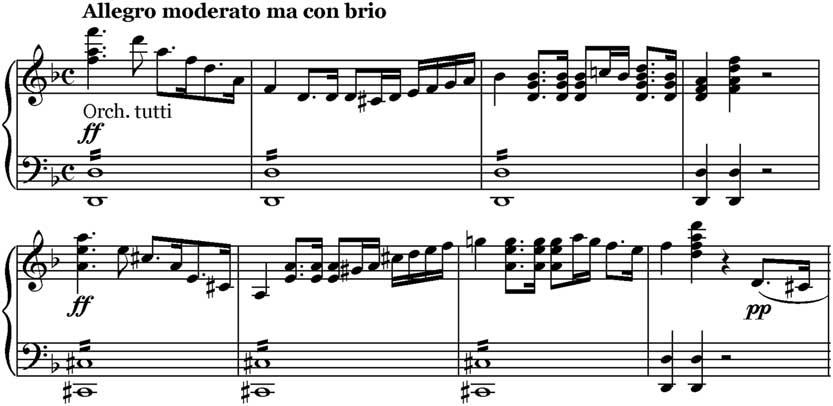
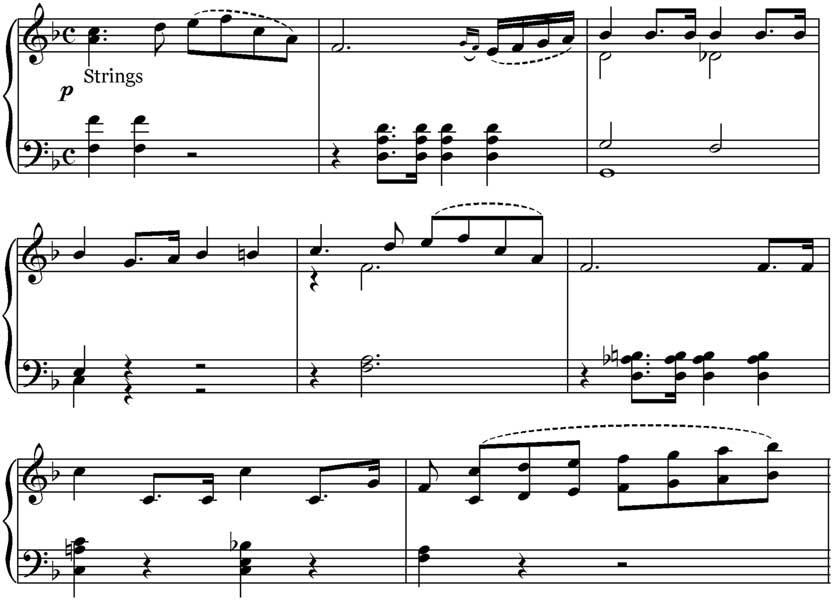
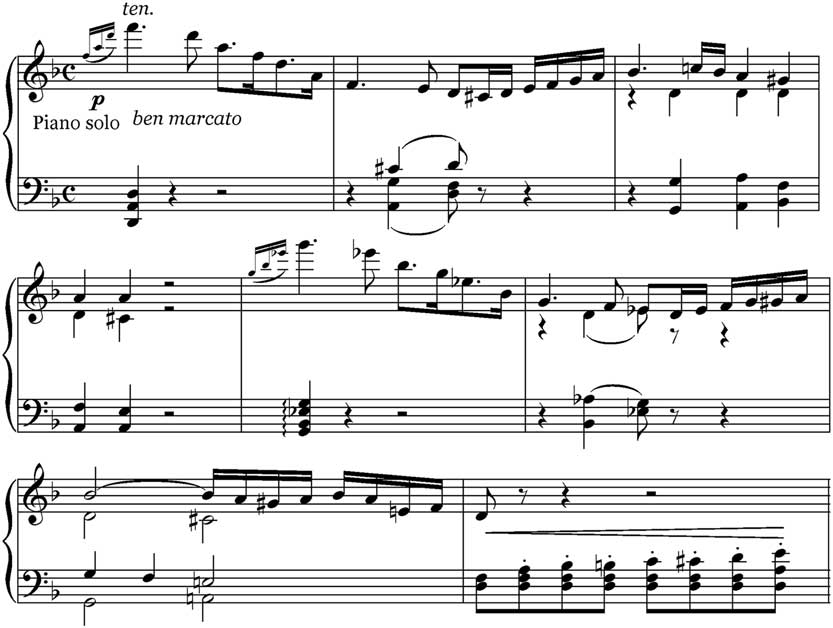
An examination of the first movement of Bennett’s Piano Concerto No. 1 in D minor Op. 1, completed in February 1832, divulges much about the steady development of the fifteen-year-old RAM student. The ritornello, of only sixty-five bars, is actually ten bars slighter than that of Mozart’s K. 466 and is essentially built on only two thematic ideas, with a third idea functioning as coda material. The first idea, in D minor, is, as Bush has remarked, ‘the D minor of Don Giovanni’,Footnote 31 and the bold gesture of the I–Vb progression that opens Bennett’s ritornello is clearly reminiscent of the initial dramatic bars of Mozart’s overture to his opera (Example 1a). In fact, Bennett seems to have exercised an obsession with D minor at this point in his education. His Second Symphony (WO 23), which also shows symptoms of Don Giovanni, and which was composed at much the same time as the First Concerto, uses the same key for its outer movements as does the Overture (WO 24)Footnote 32 composed in October 1833. It also seems more than a coincidence that Potter’s Piano Concerto No. 1, completed only two months after Bennett’s work, in December 1832, should have been written in the same key. While the Don Giovanni idea dominates the first thirty bars of Bennett’s ritornello, the second phase is taken up with a presentation of the second subject in F major. This entirely classical idea, with its regular periodic structure (Example 1b), is firmly rooted in the relative major and it is only with a repetition of the melody that Bennett redirects the tonality back to D minor in preparation for the entry of the piano. It is an indication of the emerging sophistication of Bennett’s compositional powers that, in his sonata exposition, the statement of his first subject should itself be a protracted reworking of the original material from the ritornello, but one of the most striking elements of the piano’s appearance should be an unexpected interjection of the Neapolitan in its consequent phrase (Example 1c). While Mozart’s partiality for this chromatic inflection is well known, and Bennett’s dramatic use of the harmony was no doubt a deferential gesture, it may well have been due to Potter’s influence for a similar Neapolitan flourish (albeit more cadenza-like) occurs at the same point in the first movement of his own Concerto in D minor. The presentation of Bennett’s second subject also follows a traditional ‘London’ procedure in that, after the statement of the lyrical material, a secondary phase gives rise to an exhibition of virtuoso technique from the soloist. While Bennett’s demonstration of athleticism may be relatively modest, his capacity for harmonic surprise, namely with his climactic and prolonged use of the flat submediant, shows that he was certainly a student of Beethoven and Moscheles, and this is similarly reflected in the entry of the piano in the development. Here the piano’s statement of the first subject in B flat major is afforded greater impact by the modulation of the central orchestral ritornello to A minor, once again drawing attention to the ‘purple’ area of the Neapolitan. This impressive strategic thinking for one so young is continued in the recapitulation where the reprise of the first subject is taken entirely by the orchestra, thus throwing the restatement of the second subject in the tonic major into relief with the arrival of the piano.
Bennett Piano Concerto No. 1 in D minor, first movement: opening theme

Bennett Piano Concerto No. 1 in D minor, first movement: second subject

Bennett Piano Concerto No. 1 in D minor, first movement: opening of exposition (Neapolitan inflection)

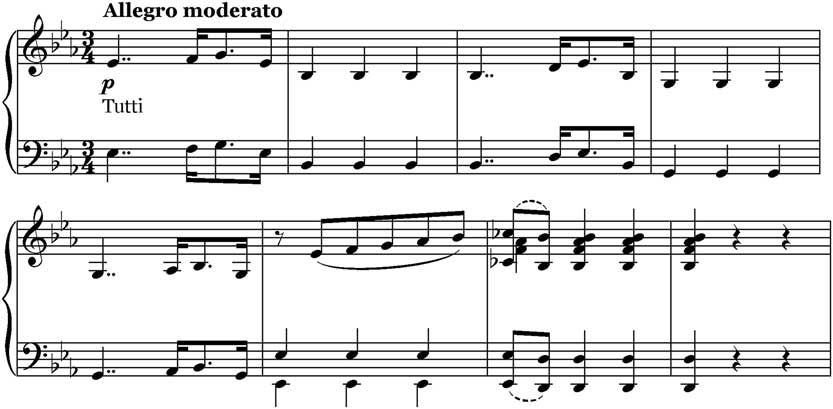
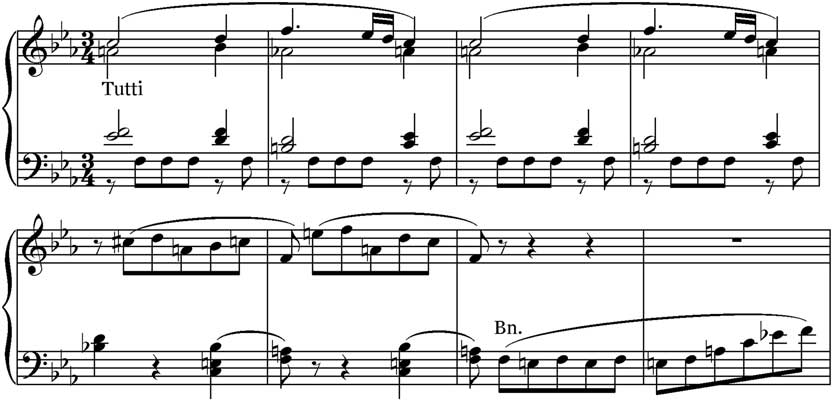
Bennett may have demonstrated his incipient powers in the first movement of his First Concerto, but in the Second, in E flat major Op. 4, composed between July and November 1833, there is a clearly a greater expression of new-found confidence.Footnote 33 Though the opening idea of the ritornello may still exude his love of Mozart (Example 2a), the scale of the orchestral introduction, of no less than 125 bars, is much more ambitious in its tonal and thematic scope; indeed, the feeling of confidence is palpable in the more complex, oblique nature of the second subject (Example 2b) which tantalizingly sits on the dominant. The proportions of the sonata movement are also larger (barely shy of 150 bars), symptomatic of the much greater technical demands Bennett makes in the solo part, and the level of invention not only embraces Mozart and Beethoven, but also, after the unexpected caesura in the development, an entirely romantic assimilation of Bachian counterpoint. In much the same manner as the First Concerto, Bennett reserves the first subject of the recapitulation (a passage of some thirty bars) for the orchestra alone, leaving the lyrical second subject and the immensely demanding bravura material that follows, to the piano.
Bennett Piano Concerto No. 2 in E flat major, first movement: opening theme

Bennett Piano Concerto No. 2 in E flat major, first movement: second subject

Composed between July and October 1834, Bennett’s Third Concerto, which Ernest Walker praised for its ‘earnestness and structural finish’,Footnote 34 builds on the ambition of the Second. The variety and boldness of the orchestral ritornello, now some 125 bars, is an impressive assimilation of Mozart and Bach. Of the former influence one senses a paraphrase of the opening idea of Mozart’s Concerto K. 491 in the same key (Example 3a), and of that contrapuntal austerity of the Adagio and Fugue in C minor K. 546, itself a manifestation of Mozart’s admiration for Bach. Indeed, Bennett demonstrates a new self-assurance in his handling of invertible counterpoint and in the symphonic dexterity by which the opening idea is reworked, notably in its use as a transition to the announcement of the second subject, its reprise after the second subject on the Neapolitan, and its last appearance in the ritornello on an extended tonic pedal replete with ‘severe’ chromaticism. As if to emphasize this greater fecundity, the exposition begins with twenty-four bars of cadenza-like improvisation for the pianist, an arresting departure accentuated by the piano’s entry on the submediant (Example 3b), a gesture which initiates a phase of austere two-part imitation before a further reiteration of the melody on a preparatory dominant pedal. This level of invention continues in the development where, in the central ritornello, the first subject appears in combination with the second. What is also interesting here is how Bennett appears to merge the function of ritornello (which is a sizeable paragraph of thirty-six bars for the orchestra alone) with the rhetoric of developmental treatment. At its conclusion this conflation of ritornello and development carries us to A flat, at which point the piano, marked ‘ad.lib.’ and perched on the dominant of A flat, briefly seems to suggest the beginning of another cadenza. This proves, however, only to be a momentary flourish, since its real function is to enunciate a secondary phase of the development. This is also largely focused on the first subject, but more significantly Bennett embarks on a ‘composing out’ of the principal events of the initial piano cadenza, beginning with a sequential treatment of the material in A flat (analogous with the cadenza’s opening on the submediant) and concluding with the same idea projected against a protracted dominant pedal. Bennett’s response to this substantial section is a truncated recapitulation of the first subject, again entirely given to the orchestra, allowing the lyrical second subject in the tonic major and the bravura material which follows to gain added weight. Moreover, the first subject is given one final hearing in a more clearly defined shared coda, markedly different from those of the First and Second Concertos which are provided by the orchestra.
Bennett Piano Concerto No. 3 in C minor, first movement: opening theme

Bennett Piano Concerto No. 3 in C minor, first movement: piano cadenza at the beginning of the exposition

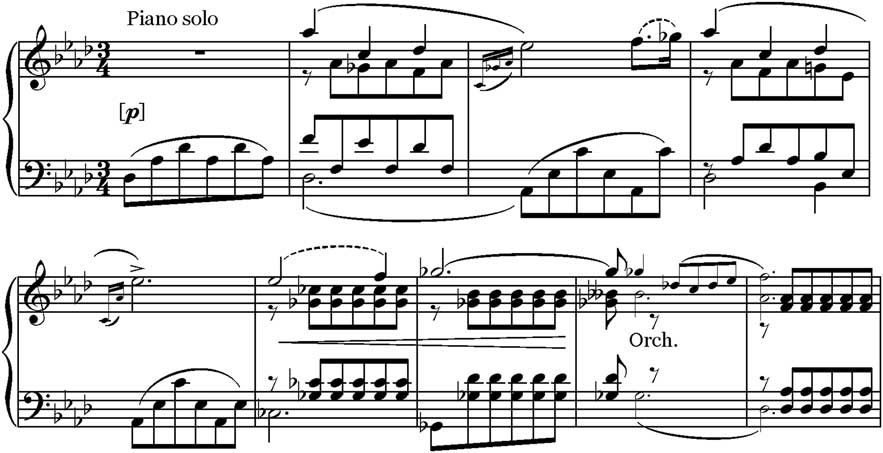
In the unpublished Concerto in F minor (WO32),Footnote 35 composed between February and May 1836 at the end of Bennett’s RAM career, the trend of expansion (a ritornello of no less than 165 bars) and increased technical difficulty continues. Bennett’s penchant for a more discursive central orchestral ritornello is also demonstrated, in this instance, because it serves to attract attention to the extended appearance of the second subject in the dominant major. Here it is very much the centrepiece of a development entirely based around the dominant key. And, emulating the processes of the Second and Third Concertos, the more condensed recapitulation in F minor is characteristically taken by the orchestra. Bennett’s coup de maître, however, is to restate his second subject initially in the submediant, D flat major, before reverting to the tonic major (Example 4). This is the first instance of such tonal treatment in Bennett’s concertos and marks a further step forward in his handling of the form.
Bennett Piano Concerto in F minor (unpublished), first movement: recapitulation of the second subject in the submediant

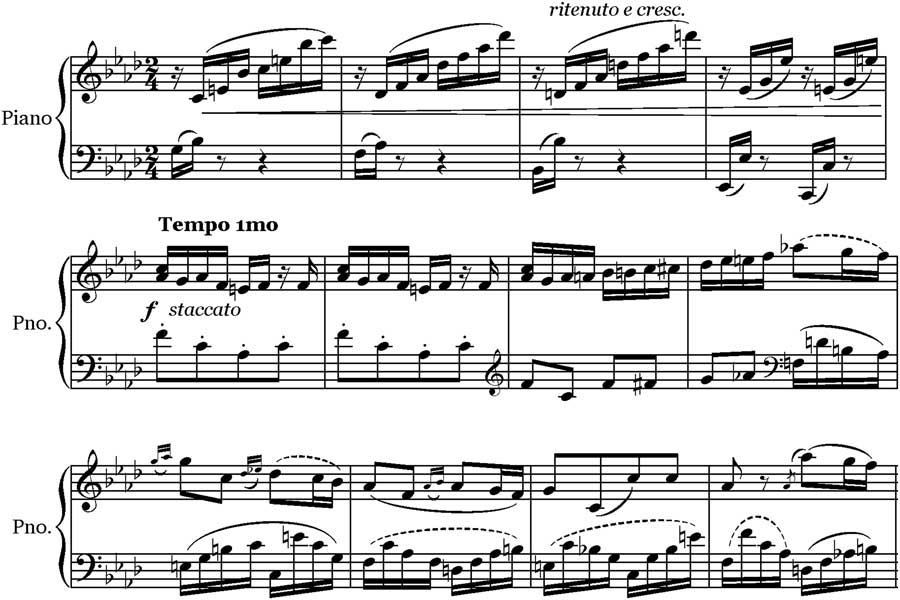
If the first movement of the unpublished Concerto in F minor exhibits a modest advance in structural treatment, then that of his next concerto shows a significant change in formal procedure. Having closely adhered to the ‘London’ model in the first movements of his first four concertos, Bennett desired to look back to his idol Mozart in the more concise first movement of his Fourth Concerto in F minor Op. 19, written between July and September 1838 (originally titled ‘Concerto Appassionata [sic]’ in the autograph manuscript, perhaps in tribute to Beethoven’s Op. 57 Piano Sonata in the same key).Footnote 36 Here Bennett clearly chose to jettison the well-tried co-relation of first and second subjects in the ritornello and sonata exposition in favour of a much shorter ritornello of seventy-nine bars; moreover, while first and second subjects are presented in the ritornello, both are firmly couched in F minor and the second subject lacks the clear delineation and structural stature it was afforded in his earlier first-movement schemes. In the exposition, as expected, the second subject is presented in the relative, A flat major, but here the style of the material is noticeably more reminiscent of Mendelssohn in its ‘song without words’ manner (Example 5). The ‘bravura’ demonstration of pianistic athleticism which habitually followed this thematic event in the earlier four concertos is evident in the passagework that follows, but there is nevertheless a greater sense of thematic integration for, following the climax marked ‘con passione’, the second subject does duty as closing material to the exposition. What is more, at this point, traditionally ushering in the entry of the central orchestral ritornello, Bennett omits it completely and, while there is a prolonged dominant pedal, there is no traditional cadence into A flat. Instead, Bennett rapidly carries us back to F minor (making reference to the second subject) in a transition of a mere sixteen bars, clearly sidestepping any developmental phase in the movement. This is confirmed by the precipitate arrival of the recapitulation of the first subject in the orchestra. As witnessed in his earlier concertos, this is again taken exclusively by the orchestra, except that here its length is truncated to a duration of only eighteen bars. Had Bennett looked to the example of Field’s concertos whose unconventional recapitulatory methods invariably involved radical truncation,Footnote 37 and in the case of the absent development, was he responding to Mendelssohn’s similarly abbreviated developments in his G minor and D minor Concertos? This series of unconventional deviations from Bennett’s standard model continues with the entry of the second group in the submediant, D flat major. The use of this tonality has already been observed in the earlier F minor Concerto. There, however, its presence was short-lived (when it yielded to a repeat in F major) whereas here the entire lyrical second subject is couched in the key, and it is only with the launch into virtuoso display that F minor is restored.
Bennett Piano Concerto No. 4 in F minor, first movement: second subject

Bennett and the Romantic Slow Movement
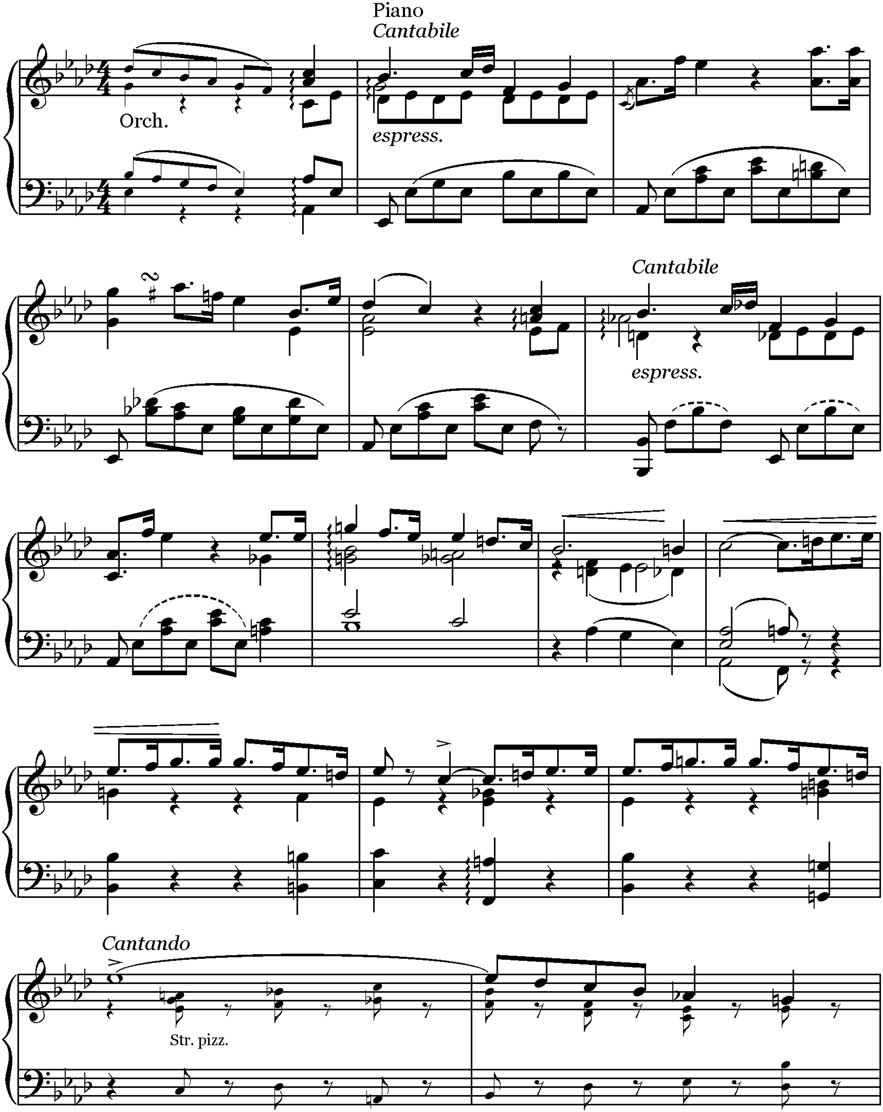
The first movement of Bennett’s Fifth Concerto indicates that the composer, now a confident twenty-two year old, was beginning to reconsider the structural tenets of first-movement concerto in light of the ‘London’ model he had espoused as a student and where the influence of Mozart was less overt. As for the slow movements and finales of his concertos, these reveal a different narrative in terms of his stylistic development and suggest an increasingly contemporaneous romantic perspective of scope and formal design. This is evident even as early as the First Concerto whose ternary Andante sostenuto has much in common with the simplicity and lyrical effusion of Field’s slow movements,Footnote 38 especially its more nocturne-like central section, though the individuality of the ‘chamber music’, as Bush has pointed out, of solo violins, flute, oboe and clarinet accompanied by the piano discloses an already vital imagination towards the idiom.Footnote 39 Characterized by the same felicitous scoring (which frequently involves the fragile sound of the piano’s solo right hand and pizzicato strings),Footnote 40 the Adagio espressivo of the Second Concerto is thematically tauter in its monothematic aims, particularly in the way that the central paragraph not only transforms the initial melody into a more severe contrapuntal ‘invention’ but also, by dint of its tonal instability, functions as a developmental phase. As if to intensify this entirely romantic sense of transformation, Bennett interrupts his dominant preparation for the reprise (itself reiterating the same ‘chamber music’ concept as the First Concerto) with a cadenza whose florid elaborations (again exclusively for the piano’s solo right hand) merge seamlessly with the orchestral tutti that follows.
It has been contended that, for the Third Concerto, Bennett made at least two attempts before settling on a final version of his slow movement. Andrew Cope, who edited the unpublished and incomplete manuscript of the Adagio in G minor for a performance at Manchester University on 18 June 1981, claimed that this movement was the one that Bennett played when the concerto was given at the Leipzig Gewandhaus on 19 January 1837,Footnote 41 citing the evidence of Schumann’s review of the concerto and that Bennett had intimated to the reviewer (Schumann was by then a close friend) that the movement had a programme. Schumann’s review captured this narrative:
Then began the Romance in G minor – so simple that the notes can almost be counted in it. Even had I not learnt from the fountain head that the idea of a fair somnambulist had floated before our poet while composing, yet all that is touching in such a fancy affects the heart at this moment. The audience sat breathless as though fearing to awaken the dreamer on the lofty palace roof; and if sympathy at moments became almost painful, the loveliness of the vision soon transformed that feeling into a pure artistic enjoyment. And here he struck that wonderful chord where he imagines the wanderer, safe from danger, again resting on her couch, over which all the moon light streams.Footnote 42
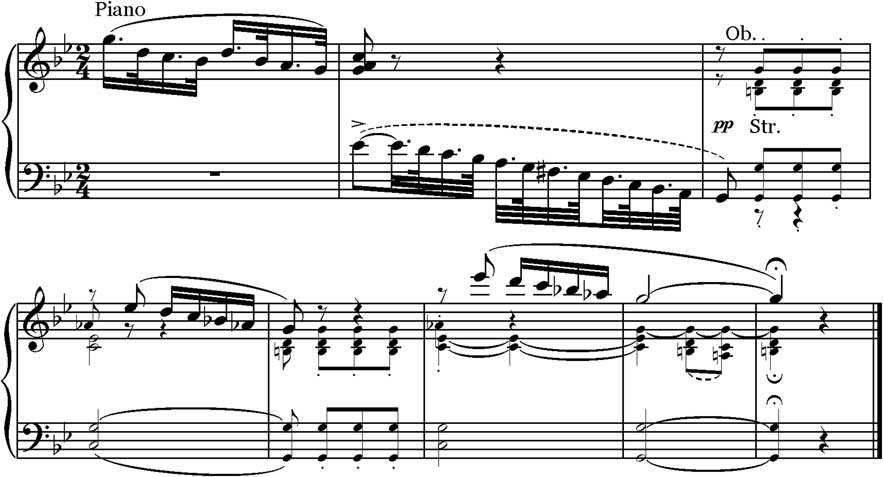
That the movement was used at Leipzig has since been disputed by Bush on the grounds that Bennett’s score did not tally with Schumann’s description,Footnote 43 and Williamson has also commented that if the Adagio, dated 24 September 1834, had been intended for the concerto, ‘it was quickly rejected in favour of the “Romanza”, which was completed on 10 September October 1834’,Footnote 44 and which was performed by Bennett at the concerto’s premiere at the RAM on 16 May 1835. It is, of course, quite possible that Bennett did, at some point, intend the Adagio as the slow movement of his work given the choice of key, but it is not clear why he rejected it unless he felt unhappy with the movement’s balance. Where Bush does agree with Cope is the fact that Bennett’s movement is more akin to a through-composed dramatic ‘scena’,Footnote 45 more comparable with the free manner of the slow movement of Beethoven’s Fourth Concerto. Indeed, the dialogue between piano and orchestra uses a rhetorical language which, in fluctuating between quasi-recitative, improvisation (in a cadenza-like fashion) and lyrical arioso, is certainly suggestive of some form of programme, and there is much in the abundance of expressive suspensions and appoggiaturas, not to mention the striking final cadence (♭II6–I), to intimate a narrative of tragic proportions prophetic perhaps of the later programmatic Piano Sonata ‘Die Jungfrau von Orleans’ (‘The Maid of Orleans’) Op. 46 based on Schiller’s eponymous play (Example 7). Quite unlike anything else Bennett wrote, the Adagio epitomizes all that is potently romantic in his style and it remains an exceptional and experimental essay in his output, but one that he may never have heard.
Bennett Piano Concerto No. 4 in F minor, second movement: transition to recapitulation

The published Romanza of the Third Concerto is itself an imaginative movement and very much an advance on the ternary designs of the first two concertos. An unostentatious idea for pizzicato strings (surely the simple ‘somnambulist’ theme Schumann described in his review), framing a more distinctly Mendelssohnian theme for the piano, provides a contrast to an adjoining poetic section in the tonic major. The climax of the movement occurs with a recurrence of the pizzicato material, now for full orchestra, in the dominant, out of which a more embellished reprise of the minor–major material, modified and condensed, emerges; though the most romantic imagery is reserved for a final reprise of the ‘somnambulist’ imagery and the tranquil, ‘moonlit’ coda.
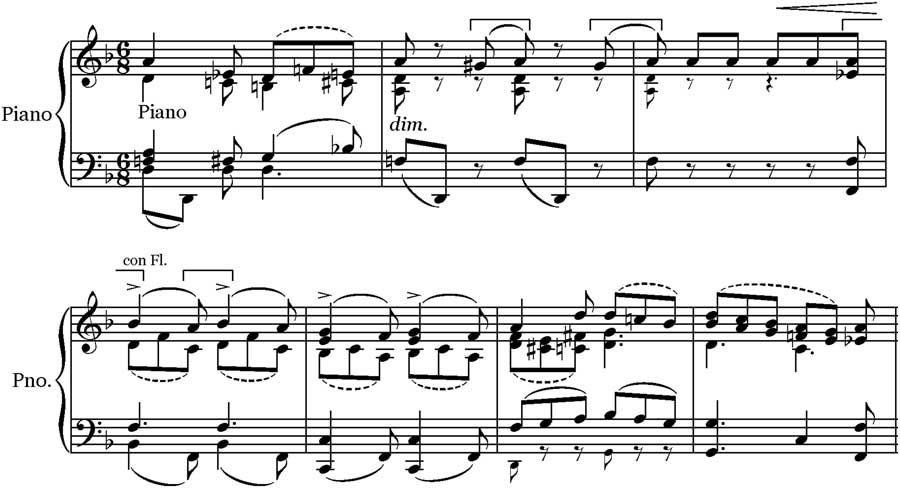
An emulation of the narrative of the Romanza may well have been at the heart of the Romanza pastorale of the Concerto F minor (WO 32), subtitled ‘A stroll through the meadows’, in that, though it reverts to a ternary scheme, it shares many of the same traits of delicate orchestration and thematic simplicity in its outer sections; and there was clearly some intended drama in the turbulence of the middle paragraph in the mediant minor (C minor). Yet, as J. R. Sterndale Bennett noted, in the rehearsal of the concerto at the RAM on 30 June 1836, the movement ‘failed to arouse interest’, and so, overnight, the composer produced a new movement, a Barcarole in F major, which was used in the first performance on 1 July and which achieved notable popularity during the composer’s lifetime in his own arrangements for solo piano and piano duet.Footnote 46 Bennett very probably derived the idea of the movement’s aura from the examples of the ‘Venetianisches Gondollied’ in Mendelssohn’s Lieder ohne Worte, notably Op. 19b No. 6 (published in 1832) and Op. 30 No. 6 (published in 1835), yet, while Mendelssohn’s introspective miniatures are couched in minor keys, Bennett’s ternary essay is in the major. Its legerdemain lies in its subdominant accentuation in the first of the melody, which Bennett often further intensifies through passing modulation, and this tangential inflection to IV is particularly effective at points of reprise, both at the end of the first section and, most remarkably, at the close of the dramatic central section in D minor where the G♯–A motion of the melody is transformed into A–B♭ (Example 6). Such adroitness, together with the delightful pianistic arabesques of the closing material (and replete with the composer’s favourite pizzicato strings), confirms Bennett’s mature creative powers. Although ‘A stroll through the meadows’ was revised and performed at the first performance of the Fourth Concerto Op. 19 at the RAM on 26 September 1838, Bennett chose to reject it again when it came to the second performance of the concerto at Leipzig in January 1839, perhaps at the suggestion of Mendelssohn (who conducted) and the Barcarole was substituted. Thereafter, this movement became the established slow movement of Op. 19 as confirmed by the published score of 1839.Footnote 47
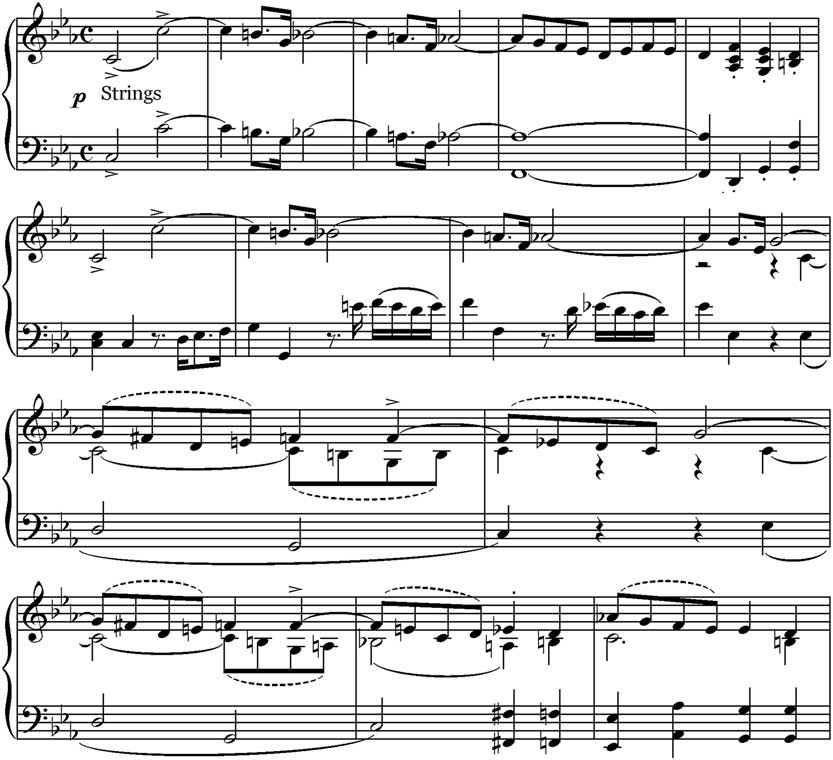
Bennett Adagio in G minor: conclusion

Bennett and the ‘Shared’ Finale
The romantic proclivity of Bennett’s slow movements is incrementally reflected in the structural thinking of his final movements. Bush has hypothesized, with some plausibility, that Bennett originally planned the innovation of four movements for his First Concerto and was persuaded to drop the finale.Footnote 48 This would explain the strange anomaly of his concerto ending with a ternary Scherzo. By contrast, the Second Concerto concludes with a shared sonata structure of considerable technical difficulty for the pianist, an approach which brings Bennett more into the province of Mendelssohn’s shared concept of sonata in the concerto idiom. Furthermore, this impression is strengthened by the piano’s early entry, and by the evident link between the end of the slow movement (ending in B flat) and the beginning of the last (beginning on a dominant pedal). Such tangible connections between slow movement and finale are evident in Potter’s concertos in D minor and E flat major which may have influenced the young Bennett, but one cannot also ignore the explicit link of these movements in Mendelssohn’s Concerto No. 1 which the composer performed in England for the first time under Potter’s baton at the Philharmonic Society on 28 May 1832.Footnote 49 Bennett’s handling of form in the finale of his Second Concerto is playful and inventive. The extended introduction on the dominant is by no means expendable extemporization, but is made use of again after an unexpected caesura at the end of the first subject. Here the dominant pedal is raised a semitone to B♮, facilitating the entry of transitional material in C minor. The counterpart of this shift in the recapitulation, after a similar caesura, is reinterpretation of B♮ as C♭, as part of a German augmented sixth, thus instigating a return to the dominant of E flat.
The close of the Romanza in the Third Concerto and the beginning of the finale is also suggestive of a link between the two movements, but perhaps most arresting is the opening for the piano alone and the orchestral paragraph (effectively a residue of a ritornello) that follows. Such rhetorical devices are strongly reminiscent of Mendelssohn’s First Concerto. Commenting on Mendelssohn’s First Concerto in his Cambridge lecture, Bennett wrote: ‘a young composer essaying to write a concerto without the traditional “tutti” would have been almost cried down. And yet we have lived to see this strong tradition broken through’.Footnote 50 Of greatest importance to Bennett, in the light of this change, was the role of the orchestra which, in Mendelssohn’s atypical structure was ‘always giving relief and imagination to the work’.Footnote 51 In the light of this remark, it is illuminating to witness the organization of Bennett’s development, for the first twenty-seven bars are entirely for orchestra and mimic the role of a central ritornello in its reiteration of the opening thematic material. Here, however, it functions as an extended transition to the presentation of an entirely new thematic episode in F minor. Likewise, Bennett reveals his penchant for an orchestral recapitulation, though in this case, after ten bars, the piano interjects in a mood to impose itself for the solo second subject (in emulation of the exposition) which soon follows.
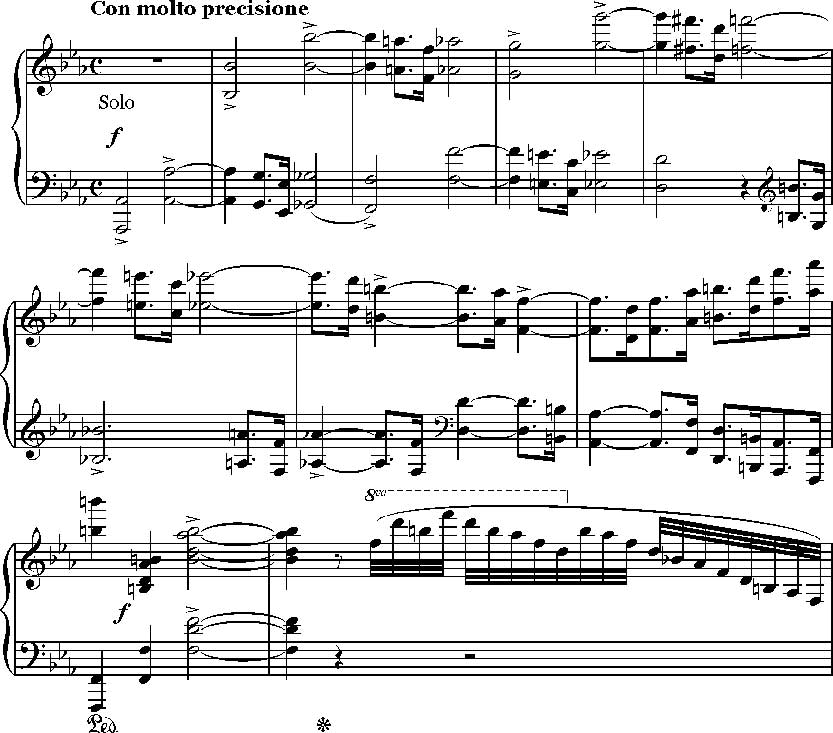
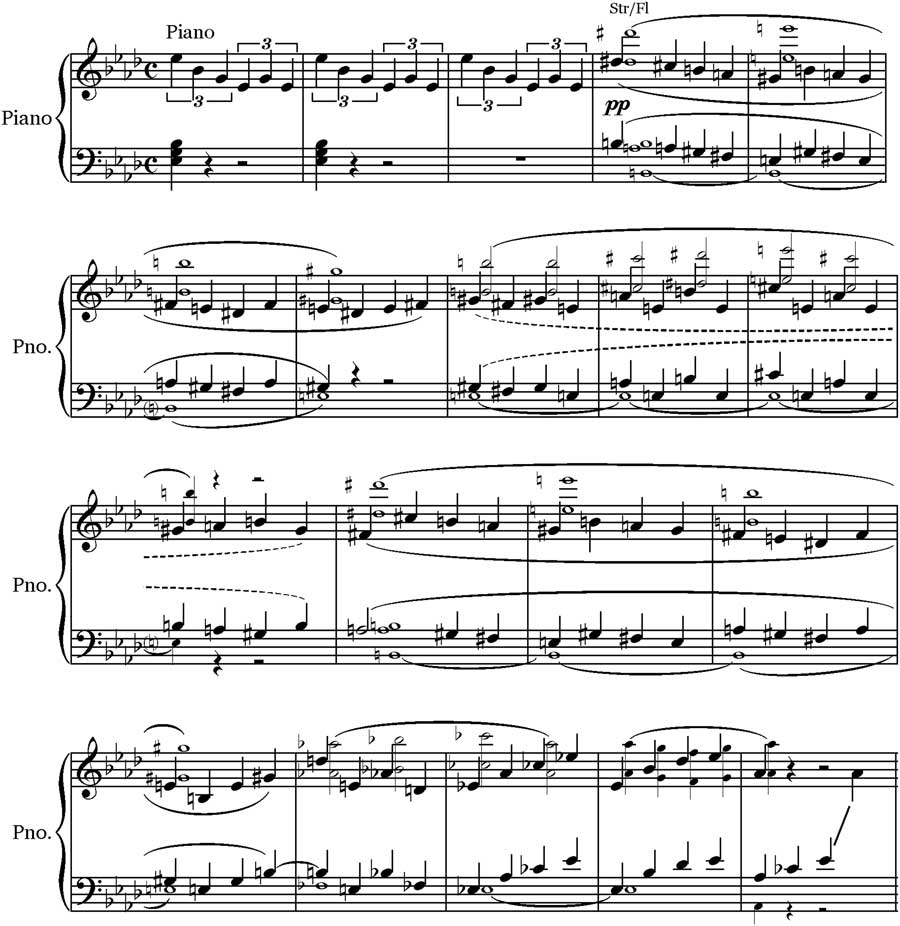
The finale of the unpublished Concerto in F minor follows much the same structural plan as the Third Concerto, and there is once again a perceptible link between the concluding A flat major of the Romanza pastorale with its C at the top of the final chord and the piano’s gesticulative C–D♭ at the head of the finale’s fifteen-bar introduction. Bush described the movement as ‘overlong, weak in invention and routine in execution’ as well as being ‘irretrievable’.Footnote 52 This is perhaps true of the first and second subjects which lack the strength of the Third Concerto, yet Bennett’s approach to A flat major, through the flat submediant, E major, is both novel, attractive and without precedent in his earlier concertos (Example 8).
Bennett Piano Concerto in F minor (unpublished), last movement: transition to second subject

The model of the shared sonata for piano and orchestra comes into focus even more sharply in the finales of the Concerto in F minor Op. 19 and in the Capriccio (originally called L’Hilarité at its first performance) in E major Op. 22, which Bennett is thought to have begun in 1836.Footnote 53 While both have much in common with the fundamental design of the Third Concerto, the handling of material is more thorough. The solo statements from the piano at the opening are considerably more extended (almost twice the length) and discursive in style, and there is a greater proliferation of thematic ideas in what would be more accurately termed as a ‘second group’, especially in the Capriccio where Bennett adheres to the dominant minor–major paradigm of the Third Concerto. Having presented the two contrasting themes, and reached his much-favoured caesura on V, a secondary phase, again more protracted, features several distinctive thematic departures before the orchestral ritornello, the last of which (derived from the opening idea) skilfully embarks from the flat mediant. Consistent with their earlier counterparts, both movements have short developments and truncated recapitulations. The principal difference, however, in these two examples is that the opening of the recapitulation is reserved on both occasions for the solo pianist instead of the orchestra, perhaps because the unequivocally pianistic idiom of the musical ideas did not translate well into orchestral terms (Example 9).
Bennett Piano Concerto No. 4 in F minor, last movement: transition to recapitulation

The Tension of Mozartian Equipoise and Romantic Abandon
Bennett’s five piano concertos, written in the space of eight years between the ages of fifteen and twenty-two (and four of them while he was a student), occupy an important place in the history of the European piano concerto during the first half of the nineteenth century. They also illuminate elements of his profound admiration for Mozart, but at the same they also tell us much about the milieu of the ‘London’ model of the concerto which was being championed by his elders such as Moscheles, Cramer and Potter at the RAM, and how he attempted to achieve a personal compromise between his classical sympathies and the structural innovations that Mendelssohn had initiated. Bennett and Mendelssohn had much in common. As child prodigies, they both venerated the classics and were brilliant executants of the piano. Indeed, when Mendelssohn heard Bennett perform his First Concerto in London in 1833 and subsequently invited him to Leipzig ‘as a friend’ rather than as a pupil,Footnote 54 he must have recognized something of his own phenomenal youthful brilliance in the gifted youngster. Certainly the five performances of the First Concerto at Cambridge (28 November 1832), the Hanover Square Rooms in London (30 March 1833), twice for Queen Adelaide at Windsor (in April 1833) and again at the Hanover Square Rooms (26 June 1833) together with the publication of the work at the behest of the Academy Committee,Footnote 55 acted as a major spur towards Bennett’s career as a virtuoso pianist-composer, even though, after the work’s early esteem, he never again chose to play it in its entirety in public. By contrast with the more Mozartian scale of the First Concerto, he remained more attached to the much expanded Second Concerto, performing it three times at the RAM in 1834 alone. It was with the work that he made his soloist debut at the Philharmonic Society on 11 May 1835, ‘establishing his fame as a first rate Pianist and Composer’.Footnote 56 Bennett also revived it in February 1838 for another London concert and other pianists such as Calkin and Dorrell gave performances in the capital in 1839 and 1842.
If the Second Concerto established Bennett’s reputation as a pianist-composer, it was with the Third Concerto that the composer, still only eighteen, began to enjoy true public adulation in a vibrant London concert world in which concertos by Mozart, Beethoven, Hummel, Herz, Potter, Moscheles, Benedict and even his RAM student colleague George Macfarren (whose own C minor Concerto was given by the Society of British Musicians on 2 November 1835) were enjoying degrees of success. After its premiere at the RAM on 16 May 1835 and the first hearing at the Philharmonic on 25 April 1836, Bennett made his debut at the Gewandhaus in Leipzig with the Concerto on 19 January 1837. Icily hostile as Gewandhaus audiences were reputed to be, not least to an English composer, Schumann’s review in Die Neue Zeitschrift für Musik was not only a rebuke to his sceptic compatriots but also a paean:
‘An English composer; no composer,’ said someone before the Gewandhaus concert of a few weeks ago, at which Mr Bennett played the above concerto. When it was over, I turned to him, questioning, ‘An English composer?’ ‘And truly an angelic one,’ answered the Anglophobe … When we remember that the above concerto was written three years ago – that is to say, in its composer’s nineteenth year, – we are astonished at the early dexterity of this artist-hand, the connection of the whole, its reposeful arrangement, its euphonious language, its purity of thought. Though perhaps I could have wished certain lengthened passages more concentrated in the first movement, yet that is individual. Nothing, on the whole, is out of place; there is nothing in the work that does not appear inwardly related to its fundamental plan; and even where new elements step in, the golden ground-threads still shine through, led as only a master-hand can lead them. How delightful it is to find an organic, living whole amid the trash of student-work; and how doubly delightful it was to find the Leipzig public, so little prepared for this, recognising it quickly and joyfully!Footnote 57
After Leipzig Bennett continued to perform the work in London for the Society of British Musicians (22 January 1838), twice for the Philharmonic in 1841 and 1844, and he performed it at least twice for benefit concerts in 1840 and 1854. But one of the intriguing elements of the Third Concerto is its range of structural paradigms – a large-scale first movement in the classical ‘London’ tradition, a programmatic ‘Romanza’ as the slow movement with its strong affinities with romanticism, and a finale which leans more towards the shared sonata scheme of Mendelssohn. Moreover, if we are to believe that the Adagio in G minor was a putative slow movement for the work, then we become aware for the first time of a tension and self-criticism within the genre and one which clearly grew as Bennett’s career progressed.
After its premiere at the RAM on 1 July 1836, the unpublished Concerto in F minor received but one performance at a benefit concert on 25 May 1838 and one hearing at the Philharmonic (18 June 1838) before the work was shelved. That he chose to write a further concerto in the same key is perhaps suggestive of going back to the drawing board. In this instance his critical instincts served him well for the Fourth Concerto proved to be his most popular and admired essay in the genre. Played before a small audience at the RAM on 26 September 1838, the work made use of the slow movement, ‘A stroll through the meadows’, but after a private hearing with Mendelssohn on 19 October 1838 in Leipzig, Bennett composed the ‘Barcarole’ which was performed with the Concerto at the Gewandhaus on 17 January 1839 and became its established second movement. The concerto was highly popular. Bennett himself performed the work several times for the Philharmonic in 1839, 1842 and 1847 and was soloist in the work at several benefit concerts in 1844, 1847 and 1849 and for the Society of British Musicians (8 April 1841). In fact Bennett gave several additional performances in the early 1850s. Pupils from the RAM, however, continued to perform them and Arabella Goddard became an aficionado (see Therese Ellsworth’s article for further details about later performance of Bennett’s concertos). It seems likely that Bennett’s championship of the Fourth Concerto, and the Capriccio in E major (which, after its London premiere in May 1838, was also performed at the Gewandhaus in 1843) were linked to their sense of contemporaneity and structural concision. In short, one senses in Bennett that there was a conflict between his classical intuition of Mozartian equipoise and his attraction to the prevailing romantic tendencies of the day. This is evident in later works such as the programmatic Fantasie-Overture Paradise and the Peri Op. 42 of 1862 and the Symphony in G minor Op. 43 of 1864 (also strongly Mozartian) whose five movements almost resemble a suite rather than a symphony. Yet this inner stylistic tension is also surely confirmed by his desire to produce a Sixth Concerto which we know he was composing in early 1842 for performance at the Gewandhaus and in London.Footnote 58 From the outset, however, it is clear that Bennett could not settle on a satisfactory form. An inability to complete the work led to the substitution of the Concerto Op. 19 with Mendelssohn in Leipzig on 3 March 1842 and with Moscheles at the Philharmonic Society on 30 May 1842.Footnote 59 Still he laboured at the piece through the first half of 1843, completing two movements (a first movement in May 1843, the finale in June), of which the manuscript was headed Concert-Stück.Footnote 60 Such a title, J. R. Sterndale Bennett believed, was because of its two-movement design;Footnote 61 moreover, Bennett’s conception of the first movement in A minor and the finale in A major was highly suggestive of that bi-partite, minor–major structure in Weber’s Konzertstück which was immensely popular in London. Between 1825 and 1842 it was played in the capital on over twenty occasions by pianists such as Mendelssohn, Neate, Dulcken, Litolff, Moscheles, Anderson and Dorrell, while Bennett himself was an executant of the work on 11 April 1844. The compressed telescoped structure of the first movement (with its orchestral introduction of twenty-five bars) and the unusual sonata rondo finale of Bennett’s work also suggest that he was looking to move in a new direction. Nonetheless, as Williamson has argued,Footnote 62 Bennett was still inclined to include a middle movement for his Konzert-Stück, since, two days before the first hearing of the work on 5 June 1843, he composed a ‘Serenade’ which itself may have been substituted for another slow movement now lost.Footnote 63 In a letter, written the same day as the first performance, Bennett gave a telling clue to the form, style and genre of his work:
Now about my Concert-Stück – I can give you the plan as I conceived it – viz. Allegro Appasionata ♯sic], rather serious and earnest, after which a short Serenade, with very very slight accompaniments for the orchestra, and finally the Allegro quasi Presto, ending as merrily as I could make it.
I have named it Concert-Stück, as I never can acknowledge that a real Concerto can be written with the old fashioned Tuttis at the commencement etc – such as I have endeavoured to make in my other Concertos.Footnote 64
Evidently Bennett keenly felt the inescapable forces of traditional concerto, one he later admitted in his Cambridge lecture,Footnote 65 and, as he enunciated in the case of Weber’s Konzertstück (which he greatly admired), ‘a desire to escape the form’.Footnote 66 Even then the story of the Concert-Stück was not over. Revisions took place in the summer of 1843 and a performance of the work at the Hanover Square Rooms was planned and advertised in June 1844; yet, when the time came, only the finale was given along with the Concerto Op. 19. And still the uncertainty and misgivings lingered, for after further, substantial revision in 1844, when the work was renamed ‘5th Concerto’, its performance on 15 June 1848 included the slow movement of his First Concerto in place of the ‘Serenade’, music which he had withheld for fifteen years.Footnote 67 Perhaps inevitably, like the rejected Concerto in F minor, the ‘5th Concerto’ remained unpublished.
For all that our picture of Bennett’s piano concertos is incomplete, what has come down to us in terms of the four published and two unpublished works (all, barring the Concert-Stück, are now available on commercial recording) is an important and fascinating legacy whose complex and multi-faceted chemistry tells us much about the composer’s creative approach to large-scale form, his relationship with the performer-composer tradition that he inherited and the fact that these works, especially the Third and Fourth Concertos, remained important to him, borne out by his performances of them until the early 1850s. We have, of course, to acknowledge the importance and influence of Mozart not only through the newly emerging performing tradition of his concertos, but also in a larger narrative, as Temperley has posited, of that composer’s influence on English music in the nineteenth century.Footnote 68 However, Bennett’s love of Mozart was itself the source of an aesthetic tension between classicism and romanticism which he clearly experienced in his encounters with the concerto genre. In this regard the structural subtlety, nuance and scale of his concertos warrant close scrutiny in much the same way as the body of concertos by, for example, Moscheles whose own works underwent comparable change. The concertos also offer more than simply reactions to existing models or stylistic topoi for, as this study of Bennett’s approach to concerto form has attempted to demonstrate, his treatment of a dialogic process between orchestra and soloist was undergoing constant change and refinement as his eclectic sources of influence were more closely assimilated. And for all Bennett’s eclecticism, his natural gift for melody and extended lyricism served to characterize much of the compellingly attractive thematic material which the concertos contain and which is also identifiable in the concert overtures, the piano works and the late G minor Symphony. As Stanford remarked, Bennett ‘was a poet, but of the school of Wordsworth rather than of Byron and Shelley … To an audience on the prowl for startling effects and for new sensations, such music as Bennett’s cannot appeal: but to those who like to sit still, and can forget temporarily the rush of trains, motors, telegrams and telephones, it will convey the soothing charm which was part and parcel of the man himself.’Footnote 69 It was this aspect, above all, which his successors admired and which they found in abundant supply in the concertos. It was a style and deportment, moreover, which had lasting influence since it can be observed in the sketches of Parry’s early Concerto in G minor (1869) and Stanford’s youthful Concerto in B flat (1873) before it was eclipsed by the influences of Schumann, Brahms and Wagner in the last twenty years of the nineteenth century.