


INTRODUCTION
The Irish and European Union (EU) dairy industry is in a period of considerable change, moving from a period of protection towards an eventual situation where milk quota will no longer be limiting milk production. This will create significant opportunities for dairy producers to expand their production. However, support from the EU is likely to diminish further, as quota is removed and milk price volatility will become a prominent feature of the production system as the principles of global supply and demand become an integral part of EU markets. It has been estimated that by 2050 that the world will have to produce 70–100% more food (O'Brien Reference O'Brien2011), which will require producers to maximize output using the least inputs. It is also important to balance the demand for greater productive efficiency with the need to conserve the environment. For example, environmental issues such as the reduction of greenhouse gas emissions by 2020 and potential pollution problems from excessive nitrates and phosphates are also factors that must be considered.
Risk factors such as milk-price fluctuations will force producers to focus on becoming more technically and economically efficient. The profitability of specialist dairy farms in Ireland decreased between 2007 and 2008 with family farm income (FFI) reduced by 10%, due mainly to increases in direct and overhead costs (Connolly et al. Reference Connolly, Kinsella, Quinlan and Moran1998–2008). The key to reducing the overall costs of production is to maximize efficiency in the use of inputs. This can be done by adopting the best practice management techniques utilized by the most efficient producers; as studies by Tauer (Reference Tauer1993), Rougoor et al. (Reference Rougoor, Trip, Huirne and Renkema1998) and Hansson & Öhlmér (Reference Hansson and Öhlmér2008) have concluded the reasons for substantial differences between efficient and inefficient producers were attributed to poor management.
Economic efficiency or overall efficiency can be defined as the product of allocative and technical efficiency (Farrell Reference Farrell1957). Technical efficiency can be described as the capacity of a business unit to produce the maximum possible output from a given mix of inputs and allocative efficiency as the selection of inputs based on the market price that they hold (Farrell Reference Farrell1957). Much of the efficiency measurement work on dairy farms has used frontier methodologies such as stochastic frontier analysis (SFA) and data envelopment analysis (DEA). Hansson & Öhlmér (Reference Hansson and Öhlmér2008) used DEA to investigate the effect of management practices such as feeding, breeding and animal health on the whole farm efficiencies of Swedish dairy farms. In a separate study carried out by Tauer & Mishra (Reference Tauer and Mishra2006), the cost efficiency of American dairy farms using stochastic cost functions was quantified. Stokes et al. (Reference Stokes, Tozer and Hyde2007) used both physical and financial information to identify both technical and cost efficient dairy producers using DEA. Unlike previous studies mentioned, the current study is focused on efficiency allocated to the dairy enterprise only and the data used are from a group of predominantly grass-based dairy producers constrained by quota, unlike most international studies. Unlike previous Irish studies by Kelly et al. (Reference Kelly, Shalloo, Geary, Kinsella and Wallace2011) and Carroll et al. (Reference Carroll, Newman and Thorne2007), which focused only on technical efficiency, the current study also investigated allocative and economic efficiency.
The objectives of the current study were to measure technical, allocative and economic efficiency for a sample of Irish specialist dairy farms and to investigate the associations of key management, qualitative and demographic characteristics with technical, allocative and economic efficiencies.
MATERIALS AND METHODS
Methodology
DEA is a non-parametric method of efficiency analysis employing linear programming techniques (Charnes et al. Reference Charnes, Cooper and Rhode1978). The methodology works by estimating a best practice frontier, which is derived by enveloping the inputs and outputs of the most efficient decision-making units (DMU). Those DMU lying on the frontier are classified as efficient relative to the sample, with a score of 1, while those below the frontier are regarded as inefficient, with a score of less than 1. All efficiency scores in DEA range between 0 and 1. The level of inefficiency for a DMU is the distance from that DMU's production point to the efficient frontier, which is the amount of inputs that can be contracted without adjusting output.
The DEA model can be either input- or output-orientated. According to Coelli et al. (Reference Coelli, Prasada Rao, O'Donnell and Battese2005) both output- and input-orientated models will recognize the same set of efficient DMU. Input-orientated models have been used in the majority of previous studies similar to the current one and it was noted by Coelli et al. (Reference Coelli, Prasada Rao, O'Donnell and Battese2005) that orientation should be selected based on which quantities the manager has most control over. In the current study, the focus is on technical and economic efficiency and minimizing input costs, therefore, since producers have most control over the amount of inputs used when limited by milk quota, input-orientated models are used.
Economic efficiency in DEA
Figure 1 provides a graphical example of DEA for an input-orientated model following that of Coelli et al. (Reference Coelli, Prasada Rao, O'Donnell and Battese2005) using two inputs, x 1 and x 2, and one output, q. Figure 1 contains a technically efficient frontier (isoquant) and a cost line that is tangential to the technical efficiency frontier. Farms C and D in Fig. 1 lie on the frontier and so are technically efficient. Farm D is the only economically efficient farm, as it also lies on the isocost line. Farms A and B lie to the right of the frontier and so are (i) technically inefficient relative to Farms C and D and (ii) economically inefficient relative to Farm D. Technical efficiency of Farm B is measured along the ray of the origin to that point off the efficiency frontier and is given by the ratio:
 $$\theta = 0{\rm B}{\rm \prime} /0{\rm B}$$
Cost efficiency with DEA. ● A, B, C and D = decision-making units (DMU); ○ A′ and B′ = projected point on the frontier which is used to indicate level of inefficiency; ▵ A″ and B″ = projected point on the frontier if DMU A or B became economic efficient; □ X1 and X2 = inputs; ■ q = output.
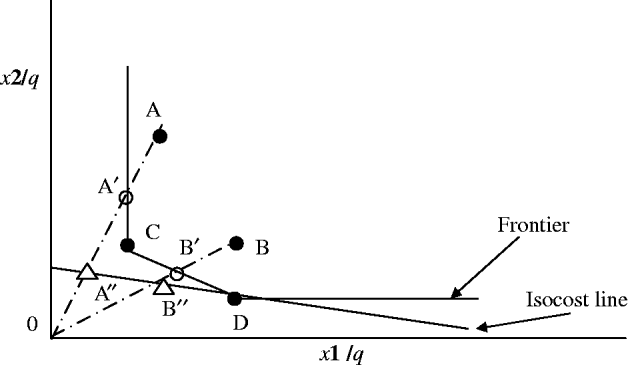
Economic efficiency for Farm B is similar to how technical efficiency is measured except that it is the distance from the point B to the isocost line which is given by the radial distance:
 $$\theta = 0{\rm B}{\rm \prime \prime} /0{\rm B}$$
Since allocative efficiency is economic efficiency divided by technical efficiency, it can be calculated as the ratio:
 $$\theta = \left( {0{\rm B}{\rm \Prime} /0{\rm B}} \right)/\left( {0{\rm B}{\rm \prime} /0{\rm B}} \right)$$
Mathematical model
In the current analysis, an input-orientated DEA model was estimated under the assumption of variable returns to scale (VRS) such that every increase in input would not result in a proportional increase in output (Banker et al. Reference Banker, Charnes and Cooper1984). The main advantage of this model was that the scale-inefficient farms would only be compared to efficient farms of similar size. This was important in the current study because the farms in the dataset utilized operated at different levels of scale; therefore, VRS was the most appropriate assumption. The VRS assumption works by firstly assuming that there are I farms with N inputs and M outputs and they are represented from the ith farm by the vectors xi and qi. Data for the ith farm is represented by the N I input matrix X and the M I output matrix Q. To assume VRS that all farms are not operating at optimal scale, the convexity constraint I1′λ = 1 is used, which benchmarks farms against farms of similar size by enveloping the data points tighter than under the assumption of VRS, thereby comparing farms of similar size.
Technical efficiency model
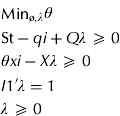
The following is an input-orientated VRS DEA model expressed as follows by Coelli et al. (Reference Coelli, Prasada Rao, O'Donnell and Battese2005):
 $$\eqalign{ & {\rm Min}_{{\o},\lambda} \theta \cr & {\rm St}-qi + Q\lambda \geqslant 0 \cr & \theta xi-X\lambda \geqslant 0 \cr & I1'\lambda = 1 \cr & \lambda \geqslant 0} $$
where I × 1 is an I1 vector of ones, θ is a scalar and λ forms part of the convexity constraint that efficiency score is between 0 and 1.
Economic efficiency model
With the same assumptions as the above technical efficiency model, the following is the economic efficiency model used in the analysis using a cost minimization model following that of Coelli et al. (Reference Coelli, Prasada Rao, O'Donnell and Battese2005):
 $$\eqalign{ & {\rm Min}_{\lambda, xi}^* w_i ^\prime x_i ^* \cr & {\rm St}-q_i + Q\lambda \geqslant 0 \cr & x_i ^*-X\lambda \geqslant 0 \cr & I1'\lambda = 1 \cr & \lambda \geqslant 0} $$
where w i is an N × 1 vector of input prices for the ith firm, x i * is the cost minimizing vector of input quantities for the ith firm with the input prices and the level of output and all other quantities are as per the technical efficiency mathematical model above, λ is an I × 1 vector of constraints.
Economic efficiency is the ratio of minimum to observed cost and can be calculated with the following ratio:
 $${\rm EE} = w_i ^\prime x_i ^*/w_i ^\prime x_i $$
Allocative efficiency model
Since economic efficiency is the product of technical efficiency and allocative efficiency (Farrell Reference Farrell1957), allocative efficiency can be calculated with the ratio:
 $${\rm AE} = \displaystyle{{{\rm EE}} \over {{\rm TE}}}$$
Like the technical efficiency score, both economic and allocative efficiency scores range between 0 and 1.
Technical, allocative and economic efficiencyscores were calculated in the first stage using DEA software, DEAP version 2.1 developed by Coelli (Reference Coelli1996).
Dataset
Data from the National Farm Survey (NFS) in 2008 (Connolly et al. Reference Connolly, Kinsella, Quinlan and Moran1998–2008) were utilized in the current analysis. The NFS is an annual survey of c. 1200 farms weighted by size and system to represent a whole population of 104800 farms in Ireland. For more information on the NFS, see Connolly et al. (Reference Connolly, Kinsella, Quinlan and Moran1998–2008). The current study uses data for the sub-sample of 324 dairy producers (including both specialist and non-specialist dairy producers), which is statistically representative of the dairy population for the year 2008.
Data envelopment analysis: inputs and outputs
All inputs and outputs related to the dairy enterprise only. Inputs such as land, cow numbers, labour and direct costs were already collected by the NFS by dairy enterprise. For overhead costs that were not collected by the dairy enterprise, the share apportioned to the dairy enterprise was determined via allocation based on proportion of gross output coming from the dairy enterprise (see Table 1). This allocation method has been used in previous studies by Smyth et al. (Reference Smyth, Butler and Hennessy2009), Donnellan et al. (Reference Donnellan, Hennessy, Keane and Thorne2011), Thorne (Reference Thorne2004) and Fingleton (Reference Fingleton1995). Since dairy inputs and outputs were allocated to the dairy enterprise only, specific dairy enterprise efficiency was measured. Descriptive statistics for all inputs and outputs used in the DEA models are shown in Table 2.
Allocation keys used to define variables associated with the dairy enterprise

* Allocated in National Farm Survey (Connolly et al. Reference Connolly, Kinsella, Quinlan and Moran1998–2008).
Descriptive statistics of input and output variables used in the efficiency models

Inputs
Physical and financial values of land, dairy livestock units, labour, concentrate, fertilizer and other direct and overhead costs were considered as inputs. Land area included both owned and rented land used by the dairy enterprise. The financial element of land value was included based on an NFS estimate of the market value of purchased land. Dairy livestock units were the average number of dairy livestock units, including dairy cows milked during the year and any other stock used in the dairy enterprise, with the price per dairy livestock unit included as the value of total livestock divided by the number of dairy livestock units in 2008.
Physical and financial quantities of purchased fertilizer, purchased concentrate and total labour units used by the dairy enterprise were included. Prices were included per kg of concentrate and fertilizer and per full time equivalent (FTE) unit of labour. Labour was expressed in total farm labour units and quantified in accordance with NFS specifications including paid (hired labour) and unpaid (family) labour.
Other direct and overhead costs were included (e.g. depreciation, veterinarian and animal health costs, electricity, repairs, miscellaneous costs, etc. attributed to the dairy enterprise).
Outputs
The outputs used were kg of milk solids (protein and fat) sold that were produced on the farm and the value of other output from subsidiary dairy farm enterprises. Milk payment systems in Ireland are centred on both protein and fat, with processors either paying on a kg of milk solids basis minus a processing charge, or on a volume of milk produced with a differential bonus for milk solids composition. Price information for milk solids was generated on a per kg basis using the average price in 2008 per kg produced for each producer. Since not all output was generated from milk sold, the financial value of other dairy farm output, including subsidiary dairy livestock sales, was also included as an output.
Second stage analysis – statistical analysis
As differences in efficiency have been widely attributed to differences in management practices, a second stage regression analysis was undertaken. The objective was to identify the key management and demographic factors associated with differences in efficiency.
Variables used
The independent variables presented in Table 3 that were used in the regression are divided into two groupings: management and demographic variables, each of which is discussed below and were regressed against technical, allocative and economic efficiency.
Descriptive statistics of variables used in the Tobit regression

Management variables
Grazing season length was the average number of 24 h periods the dairy herd spent at grass for the year.
Milk quality was the average financial reward of milk bonuses and the economic loss through milk penalties for the year. The value of milk bonuses and penalties varied, because producers did not all supply the same processor.
Artificial insemination (AI) use was included to investigate the associations with efficiency and AI use.
Milk recording was included to see if producers who were using this service to monitor individual cow performance had increased levels of efficiency.
Discussion group membership was investigated, comparing the effects of being a member of a discussion group v. not being a member.
Dairy specialization was investigated by using the proportion of gross output attributed to dairy and identifying the association with efficiency with dairy specialization.
Mean calving date was analysed by comparing five different mean calving categories. The mean calving dates were before 14 February, between 14 February and 1 March, between 2 March and 17 March, between 18 March and 31 March and finally mean calving after 1 April. The final mean calving date of after 1 April provided the base category to estimate the association with efficiency of calving earlier than 1 April relative to after. To investigate calving compaction, breeding season length was also included as a variable in the analysis.
Soil was represented by the NFS classification of land quality, which is represented by a scale of 1–5. The best soil category, with an index of 1, highlights the soil with most uses and the worst soil category, with an index of 5, highlights soil with the most limited number of uses. The worst soil class was used as the base category in order to investigate the association of having greater soil quality on efficiency levels.
Demographic variables
The association of efficiency with demographic variables such as age, age squared (to minimize the non-linear effects of the model) and marital status, whether the producer had contact with advisory services and participation in off-farm employment were all investigated.
Tobit regression
As DEA generates efficiency scores that are censored towards the upper boundaries of 1 with a positive probability a Tobit analysis is possible (Hoff Reference Hoff2007). Tobit regression has been the most common method used in DEA studies as a second stage analysis to regress independent variables on the efficiency score. Alternative regression techniques such as ordinary least squares (OLS) are not suitable due to the fact that the error term in the OLS regression models would not be normally distributed and would predict results outside the DEA rationale of between 0 and 1.
To investigate the stability of model coefficients, variables in the current analysis were introduced into the model in five different groupings, thus developing five different regression models. Model 1 accounted for management factors including number of grazing days, milk quality, breeding season length and level of dairy specialization. The second model added whether or not the producer was using services such as AI, milk recording and being a member of a discussion group. Model 3 included mean calving date, model 4 added soil quality to incorporate land quality differences and finally model 5 included demographic variables all together with the variables used in the previous models. This approach was used previously by Hansson (Reference Hansson2008). A Tobit regression model was fitted through the explanatory variables described in Table 4 using PROC LifeReg of SAS (SAS Institute Inc. 2006) and the model used which follows that of Barnes (Reference Barnes2006) can be written as
 $$\eqalign{Y = & \hskip3pt Y^*\;{\rm for}\,Y^* \gt 0 \cr Y = & \hskip3pt0\;{\rm for}\;Y^* \leqslant {\rm} 0 \cr Y^* = & \hskip3pt b'x + u} $$
where the dependent variable is given by the latent variable Y*, Y is censored efficiency score and is equal to latent variable when efficiency score is greater than 0 or equal to 0, the parameter vector is b, the regression variable vectors given by x and the distributed error term given by u.
DEA Efficiency scores under VRS*
* VRS, variable returns to scale.
† TE, technical efficiency score.
‡ AE, allocative efficiency score.
§ EE, economic efficiency score.
RESULTS
Efficiency scores
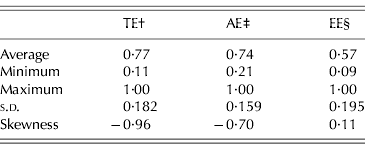
Technical, allocative and economic efficiency scores for 324 Irish dairy farms were calculated and descriptive statistics of the DEA results are shown in Table 4. A frequency distribution of the results is shown in Fig. 2.
Frequency distribution charts of efficiency scores.

Technical efficiency
On average, technical efficiency across the 324 farms was 0·77, ranging from a minimum of 0·11 to a maximum of 1·00 (s.d. 0·182). Out of the sample, 0·13 (43 DMU) of the sample was fully technically efficient. The technical efficiency scores were skewed more towards full efficiency, the majority of producers having efficiency scores between 1·00 and 0·60.
Allocative efficiency
Allocative efficiency averaged 0·74, ranging from 0·21 to 1·00 (s.d. 0·159). Allocative efficiency, like technical efficiency, was also skewed towards full efficiency with the majority of producers having efficiency scores towards the upper boundaries of total efficiency and 0·84 of producers having scores greater than 0·60. In addition, 0·03 of the sample (9 DMU) was fully allocative efficient and were also classified as fully technically efficient.
Economic efficiency
Overall or economic efficiency averaged 0·57 (range 0·09–1·00; s.d. 0·195). There was a wider overall spread in the frequency distribution of economic efficiency scores ranging from 0·09 to 1·00 compared to technical and allocative efficiency which ranged from 0·11 to 1·00 and 0·21 to 1·00, respectively. Therefore, this highlights that economic efficiency was skewed more towards lower levels of efficiency, unlike technical and allocative efficiency. Only 0·03 (9 DMU) of all producers were described as being economically efficient and these producers were also allocatively and technically efficient.
Factors affecting efficiency
In the second stage analysis, a Tobit regression was carried out to investigate the effects of key physical, management and demographic variables on technical, allocative and economic efficiency scores. The results are summarized in Tables 5–7, respectively.
Technical efficiency results
Table 5 presents the results of the regression analysis on the technical efficiency scores.
Regression results of management, qualitative and demographic factors associated with technical efficiency

* Discussion group member.
† Mean calving date: dummy variable, 1 if calving ⩽14 Feb, 2 if calving ⩽11 Mar, 3 if calving ⩽117 Mar, 4 if calving ⩽131 Mar and 5 if calving ⩾1 Apr.
‡ Soil quality ranges from 1 to 6 with 1 an indication of best soil with widest range of use and 6 the poorest soil quality with most limited range of use.
Milk penalties were zero in all cases, but bordering on significance in models 1–3 and significant for models 4 and 5. Milk bonuses were zero in all cases, but were significant throughout all models.
In model 1, grazing season length and milk bonuses (P < 0·001) were positively associated with technical efficiency, while breeding season length (P < 0·001) had a negative association. Milk penalties was bordering on significance 0·1>P > 0·05. Level of dairy specialization had no significant association with TE.
In model 2, the addition of milk recording, AI use and being a member of a discussion group had no significant associations with technical efficiency. Mean calving date was associated with technical efficiency in model 3, with all significant results from model 1 remaining the same. A mean calving date of between 14 and 28 February had a positive association with technical efficiency (P < 0·01).
In model 4, producers in the highest soil quality class had a significant association with technical efficiency (P < 0·01). However, the inclusion of soil quality removed the positive association of grazing season length with technical efficiency which may be explained by potential multi-collinearity among certain variables. Producers who were members of a discussion group, although not significantly associated with technical efficiency, did border on significance (0·1>P > 0·05).
Model 5 included demographic variables in the analysis. The results of the final model were similar to model 4. The inclusion of demographic variables resulted in age and age-squared bordering on significance 0·1>P > 0·05 negatively with technical efficiency. All other variables were not significant.
Allocative efficiency results
Table 6 presents the results of the regression using the allocative efficiency scores as dependent variables.
Regression results of management, qualitative and demographic factors associated with allocative efficiency

* Discussion group member.
† Mean calving date: dummy variable, 1 if calving ⩽14 Feb, 2 if calving ⩽1 Mar, 3 if calving ⩽17 Mar, 4 if calving ⩽31 Mar and 5 if calving ⩾1 Apr.
‡ Soil quality ranges from 1 to 6 with 1 an indication of best soil with widest range of use and 6 the poorest soil quality with most limited range of use.
Milk bonuses were zero in all cases, but bordered on significance in models 1–3. Milk penalties were also zero in all cases, and were not significant.
In model 1, greater specialization (P < 0·001) was found to have a significant positive association with allocative efficiency, while grazing season length and increased milk bonuses bordered on significance (0·1>P > 0·05). Breeding season length and milk penalties had no significant association.
In model 2, the use of milk recording (P < 0·01) and AI (bordering on significance 0·1>P > 0·05) were similar to model 1 milk bonuses, and a greater specialization in dairy production led to increased allocative efficiency.
The results in model 3 again resulted in the same associations as in model 2; however, the addition of mean calving date of between 1 and 17 March had a negative association with allocative efficiency, bordering on significance (0·1>P > 0·05).
In model 4, results were again similar to the previous model when soil quality was included and resulted in a positive association, bordering on significance (0·1>P > 0·05), of producers in the first and second highest soil quality with allocative efficiency.
Model 5 included demographic variables although these were not found to be significantly associated with allocative efficiency. Therefore, results were similar to model 4, with the exception of mean calving date having no significant association with allocative efficiency.
Economic efficiency results
Table 7 presents the results of the regression using the economic efficiency results as the dependent variables.
Regression results of management, qualitative and demographic factors associated with economic efficiency

* Discussion group member.
† Mean calving date: dummy variable, 1 if calving ⩽14 Feb, 2 if calving ⩽1 Mar, 3 if calving ⩽17 Mar, 4 if calving ⩽31 Mar and 5 if calving ⩾1 Apr.
‡ Soil quality ranges from 1 to 6 with 1 an indication of best soil with widest range of use and 6 the poorest soil quality with most limited range of use.
Milk bonuses were zero in all cases, but significant throughout all models. Milk penalties were also zero in all cases, but were not significant.
In model 1, greater economic efficiency was associated with a longer grazing season length (P < 0·001), increased milk bonuses (P < 0·001) and greater specialization (P < 0·001). Increased breeding season length had a negative association with economic efficiency, bordering on significance (0·1>P > 0·05). The association of milk penalties with economic efficiency was not significant.
In model 2, results were similar to model 1 but the addition of milk recording (P < 0·01) and using AI (P < 0·01) had significant positive associations with economic efficiency.
In model 3, the inclusion of mean calving date resulted in a positive association, bordering on significance (0·1>P > 0·05), for producers with mean calving between 14 and 28 February with economic efficiency.
In model 4, the addition of soil quality resulted in a positive association of producers in the highest soil quality with economic efficiency (bordering on significance 0·1>P > 0·05). Results were similar to the previous model, apart from the removal of grazing season length, milk bonuses and mean calving date as significant variables associated with economic efficiency. Membership of a discussion group, although not significant, was positively associated with economic efficiency (bordering on significance 0·1>P > 0·05).
The results of model 5 were similar to those of model 4; however, milk bonuses (P < 0·001) was found to have a positive association with economic efficiency. Mean calving before the end of February was positive and bordering on significance (0·1>P > 0·05). The inclusion of demographic variables resulted in age squared having a negative association (P < 0·01) with economic efficiency. Age of operator had a positive association with economic efficiency, bordering on significance (0·1>P > 0·05). All other demographic variables had insignificant associations with the levels of economic efficiency.
DISCUSSION
Methodology
The objectives of the current study were to measure technical, allocative and economic efficiency for a sample of Irish specialist dairy farms and to investigate the associations of key management and demographic characteristics with technical, allocative and economic efficiencies. DEA was the methodology chosen to calculate the efficiency scores. The main advantage of this method is that it does not require the specification of a particular functional form (Coelli et al. Reference Coelli, Prasada Rao, O'Donnell and Battese2005). Alternative econometric methods of frontier analysis have been used, such as SFA developed by Aigner et al. (Reference Aigner, Lovell and Schmidt1977) and Meeusen & van den Broeck (Reference Meeusen and Van Den Broeck1977). However, unlike DEA, SFA requires a specific functional form such as the Cobb–Douglas function or its generalization, the Translog function, to be specified for the estimation of a frontier. The main advantage of the SFA methodology, however, is that it contains an error term to account for statistical error and noise. The absence of an error term in the DEA model assumes all error, including noise, as inefficiency. On the other hand, DEA has the important advantage of being a non-parametric method and therefore, not requiring the imposition of an assumed functional form for the production technology.
A second-stage analysis was undertaken to identify key management, qualitative and demographic factors associated with technical, allocative and economic efficiency. This was undertaken using the efficiency score as a dependent variable in a Tobit regression analysis. The two-stage process as outlined in the current study has previously been criticized by Simar & Wilson (Reference Simar and Wilson2007) on the basis of bias results due to using explanatory variables in the regression that were correlated with those used in the first stage. Coelli et al. (Reference Coelli, Prasada Rao, O'Donnell and Battese2005) also stressed that estimation results could potentially be biased if there are high correlations between inputs and outputs and the explanatory variables. Simar & Wilson (Reference Simar and Wilson2007) suggested bootstrapping techniques to overcome the problem of biased DEA-Tobit results; however, Afonso & St. Aubyn (Reference Afonso and St. Aubyn2006) found very similar results comparing the DEA–Tobit results and the bootstrapping results. In the current study, to avoid multicolinearity and investigate the stability of model coefficients, variables were introduced in different groupings. This approach has been used previously by Hansson (Reference Hansson2008). Previous studies that have utilized the DEA and Tobit regression methodology include Hansson & Öhlmér (Reference Hansson and Öhlmér2008) and Barnes (Reference Barnes2006).
Inputs and outputs used
The inputs used in the current study included physical and financial data for land area, cow numbers, labour, concentrate, fertilizer and other direct and overhead costs, which were all allocated to the dairy enterprise only. Consequently, results from the analysis are specifically for dairy enterprise efficiency. The inputs studied represent the important physical and financial inputs on Irish dairy farms and are consistent with previous studies of this kind in the literature. For example, the importance of land availability has been stressed in previous studies (Dillon et al. Reference Dillon, Hennessy, Shalloo, Thorne and Horan2006; O'Donnell et al. Reference O'Donnell, Shalloo, Butler and Horan2008) such that once milk quotas are not limiting expansion the next most limiting constraint on most farms in Ireland will be land. Purchased concentrate and fertilizer are two important inputs for Irish dairy farms and they represented 0·43 and 0·19 of direct costs on Irish dairy farms in 2008, respectively (Connolly et al. Reference Connolly, Kinsella, Quinlan and Moran1998–2008). Labour is another important input for Irish dairy farms and according to O'Donnell et al. (Reference O'Donnell, Shalloo, Butler and Horan2008) labour challenges will influence future decisions at farm level in Ireland. Overall, the inputs used in the current study are similar to those used in previous DEA efficiency studies in the literature, including studies by Tauer (Reference Tauer1993), Jaforullah & Whiteman (Reference Jaforullah and Whiteman1999), Barnes (Reference Barnes2006), Stokes et al. (Reference Stokes, Tozer and Hyde2007) and Hansson & Öhlmér (Reference Hansson and Öhlmér2008).
Milk solids produced and other dairy output were included as the two output variables. Quantity of milk solids produced is important because all processors pay producers either solely on solids produced or on a volume of milk basis with a differential price for solids composition. Other output was also used to show the financial value of livestock sales from the dairy enterprise. Again the output variables in the current study have been predominantly used as outputs in similar studies by Tauer (Reference Tauer1993), Jaforullah & Whiteman (Reference Jaforullah and Whiteman1999), Barnes (Reference Barnes2006) and Hansson & Öhlmér (Reference Hansson and Öhlmér2008).
Efficiency results
Technical, allocative and economic efficiency scores generated in the first stage DEA analysis were 0·771, 0·740 and 0·571, respectively. This highlights that technical efficiency could increase by, on average, 23% and allocative efficiency by 26% to become fully efficient. There was a wider spread of economic efficiency and allocative efficiency results compared to the technical efficiency results, highlighting that producers were more technically efficient than allocatively and economically efficient. There were also a greater number of fully technical-efficient producers compared to allocative and economic-efficient producers. As technical efficiency is the maximizing of output from the level of inputs and allocative efficiency is essentially a measure of financial efficiency representing the ability of the producers to utilize the most cost-effective mix of inputs in order to produce output, this shows that producers were focusing more on maximizing output than reducing costs. According to Donnellan et al. (Reference Donnellan, Hennessy, Keane and Thorne2011), Ireland dairy producers have higher full economic costs and are characterized by lower yields in comparison with EU competitor states. This is probably due to the scale of Irish dairy farms, which are smaller than European and international competitors. As the results on average were less than 1, the efficiency results therefore highlight that on average producers were overusing inputs, therefore were technically and economically inefficient in 2008 and a potential exists to increase efficiency at farm level. This is very important as food demand worldwide is increasing and the Irish dairy industry has set targets for a 50% increase in dairy output by 2020 (Department of Agriculture, Food and the Marine 2011).
As data for all farmers that had a dairy enterprise was used, farm size varies among producers and therefore scale of production could potentially be a factor contributing to inefficient production. Land area has been found by O'Donnell et al. (Reference O'Donnell, Shalloo, Butler and Horan2008) as a constraint to expansion at farm level in Ireland. In a previous study, Hansson (Reference Hansson2008) found increased land area resulted in increased technical and economic efficiency for Swedish dairy farmers.
Another issue that is potentially impacting the results is policy. Ireland and EU member states currently have a limit on production through the milk quota. According to Burrell (Reference Burrell2004), the quota keeps inefficient producers in production. The quota can generate risk factors for producers, with quota availability and the threat of a super levy for over-production, two risk factors associated with quota that may also be influencing efficiency results. However, milk quota is set to be removed in the EU by 2015, which will overcome one of the barriers to expansion at farm level and potentially lead to economies of scale for producers.
Since producers were not fully efficient, this highlights that inputs such as labour were being overused. Labour has already been identified as a potential future problem post-quota, as O'Donovan (Reference O'Donovan2007) found that increasing scale resulted in an increased demand for hired labour. Similarly, O'Donnell et al. (Reference O'Donnell, Shalloo, Butler and Horan2008) noted that labour challenges will influence future expansion at farm level in Ireland. Another issue regarding labour is that distribution of farm size in the sample was skewed towards smaller farms; therefore, scale is an issue. This is therefore likely to impinge on allocative efficiency, for example having too much labour for the number of cows. Although not analysed in the current study, quality of labour may be potentially another factor contributing to producers overusing labour with more efficient producers having a higher labour quality standard.
The results of the current study were similar to those generated in previous studies among EU member states. In a Swedish study by Hansson & Öhlmér (Reference Hansson and Öhlmér2008) using a similar two-stage process, the average technical, allocative and economic efficiency scores were 0·865, 0·752 and 0·645, respectively. However, it should be noted that other studies may have generated efficiency scores using alternative DEA models, different efficiency measurement techniques and used producers adopting different production systems with climatic and geographical differences. It must also be noted that efficiency results in the analysis presented in the current paper are attributed to the dairy enterprise only.
Key factors associated with efficiency scores
The association between key management and demographic factors and technical, allocative and economic efficiencies was tested using a Tobit regression. The analysis was carried out by characterizing the independent variables into a number of categories. This method was used to explore the stability of the model coefficients given the potential problem of multi-collinearity in a multivariate regression analysis. For example, AI use and milk recording are likely to be correlated, grazing season length and soil quality, breeding season length and mean calving date are all variables considered to be significant in an Irish context, but which are also likely to be correlated. This is shown in the results through the significance levels and standard errors of particular variables in one model v. another model.
Management and qualitative parameters
Grazing season length
Grazing season length was positively associated with technical, allocative and economic efficiency in 2008, highlighting both the physical and financial benefits of extending the number of days spent at grass. Increasing the grazing season has been positively associated with increased profitability in a number of previous studies. Producers with a longer grazing season may also have better quality land. Land quality is highlighted in the next section as associated with differences with efficiency. In a previous study, Rougoor et al. (Reference Rougoor, Vellinga, Huirne and Kuipers1999) found a positive influence of grassland management on cost reduction and gross margin for Dutch farmers. In a separate study, Hanson et al. (Reference Hanson, Cunningham, Morehart and Parsons1998) found greater milk production on farms in New York and Pennsylvania with more extensive grazing. In Ireland, the results in the current study mirror those of Shalloo et al. (Reference Shalloo, Dillon, O'LOUGHLIN, Rath and Wallace2004a ), who found that grazing season length was associated with differences in profitability and found by comparing two farms on contrasting soil types that a longer grazing season length existed on the farm with better quality soil. Similarly, Dillon et al. (Reference Dillon, Crosse, O'BRIEN and Mayes2002) also indicated that a reliance on grazed grass represented an opportunity to reduce costs. In a separate Irish study, Kennedy et al. (Reference Kennedy, O'Donovan, Murphy, Delaby and O'MARA2005) found increased milk solids production with increased quantity of grazed grass in the early stage of lactation for spring-calving cows.
Land quality
Producers had higher levels of efficiency when originating from better quality soil, as defined by the NFS (Connolly et al. Reference Connolly, Kinsella, Quinlan and Moran1998–2008). Qualitative differences in land are likely to affect grass growth and utilization. Differences in land quality against the results of Shalloo et al. (Reference Shalloo, Dillon, O'LOUGHLIN, Rath and Wallace2004a ), who found differences in technical performance and profitability by comparing a dairy farm in an area with high rainfall on a heavy clay soil to a farm in a lower rainfall area with free-draining soil. Results by O‘Neill & Matthews (Reference O'Neill and Matthews2001) found that there were significant effects on efficiency by farming in the East of Ireland compared to the West. Soil quality was also found by Carroll et al. (Reference Carroll, Newman and Thorne2007) to have a positive effect on technical efficiency of Irish dairy producers.
Mean calving date
Producers with mean calving between 14 and 28 February had higher levels of technical and economic efficiency in 2008, highlighting the benefits of an early spring calving season over a later calving season. Early spring calving allows the opportunity to get cows out to grass in early lactation, which significantly increases milk solid outputs and helps reduce costs. Later calving in March had a negative association with allocative efficiency highlighting there were no cost gains from calving in March compared to calving after April in 2008. These findings mirror the results of Smyth et al. (Reference Smyth, Harte and Hennessy2010), who highlighted the positive effect of early spring calving on cost reductions, therefore matching peak grazing season growth to peak feed demand.
Specialization
Increased allocative and economic efficiency were associated with increased specialization in dairy production in 2008. In Ireland, specialist dairy farmers constituted the most profitable agricultural system in 2008, followed by dairy and other systems (Connolly et al. Reference Connolly, Kinsella, Quinlan and Moran1998–2008). This therefore indicates that by specializing more in the dairy enterprise in 2008, by increasing the number of dairy cows and dairy output, efficiency levels were enhanced in 2008. According to Shalloo et al. (Reference Shalloo, Dillon, Rath and Wallace2004b ) dairy specialization can be facilitated through expansion; projections indicated that Irish producers who remained static between 2004 and 2013 would have a 30% reduction in output, while those producers who expanded could maintain or increase income. Latruffe et al. (Reference Latruffe, Balcombe, Davidova and Zawalinska2005) also investigated specialization and found Polish producers with increased specialization in livestock to be more efficient compared to crop-based farms.
Milk quality
Increased milk bonuses and reduced milk penalties had a positive association on technical, allocative and economic efficiency. The results of poor milk quality on milk production has been highlighted in previous studies including Hortet & Seegers (Reference Hortet and Seegers1998), who found reductions in milk yield and composition resulting from increased cases of clinical mastitis. In a similar American study, Barbano et al. (Reference Barbano, Rasmussen and Lynch1991) found that increased somatic cell count (SCC) in milk reduced protein and fat composition, therefore indicating a negative effect of reduced milk quality on output, while in a Dutch study by Huijps et al. (Reference Huijps, Lam and Hogeveen2008), reduced economic performance was associated with mastitis.
Milk recording and AI
Producers participating in milk recording were more allocatively and economically efficient. This may be due to the individual productive and qualitative information provided by milk recording.
Milk recording is a decision support service provided to identify individual cow performance, providing information from milk yields to milk quality with the options of economic breeding data (ICBF 2011). Providing this information for individual cows allows identification of the best and worst performing cows. This therefore influences management decision-making regarding cows. Increased milk quality among producers may be due to the information provided from milk recording.
Discussion group member
It was found that all efficiency levels increased where producers were members of a discussion group. This may be due to the regular transfer of knowledge at discussion group meetings, which led to producers being better informed. Similarly, Hansson (Reference Hansson2007) found that discussion of dairy production increased allocative and economic efficiency on Swedish dairy farms. Hennessy & Newman (Reference Hennessy and Newman2010) also found that members of discussion groups in Ireland were more profitable and had a higher number of grazing days, better milk quality and were younger.
Demography
The age of the farmer was found to have a positive association and age squared was found to have a negative association with technical and economic efficiency. This highlights that technical and economic efficiency increases with age to a peak and then starts to decline. The age profile of the producers in the current study ranged from a minimum of 27 years old to a maximum of 85 years old with producers on average 52 years old. This is similar to an American study by Tauer & Lordkipanidze (Reference Tauer and Lordkipanidze2000), where productivity was found to increase with age until a certain age and then to decrease. The current analysis also found that marital status had no association with efficiency levels, which was also found in a previous Irish study by Carroll et al. (Reference Carroll, Newman and Thorne2007). Participation in off-farm employment had no significant association with efficiency, which is also similar to the findings of Carroll et al. (Reference Carroll, Newman and Thorne2007). Contact with the extension service was found to have no significant associations with technical, allocative and economic efficiency levels in the current study, which is different to O'Neill et al. (Reference O'Neill, Leavy and Matthews2002) who found a higher technical efficiency with producers who used the extension services v. producers who did not.
CONCLUSIONS
The objectives of the current study were to measure technical, allocative and economic efficiency for a sample of Irish specialist dairy farms and to investigate the associations of key management, qualitative and demographic characteristics with technical, allocative and economic efficiencies. The results highlight that this sample of dairy producers were not fully efficient for 2008 and the implications of these results show that a potential exists to increase efficiency levels through reducing input use and maximizing output. This is important, as the Irish dairy industry is expected to increase outputs after quotas are removed in 2015. Management factors were key to explaining differences in efficiency among producers, while qualitative and demographic differences were also associated with greater technical, allocative and economic efficiency. Management factors such as mean calving date, number of grazing days, breeding season length, milk quality, discussion group membership were all associated with technical and economic efficiency in 2008. Milk recording, AI use and level of dairy specialization were associated with allocative and economic efficiency only. Qualitative differences were also evident between producers as increased soil quality was associated with greater efficiency levels. Age and age squared were the only significant demographic association with the efficiency scores. The current study gives an insight into levels of technical, allocative and economic efficiency of Irish milk producers in 2008. It indicates that land quality differences were very important in explaining variation in efficiency levels among farms. Within the set of controllable factors managerial variables were the key determinants of efficiency. However, demographic factors were not found to have an important impact on efficiency. As only one year of data was used in the current study, it would be beneficial to look at efficiency over a period of time to see if the association of the same management factors such as mean calving date and dairy specialization remain constant over a number of years. The issue of economies of scale was not measured in the current study, therefore the measurement of scale efficiency would also add to further analysis.
The authors would like to thank the producers who participated in the National Farm Survey and the staff of the National Farm Survey involved in the collection, recording and analysis of data.



