On Saturday May 1, 2010, a key tunnel to Boston's water supply broke. This 10-ft diameter pipe supplied drinking water to approximately 2 million users living in 30 communities within the Greater Boston area. As water supply started being drawn from local reservoirs containing untreated water for smoother flow, a boil-water order was issued. Authorities started spreading the boil-water order in a coordinated effort with the Massachusetts Water Resources Authority, the Mayor's office, the Boston Public Health Commission, schools, businesses, faith-based organizations, the police department, and other emergency management systems. Crisis information was also spread through newscasters, the Centers for Disease Control and Prevention (CDC) Health Alert Network, reverse 911 systems, phone calls, the Internet, and even by driving vehicles with bullhorns.
The spill was controlled on May 2, and on May 4 the boil-water order was lifted. Affected residents were then instructed to flush cold water faucets for 1 minute and warm water faucets for 15 minutes. Later, laboratory results showed that during the crisis tap water had been safe to drink. Only 4 of 820 samples contained total coliform bacteria,Reference Daley and Gil1 an expected result during normal tests. Consequently, during the crisis no increase in gastrointestinal illnesses was noticed.
In the context of this event, this article explores the relationship of social determinants with: (1) behavioral compliance; (2) information sources; (3) participants' evaluation of information sources; (4) timeliness with which participants learned about the crisis; and (5) information-sharing behaviors.
BACKGROUND
Water Crises
Water safety is of paramount public health importance. Each year, nearly 2 million people worldwide die from preventable diarrheal diseases mainly caused by unsafe water supplies.2 Although most of these cases are concentrated in developing countries, the industrialized world also experiences instances in which drinking water may become unsafe for human consumption. Water disease outbreaks can be caused by a multiplicity of factors such as wastewater and fecal contamination, heavy rainfall filtration, and distribution failures.Reference Hrudey and Elizabeth3
Most previous outbreaks in recent history—ranging from nonconsequential to fatal—have been preventable. Nonetheless, at the time of an outbreak public health officials had little clear evidence on the exact nature and gravity of the problem. Therefore, emergency decision-makers usually operate in a relatively uncertain context. Prompt evaluation of the potential risks of an outbreak has immediate consequences in the concomitant crisis communication strategy. Decisions regarding whether to alert the general population carry the risk of falling into type I (false positive) or type II (false negative) errors. An alert may have long-term consequences (a “cry-wolf” scenario), while inaction may lead to immediate catastrophic outcomes.
Crisis Risk Communication
Crisis risk communication is a type of risk communication that takes place in a context of an emergency.Reference Glik4 As a crisis evolves, evidence is relatively uncertain and hazards are potentially high. Equally important, high levels of perceived uncertainty and danger may also elevate people's emotions and outrage. Under such conditions, public health authorities have to deliver timely, accurate, and actionable messages that will inform the public but will not lead to panic.Reference Mullin5Reference Lundgren and McMakin6 This task is a great challenge, but failure to do so may reduce people's likelihood of complying with current and future messages.Reference Angulo, Tippen and Sharp7Reference Atman, Bostrom, Fischhoff and Morgan8Reference Covello, Peters, Wojtecki and Hyde9
Message effectiveness depends, to a great extent, on the audience's beliefs, attitudes, and emotions toward the information sources. Messages are most effective when the sources are perceived as accountable and credible.Reference Lundgren and McMakin6Reference Fessenden-Raden, Fitchen and Heath10Reference Peters, Covello and McCallum11Reference Sorensen12 From this perspective, a universally ideal source of crisis information does not exist, but the best source is to be defined for each particular case and population subgroup. Most importantly, audience beliefs, attitudes, and emotions toward a source are developed through a gradual process. Thus, a good relationship between a source and its audience has to be built and maintained in a constant, gradual, and not always linear process that may take months, and even years, to develop.
Crisis risk information is best disseminated when done through myriad channels. Optimal decisions regarding channels might consider the hazard, the community at risk, the overall situation, the national context, and other factors such as outrage level.Reference Chipman, Kendall, Slater and Auld13Reference Harding and Anadu14 Evidence suggests that mass media and word of mouth are two of the most powerful channels for crisis risk information, although it is likely that this depends on the situation and characteristics of the target audience.Reference Fisher and Chen15Reference Mahon, Slutsker and Hutwagner16Reference Rundblad, Knapton and Hunter17
Audiences act not only as information recipients but as sources as well. In the process of transmission and diffusion of information, the message may be transformed according to the new source's personal and cultural schemas, highlighting certain aspects of the message while ignoring others. This process is influenced by individual and cultural factors.Reference Katz and Lazarsfeld18Reference Watts Duncan and Dodds Peter19 For this reason, understanding how different audiences process, react to, and share crisis messages is vital to delivering messages that will reduce panic and produce widespread compliance.
Morbidity following a water-borne epidemic is greatly determined by behavioral compliance of those affected. Previous studies have shown that compliance is not uniform but influenced by the nature of the crisis, the sociodemographic and cultural characteristics of the population, and the quality and speed of crisis management.Reference Angulo, Tippen and Sharp7Reference Casman, Fischhoff, Palmgren, Small and Wu20Reference Kocagil, Demarteau, Fisher and Shortle21Reference Laughland, Musser, Musser and Shortle22 Barriers to processing and acting on a crisis message compose two important aspects determining behavioral compliance levels.Reference O’Donnell, Platt and Aston23Reference Willocks, Sufi, Wall, Seng and Swan24Reference Nsiah-Kumi25
Vulnerable Populations and Communication Inequalities
The communication inequalities framework proposes that social determinants shape the access, use, and attention to information channels; the ability to process, comprehend, and remember health information; and the overall capacity to act on a communicated message.Reference Viswanath, Thomson, Mitchell and Williams26 This framework builds on and expands the traditional conceptualization of hard-to-reach audiences as those groups that are isolated mainly for social, geographical, and/or technological reasons. In the context of an emergency, it is critical to ensure that vulnerable groups will have access to crisis messages in a timely and comprehensible manner.
The association between social determinants and health communication processes has been increasingly acknowledged as one pathway leading to health inequalities.Reference Viswanath, Thomson, Mitchell and Williams26Reference Tierney27Reference Viswanath, Ramanadhan, Kontos and Galea28 Social determinants may have a direct influence on behavioral compliance or indirectly through communication processes.Reference O’Donnell, Platt and Aston23Reference Nsiah-Kumi25 Therefore, accounting for these factors during the message design and dissemination process may lead to improved message reach and increased behavioral compliance.
Communication planners may benefit from keeping in mind factors directly related to the communication process (eg, culture, gender, age, language, race/ethnicity, income, and education) and those that are also related to the implementation of the desired behavior (eg, financial resources, location, transportation, and health care access). In other words, risk communicators may consider all factors that may affect message reach, comprehension, and the execution of the desired behaviors.Reference Nsiah-Kumi25 This effort may require targeting messages and using alternative channels (eg, community-based organizations) to ensure that these groups receive, understand, and may be able to act on crisis messages.
This Study
Although there is substantial research in the field of crisis risk communication, the interaction among social determinants, communication processes, and behavioral compliance has been less well studied. Specifically, to our knowledge, the concept of communication inequalities has yet to be studied in the context of crisis communication. With the goal of better understanding these interactions, this report examines how social determinants influenced communications and compliance during the 2010 Boston water crisis. In particular, this article explores the relationship of social determinants with: (1) behavioral compliance; (2) information sources; (3) participants' evaluation of information sources; (4) timeliness with which participants learned about the crisis; and (5) information-sharing behaviors.
METHODS
Respondents
We conducted a survey of residents of Boston, Massachusetts, between May 27 and June 14, 2010. The total population-based sample was 726, with 78% of the respondents drawn from the local sample of Knowledge Networks' KnowledgePanel. The other 22% of participants were recruited solely for the purposes of this survey (opt-in panel). The opt-in panel participants were Boston residents who were not part of the KnowledgePanel. Both groups were recruited using a dual sampling frame, a combination of random digital dial and address-based sampling, which allows for sampling of individuals with no telephone landlines. In addition, when KnowledgePanel members were recruited, non-Internet households were provided with a laptop computer and free Internet access. Participants were not compensated for completing this survey but were eligible to win prizes through monthly sweepstakes.
Survey Design
Questions for this survey were adapted from preexisting surveys, including Harvard Opinion Research Program H1N1 Survey, the Health Information National Trends Survey,Reference Nelson, Kreps and Hesse29 and from the CDC's Behavioral Risk Factor Surveillance System.Reference Smith and Notaro30 The current survey covered knowledge, preventive behaviors, attitudes, beliefs, mass and interpersonal communication, and emergency preparedness topics in general.
Measures
Independent Variables
This report included 3 types of independent variables: social determinants; information sources; and timeliness, with which participants learned about the crisis. Social determinants included gender, age, race/ethnicity, education, and income. Information sources referred to the sources from which participants first learned about the crisis.
Dependent Variables
The outcomes measured in this article include (1) behavioral compliance; (2) information sources; (3) participants' evaluation of information sources; (4) timeliness with which participants learned about the crisis; and (5) information-sharing behaviors.
Behavioral compliance was measured in 3 dimensions: drinking unboiled tap water during the crisis, flushing cold water faucets for at least 1 minute once the crisis was resolved, and flushing warm water faucets for at least 15 minutes once the crisis was resolved. Participants' evaluation of information sources included measures of (1) trust, (2) ease with which participants understood crisis information, (3) whether they felt safe if they followed instructions during the crisis, and (4) whether they thought health officials' reaction to the crisis was appropriate. Last, information sharing included the number of people with whom participants shared information; timeliness with which they shared information; and channels used to share information.
Statistical Analyses
Poststratification adjustments were conducted to adjust for noncoverage and nonresponse biases. These adjustments were made by applying the most recent data from the Current Population Survey.31 Poststratification weights included gender, age, race/ethnicity, education, and income.
Descriptive analyses, in the form of weighted frequencies and percentages, were performed. Using cross tabulations, the bivariate associations between independent and dependent variables were then examined. The statistical significance of these associations was tested using Pearson χ2 test and two-sided z-tests for equality of proportions, with Bonferroni corrections for multiple comparisons, when appropriate.
It should be noted that before using information sources and timeliness as independent variables, their association with social determinants were first stressed. Thus, both information sources and timeliness were used initially as dependent variables.
RESULTS
Sample Characteristics
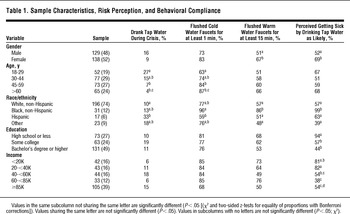
Approximately one-third (n = 267) of the total sample reported having been affected by the water crisis. The proportion of respondents affected did not vary between KnowledgePanel and opt-in panel subsamples (37.1% and 37.7% affected, respectively). Participants unaffected by the crisis were not included in these analyses. The sociodemographic characteristics of this group are shown in Table 1. The overall response rate was 73%.
Sample Characteristics, Risk Perception, and Behavioral Compliance

Behavioral Compliance
Behavioral compliance was measured with 3 variables: drinking unboiled tap water during the crisis; flushing cold faucets for at least 1 minute after the crisis; and flushing warm faucets for at least 15 minutes after the crisis. About one-tenth of the sample (12.5%) reported drinking tap water during the crisis. Compliance varied by factors such as age and race and ethnicity. Of the youngest group (aged 18-29 years), 27% drank tap water, as compared to 4% of those 60 years or older. Race and ethnicity were also associated with this behavior, with Hispanic respondents reporting the least compliance (33% drank tap water) compared to 13% of Black and 10% of White respondents.
Cold faucet flushing was reported by approximately 78% of participants. Older participants' precautionary style was also evident when engaging in this behavior. Of those 60 years or older, 87% flushed their cold faucets, whereas only 63% of those aged 18 to 29 years old did. When compared to Whites (77%) and Blacks (96%), Hispanics were the least likely ethnic group to flush their cold faucets (59%). Last, 59% of participants flushed warm faucets for 15 minutes. Warm water flushing was mostly reported by female (67% vs males 51%) and Black participants (86% vs Whites 57% and Hispanic 51%).
Perceived Risk
Most participants (61%) believed that getting sick was a likely consequence of drinking unboiled tap water. This proportion, however, varied across gender, race/ethnicity, education, and income levels. While 99% of Black participants believed tap water was unsafe, 57% of their White and 63% of their Hispanic counterparts did. Education level was very closely related to safety perceptions as well. The vast majority of participants (94%) with a high-school degree or with less than high school education perceived drinking tap water as unsafe. More educated participants were less likely to hold this belief (57% among those with less than a college degree and 44% among those with a bachelor's degree or higher, respectively). The difference between more and less educated participants was also evident across income levels. Whereas 81% of participants with the lowest income level (under $20 000) believed that tap water was unsafe, 54% of those in the highest income bracket (>$85 000) held the same belief. Risk perceptions also varied by gender. Males (52%) were less likely than females (69%) to believe that getting sick from drinking tap water was a likely consequence.
Timeliness of Crisis Information
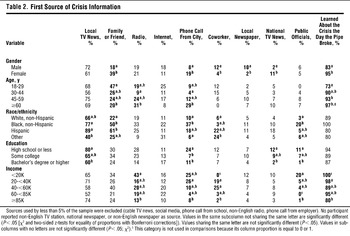
Most participants (89%) learned about the crisis the same day the pipe broke (Table 2); 9% learned the following day, and 1% learned at a later date. Yet again, these frequencies fluctuated across different sociodemographic groups. Participants who learned about the crisis within the first day of the crisis were women (95%) vs men (83%), older than 60 years (97%) vs 18-29 years old (73%), and people in the lowest income bracket (<$20 000, 100%) versus those in the highest (>$85 000, 80%).
First Source of Crisis Information

First Source of Crisis Information
The majority of the participants first learned about the water crisis from local television news (67%). This source was followed by family member or friend (28%), radio (20%), Internet (14%), phone call from city or town (14%), coworker (8%), local newspaper (6%), national network television news (6%), and public officials, such as the police (5%). Less used sources were cable network television news (4%), social media (4%), phone calls from the school district (3%), non-English radio (2%), and phone calls from an employer (1%). No participant reported learning about the crisis from a national newspaper or other non-English sources, such as television or newspapers.
The sources used for information on the crisis, however, varied by background characteristics such as gender, age, race/ethnicity, education, and income level. For instance, women (39%) relied more than men (18%) on family and friends as sources of information. This trend was also evident in reporting phone calls from the city as a first source (19% vs 8%) and then national television news (11% vs 2%). Men, on the other hand, relied more than women on coworkers (12% vs 4%) and local newspapers (10% vs 2%). Younger participants (18-29 years old, 47%) relied more on family and friends to learn about the crisis than older participants did (>60 years old, 20%). Older respondents instead reported greater use of radio (31%) versus younger respondents (18-29 years old, 19%), and being contacted by phone from their city authorities (29% vs 18-29 years old, 9%).
Local television news was used much more by Hispanics (89%) than by Whites (66%). Whites, on the other hand, were less likely to report learning about the crisis from family or friends (22%) than Blacks (61%) or Hispanics (50%). Receiving phone calls from the city and learning from public officials were reported more by Blacks (37% and 20%, respectively) than by Whites (10% and 3%, respectively) or Hispanics (18% and 5%, respectively).
Education and income were also associated with differences in sources of information. Compared to those with a college degree, participants with no college education relied more heavily on local television news (60% and 80%, respectively), phone calls from their city authorities (11% and 24%, respectively), national television news (2% and 12%, respectively), and on public officials (1% and 11%, respectively). Similarly, this trend was apparent when considering the lowest and highest income levels. Participants reporting an annual income below $20 000 were more likely to rely on the radio (43%), phone calls from city authorities (25%), and on public officials (20%) than those with an income higher than $85 000 (13%, 8%, and 1%, respectively).
It is noteworthy that no significant differences were found among sociodemographic groups' use of Internet as a source of crisis information. Last, it should be highlighted that less than 5% of the sample reported relying on social media, such as Facebook or Twitter, as their source of information.
Crisis Information Sources' Interactions With Other Outcomes
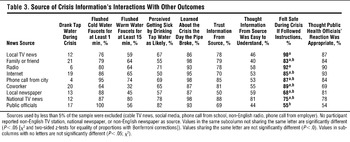
Neither behavioral compliance nor risk perceptions varied across different information sources (Table 3). Also, the timeliness with which participants learned about the water crisis showed not much variation. Participants' trust in information sources (81% reported trusting them) and their evaluation on the complexity of the information (52% perceived it as easy to understand) did not vary across sources.
Source of Crisis Information's Interactions With Other Outcomes

Feeling safe varied, depending on the information source: 92% of the participants felt safe if they followed officials' instructions, whereas 90% of local television news viewers, 92% of radio listeners, and 55% of those who cited public officials as their first information source felt safe. This trend was similar for participants' thoughts on the appropriateness of public officials' response, although not statistically significant.
Crisis Information Sharing
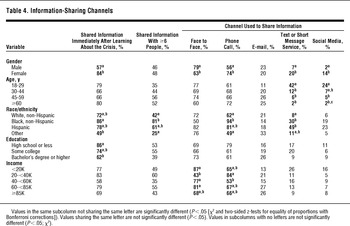
About four-fifths of the participants (82.9%) shared information about the crisis with others. Of those, 72% did so immediately after learning about the water crisis. Another 24% shared information within the first day the pipe broke. Altogether, almost 96% of the participants shared information with others within the first few hours into the crisis. Women (84%), Blacks (86%), and those with no college education (86%) were the most likely to share information immediately after the crisis broke (Table 4).
Information-Sharing Channels

On average, participants shared information with 11.5 people each. This mean, however, showed great dispersion (SD = 16.86). This finding was partly due to differences in the amount of information sharing among different groups. For example, while 81% of Black participants shared information with 6 or more people, only 42% of their White counterparts did.
Face-to-face communication was the most common channel (70%) used to spread the word about the crisis. This was followed by phone calls (67%), e-mail (21%), text or short message service (14%), and social media (2%). Women (79%) engaged more in face-to-face communication than men (63%). Black and Hispanic participants used phones (94% and 81%, respectively) and texting (30% and 49%, respectively) significantly more than Whites (62% and 8%, respectively). Texting and using social media (eg, Facebook or Twitter) were more frequent in young (18-29 years old, 42% and 24%, respectively) than in older participants (>60 years old, 2% and 2%, respectively).
Timeliness and Behavioral Compliance
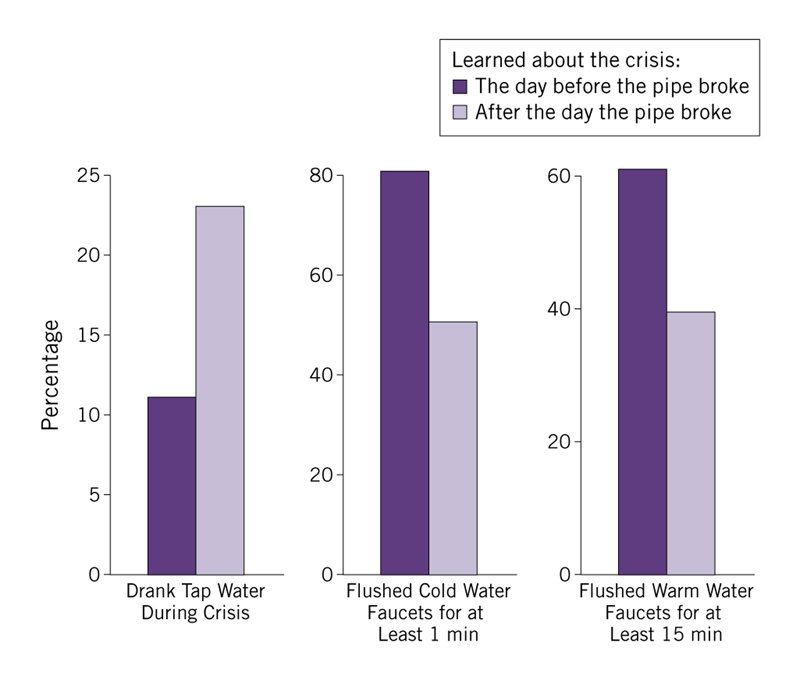
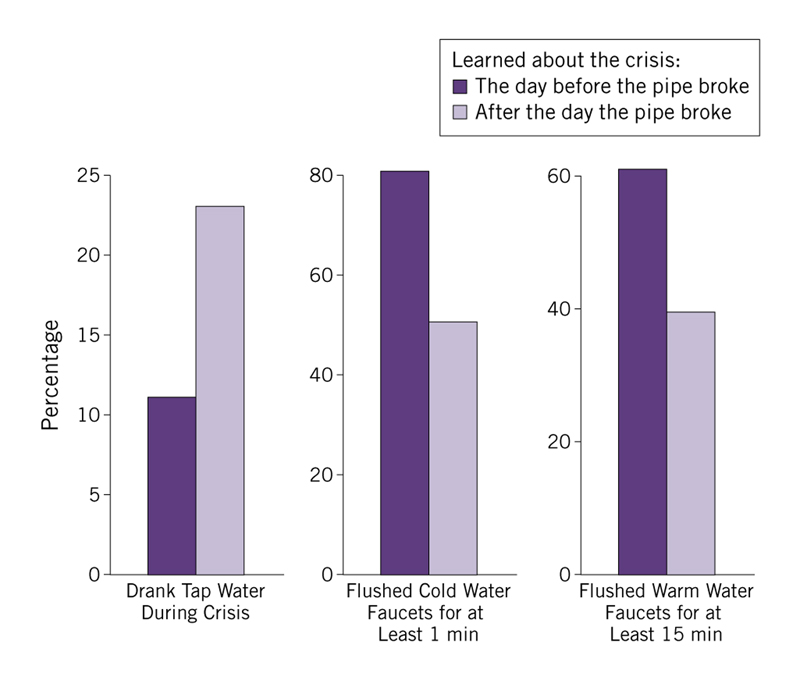
Last, these analyses unveiled an interesting relationship between timeliness and behavioral compliance (Figure). Those who learned about the crisis the first day were more likely to comply with officials' instructions than participants who learned about the crisis after the day the pipe broke. This finding included all 3 behaviors analyzed: drinking unboiled tap water (11% vs 23%), flushing cold water faucets for at least 1 minute (81% vs 51%), and flushing warm water faucets for at least 15 minutes (62% vs 40%).
Timeliness and Behavioral Compliance.
Relationship between timeliness with which participants learned about the crisis and behavioral compliance: drinking tap water (P <. 1); flushing cold water faucets (P <. 01); and flushing warm water faucets (P <. 05).
COMMENT
Overall, these results showed that the crisis communication efforts following the Boston water crisis were a relative success with most groups. Following the boil-water order, a high percentage of respondents (87.5%) refrained from drinking unboiled tap water. The fact that 89% of the sample learned about the crisis the same day the pipe broke provided more evidence to the claim that the official's response to this crisis was effective. The official response was effectively complemented by the local media and residents' information-sharing practices: 96% of the respondents shared information about the crisis within the first hours into the crisis, and 70% of the sample learned about the crisis from local television news. The spread of information and its consequences, however, were not uniform across population subgroups. In this study, all dependent variables varied across sociodemographic factors (ie, behavioral compliance, information sources, participants' evaluation of information sources, timeliness with which participants learned about the crisis, and information sharing).
Arguably the most novel finding of this report is that those typically considered at-risk or belonging to “underserved” and minority groups generally showed the most optimal responses to the crisis across all the outcome measures. In some way, the results appear as counter-intuitive. Older people, minorities, those with little education, and those with lower incomes are frequently equated with being vulnerable hard-to reach populations. Studies making this type of association range from those that focus on health outcomes to ones stressing the prevalence of communication inequalities. A question to be asked is why we found muted—if not reverse— inequalities. There are potentially 3 reasons that might have contributed to this phenomenon: (1) official's communication efforts included several emergency management systems (eg, reverse 911, faith-based organizations) that are likely to be used by older and lower income respondents; (2) local television news, which was viewed mostly by minorities and lower education respondents, played a critical role in spreading the word about the crisis; and (3) minorities and lower education respondents were the most likely to share crisis information faster and with the most people.
This report also highlighted the importance of a prompt communication strategy. The timeliness with which participants learned about the crisis was associated with their behavioral compliance. Remarkably, not only drinking unboiled tap water was associated with timeliness, but also behaviors (ie, flushing faucets) that took place a few days later. Therefore, the relationship between timeliness and behavioral compliance could not be fully explained from an awareness or knowledge perspective. Not learning about a hazard promptly may have led to unseen motivational consequences (eg, anger at information sources for not delivering the message promptly) that may have affected behavioral compliance.
Understanding the channels through which the population receives crisis messages is of utmost importance for a prompt and efficient communication campaign. It is of particular interest to understand the patterns of mass media usage across different audiences. This knowledge allows for planning and executing discrete and targeted cost-effective communication efforts to reach specific audiences.
Equally important is to recognize differences in usage of informal channels of communication. The use of informal communication channels (ie, word of mouth) by ethnic and racial minorities exemplifies this point. It is important to remember that an audience is not a passive receiver of information. Recipients of crisis messages may seek information to confirm a threat, to better learn how behave, or to know others are reacting to it.Reference Mileti and Sorensen32 An individual's own version of a crisis message will include personal and social values that will next reach that person's new audience. Another important aspect of information sharing is related not only to what is shared but also to how and when a message is shared. In this study, differences in timeliness and amount of information sharing were found among different social groups. However, little is known about the nature of information flow in times of crisis. New advances in social network analyses may provide tools to understand this phenomenon. Also, resource allocation for crisis communication campaigns may be greatly optimized if planners understand how crisis information flows among their targeted audiences.
CONCLUSION
Crisis communication, in conjunction with other public health preparedness fields, is central to reducing the negative impact of sudden hazards. The commonly used crisis communication mantra “Be First. Be Right. Be Credible” might well be preceded by “Know your audience.” This knowledge should be informed by empirical evidence of individual behavior (eg, the risk perception paradigms) and also by a deep understanding of different population subgroups' cultural and social beliefs and practices. The latter includes understanding how acquisition, processing and information sharing differ across groups. Emergency scenarios, such as the one reported in this study, serve as unique opportunities to understand how effectively crisis messages are conveyed to and received by different segments of the population.
Acknowledgments: This research was supported by Centers for Disease Control and Prevention grant 1P01TP000307 (Dr Viswanath).