Introduction
Domestic chickens (Gallus gallus domesticus) have been kept in Kenya for many centuries (Maina, Reference MAINA2000; Upton, Reference UPTON2000). The currently encountered indigenous chickens (ICs) in Kenya are a non-descript crosses of the Asiatic meat and game types, Mediterranean egg-types and the Bantams of various origins. They have all along been kept for various reasons, including social-cultural, nutritional and economic uses. The importance of IC in wealth creation and animal protein supply at national and household levels in developing countries has been well recognised (Mack et al., Reference MACK, HOFFMANN and OTTE2005). Despite increasing demand for IC products by local consumers, their low productivity, attributed to high disease incidences, inadequate nutrition, low genetic ability and poor marketing channels, reduce their contribution to rural development. This paper highlights the current IC production circumstances with a view to identifying the major challenges which need to be addressed in order to improve the IC productivity and thereby improve the livelihood of the rural households who are the custodian of these genetic resources.
Origin of indigenous chickens in Kenya
Chickens (Gallus gallus domesticus) are generally considered to have evolved from the jungle fowl (Gallus gallus) inhabiting India, Indo-China, South China, Philippines and Indonesia (Blench and MacDonald, Reference BLENCH and MACDONALD2000; Moiseyeva et al., Reference MOISEYEVA, ROMANOV, NIKIFOROV, SEVASTYANOVA and SEMYENOVA2003). They are thought to have been domesticated in South-East Asia from where they were distributed in the course of human migration to all parts of the world. Despite strong cultural and spiritual attachments to chickens in Africa, the route and dates by which they entered the continent remains poorly understood. Nevertheless, it is suggested that chickens were first introduced into Egypt from South-western Asia via the middle-east. According to Blench and MacDonald (Reference BLENCH and MACDONALD2000), archaeological evidence and other representations indicate occasional presence of chickens in Egypt in the period between 1425 and 1123 BC. The chickens are thought to have been kept for cockfighting sports. However, after 650 BC, the same evidence indicates abundance of chickens in the same locality thus suggesting a change in their importance from recreational to cultural and spiritual usage. During this period, it is thought that chickens were used to tell the time of day and for sacrifices before planting or harvesting (Maina, Reference MAINA2000) and probably, at the same time, gained their importance as a source of food.
Human migration to the South led to the spread of chickens to Central Africa at around 500 BC. Migration of the Bantu people from Central Africa eventually led to the arrival of chickens in Western Kenya at around 100 BC. Furthermore, migration of the Paranilotics from the North at around 50 AD and the Nilotics along the Nile valley later on is also thought to have brought more chickens (Maina, Reference MAINA2000). The early Greco-Roman east-coast trade is hypothesised to have brought the Asiatic and game chickens along the Kenyan coast at around 100 AD (Blench and MacDonald, Reference BLENCH and MACDONALD2000) and eventually reaching Eastern Kenya probably at around 200 AD (Maina, Reference MAINA2000). It is possibly at this period that the chickens gained some economic importance.
The present world breeds of chickens can be grouped into four evolutionary lineages: a) egg-type chickens of Mediterranean origin; b) game chickens of Asiatic origin; c) meat-type chickens of Asiatic origin and d) true Bantams of various descents (Mallia, Reference MALLIA1998; Moiseyeva et al., Reference MOISEYEVA, ROMANOV, NIKIFOROV, SEVASTYANOVA and SEMYENOVA2003). The migration from the north may possibly have brought more of the Mediterranean and the Bantams, while trade with various empires may have brought the Asiatic types into present-day Kenya. Mutations and random drifts coupled with natural and to some extent human selection over time resulted in the modifications and subsequent development of the various chicken genotypes presently available in various climatic regions. Furthermore, in more recent times, local chickens have been crossed with various specialised meat and egg breeds of European descent in an effort to increase their productivity (Wainaina, Reference WAINAINA1994). However, from ancient times, chickens have been mating randomly, sourcing their feed via scavenging and receiving minimal healthcare, if any. There has not been any significant development of IC breeds in Kenya, despite their increasing importance. However, there are currently attempts geared towards genetic improvement and development of specialized IC breeds for production in the varied environments.
Population and importance
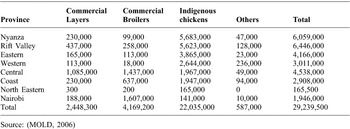
Kenya has an estimated poultry population of 29 million birds, out of which about 28.7 million (98%) are domestic chickens (MOLD, Reference MOLD2006). Although other poultry species are increasingly becoming important, they are comparatively few (2%) and include ducks, turkeys, pigeons, ostriches, guinea fowls and quails. Out of the domestic chickens, about 22 million (77%) are indigenous or crosses with exotic breeds while the rest are commercial broilers and layers (Table 1).

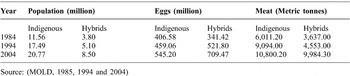
For the last 20 years, IC population has increased by more than 75% and their egg and meat products by more than 34% and 79%, respectively (Table 2). This increase may be attributed to an increase in the human population and hence a corresponding demand for chicken products as shown by the more than 100% increase in egg and meat production from commercial layers and broilers.
Indigenous chicken populations, egg and meat production trends.

Source: (MOLD, Reference MOLD1985, Reference MOLD1994 and 2004)
Studies in Kenya have reported presence of IC wherever there are human settlements. Okitoi et al. (Reference OKITOI, ONDWASY, OBALI, LINYONYI, MULAMULA, OTIENO, MUREKEFU, SOITA, NDEGE, KAHAI, ROTICH and WEKESA2000b) reported an average of 15 IC per household in over 96% of households in western Kenya. In the coastal region, Njenga (Reference NJENGA2005) reported an average of 16 IC per household in over 96% of households. Indigenous chickens in low income, food deficit countries occupy a unique and very important position in national economies and the livelihood of rural households (Sonaiya and Swan, Reference SONAIYA and SWAN2004; Mack et al., Reference MACK, HOFFMANN and OTTE2005; Sonaiya, Reference SONAIYA2007). In these countries, IC are important economically, nutritionally, social-culturally and spiritually in both rural and urban areas.
economic roles
Despite a lack of defined or measurable indicators for its contribution to the gross domestic product (GDP), the IC sub-sector in Kenya has been recognised as an important economic tool for rural poverty alleviation and households’ food and nutrition security (Upton, Reference UPTON2000; MOLD, Reference MOLD2008). In 2006, the total meat produced by poultry was estimated at 18,600 metric tonnes (Mts) valued at KSh 3.52 billion [1 US$ = 77.68 KSh] (MOLD, Reference MOLD2008). Out of this, IC produced about 11,400Mts (61%) while broilers produced about 6,300Mts (34%) and culls from hybrid layers about 900Mts (5%). In the same year, production of eggs was estimated at 1.22 billion, valued at KSh 9.70 billion with IC producing about 570 million (47%) while exotic layers produced 650 million eggs (53%). The gross marketed production statistics between 2001 and 2006 show the poultry sub-sector contributing an average of above 8% of livestock gross marketed production (KNBS, Reference KNBS2009). Assuming a 50% average contribution to the levels of poultry meat and egg total marketed production, IC contributed at least KShs.1.0 billion (4% of livestock gross marketed production) into the national economy.
food security roles
A household is food secure when it has access to food needed for a healthy life for all its members (adequate in terms of quality, quantity, safety and cultural acceptability) and when it is not at risk of losing such access (Sonaiya, Reference SONAIYA2007). Apart from generating income, chicken meat and eggs are cheap and readily available sources of food for the household. Available feedstuffs not consumed by humans are utilised by these birds to produce high-quality and cheap animal protein. Generally, over 18% of the eggs laid and 30% of the household flock are consumed (Ndegwa et al., Reference NDEGWA, KIMANI, SIAMBA, MUKISIRA and DE JONG1998; Okitoi, Reference OKITOI2000; Kaudia and Kitalyi, Reference KAUDIA and KITALYI2002). It has been shown that with only three mature hens, a household is nutritionally secure within one year (Okitoi et al., Reference OKITOI, ONDWASY, OBALI, LINYONYI, MULAMULA, OTIENO, MUREKEFU, SOITA, NDEGE, KAHAI, ROTICH and WEKESA2000b; Juma and Ondwasy, Reference JUMA and ONDWASY2002; Kaudia and Kitalyi, Reference KAUDIA and KITALYI2002). In times of droughts and related calamities, chicken eggs become a critical source of animal protein. During important occasions (holidays, banquets and ceremonies), IC are heavily consumed by households in both rural and urban areas.
other roles
In addition, the chickens are useful in a number of social, cultural and spiritual activities such as entertainments, gifts, funeral rights and spiritual cleansing (Njenga, Reference NJENGA2005). In some parts of the country, cock fighting is an exciting and popular entertainment for rural folk (Maina, Reference MAINA2000). Other uses include disposal of kitchen leftovers, manure production and being biological clocks for telling time of day especially in rural areas.
Production systems
Indigenous chicken production systems can be classified according to production objectives into commercial or subsistence (Kitalyi, Reference KITALYI1998). Based on husbandry practices and levels of inputs and outputs, Menge et al. (Reference MENGE, KOSGEY and KAHI2005) identified and categorised IC production systems in Kenya into free range systems (FRS), semi-intensive systems (SIS) and intensive systems (IS). Whereas all production systems are practised in both rural and urban residential areas, the choice of a particular system depends on a households’ land availability and the objective attached to the enterprise. As in other African countries, the objectives of rearing IC include subsistence (home consumption only), subsistence and cultural (home consumption and cultural uses), home consumption and income, and income only (Sonaiya and Swan, Reference SONAIYA and SWAN2004). Comparing the profitability of the three production systems, Menge et al. (Reference MENGE, KOSGEY and KAHI2005) found that raising IC under FRS is more profitable than in SIS and IS. However, utilisation of IS should be considered because land availability for practicing FRS is reducing due to the ever increasing human population, and therefore the production systems may shift to IS. Genetic improvement of IC may also come with need for better management and therefore commercialisation of IC production.
free range system (frs)
In this system, chickens are reared extensively for various reasons including provision of eggs and meat for household consumption, occasional source of income and various socio-cultural obligations (Njenga, Reference NJENGA2005). This system is more common in low human population density rural areas and is based entirely on low input-low output management. Small flocks of less than 30 adult birds per household are kept with minimal care and no supplementation (Ndegwa et al., Reference NDEGWA, KIMANI, SIAMBA, MUKISIRA and DE JONG1998; Nzioka, Reference NZIOKA2000). The birds leave their night shelters in the morning and are left to source any available feed resources around the homestead and take care of themselves. Free-range feed resources usually include grass, insects, earthworms and various seeds (Mwamachi et al., Reference MWAMACHI, MUINGA, BIMBUZI and MWAMBANGA2000; Birech, Reference BIRECH2002). During cropping seasons, birds are sometimes confined and supplemented with maize, kitchen leftovers and any other available feed resource. Night shelters include rudimentary coops, kitchens, stores and human habitats. Due to low inputs, production is also low but the cost per unit of egg or meat is nearly negligible (Okitoi et al., Reference OKITOI, ONDWASY, OBALI, LINYONYI, MUKISIRA and DE JONG2000a).
semi-intensive system (sis)
In this system, chickens are kept in small flocks of between five and 50 birds mainly for consumption and sale. Levels of inputs range from low to medium depending on the commercial value attached to the flock. The birds are left to free range around the homestead or in fenced runs feeding on grass, insects, kitchen wastes, and any other available feed resource (Mwamachi et al., Reference MWAMACHI, MUINGA, BIMBUZI and MWAMBANGA2000; King'ori et al., Reference KING'ORI, TUITOEK, MUIRURI, WACHIRA and BIRECH2007). They are provided with some form of housing ranging from simple shelters to proper chicken houses. Health care depends on the commercial value attached to the enterprise. However, water and supplementary feeds are provided. Because input levels are low, production is lower than in IS. The system is common in high human population density rural and peri-urban areas.
intensive system (is)
In this system, flocks ranging between five and 500 adult birds, depending on the objectives, are fully confined in constructed shelters or runs and provided with commercial or home-made feed rations and health care. The enclosed system protects the birds from thieves and predators. Deep litter and slatted floors are the most common housing systems used. Usually the birds are reared for household consumption, but are mostly for sale. Production of eggs and growth rates are higher while mortalities are low (Okitoi et al., Reference OKITOI, ONDWASY, OBALI, LINYONYI, MUKISIRA and DE JONG2000a). However, due to high costs of inputs and high levels of management required, this system is rare in rural areas and common in urban and peri-urban areas where households own very limited or no land but are able to provide the required inputs (Menge et al., Reference MENGE, KOSGEY and KAHI2005).
Genotypes and strains
Indigenous chickens worldwide are reported to be small and multi-coloured birds of no particular breed (Sonaiya and Swan, Reference SONAIYA and SWAN2004). In most areas of Kenya, especially those that were covered by the Cockerel Exchange Programme (Wainaina, Reference WAINAINA1994), local chickens are not strictly indigenous as they were crossed with exotic breeds. In those areas, most IC are non-descript crosses of both meat and egg types (Nyaga, Reference NYAGA2007). However, the effects of the introduction of foreign genes are expected to be low due to natural selection in the harsh free-ranging environment against the non-adapted exotic genotypes. Surviving offspring of the crosses with exotic birds must have had high fitness for survival hence a high proportion of the original gene frequencies (Falconer, Reference FALCONER1989). Therefore, use of the term ‘indigenous’ in this context is still valid.
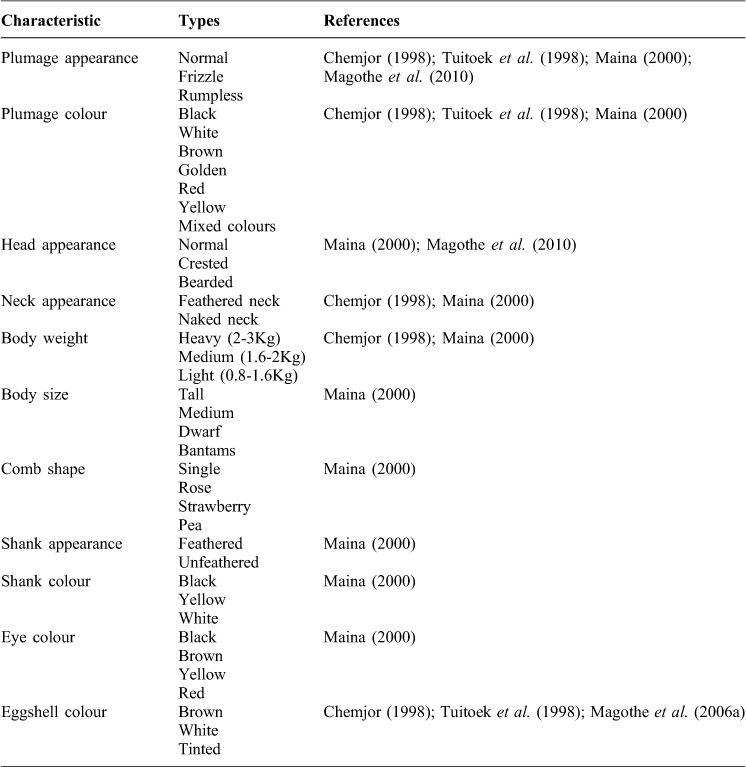
The available IC in Kenya has not been conclusively described. Nevertheless, a few attempts made have reported several distinct morphological variants; some common and others primarily found in certain parts of the country. The major phenotypes include the normal feathered, naked-neck, frizzle-feathered, dwarf, crested-head, feathered shanks and rump-less among others (Maina, Reference MAINA2000). The relationship between phenotypes and genotypes in chickens is well known (Tixier-Boichard, Reference TIXIER-BOICHARD2002). These phenotypes are a result of genes with major phenotypic effects and hence are also referred to as genotypes (Falconer, Reference FALCONER1989).
In Western and Coastal regions of the country, characterised by warm and humid climatic conditions, as well as in Eastern and Northern parts, characterised by hot and dry climate, the naked-neck, frizzle, dwarf and rump-less genotypes are found kept together with the normal feathered genotypes more than in other areas. This would be expected, as these genotypes are known to be tolerant to high ambient temperatures and other environmental stresses associated with such areas (Horst, Reference HORST1988; Barua et al., Reference BARUA, HOWLIDER and YOSHIMURA1998). In addition, IC in most areas of the regions have major socio-cultural and spiritual roles (Maina, Reference MAINA2000; Njenga, Reference NJENGA2005). Furthermore, along the coast and especially the Lamu islands, a game chicken locally known as Kuchi is common (Personal observation). On the other hand, around Mt. Kenya and the highlands East and West of Rift Valley, characterised by cool and wet climatic conditions, normal feathered, crested, feathered shank and bearded genotypes are kept. Nevertheless, there is ample evidence that some of the genotypes in most of the regions are endangered and in the verge of becoming extinct (Maina et al., Reference MAINA, BHATTACHARJEE and ADUMA2000).
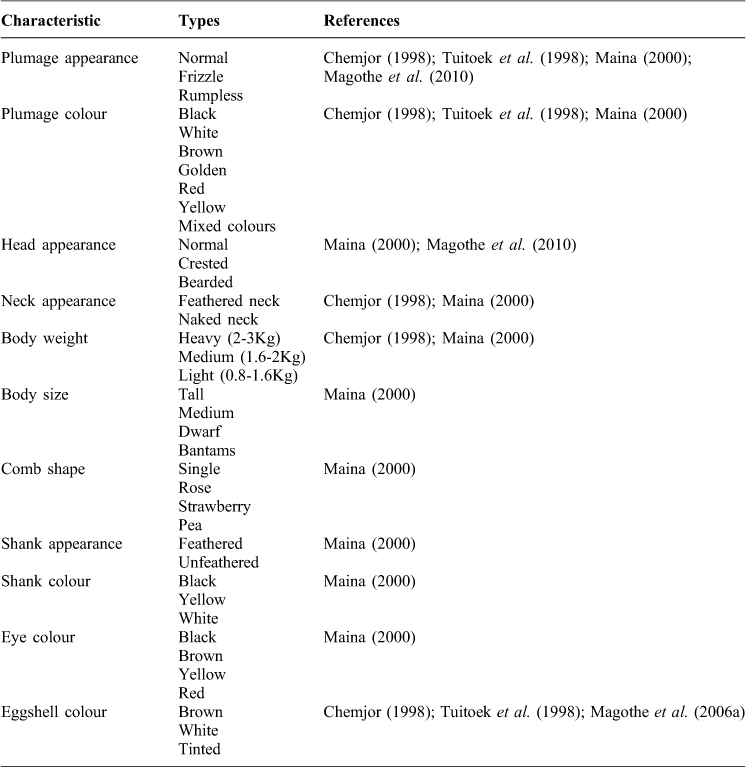
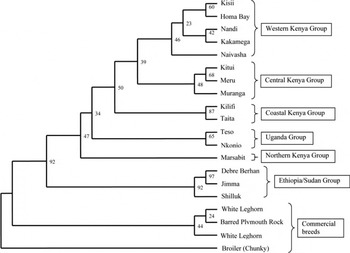
A few IC characterisation attempts, based on morphology and feather colours, indicate wide variations in these features as presented in Table 3. These phenotypes are an indicator of genetic variability within the chicken population. Maina (Reference MAINA2000) reported that, although IC in Kenya were not isolated reproductively, genotypes were significantly distinct from each other. The author reported the crested genotype to be more distinct than others while the naked neck and feathered shank were more genetically close. Using 30 microsatellite markers, Mwacharo et al. (Reference MWACHARO, NOMURA, HANADA, JIANLIN, HANOTTE and AMANO2007) concluded that the Kenyan IC can be grouped into four genetic entities which were classified tentatively as: Coastal, Central, Western and Northern Kenya groups (Figure 1).
Morphological characteristics of indigenous chickens in Kenya.
Dendrogram showing phylogenetic relationships within and between Kenyan and other indigenous chicken sampled from Ethiopia, Uganda and Sudan. The numbers at each interior node is the bootstrap value from 1000 re-samplings of loci with replacement (Mwacharo et al., Reference MWACHARO, NOMURA, HANADA, JIANLIN, HANOTTE and AMANO2007)

Production performance
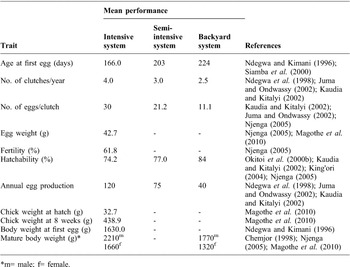
A few studies have reported production and reproduction performance of IC under backyard, semi-intensive and intensive production systems. Table 4 shows the productive and reproductive performances of IC. The various performance parameters are low and highly variable. In the backyard and semi-intensive production systems, age at first egg ranges from 180 to 240 days. However, this has been shown to reduce to 166 days under intensive management. The apparent improvement under intensive management may be an indicator of genotype x environment interaction (Ali and Brenoe, Reference ALI and BRENOE2002).
Males grow faster and are heavier than females, with an average mature body weight of 2.2 and 1.6 kg respectively. The growth rate of IC is similar to that of commercial egg-type hybrids (King'ori, Reference KING'ORI2004). Hens lay about 45 eggs per year with a range of between 30 and 75 eggs under free range and semi-free range systems. However, some lay up to 120 eggs when supplemented with concentrates. The mean egg weight in all production systems was estimated at 47.4 g with a range of between 36 and 52 g (Magothe et al., Reference MAGOTHE, MUHUYI and KAHI2006b). About three clutches are laid per year with an average of 15 eggs per clutch before incubation. In all the production systems, chicks are produced by natural incubation using broody hens. Fertility and hatchability is usually above 70% but hatching weights are often low, ranging between 25 and 43 g.
Mean production and reproduction performance of indigenous chickens.

*m= male; f= female.
Diseases and parasites
Several studies have revealed diseases and parasites that commonly affect IC in Kenya (Mwamachi et al., Reference MWAMACHI, MUINGA, BIMBUZI and MWAMBANGA2000; Okitoi et al., Reference OKITOI, ONDWASY, OBALI, LINYONYI, MUKISIRA and DE JONG2000a; Kaudia and Kitalyi, Reference KAUDIA and KITALYI2002). The most common diseases are Newcastle Disease (NCD), chronic respiratory disease (CRD), fowl pox, coccidiosis, fowl typhoid, salmonellosis, infectious coryza and pullorum. Of these, NCD is the most devastating, causing severe losses. This disease has also been reported to be the most important in other developing countries (Sonaiya and Swan, Reference SONAIYA and SWAN2004; Ssewannyana et al., Reference SSEWANNYANA, ONYAIT, OGWAL OKOT and MASABA2006; Nwanta et al., Reference NWANTA, ABDU and EZEMA2008). NCD, CRD and infectious coryza occur mostly during dry seasons between November and March. This is attributed to the dry conditions favouring the spread of the disease-causing microbes and high chicken mobility, as the period coincides with festivities (Nwanta et al., Reference NWANTA, ABDU and EZEMA2008). Fowl pox, coccidiosis, fowl typhoid and salmonellosis occur mostly during wet seasons. During these wet seasons, chicks are mostly affected by coccidiosis leading to heavy losses. Reports on other important avian diseases that mostly affect commercial hybrids (e.g. Marek, Gumboro, etc) are scarce for Kenya.
Both internal and external parasites are common. External parasites include lice, fleas, ticks and mites, while helminths and coccidia constitute the most important internal parasites. A recent study by Mungube et al. (Reference MUNGUBE, BAUNI, TENHAGEN, WAMAE, NZIOKA, MUHAMMED and NGINYI2008) showed that 93.3% of adult IC in semi-arid Kenya were infested with at least one type of helminth. In high rainfall areas, Ondwassy et al. (Reference ONDWASSY, OKITOI, OBALI, SIMWA and WAKHUSAMA2000) reported helminths infestation of 70.6%, 95.3% and 93.5% for chicks, growers and adult chickens, respectively. The most prevalent helminthes in three ecological zones in Kenya (highlands, midlands, and lowlands) have been reported (Kaingu et al., Reference KAINGU, KIBOR, SHIVAIRO, KUTIMA, OKENO, WAIHENYA and KAHI2010a). The study showed that coccidian and Ascaridia galli were the most common endo-parasites in the three ecological zones. Out of the 701 chickens examined, 27% were infested with coccidia, 25.6% with Ascaridia galli, 1.4% with Heterakis gallinarum, 0.3% with Syngamus trachea, 5.2% with Capillaria retunsa, 8.5% with Capillaria annulata, 2.9% with Raillietina tetragonal, 13.2% with Raillietina echinobothrida and 15.8% were found to be worm free. Although information concerning the prevalence of common external parasites is scarce, lice, fleas, mites and ticks have been reported as the most common, not only in Kenya but also in other developing countries (Njenga, Reference NJENGA2005; Halima et al., Reference HALIMA, NESER, VAN MARLE-KOSTER and DE KOCK2007).
Generally, rural farmers rarely control diseases and parasites. Outbreaks of NCD are the order of particular seasons and usually decimate the chickens. Herbs are sometimes used to treat sick birds, with the most commonly used herbs being Aloe vera, croton, milkweed and hot pepper (Ndegwa et al., Reference NDEGWA, KIMANI, SIAMBA, MUKISIRA and DE JONG1998; Njenga, Reference NJENGA2005). Information on the efficacy and effectiveness of these herbs in the control and treatment of the various diseases is scarce. However, examining the efficacy of Aloe secundiflora in the control and treatment of Ascaridia galli in IC, Kaingu et al. (Reference KAINGU, KIBOR, SHIVAIRO, KUTIMA, GITONGA, WIHENYA and KAHI2010b) observed that Aloe secundiflora has an inhibitory effect on the development of the parasite larvae and therefore recommended its utilization by farmers but with a caution that the dosage level should be investigated in order to avoid toxicity. Although most rural households are aware of the external parasites, control measures are usually rare unless when under severe infestation. When forced to control in such circumstances, pesticides, paraffin oil and ash are usually used. Most rural farmers are not aware of the presence of worms in their chickens hence virtually no control measures are taken (Ndegwa et al., Reference NDEGWA, KIMANI, SIAMBA, MUKISIRA and DE JONG1998).
Marketing systems
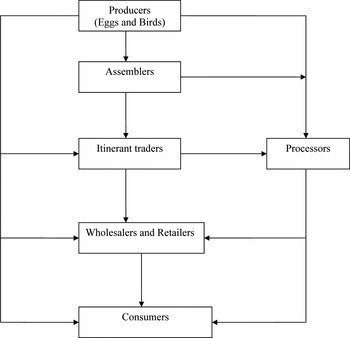
Marketing of live IC and their products is entirely a private sector business (Upton, Reference UPTON2000). The marketing chain generally involves the producers, itinerant traders, processors and finally the consumers (Njenga, Reference NJENGA2005; Nyaga, Reference NYAGA2007) as illustrated in Figure 2. The marketing process begins with a purchase of an egg or a live bird by a primary collector, direct from the household, or from small locally held weekly markets and ends with a consumer purchasing the products either in their raw form (raw egg or live bird or a piece of raw meat) or processed (cooked egg or a piece of cooked meat). The producer's decision to sell is entirely based on the economics of profits and availability of stocks. Due to lack of formal IC marketing organisations in Kenya, the commercially oriented producers usually have regular primary collectors. Although prices occasionally fluctuate due to market volatility, this marketing system is well developed and stable (Upton, Reference UPTON2000).
For the subsistence-oriented producers, egg and live chicken marketing is often erratic and unpredictable. The producer's decision to sell is dictated by the household need for cash, that is often critical during times (seasons) of human food scarcity, disease outbreaks and the need to de-stock whenever the population exceeds the household carrying capacity (Upton, Reference UPTON2000). During food scarcity and disease outbreak circumstances, which occur commonly in a locality, the supply of products, especially live birds, exceed demand by the primary collectors thus leading to depressed prices. For the same demand and supply reasons, the prices are usually stable during normal times and highest during festive seasons. Nevertheless, prices of eggs rarely fluctuate. When buying or selling live birds, prices are also determined by the weight or size and health of the bird (Njenga, Reference NJENGA2005). Although IC eggs are smaller and lighter (Magothe et al., Reference MAGOTHE, MUHUYI and KAHI2006a), they fetch higher prices than eggs from commercial exotic birds. However, very small eggs have low market value as they are not preferred by consumers.
Because of the increasing demand due to consumer preferences for IC products, processing facilities for value adding are on the increase (Nyaga, Reference NYAGA2007). In this marketing system, live birds collected via the chain of itinerant traders are slaughtered in private or local authorities slaughter premises, packaged whole or in pieces and sold either directly to consumers or to supermarkets. Birds are manually slaughtered, de-feathered, eviscerated, washed, inspected and packaged in polythene bags or plastic containers. Eggs are graded and wrapped in units of two or more using plastic packaging.
Indigenous chicken marketing chain.

Conclusions
The importance of IC in provision of quality animal protein and wealth creation at national and household levels has been well recognised. The IC in Kenya have high genetic diversity and are popular among the consumers compared to exotic chicken products. However, their productivity is low due to the associated constraints mentioned above. There is potential to improve productivity though. To sustain their utilisation against the changing climatic and economic conditions, their production must be genetically improved, with little change in input requirements. Other management strategies such as feeding, housing, disease and parasite control must also be considered. The IC marketing channels must also be streamlined in order to protect producers from exploitation. This can be achieved through a holistic approach to improvement and therefore individual and national efforts are required that takes into account the whole IC production value chain.