Clostridium difficile infection (CDI) is the leading cause of infectious diarrhea acquired in the hospital and causes significant morbidity and mortality.Reference Leffler and Lamont 1 , Reference Lofgren, Cole and Weber 2 The prevalence of CDI in US hospitals is estimated to be 13.1 of 1,000 patients; approximately 75% of cases are hospital acquired, resulting in healthcare expenditures of US$9,000–15,000 per patient, or an estimated US$1.5–3.2 billion annually.Reference Goldstein, Johnson and Maziade 3
The Infectious Diseases Society of America (IDSA) and Society for Healthcare Epidemiology of America (SHEA) published practice recommendations to reduce CDI in acute-care hospitals, and these recommendations have been widely endorsed.Reference Yokoe, Anderson and Berenholtz 4 , Reference Dubberke, Carling and Carrico 5 Despite these efforts, the incidence of CDI continues to increase, and a new strain of C. difficile has emerged that is associated with more severe disease.Reference Leffler and Lamont 1
The most recent qualitative systematic review of CDI prevention in hospitals, published in 2009,Reference Hsu, Abad, Dinh and Safdar 6 concluded that antimicrobial stewardship programs (ASPs), glove use, hand hygiene, and disposable thermometers should be used routinely. However, the review noted a lack of substantial evidence for other measures such as environmental cleaning or patient isolation. The goal of this systematic review is to update the evidence on interventions to reduce CDI in acute-care hospitals, encompassing hospital-onset and hospital-acquired CDI.
METHODS
Data Sources and Keywords
We systematically searched for controlled trials of interventions to reduce the rate of CDI in acute-care hospitals, using the biomedical electronic databases Ovid, MEDLINE, EMBASE, The Cochrane Library, CINAHL, and the ISI Web of Knowledge. We searched for articles published between January 1, 2009, and August 1, 2015. Sets of relevant terms representing “Clostridium difficile” and “prevention” were obtained from subject headings and free-text database fields and combined with the “AND” operator for database searches. The search was limited to controlled clinical trials, pre- and post-test studies, controlled before-and-after studies, and interrupted time-series studies. Additional studies were identified by scanning the references of relevant publications, using the “Related Articles” feature in PubMed, and using the “Cited Reference Search” in the ISI Web of Science. A detailed search strategy is provided in Table e1 in the online supplement.
Eligibility Criteria
We included studies that assessed the effect of interventions on the rate of CDI in acute-care hospitals. Studies must have provided a CDI rate or rate ratio, or data to calculate the rate of infection. Studies were excluded if interventions were not performed in an acute-care hospital, if the intervention was not described in sufficient detail to allow for categorization of the intervention, if there was no comparator group, or if follow-up was insufficient to allow for evaluation of the effectiveness of the intervention (ie, <3 months). Secondary studies, such as meta-analyses, were excluded.
All titles and abstracts were independently screened by 2 reviewers to identify studies potentially eligible for inclusion and a full text review was performed to identify studies eligible for data extraction. Disagreements were resolved by consensus. The process was documented using a PRISMA flow diagram (Online Supplemental Figure e1).
Data Extraction
A single reviewer performed the data extraction. A random 50% of the studies were checked by a second reviewer for accuracy. Studies were coded by type and category of intervention. Categories were approved by consensus.
Quality Assessment
Most studies were nonrandomized trials and quality-improvement–focused studies; 2 reviewers independently used the QI-Minimum Quality Criteria Set (QI-MQCS) toolReference Hempel, Shekelle and Liu 7 to evaluate the quality of studies. This tool, in contrast with the more general Grading of Recommendations Assessment, Development and Evaluation, provides a quantitative comparative evaluation of the studies.
RESULTS
Literature Search and Review Process
We reviewed the titles and abstracts of 3,236 articles for relevance and selected 261 for full-text review. Of these, 215 articles were excluded for reasons provided in Online Supplemental Figure e1. We coded the remaining 46 studies into intervention categories: environmental disinfection, antimicrobial stewardship, hand hygiene, chlorhexidine bathing, probiotics, bundled approaches, and other interventions.
Description of Studies and Study Quality
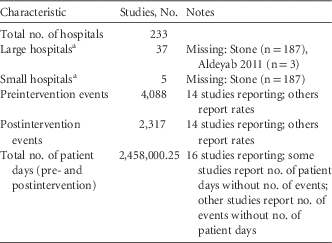
An aggregate description of the included studies is given in Table 1. The studies encompass 233 hospitals, mostly from the United States. Most hospitals had >200 beds. The average score of the studies on the QI-MQCS was 82% (Online Table e2), suggesting fair to good quality.
Overview of 46 Studies Included in the Qualitative Systematic Review

a Large hospitals are those with >200 beds; small hospitals are those with ≤200 beds.
Efficacy of Interventions
To detect heterogeneity in the data, we conducted a quantitative meta-analysis of the efficacy of interventions for reducing CDI rates. There was significant heterogeneity between the studies, as evidenced by I2>98% both for the whole group and individual intervention groupings. Further subgroup analyses and meta-regressions using variables, such as hospital size and type, components of bundled interventions, year of publication, and location of intervention (whole hospital versus specific units) were unable to explain the heterogeneity between the studies. Therefore, we present only a qualitative systematic review of the evidence.
Interventions
Environmental disinfection interventions
The 5 studies on environmental disinfection used a variety of interventions: daily bleach disinfection with auditing,Reference Orenstein, Aronhalt, McManus and Fedraw 8 terminal room disinfection with hydrogen peroxide vapor,Reference Manian, Griesnauer and Bryant 49 terminal room ultraviolet light (UV) treatment,Reference Levin, Riley and Parrish 10, Reference Haas, Menz, Dusza and Montecalvo 11 and complete surface terminal bleach disinfectionReference Hacek, Ogle and Fisher 9 (Online TABLE e3). Among these interventions, daily and terminal disinfection of the patient room with bleach-containing products in conjunction with auditing led to significant reduction in CDI. Orenstein et alReference Orenstein, Aronhalt, McManus and Fedraw 8 instituted daily bleach disinfection of patient rooms and high-touch surfaces with intensive auditing, reducing the rate of CDI from 24.2 of 10,000 to 3.6 of 10,000 patient days. Hacek et alReference Hacek, Ogle and Fisher 9 instituted terminal bleach disinfection, including disinfection of the walls and unannounced audits by the institution’s infection prevention committee. These measures reduced the rate of CDI from 8.5 of 10,000 to 4.6 of 10,000 patient days.
Terminal cleaning with UV light in addition to bleach cleaning had uncertain efficacy. Levin et alReference Levin, Riley and Parrish 10 used pulsed UV treatment in addition to terminal bleach cleaning and disinfection of rooms previously occupied by CDI patients. With treatment of 96% of the patient rooms, they observed a decrease in the rate of CDI from 9.46 of 10,000 to 4.45 of 10,000 patient days. Haas et alReference Haas, Menz, Dusza and Montecalvo 11 instituted pulsed UV treatment in addition to terminal bleach disinfection in a large urban hospital, with minimal incremental reduction in CDI rates.
Antimicrobial stewardship programs
We identified 13 studies that implemented ASPs, such as a system of prospective audit and feedback when targeted antimicrobials were prescribed or preauthorization requirements for antimicrobials.Reference Yam, Fales and Jemison 12 – Reference Borde, Litterst and Ruhnke 15 , Reference Elligsen, Walker and Pinto 27 , Reference Chan, Lin and Huang 51 – Reference Yu, Rho and Morcos 57 , Reference Amer, Akhras and Mahmood 60 Both methods appeared to be effective in reducing CDI in acute-care hospitals. Yam et alReference Yam, Fales and Jemison 12 demonstrated a decrease in CDI rates from 8.2 of 10,000 to 3.1 of 10,000 patient days with an audit and feedback system for 6 high-risk antimicrobials, although this result may have been confounded by a change in environmental cleaning practice made immediately preceding this evaluation. Similarly, Dancer et alReference Dancer, Kirkpatrick and Corcoran 13 implemented stewardship educational lectures and restricted use of ceftriaxone and ciprofloxacin, resulting in CDI reduction from 24 of 10,000 to 5.5 of 10,000 patient days. Hospitals with relatively low baseline rates of CDI did not see a substantial change after deployment of an ASP.Reference Jenkins, Knepper and Shihadeh 14 , Reference Borde, Litterst and Ruhnke 15
Hand hygiene studies
We reviewed 4 studies that evaluated the effect of hand-hygiene campaigns.Reference Kirkland, Homa and Lasky 16 – Reference Knight, Strait and Anthony 19 Kirkland et al,Reference Kirkland, Homa and Lasky 16 Doron et al,Reference Doron, Kifuji and Hynes 17 and Stone et alReference Stone, Fuller and Savage 18 used multifaceted campaigns that included access to alcohol-based hand rub, education, auditing, and feedback of hand-hygiene compliance, in addition to advertising the use of hand hygiene. Stone et alReference Stone, Fuller and Savage 18 described a significant reduction in CDI after a nationwide hand-hygiene campaign in hospitals in England and Wales, but studies that investigated single-hospital campaigns showed no change in C. difficile acquisition.Reference Kirkland, Homa and Lasky 16 , Reference Doron, Kifuji and Hynes 17
Knight et alReference Knight, Strait and Anthony 19 found that a hospitalwide policy advocating alcohol-based hand rub instead of soap and water significantly reduced CDI in acute-care hospitals, even though alcohol-based hand rub does not eradicate spores of C. difficile. The researchers hypothesized that improved hand hygiene compliance may have played a role in CDI reduction.
Chlorhexidine bathing
We reviewed 4 studies that examined daily chlorhexidine (CHG) bathing to reduce the risk of hospital-acquired infections, including CDI. Popovich et al,Reference Popovich, Hota and Hayes 20 Noto et al,Reference Noto, Domenico and Byrne 21 and Kassakian et alReference Kassakian, Mermel and Jefferson 22 evaluated CHG wipes for daily bathing of patients; none showed a statistically significant decrease in the rate of CDI.
In contrast, Rupp et alReference Rupp, Cavalieri and Lyden 23 studied CHG solution added to the traditional daily bed bathing protocol. A statistically significant decline in CDI was found during the study period, with a corresponding increase during a washout period.
Probiotics
Maziade et alReference Maziade, Andriessen and Pereira 24 , Reference Maziade, Pereira and Goldstein 25 performed a quasiexperimental study investigating 10 years of use of a high-dose preparation of Lactobacillus species after failing to reduce CDI in acute-care hospitals with augmented standard protective measures and reported a CDI rate of 2.3 of 10,000 patient days compared with 7.5 of 10,000 patient days in similar hospitals in the region.Reference Maziade, Andriessen and Pereira 24 , Reference Maziade, Pereira and Goldstein 25 In contrast, an observational study reported no difference in CDI (9.9 of 10,000 patient days vs 10.4 of 10,000 patient days) after cessation of twice daily 250 mg dosing of Saccharomyces boulardii with antibiotics without changing other C. difficile preventive measures.Reference Flatley, Wilde and Nailor 26
Other studies
The universal use of emollient-based gloves,Reference Bearman, Rosato and Duane 58 a ventilator-associated pneumonia bundle,Reference Sulis, Walkey and Abadi 59 implementation of electronic medical records to enhance stewardship activities,Reference Cook, Rizzo and Gooch 28 and strict contact precautionsReference Cheng, Chau and So 29 were each evaluated by a single study. In the emollient-based glove study, the investigators removed contact precautions and instituted universal emollient-based gloving for an 18-bed intensive care unit.Reference Elligsen, Walker and Pinto 27 Despite the removal of contact precautions for patients with multidrug-resistant organisms, the CDI rate did not increase. Cook et alReference Cook, Rizzo and Gooch 28 demonstrated a reduction in antimicrobial use and a decrease in CDI rate when existing antimicrobial stewardship activities were enhanced by the institution of electronic medical records. Cheng et alReference Cheng, Chau and So 29 used strict contact precautions and also found a small reduction in CDI.
Bundled interventions
Overall, 14 studies described the implementation of multiple interventions either simultaneously or sequentially (Online TABLE e4).Reference Abbett, Yokoe and Lipsitz 30 – Reference Bishop, Parry and Hall 42 , Reference Kallen, Thompson and Ristaino 50 All found significant reductions in CDI from baseline.
Abbett et alReference Abbett, Yokoe and Lipsitz 30 used a prevention checklist that included contact precautions, patient isolation, daily and terminal bleach disinfection, and a treatment checklist that included antibiotic guidelines. CDI rates decreased from 11.0 of 10,000 to 6.6 of 10,000 patient days. Miller et alReference Miller, Simmons and Dale 31 used a checklist to encourage compliance with hand hygiene, contact precautions, both daily and terminal bleach disinfection, and UV light disinfection. In association with these interventions, CDI rates decreased from 23.3 of 10,000 to 8.3 of 10,000 patient days.
Adelyab et alReference Aldeyab, Devine and Flanagan 32 evaluated a restrictive ASP and education and audited daily and terminal environmental disinfection with bleach. Similarly, Adelyab et alReference Aldeyab, Kearney and Scott 33 demonstrated a significant reduction in CDI rates after a bundled intervention that included an ASP with audit and feedback plus daily and terminal environmental disinfection with bleach. Bryce et alReference Bryce, Grant and Scharf 34 studied the impact of a risk-managed vancomycin-resistant Enterococci control strategy that included an enhanced environment and equipment cleaning program and an ASP protocol with audit and feedback. They achieved a significant reduction in CDI rates, from 12.0 of 10,000 to 5.3 of 10,000 patient days.
Price et alReference Price, Cheek and Lippett 35 implemented a bundle consisting of antimicrobial restriction plus a dedicated ward for patients with CDI; they achieved a 47% reduction in CDI (13.0 of 10,000 to 6.9 of 10,000 patient days). Suzuki et alReference Suzuki, Senda and Yamashita 36 implemented more stringent isolation requirements, more frequent clinical review of patients colonized with multidrug-resistant organisms, and more restrictive antimicrobial prescribing guidelines. Rates of CDI fell by >75% (4.71 of 10,000 to 1.08 of 10,000 patient days). Pokrywka et alReference Pokrywka, Feigel and Douglas 37 described the addition of a hand-hygiene intervention to an existing bundle of extended isolation periods, provider education, and environmental cleaning protocols, resulting in a 44% decrease in CDI (10.45 of 10,000 to 6.95 of 10,000 patient days) over the course of 1 year. Brakovich et alReference Brakovich, Bonham and VanBrackle 38 also observed significant CDI reduction after implementing a bundled intervention that included ASP with audited feedback, contact precautions, hand hygiene, and checklist-driven environmental cleaning.
Other studies (Weiss et al,Reference Weiss, Boisvert and Chagnon 39 You et al,Reference You, Song, Cho and Lee 40 and Salgado et alReference Salgado, Mauldin, Fogle and Bosso 41 ) also reported significant reductions in CDI following implementation of bundles that focused on contact precautions, environmental disinfection, and patient cohorting. Finally, Bishop, et alReference Bishop, Parry and Hall 42 utilized a resident-directed rounding protocol that included limiting the number of team members in patient rooms, as well as barrier precautions; these efforts were also associated with a reduction in CDI.
DISCUSSION
In comparison with the systematic review by Hsu et alReference Hsu, Abad, Dinh and Safdar 6 from 2009, we included several new categories of interventions in this review, including ASPs, CHG bathing, and UV light disinfection. We also included bundled interventions in our protocol; unlike other reviews, we categorized ASPs that included other interventions in the bundled category. This categorization enabled us to provide a more accurate comparison of interventions. We also excluded studies that did not report a rate of CDI, and we included studies performed during outbreaks. We elected not to combine this review with the Hsu et alReference Hsu, Abad, Dinh and Safdar 6 review because of these differences in eligible studies. The SHEA and the IDSA recommend appropriate use of antibiotics; contact precautions; cleaning and disinfection of equipment and environment; electronic CDI surveillance with laboratory-based alerts; education of hospital staff, patients, and families; and assessment of compliance with hand hygiene and contact precaution measures. These recommendations endure despite a low level of evidence for most of these interventions.Reference Dubberke, Carling and Carrico 5 , Reference Cohen, Gerding and Johnson 43
An expert panel in 2015 also published a “Pathway to Prevention” for CDI utilizing a modified Delphi poll based on an extensive review of literature.Reference Goldstein, Johnson and Maziade 3 Although the strength of evidence was graded in this consensus, the quality of systematic review of the evidence used to develop the categories for the consensus poll was not thoroughly discussed.
In our review of the recent CDI prevention studies performed in acute-care hospitals, bleach-based environmental disinfection and bundled interventions appeared to have the most effect in preventing CDI. Daily bleach and terminal disinfection on high-prevalence wards, as discussed by Orenstein et al,Reference Orenstein, Aronhalt, McManus and Fedraw 8 may be expected to decrease CDI rates by 85%. Terminal bleach disinfection alone, conversely, may be expected to decrease CDI rates by 48%. Treatment with UV light may reduce CDI approximately by an additional 4%, but it may have a greater effect with >95% compliance.
Bundled interventions incorporated hand hygiene, environmental bleach cleaning, checklists, and ASPs. Bundled interventions with environmental efforts appeared to be more effective than those without them, except in Suzuki et alReference Suzuki, Senda and Yamashita 36 study, in which a 77% reduction in CDI was seen with strict contact precautions and cohort procedures.
ASPs included prospective auditing, feedback, and restrictive programs across different classes of antibiotics. Institutions with higher baseline rates of CDI have reported a greater decrease in incidence after ASP initiation. This trend was also noted in a recent meta-analysis on ASPsReference Wagner, Filice and Drekonja 44 ; however, the meta-analysis included studies we considered bundled. In 2014, Feazal et alReference Feazel, Malhotra and Perencevich 45 conducted a systematic review on ASPs for preventing CDI and found a reduced incidence of CDI with restrictive ASPs; however, there was substantial heterogeneity among the studies, with some using concurrent environmental cleaning, which may have affected the results.
The lack of efficacy of hand-hygiene campaigns tested since 2009 was predictable. Although older studies have shown a significant reduction in nosocomial infections by observing good hand hygiene, further benefit from promoting hand hygiene is unlikely, as the margin for improvement diminishes. Therefore, if an institution has adequate hand-hygiene processes, incremental efforts to improve hand hygiene may not be as beneficial as other interventions.
CHG bathing to reduce CDI also showed a lack of efficacy, which was expected because CHG does not kill C. difficile spores. In the only CHG study that showed a reduction in CDI in acute-care hospitals, Rupp et alReference Flatley, Wilde and Nailor 26 speculated that scrubbing in addition to bed bathing might reduce the overall presence of spores.
We examined 2 recent systematic reviews on the use of probiotics that found moderate-quality evidence that probiotics are effective in reducing CDI, but these reviews did not specifically examine CDI in acute-care hospitals. Given the difference in the type of probiotic used here,Reference Maziade, Andriessen and Pereira 24 – Reference Flatley, Wilde and Nailor 26 it is difficult to interpret the impact of probiotic use in the hospital setting. Moreover, given the long duration of intervention in Maziade et al,Reference Maziade, Andriessen and Pereira 24 , Reference Maziade, Pereira and Goldstein 25 it is difficult to assess the impact of confounders over the 10 years of study.
This systematic review focused exclusively on hospital-based interventions with hospital-based outcomes. These criteria were most apparent in the probiotics category, where only 2 studies were included, unlike other reviews of probiotics, which included nonhospital-based interventions or outcomes.Reference Johnston, Ma and Goldenberg 46 , Reference Goldenberg, Ma and Saxton 47 Another strength of this review is the inclusion of bundled interventions, which are commonly used in hospitals. Although a meta-analysis was not possible due to the heterogeneity of data, it is valuable to review this emerging category of interventions. Another unique feature of this review is the use of the QI-MQCS scale to evaluate the quality of studies.
A major limitation of this review is the significant heterogeneity in the interventions and in duration of follow-up. There also appears to be considerable publication bias in this area of study. Analysis of negative results would be useful. Another limitation is that most studies did not separate hospital-onset versus hospital-acquired CDI, and apparently had a mix of cases. Therefore, we were unable to separate these subgroups for this review, and we instead used the term CDI (in acute care hospitals) to encompass both hospital-onset and hospital-acquired CDI. Finally, our strict criteria may have led to the exclusion of studies with interventions that may be extrapolated to an acute-care hospital setting.
CONCLUSIONS AND RESEARCH RECOMMENDATIONS
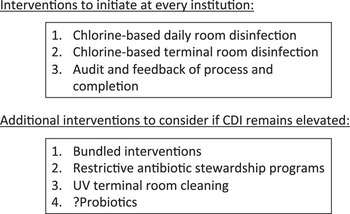
This review shows that many interventions can lead to an incremental improvement in CDI in acute-care hospitals. Bleach-based daily and terminal cleaning and bundled interventions appear to have the best evidence for reduction in CDI. Figure 1 provides a practical recommendation based on this update of the CDI intervention literature. Given the relative efficacy, institutions should focus on simple, effective interventions, and only consider more complex, costly programs if simple interventions have already been adopted. Environmental cleaning with bleach-based products carries the most impact and can be easily implemented in most institutions. However, some investigators have found that achieving compliance with appropriate cleaning technique is difficult outside of the study setting.Reference Knelson, Ramadanovic and Chen 48 Institutions with few resources should strive to improve environmental practices, with implementation of bleach-based cleaning. Institutions with more resources should consider bundled interventions that incorporate environmental cleaning, restrictive ASPs, and checklists.
Interventions aimed to target Clostridium difficile infection in acute-care hospitals.

Based on the current literature, there are several interventions, including disposable thermometers, hand hygiene, universal gloving, and CHG bathing, that do not need further evaluation and have sufficient evidence to make firm recommendations regarding managing CDI in acute-care hospitals. In contrast, there is still much to learn about ASPs given the heterogeneity of study results. Although Wagner et alReference Wagner, Filice and Drekonja 44 concluded that ASPs are not effective in impacting the incidence of CDI, there is significant variation in the classes of antibiotics studied as well as the types of ASPs to suggest further study. Other areas for future study include the types of audit and feedback used in various interventions hydrogen peroxide vapor, dry mist cleaning, UV light disinfection, and checklists. Additionally, as most studies on CDI in acute care hospitals are simple pre- and post-intervention designs, the use of a step-wedge or parallel cluster design would improve the robustness and quality of the data.
ACKNOWLEDGMENTS
We thank Laura Meli for her assistance.
Financial support: This review was supported by the Value Institute of NewYork-Presbyterian Hospital, and New York State Department of Health’s Empire Clinical Research Investigator Program (ECRIP). Additional support was provided by the Patient-Centered Outcomes Research Institute (contract no. ME-1403-12304). Dr Shaffer is supported by National Institutes of Health K23 career development award (grant no. K23 HL112850).
Potential conflicts of interest: Dr Davidson is a member of the United States Preventive Services Task Force (USPSTF). She is also the co-owner of MJBK, a small business that provides mhealth technology solutions to consumers, and IOHealthWorks, a consulting services company.
Disclaimer. This article does not necessarily represent the views and policies of the USPSTF.
SUPPLEMENTARY MATERIAL
To view supplementary material for this article, please visit https://doi.org/10.1017/ice.2016.324