Introduction
The South African endemic genus Roella L. (Campanulaceae) is mostly confined to the Cape Floristic Region, with one species occurring along the east coast from the Eastern Cape to KwaZulu-Natal. All species are described as dwarf shrubs, except for Roella muscosa L.f. which is a perennial herb. In the most comprehensive revision of the genus to date, Adamson (Reference Adamson1952) recognised 25 species divided into five series: Roella (as ‘Ciliatae’ Adamson), Prostratae Adamson, Spicatae Adamson, Squarrosae Adamson and Muscosae Adamson. Roella ser. Muscosae, to which R. muscosa belongs, comprises two species, and is characterised by a prostrate herbaceous habit and solitary bractless flowers. Roella insizwae (Zahlbr.) Hilliard & B.L.Burtt, the second species in the series, has been transferred to Craterocapsa (Hilliard & Burtt, Reference Hilliard and Burtt1973). More recently, in a checklist of Campanulaceae, Lammers (Reference Lammers2007) followed the treatment by Goldblatt & Manning (Reference Goldblatt and Manning2000) and Welman & Cupido (Reference Welman, Cupido, Germishuizen and Meyer2003), recognising 20 species. He retained the series erected by Adamson (Reference Adamson1952).
During a review of specimens for phylogenetic studies in the family, it became apparent that several specimens identified as Roella muscosa represented a related taxon. Careful examination revealed the existence of a group of specimens that displayed morphological and biogeographical variation patterns distinct from Roella muscosa. This distinct group of specimens is diagnosable by a combination of characters that is unique in the genus, and is here described as a new species.
Species Description
Roellae muscosae L.f. affinis a qua foliis linearibus uncinatis, floribus minoribus, disco epigyno applanato, et capsula per obturamentum apicale dehiscenti differt. – Type: South Africa, Western Cape, Hermanus, Vogelgat Nature Reserve, southwest facing slope between Banksia Ridge and Crassula Rock, 6 ii 2009, C.N. Cupido 403 (holo NBG; iso PRE).
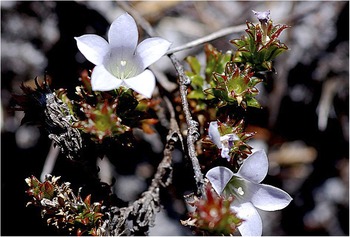
Roella uncinata Cupido (photograph: C. N. Cupido).

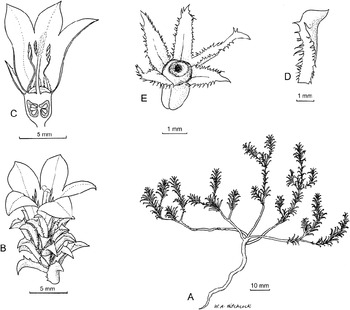
Roella uncinata Cupido. A, habit; B, flowering branch; C, flower, longitudinal section; D, leaf; E, capsule with persistent calyx (drawn from Cupido 403, holo NBG).

Perennial herb, hispid, tufted, up to 10 cm tall. Stems decumbent, branched, lower part becoming leafless, lateral branches developing in axils below the flower. Leaves alternate, linear, 3–8 mm long, succulent, subulate, apex hyaline, often red, uncinate, scattered to densely imbricate, sessile, glabrous, margins ciliate, 1 or 2 pairs of teeth near apex. Inflorescence 1–4-flowered, terminal. Flowers sessile, actinomorphic, white or pale blue; leaves subtending flower scarcely differentiated from vegetative leaves, often subtending a rudimentary flower. Hypanthium linear, minutely hairy near base. Calyx 5-lobed, lobes triangular, 3.5–4.5 mm long, often red, apex often uncinate, margins ciliate. Corolla campanulate; tube 3–4.8 mm long; lobes 5, ovate, each sinus with a tuft of hairs, 3–6 mm long. Stamens 5, free, inserted at base of corolla tube; filament base dilated, broadly triangular, ciliate, 2–2.4 mm long; anthers basifixed. Ovary inferior, 2-locular; ovules numerous, axile, epigynous disc flattened and fleshy; style cylindrical, glandular, sparsely hairy, 3–4 mm long; stigma bifid. Fruit a unilocular capsule, dehiscing by an apical plug. Seeds numerous. Flowering November–February.
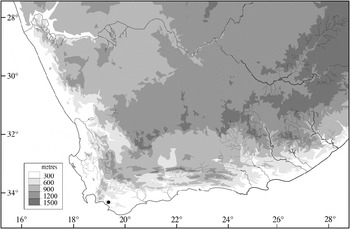
Distribution. South Africa, Western Cape, where it is known from the Kleinrivier Mountains near Hermanus within the boundaries of the Vogelgat and Maanschynkop Nature Reserves (Fig. 3).
Known distribution of Roella uncinata Cupido in South Africa.

Habitat and ecology. Roella uncinata grows in full sun in mountain fynbos on sandstone slopes in humus-rich or sandy soils at altitudes ranging from 500 to 800 m. The rainfall range is 280–2000 mm, most of which falls from May to August, with additional mist precipitation at higher altitudes in the summer months. Frost occurs 2–10 days in winter (Rebelo et al., Reference Rebelo, Boucher, Helme, Mucina, Rutherford, Mucina and Rutherford2006). Specimen information suggests that this species appears to be most abundant within the first three years after fire. Thereafter, it starts disappearing from the habitat when fire is absent for exceedingly long periods.
Proposed IUCN conservation status. Currently known from a few populations in the Vogelgat and Maanschynkop Nature Reserves in Hermanus. Although this species is protected within these reserves, it has a limited distribution, and may face threats from frequent fire and alien plant invasion. This species must therefore be considered as Vulnerable (VU D2) according to the IUCN Red List criteria (IUCN, 2001).
Diagnostic features and affinities. In the absence of phylogenetic evidence, one can only speculate on which taxon is the closest relative of Roella uncinata. One of three low-growing herbaceous species, Roella muscosa, R. goodiana or R. recurvata, is proposed as a likely contender. Roella uncinata and R. muscosa both have leaves subtending the flowers that are scarcely differentiated from the vegetative leaves and which are attached to the wall of the hypanthium. These species differ from each other in that Roella muscosa is a delicate, mat-forming species with elliptic to ovate leaves that have petiole-like bases and are without an uncinate apex. Furthermore, its style base is swollen and dome shaped, the flowers are larger than those of Roella uncinata, and the capsule dehisces via vertical slits according to Hilliard & Burtt (Reference Hilliard and Burtt1973). However, I have not observed this mode of dehiscence in this species and the capsule rather appears indehiscent. In contrast, Roella uncinata is a stout, tufted species with linear leaves with a characteristic uncinate apex. Its style base is surrounded by a flattened fleshy epigynous disc, the flowers are smaller than those of Roella muscosa and the capsule dehisces via an apical plug. The two species also differ in their distribution, with Roella muscosa not known from Hermanus, but perhaps limited to Table Mountain in the Cape Peninsula. The specimens from Kogelberg and Stellenbosch cited by Adamson (Reference Adamson1952) under Roella muscosa appear, from superficial examination, to be a separate taxonomic entity. It compares well with the type of Prismatocarpus alpinus (Bond) Adamson, a species originally described as belonging in Roella.
The closely related Roella goodiana and R. recurvata which are placed in Roella ser. Prostratae by Adamson (Reference Adamson1952) are perhaps more strikingly similar to R. uncinata than is R. muscosa. Morphologically, Roella goodiana and R. recurvata differ from each other mainly by the shorter somewhat elliptic recurved leaves, broader and elliptic leaves subtending the flowers, and densely hairy inner surface of the corolla tube in R. recurvata compared with the longer succulent ascending linear leaves, linear leaves subtending the flowers, and sparsely hairy inner surface of the corolla tube in R. goodiana. Roella goodiana starts flowering in December and is found only in the Klaver Valley area near Simonstown, whereas R. recurvata starts flowering towards the end of January and is more widespread in the southern parts of the Cape Peninsula. Of these two species Roella goodiana with its linear leaves appears more similar to R. uncinata. However, the leaves in Roella uncinata do not clasp the stem as is the case in R. goodiana and R. recurvata, and the hooked apex and pairs of teeth found in R. uncinata are distinctly absent in the other two species. In Roella goodiana the leaves subtending the flowers are scarcely differentiated from the vegetative leaves of R. uncinata and its filament base is ovate whereas in R. uncinata it is broadly triangular. In Roella goodiana and R. recurvata the upper part of the hypanthium and inner surface of the corolla tube are hairy, while in R. uncinata they are glabrous.
Etymology. The epithet is derived from the appearance of the leaf tips of the plant (uncinatus = hooked).
Additional specimens examined. South Africa. Western Cape, Hermanus, Maanschynkop Nature Reserve, Lex’s Gully, near Breakfast Rock, 16 i 2009, Cupido 402 (NBG); Maanschynkop Nature Reserve, Lex’s Gully, steep dry south facing slope, 27 i 1988, Williams 3809 (NBG); Hermanus, Vogelgat Nature Reserve, summit of Beacon Head, 30 xi 1985, Williams 3636 (NBG).
Acknowledgements
My thanks to Giorgio Lombardi of Vogelgat Private Nature Reserve for access to the reserve and assistance in locating plants; Dr Ferozah Conrad for assistance with the Latin diagnosis; Michelle Smith for preparing the distribution map; Wendy Hitchcock for the line drawings, and the Western Cape Nature Conservation Board for granting a collecting permit.