Modified Blalock–Taussig shunt thrombosis is generally fatal unless immediate intervention is pursued.Reference Sasikumar, Hermuzi and Fan1,Reference Bonnet, Petit and Lambert2 There are no guidelines for transcatheter treatment. The role of tissue plasminogen activator in shunt thrombosis has been proposed, but it is not well established.Reference Patange, Blake and Gowda3,Reference Moszura, Zubrzycka and Michalak4
Case report
We present a 5-month-old female with double-outlet right ventricle, normally related to great arteries, hypoplastic aortic arch and coarctation of aorta. She underwent pulmonary artery banding and arch repair at the age of 2 months followed by Glenn anastomosis at 4 months by dividing the main pulmonary artery creating a non-pulsatile Glenn circulation. Three weeks later, due to ineffective Glenn circulation, it was taken down by connecting the superior vena cava back to the right atrium and placing a 3.5 mm Modified Blalock–Taussig shunt. The shunt was the only source of blood supply to the pulmonary circulation. On post-surgery day 12 due to difficulty weaning ventilatory support, cardiac catheterisation was performed. Prior to the catheterisation, she was on aspirin (5 mg/kg/day) and therapeutic heparin for central line-related thrombosis. Hypercoagulability studies were negative.
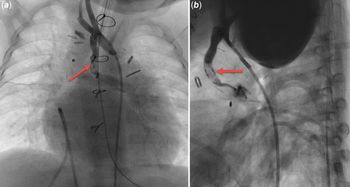
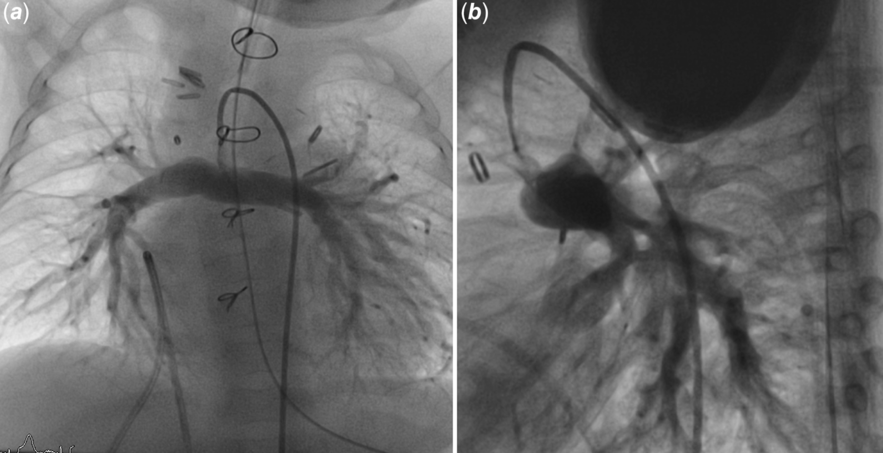
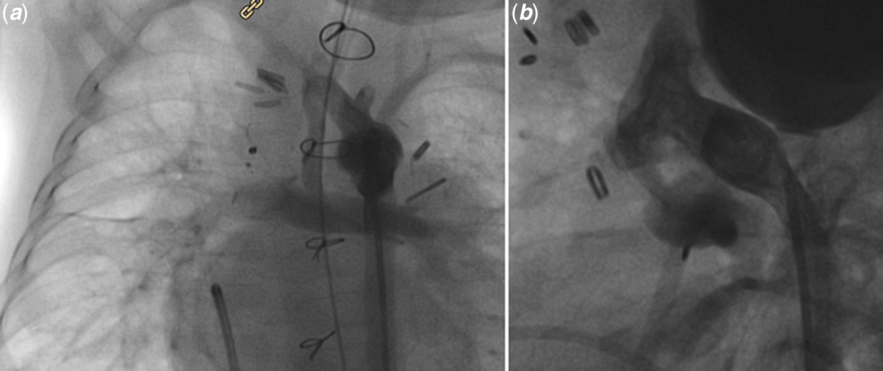
Heparin (75 IU/kg) was administered after obtaining access. Severe left upper pulmonary vein ostial stenosis was identified with a mean gradient of 10 mmHg. Balloon angioplasty was performed. Upon balloon removal, sudden decline in systemic oxygen saturation to 30% and bradycardia (60 bpm) were noted despite adequate ventilation, defined by good chest rise and no change in the lung compliance, and normal systemic arterial pressure. FiO2 was increased to 100% without improvement. Bleeding was ruled out. Aortic arch angiogram confirmed suspicion of shunt thrombosis. High-dose heparin (330 IU/kg) was administered. The shunt was accessed using a 4F right Judkins 2.5 catheter. Shunt angiogram showed large thrombus with near occlusion of flow (Fig 1). Tissue plasminogen activator (0.1 mg/kg) was directly infused over 2 minutes inside the shunt followed by balloon angioplasty. Systemic saturation increased to the high 80s. Repeat angiogram showed no thromboembolism in the shunt or the pulmonary arteries (Figs 2 and 3).
(a) Anteroposterior. (b ) Lateral angiogram of proximal shunt shows obstructive clot in distal shunt with near absence of flow distally.

(a) Anteroposterior. (b) Lateral mid-shunt angiogram shows normal distal PA arborisation.

(a) Anteroposterior. (b) Lateral angiogram of the aortic arch shows no residual thrombus in the Modified Blalock–Taussig shunt.

At the end of the case, oxygen saturation was 75–80% on 30% FiO2 similar to baseline, and activated clotting time was out of range. Heparin was not reversed due to the risk of shunt thrombosis. Haemostasis was achieved by applying direct pressure for 5 hours; therapeutic heparin was then restarted. She was extubated 8 days later. Repeat catheterisation after 2 months showed neither shunt nor pulmonary artery stenosis. She was discharged on aspirin, low-molecular-weight heparin and sildenafil with intention to repeat cardiac catheterisation followed by Glenn anastomosis.
Discussion
In the absence of additional pulmonary blood flow, acute shunt occlusion is catastrophic with low survivability. Although the aetiology of acute shunt thrombosis cannot be identified in all cases, known risk factors include anatomical stenosis in the shunt, arrhythmia, infection, dehydration, perioperative shunt clamping, thrombophilia and small shunt size.Reference Bonnet, Petit and Lambert2
In our patient, pulmonary vein angioplasty was likely the trigger for shunt thrombosis. The transient complete left pulmonary vein occlusion during balloon angioplasty likely resulted in acute increase in pulmonary artery pressure. Lack of concurrent change in systemic arterial pressure decreased the driving pressure gradient across the shunt and led to stagnated blood flow, which in turn induced thrombosis. Another possible mechanism, although unlikely, is the embolisation of a thrombus in the shunt that initially formed somewhere else.
Shunt thrombosis can be treated surgically or percutaneously.Reference Sasikumar, Hermuzi and Fan1,Reference Bonnet, Petit and Lambert2,Reference Kogon, Villari and Shah5 Transcatheter methods include balloon angioplasty, stent placement, thrombolysis and/or rheolytic thrombectomy.Reference Bonnet, Petit and Lambert2,Reference Kogon, Villari and Shah5,Reference Gillespie and Rome6 Historically, tissue plasminogen activator has been used systemically to treat thrombosis at different locations including shunt thrombosis. Most recent reports have described successful transcatheter tissue plasminogen activator use in treating thrombosis in the shunt as well in the coronary artery. Nevertheless, in these reports, relatively high doses were utilised and reflect institutional practice rather than universal guidelines.Reference Patange, Blake and Gowda3,Reference Moszura, Zubrzycka and Michalak4,Reference Mohammad Nijres, Huntington, Baliulis and Vettukattil7 Our patient responded well to local low-dose tissue plasminogen activator (0.1 mg/kg) in line with recent evidence of low-dose efficacy in small children with thrombosis.Reference Patange, Blake and Gowda3,Reference Mohammad Nijres, Huntington, Baliulis and Vettukattil7 In hindsight, high-dose heparin (330 IU/kg) administered after confirming shunt thrombosis was probably not necessary and 100 IU/kg would have been sufficient. However, total procedure heparin dose of 405 IU/kg was within previously reported range (300–500 IU/kg) in patients who underwent transcatheter recanalisation of shunt thrombosis.Reference Bonnet, Petit and Lambert2 Although angioplasty alone has the potential to dislodge and fragment the thrombus, it cannot dissolve it. Therefore, the authors agree with Moszura and colleagues’ approach where local tissue plasminogen activator was administered in all cases with shunt thrombosis unless a contraindication was present.Reference Moszura, Zubrzycka and Michalak4
Use of tissue plasminogen activator is not risk free. Major complications are estimated to affect 11.5–40% of patients. Bleeding is the most commonly encountered complication typically at the access site, although it can occur at other locations in the body including intracranial haemorrhage. Incident of major complications correlates with younger age, prolonged treatment and increased decline in fibrinogen level. It is worth mentioning that this high complication rate was extrapolated from studies that used relatively high systemic doses (0.25–0.5 mg/kg/h) for a prolonged period of time.Reference Gupta, Leaker and Andrew8,Reference Newall, Browne, Savoia, Campbell, Barnes and Monagle9
Conclusion
Local transcatheter low-dose tissue plasminogen activator (0.1 mg/kg) along with balloon angioplasty seems to be effective in treating acute shunt thrombosis. Although, this low single dose theoretically carries low risk of complications in children, further studies are required to define indications, establish dosing and confirm safety and efficacy to treat shunt thrombosis.
Acknowledgements
We would like to acknowledge Bennett Samuel MHA, BSN, RN, AACC, Clinical Research Nurse, Congenital Heart Center, Spectrum Health Helen DeVos Children’s Hospital, for editorial support and guidance.
Financial Support
This research received no specific grant from any funding agency, commercial or not-for-profit sectors.
Conflicts of Interest
None.
Ethical Standards
The authors assert that all procedures contributing to this work comply with the ethical standards of the relevant national guidelines on human experimentation (U.S. Code of Federal Regulations) and with the Helsinki Declaration of 1975, as revised in 2008. As our case report does not meet the definition of research, it is not subject to institutional review board (IRB) oversight as per the Spectrum Health IRB. As such informed consent was not obtained from the individual participant included in the case report.