Introduction
Sometimes, gravity flows suddenly bury numerous micro- and microorganisms. Such events provide critical information not only about recent natural disasters (Tanaka et al., Reference Tanaka, Naruse, Yamashita and Arai2012; Arai et al., Reference Arai, Naruse, Miura, Kawamura, Hino, Ito, Inazu, Yokokawa, Izumi, Murayama and Kasaya2013), but also data for reconstructing ancient paleoecosystems from exceptionally preserved biota (Allison and Bottjer, Reference Allison and Bottjer2011). However, the usefulness of microfossils found in gravity flows has not been explored extensively from a paleoenvironmental research viewpoint or for their paleobiogeographic significance.
Ostracoda are small crustaceans, usually <1 mm in maximum length. They have been reported from the Upper Ordovician onward and are great tools for paleobiogeographic reconstructions (Schallreuter and Siveter, Reference Schallreuter and Siveter1985; Williams et al., Reference Williams, Floyd, Salas, Siveter, Stone and Vannier2003). The Podocopida constitute the largest group of ostracodes since the Mesozoic to Recent. They are benthic and nektobenthic throughout their lives (Athersuch et al., Reference Athersuch, Horne and Whittaker1989); therefore, they are easily isolated by geographic features such as deep oceans and land bridges and are affected by various environmental conditions, such as water temperature, water depth, and bottom sediment type.
The genus Neosinocythere is a benthic podocopid ostracode that is distributed along coastal areas of the Indian Sea, Sulu Sea, South China Sea, East China Sea, and Bohai Sea from the Miocene to Recent (Zhao and Whatley, Reference Zhao and Whatley1993). Here, we report on previously undescribed upper Miocene Neosinocythere species from Japan and discuss their paleogeographical significance with a paleoenvironmental reconstruction using a modern analog technique based on an ostracode assemblage found in gravity-flow sediments.
Geological setting
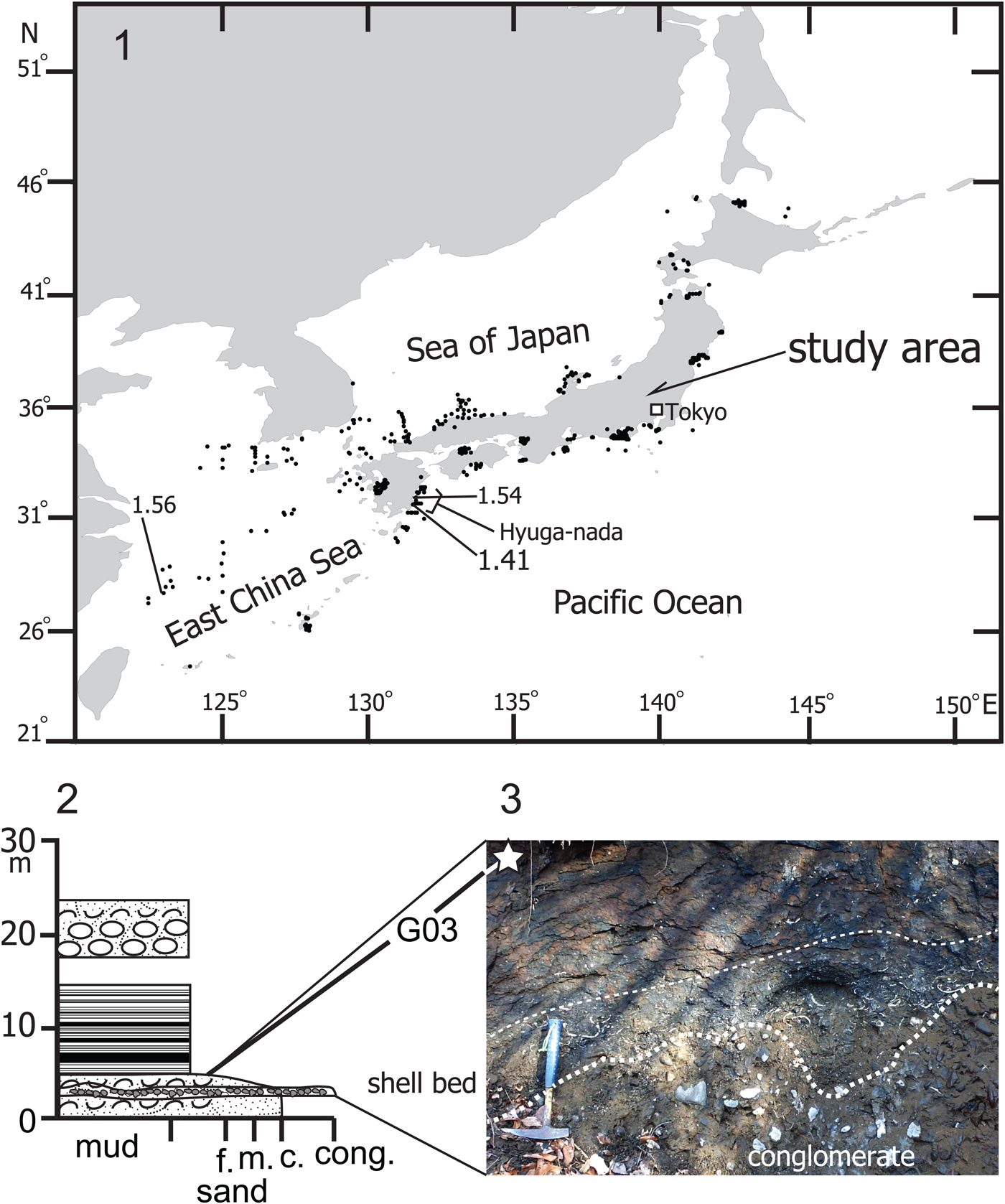
Samples were collected from a cliff (36°17′58.5″N, 138°58′58.0″E, altitude 109.9 m) along a small branch of the Gangyo River, Southwest Takasaki City, Gunma Prefecture, Central Japan (see Tanaka and Hasegawa, Reference Tanaka and Hasegawa2013). In the area, the base of the lower part of the Itahana Formation is widely exposed along the Gangyo River. The lower part of the Itahana Formation largely consists of fine-grained sandstones and conglomerates. On the basis of a qualitative analysis of the ostracode assemblages, the depositional environment is estimated to have been an upper bathyal muddy open-sea bottom with an occasional influx of shallow sediment (Tanaka and Hasegawa, Reference Tanaka and Hasegawa2013). Conversely, in the upper part of the Itahana Formation, which is primarily composed of conglomerates, the depositional environment is considered to have been a deltaic environment (Kubo and Tsunoda, Reference Kubo and Tsunoda1973). According to the sedimentation rate and radiometric dating (40Ar39Ar [biotite] and 40Ar39Ar [sanidine]) of the uppermost part of the Haraichi Formation underlying the Itahana Formation, the Itahana Formation was deposited ~11.0–10.5 Ma (Takahashi and Hayashi, Reference Takahashi and Hayashi2004).
In the cliff study section (Fig. 1), sediments are deposited as follows in ascending order. The lowest horizon consists of a dark-gray, muddy coarse-grained sandstone with many shell fragments, and is eroded by well-rounded cobbles to pebbles and covered by a bed of dark-gray, muddy coarse-grained sandstone with shells (~20–40 cm in thickness). The muddy coarse-grained sandstone gradually changes to light-gray, fine-grained sandstone toward the upper horizon with fewer shell fragments, and, finally, there is an alteration to a light-gray, fine-grained sandstone and mudstone (with a thickness of ~5–10 cm) with many plant fragments overlying the sandstone. These sedimentological characteristics indicate typical gravity flows during regression via progradation (Demarest and Kraft, Reference Demarest, Kraft, Nummedal, Pilkey and Howard1987).
Location of the study area and sampling site. (1) Study area and 595 locations of Recent ostracode assemblages (dotted points) used for the analysis of the modern analogue technique. Two decimal places of the sites had the three lowest SCD values, which were compared with fossil assemblages from the G3 sample (see Table 3). (2) Columnar sections with the sample horizon (G3). (3) Photograph of the outcrop showing the sampling site (white star). The scale (the hammer) is 33 cm; f., fine; m., medium; c., coarse; cong., conglomerate.

Materials and methods
Samples that included ostracode specimens were collected from one horizon (Fig. 1.1–1.3) selected from the lower part of the Itahana Formation (the G3 horizon in Tanaka and Hasegawa, Reference Tanaka and Hasegawa2013). Additional samples were collected by one of the authors (GT) from the same horizon. The total dried rock sample (320 g) was disaggregated using the sodium tetraphenylborate method (Yasuda et al., Reference Yasuda, Takayanagi and Hasegawa1985), washed through a 120-mesh (125 µm) screen, and the residue was collected and dried. Ostracode specimens were selected and identified under a stereoscopic microscope (OLYMPUS SZH10), and the images were captured using a HITACHI Microscope TM-3000 scanning electron microscope under a low vacuum with a non-evaporation coating.
To estimate the paleoenvironment based on the ostracode assemblage, a modern analog technique (Overpeck et al., Reference Overpeck, Webb and Prentice1985), which is a method for estimating paleoenvironmental conditions by applying similar Recent environmental data and comparing fossil assemblages, was applied to the ostracodes (Ikeya and Cronin, Reference Ikeya and Cronin1993). The degree of dissimilarity between the fossil assemblage and Recent assemblages was calculated using the following equation (1):
 $$\eqalign{&{\rm squared\;\ chord\;\ distance\;} \lpar {{\rm SCD}} \rpar \cr & \qquad = \sum\nolimits_{i = 1}^n {\lpar {\sqrt {fp_i} + \sqrt {mp_i}} \rpar } ^2}$$
where fp i is the ith number of the specified fossil species and mp i is the ith number of the specified modern species. The SCD value was computed using Microsoft Excel 2016 under the VBA environment. The SCD value ranges between 0 and 2.0. An SCD value of 0 means that the objective fossil assemblage is completely concordant with the Recent population. Tanaka et al. (Reference Tanaka, Naruse, Yamashita and Arai2012) added 203 Recent ostracode assemblages to the previous data (Ikeya and Cronin, Reference Ikeya and Cronin1993) and estimated the depth of the supply source of a tsunami sediment. In the present study, we added another 119 Recent ostracode assemblages, and 595 Recent ostracode assemblages (Fig. 1.1) were compared with the ostracode assemblages from the G3 sample of the Itahana Formation. In order to investigate the effect of the reconstruction of the analogue selection, we carried out jackknife leave-one-out and bootstrapping selection using “analogue” package on free software R (version 3.5) (Simpson, Reference Simpson2007). The number of selected analogues was chosen automatically in the “analogue” to detect the lowest possible root mean square error prediction (e.g., Herbert and Harrison, Reference Herbert and Harrison2016). A total of 368 ostracode species and three environmental parameters (water depth, summer bottom temperature [SBT], and winter bottom temperature ([WBT]) were compared and were calculated to check the statistics for reconstruction (Table 1).
Results of statistics of modern analogue technique by using jackknife leave-one-out (LOO) and bootstrapping (BOOT). RMSEP means the lowest possible mean square error of prediction. WD, water depth; SBT, summber bottom temperature; WBT, winter bottom temperature.

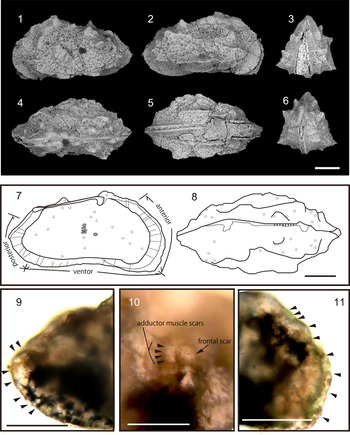
To investigate the internal structure of the Neosinocythere sp. A, the specimens were mounted on a glass slide filled with an immersion oil, observed under a transmitted optical microscope (OLYMPUS BX41), and sketched using an attached camera lucida.
Repositories and institutional abbreviations
All types and figured specimens examined in this study are deposited in the following institutions: The University Museum, the University of Tokyo (UMUT), Tokyo, Japan; Utrecht University (T), The Netherlands; the Natural History Museum (NHM), London, UK; British Museum (OS), London UK; and Nanjing Institute of Geology and Palaeontology (NPIM), Nanjing, China.
Systematic paleontology
The morphological terms used here are based on Scott (Reference Scott and Moore1961) and Horne et al. (Reference Horne, Cohen, Martens, Holmes and Chivas2002).
Order Podocopida (Sars, Reference Sars1866)
Family Hemicytheridae (Puri, Reference Puri1953)
Genus Neosinocythere (Huang, Reference Huang1985)
Type species
Sinocythere reticulata (Chen in Hou et al., Reference Hou, Chen, Yang, Zhou and Tian1982).
Neosinocythere sp. A
Figure 2
- 2013
Spinileberis? sp. Tanaka and Hasegawa, p. 143.
Description
The carapace is trapezoid in lateral view (Fig. 2.1, 2.2). The anterior margin is evenly rounded; the dorsal margin slopes toward the posterior; the posterior margin is truncated in a V-shape, projecting posteriorly; and the ventral margin is situated at mid-length. There is no eye tubercle. Except for the anterior and posterior areas, the surface is ornamented by reticulation: primary reticulation develops an antero-median to postero-median area via the median area, and secondary reticulation develops a dorso-median area. Two strong carinae run from the anterior to the posterior: one carina runs from the antero-ventral area to the postero-dorsal area; one carina diverges at the antero-ventral area from the other carina and undulates to postero-ventral area, and then ends in the postero-ventral area. One short undulating carina develops at the mid-ventral area. A sub-central tubercle is developed. In left lateral views, prominent nodes develop anterior and posterior cardinal angles, accommodating anterior and posterior hinge elements. At least two nodes develop at the postero-dorsal area (Fig. 2.1–2.4, 2.6), and two nodes develop at the mid-anterior area (Fig. 2.2, 2.4, 2.6). An inner margin develops on the anterior, ventral, and posterior margins (Fig. 2.7). No selvage is developed. Marginal pore canals; nine in anterior, eight in ventral, and seven in posterior margin (Fig. 2.7, 2.9, 2.11). Hinge amphidont: in the right valve, the anterior element has a comma-shaped tooth with a socket in the posterior area; the antero-median and median element is a smooth tooth; the postero-median element is a crenulated bar (Fig. 2.8); the posterior element is an elliptical rounded tooth (Fig. 2.7, 2.8). There is one oblong frontal scar and four elliptical/kidney-shaped adductor scars (one upper adductor scar is kidney shaped, and the remaining three scars are elliptical and elongated; Fig. 2.7, 2.10).
Neosinocythere sp. A from the upper Miocene Itahana Formation, Central Japan (UMUT-CA-32941). (1–6) Scanning electron micrographs of an externally viewed specimen: (1) left lateral view; (2) right lateral view; (3) anterior view; (4) dorsal view; (5) ventral view; and (6) posterior view. (7, 8) Drawing of the inner morphology using a transmitted optical microscope: (7) internal features of the right valve and (8) dorsal view showing the hinge. (9–11) Transmitted optical microphotographs of internal view of specimen of right valve: (9) posterior margin; (10) adductor muscle scars and frontal scar; and (11) anterior margin. All scale bars represent 100 µm.

Material
An adult carapace specimen, UMUT-CA-32941, in the collection of The University Museum, the University of Tokyo (Tokyo, Japan).
Remarks
Neosinocythere sp. A is similar to Neosinocythere elongata (Hu, Reference Hu1976) from the Pliocene Cholan Formation, Taiwan, but this species is distinguished from N. elongata by having a posteriorly protruded posterior margin, a more finely ornamented carapace, and two longer carinae running from the anterior to the posterior area. This species is similar to N. macropunctata Zhao and Whatley, Reference Zhao and Whatley1993 from the Sedili River estuary, Malaysia; however, this species is distinguished from the latter by the smooth surface at the posterior area, by two nodes at the postero-dorsal area, and by the long mid-ventral carina. Neosinocythere elongata is similar to N. dekrooni (Kingma, Reference Kingma1948) from the upper Pliocene upper Kaliberg Bed, Java Island, Indonesia, but this species differs from N. dekrooni by having a long carina running from the antero-ventral area to the postero-dorsal area, a posteriorly protruded posterior margin, and a rather indistinct sub-central tubercle.
Check list of other Neosinocythere spp. from around the world
Currently, nine species have been recognized, and two species have replaced different genera based on morphology (see the remarks for each species).
Neosinocythere dekrooni (Kingma, Reference Kingma1948)
- 1948
Cythere dekrooni Kingma, p. 79, pl. 9, fig. 15.
- 1989b
Neosinocythere dekrooni (Kingma); Zhao and Whatley, p. 243, pl. 4, figs. 9–12.
- 1997
Neosinocythere dekrooni (Kingma); Kumar and Hussain, p. 134, pl. 1, fig. 9.
- 2003
Neosinocythere dekrooni (Kingma); Arul et al., p. 66, pl. 3, figs. 1, 2.
- 2015
Neosinocythere dekrooni (Kingma); Mahalakshmi and Hussain, pl. 1, fig. 8.
Lectotype
T402, designated by Zhao and Whatley (Reference Zhao and Whatley1993).
Remarks
According to Zhao and Whatley (Reference Zhao and Whatley1993), this species has been known to be exclusively female. Elumalai et al. (Reference Elumalai, Hussain and Dhas2010) reported male and female species from the east coast of India. The male has a longer lateral outline compared with the female. This species has not been reported from the west coast of India (Hussain, Reference Hussain, Kathal, Nigam and Talib2017, table 1).
Neosinocythere indica Zhao and Whatley, Reference Zhao and Whatley1993
- 1981
Genus A Jain, p. 108, pl. 2, fig 7.
- 1985
Palmenella mckenzii Annapurna and Rama Sarma, p. 141, pl. 1, fig. 1.
- 1993
Neosinocythere indica Zhao and Whatley, p. 3, 4, pl. 1, figs. 10–17.
- 2007
Neosinocythere indica Zhao and Whatley; Gopalakrishna et al., pl. 4, fig. 1.
- 2015
Jankeij cythere mckenziei (Annapurna and Rama Sarma, Reference Annapurna and Rama Sarma1985); Mahalakshmi and Hussain, pl. 1, fig. 7.
Holotype
NHM 1991.336.
Remarks
Palmenella mckenzii described by Annapurna and Rama Sarma (Reference Annapurna and Rama Sarma1985) from the east coast of India is identified as Neosinocythere indica based on carapace outline and surface ornamentations. Neosinocythere indica Zhao and Whatley is reported to be from the southeast to west coast of India (see Hussain, Reference Hussain, Kathal, Nigam and Talib2017, table 1). Mahalakshmi and Hussain (Reference Mahalakshmi, Hussain, Vasudevan, Ramkumar, Singhal, Rajanikanth and Ramesh2015) assigned Neosinocythere mckenzii to Jankeijcythere mckenzii, but Jankeijicythere differs from Neosinocythere in having prominent dorso-medial sulcus and antimerodont hingement (see McKenzie, Reference McKenzie, Hanai, Ikeya and Ishizaki1988).
Neosinocythere indowestpacifica Zhao and Whatley, Reference Zhao and Whatley1993
- 1989?
Caudites sp. Whatley and Keeler, p. 71, pl. 2, figs. 14, 15, 17.
- 1993
Neosinocythere indowestpacifica Zhao and Whatley, p. 4, pl. 1, fig. 18, pl. 2, figs. 1–3.
Holotype
NHM 1991.344.
Remarks
This species exhibits transoceanic distribution from the Saint-Pierre Harbour (off the east coast of Madagascar) to Palau Pari Island (off the west coast of Java). However, only empty valves have been reported (Zhao and Whatley, Reference Zhao and Whatley1993).
Neosinocythere macropunctata Zhao and Whatley, Reference Zhao and Whatley1993
- 1989a
Sinocythere superba (Guan); Zhao and Whatley, p. 187.
- 1993
Neosinocythere macropunctata Zhao and Whatley, p. 6, pl. 2, figs. 4–10.
Holotype
NHM 1991.344.
Remarks
Only reported from the Sedili River, Malay Peninsula.
Neosinocythere micropunctata Zhao and Whatley, Reference Zhao and Whatley1993
- 1993
Neosinocythere micropunctara Zhao and Whatley, p. 7, pl. 2, figs. 11–18.
- 1993
Neosinocythere dekrooni (Kingma); Varma et al., p. 557, pl. 2, figs. 1–3.
- 1997
Neosinocythere dekrooni (Kingma); Naidu et al., p. 728, pl. 4, figs. 7, 8.
- 2002
Neosinocythere dekrooni (Kingma); Sridhar et al., p. 31, pl. 3, figs. 14, 15.
- 2010
Neosinocythere dekrooni (Kingma); Elumalai et al., p. 16, pl. 1, figs. 13, 17–19.
Holotype
NHM 1991.354.
Remarks
The listed specimens reported from the east coast of India (Verma et al., Reference Varma, Shyam Sunder and Naidu1993; Naidu et al., Reference Naidu, Varma and Shyam Sunder1997; Sridhar et al., Reference Sridhar, Hussain, Kumar and Periakali2002; Elumalai et al., Reference Elumalai, Hussain and Dhas2010) are identified as N. micropunctata, which has a finely puncate outer surface and prominent long caudal process. This species has been reported to be from the east coast of India.
Neosinocythere chungchengi Hu and Tao, Reference Hu and Tao2008
- 2008
Neosinocythere chungchengi Hu and Tao, p. 344, pl. 141, figs. 19, 22, 24.
Holotype
NPIM 038602
Remarks
Only reported from the type locality (Pleistocene Guanmiao Formation, South West Taiwan).
Neosinocythere elongata (Hu, Reference Hu1976)
- 1976
Orionina elongata Hu, p. 38, text-fig. 10, pl. 3, figs 4, 12, 20, 21.
- 1978
Atopocythere superba Guan in Guan et al., p. 289, pl. 75, fig. 13.
- 1982
Sinocythere? reticulata (Chen); Hou et al., p. 243, pl. 87, figs. 1–9.
- 1983
Sinocythere reticulata (Chen); Gou et al., p. 107, pl. 21, figs. 38–45.
- 1985
Neosinocythere reticulata Huang, p. 49, pl. 1, figs. 14, 15.
- 1986
Sinocythere? reticulata (Chen); Hou and Zhao, pl. 4, figs. 1, 2.
- 1987
Sinocythere? reticulata (Chen); Zheng, p. 205, pl. 8, figs. 24–26.
- 1988
Sinocythere reticulata (Chen); Ruan and Hao, p. 279, pl. 70, figs. 16, 17.
- 1988
Sinocythere? reticulata (Chen); Wang, Q. et al., pl. 1, fig. 28.
- 1989
Sinocythere reticulata (Chen); Liu, p. 160, pl. 171, figs. 8–10.
- 1993
Neosinocythere elongata (Hu); Zhao and Whatley, p. 3, pl. 1, figs. 1–7.
- 1994
Cathaycythere? reticulata (Chen); Zheng et al., pl. 59, fig. 18.
- 2000
Sinocythere reticulata (Chen); Gou in Gou and Tang, pl. 13, figs. 11, 12.
- 2007
Neosinocythere elongata (Hu); Hou and Gou, p. 441, pl. 159, figs. 11–13, pl. 174, figs. 9–14.
- 2008
Neosinocythere elongata (Hu); Hu and Tao, p. 344, pl. 8, figs. 1, 2, pl. 84, figs. 3, 6, pl. 150, fig. 6, pl. 213, figs. 19, 22.
Holotype
NHM 1991.330.
Remarks
Hu (Reference Hu1976) described this species from the Pliocene Cholan Formation on the basis of one holotype (CKUM 2012) and one paratype (CKUM 2013). However, according to information from late Prof. Hu in 2004, the types of these specimens were lost in a typhoon before deposition in the Geology Museum, Cheng Kung University, Taiwan (CKUM-number). Therefore, we redefine the female specimen of Zhao and Whatley (Reference Zhao and Whatley1993) as the neotype in this study. The genus Neosinocythere was divided from the genus Sinocythere because of its female having a caudal process in the postero-ventral end (Zhao and Whatley, Reference Zhao and Whatley1993), and on the basis of this characteristic, several figured specimens listed above (Gou et al., Reference Gou, Zheng and Huang1983; Ruan and Hao, Reference Ruan and Hao1988; Liu, Reference Liu1989; Gou, Reference Gou, Gou and Tang2000) are identified as Neosinocythere.
Neosinocythere sp.
- 2008
Neosinocythere acupunctata (Brady); Hu and Tao, p. 345, pl. 70, fig. 21; (non pl. 213, figs. 13, 20).
Remarks
This species has only been discovered in the Pliocene Maanshan Formation, South Taiwan.
Neosinocythere sp. A
Remarks
This species has only been found in the upper Miocene Itahana Formation, Central Japan.
Sinocythere chenwui (Hu and Tao, Reference Hu and Tao2008)
- 2008
Neosinocythere chenwui Hu and Tao, p. 345, pl. 224, figs. 14–16.
Holotype
NPIM 040130.
Remarks
The genus Neosinocythere was divided from the genus Sinocythere by its female possession of caudal process in the postero-ventral end (Zhao and Whatley, Reference Zhao and Whatley1993). However, the female specimen of Neosinocythere chenwui lacks a caudal process in the postero-ventral end. We reclassified this species into genus Sinocythere.
Paracathaycythere costaereticulata Whatley and Zhao, Reference Whatley and Zhao1991
- 1991
Paracathaycythere costaereticulata Whatley and Zhao, p. 93, pl. 18, figs. 1–3.
- 2008
Neosinocythere lungmera Hu and Tao, p. 343, pl. 218, figs. 13, 15, 18–21.
Holotype
OS 13742.
Remarks
Neosinocythere lungmera Hu and Tao, Reference Hu and Tao2008 is a junior synonym of Paracathaycythere costaereticulata Whatley and Zhao, Reference Whatley and Zhao1991. The genus Paracathaycythere has a less-developed amphidont hinge (Whatley and Zhao, Reference Whatley and Zhao1991).
Results
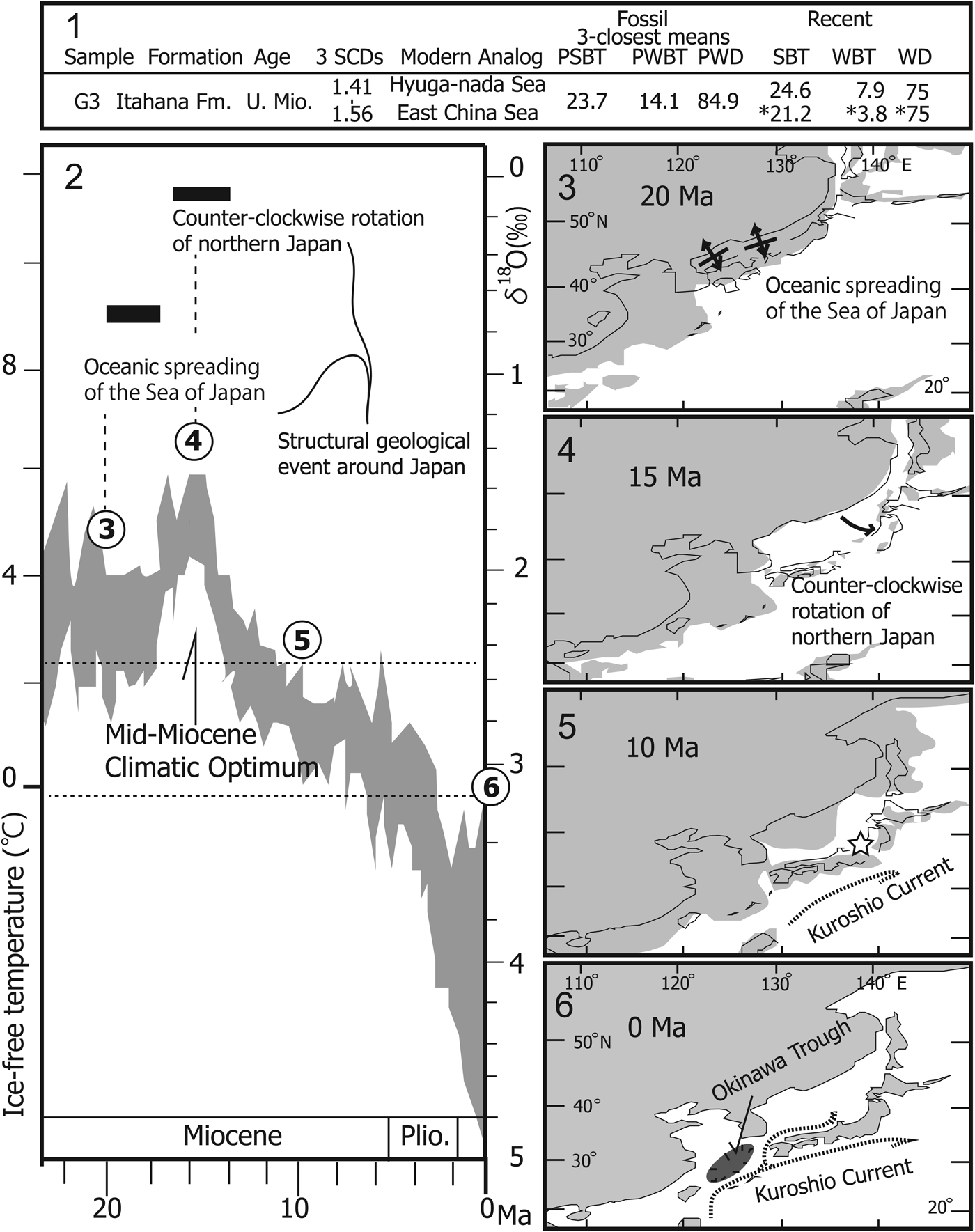
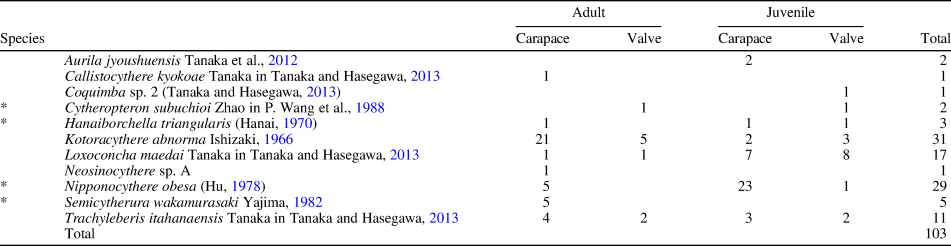
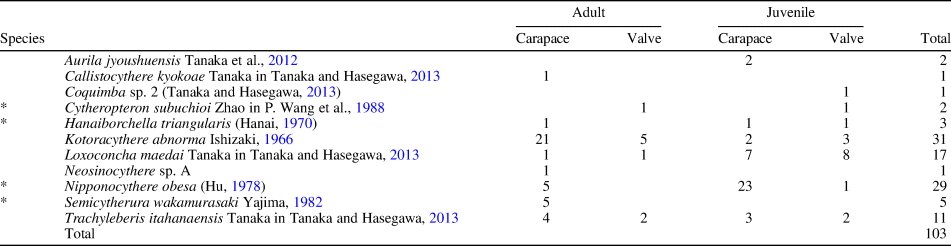
One hundred three specimens were discovered, and 11 species belonging to 11 genera were identified (Table 2). The assemblage is characterized by Kotoracythere abnorma Ishizaki, Reference Ishizaki1966, Nipponocythere obesa (Hu, Reference Hu1978), and Loxoconcha maedai Tanaka in Tanaka and Hasegawa, Reference Tanaka and Hasegawa2013. Of the 11 species discovered in the present sample, four species, Cytheropteron subuchioi Zhao in P. Wang et al., Reference Wang, Li, Tian and Lin1988, Hanaiborchella triangularis (Hanai, Reference Hanai1970), Nipponocythere obesa (Hu, Reference Hu1978), and Semicytherura wakamurasaki Yajima, Reference Yajima and Hanai1982 are extant species. Even though the SCD value is rather large (1.41), the result of the modern analog technique indicates that the G3 sample matched the Recent sample collected from the Hyuga-nada Sea at a water depth of 54 m. Ikeya and Cronin (Reference Ikeya and Cronin1993) estimated paleo-summer bottom temperature (PSBT), paleo-winter bottom temperature (PWBT), and paleo-water depth (PWD) on the basis of the mean values of the five lowest SCDs. Based on these results, we calculated the three lowest SCDs and present the values for each site in Figure 1.1. Water depth in the three sites ranged from 54 m to 100 m, with a mean of 81 m (Fig. 3.1, Table 1). The jackknife leave-one-out and bootstrapping simulations revealed that the three closest analogues were most useful for reconstructing the PWD of the G3 horizons, and the estimated value is 84.9 m. The mean value is somewhat consistent with the estimation for the habitat of the extinct species K. abnorma by Yamaguchi and Hayashi (Reference Yamaguchi and Hayashi2001), which lived in the lower sublittoral zone.
Reconstruction of paleoenvironment of the upper Miocene Itahana Formation based on modern analog technique and global paleoclimatic change and regional tectonic change around Japan after the Miocene. (1) Squared chord distance (SCD) and paleoenvironment estimates of the upper Miocene Itahana Formation. (2) Global climatic change based on stable oxygen isotopes of deep sea benthic foraminifers (Zachos et al., Reference Zachos, Dickens and Zeebe2008). (3–6) Paleogeographic reconstruction around Japan. Paleogeographical maps were downloaded from the online service of the Ocean Drilling Stratigraphic Network (http://www.odsn.de) and are also based on the findings of Jolivet et al. (Reference Jolivet, Tamaki and Fournier1994). PSBT, paleo-summer bottom temperature (°C); PWBT, paleo-winter bottom temperature (°C); PWD, paleo-water depth (m); SBT, summer bottom temperature (°C); WBT, winter bottom temperature (°C); WD, water depth; Fm., Formation, U. Mio, upper Miocene. In Figure 3.1, asterisk shows Recent data from the Pacific coast.

List of ostracodes discovered in the G3 sample of the upper Miocene Itahana Formation in Central Japan. Asterisks show the extant species used for the modern analog technique.
Paleontological signal
Brouwers (Reference Brouwers, De Deckker, Colin and Peyopuquet1988) noted that the Recent ostracode assemblage is identified as allochthonous when the ratio of the number of adult shells and that of juvenile shells in a sample is 1:3 to 1:5. Although the number of specimens recovered is low, the ratio of adults and juveniles of N. obesa is 1:5. Therefore, the most dominant species was identified as autochthonous. This is supported by the observation that the 28 specimens were articulated valves and only 1 specimen was a disarticulated valve. However, the ratio of adult shells to juvenile shells in the most abundant extinct species, K. abnorma, was 5:1. The result indicates that K. abnorma was allochthonous. To estimate the original habitat of K. abnorma, we used the relationship between water depth and the relative size of the cuticular lens (maximum diameter of eye tubercle/maximum shell length) of ostracodes (Tanaka et al., Reference Tanaka, Siveter and Parker2009, fig. 9). The value of relative size of the cuticular lens of K. abnorma was 0.07, whereas the water depth was estimated to be 120 m. Therefore, the depositional environment is potentially deeper than 120 m, although we discuss the following paleoenvironment based on the result of the MAT analysis, which was mainly calculated using the dominant autochthonous N. obesa. The result of the modern analog technique with the combination of jackknife leave-one-out and bootstrapping simulations indicates that the G3 sample was deposited below a depth of 84.9 m with a PSBT of 23.7°C and a PWBT of 14.1°C (Fig. 3.1). The estimated temperature is warmer than that of the Recent sea near the fossil location (36°–37°N): on the Pacific coast (140°–141°E, 75 m in depth), SBT is 21.2°C and WBT is 3.8°C; on the coast of the Sea of Japan (137–138°E, 75 m in depth), SBT is 24.6°C and WBT is 7.9°C (Fig. 3.1) (original data from http://jdoss1.jodc.go.jp/vpage/bts_j.html). The result indicates that the PSBTs were 0.9°C cooler/2.5°C warmer, whereas the PWBTs were 6.2°C–10.3°C warmer than today. The minimal difference between PSBT and PWBT was more similar to that in the East China Sea than that in the Hyuga-nada Sea (Table 3).
Recent sites showing three lowest SCD values, which are compared with fossil assemblage from G3 sample.

This result supports Cenozoic global climate change based on the deep sea benthic foraminiferal oxygen-isotopic curve (Fig. 3.2), which indicates that the deep sea approximately 10 Mya was 3°C warmer than the Recent deep sea (Zachos et al., Reference Zachos, Dickens and Zeebe2008), even though the reconstructed temperature tends to show larger fluctuations than that of the deep sea record. The regional temperature fractionation may be the result of regional tectonics around Japan. However, according to multiple researchers (Otofuji et al., Reference Otofuji, Kambara, Matsuda and Nohdam1994; Hoshi et al., Reference Hoshi, Iwano and Danhara2006; Baba et al., Reference Baba, Matsuda, Itaya, Wada, Hori, Yokoyama, Eto, Kamei, Zaman, Kidane and Otofuji2007; Yanai et al., Reference Yanai, Aoki and Akahori2010; Sawada et al., Reference Sawada, Mishiro, Imaoka, Yoshida, Inada, Hisai, Kondo and Hyodo2013), the major tectonic activity in Japan occurred ~20 Mya due to back-arc spreading until 15 Mya (Fig. 3.3, 3.4). From 15 Mya to ~3 Mya, the Japanese Islands were generally stable (Fig. 3.5), until formation of the Okinawa Trough (Tanaka and Nomura, Reference Tanaka and Nomura2009). The species composition of marine organisms was primarily affected by global climatic changes and the Kuroshio Current, as it is today (Fig. 3.6). Due to the existence of a land bridge between Korea and Japan 10 Mya (Fig. 3.5), the branch of the Kuroshio Warm Current did not reach the study area. Nevertheless, our results show that the paleotemperature was higher than that at the same latitude along the coast of Japan. This result supports the global climatic change hypothesis (see Zachos et al., Reference Zachos, Dickens and Zeebe2008).
Discussion
Paleogeographical significance of Neosinocythere species
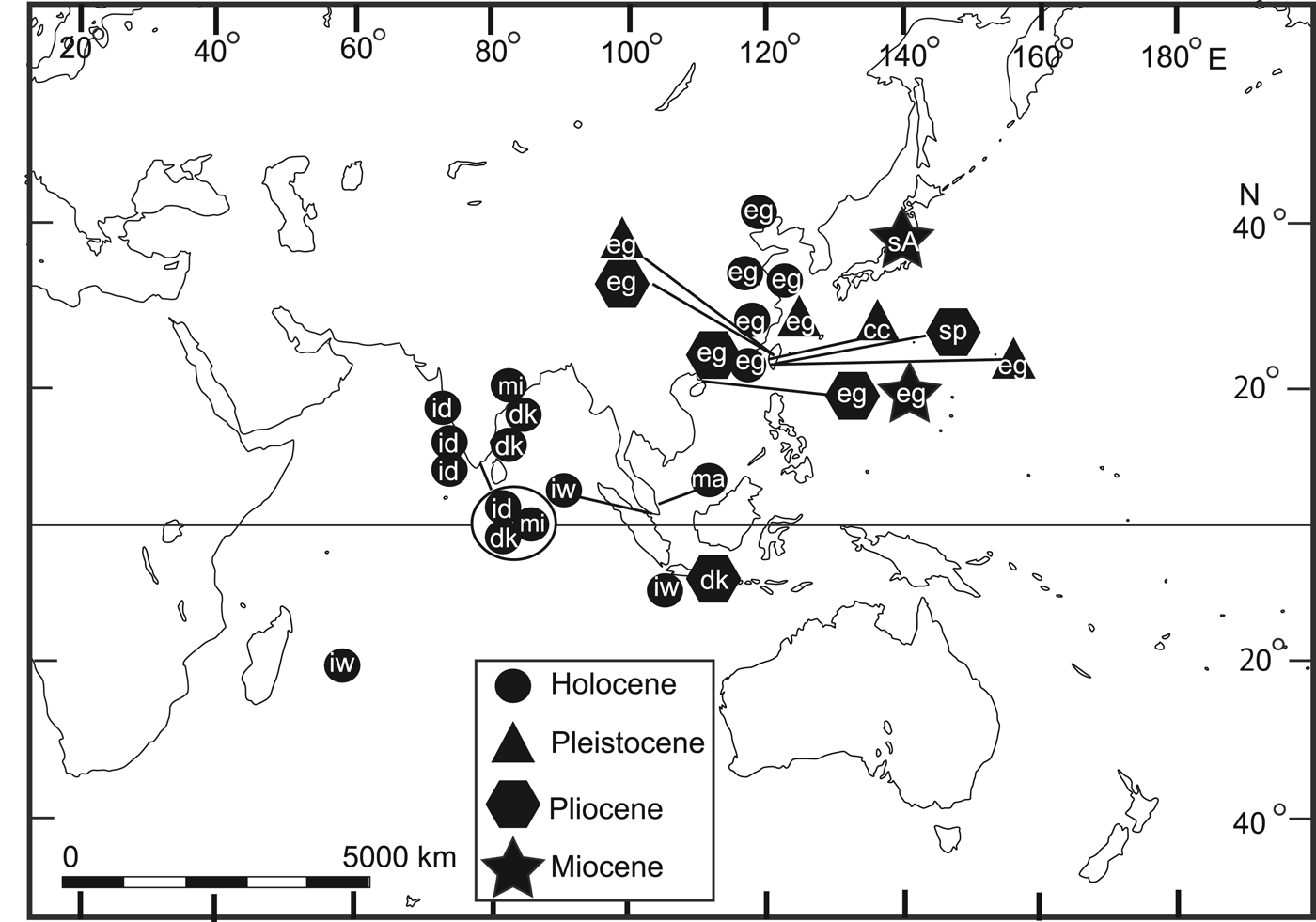
At present, nine species, including Neosinocythere sp. A, have been reported around the world, and their geographical distributions are illustrated in Figure 4. The oldest record of Neosinocythere species is Neosinocythere elongata, which is reported from the middle Miocene Jiaowei Formation in Hainan Island, South China (Guan, Reference Guan, Sun, Jiang, Li, Zhang, Yang and Feng1978; the date of the formation is from Zhou et al., Reference Zhou2013). The second oldest record is Neosinocythere sp. A reported in this study from the upper Miocene Itahana Formation in Central Japan (Fig. 4). In addition, N. elongata, N. indowestpacifica, and Neosinocythere sp. have been found in Pliocene sediments from Taiwan, Leizhou Peninsula, and Hainan Island. In addition, N. dekrooni was reported from the upper Pliocene of Java Island. The fossil records and their geographical distributions imply that Southeast Asia was the center of origin for the genus, which subsequently dispersed toward the northern and western part of the Eurasian continent. The Recent distribution of Neosinocythere exhibits higher species diversity at low latitudes (20°N and 20°S), where five species, N. macropunctata, N. indowestpacifica, N. micropunctata, N. dekrooni, and N. indica, are found; only N. elongata is currently distributed at higher latitudes (20°N and 40°N). According to Zhao and Whatley (Reference Zhao and Whatley1993), N. indowestpacifica inhabits intertidal zones and reef lagoons around the islands off Java, extant N. elongata is found in Yangtze River estuaries where salinity is less than 25‰, and N. macropunctata is found in Sedili River estuaries in Malaysia where the salinity ranges from 8‰ to 34‰ (Zhao and Whatley, Reference Zhao and Whatley1993). Therefore, Recent Neosinocythere inhabit extremely shallow seas with an influx of freshwater. Carapace preservation of the upper Miocene Neosinocythere sp. A was not good (Fig. 3), and only one specimen was discovered, indicating that it was transported from an extremely shallow habitat and buried by gravity flows. The species diversity was high at high latitudes during the upper Miocene to the upper Pliocene (Fig. 4). During the upper Miocene (Fig. 3.5) to the Pliocene (Tanaka and Nomura, Reference Tanaka and Nomura2009, fig. 7C), Japan was connected to East Asia via a land bridge and there were numerous inlets along the eastern coast of East Asia. In addition, tectonic activity was not strong during the upper Miocene to the Pliocene and global climate was warmer than today. Therefore, Neosinocythere appeared around the southeastern coast of the Eurasian continent and extended distribution to the northern coast, and then, following a decrease in global temperature, migrated southward along the east coast. Finally, the high-diversity area shifted from high latitudes to low latitudes, and genus Neosinocythere disappeared from Japan.
Geographical distribution of Neosinocythere. Abbreviations are as follows: cc, chungchengi; dk, dekrooni; eg, elongata; id, indica; iw, indowestpacifica; ma, macropunctata; mi, micropunctata; sp, sp.; sA, sp. A.

Length versus height in Neosinocythere species
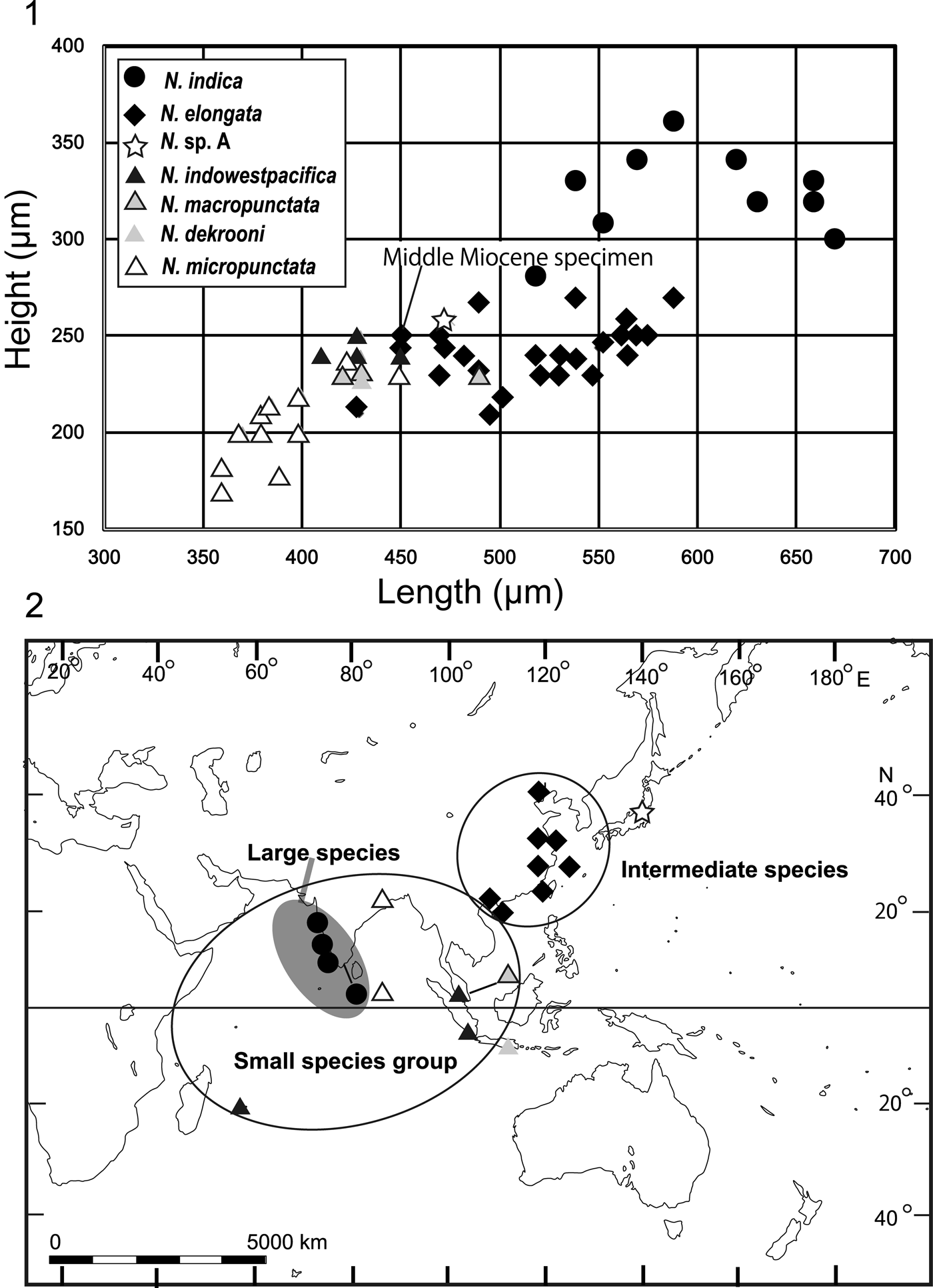
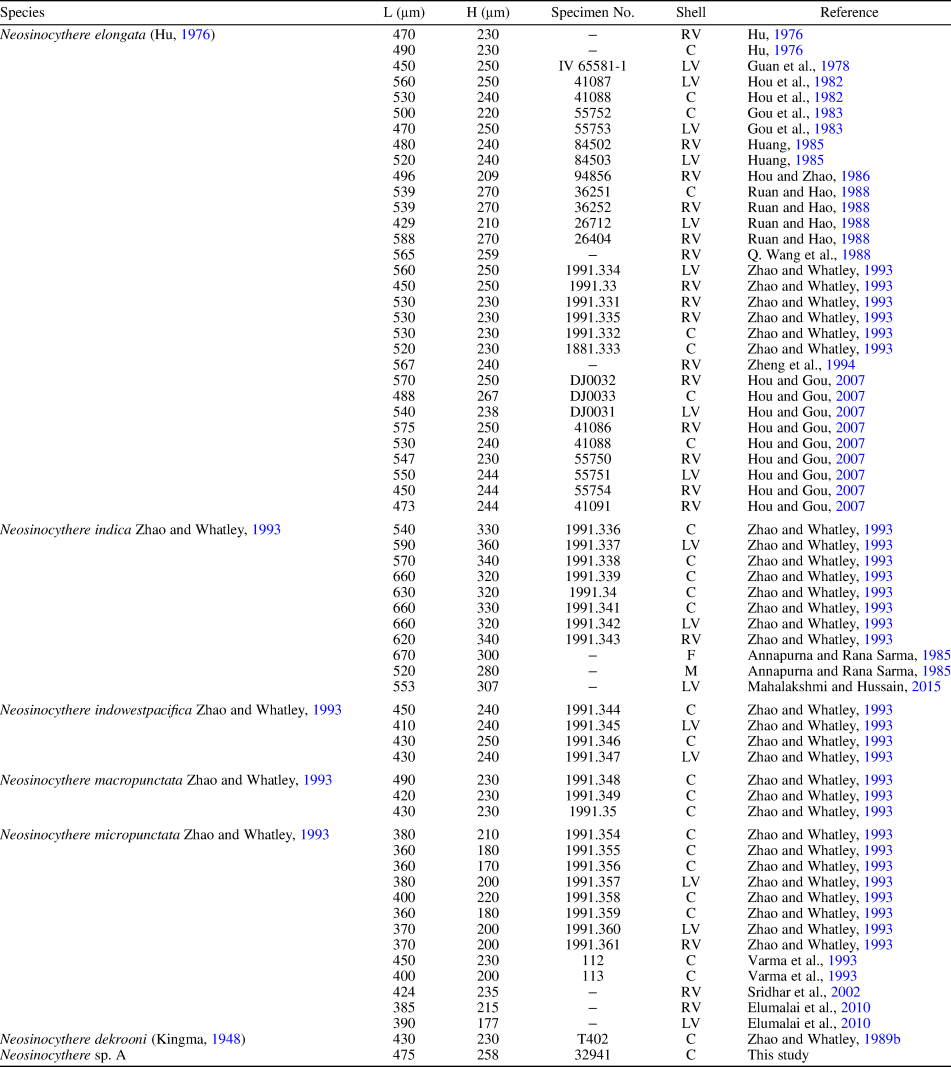
We plotted length and height of seven Neosinocythere species based on reference data (Fig. 5.1, Table 4). We excluded N. chungchengi and N. sp. in the analysis because there was no associated information about size and magnification in literature. Figure 5.1 shows the similarity in length and height in four Neosinocythere species (N. indowestpacifica, N. macropunctata, N. dekrooni, and N. micropunctata) from low latitude areas (Fig. 5.2). The Neosinocythere elongata specimens are largely plotted on the intermediate area of length and height (Fig. 5.1). Neosinocythere elongata is distributed in the middle latitude area along the eastern coast of China (Fig. 5.2). The length and height of Neosinocythere elongata reported from the middle Miocene, which is the oldest record of Neosinocythere, were somewhat low values (Fig. 5.1), denoting that larger or smaller N. elongata populations descended from this small ancestor. The length and height plot of Neosinocythere sp. A closely situates at the middle Miocene specimen of N. elongata, and the carapace morphology of Neosinocythere sp. A is similar with that of N. elongata. Therefore, Neosinocythere sp. A probably speciated from the northern population of N. elongata, which extended its distribution in the northern coast of the Eurasian continent. The population of N. elongata with larger shells is currently more distributed in higher latitude areas than the middle Miocene specimen. When we plot the geographical distribution of small species groups (N. indowestpacifica, N. macropunctata, N. dekrooni, and N. micropunctata) and intermediate species (Neosinocythere elongata), the small species tend to be distributed in low latitudes, and intermediate species exhibit middle latitudinal distribution along the east margin of the Eurasian continent (Fig. 5). However, the population of N. indica, which is distributed in low latitudes along the Indian coast (Fig. 5.2), tends to be plotted on the large length and height area (Fig. 5.1). Morphologically, N. indica is highly similar with N. indowestpacifica, although both have no fossil record. If we assume that the ancestor of Neosinocythere was the middle Miocene specimen of N. elongata based on the fossil record, N. indica evolved from a common ancestor of N. elongata and N. indica, based on having a larger shell. Although phylogenetic analyses are required to resolve the problem, the present study suggests that the length versus height data and paleobiogeographical distribution of each species are powerful tools for estimating migration and speciation of each of the species in the genus (see Cronin and Schmidt, Reference Cronin, Schmidt, Hanai, Ikeya and Ishizaki1988).
Plot of length versus height for six species of Neosinocythere and their geographical distributions. (1) Length versus height of six species; original data are cited from references (see Table 4). (2) Geographical distribution of six species plotted in Figure 5.1. Except for Neomonoceratina sp. A from the upper Miocene Itahana Formation (open star), three species (group) are recognized on the basis of their shell size and geographical distributions: small species group (N. indowestpacifica, N. macropunctata, N. dekrooni, and N. micropunctata); intermediate species (N. elongata); and large species (N. indica).

Length and height data for six Neosinocythere species. Abbrebiation: L, length; H, height; RV, right valve; LV, left valve; C, carapace; F, female; M, male. ‘-’ shows no data.

Conclusions
We analyzed gravity flow deposits from the upper Miocene Itahana Formation in Central Japan and observed the following: (1) we discovered and described a Neosinocythere specimen from Japan; (2) the depositional environment was 84.9 m in depth, and its bottom temperature was similar to that of the Recent East China Sea; and (3) Neosinocythere appeared around the southeastern coast of the Eurasian continent, extended distribution in the northern coast, and then, following a decrease in global temperature, migrated southward along the east coast.
Acknowledgments
We thank D. Horne (Queen Mary, University of London, UK), an anonymous reviewer, B. Hunda (Editor-in-Chief, Journal of Paleontology), and T. Cronin (Associate Editor, Journal of Paleontology) for their constructive reviews. I (G.T.) thank G. Simpson (University of Regina, USA) for his helpful advice about using “analogue.” This study was partly supported by a Grant-in-Aid for Science Research from the Ministry of Education of Science of the Government of Japan (No. 16K05592 to G.T and No. 15K01166-01 to H.M.). The authors would like to thank Enago (www.enago.jp) for the English language review.