Introduction
Hearing impairment is most prevalent in the older adult population and is associated with social, economic and physical functioning. There is growing evidence indicating that hearing impairment in older individuals affects cognitive function and increases the risk of dementia.Reference Fulton, Lister, Bush, Edwards and Andel1,Reference Thomson, Auduong, Miller and Gurgel2 Despite numerous research efforts, a consensus regarding the relationship between hearing loss and cognitive impairment has not been reached. However, we speculate that overdiagnosis may potentially explain the relationship observed between the two in older adults. The adequacy of cognitive test methods for individuals with hearing loss is debatable. Most cognitive tests are delivered auditorily. Individuals with hearing loss may fail to hear the spoken instruction, regardless of their cognitive function. Moreover, more listening effort and fatigue in acoustic conditions may impact cognitive test performance.Reference Völter, Götze, Dazert, Wirth and Thomas3 Therefore, the relationship between the severity of hearing loss and modalities of cognitive testing in older individuals with hearing loss should be clarified.
The Mini-Mental State Examination and Montreal Cognitive Assessment scores are the most popular measures for cognitive impairment screening and following the progress of cognitive changes. Dupuis et al. conducted a modified Montreal Cognitive Assessment test in 2015 by removing test items that relied heavily on hearing.Reference Dupuis, Pichora-Fuller, Chasteen, Marchuk, Singh and Smith4 They suggested that cognitive abilities may be underestimated in individuals with hearing loss if auditory problems are not considered. Moreover, Jorgensen et al. complemented the Mini-Mental State Examination test with five different auditory conditions in young adults with normal cognition and hearing, and they found that decreased auditory conditions resulted in worse scores than under normal auditory conditions.Reference Jorgensen, Palmer, Pratt, Erickson and Moncrieff5
However, other studies that investigated the altered modalities of cognitive tests have not found a potential effect of auditory components on cognitive screening test scores.Reference Saunders, Odgear, Cosgrove and Frederick6–Reference De Silva, Mclaughlin, Rodrigues, Broadbent, Gray and Hammond-Tooke8 In 2018, Saunders et al. tested older listeners with hearing loss (average pure tone average (PTA): 38.7–44.4 dB HL), and all individuals were tested once with hearing aids or pocket talkers and once unaided. However, amplification did not improve test performance relative to unaided testing.Reference Saunders, Odgear, Cosgrove and Frederick6 Lin et al. administered the hearing-impaired Montreal Cognitive Assessment to normal hearing and severely hearing-impaired older adults.Reference Lin, Chung, Callahan, Smith, Gritters and Chen7 Their main purpose was to validate the hearing-impaired Montreal Cognitive Assessment test, and they selected a group of cognitively intact individuals. Individuals with severe hearing loss exhibited no significant difference in the test modality (Montreal Cognitive Assessment, 26.18 points; hearing-impaired Montreal Cognitive Assessment, 26.49 points). Similarly, De Silva et al. compared scores for a standard and a written version of the Mini-Mental State Examination in individuals with mild hearing loss diagnosed by a whispered voice test, and there was no significant difference between the test versions.Reference De Silva, Mclaughlin, Rodrigues, Broadbent, Gray and Hammond-Tooke8
Because of conflicting results, it remains debatable whether it is appropriate to accept the results of standard cognitive tests in hearing-impaired individuals and what hearing level is acceptable when performing the standard version of cognitive tests. The main limitation of previous studies assessing the effect of audibility on the performance scores in cognitive tests was that they did not use objective audiometric tests to diagnose ‘hearing loss’, nor did they provide accurate audiometric thresholds. Additionally, the included individuals with hearing loss had varying hearing levels, which might have contributed to the conflicting results.
Individuals with hearing loss exhibit various clinical manifestations depending on the degree of hearing loss. For instance, most people with mild hearing loss (less than 40 dB) can hear people talking at a normal volume and understand even soft sounds in quiet places. Individuals with severe hearing loss (more than 70 dB) hear only some very loud sounds even in quiet places and tend to rely on reading lips, even when using hearing aids. Cognitive tests are conducted as a one-on-one conversation in a physician's office or testing room that is quiet. Therefore, individuals with mild hearing loss may not experience difficulty in performing auditory-delivered cognitive tests; their performance is similar to that of individuals with normal hearing, but those with at least moderate hearing loss might not be able to hear verbal instructions.
This study aimed to classify hearing-impaired older individuals by the degree of hearing loss and to investigate whether the different modalities of the test (i.e. visual or auditory) influence test performance in older adults based on their hearing levels.
Materials and methods
Before designing the study, we investigated the overall performance ability of a standard Mini-Mental State Examination test in older hearing-impaired individuals. In the preliminary test (n = 156), individuals with severe hearing loss (more than 70 dB) were likely to fail the test without hearing aids because they abandoned or were unable to even start the test. Older adults with severe hearing loss (more than 70 dB) were ineligible for evaluation by the standard version of Mini-Mental State Examination. Therefore, we performed a prospective assessment of older adults aged more than 60 years with a hearing loss of 21–70 dB. We excluded people with visual impairment or poor literacy, which would have limited their test performance and those without other major impairments (e.g. intellectual or physical impairments).
This study was approved by our hospital's institutional review board (approval number: 2021-05-005-001). The participants were recruited from the ENT clinic. They were given sufficient time to decide on whether to participate and had to provide written informed consent.
In a soundproofing booth, the audiometric PTA was measured at frequencies of 0.5, 1, 2, 3, 4 and 8 kHz in both ears using standard headphones. The hearing thresholds used to establish hearing-loss severity were based on the four-frequency PTA for the better ear (average of 0.5, 1, 2 and 4 kHz). The hearing thresholds were considered to be within the normal range if they were equal to or more than 20 dB HL. The audiometric test was performed on the day that the first Mini-Mental State Examination was performed. In general, people with mild hearing loss (21–40 dB) are able to (clinically) follow and understand one-to-one conversations in a quiet environment where cognitive tests are usually performed. We divided the older adults into mild (21–40 dB) and moderate to moderately severe (41–70 dB) hearing loss groups.
The Mini-Mental State Examination consists of questions that assess five areas of cognitive function, namely orientation, immediate memory, attention, delayed recall and language. The maximum score for the Mini-Mental State Examination is 30 points; scores equal to or more than 26 points, equal to or less than 25 points, and less than 9 points are considered normal, abnormal and indicative of severe impairment, respectively.
Participants were randomised to receive either the standard Mini-Mental State Examination or written Mini-Mental State Examination during the first visit. Approximately 2–3 months later, the participants were retested with either the standard Mini-Mental State Examination or written Mini-Mental State Examination, which they did not receive during their first visit. We also used alternative forms of the Mini-Mental State Examination-2 (i.e. the blue form for a written version and the red form for an auditory version) to minimise any potential learning effects from repeating the Mini-Mental State Examination. The participants were not required to undergo secondary tests, which were only administered when they were scheduled for follow-up appointments. We compared the paired differences in scores according to the test modalities by the hearing loss group. For each group, the individual's cognition was subdivided based on their standard Mini-Mental State Examination score (equal to or more than 26 points as a normal cognition score), and the paired score difference by the test modalities was further analysed.
In order to administer the visual instruction to participants, we converted the verbal instructions from the Mini-Mental State Examination (second edition) guidelines into written instructions on PowerPoint® presentations. For example, the visual instructions showed written phrases, such as ‘What year is this?’, ‘What country are we in?’ or ‘Please begin with 100 and count backwards by 7’. In the memory and delayed recall tests, words on flashcards were presented 1 per sheet for 1 second each. The participants were instructed to read the written instructions to let the examiner know their progress. We adjusted the verbal instructions to reflect the written instructions and followed the test items and materials of the standard version. Previous research using written versions of the cognitive test has demonstrated the same performance as those of verbal versions.Reference Lin, Chung, Callahan, Smith, Gritters and Chen7–Reference Uhlmann, Larson, Rees, Koepsell and Duckert9 We also measured the time duration for each test, and participants were instructed to answer questions regarding which version of Mini-Mental State Examination was convenient and their preference for the test method.
Data are presented as means and standard deviations. A paired t-test was used to compare the mean scores of differences between test modalities within each group. Multivariate regression analysis was adjusted for age and education duration to compare the test duration between groups. Statistical analysis was performed with SPSS® (version 23) for most analyses.
Results
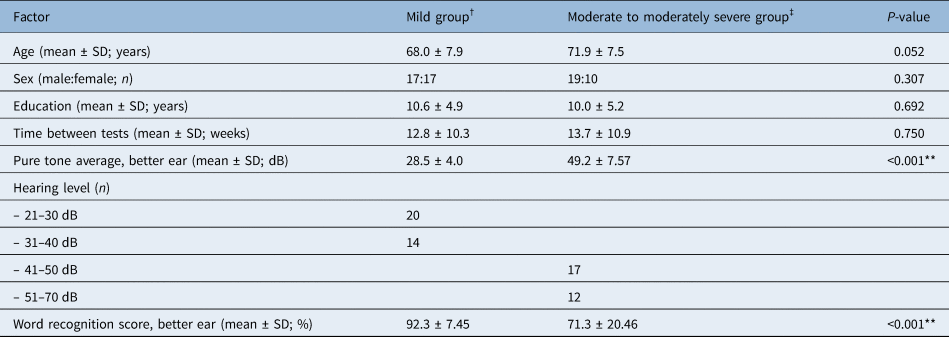
Of 74 prospectively followed-up patients, 63 with mild to moderately severe hearing loss (21–70 dB) completed both the verbal and visual Mini-Mental State Examination and were included in this study; the remaining 11 did not adequately complete both tests or were lost to follow up. Thirty-seven participants underwent the verbal Mini-Mental State Examination first, followed by the visual Mini-Mental State Examination approximately 1–2 months later, and 26 underwent the visual Mini-Mental State Examination first, followed by the verbal Mini-Mental State Examination approximately 1–2 months later. There were no significant differences between the mild and moderate to moderately severe groups regarding sex, years of education and the number of weeks between the tests (Table 1). The participants in the mild and moderate to moderately severe groups had a mean age of 68.0 and 71.9 years, respectively (p = 0.052), with average PTA thresholds of 28.5 and 49.2 dB, respectively, in the better ear (p < 0.001).
Demographic data and clinical features of the participants*

*n = 63; †n = 34; ‡n = 29; **statistically significant value. SD = standard deviation
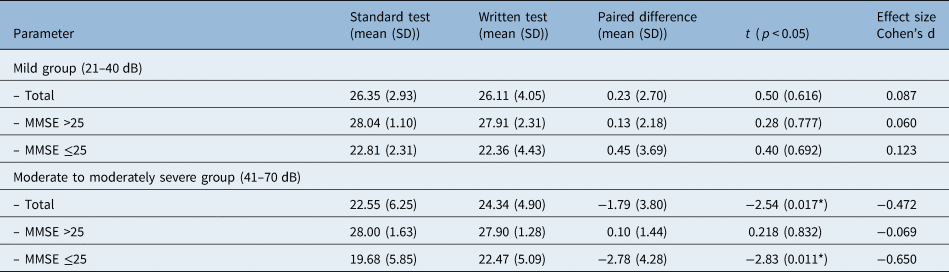
In the mild group, the average standard Mini-Mental State Examination score was 26.35 points. The written Mini-Mental State Examination score for this group was 26.11 points. Twenty-three participants with normal standard Mini-Mental State Examination scores in the mild group had similar scores in both written and standard tests (28.04 points in standard Mini-Mental State Examination vs 27.91 points in written Mini-Mental State Examination; p = 0.777). Moreover, 11 participants with abnormal standard Mini-Mental State Examination scores in the mild group had no significant difference between the two modalities of tests (22.81 points in standard Mini-Mental State Examination vs 22.36 points in written test; p = 0.692) (Table 2).
Comparison of the standard and written Mini-Mental State Examination in the mild and moderate to moderately severe groups

*p < 0.05. SD = standard deviation; MMSE = Mini-Mental State Examination, second edition
There were 29 participants in the moderate to moderately severe group, wherein the average standard Mini-Mental State Examination score was 22.55 points and that of the written Mini-Mental State Examination was 24.34 points. The 1.79-point difference between the standard and written Mini-Mental State Examination scores was statistically significant (p = 0.017). There were 10 participants with normal standard Mini-Mental State Examination scores in the moderate to moderately severe group, and they scored 28.00 points on the standard test and 27.90 points in the written test (p = 0.832). In 19 participants with abnormal standard Mini-Mental State Examination scores in the moderate to moderately severe group, their average Mini-Mental State Examination scores for the standard and written versions were 19.68 and 22.47, respectively. The 2.78-point difference between both test versions was statistically significant (p = 0.011).
Figure 1 presents the percentages of the difference in two paired test scores by group. In the mild group, 17.4 per cent of participants with normal standard Mini-Mental State Examination (more than 25) and 27.3 per cent of the participants with abnormal Mini-Mental State Examination (equal to or less than 25) had higher written Mini-Mental State Examination scores by more than 2 points compared with the standard Mini-Mental State Examination test. In the moderate to moderately severe group, 63.2 per cent of participants with abnormal standard Mini-Mental State Examination (equal to or less than 25) showed scores more than 2 points higher for written test scores. We also compared the subtest scores between the test modalities in the moderate to moderately severe group (Table 3). They achieved higher scores in all subtests of the written Mini-Mental State Examination test. In particular, attention showed a significant difference between the written and standard Mini-Mental State Examination (3.10 vs 3.68; p = 0.004). The subtest scores and p-values are listed in Table 3.
Differences between the standard and written Mini-Mental State Examination scores in each group (mild group vs moderate to moderately severe group). In each column, white, grey and black sections indicate the proportions of individuals with a difference of more than 2 points, between −1 and 1 point, and −2 points or less, respectively, between the standard and written Mini-Mental State Examination scores. MMSE = Mini-Mental State Examination; Mod-Sev = moderate to moderately severe

Standard and written Mini-Mental State Examination subtest scores

Mini-Mental State Examination, second edition. Significant results are boldfaced.
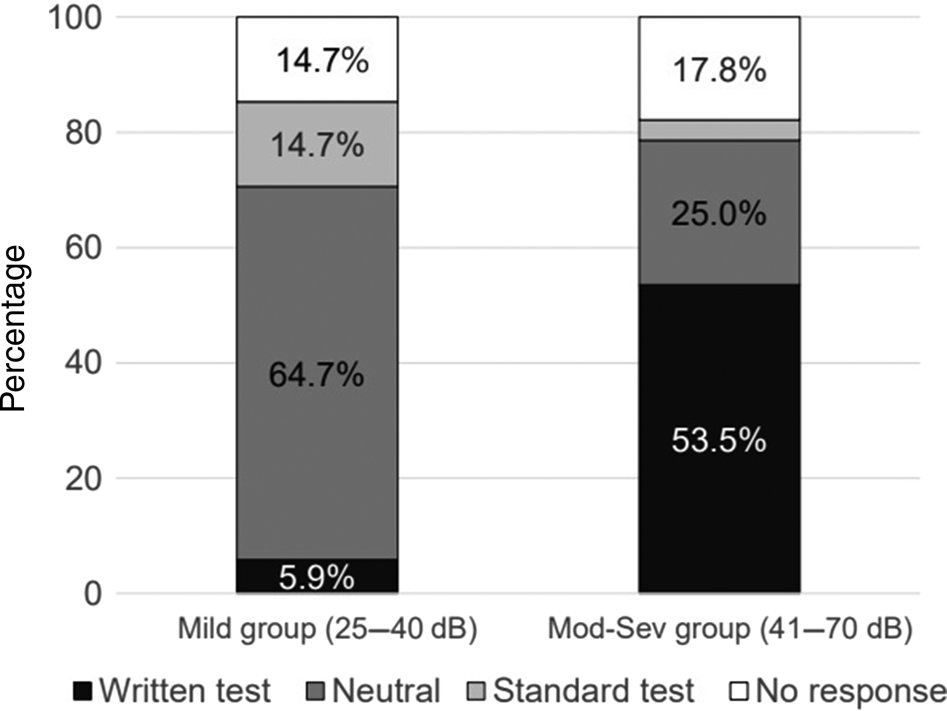
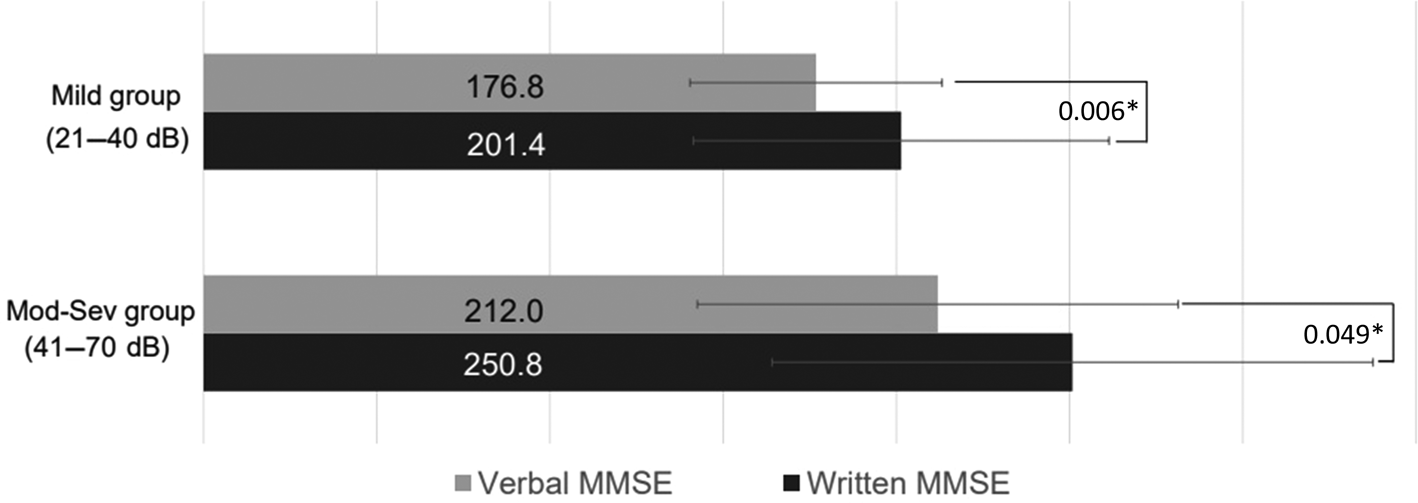
In participants with mild hearing loss, most (64.7 per cent) reported no preference between the test modalities (Figure 2). Some participants (14.7 per cent) with mild hearing loss preferred the standard Mini-Mental State Examination and reported that visual instructions were more complex and difficult than audible instructions. Of the participants with moderate to moderately severe hearing loss, 53.5 per cent preferred the written Mini-Mental State Examination. We expected that the written version would reduce the test duration in hearing-impaired people because they would struggle to catch up with the instructions and would constantly ask examiners to repeat their questions (Figure 3). However, the written version of the Mini-Mental State Examination required longer test durations than the standard version of the Mini-Mental State Examination in both groups. The moderate to moderately severe group required significantly longer testing times than the mild group on both the written and standard Mini-Mental State Examination tests.
Test modality preferences according to the hearing loss group. In each column, black sections indicate a preference for a written version of the Mini-Mental State Examination, dark grey sections indicate a neutral preference regarding test modality and light grey sections indicate a preference for the standard Mini-Mental State Examination. MMSE = Mini-Mental State Examination; Mod-Sev = moderate to moderately severe

Test duration of the two groups (mild group vs moderate to moderately severe group) for each test modality. MMSE = Mini-Mental State Examination; Mod-sev = moderate to moderately severe. *p < 0.05.

Discussion
Despite increasing research describing the close association between hearing impairment and cognition, it remains debateable whether the relationship is partly attributable to the modality of cognitive testing based on oral instructions. Recent cognitive tests rely on auditory function, which may cause false positive results. The most frequently used screening tests, the Mini-Mental State Examination and Montreal Cognitive Assessment, are administered verbally, requiring recipients to respond to auditory instructions. Therefore, hearing deficits can compromise the understanding of verbal instructions or items and negatively impact the evaluated cognitive scores. Moreover, reduced hearing ability can increase the listening effort required and the subjective fatigue experienced, leading to impaired concentration and a reduced willingness to continue testing.
Researchers have attempted to demonstrate the lack of adequacy of cognitive testing tools for individuals with hearing loss by using various cognitive screening tests and experimental settings. Uhlmann et al. compared the scores of adults with Alzheimer's disease with normal hearing and those with mild hearing loss (average PTA, 34.2 dB) using the written and standard Mini-Mental State Examination.Reference Uhlmann, Larson, Rees, Koepsell and Duckert9 Although no statistically significant difference was observed between the normal hearing and hearing loss groups, two independent groups of cases were compared to evaluate the written and standard tests, and multiple variables between the groups were not fully validated. De Silva et al. also tested older adults with hearing loss using a written and original version of the Mini-Mental State Examination, but this study also did not formally assess hearing.Reference De Silva, Mclaughlin, Rodrigues, Broadbent, Gray and Hammond-Tooke8 The participants with hearing loss were selected by a whispered voice test with an approximately 30 dB positivity threshold by audiometry.
In 2017, Lin et al. developed a visual version of the Montreal Cognitive Assessment using computer-based testing tools and evaluated the validity in participants with severe hearing loss and normal cognition, who were recruited from the cochlear implant programme.Reference Lin, Chung, Callahan, Smith, Gritters and Chen7 Similar to the Mini-Mental State Examination, the Montreal Cognitive Assessment is used to assess several areas. It comprises 30 items (such as the clock-drawing and trail tests) that allow for a more in-depth examination of executive functioning. A limitation of the study by Lin et al. is that the audiometric thresholds of the participants were not documented. Moreover, based on our preliminary study, it is questionable whether participants with severe hearing loss (more than 70 dB, enrolled in the cochlear implant programme) could complete the standard Mini-Mental State Examination without hearing devices. A major difference between the study by Lin et al. and our study is that Lin et al. included individuals with hearing impairment but normal cognition, whereas we included individuals with hearing impairment and various cognitive issues. Despite this, their findings in individuals with hearing impairment with normal cognition were consistent with our results.
Augmentation with a hearing device did not change the cognitive performance of the hearing-impaired participants in the study by Saunders et al.Reference Saunders, Odgear, Cosgrove and Frederick6 They used both hearing aids and pocket talkers. The study was limited as it did not assess the adequacy of fitting, validation and adaptation in aided conditions. Unadapted hearing aids or pocket talkers can be detrimental to speech understanding.
Beyond the study design or experimental setting, the results of some studies tended to conform with our findings. As aforementioned, the participants tested by Uhlmann et al. and De Silva et al. had mild hearing loss, and those with mild hearing loss (less than 40 dB) were not affected by the test modalities as in our study.Reference De Silva, Mclaughlin, Rodrigues, Broadbent, Gray and Hammond-Tooke8,Reference Uhlmann, Larson, Rees, Koepsell and Duckert9
Limited studies have assessed the impact of different degrees of hearing loss on cognitive testing performance. In line with our results, Jupiter et al. tested 101 patients with Alzheimer's disease and reported that those with hearing thresholds more than 40 dB could perform the standard Mini-Mental State Examination similarly to individuals with normal hearing.Reference Jupiter10 Jorgensen et al. conducted a laboratory experiment to investigate cognitive performance after simulating five different hearing-loss conditions in young adults with normal hearing and normal cognition.Reference Jorgensen, Palmer, Pratt, Erickson and Moncrieff5 Consistent with the findings of our ‘real-world’ experiments, they found that 16 per cent of their participants with at least moderate hearing loss were misdiagnosed with cognitive impairment, whereas mild hearing loss did not affect cognitive performance. They reported that speech recognition of at least 40 per cent was required to facilitate understanding verbal instructions. Therefore, cognitive testing may be hampered specifically in patients with at least moderate hearing loss.
In the present study, the moderate to moderately severe group with abnormal cognition (as identified by the standard Mini-Mental State Examination) performed significantly better on the written Mini-Mental State Examination. In this group, 63.2 per cent of participants had written Mini-Mental State Examination scores of more than 2 points higher than their scores on the standard Mini-Mental State Examination. However, the participants in the moderate to moderately severe group with normal cognition on the standard Mini-Mental State Examination exhibited no significant difference in terms of the two test modalities.
Based on this finding, we considered that a greater severity in hearing loss and greater cognitive impairment increased the likelihood that participants would be affected by the test modalities. Some individuals with good cognitive function, even with poor hearing, are likely to perform well on general cognitive testing. Deaf individuals, who possess superior cognitive compensation and intellectual abilities, can perform auditory tasks by utilising non-verbal communication techniques, such as lip movements and facial expressions.Reference Hallam and Corney11 They can also obtain communication cues from the given test tools. Furthermore, they are more likely to try to make an effort to understand the examiner's questions by occasionally asking them to speak louder or repeat themselves.
Individuals with hearing loss who fail to develop non-verbal communication skills may face more difficulties because of their hearing loss when concentrating on cognitive tests with auditory instructions. The lack of compensation for hearing loss and reduced non-verbal communication skills are probably more pronounced in individuals with cognitive decline, and this may naturally be reflected in their cognitive scores as well. However, it is important to note that hearing loss is a factor that can be modified by assistive listening devices, such as hearing aids or cochlear implants. Previous studies have showed positive effects of hearing-aid usage on cognition in older adults.Reference Maharani, Dawes, Nazroo, Tampubolon and Pendleton12,Reference Mahmoudi, Basu, Langa, McKee, Zazove and Alexander13 A recent study also showed significant cognitive improvements in executive function, memory and attention after hearing-aid use.Reference Sarant, Harris, Busby, Maruff, Schembri and Launer14 In order to explore the effect of hearing devices on cognitive function, a more sophisticated experimental design should be used to avoid confounding factors that overestimate cognitive decline in people with hearing loss when using traditional cognitive screening tests.
The present study suggested that a misdiagnosis might occur if an individual with greater than moderate hearing loss undergoes the standard Mini-Mental State Examination. The study findings also indicated that the degree of cognitive impairment may be overestimated when an individual with greater than moderate hearing loss also has cognitive impairment. Moreover, the suitability of a general cognitive screening test for individuals with severe hearing loss (more than 70 dB) requires consideration. Therefore, new cognitive testing tools should be developed to clarify the link between hearing loss and cognitive decline in older adults; these tools must be different from the traditional cognitive tests that heavily rely on hearing.
In our study, all subscale scores on the written Mini-Mental State Examination were higher than the corresponding scores on the standard Mini-Mental State Examination in participants with low cognitive function in the moderate to moderately severe group; the scores for attention increased significantly. In the Mini-Mental State Examination, the ‘attention’ item requires the participant to serially subtract 7 from 100. This item represents an important percentage of the Mini-Mental State Examination score (5 out of 30 points); thus, it may significantly impact the total score. The exact meaning of ‘attention’ is the act of listening to, looking at, or thinking about something or somebody carefully. It is believed that the decreased attention of individuals with hearing loss is derived from the burden of listening effort and fatigue in a testing environment with reduced audibility. The listening effort refers to the process of hearing with intention and attention beyond that required for fundamental hearing function. Thus, decreased audibility requires more attention-based and cognitive neural resources (i.e. listening effort, for understanding speech sound in adverse listening conditions). Furthermore, individuals with hearing loss feel embarrassed and intimidated when they mishear a question or answer inappropriately. Because the test continues in an environment of reduced audibility, a loss of confidence in listening impairs the individual's attention and causes them easily to give up on testing.
• Hearing evaluations should be included in cognitive assessment
• Test performance should be carefully interpreted in individuals with hearing loss to avoid overestimating cognitive decline
• When cognitive decline is determined using general cognitive screening test scores, the degree of cognitive impairment in individuals with at least moderate hearing loss may be overestimated
• As hearing loss is prevalent with advancing age, development of new methods for cognitive assessment in older adults with hearing loss should be emphasised
This study provides evidence for the effect of different degrees of hearing loss on cognitive test scores. Individuals with mild hearing loss (less than 40 dB) can perform general auditorily presented cognitive screening tests. Those with moderate to moderately severe hearing loss (41–70 dB) may be partially underestimated by test modalities comprising only auditory presentation. Individuals with severe hearing loss (more than 70 dB) may require forms of cognitive testing tools containing components other than auditory ones. Our data suggest that the performance in cognitive screening tests is influenced by the degree of audibility and indicates the need for accurate hearing evaluation before cognitive screening tests in older adults.
Conclusion
When cognitive decline is determined using general cognitive screening test scores, the degree of cognitive impairment may be overestimated in individuals with at least moderate hearing loss (more than 40 dB). Audiometric evaluation should be considered essential in cognitive assessment, and care should be taken when interpreting cognitive screening test scores without considering the participant's hearing level. Hearing loss becomes more prevalent with advancing age, and new methods should be established for cognitive assessment in older adults with hearing loss.
Acknowledgements
The authors would like to thank the participants for their time and contribution.
Competing interests
None declared