


Introduction
Modern cognitive therapy represents a broad therapeutic approach that aims to address the maladaptive cognitions associated with psychopathology (Hofmann et al., Reference Hofmann, Asmundson and Beck2013). Following innumerable evaluations, cognitive therapy has developed an impressive evidence base and is now recognized as an effective treatment for various disorders (Hofmann et al., Reference Hofmann, Asnaani, Vonk, Sawyer and Fang2012). That is not to say cognitive therapy is without limitations: research indicates that a substantial proportion of individuals do not complete or respond to this approach (Westen and Morrison, Reference Westen and Morrison2001). Concurrently, the variety of cognitive therapies has increased exponentially in recent years, establishing a heterogenous, multi-modal intervention science (Mennin et al., Reference Mennin, Ellard, Fresco and Gross2013). This evolution, coupled with the need to improve outcomes, places cognitive therapy at a crossroads: while what is known to work should be preserved, horizons must also be broadened to discover (and re-discover) effective ways of working.
Rethinking reappraisal: the limits of disputation
Cognitive reappraisal is a hallmark of the cognitive approach (Beck, Reference Beck1976) and represents one of its most popular methods of intervention (Parker and Waller, Reference Parker and Waller2019). Cognitive therapists utilize a variety of reappraisal strategies to modify the different levels of meaning associated with emotional distress (e.g. automatic thoughts, dysfunctional assumptions, and negative core beliefs) (Beck, Reference Beck1976; Beck, Reference Beck1995), a process which usually takes place in several stages involving the identification, evaluation and modification of maladaptive cognitions (Wenzel, Reference Wenzel, Hayes and Hofmann2018). While demonstrably effective (e.g. Shurick et al., Reference Shurick, Hamilton, Harris, Roy, Gross and Phelps2012), it is not uncommon for disputational techniques to produce changes at an intellectual level but not at a deeper, emotional level, resulting in only limited or short-lasting reductions in distress (Beck, Reference Beck1976). Various factors are believed to contribute to this ‘head-heart lag’ including the presence of implicit, resistant or situationally specific schematic beliefs and the operation of parallel information processing streams that are more or less effected by analytic modes of thinking (Stott, Reference Stott2007). More concerningly, analytic reappraisal procedures have the capacity to deactivate affect-laden schematic beliefs and inhibit emotional processing, thus obstructing cognitive modification (Salas-Auvert and Felgoise, Reference Salas-Auvert and Felgoise2003; Teasdale, Reference Teasdale1999). Early research has supported this hypothesis, demonstrating that cognitive restructuring in an emotional vacuum is not only ineffective, but may be counter-therapeutic (Hunt et al., Reference Hunt, Schloss, Moonat, Poulos and Wieland2007).
Show, don’t tell: aboutism and its discontents
Concerns about the ineffectiveness of a principally analytic approach to psychotherapy are not new. Fredrik (‘Fritz’) Perls, the founder of gestalt therapy, was one of the first clinicians to rally against this trend. ‘We [the therapist and patient] talk about it and talk about it’, he writes, ‘and nothing is accomplished’ (Perls, Reference Perls1969; p. 36). To avoid the pitfalls of this ‘aboutist’ approach to therapy (that is, talking about one’s problems without resolution), Perls sought to translate clients’ thoughts and feelings into present-moment actions: ‘We ask our patients not to talk about their traumas and their problems in the removed area of the past tense and memory, but to re-experience their problems and their traumas … in the here and now’ (Perls, Reference Perls1973; p. 63). Whilst many evocative methods were employed by Perls to achieve this aim (e.g. guided imagery), the gestalt approach is best known for its use of action-based, role-playing procedures – collectively known as ‘chairwork’ – which seek to bring ‘the individual’s action system right into the room’ (Polster and Polster, Reference Polster and Polster1973; p. 234). Gestalt therapy has since distanced itself from enactive ‘experimentation’ and adopted a greater interpersonal focus, although this appears to be changing (Kellogg, Reference Kellogg2015). Rarely acknowledged, Perls’ experiential methods have also informed the development of Ellis’s rational emotive behaviour therapy (REBT; Ellis, Reference Ellis2004) and Beck’s cognitive therapy (Beck, Reference Beck1991).
Aboutism and cognitive therapy
Cognitive therapy regularly falls foul of ‘aboutism’: many therapists find themselves engaged in dispassionate and often unproductive discussions regarding the accuracy and utility of clients’ dysfunctional cognitions. The usual advice at such points has been to seek out ‘hotter’, affectively charged appraisals in the hope that this will stimulate more constructive cognitive restructuring. Teasdale (Reference Teasdale, Clark and Fairburn1997) has highlighted the flaws in both approaches, stating that ‘it is not sufficient simply to gather data about experience, and evaluate beliefs against this evidence. Rather it is necessary to arrange for actual experiences in which new or modified models are created’ [emphasis in original text] (p. 90). Other researchers have also highlighted the value of experiential approaches to cognitive reappraisal. Safran and Greenberg (Reference Safran and Greenberg1982), for example, argue that reflective, cognitive interventions such as thought monitoring and Socratic questioning tend to elicit emotionally dampened, secondary ‘reappraisals’ of events (i.e. appraisals about subjective experience) rather than the immediate, ‘intuitive’ appraisals that occur before this. Much like Teasdale and Perls’ before him, Safran and Greenberg conclude that enactive techniques such as chairwork may be a particularly useful method for eliciting and modifying the raw, affect-laden cognitions underlying distress.
Unfortunately, aboutist approaches to change are not restricted to the cognitive domain. With few exceptions (e.g. exposure and response prevention), it is rare for cognitive therapists to encourage clients to re-experience problematic emotions. Instead, discussion tends to focus on the description and containment of affect (Samoilov and Goldfried, Reference Samoilov and Goldfried2000) – an approach that conflicts with research associating higher levels of in-session emotional experiencing with better treatment outcomes (e.g. Castonguay et al., Reference Castonguay, Pincus, Agras and Hines1998; Hunt et al., Reference Hunt, Schloss, Moonat, Poulos and Wieland2007). Regarding problem behaviour, retrospective discussion and didactic instruction also predominate in clinical practice, often at the expense of evidence-based, action-focused interventions such as behavioural re-enactment and rehearsal (Speed et al., Reference Speed, Goldstein and Goldfried2018).
Abating aboutism: lessons from cognitive science
Fortunately, modern therapists have begun to recognize the limitations of an aboutist approach to cognitive therapy, and generally agree that meaning structures are based on reciprocally determining cognitive-affective associations (e.g. Clark, Reference Clark1995; Lang, Reference Lang, Izard, Kagan and Zajonc1983; Mahoney, Reference Mahoney1991; Safran and Greenberg, Reference Safran and Greenberg1982) (see Safran and Greenberg, Reference Safran, Greenberg and Kendall1986, for review). These insights are reflected by Jeffrey Young’s observation that ‘it is often more effective to ignore the immediate verbal content of thoughts and focus on here and now affective states’ (Edwards, Reference Edwards2007). While seemingly at odds with the principles of cognitive therapy, this recommendation is entirely consistent with multi-level theories of cognitive science, including the theory of interacting cognitive systems (ICS; Teasdale and Barnard, Reference Teasdale and Barnard1993) and cognitive-experiential theory (CET; Epstein, Reference Epstein2014).
Beginning with the former, ICS identifies two levels of meaning. The first, referred to as the propositional subsystem, concerns itself with semantic, factual information that is relatively easy to convey in words but unrelated to emotional processes. Meanings at this level are equated with ‘intellectual beliefs’ or ‘knowing with one’s head’. In contrast, the implicational code shares direct links with emotion, processes information holistically, and is influenced by multi-sensory inputs such as body states and visual stimuli. Meanings at this level are synonymous with ‘knowing with one’s heart’ or ‘emotional beliefs’, which are often experienced as non-verbal ‘felt senses’.
Similarly, CET (Epstein, Reference Epstein2014) proposes that two interactive systems govern information processing. The experiential system is believed to contain implicit, generalized beliefs linked to emotionally significant events and operates in a rapid, preconscious, and affect-driven manner. This system learns from direct experience (rather than logical inference) and encodes information holistically and non-verbally. In contrast, the rational system operates mainly through language and utilizes conscious, analytic and affect-free processing. As with ICS, changes in the rational/propositional system are believed to be therapeutic only in the extent to which they generate changes in the more compelling experiential/implicational system.
An extended discussion of information processing theory and its implications for cognitive therapy is beyond the scope of this paper.Footnote 1 However, the critical implications of multi-level models are as follows:
Multi-level theories of information processing stress the importance of modifying the affect-laden, schematic models that lie at the core of emotional distress.
Because these higher-order meanings operate largely outside of conscious awareness and are encoded non-verbally, accessing and changing these schematic models through verbal-linguistic channels (e.g. Socratic discussion and self-monitoring) is challenging.
Modifying higher-order meanings relies upon experiential modes of information processing, characterized by higher levels of emotional arousal and multi-sensory inputs including sights (imagery), sounds (voice tone), and bodily feedback (posture and facial expression). This contrasts with analytic modes of information processing associated with ‘standard’ reappraisal interventions.
While analytic processing can contribute to cognitive modification, reliance on this mode can restrict and impair emotional processing, thereby limiting cognitive and affective change (Teasdale, Reference Teasdale1999). In contrast, experiential processing impacts upon all schematic dimensions (e.g. body, emotion, beliefs and behaviour) and may, therefore, be a more effective means to bring about cognitive-affective change (Bennett-Levy et al., Reference Bennett-Levy, Thwaites, Haarhoff and Perry2015).
Consistent with dual information processing models, considerable research has highlighted the importance of emotional arousal, processing, and reflection in psychotherapy, including cognitive therapies (Greenberg and Pascual-Leone, Reference Greenberg and Pascual-Leone2006; Samoilov and Goldfried, Reference Samoilov and Goldfried2000). Studies indicate that impairments in emotional processing are common across psychopathologies (Baker et al., Reference Baker, Owens, Thomas, Whittlesea, Abbey and Gower2011) and that clients’ in-session affective experiencing is related to therapy outcomes (Aafjes-van Doorn and Barber, Reference Aafjes-van Doorn and Barber2017). For example, higher levels of emotional arousal predict better symptomatic improvements in CBT (Castonguay et al., Reference Castonguay, Pincus, Agras and Hines1998; Watson and Bedard, Reference Watson and Bedard2006), while within-session anxiety correlates with successful outcomes in exposure-based treatments (e.g. Jaycox et al., Reference Jaycox, Foa and Morral1998). Dual models are also supported by research which indicates that within-session emotional arousal and exploration (which presumably interacts with the implicational/experiential code) is positively related to outcomes in CBT for depression (Aafjes-van Doorn and Barber, Reference Aafjes-van Doorn and Barber2017), while educational and directive interventions (influencing the propositional/rational code) are not (Coombs et al., Reference Coombs, Coleman and Jones2002). Furthermore, experiential cognitive behavioural interventions such as behavioural experiments are rated as both more evocative and effective than analytic interventions (e.g. automatic thought recording) in generating belief change (Bennett-Levy, Reference Bennett-Levy2003; McManus et al., Reference McManus, Van Doorn and Yiend2012). In summary, research suggests that evocative interventions are more successful in modifying the cognitive-affective structures linked to distress, perhaps due to their interactions with implicational/experiential modes of information processing.
Action speaks louder than words: a dialogical approach to cognitive therapy
Cognitive theory provides a compelling rationale for bringing cognitive therapy out-of-the-about and into the emotionally enlivened here-and-now. Cognitive therapists achieve this via a range of experiential techniques including behavioural experimentation, imagery, and working within the therapeutic relationship. Indeed, experiential interventions are now centralized in the treatment of multiple disorders including depression, anxiety, PTSD and personality disorders (e.g. Arntz, Reference Arntz2012; Beck et al., Reference Beck, Davis and Freeman2016).
Buoyed by the technical eclecticism advocated in cognitive therapy (Beck, Reference Beck1991) and its positive regard for action-based methods (Beck, Reference Beck1976), a further ‘dialogical’ method of cognitive intervention is now proposed. This approach is conceptualized as being dialogical insofar as it invites the client (or the therapist) to directly ‘speak to’ or ‘speak as’ aspects of cognitive-affective experience. These imaginal interactions may take the form of present-moment conversations with features of the client’s inner world (‘internal’ or ‘self-to-self’ dialogues) or internalized representations of individuals in the client’s external world (‘external’ or ‘self-to-other’ dialogues) (Kellogg, Reference Kellogg2015; Pugh, Reference Pugh2019). Crucially, with this here-and-now dialogue comes an immersiveness, immediacy and emotional intensity which is not only uniquely memorable but also highly conducive to cognitive modification and emotional processing (Epstein, Reference Epstein2014; Samoilov and Goldfried, Reference Samoilov and Goldfried2000; Teasdale, Reference Teasdale and Salkovskis1996; Teasdale and Barnard, Reference Teasdale and Barnard1993).
The passionate technique
If dialogue represents its means, chairwork provides a medium for dialogical cognitive therapy. This collective of experiential methods has been categorized in different ways (Pugh, Reference Pugh2019). Empty-chair interventions involve speaking with parts of the self or other individuals which are held, symbolically, in an empty seat. Multi-chair techniques involve movement between two or more chairs representing specific thoughts, feelings, or motivations. Lastly, role-play techniques simulate self-to-other and self-to-self interactions. These interactions may relate to events involving other individuals (‘interpersonal role-plays’), the enactment of parts of the self (voice dialogue or ‘intrapersonal role-plays’), or the adoption of symbolic roles (‘allegorical role-plays’). It should be noted that chair-based techniques are not the only means to facilitate dialogical encounters in cognitive therapy: imagery-based techniques such as reliving and imagery rescripting have been used for similar purposes (Arntz and Weertman, Reference Arntz and Weertman1999). Indeed, such is the overlap between chairwork and imagery that these terms have sometimes been used interchangeably (e.g. ‘imagery psychodrama’). Real, as opposed to imaginal, dialogues are also centralized in cognitive behavioural couples therapy, of course (Epstein and Zheng, Reference Epstein and Zheng2017).
Seasoned therapists will be aware that chairwork has been used in cognitive therapy for some time and derives from the seminal works of Moreno (Reference Moreno1987), Perls (Reference Perls1969), and Kelly (Reference Kelly1955). Previously, chairwork has been recommended in cognitive therapy when ‘standard’ disputation techniques prove ineffective (Beck, Reference Beck1995), emotional change is limited (Goldfried, Reference Goldfried1988), cognitions are deeply entrenched (Ellis, Reference Ellis, O’Donohue, Henderson, Hayes, Fisher and Hayes2001), or if beliefs are difficult to elicit (Safran and Greenberg, Reference Safran and Greenberg1982). The dialogical framework presented here expands upon this general guidance in two ways. Firstly, it does not restrict chairwork to the disputation of cognitions but instead suggests that these techniques can be used to enhance most, if not all, cognitive and emotion-focused procedures. Secondly, it proposes that effective dialogical methods require the application of intervention-specific principles, processes and procedures. It is hoped that the framework which follows will help demystify what has been a rather opaque group of interventions and lay the foundations for generating testable hypotheses regarding their change mechanisms and clinical effectiveness.
Principles
Despite their application across a range of psychotherapies, dialogical interventions are unified by three principles: self-multiplicity, embodiment and personification, and dialogue (Pugh, Reference Pugh2018, Reference Pugh2019).
Self-multiplicity
In line with findings from cognitive neuroscience (e.g. Klein and Gangi, Reference Klein and Gangi2010), individuals are understood as being composed of multiple, interacting ‘parts’, ‘selves’, or ‘voices’ (including internalized representations of other individuals), each possessing their own perspectives, feelings and motives (Hermans, Reference Hermans1996). Cognitive therapy has conceptualized these components of personality as distinct ‘modes’ of information processing (Beck, Reference Beck and Salkovskis1996) or dynamic ‘minds-in-place’ which are wheeled in and out of awareness depending upon environment inputs (Teasdale, Reference Teasdale, Clark and Fairburn1997). Dialogical interventions work directly with these aspects of self-experience, firstly by determining which self-parts will form the focus of the intervention, and then locating these parts in separate chairs.
Embodiment and personification
In order to facilitate their modification, self-parts must be imbued with a capacity to exchange information (i.e. to ‘speak’ and to ‘listen’). This is achieved in two ways. Embodiment is the more evocative approach and involves the client changing seats and ‘speaking as’ an aspect of their experience (Therapist: ‘Switch chairs and speak as your inner critic. What is that part of you saying right now?’). Alternatively, therapists can embody self-parts on behalf of the client (Therapist: ‘I’m going to change seats and speak as your inner critic’). Personification, on the other hand, is less emotive and invites the client to represent a self-part as a visual percept held in the empty chair (Therapist: ‘Imagine your inner critic were sat in this seat. [Gestures to an empty chair]. What would it look like?’). Generally speaking, embodiment tends to produce more immersive dialogical experiences and is often the preferred method.
Dialogue
Dialogue represents the ‘action’ of chairwork insofar as cognitive-affective change relies upon exchanges of information between self-parts. To facilitate this, self-parts are given voice during chairwork. In embodied dialogues, this takes the form of first-person or second-person narratives (Therapist: ‘As the inner critic, what tells this individual why they are a failure’), whereas personified dialogues adopt a third-person narrative (Therapist: ‘What is the inner critic saying to you from its chair?’). Different forms of dialogue also require different styles of facilitation. In exploratory dialogues, therapists adopt a reflective stance to allow organic material to emerge. In contrast, ‘corrective’ dialogues require a directive style of facilitation to achieve specific outcomes (e.g. modification of negative automatic thoughts) (Kellogg, Reference Kellogg2015). Given the structured, problem-focused nature of cognitive therapy, corrective dialogues dominate in this approach.
Procedures
The following section presents a selection of dialogical interventions that can be incorporated into routine courses of cognitive therapy. These include action-based methods for introducing clients to the cognitive behavioural model; restructuring negative automatic thoughts, including responsibility appraisals; conducting functional analyses of cognitive processes such as rumination and self-criticism; costs-benefits analysis of behaviour; enhancing emotional processing and regulation; developing and consolidating positive core beliefs, client strengths, and ‘new ways of being’; resolving distressing memories associated with dysfunctional cognitions; and addressing therapeutic impasses. While some of these procedures have been developed within cognitive therapy, others originate from psychodrama, gestalt, and emotion-focused approaches.
Readers are asked to hold the following points in mind while reviewing these interventions. First and foremost, these descriptions are by no means prescriptive: chairwork is a creative method, and cognitive therapists are encouraged to exercise this creativity when working dialogically. Second, these procedures do not seek to replace standard cognitive interventions. Quite the opposite: dialogical interventions provide additive and complementary functions, bringing cognitive techniques into the here-and-now. Third, these interventions might seem rather directive at first glance. In reality, dialogical interventions are approached collaboratively and framed as therapeutic opportunities rather than directives. Finally, cognitive therapists are encouraged to maintain a ‘cognitive frame’ when using these techniques, including pre- and post-intervention ratings to assess change and the use of Socratic questioning to consolidate learning through chairwork.
Socialization to the cognitive behavioural model
The ‘standard’ approach
Sean was introduced to the cognitive behavioural model using the five systems framework (Padesky, Reference Padesky1990). Key thoughts, feelings, behaviours and physiological responses during a recent problem event were identified and then mapped using a cross-sectional ‘hot cross bun’ formulation.
The dialogical approach
Chairwork allowed Sean to experience the links between his thoughts, feelings and behaviours. Three seats were introduced into the therapy space. Sean began by moving to chair 1 and voicing his negative automatic thoughts in the second-person (Therapist: ‘Change seats and speak as the negative thoughts that arose during your presentation. Tell your self about how badly you came across to the audience’). Next, Sean moved to chair 2 and reflected on his affective reactions to experiencing these cognitions (Therapist: ‘What happens inside when you experience those critical thoughts again? How do they make you feel?’). Lastly, Sean moved to the third ‘behaviour chair’ and reflected on his consequent motivations (Therapist: ‘When you experience these thoughts [gestures to chair 1] and the feeling of anxiety accompanying them [gestures to chair 2], what do you feel like doing?’).
Cognitive restructuring
The ‘standard’ approach
Lori’s depression was perpetuated by recurrent negative automatic thoughts (NATs). After practising the identification of her NATs in situ, Socratic questioning and automatic thought records were used to help Lori re-evaluate the logic, accuracy and utility of these cognitions (Beck, Reference Beck1995).
The dialogical approach I
Three-chair cognitive restructuring (Pugh, Reference Pugh2019) provided a more evocative medium for facilitating cognitive restructuring. Lori began by voicing her negative automatic thoughts in the ‘NATs chair’ (chair 1) (Therapist: ‘Tell Lori [gesturing to chair 2] why nobody likes her’). Next, she moved to the ‘emotions seat’ (chair 2) and reflected on her affective reactions to experiencing these cognitions (Therapist: ‘How do you feel when you re-experience these thoughts?’). Finally, Lori moved to chair 3 (the ‘healthy seat’) and presented counter-arguments to her NATs (Therapist: ‘Tell those thoughts why they aren’t true. [Gestures to empty chair 1]. What’s the counter-evidence?’). When Lori struggled to counter-argue, chairwork was paused so that her therapist could coach her in formulating compelling rebuttals to her NATs.
The dialogical approach II
A more complex multi-chair procedure, ‘compass dialogues’ (Chesner, Reference Chesner and Chesner2019), involved Lori responding to her NATs from four perspectives corresponding to the directions of north, south, east and west. After presenting her NAT from the centre position (chair 1), Lori moved to the ‘southern seat’ (chair 2) and explored the context of her thoughts (Therapist: ‘This chair represents the south – what sits behind your NATs. From this position, how is it understandable that you find your self thinking this way given the demands of this situation and your life experiences?’). Moving to the ‘western seat’ (chair 3), Lori then responded to her NAT from the perspective of her ‘rational mindset’ (Therapist: ‘This chair represents the west – whether this thought is consistent with the facts of this situation. What evidence shows this thought might not be entirely accurate?’). Next, Lori moved to the ‘eastern seat’ (chair 4) and responded to her thought from the position of her ‘compassionate mindset’ (Therapist: ‘This chair represents the east – your compassionate mind. How can we respond to this thought with care, understanding, and self-acceptance? What would you say to someone you cared about if they were thinking the same way?’). Finally, Lori switched to the ‘northern seat’ (chair 5) and responded to her NAT from the perspective of her values (Therapist: ‘This chair represents the north – the direction in which you wish to travel in life. Given what we have discussed so far, what values matter in this situation and what values-consistent behaviours would they motivate?’).
The dialogical approach III
Once able to challenge her NATs, Lori’s healthy self-appraisals were strengthened through the use of the ‘devil’s advocate’ technique (Goldfried et al., Reference Goldfried, Linehan and Smith1978). This involved Lori defending her balanced thoughts in chair 1 while her therapist actively challenged these in chair 2 (Therapist: ‘I’m going to change seats and enact your self-critical thoughts, and I’d like you to defend your self against these accusations’). A variation of this technique, ‘defence of the self’ (Padesky, Reference Padesky1997) would have involved the therapist presenting Lori’s NATs from the perspective of a fictitious and highly critical individual, to whom the client counter-responds (Therapist: ‘I’m going to change seats and play a really judgemental individual you’ve just met. When I point out the reasons why I think you’re unlikeable, I’d like you to defend your self as assertively as you can’).
Responsibility appraisals and ‘personalization’
The ‘standard’ approach
Maria held herself responsible for her son’s alcoholism and subsequent death (‘If I had been a better mother, my son would not have turned to drinking’). Responsibility pie charts were used to explore other factors that contributed to his addiction. Later, the dysfunctional assumptions underlying Maria’s self-blame were re-evaluated and subjected to costs-benefits analysis.
The dialogical approach
An ‘imaginal survey’ was used to address Maria’s self-blame. First, Maria identified individuals whose opinions she valued, including family members (e.g. her husband), community figures (her physician), and moral authorities (e.g. her pastor). Next, Maria was asked to role-play these individuals to solicit their perspectives on her son’s death (Therapist: ‘Dr Smith, how long have you known Maria and her son, Graham? What do you believe were the causes of his addiction? To what extent do you hold Maria responsible for his death?’). Chairwork later culminated with Maria reversing roles with her deceased son, who was then ‘interviewed’ by the therapist with regard to his addiction (Therapist: ‘Tell me about your life, Graham. How did your alcoholism begin? What maintained it? What led you to continue drinking despite its impact on your health?’). At the end of this dialogue, Graham (enacted by Maria) was invited to share consolatory messages with his mother (Therapist: ‘As you know, Graham, your mother sees herself as entirely responsible for your passing. [Gestures to Maria’s empty chair]. What would you like to say to her about that? How would you prefer her to understand your life and your death? Is there anything else you would like to share to help her move on?’).
Functional analysis of cognitive processes
The ‘standard’ approach
George’s self-critical thoughts were highly resistant to cognitive modification. His therapist hypothesized that this may relate to positive metacognitive beliefs regarding the perceived utility of self-criticism. Accordingly, functional analysis was used to determine the antecedents, consequences and purpose of George’s self-attacking (Watkins, Reference Watkins2016).
The dialogical approach
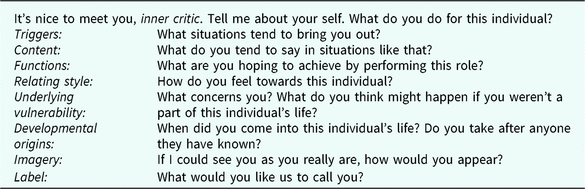
Intrapersonal role-play or ‘voice dialogue’ (Stone and Stone, Reference Stone and Stone1989) offered a more creative means to assess the origins, triggers, content and motivations of George’s self-criticism. This involved George changing seats and speaking from the perspective of his ‘inner critic’, who was then interviewed by the therapist (Therapist: ‘Nice to meet you, inner critic. Tell me about your self. When and why did you first come into George’s life? What situations tend to activate you? What do you hope to achieve by criticizing him? What would happen if you weren’t around? If I could see you, how would you look?’). The dialogue concluded with George returning to his original chair and reflecting on his self-criticism from a new, metacognitive perspective (Therapist: ‘Come back to your first chair. As you do that, allow your self to separate from your inner critic and notice how, from this seat, you can now observe that part of your self from more of a distance’ [gestures to the ‘inner critic’s’ empty chair]). A semi-structured interview schedule for voice dialogues is provided in Table 1.
Semi-structured interview schedule for voice dialogues
Costs-benefits analysis
The ‘standard’ approach
Astrid’s drug addiction was maintained by beliefs which minimized the disadvantages and maximized the advantages of her substance use. Decisional balancing or ‘costs-benefits analysis’ encouraged Astrid to reflect on the problems cause by her addiction (Beck et al., Reference Beck, Wright, Newman and Liese1993). Sorting these pros and cons into short-term and long-term lists demonstrated that while many advantages provided immediate benefits, the negative consequences of her drug use were more enduring and pervasive (Waller et al., Reference Waller, Cordery, Corstorphine, Hinrichsen, Lawson, Mountford and Russell2007).
The dialogical approach I
Two-chair decisional balancing encouraged Astrid to ‘know’ and ‘feel’ her reasons for change. First, Astrid presented the advantages of using drugs from chair 1 (Therapist: ‘What are the good aspects of using cannabis? “I like smoking weed because …”’), followed by its disadvantages in chair 2 (Therapist: ‘What concerns does this part of you have about using drugs? “Smoking cannabis worries me because …”’). Astrid proceeded to shuttle between the two chairs, speaking from both perspectives, until she felt more decided about choosing abstinence.
The dialogical approach II
In order to explore the longer-term consequences of drug use, Astrid enacted two versions of her ‘future self’ (Pugh and Salter, Reference Pugh and Salter2018). In the first dialogue, Astrid (chair 1) role-played herself in 10 years as if her cannabis use was unchanged. Her therapist then interviewed this future self regarding the impact of continued addiction upon key life domains (Therapist: ‘Nice to see you again, Astrid. I understand you’ve continued to smoke weed since we last met one decade ago. How are things going for you? What’s your health like these days? And your work? And your relationships?’). Astrid’s future self was then encouraged to offer advice to her ‘past self’ (Therapist: ‘Imagine this chair holds the version of Astrid who was contemplating giving up cannabis 10 years ago. [Introduces an empty chair]. If you could go back in time and give her any guidance, what would it be?’). This dialogue was then repeated with Astrid’s future-recovered self.
Emotional processing and regulation
The ‘standard’ approach
Joyce found it difficult to process and tolerate unpleasant emotions, resulting in a tendency to inhibit, suppress, and avoid these experiences. This ‘emotional processing avoidance’ appeared to not only maintain her emotional dysregulation but also limited the effectiveness of cognitive restructuring techniques. Accordingly, treatment focused on modifying Joyce’s dysfunctional appraisals about her emotions (‘emotional schemas’), including their perceived incomprehensibility (‘my emotions don’t make sense’), invalidity (‘my emotions aren’t legitimate’), and shamefulness (‘feeling this way makes me bad’) (Leahy, Reference Leahy2016).
The dialogical approach I
‘Multiple selves’ (Gilbert, Reference Gilbert2009) enabled Joyce to practise validating, soothing and safely processing her distressing emotions in the here-and-now. This dialogue involved Joyce speaking from the perspective of key distress-related emotions in different chairs, including her anxiety, sadness and anger (Therapist: ‘Change seats and step into the shoes of your ‘Anxious Self’. How do you experience this self in your body? What does ‘Anxious Self’ want to say? What memories go with this self? If ‘Anxious Self’ were in complete control, what would it want to do? What does this self need in order to settle?’). When obstacles to emotional expression arose during the dialogue, these blocks were ‘set aside’ in another chair (‘Let’s place the idea that your anger is stupid in this seat and return to hearing more from ‘Angry Self’’). Once each self had been expressed, Joyce practised validating and soothing her emotions from the seat of her ‘healthy’ or ‘Compassionate Self’ (Kolts, Reference Kolts2016) (Therapist: ‘Looking at these feelings through the eyes of your ‘Compassionate Self’, how do they make sense? [Gestures to the empty chairs]. What do you want for each of these selves? What would you like them to understand to help them settle?’). Had Joyce found this process challenging, enacting a ‘caring other’ would have provided an alternative approach to stimulating self-validation and compassion (Therapist: ‘Change seats and speak to these emotions from the perspective of your kind uncle – what would he say in response to hearing your feelings?’).
The dialogical approach II
Chairwork also allowed Joyce to practise emotional regulation by ‘dialling into’ her emotional selves. First, Joyce stood amongst the chairs to establish a mindful perspective on her different affective states (Therapist: ‘From this standing position, notice how you can observe each emotional self with curiosity and non-judgemental acceptance. Take a moment to notice the unique ways each self presents itself to you. [Gestures to the empty chairs]. Imagine how ‘Sad Self’, ‘Anxious Self’ and ‘Angry Self’ might sit, speak and behave in their respective seats’). Next, Joyce connected with her least threatening emotional self and gradually ‘dialled up’ its intensity (Therapist: ‘Let’s start by connecting with ‘Sad Self’. [Gestures to empty chair 1]. Begin by dialling up that self just a little, from zero to one… Allow the sadness to increase a small amount… Observe where this self first shows up in your body and how it feels there… Notice the thoughts it generates and the actions it prompts… Now, holding ‘Sad Self’ with compassion and acceptance, dial it up a little more, increasing its intensity from a one to two’). After holding this self at peak tolerability, Joyce rehearsed ‘dialling down’ its intensity before connecting with a more threatening emotional self (Therapist: ‘…Now dial down ‘Sad Self’ from a four to a three… Noticing the sadness lifting… The ache in your stomach beginning to ease… Dialling down to a two… And now one… And with compassion and great appreciation for this self, returning to a position of non-judgemental observation… Well done, Joyce. Shall we connect with ‘Angry Self’ next?’).
Positive data logging and reducing ‘discounting’
The ‘standard’ approach
Numerous perceptual biases maintained Juan’s low self-esteem, including a tendency to discount, ignore or distort experiences which highlighted his personal strengths. To address this bias, Juan was asked to record daily examples of his positive qualities and personal assets (‘positive data logging’) (Fennell, Reference Fennell1998).
The dialogical approach
‘Appreciation dialogues’ (Dayton, Reference Dayton1994) encouraged deeper acceptance and elaboration of Juan’s positive qualities. First, an individual who seemed appreciative of his existence was identified. Switching seats, Juan then adopted the perspective of this individual and shared their appreciations (Therapist: ‘Sally, I understand that you feel grateful to Juan for his support when you lost your mother. Can you tell him what you appreciated about his help? [Gestures to Juan’s empty chair]. What else you do like and value about Juan?’). In anticipation of this information being distorted or discounted by Juan, the therapist explored how the appreciative other might respond to this (Therapist: ‘Sally, you might not be aware that Juan often discounts his positive qualities and thinks that feedback like this is an exception. What would you say to him about that? What do you like him to do with the gratitudes you have shared?’).
Resolving distressing memories
The ‘standard’ approach
Dev linked his self-criticism to experiences of being shamed by his father. To reduce his self-attacking, the ‘credentials’ of this critic were explored (Lee, Reference Lee and Gilbert2005), including the positive and negative aspects of his father’s behaviour, personal beliefs, and his manner of relating to others. Non-self-referential explanations for his father’s actions were then developed in the context of his life circumstances and personal history (e.g. ‘my father shamed me because he was shamed by his father’).
The dialogical approach
Enactive rescripting (Pugh, Reference Pugh2019) provided a more evocative means of modifying the encapsulated meanings of Dev’s memories. This dialogue began by recreating a representative memory through ‘historical role-play’, with Dev enacting his child self and his therapist enacting his critical father (Arntz and Weertman, Reference Arntz and Weertman1999). After role-play, Socratic questioning was used to highlight the ways in which this interaction was inappropriate and failed to meet his needs as a child. Drawing upon this new understanding of events, Dev proceeded to challenge his father, held in empty seat 1 (Therapist: ‘As your adult self, tell your father what being shamed by him was like for you as a child. [Gestures to the empty chair]. How did it impact you? What did you need from him as a child? Hearing your suffering, how does he respond?’). Had Dev found this process of confrontation difficult, a protective wall of chairs could have been set up between him and his father, or a supportive ‘helper’ introduced into the dialogue (Therapist: ‘Imagine your auntie is here with you as you speak to your father. [Introduces a second empty chair]. Knowing that she is beside you, what do you want to say to him?’). Finally, Dev was guided in providing care, support and encouragement to his child self, held in another chair (Therapist: ‘Picture Little Dev in this seat. [Gestures to the second empty seat]. What do you want him to understand about his father’s actions? What does he need to feel better? Can you say that to him?’).
Constructing positive core beliefs
The ‘standard’ approach
After critically examining the evidence in support of her negative core belief, Rita was asked to construct a more adaptive core belief for herself. This belief was then strengthened through cognitive continuums and the identification of evidence supporting this new self-appraisal (Beck, Reference Beck1995).
The dialogical approach
Rita began chairwork by describing her lived experience of her negative core belief in chair 1 (Therapist: ‘How do you experience your self when this self-belief becomes activated? How do you experience other people and the world? What do you feel like doing? Does this experience of your self seem like it will ever change?’). Next, Rita explored positive experiences of her self in chair 2, including relevant autobiographical events (Therapist: ‘Have you ever experienced your self as something other than unlovable, even if it was for just a moment? Close your eyes and describe that memory to me. How did you experience your self in that situation? And other people? And the world?’) (Chadwick, Reference Chadwick2003). Once connected with this positive experience of her self, an affective bridge was used to identify other positive self-referential memories (Therapist: ‘As you relive this memory, where do you experience that sense of being lovable in your body? Focusing that sensation, allow other images and memories to come to mind where you felt a similar way. What do you see?’). The dialogue concluded with Rita exploring how both experiences of her self were concurrently accurate and valid (Therapist: ‘Can you stand with me? Here we have two very different experiences of your self. [Gestures to chairs 1 and 2], yet both experiences are equally real and valid. What does that tell you about your sense of being unlovable?’).
Consolidating ‘new ways of being’
The ‘standard’ approach
Sam’s recurrent depression related to several dysfunctional assumptions grounded in core beliefs regarding his personal inadequacy. Accordingly, treatment focused not only on restructuring these cognitions but also on the creation of an alternative schematic model or ‘new way of being’ (Mooney and Padesky, Reference Mooney and Padesky2000). This ‘new system’ was composed of positive core beliefs, functional rules for living, and adaptive behaviours, which Sam believed would support him in pursuing his life goals. This new way of being was mapped out on paper and tested through behavioural experiments (Bennett-Levy et al., Reference Bennett-Levy, Thwaites, Haarhoff and Perry2015).
The dialogical approach
Chairwork concretized and enlivened Sam’s new way of being in three stages. First, embodiment was used to anchor Sam to this new self-experience (Therapist: ‘Change seats and step into the shoes of your new system – that “I’m a stand-out guy”. What posture goes with being a stand-out guy? What tone of voice? What facial expression? Show me how you would interact with me if you 100% believed this’). Shuttling between two chairs, Sam then practised interpreting current events from the perspective of his old system (chair 1) and his new system (chair 2) (Therapist: ‘From the vantage of your old system, how do you make sense of the argument you had with your daughter?… Now change seats and see this event through the eyes of your new system. From this perspective, how can we understand the argument differently?’). Finally, chairwork was used to rehearse new, adaptive responses to hypothetical events (Therapist: ‘Suppose your daughter did decide to move out of your family home. Change seats and take a look at her decision through the lens of your ‘new system’. How would this system make sense of her choice? Let’s role-play how you would respond to her decision as if you believed you were a 100% ‘stand-out father’’).
Developing strengths
The ‘standard’ approach
Stanley felt anxious about lapsing back into binge-eating after treatment. In order to bolster his resilience, relapse prevention planning also incorporated a strengths-focused perspective (Padesky and Mooney, Reference Padesky and Mooney2012). This involved identifying the unique strengths and talents which enabled Stanley to persist with ‘never miss’ activities despite obstructions (i.e. completing challenging videogames). These signature strengths were then used to generate ‘resilience strategies’ for maintaining the progress he had made in therapy.
The dialogical approach I
Stanley’s strengths-focused dialogue (Pugh, Reference Pugh2019) began by representing one of his strengths with a chair (Therapist: ‘Imagine that this chair holds the determination you bring to completing videogames’). Moving to this ‘strengths seat’, Socratic questioning was used to elaborate specific strategies associated with this strength (Therapist: ‘Speaking from your strengths seat – how do you maintain your determination when finishing a videogame? What strategies do you use? When you encounter problems, how do you apply this strength?’). Next, Stanley explored how these strengths and associated resilience strategies might be applied to relapse prevention. Standing at this point helped bring power to Stanley’s strengths, as well as establishing a decentred perspective on his concerns about relapse (Therapist: ‘Imagine this empty seat represents your fears about lapsing into binge-eating. [Introduces a second empty chair]. Looking at this issue from the perspective of your determination, what strategies could help address this issue?’).
The dialogical approach II
Intrapersonal role-plays were used to explore Stanley’s character strengths in more depth. This dialogue began with Stanley switching seats and adopting the perspective of his strength (Therapist: ‘Change chairs and speak as your determination’). His therapist then ‘interviewed’ this personal strength with regard to its origins, applications and associated resilience strategies (Therapist: ‘Nice to meet you, Determination. When did you become a part of Stanley’s life? Where do you show up in Stanley’s life now? How do you help him? What techniques do you use?’). Once immersed in this role, Stanley (speaking as his strength) was invited to impart guidance regarding his fear of relapse (Therapist: ‘As you know, Determination, Stanley is worried about falling off the wagon when he ends treatment. Can you offer him any advice about preventing that? [Gestures to Stanley’s empty seat]. What strategies could he use to manage this issue? How else could you help him maintain his progress?’).
Addressing impasses
The ‘standard’ approach
Layla became withdrawn whenever change strategies were introduced into her sessions (e.g. thought challenging). Her therapist hypothesized that this reaction might relate to Layla’s validation beliefs (Leahy et al., Reference Leahy, Tirch and Napolitano2011) (‘My therapist should focus on validating my emotional pain rather than changing it’). To test this theory, Layla was encouraged to share and re-evaluate her present-moment construal of events when this impasse arose (Therapist: ‘What ran through your mind just now when I suggested completing a thought record?’) (Katzow and Safran, Reference Katzow, Safran, Gilbert and Leahy2007).
The dialogical approach I
To maximize validation for Layla’s ‘resistance’, her therapist utilized chairwork to enact her possible perspective(s) on events (Therapist: ‘I wonder what the silence between us is about. Do you mind if I share some of the ideas I’ve been having about this? Tell me if I get this right’). Moving between seats, her therapist then presented potential reasons for her withdrawal from a first-person perspective (Pitzele, Reference Pitzele, Holmes and Karp1991) (Therapist: ‘[Moving to chair 1] Maybe it’s like, “These thought records are so boring, can’t we do something else?”… [Moving to chair 2]… Or perhaps it’s, “This guy should be listening to my pain before he tries to change it”… [Moving to chair 3] … Or could it be, “I feel really uncomfortable seeing my thoughts on paper”… Am I getting close?’).
The dialogical approach II
Layla’s withdrawal was re-enacted through role reversal (Therapist: ‘Let’s recreate what happened earlier when I suggested completing a thought record – you play me and I’ll play you’). Exchanging points of view served two important functions. First, adopting Layla’s perspective allowed the therapist to ‘feel’ his way into the thoughts underlying her silence. Second, playing the clinican’s role helped Layla better understand her therapist’s motives and the impact her withdrawal had upon the therapeutic process (Corsini, Reference Corsini2017). Sharing the tensions of both perspectives, Layla and her therapist were then better placed to negotiate a route through the impasse (Therapist: ‘So now we both understand where the other is coming from, what can we do differently to help us move forwards?’).
Processes
Cognitive therapists utilize a variety of process-driven interventions to ensure that chairwork dialogues are guided towards a therapeutic conclusion (Pugh, Reference Pugh2019). Accordingly, cognitive therapists must maintain an active role throughout the dialogical process. For instance, three-chair cognitive restructuring will often use considerable scaffolding, with the therapist deliberately amplifying affect at certain points (i.e. encouraging implicational information processing) and encouraging analytic modes of thinking at other times (i.e. propositional information processing). Detailed illustrations of these process-skills are provided elsewhere (e.g. Greenberg, Reference Greenberg1979; Kellogg, Reference Kellogg2015; Pugh, Reference Pugh2019). Here, discussion will focus on those process-skills that maximize the effectiveness of cognitive restructuring and emotional processing through chairwork.
Doubling
Doubling (Moreno, Reference Moreno1987) encourages the expression of ‘hot’ cognitive material which is either unexpressed or lies outside of the client’s present awareness. Therapist doubling involves speaking on behalf of the client and is typically used in two circumstances. First, speaking for the client brings to the fore ‘hot’ cognitions which might otherwise be avoided, suppressed or unarticulated. Second, doubling for client supports information processing and recall if this becomes impaired under conditions of high emotional arousal (Bennett-Levy, Reference Bennett-Levy2003).
Therapist: Come back to your first chair. [Client moves]. Now that we’ve heard from your inner critic [gestures to the empty chair], what does your healthy side say in response?
Client: I don’t know… The critical side feels so right.
Therapist: Can I speak to the critical side of your self?
Client: Ok.
Therapist: [Addressing the chair representing the inner critic]. What you’re saying is not true. Billy is a great person to spend time with. We know this because his friends are always inviting him to go out. [Turns to the client]. Can you take over? …
The alternative approach, self-doubling, invites the client to change positions and express the thoughts and feelings which are more challenging to share or acknowledge.
Therapist: What does your anxious side think about these arguments with your husband?
Client: [Speaking as ‘Anxious Self’]. I’m constantly worried about saying the wrong thing and starting another fight. It’s like treading on eggshells at home.
Therapist: Can you stand behind your chair? [Client moves]. What else does Anxious Self think about these fights? What’s harder to say?
Client: [Silent]… I’m so scared this could be the end of our relationship. [Becomes tearful]. What if it’s beyond repair? …
Embodiment
Embodiment is often spontaneous when individuals enact familiar, maladaptive self-parts, such as by adopting contemptuous voice tones and facial expressions when speaking as the inner critic (Whelton and Greenberg, Reference Whelton and Greenberg2005). Guided embodiment is usually required when clients enact adaptive self-parts which are less familiar, thus helping to bring conviction to these functional self-experiences and anchor them in physical states (Bell et al., Reference Bell, Montague, Elander and Gilbert2019). In psychodramatic terms, these prompts function as stage directions which help the client ‘warm-up’ for the new internal role(s) they are to enact.
Therapist: Before we look at this event from the perspective of your Compassionate Self, let’s begin by connecting with that side. Starting with the outward characteristics of compassion, find an expression that captures a sense of warmth and non-judgemental acceptance… Taking on a relaxed yet grounded bodily posture… Finding a tone of voice that conveys care and understanding… Now, inwardly, bring to mind a motivation to relieve the suffering of your self and others…
Embodying other individuals during external dialogues demands considerable ‘creative empathy’ from the client (Yaniv, Reference Yaniv2012). To help immerse themselves in the mind of other people, the client is initially ‘interviewed’ by the therapist after switching perspectives (Blatner and Blatner, Reference Blatner and Blatner1991).
Therapist: I wonder what your husband would say about the regrets you’ve carried since his death.
Client: I’ll never know.
Therapist: Perhaps we could ask him. [Client looks confused]. If you’re willing to, I’d like you to change seats and speak as if you were him. Can you do that? [Client changes seats]. It’s nice to meet you, Mr Lee. How long were you married to your wife for? [Gestures to the client’s former seat].
Client: [Speaking as her deceased husband]. We were married for 40 years.
Therapist: And how old were you when you died?
Client: I was 68.
Therapist: What caused your passing?
Client: I died of a heart attack.
Therapist: What did you love most about your wife?
Client: … [Begins to cry]. I loved her gentleness. She always took such good care of me.
Therapist: Your wife has many regrets about your final days together. What would you say to her about that? …
Feeding lines
Therapists sometimes offer the client statements to repeat aloud during chairwork (Kellogg, Reference Kellogg2015). Unlike doubling, which involves naming what is avoided or not yet known, feeding lines aims to simplify or expand upon what has been conveyed. This might be with the intention of stimulating continued dialogue, amplify affect, or validating the client’s experience.
Therapist: Change seats and speak as your permissive thoughts in this chair. [Client changes seats]. How do you encourage your self to binge-eat?
Client: [Talking to her empty seat]. Go on, Lisa. Go ahead and binge. You’ve already made a mess of your diet today.
Therapist: There’s no point in trying anymore.
Client: Exactly. There’s no point being good when the day is already ruined…
Imagery
Imagery shares a special relationship with affect and autobiographical memory (Holmes and Mathews, Reference Holmes and Mathews2010). Chairwork makes considerable use of mental images to stimulate immersion and emotion. For example, ‘contact’ with other individuals during empty-chair dialogues begins with imagining their presence (Greenberg et al., Reference Greenberg, Rice and Elliott1993). Often, these mental images also carry important information regarding key episodic memories and their encapsulated meanings.
Therapist: Imagine your mother were here with us. [Pulls up an empty chair]. How do you see her?
Client: [Looking at the empty chair]. She’s crossing her arms and squinting over her glasses at me.
Therapist: What happens for you when she does that?
Client: It reminds me of when I was a kid. She always seemed so disappointed in me. It’s sad.
Therapist: Tell her this. ‘Mother, when I see you, I feel such sadness…’…
Clients are similarly encouraged to use mental imagery when dialoguing with personified aspects of their internal world.
Therapist: Let’s place your Vulnerable Self in this chair. [Pulls up a seat]. How do you picture that part of your self?
Client: I see a scared little boy.
Therapist: What’s he experiencing right now?
Client: He’s really nervous. He thinks people are mean and want to hurt him.
Therapist: What does that part of you need?
Client: To feel safe and protect him. I want to take care of him.
Therapist: What can you say to help him feel safe and cared for? …
Non-verbal communication
Cognitive therapists rely on clients’ ability to convey cognitive and emotional experiences accurately and openly. However, this can be problematic when internal events are challenging to articulate, evoke shame, or lie at the edges of awareness. Indeed, cognitive theory would predict such complications since many implicational meanings are encoded non-verbally. Given that the cognitive model assumes bidirectional relationships between thoughts, feelings, physiological states and behaviour, attending to clients’ non-verbal behaviour and ‘psychosomatic language’ (Perls, Reference Perls1969) during chairwork can bring cognitive-affective material into sharper focus.
Client: [Speaking as her anxious thoughts]. What if you fail the exam? If you don’t pass, you’ll never go to university. Everyone will be so disappointed in you.
Therapist: Come back to your first seat. [Client switches chairs]. How do you feel hearing that?
Client: Really scared. I feel like puking.
Therapist: [Somatic focus]. Give that sickness a voice. What is it saying to you?…
Or:
Therapist: [Behavioural focus]. Are you aware of your shaking hands? How do they relate to what you are thinking and feeling right now?…
Presencing
Novice therapists often approach chairwork in a tentative manner (Therapist: ‘Let’s pretend this chair holds your ruminating side – would you mind changing seats and acting like that part of your self?’). While understandable, this can detract from the immediacy of chairwork and over-emphasize its ‘as-if’ nature. Presencing refers to therapists’ use of language which asserts the reality and familiarity of chairwork – a strategy which helps build clients’ confidence when using these techniques (Yardley-Matwiejczuk, Reference Yardley-Matwiejczuk1997).
Therapist: Would you be willing to work with your rumination more experientially?
Client: Sure.
Therapist: Great. Come over to this chair and speak as your ruminating side. [Pulls up an empty seat]. Show me how you experience it…
Repetition
Prompting the client to repeat key statements during chairwork serves to intensify affect and strengthen conviction in adaptive appraisals. Perls (Reference Perls1973) explains, ‘If one feels there is a key sentence involved… Reinforce it, let her talk again, speak over again and reinforce it… Then you notice something completely unexpected happens. The personality gets involved, and the emotions, and there is again a turning point’ (p. 198).
Client: [Speaking as the side which does not want to recover from anorexia nervosa]. Losing weight feels so good. I feel so powerful seeing the pounds go down… [Sighs].
Therapist: That’s a big sigh. What are you thinking?
Client: But it’s so exhausting.
Therapist: It sounds like the other side is speaking now. Can you switch seats? [Client changes chairs]. So, this other side says, ‘Actually, I do want to change. Anorexia exhausts me’.
Client: Right. I feel so tired all of the time. I want my strength back.
Therapist: Say that again.
Client: I want my strength back!…
Unmet needs
Focusing individuals’ attention on their unmet needs represents a core change process in many dialogical interventions. Emotion-focused research indicates that identifying and expressing these needs during chairwork can stimulate transformations in cognition and affect (Kramer and Pascual-Leone, Reference Kramer and Pascual-Leone2015).
Therapist: How do you feel after hearing your critical side? [Gestures to the empty chair].
Client: It’s right. I really am a loser.
Therapist: You might agree with it, but what do you feel ?
Client: Shame. [Client begins to cry]. It makes me feel so ashamed of myself. I hate it.
Therapist: What do you need from that side?
Client: I need it to give me a break. It hurts too much.
Therapist: Say that to the critical side. [Gestures to the empty chair]. ‘I need you to give me a break’…
Conclusions
Dialogical methods represent an exciting, yet relatively unexplored, frontier for cognitive therapy. Consistent with theories of information processing, the basic premise of this paper has been that action-based, dialogical procedures may be an advantageous approach to cognitive reappraisal and emotional processing. Accordingly, these interventions have the potential to augment many standard cognitive techniques by helping clients ‘get out of their heads’ and into an affectively charged here-and-now. Indeed, the recent emergence of cognitive therapies which centralize chairwork is perhaps the greatest testament to its therapeutic value (e.g. de Oliveira, Reference de Oliveira2015).
To help delineate this method of working, this article has presented a framework for conceptualizing, applying, and facilitating dialogical interventions in cognitive therapy. Dialogical methods for achieving some of the ‘core tasks’ of cognitive therapy have been presented including socializing clients to the cognitive behavioural model, restructuring maladaptive cognitions, conducting functional and costs-benefits analyses, improving emotional regulation, resolving distressing memories, and consolidating client strengths and ‘new ways of being’. It is hoped that these descriptions will support therapists in making greater use of these interventions and encourage further research in this area of clinical practice.
Dialogical interventions have earned a reputation for being potent and transformative (Perls, Reference Perls1969). As the adage goes, with power comes responsibility. These techniques should not be applied indiscriminately and often require some adaptation in treatments for complex disorders (Pos and Greenberg, Reference Pos and Greenberg2012). Used flippantly, chairwork also risks ‘theatricalizing’ clients’ emotional concerns and the process of therapy. Effective dialogical practice, therefore, requires sensitivity and reflectivity on behalf of clinicians. Given that many therapists lack confidence using these techniques (e.g. Owen-Pugh and Symons, Reference Owen-Pugh and Symons2013), there exists a need for more training and supervised practice in the application of dialogical methods.
This article has described some of the ways dialogical interventions are used to address maladaptive cognitive-affective structures and processes. Other areas of dysfunction might also benefit from these methods. For example, research indicates that role-play is an effective approach to behavioural skills training (Mueser and Bellack, Reference Mueser and Bellack2007). In the interpersonal domain, empty-chair dialogues have been applied to lingering resentments towards others (‘unfinished business’) (Greenberg et al., Reference Greenberg, Rice and Elliott1993), interpersonal traumas (Paivio and Nieuwenhuis, Reference Paivio and Nieuwenhuis2001), and unresolved grief (Neimeyer, Reference Neimeyer and Neimeyer2012). Additionally, dialogical interventions may provide an alternative to imagery-based techniques if these prove ineffective or unacceptable to clients. To illustrate, ‘dialogical exposure’ to traumatic events invites the client to ‘tell the story’ of their trauma in another chair (Kellogg, Reference Kellogg2018; Yardley-Matwiejczuk, Reference Yardley-Matwiejczuk1997). As with imagery, this method of exposure is approached in a graded fashion, beginning with past-tense, third-person descriptions of events (i.e. self-distanced dialogues) (Therapist: ‘Describe your car accident through the eyes of an observer – what happened to the young lady as she journeyed home from work?’) and ending with more evocative present-tense, first-person descriptions (i.e. self-immersed dialogues) (Therapist: ‘Now, tell me the story of your car accident through your own eyes – what happens as you begin your journey home?’) (Dayton, Reference Dayton1994). Regarding metaphorical and spontaneous imagery, clients are also able to dialogue with the contents of these visualizations to clarify and transform their meanings (Edwards, Reference Edwards, Freeman, Simon, Beutler and Arkowitz1989).
Other areas of practice might also benefit from the use of dialogical procedures. Like cognitive therapy, effective supervision should be both a ‘talking’ and a ‘doing’ process. Dialogical methods such as re-enactment, rehearsal and role reversal are a powerful means to enhance therapists’ technical, relational and reflective competencies (Pugh, Reference Pugh2019). ‘Positive’ forms of cognitive therapy which aim to enhance well-being are also given depth and authenticity through the use of action-based procedures (Pugh, Reference Pugh2019; Tomasolu, Reference Tomasolu, Van Zyl and Rothmann2019). Finally, dialogical interventions offer cognitive coaches an evocative medium for cultivating professional and organizational development (Carnabucci, Reference Carnabucci2014).
This article has grounded dialogical interventions in an information processing framework. Other mechanisms are also likely to contribute to their effectiveness. Theories of embodied cognition (e.g. Hauke et al., Reference Hauke, Lohr and Pietrzak2016) would suggest that the therapeutic effects of chairwork partly relate to adjustments in posture, gesture and movement during enactment. Alternatively, movement between seats might help strengthen attentional control and allow clients to practise ‘stepping into’ (immersion) and ‘stepping back from’ (decentring) their distressing thoughts and feelings (Pugh, Reference Pugh2017, Reference Pugh2019). Finally, constructivist theories of psychotherapeutic change would hypothesize that chairwork generates salient, multisensory, adaptive internal representations that successfully out-compete their maladaptive counter-parts (Brewin, Reference Brewin2006). This may stem from the immersive nature of chairwork or the novel, social-relational frames which these procedures introduce into therapeutic processes such as cognitive restructuring (e.g. responding to one’s inner critic as if it were a person).
Continued research is needed to drive developments in this area of practice. Quantitative studies indicate that dialogical interventions have the capacity to outperform standard cognitive techniques such as positive data logging and problem-solving (Clarke and Greenberg, Reference Clarke and Greenberg1986; de Oliveira et al., Reference de Oliveira, Powell, Wenzel, Caldas, Seixas and Almeida2012), while qualitative research has highlighted the memorability, ‘felt truth’, and compelling nature of chairwork compared with ‘standard’ interventions (Bell et al., Reference Bell, Montague, Elander and Gilbert2019; Chadwick, Reference Chadwick2003). Additional studies are needed to ratify these findings. Furthermore, task analytic research is needed to establish which processes drive change in dialogical work (Greenberg, Reference Greenberg1986). By elucidating its mechanisms of action, ways of maximizing the therapeutic effects of cognitive chairwork will surely follow.
Acknowledgements
None.
Financial support
None.
Conflicts of interest
The author of this paper is provided royalties from a related textbook.
Ethical statement
The author abides by the Ethical Principles of Psychologists and Code of Conduct as set out by the APA. Ethical approval was not needed for this paper.
Key practice points
(1) Standard reappraisal techniques sometimes produce limited or short-term changes in cognition and emotion.
(2) Theories of cognitive science suggest that experiential interventions (including chairwork) may be advantageous in terms of facilitating cognitive modification.
(3) Dialogical procedures aim to facilitate present-moment interactions with parts of the self and other individuals through the medium of chairwork, and draw upon unique principles, implementation processes and procedures.
(4) Chairwork can augment many standard cognitive interventions and so represents a valuable addition to therapists’ technical repertoires.




Comments
No Comments have been published for this article.