Implications
Concern about dairy cows welfare is not a new issue, but there is a huge variation among farm producers and veterinarians about their perception of pain in domestic animals. Although severe clinical mastitis is usually considered painful and high scores of pain were acknowledged by farmers and veterinarians, our research gives the first tentative indication that subclinical mastitis alters thermal nociceptive thresholds.
Introduction
Mastitis is the most common infectious disease found in worldwide dairy herds, accounting for large but variable economic losses in this activity as pointed out by several reviews (Seegers et al., Reference Seegers, Fourichon and Beaudeau2003; Hogeveen et al., Reference Hogeveen, Huijps and TJGM2011). In Brazil, it is calculated that due to the high incidence of mastitis in herds, losses of the order of 12% to 15% may occur (Santos and Fonseca, Reference Santos and Fonseca2007). Considering that Brazilian milk production in 2012 was ~30.7 billion liters (FAO, 2012), an estimated loss of 4.6 billion liters is assumed.
Besides the needs to meet national and international milk quality standards, animal welfare is increasingly becoming an issue in the dairy market. One of the most important concerns is about pain and discomfort caused by diseases (Broom and Fraser, Reference Broom and Fraser2010). Concern for animal welfare and pain can be advantageous to productivity, since, for example, pain reduces food intake resulting in lower milk production (Hellebrekers, Reference Hellebrekers2002).
As far as pain and mastitis evaluation are concerned, studies on bovines have used (1) expression of pain-indicating behavior such as flinching, vocalizing or leg raising (Medrano-Galarza et al., Reference Medrano-Galarza, Gibbons, Wagner, De Passillé and Rushen2012) and alterations of postural and ingestive behaviors (Siivonen et al., Reference Siivonen, Taponen, Hovinen, Pastell, Lensink, Pyörälä and Hänninen2011); (2) hyperalgesia and pain nociceptive threshold (Fitzpatrick et al., Reference Fitzpatrick, Scott and Nolan2006; Potter et al., Reference Potter, Mccarthy and Oldham2006); (3) physiological traits as heart and respiratory rates and body temperature, in addition to plasma metabolites such as cortisol and acute phase proteins (Leslie and Petersson-Wolfe, Reference Leslie and Petersson-Wolfe2012). Nociception refers to signals arriving in the central nervous system resulting from activation of specialized sensory receptors called nociceptors that provide information about tissue damage. Pain is the unpleasant emotional experience that usually accompanies nociception. Nociceptive threshold is characterized as the minimal stimulus perceived as painful by the animal and capable of eliciting avoidance, flight or leg retraction reactions (Muir III, Reference Muir2009). Pinheiro Machado Filho et al. (Reference Pinheiro Machado Filho, Hurnik and Ewing1998) reported the use of thermal nociceptive threshold to investigate the sensitivity of peripheral nociceptors to pain. However, few studies (Kemp et al., Reference Kemp, Nolan, Cripps and Fitzpatrick2008; Fitzpatrick et al., Reference Fitzpatrick, Chapinal, Petersson-Wolfe, Devries, Kelton, Duffield and Leslie2013) investigated the nociceptive response in dairy animals with mammary gland inflammation. It is not yet established how nociception is different for clinical and subclinical mastitis.
Assessment of mastitis is quantitatively done using somatic cell count (SCC), as there is a positive correlation between mastitis infection severity with SCC (Coffey et al., Reference Coffey, Vinson and Pearson1986; Rupp and Boichard, Reference Rupp and Boichard2000), with predominance of neutrophils, macrophages and lymphocytes, whereas the number of epithelial cells remains unchanged (Philpot and Nickerson, Reference Philpot and Nickerson2002). Farmers usually acknowledge that cows with severe clinical mastitis appear to be distressed and in pain (Kielland et al., Reference Kielland, Skjerve, Osteras and Zanella2010). Cows can experience pain in even mild cases of clinical mastitis (Leslie and Petersson-Wolfe, Reference Leslie and Petersson-Wolfe2012). However the assessment of pain or nociceptive threshold due to subclinical mastitis has not been adequately studied.
Although subclinical mastitis is characterized by absence of external signs such as heat, swelling and discoloration of the udder, abnormal secretion and systemic reactions, such as fever and loss of appetite, several studies have shown behavioral changes some days before clinical signs of illness had been detected. For example, changes in the rumination patterns and daily amount of time spent ruminating were associated with metabolic disorders and were detected several hours or days before onset of clinical symptoms (Fitzpatrick et al., Reference Fitzpatrick, Chapinal, Petersson-Wolfe, Devries, Kelton, Duffield and Leslie2013; Calamari et al., Reference Calamari, Soriani, Panella, Petrera, Minuti and Trevisi2014). In sheep, ewes diagnosed with subclinical mastitis increased vocalization and reduced head-up postures compared with healthy ewes. These behaviors are used by ewes to call their lambs to suck and may indicate some discomfort or change in attention due to subclinical mastitis (Gougoulis et al., Reference Gougoulis, Kyriazakis, Papaioannou, Papadopoulos, Taitzoglou and Fthenakis2008).
Furthermore, Eshraghi et al. (Reference Eshraghi, Zeitlin, Fitzpatrick, Ternent and Logue1999) reported increased concentration of bradykinin in milk from cows with subclinical mastitis when Staphylococcus aureus was detected in the affected udder quarters. Bradykininn are peptides are released during inflammation and are among the most potent known mediators of vasodilatation, pain and edema which might be related to changes in behavior and sensitivity to pain. Therefore we hypothesize that subclinical mastitis cause inflammation, increases cow’s sensitivity to noxious stimuli and change their behavior. The objective of this study was to evaluate changes in thermal nociceptive threshold in response to subclinical and clinical mastitis using a thermal inducing nociceptive-device.
Material and methods
Local description, animals and management
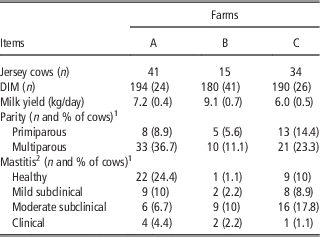
This study was conducted in three commercial dairy farms at the southern region of Rio Grande do Sul state, Brazil, from February to August 2011. The trial was approved by Ethical Committee for Animal Use of the Federal University of Pelotas, under protocol number 6537. A total of 90 lactating Jersey cows with no clinical signs of other illnesses and no history of treatment for illnesses in the last 30 days were enrolled in this study. Number of selected cows from each farm is show on Table 1.
Characteristics of selected cows in each farm according to number, average days in milk (DIM), average milk yield, parity, breed and status of udder health

1 Absolute and relative values (percentage in the brackets).
2 Cows were considered healthy when SCC<200 000 cells/ml and no visual alterations in milk and/or udder, with mild subclinical mastitis when SCC>200 000 cells/ml and no visual alterations in milk and/or udder, with moderate subclinical mastitis when SCC>500 000 cells/ml and no visual alterations in milk and/or udder and with clinical mastitis when visual alterations in milk and/or udder were detected.
Cows were managed similarly in all farms as they were kept on pasture, were fed with concentrate after morning and evening milking and were managed calmly and with neutral or non aversive human-animal relation. We did not evaluate human-animal relation, but we observed how the farmers and employees conducted the cows from pasture to the milking parlour, during the milking and the feeding procedures, and on the way back to the pasture. Humans were not observed to hit or yell at the cows.
At the beginning of the trial across all farms there were 29% primiparous and 71% multiparous cows, between 3 and 15 years old, 5 to 523 days in milk (DIM), 7.4±3 l/day of milk production (range from 1.5 to 16.5 l/day). The day before nociceptive threshold measurements were performed, cows were evaluated for mammary gland health condition with visual inspection and palpation of the udder to identify alterations such as nodules, swelling, redness and pain reaction such as depressed appearance, abnormal postures, vocalizations, kicking, weight shifting, and looking backwards to udder. Thereafter milk strips from each mammary quarter were collected into a dark bottom cup and visually inspected to identify visual changes in milk indicatives of clinical mastitis as clots and pus, while the California Mastitis Test (CMT) was performed to identify mastitis subclinical cases. Cows either with or without positive results in CMT and without any clinical symptoms of other illness such as lameness or injuries were selected. The selection was based on the dairy farmer report and on visual inspection of cows, although we did not inspected the feet on the rear legs. We did not register the number of rejected cows which did not take part in to the study.
Thermal nociceptive threshold measurements were performed at 0600 h, after the morning milking, utilizing the thermal threshold meter (TTM) device developed by Pinheiro Machado Filho et al. (Reference Pinheiro Machado Filho, Hurnik and Ewing1998). These measurements consisted in applying a thermal stimulus at the dorsal region of the middle phalanges of both rear legs, just above the hoof and observing the foot-lift response. Measurements were made randomly in the left and right rear legs. Cows were kept inside the barn where they were usually fed and they were not restrained. Most of the time cows allowed human approximation without moving. In the few cases when cows moved, they were observed later during the same measurement session. Concomitantly the temperature which elicited the foot-lift response reaction was recorded. An upper limit temperature of 25°C above the animal basal temperature (38°C), that is, 63°C was adopted to avoid any harm to animal skin. When this temperature was reached, without any change in the cow’s behavior, the stimulus was inactivated. All the nociceptive tests were performed by the same person accordingly to the methodology describe by Pinheiro Machado Filho et al. (Reference Pinheiro Machado Filho, Hurnik and Ewing1998). Each nociceptive test consisted of three consecutive measurements of the threshold temperature per foot at which the foot-lift response was initiated by the cow in both hindquarter legs, which were pooled by cow and by leg. The person charged of measuring nociceptive reaction was blinded to the milk findings.
Milk collection and analysis
Milk was collected on the same day of nociceptive test. After sampling, milk was stored under refrigeration. As milking intervals were not exactly the same for all farms, a mixture of milk from morning and evening milking from each cow composed the individual samples which were place into tubes containing Bronopol: SCC was determined by flow cytometry with Somacount 300® (Bentley Instruments, Chaska, MN, USA).
Statistical analysis
Individual cows were considered the experimental units. Cows were considered healthy when SCC<200 000 cells/ml and no visual alterations in milk and/or udder, with mild subclinical mastitis when SCC>200 000 cells/ml and no visual alterations in milk and/or udder, with moderate subclinical mastitis when SCC>500 000 cells/ml and no visual alterations in milk and/or udder and with clinical mastitis when visual alterations in milk and/or udder were detected. Values of SCC were transformed using log10 previously statistical analysis.
Thermal threshold data pooled by leg and cow was pooled by cow (average of the measures taken on both rear legs) independently if mastitis was diagnosed in one or more teats and it was submitted to analysis of variance, considering the following variables udder health score (n=4: healthy, mild and moderate subclinical and clinical), farm (n=3), parity (n=2: primiparous and multiparous), and DIM and milk yield were used as covariates, using the Mixed procedure of SAS®, option LSmeans, adjusted Dunnett (to compare udder health scores) and Tukey (to compare farms). The mathematical model used for analysis of variance included the fixed effects of udder health score (n=4), farm (n=3), parity (n=2) and cow as random effect. DIM and milk yield were included as covariates. Interactions between the fixed effects were not evaluated because of the uneven distribution of cows in all classes.
Broken line regression was calculated to determine the limiting SCC that sharply changes thermal threshold mean values. The model used for the broken regression line was: y i =β 0 +β 1 x i1 +β 2 ( x i1 -x)δ i +ε i, where: δ i=1 if x i1>x and 0 if x i1 <x and where y is the dependent variable, x the independent variable and β is the regression coefficient. Logistic regression (Proc LOGISTIC) was performed to perceive the increase in the odds of cows presenting thermal threshold values lower than 55°C, which was the lower limit of healthy cows, calculated as mean – STDERR). The model used for the logistic regression was: y i =β 0 +β 1 x i1, where y is the dependent variable, x the independent variable (log10SCC) and β is the regression coefficient.
In sub group of cows, which were diagnosed with mastitis in just one side of the udder (n=32), we compared the thermal threshold values at the ipsilateral and contralateral hindquarter legs of the affected udder side using t-test. P-values <0.05 were considered significant and trends toward significance are discussed at P<0.10.
Results
On the beginning of the trial, when cows were examined and tested for mastitis; from the total of 90 cows, 32 did not present any clinical symptom of mastitis and presented SCC value less than 200 000 cells/ml. Of the remaining cows, 20, 31 and 7 presented mild subclinical, moderate subclinical and clinical mastitis, respectively (Table 1). Variance analysis showed significant effects of farm (P=0.04), for udder health score (P=0.03), for DIM (P=0.05), (Table 2) but no significant effects of parity (P=0.50) and milk yield (P=0.90) on TT.
Thermal threshold and log10SCC values of cows diagnosed with subclinical and clinical mastitis compared with healthy cows

a,bValues within a row tend to be different (P<0.10) according to Dunnett test.
a,cValues within a row with different superscripts differ significantly at P<0.05 according to Dunnett test.
A,BMeans in the same row tended are different (P<0.05) according to Tukey’s test.
1 Cows were considered healthy when SCC<200 000 cells/ml and no visual alterations in milk and/or udder, with mild subclinical mastitis when SCC>200 000 cells/ml and no visual alterations in milk and/or udder, with moderate subclinical mastitis when SCC>500 000 cells/ml and no visual alterations in milk and/or udder and with clinical mastitis when visual alterations in milk and/or udder were detected.
2 TT=pain thermal threshold (°C) – the average temperature of the thermal stimulus applied three times consecutively at the dorsal region of the middle phalanges of each rear leg, just above the hoof which elicited the foot-lift response (values pooled by cow).
Cows with healthy udders, mild subclinical, moderate subclinical and clinical mastitis presented values TT (mean±SE) of 56.9±1.0°C, 55.6±1.9°C, 53.4±1.0°C and 50.8±1.9°C respectively. Cows with healthy udders showed higher values of TT than cows with clinical mastitis (P=0.02) and tended to have higher values than those cows with moderate subclinical mastitis (P=0.06, RSME=4.87, coefficient of variation=8.9) (Table 2). Thermal nociceptive threshold decreased linearly with log10 SCC (Thermal threshold=63.49–1.54 X, where X=log10SCC, varying from 3.8 to 7, P<0.05).
Broken line regression analysis between log10 SCC and thermal nociceptive threshold showed that log10SCC above 6.4 sharply decreased thermal nociceptive threshold values probably meaning increased sensitivity to pain. The odds of cows presenting thermal nociceptive threshold lower than 55.8°C increased in 1.8 units at every 1 unit increase in log10SCC. Thermal threshold was lower in the ipsilateral compared with contralateral hindquarters legs to affected mammary gland, 52.8±7.5°C and 54.1±7.6°C, respectively (P=0.04). Cows from farms C and B presented the highest and lowest thermal nociceptive threshold values, respectively (P<0.05), while farms A showed intermediary values, not different from farms C and B. Parity did not affect TT values, as primiparous and multiparous cows has been shown similar values, respectively, 53.8°C and 54.7°C.
Discussion
In this study the technique of measuring thermal nociceptive thresholds in cows using a thermal stimulus has been shown to be feasible as all cows tolerated the approaching of heating device to their hind hoofs, and their response of moving the limb as a result of the stimuli was easily recorded. The fact that cows with clinical mastitis presented lower average thermal nociception thresholds especially noticeable at the ipsilateral hindquarters legs to affected mammary gland is related to resulting inflammatory processes, which increase vasodilatation, intramammary pressure and external pressure, for example from an adjacent limb on a swollen udder. In other studies (Fitzpatrick et al., Reference Fitzpatrick, Scott and Nolan2006 and Reference Fitzpatrick, Chapinal, Petersson-Wolfe, Devries, Kelton, Duffield and Leslie2013; Kemp et al., Reference Kemp, Nolan, Cripps and Fitzpatrick2008) cows diagnosed with clinical mastitis have shown higher sensitivity to pain, although these authors used another stimulus (pressure) and evaluated mechanical threshold to pain.
Mastitis may elicit lower threshold sensitivity to pain as the resulting inflammatory process induces alterations in the nociceptive pain information processing and may provoke hyperalgesia and exaggerated responses to painful stimuli (Coderre and Melzack, Reference Coderre and Melzack1987). We show that moderate subclinical mastitis tended to decrease thermal nociceptive threshold despite non noticeable alterations in the udder or milk and suggest that this might be related to higher concentrations of chemical mediators which could enhance vasodilatation and lower threshold of thermal nociceptors. In other studies, lactating ewes diagnosed with subclinical mastitis showed changes in vocalization patterns and posture (Gougoulis et al., Reference Gougoulis, Kyriazakis, Papaioannou, Papadopoulos, Taitzoglou and Fthenakis2008) and higher concentrations of bradykinin have been detected in the milk of subclinical mastitic cows (Eshraghi et al., Reference Eshraghi, Zeitlin, Fitzpatrick, Ternent and Logue1999), which could mediate the inflammatory process. Cows with naturally occurring clinical mastitis exhibited signs of sickness behavior in the days before diagnosis (Sepúlveda-Varas et al., Reference Sepúlveda-Varas, Proudfoot, Weary and von Keyserlingk2014).
The differences in TT values detected between farms might be due to the infectious agent, although we did not perform microbiological test to identify the agents; and the difference in the relative frequencies of mild, moderate and clinical mastitis. Cows were managed similarly in all farms and they were managed calmly and with neutral or non aversive human–animal relation. Although we did not evaluate precisely the human–animal relation, we might hypothesize that it was not relevant to explain the differences in TT values we detected between farms.
We did not detect differences in TT values between primiparous and multiparous cows and we speculate that thermal nociceptive threshold was not affected by memory or experience of previous pain as parity did not affect TT values. Tadich et al. (Reference Tadich, Tejeda, Bastias, Rosenfeld and Green2013) did not find consistent associations between the outcome variables related to pain threshold and inflammation and parity or stage of lactation.
The knowledge that cow with subclinical mastitis tended to show decreased thermal nociceptive threshold may stimulate the adoption of more effective measures to control subclinical mastitis and more careful management when cleaning udder and teats before milking the cows by dairy farmers and employees. It would had been useful if we have observed the behavior of the cows with or without mastitis such social behavior, changes in posture, number and intensity of vocalization, times spent lying, standing and ruminating in order to better evaluate sensitivity to pain and discomfort. In this study, we recorded TT on Jersey cattle, a breed that is common in this area of Brazil. However, to be relevant to worldwide dairy production it would be useful to apply this method to Holsteins. We believe that this method (TTM) is suitable for evaluating thermal nociceptive threshold in Holstein cows. Indeed we used TTM device with Holstein cows and they adapted to the test. But as we measured just 10 Holstein cows from one of the farms we did not considered these data in the analysis.
Finally we also should consider that as we did a rather superficial health examination when we selected the cows without an examination of the claws and limbs we cannot exclude comorbidity, although it is known thermal nociceptive thresholds decrease with increasing inflammation. We only found a tendency of lower thermal nociceptive threshold for cows with subclinical mastitis, what was probably due to the fact that the somatic cell count does not necessarily imply the presence of microbial agents and their toxins, which may have increased the nociceptive threshold variability.
Conclusion
It is possible to measure the thermal nociceptive threshold of cows with clinical and subclinical mastitis using the TTM. At the conditions of non aversive human-animal relation, there is reduced thermal nociceptive threshold on cows diagnosed with clinical mastitis and on the leg nearest the side to the clinical and subclinical mastitic quarter. Cows with subclinical mastitis tended to show decreased thermal nociceptive threshold.
Acknowledgments
The study was supported with CNPq scholarship grants and it was performed with the collaboration of commercial farms.