Introduction
Kochia is an annual broadleaf weed that is economically important in crop production systems and non-crop areas in semiarid to arid regions of western North America (Friesen et al. Reference Friesen, Beckie, Warwick and Van Acker2009; Kumar et al. Reference Kumar, Jha, Jugulam, Yadav and Stahlman2019). Kochia is an introduced C4 plant that germinates at low soil temperatures, emerges early in the spring (sometimes as early as late February in Colorado), grows rapidly, and is tolerant to heat, drought, and soil salinity. If kochia accessions are not controlled or if resistant individuals survive herbicide applications, kochia densities can increase rapidly as a result of prolific seed production that can range from 2,000 to 30,000 seeds per plant and >100,000 seeds m–2 under typical densities (Kumar and Jha Reference Kumar and Jha2015a; Stallings et al. Reference Stallings, Thill, Mallory-Smith and Shafii1995). Seeds are physically dispersed when mature plants detach from their root systems in the fall and tumble across the landscape, causing seed-mediated gene flow among accessions (Beckie et al. Reference Beckie, Blackshaw, Hall and Johnson2016). Significant outcrossing occurs in kochia because of its flower morphology, facilitating pollen-mediated gene flow (Beckie et al. Reference Beckie, Blackshaw, Hall and Johnson2016; Mulugeta et al. Reference Mulugeta, Maxwell, Fay and Dyer1994). Kochia accessions contain high levels of genetic and phenotypic diversity (Mengistu and Messersmith Reference Mengistu and Messersmith2002), probably partly as a result of this pollen-mediated gene flow and wind-driven seed dispersal (Beckie et al. Reference Beckie, Blackshaw, Hall and Johnson2016).
Glyphosate is a key herbicide for POST weed control in no-tillage chemical-fallow systems, as well as for pre-plant and post-harvest weed control. Selection pressure resulting from both chemical fallow and in-crop glyphosate applications to a weed as genetically diverse and abundant as kochia has resulted in the evolution of glyphosate-resistant (GR) kochia accessions. Since the first discovery of GR kochia from Kansas in 2007 (Waite et al. Reference Waite, Thompson, Peterson, Currie, Olson, Stahlman and Al-Khatib2013), GR kochia has been reported in 10 US states across the West and Midwest (Heap Reference Heap2019; Kumar et al. Reference Kumar, Jha, Jugulam, Yadav and Stahlman2019), including Colorado (Wiersma et al. Reference Wiersma, Gaines, Preston, Hamilton, Giacomini, Buell, Leach and Westra2015), Kansas (Godar et al. Reference Godar, Stahlman, Jugulam and Dille2015), Montana (Kumar et al. Reference Kumar, Jha and Reichard2014), Wyoming (Gaines et al. Reference Gaines, Barker, Patterson, Westra, Westra, Wilson, Jha, Kumar and Kniss2016), Idaho and Oregon (Kumar et al. Reference Kumar, Felix, Morishita and Jha2018), Nebraska, North Dakota, Oklahoma, Oregon, South Dakota, as well as the Canadian provinces of Alberta, Manitoba, and Saskatchewan (Beckie et al. Reference Beckie, Blackshaw, Low, Hall, Sauder, Martin, Brandt and Shirriff2013, Reference Beckie, Gulden, Shaikh, Johnson, Willenborg, Brenzil, Shirriff, Lozinski and Ford2015; Hall et al. Reference Hall, Beckie, Low, Shirriff, Blackshaw, Kimmel and Neeser2014).
Only 5 yr after the introduction of the first acetolactate synthase (ALS)–inhibiting herbicide, a chlorsulfuron-resistant kochia biotype was discovered (Primiani et al. Reference Primiani, Cotterman and Saari1990), showing that ALS-inhibiting herbicides could rapidly select for ALS-resistant accessions (Kumar et al. Reference Kumar, Jha, Jugulam, Yadav and Stahlman2019; Tranel and Wright Reference Tranel and Wright2002). Surveys across western Canada have shown that ALS inhibitor–resistant kochia was widespread and was found in 85% of fields surveyed (Beckie et al. Reference Beckie, Blackshaw, Low, Hall, Sauder, Martin, Brandt and Shirriff2013). Currently, 98 dicot and 62 monocot species are known to have evolved resistance to ALS-inhibiting herbicides (Heap Reference Heap2019). This represents the greatest number of weed species resistant to a single herbicide site of action, and displays the propensity for selecting ALS-resistant weed accessions with this site of action.
Synthetic auxin herbicides, primarily dicamba and to a lesser extent fluroxypyr, have been used to control glyphosate and ALS multiple-resistant kochia accessions in chemical fallow and in small grains and corn (Zea mays L.) (Beckie et al. Reference Beckie, Gulden, Shaikh, Johnson, Willenborg, Brenzil, Shirriff, Lozinski and Ford2015; Kumar et al. Reference Kumar, Jha, Jugulam, Yadav and Stahlman2019; Nandula and Manthey Reference Nandula and Manthey2002). Dicamba and glyphosate are used in combination for kochia control in transgenic glyphosate- and dicamba-resistant soybean [Glycine max (L.) Merr.] (Roundup Ready Xtend®). Fluroxypyr is labeled for use in small grains, corn, and non-cropland; however, fluroxypyr use has been less than dicamba, probably as a function of its limited weed control spectrum and cost. Currently, kochia accessions have evolved resistance to four herbicide modes of action, including ALS inhibitors (B/2) (HRAC/WSSA mode-of-action classification), 5-enolpyruvyl-shikimate-3-phosphate (EPSPS) inhibitors (G/9), photosystem II (PSII) inhibitors (C1/5), and synthetic auxin (O/4) herbicides (Heap Reference Heap2019; Kumar et al. Reference Kumar, Jha, Jugulam, Yadav and Stahlman2019). Recently, a kochia population from Kansas was found to have multiple resistance to these four modes of action within a single population (Varanasi et al. Reference Varanasi, Godar, Currie, Dille, Thompson, Stahlman and Jugulam2015).
We conducted a 4-yr survey from 2011 to 2014 to evaluate the frequency and distribution of herbicide-resistant kochia accessions in Colorado. The objectives of this study were to (1) evaluate the frequency and distribution of glyphosate-, dicamba-, and fluroxypyr-resistant kochia in Colorado, (2) evaluate multiple-resistance patterns within kochia accessions, and (3) evaluate changes in the frequency and distribution of herbicide-resistant and multiple-resistant kochia over a 4-yr time frame.
Materials and Methods
Seed Collections
Kochia seed was collected from field and roadside locations across Colorado in autumn (October and November) each year from 2011 to 2014.These collections were conducted by driving transects throughout Colorado while maintaining a minimum distance of 16 km between sample locations. The sampling locations and driving transects were designed to separate kochia collection sites, while providing representative kochia accessions in cropping areas across Colorado without biasing the collection to grower-reported kochia control failures. The kochia seeds collected from crop fields were harvested from individuals that survived throughout the growing season, which could bias accessions collected in these areas toward having an increased probability of herbicide resistance. Most sampling efforts were targeted to eastern Colorado croplands; however, in 2014 accessions were collected from Colorado’s western slope (west of the Continental Divide) to evaluate the frequency of herbicide-resistant kochia in an area where historically much less glyphosate has been used. Most kochia accessions were collected from either wheat [Triticum aestivum (L.); 26%] or corn (23%) cropping systems, including collections in chemical-fallowed fields (27%) in rotation with these crops. Kochia accessions were also collected from roadsides and field margins (6%) and from alfalfa (Medicago sativa L.) fields (5%). After a collection location had been selected, seed was harvested from 5 to 20 individual kochia plants to create a composite sample for that location (referred to as the population). The number of plants, as well as the radius from which plants were collected, was recorded for each site. Each sampling location was geo-referenced using a handheld GPS unit (Trimble Geo XH 2005 series; Trimble Boulder, Boulder, CO).
Greenhouse Screening
Kochia seed was cleaned with a combination of sieves and an air-blower prior to thorough blending to assure an even probability of screening progeny from each mature plant collected per location. Composite seed from each location was seeded into plug flats where individual kochia seedlings were grown in 1.3-cm by 1.3-cm by 2.5-cm cells (American Clay Works, Denver CO) until the kochia seedlings were approximately 2.5 cm tall. Seedlings were then transplanted into 3.8-cm by 3.8-cm by 5.8-cm pots (American Clay Works, Denver, CO), where they were grown until plants were 10 to 15 cm tall. In 2014, kochia accessions were screened in smaller pots to minimize greenhouse space usage. In 2011 to 2013, 54 individual plants from each population were screened, whereas in 2014, 72 individuals were screened. Fine-grade potting mix (Fafard #2-SV; American Clay Works, Denver, CO) was used as the growing medium for plug flats and larger pots. Plants were grown and watered daily in a greenhouse that had a 14-h/10-h photoperiod with temperatures maintained between 22 and 26 C. All screening occurred on single plants per pot.
Herbicide Applications
In 2011, 55 kochia accessions were screened with glyphosate only, whereas in 2012 to 2014 all kochia accessions (42 in 2012; 33 in 2013; 96 in 2014) were screened separately with glyphosate, dicamba, and fluroxypyr. Herbicide applications were made with a moving overhead single-nozzle sprayer (DeVries Manufacturing, Hollandale, MN) calibrated to deliver 187 L ha–1. For glyphosate treatments, RoundUp Weathermax® (Monsanto, St. Louis, MO) was applied at 840 g ae ha–1 with ammonium sulfate (AMS) at 20 g L–1; for dicamba treatments, Clarity® (BASF, Research Triangle Park, NC) was applied at 280 g ae ha–1 with nonionic surfactant at 0.25% v/v; and for fluroxypyr treatments, Starane Ultra® (Dow AgroSciences, Indianapolis, IN) was applied at 157 g ae ha–1. These discriminating rates were selected based on recommended labeled rates for kochia control. If kochia individuals survived labeled field rates, they were classified as resistant, as these accessions would exhibit reduced weed control at rates that control susceptible accessions. Although weed accessions screened in the greenhouse tend to be more susceptible compared to field applications, field-labeled rates for all three herbicides were used to avoid false-positives of categorizing accessions as resistant and to better translate screening results to practical resistance at the field level. Following herbicide applications, plants were maintained in the greenhouse for 21 d before they were rated as either dead or alive on an individual plant basis. Individual plants varied in their response to herbicide applications, ranging from complete control (dead) to minimal visual injury (alive). If plants showed initial herbicide symptoms (e.g., varying levels of chlorosis or epinasty) but then displayed regrowth during the 21-d time period, they were rated as alive. The frequency of resistance to a given herbicide was calculated as a simple ratio (number alive/number of individuals screened). To describe the resistance level, we used categories previously described by Owen et al. (Reference Owen, Walsh, Llewellyn and Powles2007), classifying kochia accessions as either susceptible (<2% survival), having low resistance (2% to 19% survival), or resistant (>20% survival) to the respective discriminating herbicide rate for each herbicide. Geo-referenced collections sites were mapped using Arc Catalogue and ArcMap (Version 10.2.1) to visualize spatial patterns of resistance for a given year, as well as to compare changes over time.
Multiple Resistance at Individual Level
To determine if individuals within accessions were resistant to both glyphosate and dicamba, selected accessions having higher resistance levels for both glyphosate and dicamba were sprayed with both herbicides as a tank mix, and survival was evaluated as described above. Plant growing conditions and herbicide applications were as described for single-herbicide application, except that glyphosate (840 g ae ha–1 with AMS at 20 g L–1) was tank-mixed with dicamba (280 g ai ha–1 with nonionic surfactant at 0.25% v/v).
Results and Discussion
Resistance Survey 2011
Kochia accessions from 55 locations were screened for glyphosate resistance (Figure 1). The frequency of glyphosate resistance within accessions ranged from 0% to 96%. The proportion of GR kochia accessions was as follows: 11% resistant, 49% low resistance, and 40% susceptible (Figure 2). Based on combining the number of accessions that had low resistance or were resistant, 60% of accessions were no longer totally susceptible to glyphosate.
Geo-referenced glyphosate-resistant (GR) kochia accessions over time (2011 to 2014). Resistance level classified as three categories based on survival following glyphosate treatment; 0% to 2% susceptible (green), 2% to 20% low resistance (yellow), and 20% to 100% resistant (red).

Percent of kochia accessions classified as susceptible (<2% survival), having low resistance (2% to 20% survival), and resistant (>20% survival) to a discriminating rate for glyphosate (Gly), dicamba (Dic), and fluroxypyr (Flur) over the 4-yr survey (2011 to 2014).

Resistance Survey 2012
Forty-two kochia accessions were screened for resistance to glyphosate, dicamba, and fluroxypyr to determine the frequency of resistance to herbicides representing two modes of action, and to evaluate the potential for and patterns of multiple resistance within and among kochia accessions (Figures 1 and 3). The frequency of glyphosate resistance ranged from 0% to 98%, whereas the frequency of dicamba resistance ranged from 0% to 78%. The frequency of fluroxypyr resistance was 0% for all accessions. For glyphosate, 24% of accessions were resistant, 21% had low resistance, and 55% were susceptible (Figure 2). For dicamba, 10% of accessions were resistant, 24% had low resistance, and 67% were susceptible (Figure 2). For fluroxypyr, 100% of accessions were susceptible (Figure 2). Out of 42 accessions, 45% and 33% had some level of resistance to glyphosate and dicamba, respectively (Figure 4B). In the first year of screening for multiple resistance (2012), 14% of the accessions were classified as having either low resistance or resistance to both glyphosate and dicamba, and only 36% of accessions were classified as susceptible to all three herbicides (Figure 4B).
Geo-referenced dicamba-resistant kochia accessions over time (2012 to 2014). Resistance level classified as three categories based on survival following dicamba treatment: 0% to 2% susceptible (green), 2% to 20% having low resistance (yellow), and 20% to 100% resistant (red).

Proportion of kochia accessions characterized as resistant (>20%) or having low resistance (2% to 20%) to glyphosate, dicamba, and fluroxypyr, and the proportion of accessions that were completely susceptible to all three herbicides from (A) 2011 (glyphosate only) (B) 2012 (C) 2013, and (D) 2014.

Resistance Survey 2013
Thirty-three kochia accessions were screened for resistance to glyphosate, dicamba, and fluroxypyr (Figures 1 and 3). Within an individual population the frequency of glyphosate resistance ranged from 0% to 76%, whereas the frequency of dicamba resistance ranged from 0% to 82%. No fluroxypyr resistance was detected (Figure 2). For glyphosate, 12% of accessions were resistant, 27% had low resistance, and the remaining 61% were susceptible (Figure 2). For dicamba, 9% of accessions were resistant, 36% had low resistance, and the remaining 55% were susceptible (Figure 2). Out of 33 accessions, 39% and 45% were resistant to glyphosate or dicamba, respectively, whereas 15% of accessions were resistant to both glyphosate and dicamba. Ten kochia accessions (30%) were susceptible to all three herbicides (Figure 4C).
Resistance Survey 2014
Ninety-six kochia accessions were screened for resistance to glyphosate, dicamba, and fluroxypyr (Figures 1 and 3). Within an individual population the resistance frequency ranged from 0% to 67% for glyphosate, 0% to 72% for dicamba, and 0% for fluorxypyr. For glyphosate, 23% of accessions were resistant, 29% had low resistance, and the remaining 47% were susceptible (Figure 2). For dicamba 8% of accessions were resistant, 19% had low resistance, and the remaining 72% were susceptible (Figure 2). Out of 96 accessions, 52% and 28% of accessions exhibited some level of resistance to glyphosate and dicamba, respectively, whereas 20% of accessions were resistant to both glyphosate and dicamba. Twenty-one accessions (40%) were susceptible to all three herbicides (Figure 4D).
In 2014, 20 kochia accessions were collected from Colorado’s western slope. Only one population (collected near Grand Junction, CO) was classified as resistant to glyphosate (47% survival within the population); however, it was susceptible to dicamba and fluroxypyr. The remaining 19 accessions were susceptible to all three herbicides but were not included on geo-referenced maps to maintain map resolution in eastern Colorado, where the majority of kochia accessions were collected (Figure 1).
The average occurrence of glyphosate and dicamba resistance remained relatively consistent over the time frame of this field survey (Figure 2), and there were no kochia accessions identified as fluroxypyr resistant (Figure 2). Although most collection sites were from wheat-fallow systems, where the selection for resistance is largely driven by fallow applications, glyphosate use in GR cropping systems may also contribute to GR evolution over time at a landscape scale. Based on greenhouse screening results from these accessions, we did not see changes in the distribution of glyphosate or dicamba resistance (Figures 1 and 3). This contrasts with other modes of action represented by herbicides such as ALS or PSII inhibitors, for which a rapid increase in resistance distribution and frequency was observed in kochia (Guttieri et al. 1995). With increased grower awareness of herbicide resistance over the past 10 yr, proactive herbicide resistance management could contribute to slower increase in distribution and frequency of glyphosate and dicamba resistance in kochia.
Multiple Resistance at Individual Plant Level
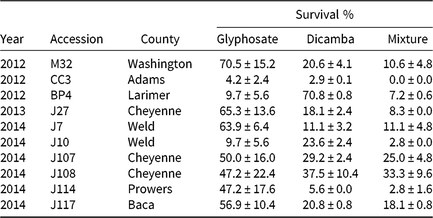
Following initial greenhouse screenings, a subset of accessions with resistance to both glyphosate and dicamba was screened with a tank mixture of glyphosate plus dicamba to evaluate survival (Table 1). This tank-mix screening showed that individual kochia plants from accessions that had both glyphosate and dicamba resistance were able to survive a simultaneous application of both herbicides. On average, 12% (± 3.4%) of individuals in the tested multiple-resistant accessions were resistant to the tank mixture of glyphosate and dicamba. Individual survival was typically equal to the lower of the two separate resistance frequencies for glyphosate or dicamba alone (Table 1). For example, in 2014, population J7 survival was equal to the frequency of dicamba resistance in the population, which was lower than the frequency of glyphosate resistance in the population (Table 1). With population BP4 in 2012, tank mixture survival was limited by the level of glyphosate resistance in the population (Table 1). The presence of glyphosate and dicamba multiple-resistant kochia presents a major challenge for kochia management, both in chemical fallow and in Roundup Ready Xtend soybean.
Kochia accession survival to glyphosate, dicamba, and mixture of the two herbicides.

Similar surveys with GR kochia have been conducted to determine the frequency of GR kochia in Alberta, Saskatchewan, and Manitoba (Beckie et al. Reference Beckie, Gulden, Shaikh, Johnson, Willenborg, Brenzil, Shirriff, Lozinski and Ford2015; Hall et al. Reference Hall, Beckie, Low, Shirriff, Blackshaw, Kimmel and Neeser2014) and of dicamba-resistant kochia from Nebraska (Crespo et al. Reference Crespo, Bernards, Sbatella, Kruger, Lee and Wilson2014) and Alberta (Beckie et al. Reference Beckie, Hall, Shirriff, Martin and Leeson2019). The majority of GR kochia accessions identified in Canadian surveys found that GR kochia occurred in areas with chemical fallow as part of the cropping system rotation, and nearly all GR-kochia accessions were also resistant to ALS herbicides (Beckie et al. Reference Beckie, Gulden, Shaikh, Johnson, Willenborg, Brenzil, Shirriff, Lozinski and Ford2015; Hall et al. Reference Hall, Beckie, Low, Shirriff, Blackshaw, Kimmel and Neeser2014). The initial GR-kochia surveys in western Canada showed that GR-kochia accessions were completely susceptible to dicamba (Beckie et al. Reference Beckie, Gulden, Shaikh, Johnson, Willenborg, Brenzil, Shirriff, Lozinski and Ford2015; Hall et al. Reference Hall, Beckie, Low, Shirriff, Blackshaw, Kimmel and Neeser2014), with dicamba resistance reported from Saskatchewan in 2015 (Heap Reference Heap2019). A subsequent survey in Alberta in 2017 found that glyphosate resistance had increased to 50% of accessions; dicamba resistance was found in 18% of accessions, and 10% of accessions were resistant to glyphosate, dicamba, and ALS-inhibiting herbicides (Beckie et al. Reference Beckie, Hall, Shirriff, Martin and Leeson2019). In the 2017 Alberta survey, glyphosate resistance was present in chemical fallow and had expanded to multiple crops and non-crop areas such as oil well sites (Beckie et al. Reference Beckie, Hall, Shirriff, Martin and Leeson2019). We did not screen for ALS-inhibitor resistance in our survey, as ALS-inhibitor resistance is widespread and Colorado growers do not typically use Group 2 herbicides for kochia control. Our survey data from Colorado demonstrated an occurrence of dicamba resistance and multiple (dicamba and glyphosate) resistance that was similar to the 2017 Alberta survey. As in the Canadian surveys, the majority of kochia accessions screened in our study were collected in chemical-fallow cropping systems.
Inheritance of glyphosate resistance due to EPSPS gene amplification in kochia follows a single-gene pattern, due to the linked inheritance of the tandemly duplicated EPSPS genes (Jugulam et al. Reference Jugulam, Niehues, Godar, Koo, Danilova, Friebe, Sehgal, Varanasi, Wiersma, Westra, Stahlman and Gill2014). GR accessions in eastern Colorado and western Kansas have previously been shown to have increased EPSPS gene copy number (Gaines et al. Reference Gaines, Barker, Patterson, Westra, Westra, Wilson, Jha, Kumar and Kniss2016; Godar et al. Reference Godar, Stahlman, Jugulam and Dille2015; Wiersma et al. Reference Wiersma, Gaines, Preston, Hamilton, Giacomini, Buell, Leach and Westra2015). One GR-kochia population from Canada was found to have fitness costs for increased EPSPS copy number and glyphosate resistance (Martin et al. Reference Martin, Benedict, Sauder, Wei, da Costa, Hall and Beckie2017), whereas a different kochia population did not have apparent fitness costs for glyphosate resistance (Kumar and Jha Reference Kumar and Jha2015b). GR kochia accessions from the United States and Canada generally had slower germination and growth rates than glyphosate-susceptible accessions, with some GR accessions having germination and growth rates similar to glyphosate-susceptible popualtions (Beckie et al. Reference Beckie, Blackshaw, Leeson, Stahlman, Gaines and Johnson2018). GR kochia accessions from Kansas had slower germination and reduced seed longevity compared to glyphosate-susceptible kochia accessions but exhibited no differences in plant growth characteristics (Osipitan and Dille Reference Osipitan and Dille2017).
Currently, dicamba resistance is known to have evolved in six different dicot species, and dicamba-resistant kochia has been reported in six different states in the US Midwest and in Saskatchewan, Canada (Cranston et al. Reference Cranston, Kern, Hackett, Miller, Maxwell and Dyer2001; Crespo et al. Reference Crespo, Bernards, Sbatella, Kruger, Lee and Wilson2014; Heap Reference Heap2019; Howatt et al. Reference Howatt, Westra and Nissen2006; Jha et al. Reference Jha, Kumar and Lim2015; Varanasi et al. Reference Varanasi, Godar, Currie, Dille, Thompson, Stahlman and Jugulam2015). Interestingly, dicamba applied PRE can control accessions resistant to dicamba applied POST (Ou et al. Reference Ou, Thompson, Stahlman and Jugulam2018). Compared to herbicide classes such as ALS and PSII inhibitors, synthetic auxin resistance is much less common, even though members of this herbicide mode-of-action group have been used for >70 yr (Busi et al. Reference Busi, Goggin, Heap, Horak, Jugulam, Masters, Napier, Riar, Satchivi, Torra, Westra and Wright2018). The relatively lower occurrence of dicamba resistance may be due to an initial low frequency of resistant individuals (resistant alleles) in natural weed accessions; also, mutations that confer resistance may be associated with substantial fitness costs (Jasieniuk et al. Reference Jasieniuk, Morrison and Brûlé-Babel1995). Differences in use patterns could also potentially influence the rate of resistance increase for dicamba compared to ALS or PSII inhibitors. Relative to ALS and PSII inhibitors, dicamba is more likely to be applied in a mixture with additional herbicides, typically 2,4-D and ALS-inhibiting herbicides and especially in small-grain cropping systems, which would reduce the selection pressure for dicamba resistance (Cranston et al. Reference Cranston, Kern, Hackett, Miller, Maxwell and Dyer2001).
Dicamba resistance in a kochia population from western Nebraska is due to a mutation in the auxin co-receptor IAA16 (LeClere et al. Reference LeClere, Wu, Westra and Sammons2018), with evidence to suggest the mutation has a fitness cost for growth rate and seed production. This population did not have any change in dicamba metabolism, but it did have reduced dicamba translocation to shoots (Pettinga et al. Reference Pettinga, Ou, Patterson, Jugulam, Westra and Gaines2018). Dicamba resistance in this kochia population is inherited as a single dominant allele (Preston et al. Reference Preston, Belles, Westra, Nissen and Ward2009). Dicamba resistance in a different kochia population from Montana has been suggested to be caused by mutations in the auxin receptor(s), which may affect endogenous auxin binding and alter auxin-mediated responses such as gravitropism and root growth inhibition (Goss and Dyer Reference Goss and Dyer2003). Dicamba-resistant kochia from Montana had lower germination and reduced seed production, indicative of fitness costs for dicamba resistance (Kumar and Jha Reference Kumar and Jha2016). The relatively lower occurrence of dicamba-resistant kochia in Colorado, along with the lack of increase in frequency over time, suggest that a fitness cost could be limiting the spread of dicamba resistance in the state.
Recently there have been reports of fluroxypyr-resistant kochia that has 1.4- to 5.7-fold resistance relative to fluroxypyr-susceptible kochia (Jha et al. Reference Jha, Kumar and Lim2015). A dicamba-resistant population from Saskatchewan was reported to have a low level of resistance to fluroxypyr (Beckie et al. Reference Beckie, Hall, Shirriff, Martin and Leeson2019; Heap Reference Heap2019). A dicamba-resistant population with the IAA16 co-receptor mutation was reported to be cross-resistant to fluroxypyr (LeClere et al. Reference LeClere, Wu, Westra and Sammons2018); however, we did not observe fluroxypyr resistance in dicamba-resistant accessions in this survey. This observation may indicate that different resistance mechanisms that do not confer cross-resistance to fluroxypyr are present in the dicamba-resistant kochia accessions sampled in this survey. Dose–response studies have demonstrated that kochia biotypes from North Dakota had up to a 6-fold resistance to fluroxypyr relative to a susceptible population, and fluroxypyr doses >1,120 g ha–1 were needed for 90% control of those accessions (Howatt and Ciernia Reference Howatt and Ciernia2014). Although there have been reports of fluroxypyr-resistant kochia dating back to 1994 in Montana (Heap Reference Heap2019), currently there are no studies that have evaluated physiological, biochemical, or molecular aspects of fluroxypyr-resistant kochia. Fluroxypyr use patterns including restrictions for in-crop applications may limit selection pressure relative to dicamba, which can be used for in-crop, chemical-fallow, and post-harvest applications resulting in greater selection pressure for resistance evolution (Jha et al. Reference Jha, Kumar and Lim2015).
Based on results from this 4-yr survey, it is evident that both glyphosate- and dicamba-resistant kochia accessions are widely present in Colorado. Fall collections of seeds from kochia individuals that survived the growing season within crop fields could bias accessions toward having a greater probability of being herbicide resistant, but the widespread distribution of herbicide-resistant kochia shows the extent of this problem in eastern Colorado. The frequency and distribution of kochia accessions resistant to glyphosate and dicamba have remained relatively constant over this 4-yr period (Figure 3). Multiple resistance to both glyphosate and dicamba can co-occur in a single individual and can confer resistance to applications of the individual herbicides, as well as tank mixtures of glyphosate and dicamba. With the detection of both glyphosate and dicamba resistance in kochia from Colorado, fluroxypyr along with PRE herbicides and contact POST herbicides such as glufosinate and paraquat are important for controlling accessions that have now evolved multiple resistance to ALS inhibitors, glyphosate, and dicamba. Further research evaluating the inheritance and fitness costs associated with glyphosate and dicamba resistance in kochia can provide insight into how these factors influence herbicide-resistance evolution (Kumar et al. Reference Kumar, Jha, Jugulam, Yadav and Stahlman2019). Over-reliance on glyphosate and synthetic auxin herbicides for kochia control should be avoided to maintain the utility of these important kochia herbicides where susceptibility remains. Proactive integrated weed management strategies are needed to slow or delay further herbicide-resistance evolution in kochia.
Acknowledgments
The authors thank Jim Daniel for his assistance collecting the seed accessions. This work was supported by the Colorado Wheat Administrative Committee, by the Colorado Wheat Research Foundation, by BASF, by Dow AgroSciences, and by the USDA National Institute of Food and Agriculture, Hatch project COL00719 to the Colorado State University Agricultural Experiment Station.
Conflicts of interest
No conflicts of interest have been declared.