Implications
A meta-analysis of the literature data obtained from different experimental conditions was performed to obtain a quantitative synthesis of the responses to immunocastration. Boar taint compounds are significantly reduced in immunocastrates, and yet remain slightly higher than that in surgical castrates (SC). Immunocastrates are less efficient, fatter but grow more rapidly and may have better meat quality than entire males (EM). Compared with SC, they have superior performance with no difference in meat quality. It is more economical to fatten immunocastrates than SC; yet, production costs and carcass quality are less favourable than that of EM.
Introduction
Surgical castration of male piglets is a traditional practice used to avoid boar taint, an unpleasant odour and flavour of meat from entire male (EM) pigs that has been ascribed to the presence of androstenone (Patterson, Reference Patterson1968) and skatole (Vold, Reference Vold1970; Walstra and Maarse, Reference Walstra and Maarse1970). Androstenone is a testicular steroid producing a urine-like smell, whereas skatole has a faecal-like odour and is produced by bacteria in the large intestine. Recently, the citizen concern on animal welfare has been exerting increasing pressure on pig producers to stop surgical castration without anaesthesia because it is painful for the animal. A ban on surgical castration without pain relief is already enforced in Norway, Switzerland and the Netherlands and is also under consideration by the European Union. The alternatives currently under consideration include surgical castration with anaesthesia and/or analgesia, raising EM, sperm sexing and immunocastration (attitude, practices and state of the art regarding piglet castration in Europe; PIGCAS, 2009). The latter method is a vaccination against the gonadotrophin-releasing hormone (GnRH), which induces the formation of specific antibodies that bind and neutralize GnRH, and thus disrupt the hypothalamic–pituitary–gonadal axis. Early studies, using experimental vaccines, demonstrated the effectiveness of immunocastration to prevent sexual development and occurrence of boar taint (Caraty and Bonneau, Reference Caraty and Bonneau1986; Falvo et al., Reference Falvo, Chandrashekar, Arthur, Kuenstler, Hasson, Awoniyi and Schanbacher1986; Awoniyi et al., Reference Awoniyi, Chandrashekar, Arthur, Schanbacher, Amador and Falvo1988). The first commercial product for immunocastration of male pigs (Improvac®) has been released in Australia and New Zealand in 1998 and since then has been registered in 53 countriesslt, including the European Union in 2009. Although it is widely used in Australia, New Zealand and Brazil, its use in Europe is still under intensive testing in view of local conditions and consumer acceptability. In addition to the effectiveness of immunocastration to prevent sexual development and boar taint, the published studies indicate better production performance (i.e. growth rate, feed intake, feed efficiency and leanness) of immunocastrated pigs compared with surgical castrates (SC; for review see Millet et al., Reference Millet, Gielkens, De Brabander and Janssens2011). However, the results are not always consistent and factors associated with the different studies can interfere with the effect of immunocastration. Meta-analysis is a research methodology to integrate and to quantify experimental results of different origins. The aim of this study was to assess the magnitude and heterogeneity of the effects of immunocastration in pigs through a meta-analysis of currently available research results, focussing on performance, carcass characteristics, meat quality, reproductive organs and boar taint substances.
Material and methods
Data collection
The search for articles was carried out using the bibliographic databases Web of Science (http://www.isiwebofknowledge.com/), CAB Direct (http://www.cabdirect.org/) and the internet. Only studies published before July 2011 were considered. To be included in the meta-analysis, studies had to be original research work reporting the mean and variability (per treatment group or pooled) of the response traits. Because of these conditions, many studies published only as abstracts at congresses were not included. Pooled within-study standard deviations were calculated from the reported variabilities that were expressed in different ways (e.g. standard error, standard error of mean, standard error of difference, least significant difference). Calculations were made according to Saville and Rowarth (Reference Saville and Rowarth2008). Only the studies that provided the results for the treatment group (immunocastrated males, IM) and at least one of the control groups (EM and/or SC) were considered. When several independent experiments were reported within an article, they were considered as separate studies. When other treatments were applied in addition to immunocastration within a study (e.g. ractopamine, somatotrophin, different stages of immunization, different adjuvants, different types of the vaccine, different doses, different energy levels of the diet, different vaccination protocols, different periods between revaccination and slaughter; see Supplementary Table S1), these treatments and their relevant controls were also considered as separate studies. The complete database thus consisted of 68 ‘experiments’ from 41 articles, involving 7288 pigs (n = 3483 IM, n = 1162 EM and n = 2643 SC). The meta-analysis was performed only for those traits for which a sufficient number of studies (n ⩾ 5) was available, with the exception of the weights of the belly, shoulder, bulbourethral glands (n = 4), seminal vesicle weight (n = 3) and shear force (n = 2) in the comparison between immunocastration treatment (IC) and SC. Growth rate, feed intake and feed efficiency were considered for three periods: from the first vaccination (V1) to the second vaccination (V2), from V2 to slaughter (S) and for the overall fattening (experimental) period (V1 to S). Carcass traits included dressing percentage, longissimus dorsi (LD) muscle thickness, subcutaneous backfat thickness, lean meat percentage and weights of the carcass prime cuts (i.e. loin, ham, belly and shoulder). The value of pH measured 24 h post mortem (pH24), CIE colour measurements (L*, a*, b*), water holding capacity assessed as drip loss, shear force and intramuscular fat content were the meat quality traits considered in the meta-analysis. Boar taint compounds included skatole and androstenone levels in fat. Regarding reproductive organs, the weights and lengths of testes and bulbourethral glands and seminal vesicle weight were compared between IC and EM, whereas IC and SC were compared only for bulbourethral gland and seminal vesicle weight.
Meta-analysis
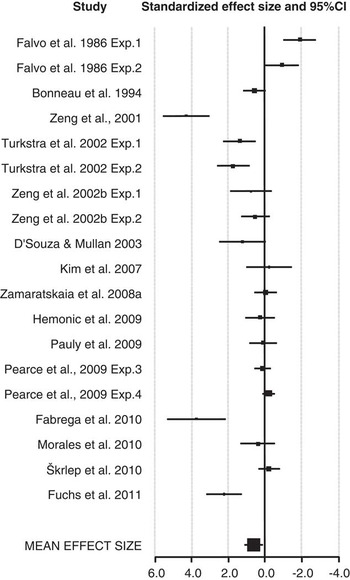
The effect of the immunocastration on the studied traits was evaluated using the effect size method (Borenstein et al., Reference Borenstein, Hedges and Rothstein2007), which allows the comparison of two populations. For each variable, the standardized effect size (θ) was calculated as the difference between the treatment (IC) and control groups (EM or SC) divided by its pooled standard deviation (s.d.). The effect size method requires information on intra-study variability for the computation of a weighted mean, with more weight given to studies with lower variation and vice versa. The effect size was calculated according to a random model, which assumes that the studies were drawn from populations that differ from each other in ways that could have an impact on the treatment effect (e.g. early or late immunization, ractopamine or somatotrophin treatment, energy level of the diet). The forest plot of effect sizes for average daily gain (ADG) in the period V1 to S (comparison between IC and EM) is given in Figure 1 to illustrate the variation within a study and the weight given to each study. The heterogeneity or between-studies variability was assessed using Cochran's Q χ 2 test. However, as the Q statistic does not provide information on the extent of true heterogeneity (only on its significance), the I 2 statistic was calculated, which denotes the percentage of the total variability, that is, due to between-studies variability (Higgins and Thompson, Reference Higgins and Thompson2002). All calculations were made according to Borenstein et al. (Reference Borenstein, Hedges and Rothstein2007). It should be mentioned that in some cases (e.g. shear force for comparison IC to SC) the number of studies was very small, which may represent a problem for estimating between-studies variance and consequently draw any firm conclusions. However, in such cases, the effect size was insignificant and therefore not considered and discussed.
Forest plot of immunocastration effect (comparison with entire males) on average daily gain from the first vaccination to slaughter.

Results
The importance of immunocastration effect with regard to the studied traits
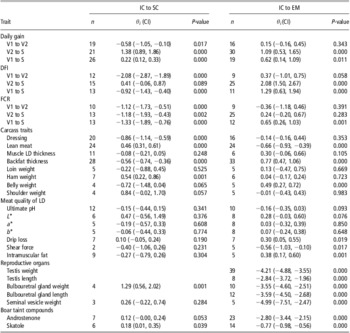
The magnitude of the effect of immunocastration is given in Table 1 and this magnitude was different for different traits of interest. The strongest impact (effect size ranging from −2.8 to −5.0) was observed for reproductive organs and androstenone concentration (comparison IC v. EM). High values for effect size (absolute value >0.8) were also observed for certain traits of performance, whereas low (absolute value <0.4) to moderate effect sizes (absolute value in the range of 0.4 to 0.8) were observed for carcass and meat quality traits.
Summary of meta-analysis (effect size) for IC compared with the SC or EM

IC = immunocastration treatment; SC = surgical castrates; EM = entire males.
θ i = mean effect size calculated according to random effect model; CI = 95% confidence interval; V1 = first vaccination; V2 = second vaccination; S = slaughter; LD = longissimus dorsi muscle; L*a*b* are colorimetric parameters.
Performance
Effect sizes for ADG, daily feed intake (DFI) and feed conversion ratio (FCR; Table 1) were derived from 29 references (Supplementary Table S1) that dealt with the effect of the immunocastration in comparison with SC or EM.
The comparison of IC and EM
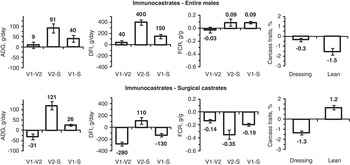
There was no significant difference in performance between IC and EM in the period between the two vaccinations (V1 and V2). However, growth rate tended to be greater in IC than in EM (P = 0.058). After the second vaccination (V2 to S), IC consumed more and grew faster than EM. Considering the overall period (V1 to S), consumed more and grew faster than EM but had a higher FCR. The comparison of effect sizes between traits demonstrates that the largest difference between IC and EM pertains to the higher feed intake of IC after the second vaccination. For illustration, the non-standardized (raw) differences in performance traits between IC and EM are given in Figure 2. In general, the heterogeneity of the results as estimated by the Q statistic was significant (P < 0.10 for DFI and for ADG in the period V1 to V2; P < 0.05 for the other traits; data not shown). The I 2, denoting the degree of variability between studies, ranged from 40% to 90% (data not shown). The heterogeneity of the results is also illustrated in the forest plot for ADG in the period V1 to S (Figure 1).
Unstandardized (raw) differences between immunocastrates and entire males or surgical castrates (SC) for average daily gain (ADG), average daily feed intake (DFI), feed conversion ratio (FCR) and carcass traits (dressing %, lean meat %).

The comparison of IC and SC
In the period (V1 to V2) before the second vaccination, IC consumed and grew less, and had a lower FCR than SC. After the second vaccination (V2 to S), IC tended to have a higher feed intake and had a higher growth rate and lower FCR than SC. Considering the overall fattening period (V1 to S), IC consumed much less, grew faster and had a lower FCR than SC. The comparison of effect sizes between the traits shows that the biggest difference between IC and SC pertains to the lower feed intake in the period before immunization. The comparison of IC and SC is further illustrated by the non-standardized differences shown in Figure 2. The heterogeneity of the results of different studies was significant and high (I 2 > 75%, data not shown), except for daily gain for the overall fattening period (I 2 = 16%).
Carcass traits
Effect sizes for carcass traits (Table 1) were calculated on data gathered from 30 studies (Supplementary Table S1). The majority of studies dealt with dressing percentage, backfat thickness and lean meat percentage. Studies reporting more detailed data on carcass body composition or prime cuts were scarce.
The comparison of IC and EM
Compared with EM, IC pigs had a greater backfat thickness, resulting in lower carcass lean meat percentage. Concerning the carcass prime cuts, IC pigs were similar to EM, except for belly weight, which was higher in IC. The comparison of effect sizes between carcass traits shows that the most important difference between IC and EM concerns body fatness. Non-standardized trait differences given in Figure 2 also illustrate this difference. In general, the heterogeneity of the results of different studies was significant, except for ham and belly weight, and the I 2 ranged from 0% to 93% (data not shown).
The comparison of IC and SC
Compared with SC, dressing percentage was lower for IC. In contrast, IC pigs were leaner (lower backfat thickness and higher lean meat percentage). Concerning the prime cuts, IC pigs had heavier ham and shoulder weights (P = 0.06) but lower belly weight (P = 0.07). The comparison of the effect size shows the greatest impact on dressing percentage and shoulder weight. The differences between IC and SC are further illustrated in Figure 2 for non-standardized traits. The heterogeneity among studies was significant and high (58% <I 2 <93%), except for LD muscle thickness (I 2 = 31%; data not shown).
Meat quality
Data for the calculation of effect sizes for pH24, CIE colour measurements (i.e. L*, a*, b*), drip loss, shear force and intramuscular fat content were obtained from 12 studies (Supplementary Table S1) and results are presented in Table 1.
The comparison of IC and EM
The higher drip loss observed for IC compared with EM is consistent with the slightly lower pH24 and higher L* values (P < 0.10). In contrast, intramuscular fat content was higher and shear force was lower in IC than in EM. Regarding meat quality traits, the largest effect size was observed for shear force. The heterogeneity of studies was mostly insignificant and moderate (I 2 < 55%; data not shown).
The comparison of IC and SC
Differences between IC and SC were not significant for any of the meat quality traits. The heterogeneity of studies was significant for pH24, colour values L*, a* and intramuscular fat, with I 2 varying from 12% to 96% (data not shown).
Reproductive organs and boar taint compounds
Studies addressing the development of reproductive organs were the most abundant (Supplementary Table S1). Among 41 investigated studies, 26 reported reproductive organ size or weight, mostly testes weight, whereas 15 studies presented data for the concentration of boar taint compounds (Table 1).
The comparison of IC and EM
Effect size for the weights of testes and accessory sex glands indicated drastic regression of reproductive organs in IC pigs. The most marked effect was noted for the seminal vesicle, followed by testis and the bulbourethral gland, as also confirmed by the non-standardized differences that indicated a 87%, 65% and 66% weight reduction for the respective organs. Because of immunocastration, levels of androstenone and skatole were also strongly reduced. However, the impact was more important for androstenone than for skatole. The heterogeneity of the results from different studies was significant and high for reproductive organs and androstenone concentration (I 2 > 90%) and low for skatole concentration (I 2 < 40%; data not shown).
The comparison of IC and SC
With regard to the accessory sex glands, the comparison of IC and SC indicated a strong effect size for the bulbourethral gland, but not for the seminal vesicles. Although the effect sizes for androstenone and skatole concentrations were small (0.12 and 0.18, respectively), they were significant (P = 0.05 and P = 0.04, respectively). The heterogeneity of data was low (I 2 < 40%) for both substances (data not shown).
Discussion
Immunocastration is a new, alternative technique to control boar taint. As indicated by the review of Millet et al. (Reference Millet, Gielkens, De Brabander and Janssens2011), immunocastration alters animal performance, but the results are not always consistent. This is why we carried out a quantitative analysis of available results, using all relevant published information to date, in order to compare and quantify the importance of the effects for different traits.
Performance
Before the second vaccination, IC appeared to be (physiologically) similar to EM, with mostly no difference in performance. However, feed intake tended to be higher in IC than in EM. This could be explained with an early response to the vaccination. Indeed, Turkstra et al. (Reference Turkstra, van Diepen, Jongbloed, Oonk, van de Wiel and Meloen2002) observed that in some pigs (qualified as early responders), LH and testosterone levels were reduced after V1. After the second vaccination, IC produce a large quantity of antibodies, sufficient for the neutralization of all secreted GnRH. Within 5 days, LH and steroid secretions are suppressed and the metabolism adapts in 7 days (Claus et al., Reference Claus, Lacorn, Danowski, Pearce and Bauer2007). As a result, major performance changes occur in IC after V2. The largest effect is a drastic increase in feed intake compared with EM, in relation with the sharp reduction in the production of androgens and oestrogens, which are known to negatively affect feed intake (Claus and Weiler, Reference Claus and Weiler1987). Cronin et al. (Reference Cronin, Dunshea, Butler, McCauley, Barnett and Hemsworth2003) observed that IC had spent more time eating after V2, possibly in relation with their reduced sociosexual behaviour.
Our analysis shows that feed intake after V2 is also slightly higher in IC compared with SC. A possible explanation for this effect pertains with leptin. Because IC pigs are leaner than SC at the time of V2, they may have lower circulating levels of leptin (Ramsay et al., Reference Ramsay, Yan and Morrison1998), which is known to be an inhibitor of feed intake (Houseknecht et al., Reference Houseknecht, Baile, Matteri and Spurlock1998; Ramsay, Reference Ramsay1999). The faster growth of IC compared with SC results to a small extent not only from the increased intake, but also, and mostly, from a much better feed efficiency demonstrated by the lower FCR. It could be hypothesized that the better feed efficiency of IC relative to SC results from the fact that immunocastration does not impair growth hormone (GH) secretion compared with EM, whereas it is much lower in SC (Metz and Claus, Reference Metz and Claus2003). However, the secretion of IGF1, which is the real active hormone mediating the effect of GH on growth and feed efficiency, is impaired in IC relative to EM (Metz and Claus, Reference Metz and Claus2003; Brunius et al., Reference Brunius, Zamaratskaia, Andersson, Chen, Norrby, Madej and Lundström2011). Compared with SC, IGF1 levels of IC were found similar (Metz and Claus, Reference Metz and Claus2003) or higher (Brunius et al., Reference Brunius, Zamaratskaia, Andersson, Chen, Norrby, Madej and Lundström2011). It can be argued, however, that because circulating IGF1 has a long half-life (Claus et al., Reference Claus, Lacorn, Danowski, Pearce and Bauer2007) and because high feed intake stimulates IGF1 secretion (Bauer et al., Reference Bauer, Lacorn, Danowski and Claus2008), IGF1 decreases only slowly after the second vaccination is fully effective, which occurs only 1 week after the second injection (Claus et al., Reference Claus, Lacorn, Danowski, Pearce and Bauer2007). Therefore, there is a transient period after the second vaccination when the IC still benefits from higher IGF1 levels, resulting in better feed efficiency and higher feed intake, and thus resulting in faster growth.
Overall for the whole fattening period (V1 to S), IC are much more efficient than SC (because they behave like EM before the second vaccination and also some time after) but less efficient than EM because they are slaughtered much after the transient period is finished, when IC behave more or less like EM.
Carcass traits
Dressing percentage of EM is usually slightly lower than that of barrows or gilts (Babol and Squires, Reference Babol and Squires1995), mostly because of the weight of the genital tract. In that respect, IC seem to differ from SC, but not from EM. Although the total weight of the reproductive organs is lower in IC compared with EM, it is still higher than that in SC because the testes are still present and the accessory sex glands have not regressed to the same extent as in SC. Moreover, there are other factors that can explain impaired dressing percentage in IC, such as increased abdominal fat (Škrlep et al., Reference Škrlep, Šegula, Zajec, Kastelic, Košorok, Fazarinc and Čandek-Potokar2010a and Reference Škrlep, Šegula, Prevolnik, Kirbiš, Fazarinc and Čandek-Potokar2010b) and higher weights of intestinal tract, kidneys and liver (Pauly et al., Reference Pauly, Spring, O'Doherty, Kragten and Bee2009; Gispert et al., Reference Gispert, Àngels Oliver, Velarde, Suarez, Pérez and Font i Furnols2010).
As discussed above, the hormonal status of the IC is similar to that of the EM for most of the fattening period, except for the last few weeks before slaughter, when the transient period after the second vaccination is finished. This is why lean content in IC is intermediate between those in EM and SC. As could be expected, backfat thickness in IC increases with the time between V2 and slaughter (Lealiifano et al., Reference Lealiifano, Pluske, Nicholls, Dunshea, Campbell, Hennessy, Miller, Hansen and Mullan2011). IC submitted to an early vaccination schedule (Falvo et al., Reference Falvo, Chandrashekar, Arthur, Kuenstler, Hasson, Awoniyi and Schanbacher1986) or exhibiting a response after the first vaccination (early responders described by Turkstra et al., Reference Turkstra, van Diepen, Jongbloed, Oonk, van de Wiel and Meloen2002) may actually be fatter than SC.
The heavier belly weight in IC than in EM is consistent with the higher fat content of the carcass. The higher ham and shoulder weights and the lower belly weight in IC compared with SC can be ascribed to the fact that muscles of the fore and hind limbs develop earlier in life than muscles of posture (e.g. loin, belly muscles) and may be less affected by the reduced anabolic potential after immunocastration (Pauly et al., Reference Pauly, Spring, O'Doherty, Kragten and Bee2009).
Meat quality
The synthesis of published data on meat quality as affected by the immunocastration shows that IC do not differ from SC, whereas IC present some advantages over EM, namely higher intramuscular fat content and lower shear force. Higher intramuscular fat content has been a consistent finding in all five studies and could partly explain the lower shear force (van Laack et al., Reference van Laack, Stevens and Stalder2001). Another possible explanation pertains with the much increased growth rate in the weeks before slaughter, resulting in enhanced protein turnover in vivo, and hence increased proteolysis post mortem (Therkildsen et al., Reference Therkildsen, Vestergaard, Busk, Jensen, Riis, Karlsson, Kristensen, Ertbjerg and Oksbjerg2004; Lametsch et al., Reference Lametsch, Kristensen, Larsen, Therkildsen, Oksbjerg and Ertbjerg2006). Compensatory growth has been proposed to have a positive effect on pork tenderness (Kristensen et al., Reference Kristensen, Therkildsen, Riis, Sorensen, Oksbjerg, Purslow and Ertbjerg2002).
However, IC also have some disadvantages compared with EM, including a higher drip loss, which is consistent with a tendency for lower ultimate pH and higher L value. The lower ultimate pH is consistent with the reduced aggressive behaviour and physical activity of IC (Cronin et al., Reference Cronin, Dunshea, Butler, McCauley, Barnett and Hemsworth2003). Increased activity in EM is indeed known to result in higher ultimate pH (Sather et al., Reference Sather, Jones, Squires, Schaefer, Robertson, Tong and Zawadski1995) because muscle glycogen is depleted to a greater extent before slaughter.
Because of the limited number of available data, more studies are needed to confirm the positive influence of immunocastration on meat quality.
Reproductive organs and boar taint compounds
Immunocastration results in a dramatic regression of the genital tract. This has been shown in all studies, despite the high heterogeneity between studies because of variation in vaccination protocols. The effects on reproductive organs are indeed larger for early vaccination than for late vaccination. The meta-analysis shows that the largest reduction is observed for seminal vesicle weight, which supports the suggestion of Bonneau (Reference Bonneau2010) to use this as a diagnostic tool to assess the success of immunization at slaughter. This outcome can be related to their anatomical structure of liquid-containing vesicles, which can be quickly resorbed. The other accessory glands and testes have a more firm structure and thicker walls and they take more time to regress (Bonneau, Reference Bonneau2010). This can also explain why bulbourethral glands are larger in IC than in SC, whereas no difference is observed for seminal vesicles. Regression of the reproductive tract is consistent with loss of functional activity as shown by histological observations (Falvo et al., Reference Falvo, Chandrashekar, Arthur, Kuenstler, Hasson, Awoniyi and Schanbacher1986; Grizzle et al., Reference Grizzle, Esbenshade and Johnson1987; Awoniyi et al., Reference Awoniyi, Chandrashekar, Arthur, Schanbacher, Amador and Falvo1988). Immunocastration reduces the mean diameter of the seminiferous tubules, the number of spermatogonia and spermatocytes, induces atrophy of the Leydig and reduces the weight of gland tissues and secretory products of accessory sexual glands. These changes were shown to be dependent on the time of immunization (Einarsson et al., Reference Einarsson, Brunius, Wallgren, Lundström, Andersson, Zamaratskaia and Rodriguez-Martinez2011; Kubale et al., Reference Kubale, Fazarinc, Batorek, Škrlep, Šegula, Bonneau and Čandek-Potokar2011).
The impairment of testis functionality is also apparent from the reduction of boar taint compounds. These are reduced substantially in IC as compared with EM, although the elimination is not fully complete, as shown by the small but significant differences between IC and SC for both skatole and androstenone. A first possible explanation could be that in some studies, the relatively short time between V2 and slaughter was insufficient for complete elimination of androstenone and skatole from the fat depots. This is, however, unlikely because the half-life of these compounds in fat is short (Claus, Reference Claus1976; Bonneau et al., Reference Bonneau, Meusy-Dessolle, Léglise and Claus1982; Friis, Reference Friis1993) compared with the time interval between full effectiveness of the second vaccination and slaughter. Another explanation is that some animals do not react to the vaccination, or have not been correctly vaccinated. The so-called non-responders have been identified by Zeng et al. (Reference Zeng, Turkstra, Meloen, Liu, Chen, Schaaper, Oonk, Guo and van de Wiel2002a), Jaros et al. (Reference Jaros, Bürgi, Stärk, Claus, Hennessy and Thun2005) and Hilbe et al. (Reference Hilbe, Jaros, Ehrensperger, Zlinszky, Janett, Hässing and Thun2006).
Acknowledgements
The study has been cofinanced by the grants of Slovenian Research Agency (ARRS) through research programme P4-0072 and PhD scholarship of Nina Batorek and partly by the Slovenian Ministry of Agriculture, Forestry and Food. The financing of bilateral cooperation between France and Slovenia (programme Proteus) by EGIDE and ARRS is also acknowledged.
Supplementary materials
For supplementary material referred to in this article, please visit http://dx.doi.org/doi:10.1017/S1751731112000146