Introduction
The power of African music to critically engage new experiences is demonstrated in its active and continuing responsiveness to the historical and power dynamics of colonialism. However, the conception of music as narratives of everyday life and as a medium for interrogating the politics of marginalisation often reflects uneasy choices. African musicians, for example, often must balance the need to position themselves as beneficiaries of global cosmopolitan networks with the mandate to critically engage the social and political ruptures precipitated by global forces. It should not be surprising that the complex impact of colonialism manifests in the musical forms it generated, defined by multiple styles and ironic syntaxes. Disrupting social and political systems across Africa and undermining its civilisations and self-dignity, colonial rule triggered musical responses that interrogated the issues of identity and the competing notions of modernity. The overlaps between precolonial, colonial, and post-colonial eras in terms of the social and political experiences that define them provide the background for my interrogation of what I characterise as the African musical postcolony. Focusing on selected examples, I examine the musical emblems of the phenomenon by analysing how musicians of various generations have grappled with the issue of power through their music against the background of colonial rule and its impact. My discussion links musical form, styles, and biographies to social and political developments and actions.
Of relevance to my discussion are the concepts of nationalism, cosmopolitanism, and decoloniality. Nationalism manifests on many levels. It could exist as a “sentiment” functioning as a means of rallying together a community and identifying it in exclusive terms. It could also manifest indexically as “cultural symbols, ideas and beliefs” that identify a group of people and support movements and actions of political resistance.Footnote 1 The use of cultural forms like music and theatre as a tool of resistance and self-preservation represents a form of cultural nationalism in many parts of Africa, beginning from the colonial era when the reclaim of indigenous cultural practices provided a fillip for anti-colonial activities and a means for consolidating political freedom following flag independence. However, how to recall culture has often generated significant debate between those who propose a binary-oriented rejection of European elements and those who opt for a pragmatic approach that is open to embracing syncretic musical styles, as I explain below.
Although the terms decoloniality and decolonisation have been used interchangeably to characterise acts intended to redress or reverse the negative impact of colonial domination, they are both informed by the need to engage with the historicity of colonial power. As Walter D. Mignolo explains, the main goals of decoloniality “are to delink in order to re-exist, which implies relinking with the legacies one wants to preserve in order to engage in modes of existence with which one wants to engage.”Footnote 2 But decoloniality or decolonisation must be subjected to the pragmatics of the temporal continuity and overlaps that define the pre-colonial, colonial, and postcolonial history of the African continent—an issue which brings me to the very notion of postcolony, which Achille MbembeFootnote 3 has theorised in ways that are helpful for my interrogation of the Africanist musical postcolony. As he explains, the postcolony represents “several temporalities.”Footnote 4 It is “neither a linear time nor a simple sequence in which each moment effaces, annuls, and replaces those that preceded it, to the point where a single age exists within each society. This time is not a series but an interlocking of presents, pasts, and futures, each age bearing, altering, and maintaining the previous ones.”Footnote 5 As I show in my analysis, this reality—the entangled and overlapping relationships that mark the multiple phases of African history —is attested to in the ways African musicians have engaged with the issues of power and the politics of difference since the colonial era.
With musical expressions in mind, a critical question is triggered by the dual claims of cosmopolitanism, regarding its support for “particular human life” as well as the “obligations to others.”Footnote 6 What, for example, are the real prospects of achieving an equitable representation of global humanity given its political and economic domination by Western countries? And how should we explain the seemingly contradictory gestures of musical expressions that simultaneously resist and embrace global (cosmopolitan) genres? I should note that, for African composers, cosmopolitan experiences are often automatically guaranteed by the imperative of colonial rule and because of the transmission of musical sounds from Europe to Africa. As I explain below, the need to respond to global issues and be part of global musical discourses often goes hand in hand with the desire to resist the forces of global domination.
A few observations about the history of African music research are also necessary as part of my introduction. Notable pioneering Africanist scholars, especially of the colonial era, have tended to focus mainly on indigenous practices. This is illustrated in Kwabena Nketia’s influential work (The Music of Africa) and Francis Bebey’s book (African Music: A People’s Art), both of which emphasise the significance of music in pre-colonial community life.Footnote 7 The two books, like many contemporaneous publications, largely ignore new music practices shaped by colonial experience. The celebration of musical indigeneity also typifies the scholarship of Western scholars like Gerard Kubik, as illustrated in his numerous studies on East African xylophone music and neo-traditional forms.Footnote 8 Closely aligned to the preservationist research agenda is the project of documentation for which the extensive recordings of Hugh Tracey provide the most significant example.Footnote 9 It should not be surprising that there has been a shift away from this trend, most considerably since the last few decades of the twentieth century. This is exemplified in Kofi Agawu’s groundbreaking book (Representing African Music), which offers a critique of the pervasiveness of colonialist discourses grounded in essentialism and difference and the lack of adequate attention given to the music itself.Footnote 10 Unlike the situation in the academia, such a shift occurred many decades earlier in the compositions of musicians who explored the interface of European and African elements in their works, reflecting a strategic response to the politics of cultural domination.
The Politics of Nationalism: An Example from Ghana
I begin my discussion with Ghana, the first Black country to gain independence. Arguments and positions about how to pursue the culture recall mission are illustrated in the history of the Ghana National Symphony Orchestra, which was founded in 1959 during Kwame Nkrumah’s reign. For Nkrumah, the arts represented “an instrument of ideology.”Footnote 11 Reviving indigenous modes of artistic expression and cultural practices was thus crucial to mitigating the negative impact of colonial rule. Nkrumah’s cultural nationalism was, however, not a binary-oriented agenda, conceived as an essentialist retrieval of indigenous culture. As Nii-Dortey and Arhine explain, Nkrumah was open to “selective accommodation of foreign elements.” Nkrumah’s approach was similar to that of other African leaders like Julius Nyerere of Tanzania, also a “post-colonial, pro-socialist,” and Leopold Senghor, the apostle of Negritude.Footnote 12 While the need for culture reclaim was in itself not in doubt among African leaders, and even when the ideological representation of cultural nationalism was clearly stated, as in the case of Nkrumah, perspectives on how to pursue the objective were often subjects of debate among politicians and cultural administrators.
But while politicians and cultural administrators continued to argue how to implement cultural nationalism, musicians always seemed to know how to do so. Indeed, the debate about the identity of the Ghana orchestra was preceded by the activities of coastal West African musicians who, by the early decades of the twentieth century, were already creating experimental forms. Those musicians, initially comprising sailors, explored intercultural instrumentation to create new forms known collectively as palm wine music, paving the way for the emergence of dance-band “highlife music of the 1950s’.”Footnote 13 Highlife music would later become an important cultural symbol of Ghanaian nationalism and a major source of the country’s pan-regional musical power. Its significance in Ghana is exemplified in the music of Emmanuel Tettey Mensah (aka E.T. Mensah) who, in the 1960s, was generally considered the icon of the genre in West Africa and a powerful symbol of Nkrumah’s Pan-Africanism.
As illustrated in Mensah’s song entitled “205,” highlife music, although it often draws on indigenous local languages and rhythmic patterns, is distinct for its miniaturised appropriation of the European tonal language, exoticised and branded for the then-emerging Ghanaian elite of Accra.Footnote 14 With the benefit of hindsight, highlife is an important index of Ghana’s post-colonial musical modernity. It is a vital component of Ghana’s mid-twentieth-century Concert Party Theatre and features prominently in modern-day Christian worship, where it is valued for its proselytizing power. Highlife is also often adumbrated by art music composers to court popular appeal, and it is a crucial enabler of the Ghanaian hip-life. Most crucially, its history illustrates a recurring formula in Africa’s musical postcolony—an engagement with notable gestures of colonialism (for example, European tonality) as part of a strategy for resisting or undermining colonialist hegemony.
Cultural Nationalism in Diasporic Contexts: Babatunde Olatunji
Musical activity on the global level has also been crucial to the project of African nationalism. But performing to foreign audiences entails unique strategies. The complexity of representing Africa outside the continent is illustrated in the career of Babatunde Olatunji (1927–2003), the late Nigerian musician who has been described as the Father of African drumming in the United States. In 1958, he was invited by Nkrumah to the All-African Peoples Conference held in Accra, one year after Ghana’s independence. At a private meeting during the conference, Nkrumah urged Olatunji to transform into a cultural ambassador for Africa, advice that was supplemented with a donation of a set of Ghanaian drums. The gift was a much-needed fillip to Olatunji’s career at a time when he had yet to decide for sure if music was the career to pursue. The instruments were used in the recording of his groundbreaking album, Drums of Passion,Footnote 15 tagged “the first album to bring African music to Western ears.”Footnote 16 Olatunji’s musical representation of Africa was informed by the notion of a shared humanity symbolised by the power of rhythm. He proclaimed thus: “I am the drum, you are the drum, and we are the drum. Because the whole world revolves in rhythm, and rhythm is the soul of life, for everything that we do in life is in rhythm.”Footnote 17
His rhythm-denominated universalism privileges African music as its primal exemplar. According to him, “Africa had given so much to world culture, but they didn’t know it. I decided to educate my colleagues about Africa. So I would invite them to my room and we would talk about their African heritage. We’d listen to blues on the radio, and I’d say, ‘That’s African music!’”Footnote 18 Olatunji sang Yoruba songs and chants, evoked Yoruba deities, and played African drums with drummers from different parts of Africa and the African diaspora. A close look at one of the songs in Drums of Passion reveals some interesting elements of representation.
“Shàngó” By OlatunjiFootnote 19.
In the piece, “Shàngó,” Olatunji pays tribute to the Yorùbá deity of thunder, lightning, and retributive justice. S᷂àngó, like many Yorùbá deities, as practiced in Nigeria, is honoured with a unique type of music played on bàtá drums.Footnote 20 S᷂àngó’s music is also defined through specific ostinato patterns played by supporting instruments (omele drums) and speech-based patterns of the lead drummer in praise of the deity.
Olatunji’s “Shango,” however, departs significantly from these features: bata drums are not used, S᷂àngó-specific ostinato patterns are not played, and S᷂àngó’s liturgical chant is reworked considerably. Although he recalls certain key themes from traditional Yorùbá S᷂àngó chant, Olatunji creates his own S᷂àngó through a revised set of parameters. As shown in the below excerpted text from the song, key references to S᷂àngó include the mentioning of “blood” and “palm oil,” both of which are meant to recall S᷂àngó’s temperamental personality and his proclivity for dramatic justice, qualities captured in the double-headed axe.
Shàngó (excerpted song-text).
English Summary:
Olatunji’s piece is conceived as an incantation and marked by the exploration of different types of sounds: drum rolls, grunts, yodelling/ululation, and cries. Fluctuations in the density of these sounds help to inscribe an otherworldly quality to the performance, depicting an image of a deity that is different and distant, one that is far removed from the electronic world of the studios of Columbia Records in New York. The image of home in “S᷂àngó” is elusive and fictional, a mode of representation that aligns with the typical Western European narrative about African deities—who are often made to speak incomprehensible languages. Olatunji probably had this in mind in his creation of a generic deity whose musical representation and spiritual identity transcend the aesthetic and religious imaginaries of the Yorùbá people. Olatunji’s representation seems to echo the otherness-based European essentialist construction of the African continent. Representing Africa through the lens of his Western listeners, however, worked for him. He attracted large audiences, initially from African American populations on the East Coast and later from White audiences on the West Coast. Olatunji’s Africanist postcolony differs from Mensah’s. Although the musical material is mostly indigenous in its African origins, it is interpreted in ways that conform with the expectations of its new environment as shaped by the cultural dynamics and the economics of diaspora life.
Womanhood, Gender, and Transnational Feminism
The Voice of Africa: Miriam Makeba
Despite some overlaps, Miriam Makeba’s representation of Africa outside the continent differs significantly in content and context from that of Olatunji’s. Unlike Olatunji, she had to deal with the grave burden of apartheid. Also, she was a female activist who embodied the pains of political domination and racism through personal tragedies. Under the mentorship of Harry Belafonte, she performed to the delight of teeming audiences in various US cities, won a joint Grammy Award, produced an album titled An Evening with Belafonte/Makeba (1966), and earned the appellation Voice of Africa. Her initial success derived from her tactical response to the expectations of her US audiences of the times, who tended to define African musical authenticity in exotic, homogenised, and essentialised ways.Footnote 21 The cover notes of her album resonate to an extent with these expectations in their semblance to my earlier description of Olatunji’s Sango:
Makeba sang in South African languages, including Xhosa and Zulu, and used “obstruents” (click sounds) to convey the idyllic experience of rural life in songs like Pata and the Click Song (“Ngqothwane”). Her musical nostalgia helped to spotlight the disruptive impact of foreign political subjugation of her country. Furthermore, issues of gender also intervened in how Makeba was perceived in the United States. She was often referred to as a symbol of “black womanhood” and “black female celebrity,” descriptions that marked her initial success in the country.Footnote 23 Departing from such stereotypes and expectations led to the tumbling of her career in 1968 following her marriage to Stokely Carmichael, the Civil Rights leader detested largely by American institutions. The marriage, in its political connotations, draws attention to her previous political activism, for example, her role in the 1959 anti-apartheid movie, Come Back Africa and her 1962 testimony before the UN Committee against apartheid. It also foreshadowed her commitment to Pan-Africanism as forged in her political relations with African nationalists from countries like Kenya and Guinea. While her songs often did not carry overt political messages, these personal and political activities helped to extend political significance to her musical career.
The Voice of Egypt—Umm KulthŪm
Decades before the global popularity of Makeba, another matriarch of African music was navigating a different political landscape in another part of the continent. Umm Kulthūm (1904?–1975), hailed as the “Voice of Egypt,” positioned her music as an integral part of social and political life in her country and the wider Arab world. She was “the village girl” who became the “cultural symbol” of her country and championed the “aesthetics of Arab” for over 50 years.Footnote 24 Similar to Makeba, her career upsets conventional notions about the place of women in the public space. But unlike Makeba, the political significance of her career is ingrained strongly in the very structure and style of her music. Describing her performance at the 1967 Paris L’Olympia, Kulthūm stated as follows: “No one can describe the extent of my pride when I went to Paris, stood in the middle of Europe, and raised my voice in the name of Egypt.”Footnote 25
Kulthūm composed at least 300 songs, toured globally, and held monthly concerts in Egypt. Her music was also an important marker of the turbulent political history of Egypt in the twentieth century, shaped by the relationship between her country and the United Kingdom. Although the British granted Egypt independence in 1922, they continued to occupy the country, partly to protect their interests in the Suez Canal. Kulthūm’s career spanned the Egyptian revolutions of 1919 and 1952 and benefitted from the burgeoning Egyptian recording and film industries in the early decades of the twentieth century.
Political messaging was of the utmost importance in Kulthūm’s career. She advocated for the freedom of her country and preached Pan-Arabism against the backdrop of British occupation. She used her music to empower Egypt’s political leaders (for example, Gamal Abdel Nasser), and she was a strong ally of the Egyptian military. Her larger-than-life personality also often meant that even seemingly non-partisan love songs could pass for political statements. But politics aside, Kulthūm’s legacy resides strongly in her musical legacy.Footnote 26
The song titled “al-Atlal” illustrates some vital elements of her performance aesthetic.Footnote 27 It opens with a short and assertive instrumental prelude (descending, terraced, scalic) that introduces the Maqãm, the melodic mode of the opening verse. It prepares Kulthūm’s singing, which progresses in verses separated by instrumental interludes. The instrumental accompaniment plays variable roles, sometimes asserting itself but often deferring to Kulthūm’s singing in monodic and conversational (call-and-response) relationships. As pundits and scholars have observed, this performance illustrates Kulthūm’s skills at conveying the meaning of song texts and generating nuanced variations of the musical verse.
As shown in the video,Footnote 28 audience members attest to the effectiveness of these skills in their “cadential” approvals at the end of each verse. Their reactions demonstrate Kulthūm’s ability to enable the attainment of tarab (an optimal state of emotional joy) in her listeners. This love song (see English translation below) was so popular in Egypt that it was appropriated for other uses—for example, to echo the dictatorial politics of ‘Abd al-Nasir.
“Give me my freedom, set free my hands that I might give you everything, I will hold back nothing” (or “Give me my freedom, let go of my hands, I gave (everything) and left nothing (to be given.”)).
Danielson, drawing on practice theory and cultural studies, explains how Kulthūm’s music, the listening habits that it generated, and the metalanguage constructed by fans around it were crucial to the sustenance of a Pan-Arab performance aesthetic in the twentieth century and beyond. Through her concerts, her work with composers and poets, and recording companies, she helped to consolidate and popularise a maqam-based musical Arabism modelled on the Mawwãl, an ancient song tradition dating back to the twelfth century. The orientation of her music is often both populist and profound, religious, and folkloric, marking everyday-life experiences of both the elite and the average urban dweller and blurring the demarcations of the European folk–pop–art music tripartite. In addition, she helped bring to global attention alternative parameters of vocality, for example, “hoarseness” and “nasality,” both of which are valued elements of the Arabic musical aesthetic.Footnote 29
Wayna Wondwossen: Ambivalence of Home
Contrasting with the Pan-Arab nationalism of Kulthūm is the musical introspection of Wayna Wondwossen through which she filters the issues of gender and the Ethiopian notion of home. In her music, the African musical postcolony is expressed in terms of a personal experience rather than a desire to be the voice of a nation, as is the case with Kulthūm and Makeba. Wondwossen’s reflection is illustrated in the song, titled “My Love & Home” (from the album Higher Ground).Footnote 30 In the song, Wondwossen, an Ethiopian American, conveys multiple layers of meanings that revolve around the issues of gender, notions of home, and the reality of diaspora life. These multifaceted elements define Wondwossen’s “transnational feminism.”Footnote 31 As she explains, “My Love & Home” “paints a composite picture of a musician for whom country and family are made to equate to one another in the generic term “home.”Footnote 32 In the video narrative that accompanies the song, the ambivalence of home is conveyed through the domestic space in which the trauma of gender-based violence conflicts with the desire for blissful matrimony.
Ilana Webster-Kogen’s discussion of this music explains its cultural background. The song is informed by Tezeta, an Ethiopian trope of nostalgia, a longing for home that is traditionally expressed in pentatonic singing.Footnote 33 However, Wondwossen’s performance of this trope in the United States draws not on Ethiopian musical elements but rather on the African American R&B. Home is represented in African American musical terms. For many African immigrants, the longing for the “original” home is often counteracted by the need to escape from the harsh conditions of life there to experience the greener pastures of the United States. The reinvention of Tezeta in R&B terms also mirrors the constant dialogue between inner and outer spheres of identity, and the liminal space of contemplation that seldom goes away in the life of immigrants.
Although defined by contrasting vocality and musical styles, the careers of these three women present varied perspectives on issues of power, womanhood, and gender. The fluctuating career of Miriam Makeba’s music was linked to the politics of apartheid, while Kulthūm’s musicianship served to lend political impetus to Pan-Arabism. Wondwossen’s reinventing of indigenous tropes and recall of the experience of gender-based domestic violence provide a means for self-representation in the context of diaspora life.
Fela Kuti’s Activism and the Political Economy of Afrobeats
The international success story of twenty-first-century Afro-pop is a product of the effective branding of specific music genres in addition to deriving from the activities of iconic individuals, notably Burna Boy. Stardom in afro-pop, however, is significantly enabled by a collectivist aesthetic mode, linked to the economy of neo-liberalism. For example, the return of democratic rule in Nigeria in 1979, after many years of military rule, coups, and countercoups, helped to consolidate a new wave of market-friendly politics. Pushed by the IMF, Nigeria embarked on a structural adjustment programme defined by privatisation and the devaluation of the Naira.Footnote 34 Despite the pain of neo-liberalism, Nigerian youths (like their counterparts in Ghana, South Africa, Senegal, and other countries) empowered by new technologies saw an opportunity to create and market their music globally devoid of the encumbrances of state control and bureaucratic bottlenecks. The global success of Nollywood, and subsequently, afrobeats, has been attributed to that new economic and political dispensation.
Afrobeats, as practiced in Nigeria, could be seen to expand on its older near namesake, afrobeat (that is, afrobeat without “s”), which Fela Kuti created from the 1970s to the 1990s as the music of political activism. Fela’s music remains topical in its relevance to the myriad of social and political problems besetting the continent. In explaining the relationship between afrobeats and Fela’s afrobeat, Garhe Osiebe describes a process of “entextualisation” in which Afrobeats musicians often quote Fela’s song text and sound gestures to articulate messages that depart from the intense politics of Fela’s music.Footnote 35 Fela’s afrobeat is, however, only one of the sources of afrobeats. Indigenous elements, for example, Yoruba modular form and dundun drumming, often feature in the new genre, as illustrated in a song by Burna Boy titled “Koni Baje” (from the album titled Outside[2018]).Footnote 36
The modular structure of the song is a miniaturised one, though, lasting for just about 3.5 minutes, which is far shorter than what is obtained in the music of Fela and traditional Yoruba performances (see table of form below). In its treatment of a series of subjects, including fair-weather friends, the praise of tradition, and the nebulous work of the anonymous enemy, Koni Baje evokes the chain-song modular character of Yoruba recreational music. The song is devoid of politics, as it focuses mainly on the musician himself and his relationship with the human subjects around him.
“Ko Ni Baje” by Burna Boy: Micro-modular Form.
“Ko Ni Baje” (Song text excerpt).

Minimalist form and the avoidance of the intense politics of Fela’s music are crucial to the global economic success of Burna Boy and his afrobeats companion. Afrobeats genre often projects an apolitical or negligibly political narrative and commercial success is of central concern for many Afrobeats musicians. The abbreviated modular form illustrated in Ko Ni Baje is predisposed towards successful marketability because, unlike Fela Kuti’s afrobeat, it is far easier to digest and amenable to the constraints of radio airtime and Internet access. Musically speaking, afrobeats music is marked by the consistent presence of the clave, which, in addition to indexing transnational recognisability, marks the pleasure-oriented aesthetics of the genre.
The relationship between Afrobeat and afrobeats could also be understood in terms of how they respond to and manage the social and economic rupture occasioned by global forces. Fela’ Kuti’s is conceived largely as an ideological response to the rupture of colonial rule and its attendant impact. It is also anchored in the ideological grounds of Negritude and Pan-Africanism. It is fair to suggest that Afrobeats has responded differently to neo-liberalism. The lack of intense politicism suggests a strategic desire to situate the music in ways that benefit from global capitalism. The privileging of pleasure and gentle narrative of everyday life enhances its marketability.
Cosmopolitan Nationalism: African Art Music
Fela’s musical activism also helps to shed light on two-dimensional elements of nationalism—its positive role in the anti-colonial movement and its dictatorial appropriation by post-colonial African political leadership, who often demand absolute loyalty couched in the language of patriotism. Fela Kuti, while advancing the cause of an African sovereign nationalism through his music also had to engage in sustained activism against the “retrofitted”Footnote 37 nationalism of the likes of Sanni Abacha and Ibrahim Babangida, to mention but just a few of the panoply of Nigeria’s military dictators. The composite space of the African post-colonial state is complicated in another way: the challenge of uniting a multi-ethnic nation on the one hand and, on the other, the equally important need to situate a country as an effective player within the global political order. This added complexity—the entanglement of nationalism and cosmopolitanism—is revealed in the works of African composers and represents another recurring theme in African musical postcolony.
In countries like Ghana, Nigeria, South Africa, Egypt, Kenya, and Uganda, the practice of art music is associated with a Western-trained elite. However, South Africa presents a unique situation because of its history of apartheid. Pioneering White composers in the country embraced European art music in ways that alienated populations of colour and helped to reinforce the racist politics of a settler colony. Its discriminatory connotations notwithstanding, composers of colour have been writing music that bears strong relationships to European art music. Ironically, an idiom that is highly representative of European racism has been explored with a view to decolonizing art music practice in the country by drawing on indigenous African elements. This process is what I call taking the cultural battle to the musical war front, in which a critical arsenal of cultural domination is redesigned as a tool of resistance.
The musical exegesis of cosmopolitan nationalism is illustrated in Ma Sisulu Sinfonia, composed by Bongani Ndodana-Breen, one of South Africa’s prominent composers. Based on the life of Nontsikelelo Albertina Sisulu (AKA Ma Sisulu, 1918–2011), a major figure in South Africa’s anti-apartheid struggle, the piece is a one-movement orchestral work whose sonority and harmonic resources recall the music of composers like Béla Bartók and Leoš Janáček. Commenting on the political goals of his work, Ndodana-Breen explains: “As an artist, I have been enormously privileged to use the arts, especially classical music, to shine a light on the many stories that form the tapestry that is South Africa’s journey to freedom.” And reflecting on the significance of Ma Sisulu’s political activism, he observed as follows:
“What struck me about Ma Sisulu’s life is the quiet dignity she exuded, her resilience and steely resolve. She and her family endured so much, from solitary confinement in prison to being harassed by the authorities, banned, and separated from her loved ones. Through all this, she was steadfast and selfless. She sacrificed so much for her family and her country. Her enduring dream was the liberation of South Africa, and we now live in the manifestation of that dream.”Footnote 38
The statements contain extra-musical ideas that prescribe how we could listen to and analyse the music. Words like “quiet dignity,” “endure,” “resilience,” and “steely resolve” offer a premise for linking musical style to political discourse and situating the work within the political history of South Africa.
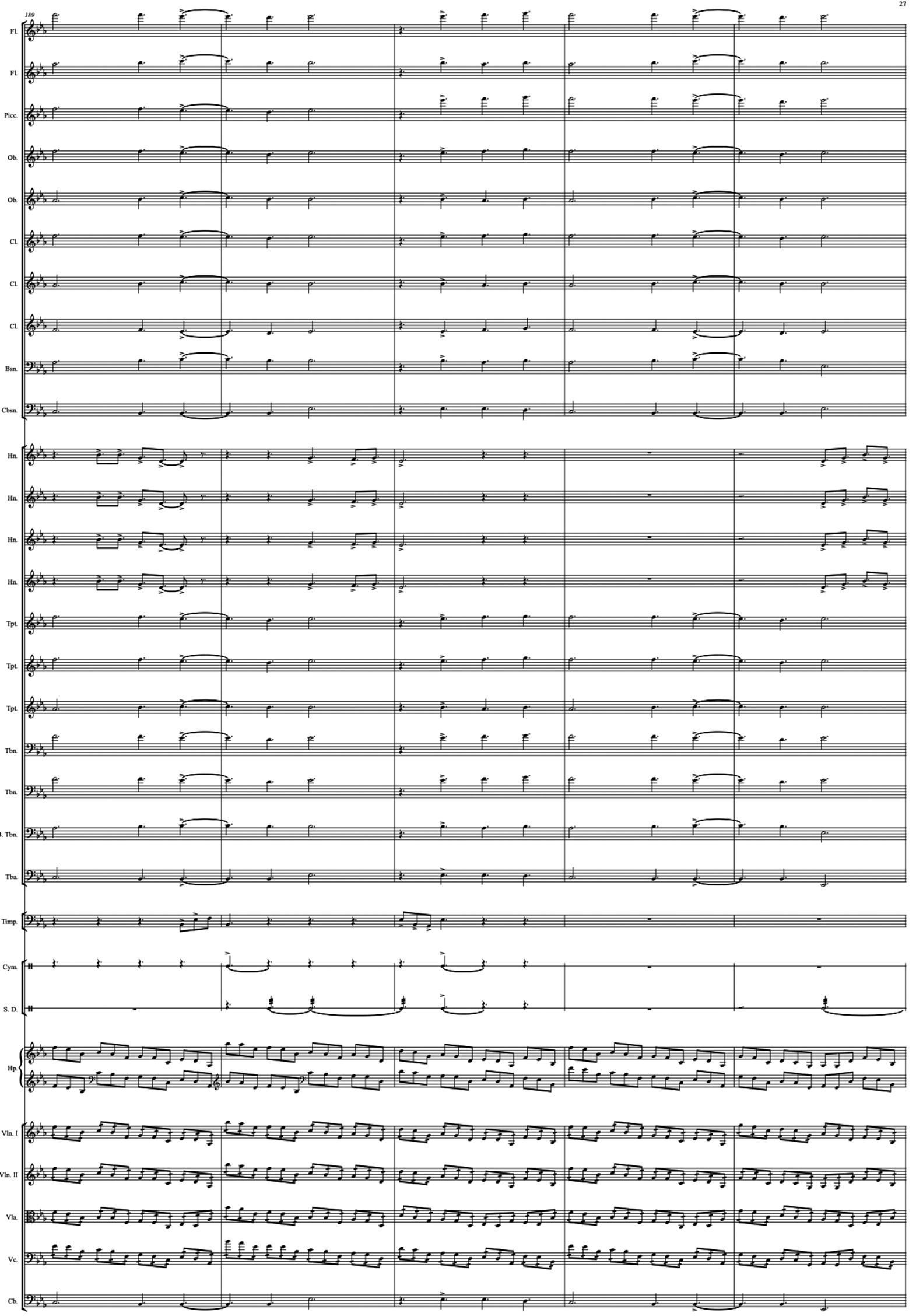
For example, the sense of endurance and resilience is conveyed in the progression from the struggling, long-winding modal material of the opening measures to the modestly convivial and semitonally marked closing measures. Conviviality is also generated in the realm of rhythmic activity and the simulation of dance. Ndodana-Breen often makes the European orchestra play traditional South African polyrhythms. But moments of rhythmic vitality signal hope rather than victory, reminding us of the continuity of the struggle for racial and socioeconomic equality, despite the official abrogation of apartheid. The function of the closing section (measures 187–199) is to give a seal of approval to the slowly unfolding sparkle of the piece. It is conveyed in the strong appearance of the anti-apartheid song “Thina Sizwe Esimnyama” about the land dispossession of South Africa’s native population, as illustrated in mm 189–193 in figure 1 below.
Ma Sisulu Sinfonia by Bongani Ndodana-Breen

Indigenous Music of Everyday Life
There’s no gainsaying the continuous relevance of older African music practices. Ancient musical traditions associated with sacred and secular festivals and rituals continue to flourish (though not statically), supported by traditional institutions, notably royal palaces. Government ministries of arts and culture and the media, including social media, have also been instrumental in sustaining the importance of indigenous practices all over the continent. They also thrive in domestic and community spaces, re-enacted, constantly revised, and adapted as markers of passage rites and everyday life activities. I experienced many such performances as a child growing up in Western Nigeria, thanks to my mother, who sang as she performed her numerous chores and led moonlight musical storytelling sessions. One of my favourites is the song titled Amúlétigbó (see song-text and translation below).
Text and translation:
This song presents three types of “voices,” the voice of nature (as conveyed by birds) and the “voice of the church,” considered by the Ekiti people to be inseparable from the identity of the British Empire. The song’s last two lines depict a third type of voice—a harbinger of punishment for the evil-doer. The three voices articulate two sets of binaries: nature–technology and human–spiritual. The structure of the song—notably its modal pitch system—is striking for the harmonic use of seconds at cadential points and as embellishment. The secundal harmonic device is at variance with the triadic harmonies of European church music. This conflict also draws attention to the contrasting aesthetic parameters that continue to shape the African musical postcolony.
Conclusions: Characterizing the African Musical Postcolony
These examples highlight different musical strategies for engaging with the power dynamics and politics of difference that colonialism helped to set in motion. These include Olatunji’s African-centred universalism; the differently constituted transnational feminism of Makeba, Kulthūm, and Wondwossen; the musical activism of Fela Kuti that targets internal dictators and the power legacy of colonial rule; and the exploration of global capital by Afrobeats musicians. The performance of Ghanaian drums and Yoruba sacred chants in New York studios and at concerts in the 1960s and the use of Western music notation by composers like Ndodana-Breen demonstrate breathtaking transformations. Likewise, the gender barrier-breaking activities of Makeba and Kulthūm are significant at the time they occurred, especially in their imbrication with high-wired activism. The global visibility of these two pioneering musicians foreshadowed the success of afrobeats musicians in creating and inhabiting new spheres of influence in the crowded global music market of the twenty-first century.
As shown in all the examples covered, responding to the politics of difference is a complex undertaking that takes different forms.Footnote 39 For example, E.T. Mensah and Bongani Ndodana-Breen resist essentialism by creating syncretic forms that shun simplistic Africa–Europe binarism. This approach contrasts with the embrace and rebranding of pre-colonial African traditions by Kulthūm and Olatunji, who choose to reject the notion of European musical superiority by offering alternative aesthetic paradigms. The Ekiti song, Amuletigbo, paints contrasting forms of sound and audibility that mark rural and urban life and as occasioned by the disruption of colonial rule.
As metaphors and reflections of specific moments of individual and group experience, these musical stories exist as minuscule and variable units within a broad discourse of what I have characterised as the African musical postcolony. Its discourse is grounded in an ongoing patchwork and multiple modes of functional aesthetics marked by both musical exploration and an engagement with social and political issues. It is improvisatory and unstable, but recognisable in its broad patterns. Foundational aesthetic concepts include multivocality, embodiment, communality, and spiritual embeddedness, manifesting in musical elements that include dance-oriented polyrhythm, Maqam-enabled tarab, and ancestral-invoking chants.Footnote 40 It is marked by the expansion of the musical frontiers to include and engage with new musical resources, as demonstrated in the minimalized tonal harmonies of E.T. Mensah and the exploration of new and still-forming paradigms, for example, the new art music language of composers like Ndodana-Breen.
African musicians are adept at providing descriptive, dialectical, and pragmatic narratives of everyday life and power in various forms. Through their music and actions, they have resisted colonial rule and its justification, fought marginalisation, and challenged racism. They have celebrated old traditions and created new ones that mitigate the racist politics of fictionalisation and homogeny. And they have been engaged in such musical actions for over a century and in ways that remind us how we scholars often struggle to catch up with African musicians in the task of understanding and responding to the existential reality of life on the mother continent, Afrika.