Calcineurin inhibitors are associated with a wide range of side effects, common ones being renal dysfunction and hyperglycaemia. Reference Miwa, Isozaki and Wakabayashi1 Rarely, tacrolimus has been associated with lung injury, including bronchiolitis obliterans organising pneumonia. Reference Miwa, Isozaki and Wakabayashi1,Reference Cunha, Syed and Mickail2,Reference Schmidt, Lenz, Grone, Geiqur and Scheuermann3,Reference Przepiorka, Abu-Elmagd and Huaringa4 Bronchiolitis obliterans organising pneumonia has mainly been reported, and that too rarely in adult and pediatric Solid organ transplant patients on sirolimus therapy. Reference Lindenfeld, Simon and Zamora5,Reference Kelchtermans, Chang, Glaberson, DeFreitas, Alba-Sandoval and Chandar6 To our knowledge, tacrolimus has not been implicated as a cause of bronchiolitis obliterans organising pneumonia in pediatric heart transplant recipients. We describe a rare case of a 19-month-old cardiac transplant patient who developed bronchiolitis obliterans organising pneumonia in the context of severely elevated levels of tacrolimus.
Case description
Our patient is an African-American male with a history of glucose-6-phosphate-dehydrogenase deficiency who presented to our institution at 7 months of age in congestive heart failure. He was diagnosed with dilated cardiomyopathy and subsequently underwent orthotropic heart transplantation at 14 months of life due to heart failure refractory to medical management and requiring mechanical cardiac support. He received induction therapy with three doses of antithymocyte globulin and was placed on mycophenolate mofetil 20 mg/kg/dose twice daily and tacrolimus for maintenance immunosuppression, with target troughs of 12–15 ng/ml for tacrolimus. His discharge levels were in goal range. He was placed on valganciclovir for cytomegalovirus prophylaxis and atovaquone for pneumocystis jiroveci prophylaxis avoiding trimethoprim-sulfamethoxazole due to G6PD deficiency. His immediate post-operative course was uncomplicated. He was discharged in a stable condition in 21 days.
He had an uneventful course in the first 4 months post-transplant except for a few hospitalisations for fever that were treated with empiric antibiotics, and he was discharged once the blood cultures were negative for bacteremia. Four months after transplant, he presented to our emergency department with diarrhoea and vomiting. His laboratory values were significant for a blood urea nitrogen of 29 mg/dL (baseline 9–10) and creatinine of 0.83 mg/dL (baseline 0.29), with the rest of his electrolytes within normal limits. His tacrolimus level was 12.3 ng/dL, with target level of 10–12 ng/ml as he was 3 months post transplant. His hemoglobin was 7.1 g/dL (previous baseline 9–10), with fecal occult blood test positive. Due to this level, his tacrolimus dosage was kept the same with plan to monitor periodically.
He was provided supportive care with intravenous fluids. Given concern for a gastrointestinal bleed, he underwent esophagogastroduodenoscopy and flexible sigmoidoscopy with biopsy which showed distal oesophagitis with esophageal ulcer. His ranitidine was switched to pantoprazole which was later switched to oral omeprazole. Two days later, he developed fever and was placed on vancomycin and cefepime while being evaluated for aetiology of fever. His vancomycin levels were within normal limits during his stay. Few days into this febrile illness, he developed tachypnea that quickly progressed to significant respiratory distress, requiring non-invasive positive pressure ventilation for worsening respiratory status and ultimately intubation and mechanical ventilation within 12 hours. Echocardiogram showed normal biventricular graft systolic function with no significant mitral or tricuspid valve insufficiency and no pericardial effusion. Chest X-ray at that time was suggestive of right lower lobe pneumonia. Pentamidine was added to the antibiotic regimen as pneumocystis jiroveci pneumonia was in the differential diagnoses. Tacrolimus level obtained as a part of routine blood work at this time (on the day of worsening respiratory status) was found to be severely elevated at 84.2 ng/ml with repeat creatinine level was 0.29 mg/dl. The test was repeated in our lab with an additional blood specimen sent to an outside lab and was confirmed to be an accurate value. His tacrolimus was immediately held; no other immunosuppressants were initiated given the elevated level.
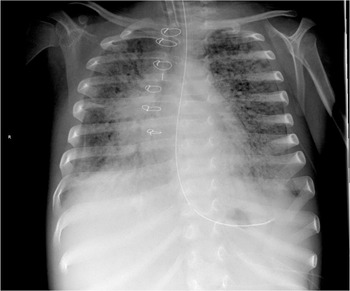
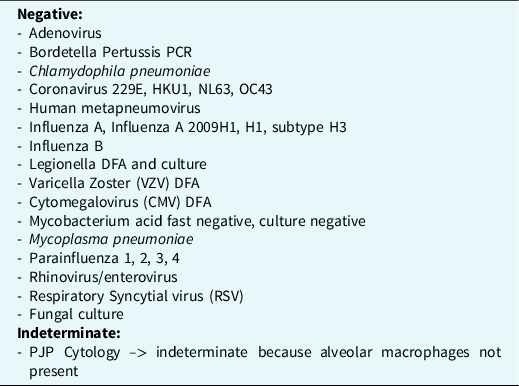
His clinical condition proceeded to worsen over the course of two weeks, notable for severe hypoxia with oxygen saturation in the 75–85% range on high ventilator settings. Chest radiograph at this time demonstrated diffuse bilateral interstitial opacities (Fig 1). CT chest and lung biopsy were considered, but he was in a critical clinical condition that was deemed unsafe for transportation and procedures. He was treated for acute respiratory distress syndrome with intravenous methylprednisolone and high positive end expiratory pressure settings on the ventilator. Attempts were made to transition patient to oscillator, but he did not tolerate this long term and was switched back to conventional ventilation. Infectious work up that included procurement of samples for culture via broncho-alveolar lavage was negative for all testable viruses, bacteria, and fungi (see Table 1); with the exception of pneumocystis jiroveci which was indeterminate due to the absence of alveolar macrophages but he was on Pentamidine at that point as we were empirically treating for pneumocystis jiroveci. Due to a previous history of multiple sternotomies, prior extracorporeal membrane oxygenation and poor vascular access, he was not an extracoporeal membrane oxygention candidate. He developed worsening hypoxia, with oxygen saturations in the range of 75–80% on 100% fractional inspired oxygen. We discussed the lack of other treatment options and no response to steroids with the family and the family decided to opt for comfort care. He was terminally weaned and passed away at 19 months of life.
Chest radiograph demonstrating diffuse bilateral interstitial opacities.

List of organisms tested on broncho-alveolar lavage specimen

On autopsy, his lung sections showed a spectrum of end-stage lung disease, involving over 95% of sections examined. Many alveoli had massive intraalveolar hemorrhage and prominent hyaline membrane disease, with multiple obliterated by organised fibrous proliferation. Additionally, emphysematous changes secondary to ventilator efforts and areas of subpleural hemorrhage were seen. He was given a diagnosis of bronchiolitis obliterans organising pneumonia (bronchiolitis obliterans organising pneumonia) based on these findings. There was no evidence of cardiac pathology identified on autopsy; additionally, pneumocystis pneumonia was not evident based on the autopsy.
Discussion
To our knowledge, this is the first description of a pediatric heart transplant recipient developing acute lung injury with bronchiolitis obliterans organising pneumonia secondary to supratherapeutic tacrolimus levels.
Bronchiolitis obliterans organising pneumonia is a type of inflammatory lung disease consisting of granular tissue involvement of the bronchioles to the alveolar ducts. Reference Epler7 On CT scan, bronchiolitis obliterans organising pneumonia has a non-specific appearance, consisting of patchy ground glass opacification with lung biopsy being the gold standard for confirmation of diagnosis. Reference Epler7 While there is an idiopathic form of bronchiolitis obliterans organising pneumonia, the condition may be caused by an inciting infectious agent or medication and may occur in the context of a systemic illness such as connective tissue disorders. Reference Epler7,Reference Dodd and Müller8 Causes of bronchiolitis obliterans organising pneumonia include bacteria (Mycoplasma pneumoniae, Chlamydia pneumoniae, and Streptococcus pneumonia), viruses like influenza, and herpes simplex, and medications such as amiodarone, sotalol, and phenytoin. Reference Epler7 In our patient, our infectious work-up was essentially negative; he was not on any medications other than tacrolimus that have been associated with bronchiolitis obliterans organising pneumonia.
Corticosteroids are used in the treatment of bronchiolitis obliterans organising pneumonia, although spontaneous improvement and slow improvement after prolonged treatment with erythromycin have been reported. Reference Epler7,Reference Ishii, Manabe and Ebihara9 Radiographic pulmonary infiltrates can disappear within a few weeks if the treatment is successful. Reference Epler7 For drug-induced bronchiolitis obliterans organising pneumonia, discontinuation of the inciting medication is essential. For patients with significant advanced lung disease, such as our patient, despite appropriate treatment, the condition can be fatal. Reference Cunha, Syed and Mickail2 Our patient unfortunately had diffuse disease, complicating his condition.
Tacrolimus-induced bronchiolitis obliterans organising pneumonia is a rare entity. There have been documented cases in non solid organ transplant patients, including one in a patient with hemolytic–uremic syndrome and another in a patient following bone marrow transplantation. Reference Schmidt, Lenz, Grone, Geiqur and Scheuermann3,Reference Przepiorka, Abu-Elmagd and Huaringa4 In lung transplant patients, up to 25% of lung transplant patients can develop bronchiolitis obliterans organising pneumonia. Reference Epler7 In pediatric solid organ transplant, bronchiolitis obliterans organising pneumonia due to immunosuppressive medications has been only rarely reported. Reference Kelchtermans, Chang, Glaberson, DeFreitas, Alba-Sandoval and Chandar6
To our knowledge, this is the first reported case of bronchiolitis obliterans organising pneumonia secondary to tacrolimus in a pediatric heart transplant recipient. Our patient was thought to have bronchiolitis obliterans organising pneumonia given the pattern of alveolar involvement seen on the autopsy. In adult literature, most cases of bronchiolitis obliterans organising pneumonia have been reported in patients who had concomitant infection and, in our patient, no infectious agent was found on extensive evaluation including bronchoalveolar lavage cultures. Furthermore, bronchiolitis obliterans organising pneumonia has been reported with low targeted levels of tacrolimus, but in our patient the tacrolimus level was in the toxic range at the time of development of hypoxia. After extensive root cause analysis, we were not able to determine the cause for toxic levels of tacrolimus in our patient. Our patient was on omeprazole which can interact with tacrolimus metabolism. We did not believe this interaction leads to his significantly supratherapeutic level as previous literature has suggested that omeprazole–tacrolimus interaction does not typically cause supratherapeutic levels that would be clinically relevant; Reference Pascual, Marcén and Orea10 additionally, in our personal experience we have utilised omeprazole in our transplant patients without significant increases in tacrolimus levels. As such, it is unclear if this patient would have developed bronchiolitis obliterans organising pneumonia with normal targeted range of tacrolimus, but we suspect that elevated tacrolimus level may have increased his risk of developing bronchiolitis obliterans organising pneumonia.
Conclusion
We describe a case of a 19-month-old toddler with a history of heart transplant who died after developing severe acute lung injury secondary to tacrolimus-induced bronchiolitis obliterans organising pneumonia that was refractory to steroids. His case highlights the importance of close monitoring of tacrolimus levels for hospitalised pediatric transplant patients. For transplant patients with significant hypoxaemia and elevated tacrolimus levels, in the absence of a clear infectious aetiology, the diagnosis of bronchiolitis obliterans organising pneumonia should be considered.